Nonverbal Communication: Types and Why It Matters
Turn this article into takeaways for your work.


Each assistant summarizes the article only for you and suggests best practices for your work.
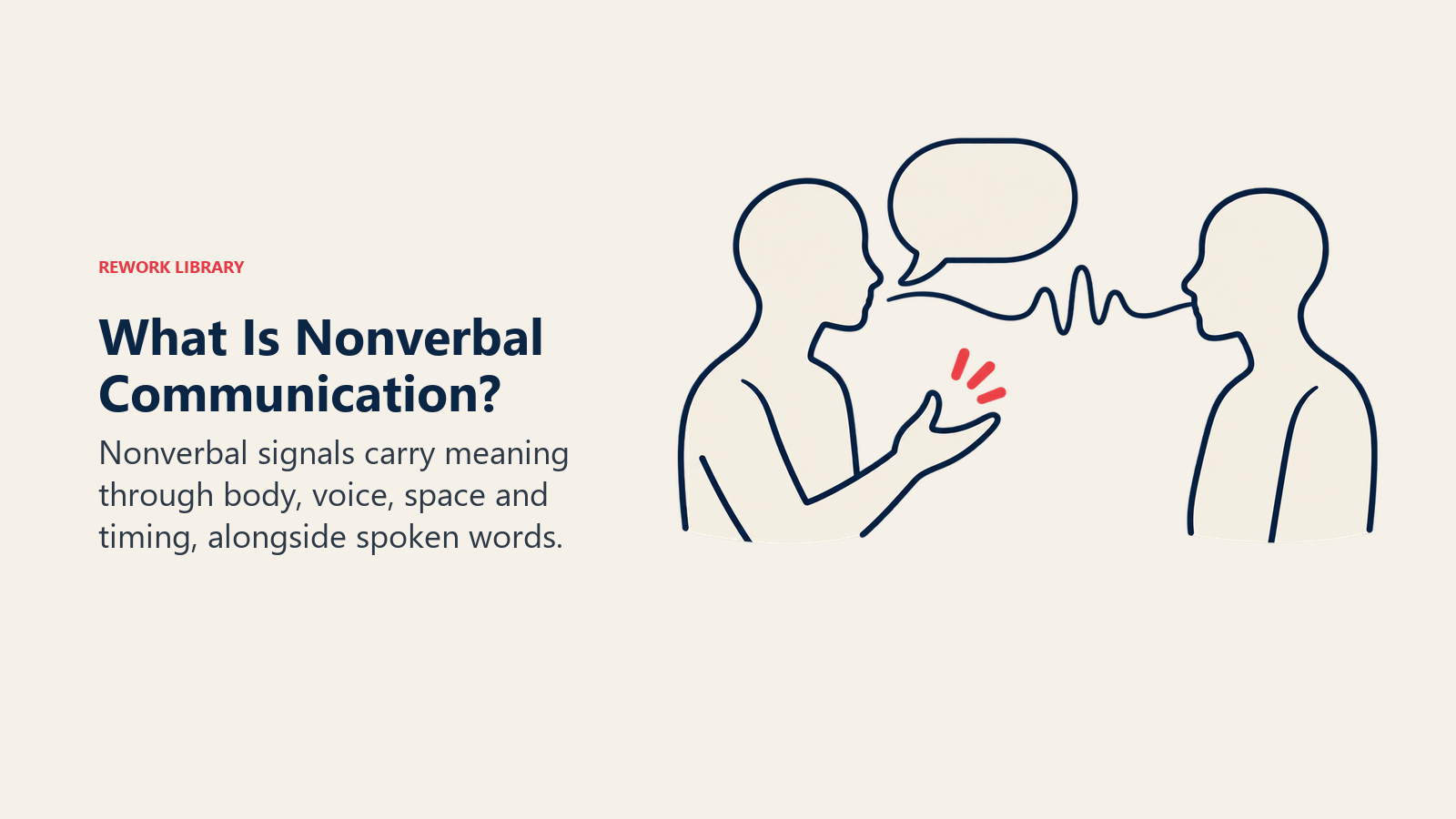
Before anyone on your team says a word, they've already sent a message. The pace of their walk into the room, whether they look up from their laptop, how close they stand, it all lands before the first sentence does. Nonverbal communication is that entire channel: face, body, voice, space, and timing carrying meaning alongside, and sometimes instead of, language.
It matters at work for a plain reason. People decide whether to trust you, hire you, or back your proposal based on more than your words. Get the nonverbal layer wrong, arms crossed in a negotiation, a flat voice in a pitch, and a technically correct message can still land badly. This guide covers what communication research actually supports, not the inflated claims in training decks.
Key Facts
Key Facts: Nonverbal Communication
- Albert Mehrabian's famous 7%-38%-55% ratio came from two small 1967 studies on judging liking, not a measurement of communication overall. Mehrabian has stated directly that the equations "are not applicable" unless someone is talking about their own feelings or attitudes.
- Princeton researchers Janine Willis and Alexander Todorov found people form stable judgments of a stranger's trustworthiness and competence from a face in as little as 100 milliseconds; longer viewing mostly raises confidence in that snap judgment, not its accuracy (Willis and Todorov, Psychological Science, 2006).
- A cross-cultural study in PLOS ONE found Japanese participants rated direct eye contact as considerably angrier and less approachable than Finnish participants did, evidence against treating any single eye-contact norm as universal.
- Americans typically hold a conversational distance of four to seven feet, while in much of Europe and Latin America the comfortable distance is roughly half that, per proxemics research built on anthropologist Edward T. Hall's work.
- SHRM reports that 61% of U.S. workers recently experienced or witnessed workplace incivility, with two-thirds saying it hurt productivity, and names body language as a tool leaders use to counter it.
What is nonverbal communication?
Nonverbal communication is every signal you send that isn't the literal content of your words: face, posture, gestures, eye contact, how close you stand, whether and how you touch someone, your tone and pace of speech, how you dress, and how you treat time. It runs alongside spoken and written language, sometimes reinforcing it, sometimes contradicting it, sometimes carrying meaning language never touches at all.
It's easy to reduce this to "body language," but that undersells it. Tone of voice (paralanguage) isn't body language, and neither is showing up ten minutes late to a client call (chronemics). Nonverbal communication is the umbrella term; body language is one piece under it.
Three things make this competency different from most on a skills list. It's mostly automatic, people leak signals whether or not they intend to. It's read constantly, whether you're aware of it or not. And it's the layer most likely to contradict your message under stress, which is exactly when it matters most.
The 9 types of nonverbal communication
Researchers usually break nonverbal communication into a handful of channels. Here's the working set, with a workplace example for each.
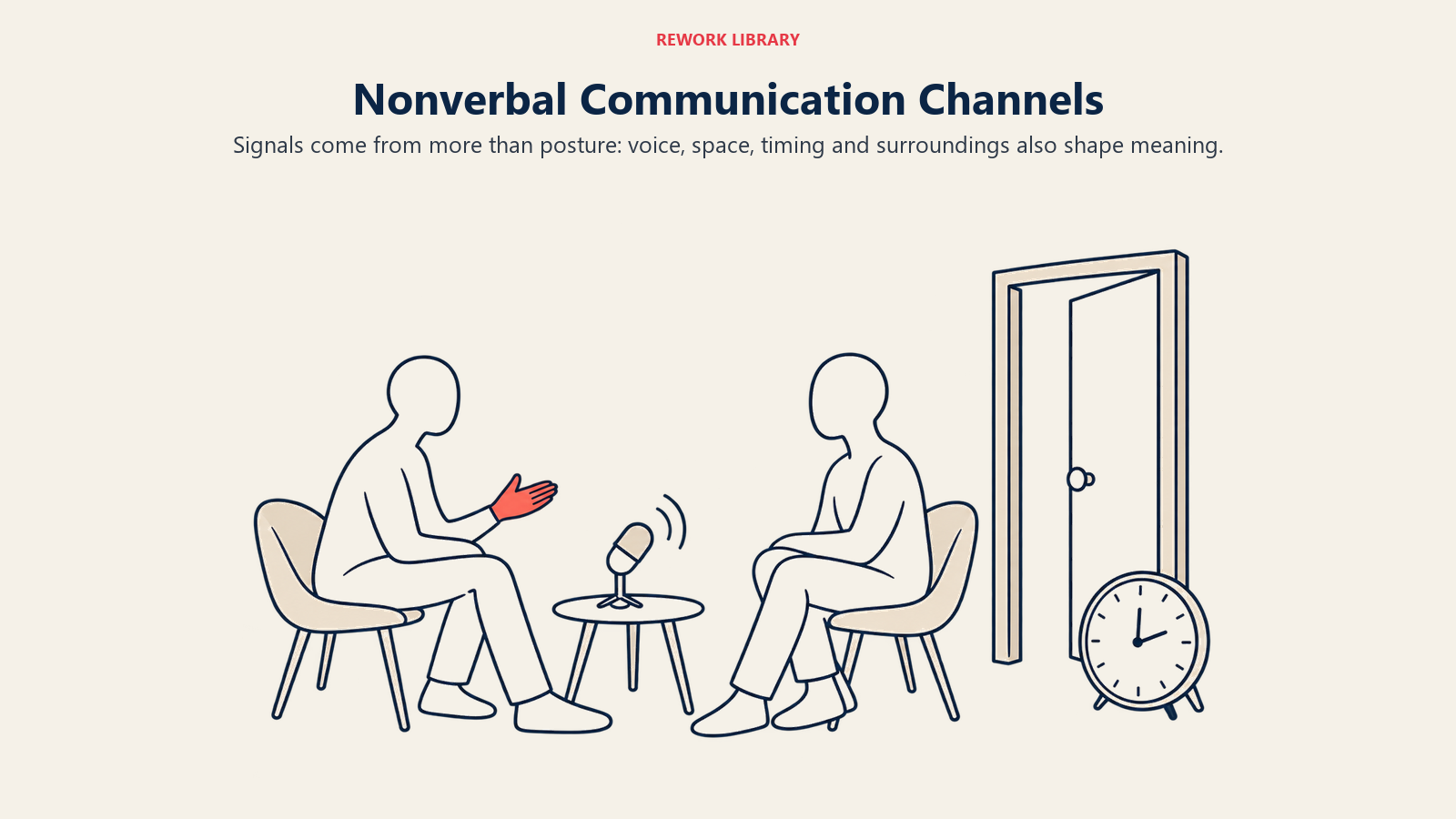
| Type | What it covers | Workplace example |
|---|---|---|
| Facial expression | Movements of the face that signal emotion | A raised eyebrow that says "explain that number" |
| Kinesics (gesture, posture) | Body movement, hand gestures, stance | Leaning forward during a pitch |
| Oculesics (eye contact) | Gaze direction and duration | Holding eye contact while delivering hard feedback |
| Proxemics (space) | Physical distance between people | Standing closer to a mentee than to a peer |
| Haptics (touch) | Physical contact | A handshake at the start of a client meeting |
| Paralanguage (voice) | Tone, pitch, pace, volume, pauses | Slowing down to signal a serious point |
| Appearance | Dress, grooming, presentation | Matching the formality of a client's office |
| Chronemics (time) | How you use and signal around time | Arriving five minutes early to an interview |
| Artifacts and environment | Objects and physical setup that send signals | A closed office door during a hard conversation |
Face and eyes
The face is the most information-dense nonverbal channel, and also the one non-experts most overestimate their ability to read. A smile can signal warmth, polite compliance, or discomfort, and untrained observers confuse these regularly. Eye contact carries even more cultural weight than expression does (more on that below), which is why "just make more eye contact" is bad universal advice. Active listening depends heavily on this channel: timed eye contact and responsive expression signal "I'm tracking this," separate from anything said out loud.
Body: gesture and posture
Kinesics covers everything from a shrug to a full change in stance. Open posture reads as approachable; closed posture reads as defensive, though context matters (someone might cross their arms because the room is cold). Gesture amplifies speech: a pointed hand during a pitch adds emphasis words alone don't carry. Assertiveness has a strong kinesic signature too, upright and steady without tipping into aggression.
Space and touch
Proxemics and haptics are the two channels people misjudge most often, especially across cultures. Standing too close reads as intrusive; too far reads as cold, and the "right" distance shifts by relationship and culture. Touch is higher stakes still: a handshake is close to universal in Western business, but touch beyond that varies enormously and should default to restraint, particularly in negotiation settings where a misjudged gesture can derail trust before terms are discussed.
Voice, appearance, and time
Paralanguage is what you do with your voice beyond the words: pitch, pace, volume, pauses. A flat, fast delivery reads as anxious even when the content is solid. Appearance signals respect for context; dressing far outside a room's norm pulls attention from your message. And chronemics is underrated: showing up late is a nonverbal statement about priority, whether or not you mean it that way. So is visibly multitasking while someone else is talking, which reads as a ranking of their importance even when you are genuinely keeping up.
Why nonverbal communication matters at work
The stakes show up fastest where someone is judging you quickly with limited information: interviews, first client meetings, any pitch where you're asking someone to trust you before you've built a track record.
The Willis and Todorov research cited above found that people form trait judgments (trustworthy, competent, likeable) from a face in a tenth of a second, and that those snap judgments barely change with more viewing time. That's a real finding about how fast and sticky first impressions are. It is not a finding that those impressions are accurate; the researchers were explicit that fast agreement between observers is different from correctness about someone's actual character. The practical takeaway isn't "manufacture the right face." It's that your baseline presentation, calm posture, steady eye contact, a level voice, gets locked in faster than you'd like, so it's worth being deliberate about it in high-stakes moments.
This shows up function by function. In sales, influencing skills lean heavily on nonverbal congruence: a confident pitch delivered with a hesitant voice undercuts the words no matter how good the deck is. In leadership, the SHRM incivility data above ties directly to nonverbal behavior, eye rolling and closed posture are named drivers of the perceived disrespect that erodes team trust. In relationship building, small signals like facing someone fully instead of glancing at a screen compound into a reputation for being easy or hard to work with.
What the Mehrabian research actually says (and what it doesn't)
If you've heard "93% of communication is nonverbal," you've heard a popular distortion of a narrow study, and getting this right is the single biggest credibility gap in writing about this topic.
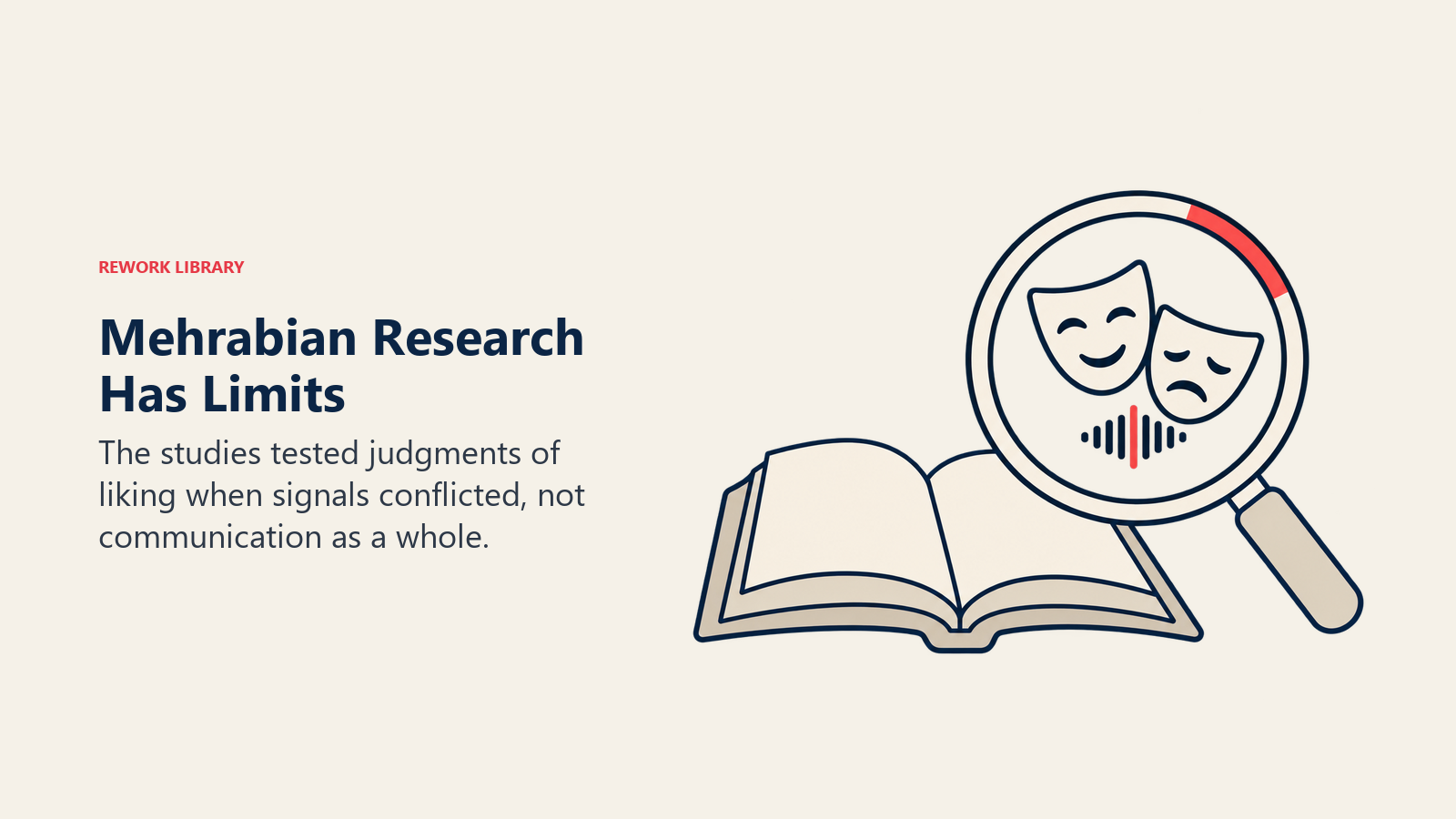
The real research is two small laboratory studies Albert Mehrabian ran in 1967. Participants, all women, listened to single words spoken in different tones, or looked at photos of facial expressions paired with words, and judged how much the speaker liked them. Mehrabian was studying what happens when words, tone, and expression contradict each other on one specific question: liking and attitude. No actual conversation took place in either study. Facial expression was the only nonverbal channel tested; gesture, posture, proxemics, and touch weren't part of it. Neither study measured ordinary conversation, public speaking, teaching, negotiation, or the transfer of factual information.
Mehrabian addressed the misreading directly on his own site: the equations "were derived from experiments dealing with communications of feelings and attitudes... Unless a communicator is talking about their feelings or attitudes, these equations are not applicable." Even Mehrabian doesn't stand behind the "93% nonverbal" generalization attached to his name.
That doesn't make the underlying insight worthless. When tone or face contradicts words, especially on loaded topics like whether you're upset or whether you trust someone, people tend to believe the nonverbal signal over the words. That's a useful principle for leaders giving feedback or handling conflict. It just isn't a formula for how much of communication overall is nonverbal, and treating it as one gets the ratio wrong for teaching, presenting, and most of the actual work of a job.
Nonverbal communication on video calls and in remote and hybrid work
Video calls strip out most proxemics and the natural eye contact loop (looking at a face on screen isn't the same as looking into a camera lens, so true eye contact is nearly impossible on standard calls). What's left gets amplified in ways that create real fatigue.
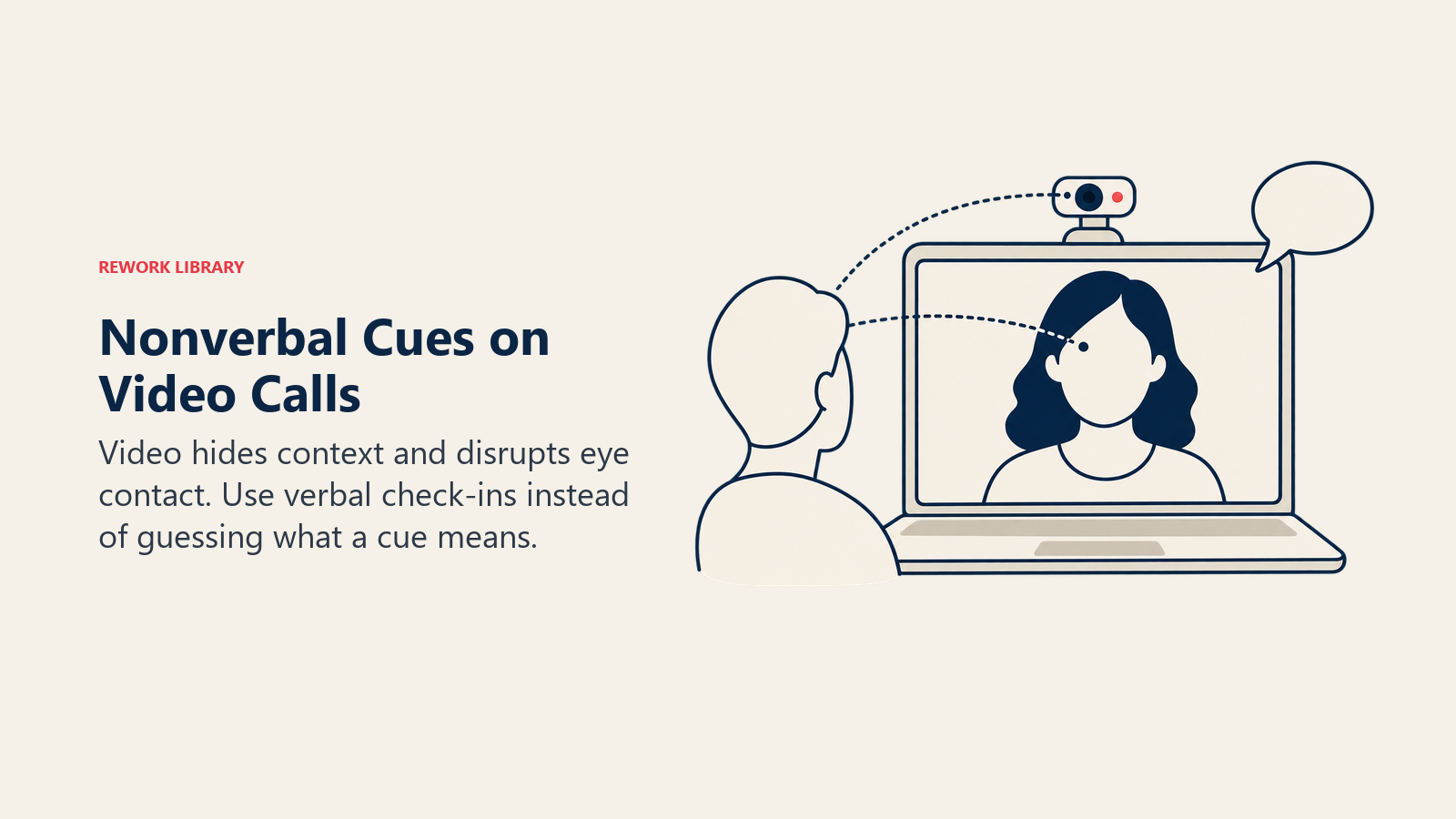
Stanford researcher Jeremy Bailenson's nonverbal overload theory, summarized here, names five specific mechanisms behind that fatigue:
| Mechanism | What happens | A practical fix |
|---|---|---|
| Mirror anxiety | Seeing your own face constantly increases self-monitoring | Hide self-view once you've checked framing |
| Feeling physically trapped | Camera framing discourages natural movement | Stand or use a wider shot when you can |
| Hyper-gaze | Close-up faces on a grid mimic an intensity that isn't natural in a group | Switch to speaker view for large meetings |
| Cognitive load producing cues | You have to exaggerate nodding and expression to be read | Add verbal acknowledgment ("got it," "makes sense") instead of relying on your face |
| Cognitive load interpreting cues | Lag and framing make it hard to tell who's looking at whom | Ask directly rather than guessing from the feed |
For remote and hybrid teams, the practical implication is to stop expecting video calls to carry the same nonverbal bandwidth as an in-person meeting and compensate deliberately: explicit verbal signals of agreement or confusion, shorter meetings, and cameras-optional norms where the extra channel isn't needed. Active listening habits, verbal check-ins, brief paraphrasing, do more work on video than in person, precisely because the nonverbal channel that would normally carry that signal is degraded.
Cultural differences in nonverbal communication
Every reading in this article carries an unspoken asterisk: it describes norms common in specific cultural contexts, usually Western and American ones, and those norms are not universal. Treating any single reading of eye contact, space, gesture, or touch as a global default is a mistake that shows up constantly in cross-border teams and international sales.
The PLOS ONE study cited above found genuinely opposite reactions to the same behavior: direct eye contact read as more approachable to Finnish participants and more unpleasant and dominant to Japanese participants. Proxemics research shows a similar split on physical distance, with typical American conversational distance running roughly twice the comfortable distance in parts of Southern Europe and Latin America. Gesture and touch norms vary just as widely, and the safest default for touch beyond a handshake is restraint until you know the specific norm.
| Behavior | Higher-contact / expressive norm | Lower-contact / reserved norm | Workplace implication |
|---|---|---|---|
| Eye contact | Sustained contact signals honesty and engagement | Sustained contact can read as challenging | Don't score someone down for less eye contact without context |
| Physical distance | Closer conversational distance is comfortable | Greater distance is expected | Let the other person set the distance in a first meeting |
| Gesture | Frequent, expansive gesture is expected | Minimal gesture is the norm | Match your counterpart's baseline, not your own default |
| Touch | Handshakes, and sometimes more, are common | Touch beyond a handshake is rare | Default to a handshake and let the other person initiate more |
This is exactly where cultural intelligence becomes a hard requirement for anyone leading a distributed team or selling across borders. It isn't memorizing a chart of national norms; it's treating your own nonverbal defaults as one option among many, watching for the other person's baseline, and adjusting without assuming your read of a gesture is the only correct one.
How to read (and improve) your own nonverbal signals
Reading nonverbal cues well is less about decoding any single gesture and more about noticing clusters and changes against a baseline. A normally animated person going quiet and still is telling you something; a single crossed-arm moment from someone who gestures constantly is a far weaker signal than the same posture read in isolation.
| Cluster of cues | Possible read | Caution before you act on it |
|---|---|---|
| Crossed arms, reduced eye contact, leaning back | Discomfort or disagreement | Could be a cold room or resting posture; ask, don't assume |
| Fast speech, short answers, checking the clock | Time pressure or disengagement | They may genuinely be double-booked, not disrespectful |
| Sustained eye contact, forward lean, nodding | Engagement and agreement | In some cultures this is simply politeness, not confirmation |
| Flat tone paired with positive words | Possible incongruence | A naturally low-affect communicator may sound flat while fully engaged |
Improving your own signals starts with the same discipline: build awareness of your interpersonal defaults under stress. Most people have a tell, a foot that bounces, a voice that speeds up, arms that fold, that shows up when they're unsure or under pressure. Recording yourself in a practice presentation surfaces this fast; most people are surprised by what they see. From there the fix is usually physical: slow your pace, plant your feet, unfold your arms, and look up before a sentence you want someone to trust.
Emotional intelligence and empathy at work turn this from a performance trick into something useful. Reading a colleague's nonverbal shift and responding with genuine curiosity, rather than ignoring it or calling it out bluntly, is what separates people who use this competency well from people who just memorize a list of gestures.
Nonverbal communication in interviews and presentations
Interviews and presentations are where nonverbal signals get evaluated most directly, often by people working entirely off instinct.
| Situation | What tends to help | Why |
|---|---|---|
| Interview opening | Firm handshake or clear greeting, steady eye contact, upright posture | First impressions form fast (Willis and Todorov, above), so a calm opening sets the baseline everything else gets read against |
| Answering a hard question | A brief pause, steady pace, hands visible and still | Rushed, high-pitched answers read as anxious even when the content is strong |
| Presenting to a group | Scanning the room, purposeful gesture, moving with intent rather than pacing | Distributes engagement and signals confidence without looking rehearsed |
| Taking a tough question live | Open posture, a genuine pause to think, tone matched to the question's seriousness | Signals you're actually considering it instead of running a script |
These skills overlap heavily with presentation skills and public speaking: both are, largely, the discipline of managing your nonverbal channel deliberately instead of leaving it to nerves. The good news is that it's trainable. Rehearsal and video review close most of the gap between someone's default under-pressure signals and the calm presentation they're capable of.
Frequently Asked Questions about Nonverbal Communication
Is it true that 93% of communication is nonverbal?
No. That figure distorts two narrow 1967 studies by Albert Mehrabian on how people judge liking and attitude when facial expression, tone, and words conflict. The studies covered only one nonverbal channel, involved no real conversation, and measured one narrow question, not communication in general. Mehrabian himself has said the equations don't apply unless someone is talking about their own feelings or attitudes.
What are the main types of nonverbal communication?
The commonly used set includes facial expression, kinesics (gesture and posture), oculesics (eye contact), proxemics (space), haptics (touch), paralanguage (voice), appearance, chronemics (time), and artifacts or environment. Each carries meaning alone and in combination.
Why does nonverbal communication matter more in some situations than others?
It matters most when someone is forming a fast judgment with limited information, like an interview opening or a first sales meeting, because research on snap judgments shows people form and lock in impressions quickly. It matters less for transferring detailed factual information, where words carry most of the load.
How can I improve my nonverbal communication?
Start by identifying your stress tell (a bouncing foot, folded arms, a rushed voice) through honest self-review, such as recording a practice presentation. Then work the physical basics: steady pace, open posture, eye contact appropriate to context, and a tone that matches your words. Pair it with genuine curiosity about what you're reading in others.
Do nonverbal communication norms differ across cultures?
Yes, substantially. Eye contact that reads as engaged in one culture can read as disrespectful in another; comfortable conversational distance varies by roughly double between some Western and Southern European or Latin American norms; and touch and gesture norms differ widely. Treat your own defaults as one option among many, not a universal standard.
Nonverbal communication isn't a bonus skill layered on top of what you say. It runs constantly, and it's often the first thing a colleague, a client, or an interviewer reads before your words get a chance to land. The people who handle it well don't chase a viral statistic or a fixed list of power gestures. They build the habit of matching tone and body to message, reading context instead of isolated cues, and staying alert to the fact that the "normal" read on any signal changes depending on who's in the room.

Senior Customer Retention Strategist
On this page
- Key Facts
- What is nonverbal communication?
- The 9 types of nonverbal communication
- Face and eyes
- Body: gesture and posture
- Space and touch
- Voice, appearance, and time
- Why nonverbal communication matters at work
- What the Mehrabian research actually says (and what it doesn't)
- Nonverbal communication on video calls and in remote and hybrid work
- Cultural differences in nonverbal communication
- How to read (and improve) your own nonverbal signals
- Nonverbal communication in interviews and presentations