Networking Skills: How to Build Professional Relationships
Turn this article into takeaways for your work.


Each assistant summarizes the article only for you and suggests best practices for your work.
Networking skills are what separate people who wait for opportunity from those who create it. Every job offer, client introduction, or collaboration that lands in your lap came through someone who knew you, trusted you, or thought of you when the moment arrived. That doesn't happen by accident.
Key Facts
- 85% of jobs are filled through networking, according to a survey by LinkedIn (LinkedIn, 2016), making professional relationships the primary driver of career advancement.
- A Harvard Business Review study found that people with strong professional networks earn higher incomes and report greater career satisfaction than those who rely solely on formal job-seeking channels (HBR, 2018).
- 70% of professionals hired in a given month were connected to their new company before applying, based on LinkedIn data, underscoring that relationships precede opportunities (LinkedIn, 2022).
What Are Networking Skills?
Networking skills are the interpersonal behaviors and communication abilities that let you build, maintain, and activate a professional network over time. They're not about collecting business cards or attending events awkwardly. They're about creating genuine relationships where both people get value.
Networking skills include how you start conversations, how you stay in touch, how you offer help, and how you ask for it. They're closely tied to interpersonal skills and relationship building, but networking adds a specific dimension: intentional connection across professional contexts, not just within your immediate team.
The skills that make networking work are learnable. Whether you're naturally outgoing or find social situations draining, you can get good at building professional relationships with the right habits and approach.
Why Networking Skills Matter
The professional value of a strong network is hard to overstate, and it compounds across three distinct dimensions.
Career advancement: Most roles aren't advertised publicly before someone internal or connected has already been considered. Hiring managers default to people they know or people someone they trust recommends. A strong network means you're in the consideration set before the job posting goes live. It also means sponsors, mentors, and advocates who can vouch for you when you're not in the room.
Access to knowledge and opportunities: Your network is a live information source. You'll hear about market shifts, new tools, emerging roles, and hard-won lessons from people who've been there before you. This kind of ambient knowledge doesn't show up in articles or courses. It comes from people who tell you things because they know and trust you.
Long-term business development: For managers, directors, and executives, relationships are commercial assets. Client retention, partnership deals, referrals, and cross-team collaboration all depend on personal trust that was built before it was needed. Teams with strong internal and external networks execute faster because they can call someone directly instead of working through formal channels.
Networking also reinforces other competencies. Communication sharpens when you practice it with people outside your immediate circle. Influencing skills develop when you build trust without formal authority. And personal branding becomes a natural by-product of consistent, genuine engagement over time.
Types of Professional Networking
Networking doesn't happen in one setting. The most effective professionals build across three channels:
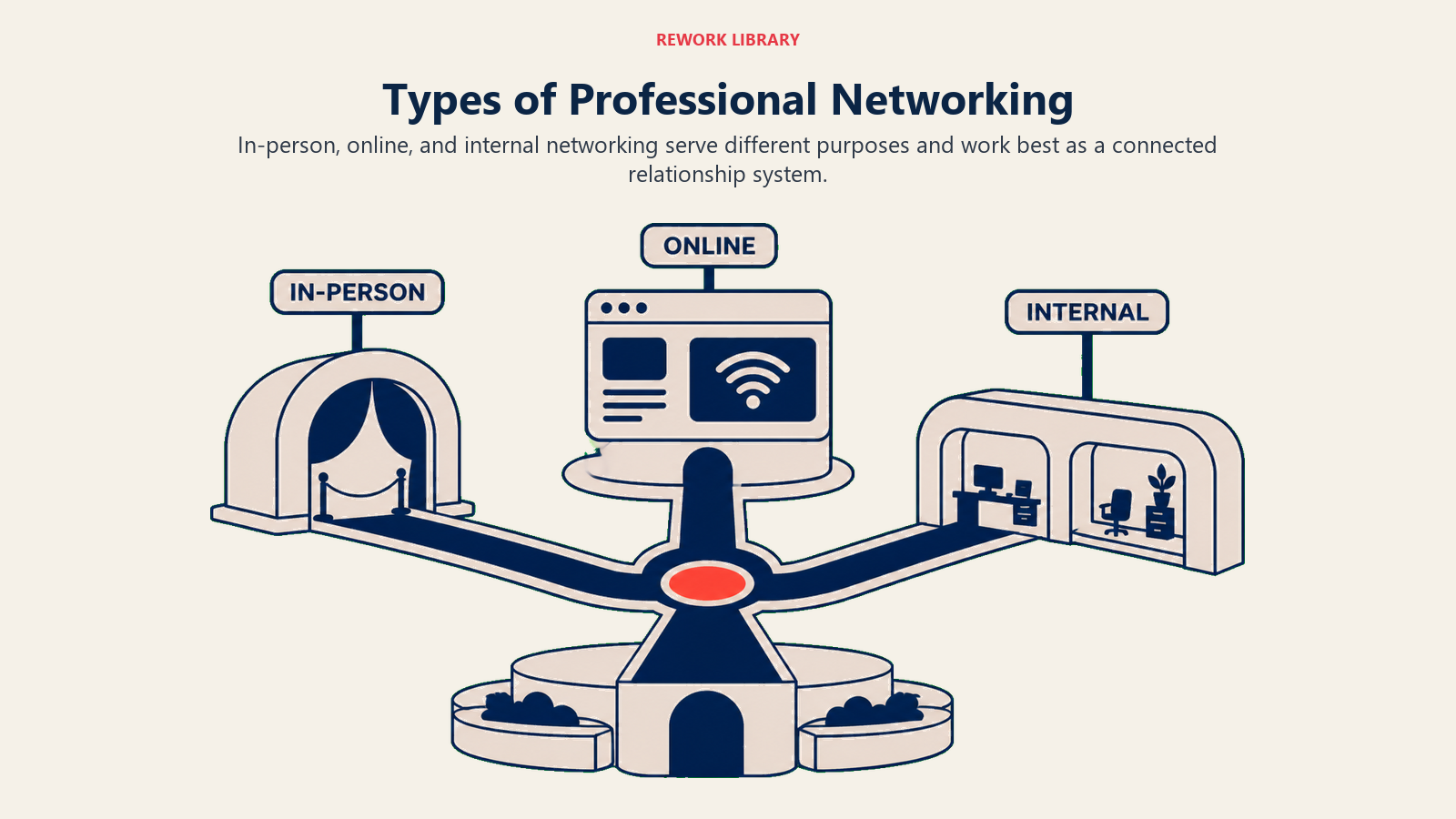
| Type | Setting | Best Used For |
|---|---|---|
| In-person networking | Conferences, industry events, meetups, alumni gatherings, team offsites | Deep first impressions, relationship launches, catching up with existing contacts |
| Online/LinkedIn networking | LinkedIn, professional communities, industry forums, virtual events | Scaling reach, maintaining weak ties, reconnecting with lapsed contacts |
| Internal networking | Colleagues, cross-functional partners, senior leaders within your organization | Career visibility, collaborative momentum, access to internal opportunities |
Most people over-index on one type and neglect the others. Someone who works their conference circuit but ignores LinkedIn misses all the between-event relationship maintenance. Someone who's well-connected internally but has no external network is vulnerable when the organization changes. And someone who's great on LinkedIn but rarely shows up in person builds shallower connections than the medium could support.
The goal isn't to be everywhere. It's to be consistently present in the channels that matter most for your role and ambitions, and to maintain the other channels at a low but steady level.
Core Networking Skills
These are the specific skills that determine whether your networking efforts build real relationships or just surface interactions:
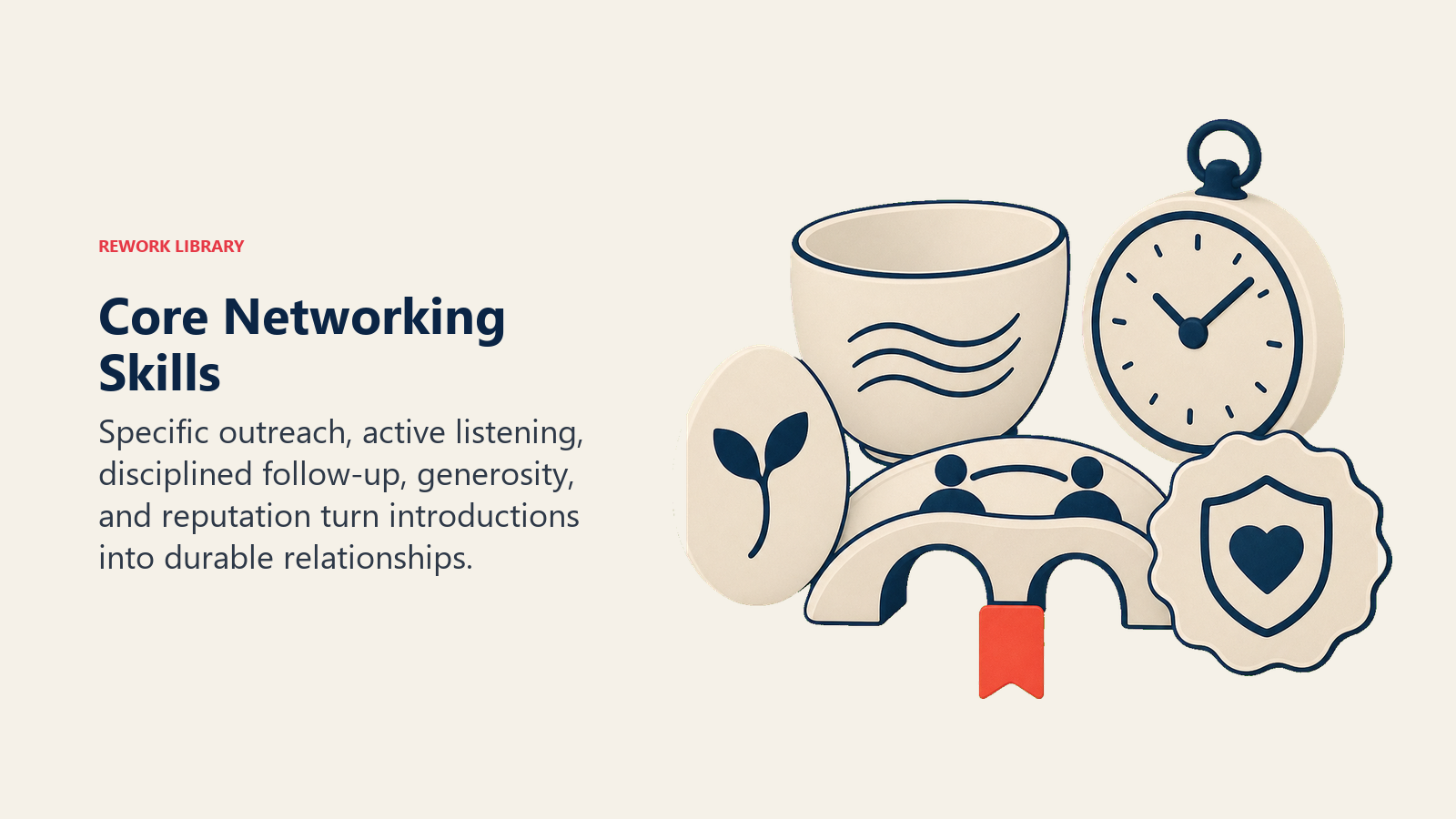
Starting conversations well: The ability to initiate contact without it feeling forced or transactional. This means having a genuine reason for reaching out, a clear but natural opener, and enough curiosity about the other person to keep the conversation going. Cold outreach works when it's specific and respectful of the other person's time.
Active listening: The most underrated networking skill. People remember conversations where they felt heard. If you spend a networking conversation talking about yourself, you'll be forgotten. If you ask good questions and listen carefully, people will think of you as someone worth staying in touch with.
Follow-up discipline: Most networking falls apart at this step. Meeting someone at an event means almost nothing if you don't follow up within 48 hours with a specific reference to your conversation. Good follow-up is brief, personal, and forward-looking. It doesn't have to be long. It just has to happen.
Giving value first: Strong networkers think about what they can offer before they think about what they need. This might be an article relevant to what someone mentioned, an introduction to a contact they'd benefit from knowing, or a specific skill you can offer in a collaborative context. Relationships built on reciprocal value last. Relationships built on one-sided extraction don't.
Maintaining weak ties: Research by sociologist Mark Granovetter showed that weak ties, people you know but don't interact with often, are frequently more valuable for new opportunities than strong ties. The skills that maintain weak ties are low-effort, consistent: a LinkedIn comment, a brief check-in message, sharing something they'd find relevant. This takes minutes but keeps you alive in someone's awareness over years.
Reading social dynamics: Knowing when to approach someone who looks busy, how to exit a conversation gracefully, when to introduce two people who'd benefit from meeting each other. These micro-skills matter more in in-person settings but apply online too. The ability to make others feel comfortable is central to all of it.
How to Improve Your Networking Skills
Networking skills improve with deliberate practice, not just exposure. Attending more events won't make you better if you're repeating the same unhelpful patterns. Here's a structured approach:
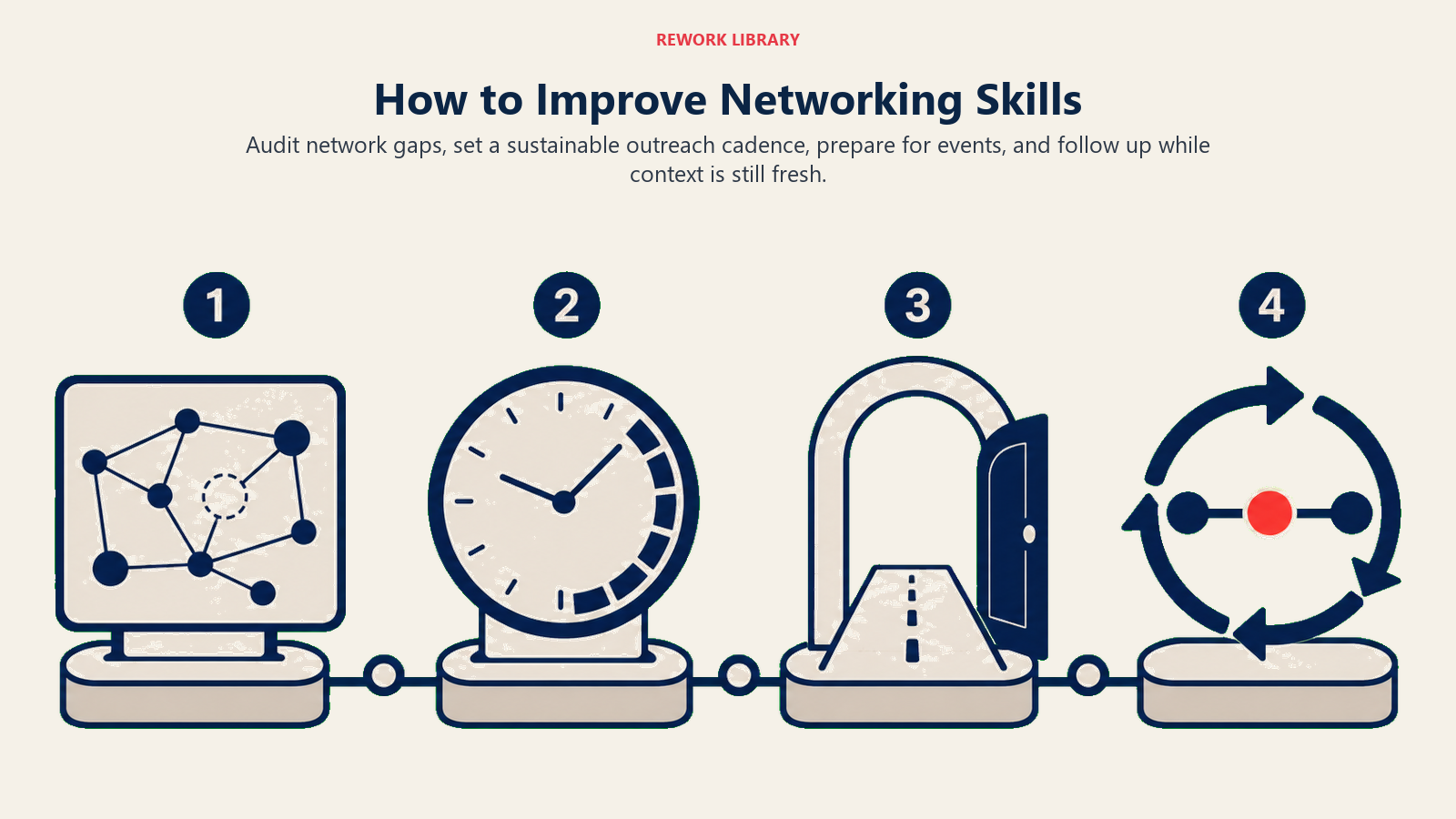
Audit your current network. Map out who you know across industries, functions, and seniority levels. Where are the gaps? Most people find they're heavily connected within their immediate team and nearly disconnected from adjacent functions, senior leaders, and people outside their industry. The gaps tell you where to focus.
Set a consistent outreach cadence. Pick a number you can maintain without it feeling like a burden. For most people, two to three new outreach messages per week, and one to two follow-ups on existing conversations, is enough to build real momentum over a year. Consistency beats intensity.
Prepare before events. If you're going to a conference or industry gathering, research who's attending. Identify five to ten people you'd genuinely want to talk to. Have a two-sentence version of what you're working on and what kind of conversations you're looking for. Preparation converts awkward intros into useful exchanges.
Practice the follow-up habit. Right after a meaningful conversation, whether at an event or on a call, spend five minutes writing a brief follow-up. Reference something specific from the conversation. Suggest one concrete next step if there is one. Do this every time until it's automatic.
Ask for introductions strategically. When you want to meet someone, check if a mutual connection can introduce you. A warm introduction converts at a much higher rate than a cold message. Being clear about why you want to meet, and what the other person might get from it, makes it easy for your contact to say yes.
Offer before you need. Pass along useful things without expectation: an article, an introduction, a piece of feedback. This shifts your network from transactional to genuinely reciprocal. People help people who've helped them.
Review and refresh annually. Once a year, reconnect with people you haven't spoken to recently. A brief "thinking of you" message costs almost nothing and keeps a relationship from going cold.
Networking Techniques That Work
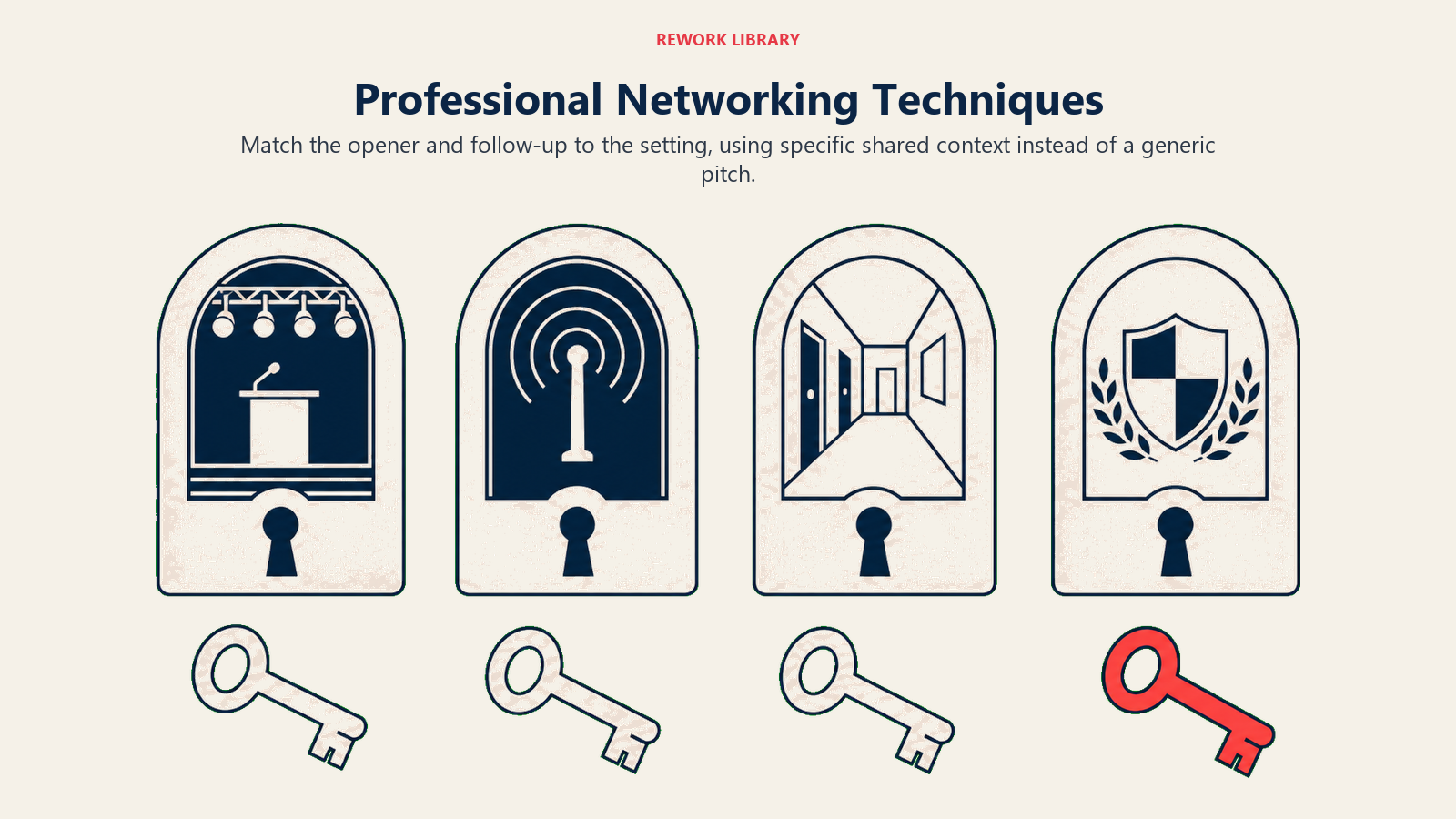
The right approach varies by context. Here's what tends to work across the most common networking settings:
| Setting | Technique | What Makes It Work |
|---|---|---|
| Industry conference | Target two or three specific sessions or speakers, then introduce yourself with a reference to something they said | Specific and genuine openers are far more memorable than generic greetings |
| LinkedIn outreach | Personalized connection request referencing shared context (mutual connection, shared event, relevant post they wrote) | Generic requests get ignored; specificity signals real interest |
| Internal company event | Seek out one person from a team you rarely interact with; ask about their current work, not just their role title | Cross-functional relationships are often more valuable than depth in your own silo |
| Alumni network | Reach out to alumni a year or two ahead of you in your career path; ask for 20 minutes to learn from their experience | People enjoy helping those slightly behind them; it's low-stakes and often rewarding |
| Post-meeting follow-up | Reference the most useful insight from the conversation and suggest one concrete next step | Shows you were listening; turns a one-off meeting into an ongoing relationship |
| Online community | Contribute answers or perspectives before asking questions | Establish credibility first; the community will be more receptive to what you need later |
Common Networking Mistakes
Even well-intentioned networkers make the same errors repeatedly. Knowing what they are makes them easier to avoid.
Treating networking as a transaction. Reaching out only when you need something is noticeable, and it's off-putting. People can tell when they're being used. If you only contact someone when you want a favor, they'll start responding slowly, or not at all.
Talking too much about yourself. A common mistake at events and on calls: treating the conversation as a pitch for yourself. The best networkers ask more questions than they answer. Curiosity about other people is the single trait most associated with being memorable and likeable.
Skipping the follow-up. Most networking dies between the meeting and the follow-up. If you don't send a message within 48 hours, the conversation is effectively over. The person you spoke to will have met 10 other people and won't remember you clearly by the time you reach out two weeks later.
Connecting without context. Sending a blank LinkedIn request to someone you've never met signals that you haven't thought about why they should connect with you. Write a brief note. Reference something real. It takes 30 seconds and dramatically increases the acceptance rate.
Neglecting your existing network. Most people focus on meeting new contacts while letting existing relationships go cold. The relationships you already have are often your most valuable assets. Maintaining them requires less effort than building new ones from scratch.
Expecting immediate returns. Networking operates on a long time horizon. A conversation you have today might lead to something meaningful in three years. People who network with a short-term ROI mindset get frustrated and quit. The compounding happens slowly, then suddenly.
Best Practices
A few principles that make networking work better over time:
Be specific in every interaction. Vague networking is forgettable. Specific networking is memorable. Specific compliment, specific request, specific follow-up. When in doubt, add one more concrete detail.
Treat your reputation as your network's foundation. What people say about you when you're not in the room is what attracts new connections. Being known as someone who delivers on commitments and treats people well is worth more than any event you could attend.
Connect others generously. When two people in your network would benefit from knowing each other, make the introduction. It builds goodwill with both parties and makes your network more valuable to everyone in it.
Use public speaking as a multiplier. Speaking at events or internal all-hands puts you in front of dozens of people at once. A single well-delivered talk can generate more meaningful connections than a year of cold outreach.
Pair networking with persuasion skills. Knowing how to frame a request and make a compelling case makes every networking interaction more productive.
Networking skills aren't a personality trait. They're a set of learnable behaviors that anyone can build with consistent attention. The people who are well-networked five years from now are the ones who started the habits today, not the ones who waited until they needed something.
If you're not sure where to begin, start with one person you respect and haven't spoken to in a while. Reach out with something specific. That's it. That's the whole skill, practiced once. Do it again next week.
- Relationship Building: the foundation of every lasting professional connection
- Interpersonal Skills: the broader people-skills that make all interactions work
- Communication: expressing yourself clearly in every channel
- Active Listening: the skill most people underestimate in networking
- Influencing Skills: moving people without formal authority
- Personal Branding: how others perceive you when you're not in the room
- Public Speaking: a networking multiplier that builds credibility at scale
- Persuasion Skills: framing and communicating in ways that move people to act