Presentation Skills: How to Present With Confidence
Turn this article into takeaways for your work.


Each assistant summarizes the article only for you and suggests best practices for your work.
Presentation skills are the difference between an idea that gets funded and one that gets forgotten. They shape whether your proposal earns buy-in, whether your team follows your lead, and whether your name comes up when leadership looks for people to represent the company.
What Are Presentation Skills?
Presentation skills are the abilities you use to plan, design, and deliver information to an audience effectively. They cover everything from structuring your content and designing clear slides to controlling your voice, reading the room, and handling tough questions without losing your footing.
The term sounds simple, but it bundles together several distinct capabilities. A strong presenter needs to think like a writer (clear structure), a designer (useful visuals), a speaker (confident delivery), and a listener (real-time audience awareness). Miss any one of those, and even a genuinely good idea can fall flat.
Good presentation skills aren't a personality trait. They're a learned, practiced set of behaviors. And that matters, because it means anyone can build them.
Key Facts
- Glossophobia (fear of public speaking) affects an estimated 73% of people, making it one of the most common fears worldwide (Chapman University Survey of American Fears, 2022).
- In a LinkedIn Workplace Learning Report, communication and presentation skills consistently rank in the top five skills employers say they struggle to find in candidates.
- Guy Kawasaki's 10-20-30 Rule, developed from his work as a venture capitalist, recommends no more than 10 slides, a 20-minute talk, and 30-point minimum font size, which forces presenters to be clear and concise rather than comprehensive.
Why Presentation Skills Matter at Work
Every professional presents, whether they call it that or not. A project update, a hiring decision pitch to a hiring panel, a sales call, a one-pager walked through with a client: these are all presentations.
But the stakes vary. A polished presenter in a budget review can shift resource allocation. A stumbling one in a board meeting can raise questions about their readiness for senior roles. Research consistently links visible communication skills with faster promotion and higher earnings over a career.
There's also a compound effect. Each time you present well, you build credibility. Credibility earns you more opportunities to present. More practice sharpens the skill further. It's one of those virtuous cycles worth investing in early.
And for managers and leaders, the ability to present isn't optional. Your team's morale, your stakeholder relationships, and your organization's direction often hinge on how clearly you can stand up and articulate what you're thinking.
Key Presentation Skills
These are the core sub-skills that make up a complete presenter. Most people are stronger in some areas than others, which is useful to know when you're deciding where to focus.
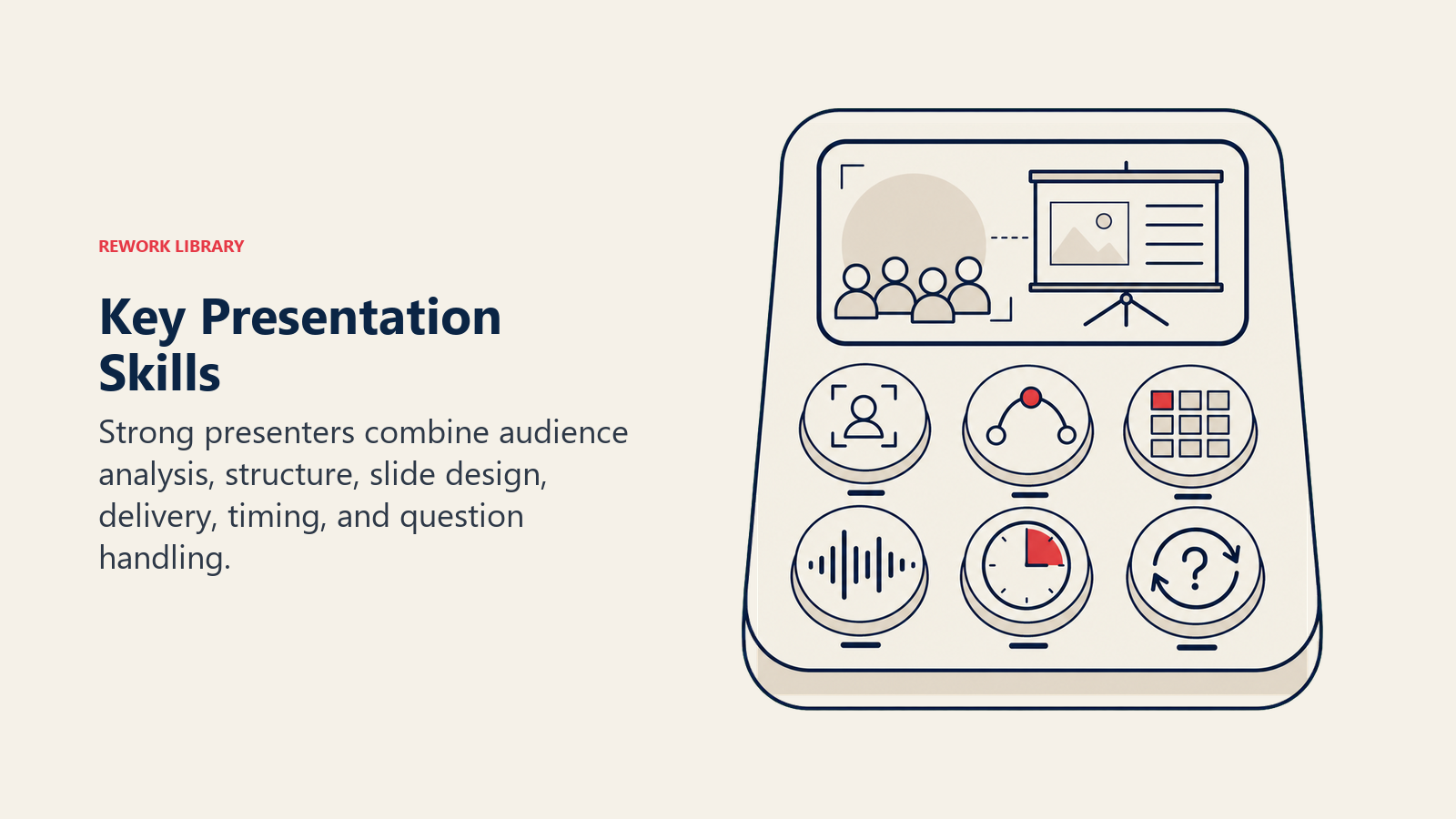
| Sub-Skill | What Good Looks Like |
|---|---|
| Structuring content | Clear beginning, middle, and end. One central idea per presentation. The audience always knows where they are and why it matters. |
| Visual design | Slides support the speaker, not replace them. Key points use visuals, not walls of text. Fonts are readable from the back of the room. |
| Verbal delivery | Varied pace, deliberate pauses, clear enunciation. Avoids filler words (um, uh, you know). Adjusts volume to the room. |
| Body language | Open posture, purposeful movement, eye contact that includes the whole room not just one person. Gestures reinforce meaning. |
| Audience awareness | Reads energy and adjusts. Notices when people are confused or disengaged. Adapts content or pace mid-presentation when needed. |
| Handling Q&A | Listens fully before responding. Says "I don't know" when appropriate. Doesn't get rattled by tough questions. |
| Managing nerves | Uses preparation to convert anxiety into energy. Breathes. Doesn't let physical symptoms (racing heart, dry mouth) derail delivery. |
How to Improve Your Presentation Skills
Building these skills takes practice, but practice on its own isn't enough. You need deliberate practice with feedback. Here's a step-by-step approach that actually works.
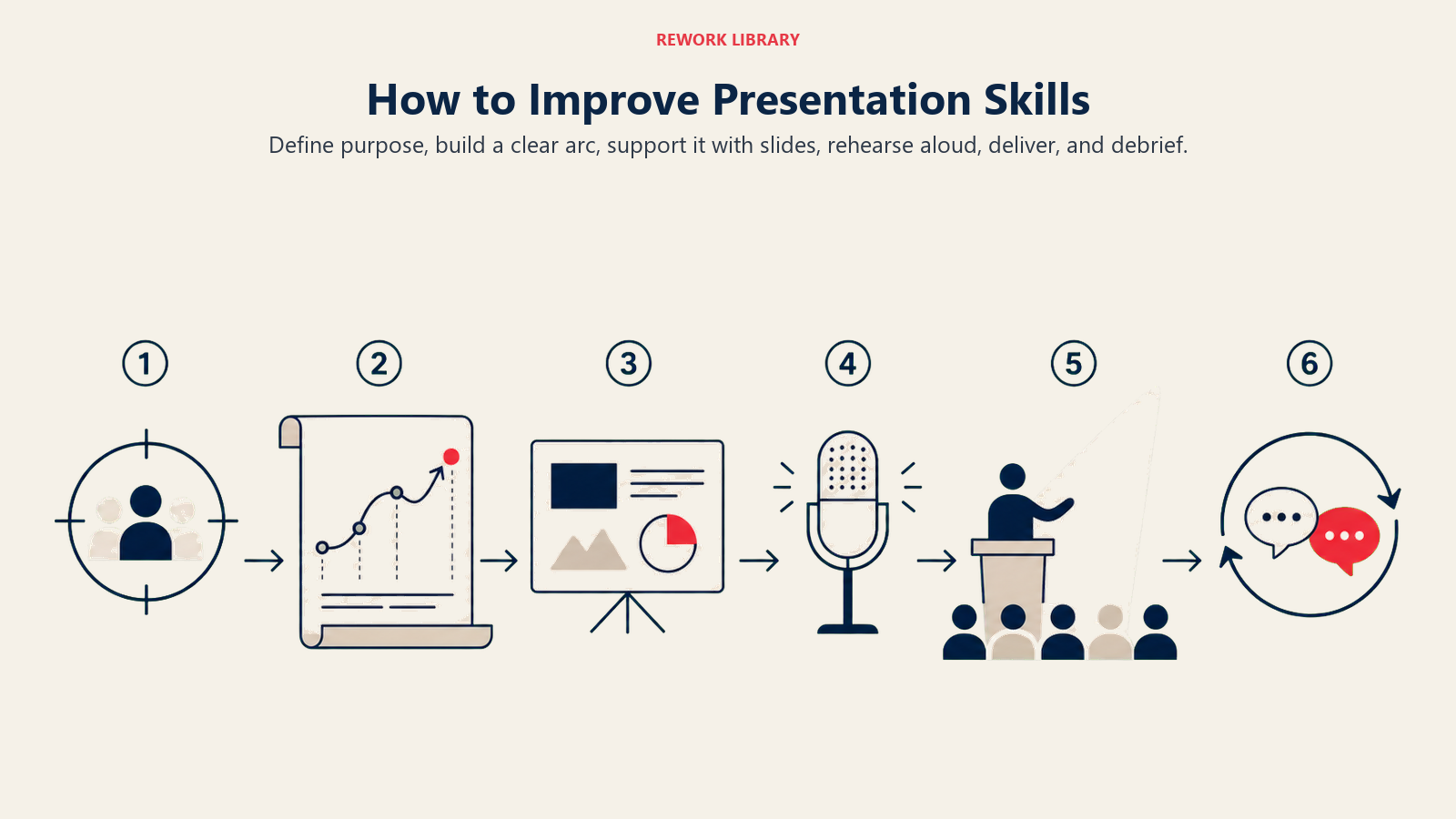
Step 1: Know your purpose and audience before anything else
Before you open a slide deck, answer two questions: What do I want the audience to do or believe after this? And what does the audience already know and care about?
These answers shape everything. A C-suite update needs different framing than a team standup. A sales pitch to a technical buyer is different from one to a CFO. If you skip this step, you might build a technically strong presentation that lands wrong because it wasn't designed for that specific room.
Step 2: Build a clear arc
The most common structural mistake is presenting information in the order you learned it rather than the order that helps your audience understand it. A better default structure looks like this: hook (why should they care?), context (what's the situation?), key points (what do they need to know?), recommendation or call to action (what do you want them to do?).
This is sometimes called the Pyramid Principle (from Barbara Minto's work at McKinsey): lead with your conclusion, then support it with evidence. It's the opposite of building to a reveal, which loses audiences before you get there.
Step 3: Design slides that support, not substitute
Think of your slides as visual aids, not speaker notes. Each slide should have one clear idea. If a slide needs a paragraph to explain it, the slide isn't doing its job.
A few rules that actually help: use a large font (30pt minimum per Kawasaki's rule), limit each slide to one or two visuals or data points, and test your slides by covering your speaker notes to see if the slide still communicates clearly on its own.
Step 4: Rehearse out loud, not just in your head
Reading through your presentation silently is almost useless as practice. You need to hear yourself say the words. Record yourself on your phone and watch it back. This is uncomfortable and also one of the fastest ways to improve. You'll catch filler words, awkward phrasing, and pacing issues you'd never notice otherwise.
Rehearse in the actual space if you can, or simulate it. Stand up. Speak at full volume. Time yourself.
Step 5: Deliver, then debrief
The day of the presentation, don't try to memorize every word. Know your opening cold (the first 30 seconds matter most) and know your key transitions. The rest can be flexible.
After the presentation, debrief while it's fresh. What landed well? Where did you lose the room? What would you cut or expand next time? This reflection loop is what turns experience into actual skill growth.
Step 6: Build your Q&A confidence separately
Most presenters over-prepare the content and under-prepare for questions. Run through the ten hardest questions someone could ask, then practice your answers. This isn't about having a scripted response for everything. It's about having thought through the hard ones so you're not caught off guard.
When you get a question you can't answer, it's fine to say: "That's a good question. I don't have that data in front of me, but I'll follow up by end of week." That's not weakness. It's credibility.
Presentation Skills Examples
How these skills show up varies a lot by context. The same core competency looks different in a board meeting versus a team standup.
| Scenario | What Strong Presentation Skills Look Like |
|---|---|
| Sales pitch | Leads with the client's problem, not the product. Customizes the slide deck to their industry. Handles objections calmly and pivots the conversation. |
| Board or executive update | Leads with the recommendation first. Uses data selectively, not exhaustively. Keeps it to 10 minutes, leaves 20 for questions. |
| Team standup | Concise, structured, no slides needed. Covers blockers clearly, doesn't bury the lede. Reads team energy and adjusts if something needs more discussion. |
| Conference talk | Strong opening story or provocation. Avoids reading from slides. Builds to a clear takeaway the audience can use. |
| Job interview presentation | Shows evidence, not just claims. Tells a coherent narrative. Invites questions and uses them to demonstrate depth. |
Common Presentation Mistakes
Even experienced presenters fall into these patterns. Knowing them is the first step to avoiding them.
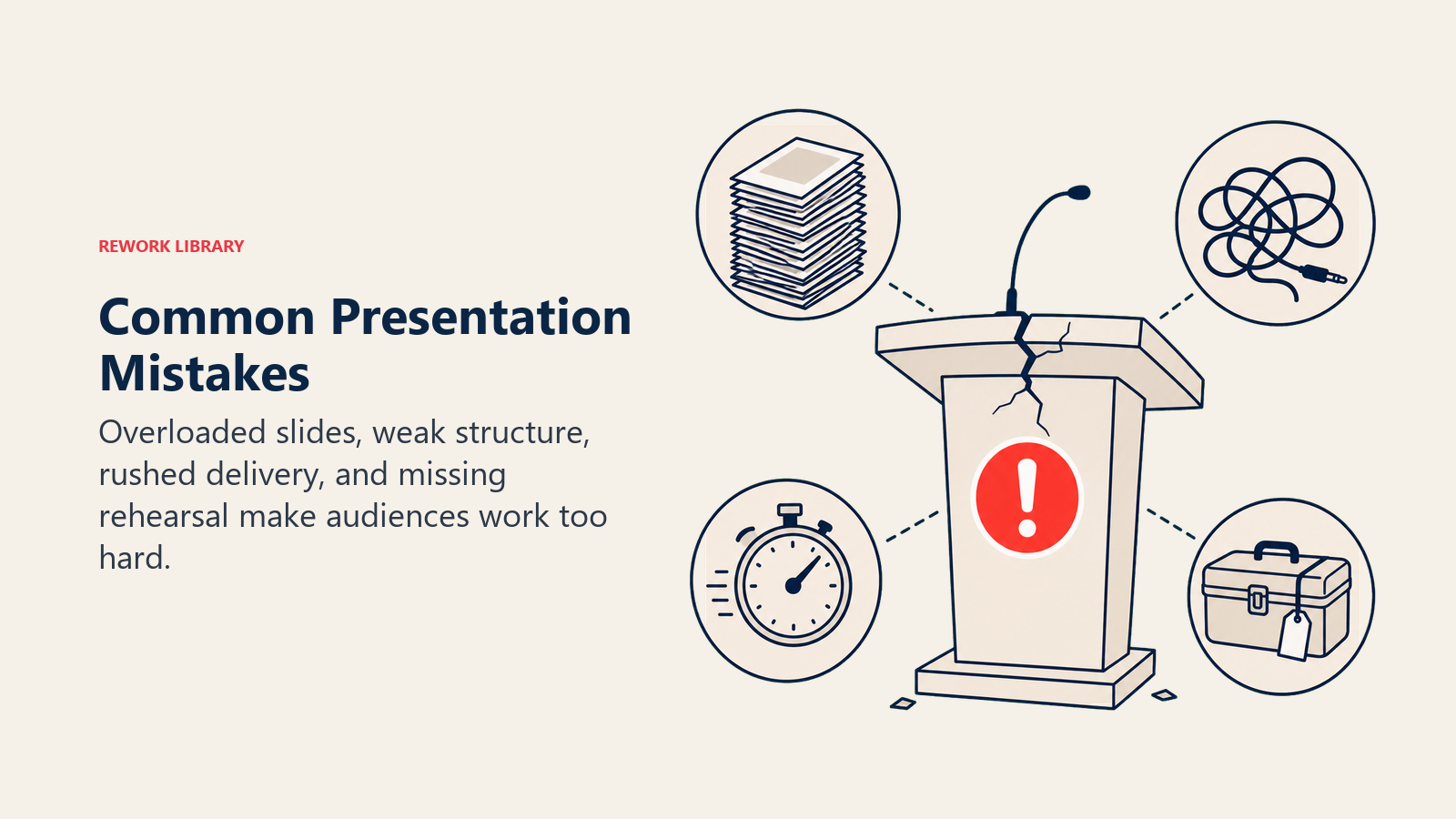
Reading from slides. If your audience can read faster than you speak (and they can), reading aloud means they're already ahead of you. Use slides as prompts, not scripts.
Starting with an apology or disclaimer. "I know this deck is rough" or "I'm not great at public speaking" lowers the audience's confidence before you've said anything useful. Start strong instead.
Too much content. The most common mistake. Cut one-third of what you planned to say. Depth on fewer points beats breadth across many.
Ignoring the room. Staring at your slides or your notes instead of your audience breaks connection. Even in a virtual presentation, looking into the camera matters more than looking at the slide preview.
Weak endings. Trailing off with "so...yeah, that's it" wastes the moment when the audience is most ready to act or commit. End with a clear call to action or a memorable statement.
Skipping the dry run. Winging a presentation because you know the material is a trap. You might know the content cold, but you haven't practiced the delivery, pacing, or transitions.
How to Show Presentation Skills on a Resume or in an Interview
If presentation skills are relevant to a role you're pursuing, make them visible with specifics rather than vague claims.
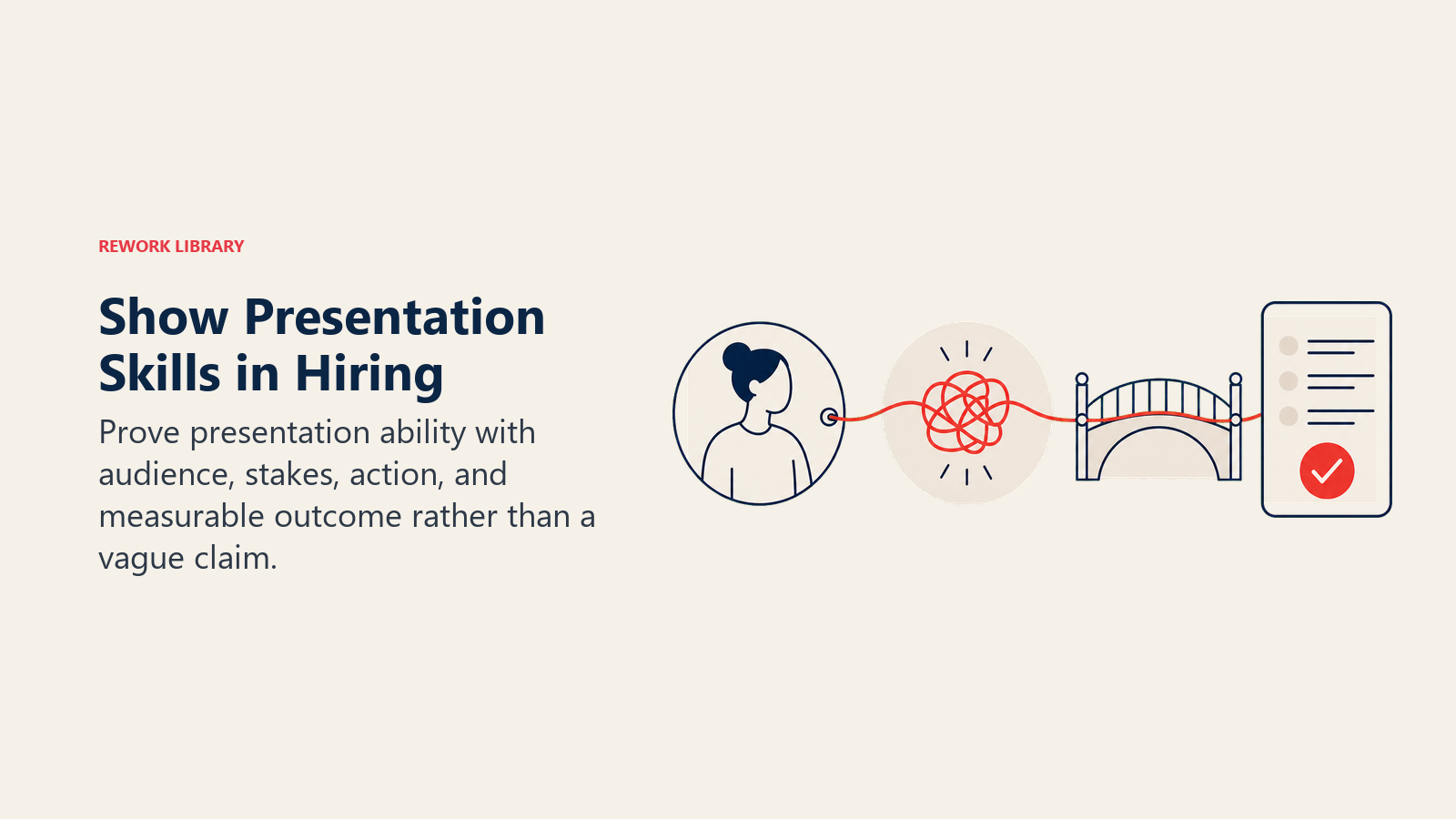
On a resume, include concrete examples: "Presented quarterly business reviews to 200-person sales org" or "Led executive briefings for C-suite stakeholders across 8 product lines." Numbers and scope signal the actual level of the skill.
In an interview, when asked about a presentation you gave, use the STAR format (Situation, Task, Action, Result). Describe a specific presentation, what made it challenging, what you did differently, and what the outcome was.
If the role involves a lot of presenting, ask to do a short presentation as part of the interview process. It shows confidence and initiative, two signals interviewers value, and it lets your actual skill speak for itself.
Developing your influencing skills alongside presentation skills also helps here. Influence is often what happens after the presentation, and the two capabilities reinforce each other.
Where to Go From Here
Presentation skills compound. Each time you get in front of an audience, whether it's four people on a Zoom call or four hundred at a conference, you're making a deposit into a skill account that pays out over an entire career.
Start with the next presentation you have scheduled, however small. Apply one thing from this article: a cleaner structure, a practice run out loud, a stronger opening. Build from there.
If you want to go deeper on the skills that complement strong presenting, active listening will make you a better Q&A handler, emotional intelligence will help you read the room, self-awareness will surface the blind spots in how you come across, and interpersonal skills will carry your credibility beyond the presentation itself.
The ability to present well isn't just about public speaking. It's about being someone whose thinking is clear enough to share, and confident enough to share it.

Senior Customer Retention Strategist
On this page
- What Are Presentation Skills?
- Why Presentation Skills Matter at Work
- Key Presentation Skills
- How to Improve Your Presentation Skills
- Step 1: Know your purpose and audience before anything else
- Step 2: Build a clear arc
- Step 3: Design slides that support, not substitute
- Step 4: Rehearse out loud, not just in your head
- Step 5: Deliver, then debrief
- Step 6: Build your Q&A confidence separately
- Presentation Skills Examples
- Common Presentation Mistakes
- How to Show Presentation Skills on a Resume or in an Interview
- Where to Go From Here