AI Ethics Awareness: Your Guide to Responsible AI Use at Work

Turn this article into takeaways for your work.


Each assistant summarizes the article only for you and suggests best practices for your work.
What You'll Get From This Guide
- Understand why AI ethics matters for every employee, not just technical teams
- Assess your current awareness level using our 5-level AI ethics framework with clear indicators
- Recognize and address AI bias before it affects your work and decisions
- Navigate data privacy requirements when using AI tools with sensitive information
- Know when transparency is required about AI involvement in your work
- Apply your organization's responsible AI policies with confidence
Your colleague just showed you a customer analysis report they generated in minutes using an AI tool. The insights look impressive. But then you notice something odd: the AI seems to have made assumptions about customer preferences based on demographic data that feels uncomfortably close to stereotyping. Do you say something? How do you even know if what you're seeing is problematic?
This scenario plays out thousands of times daily across workplaces everywhere. AI tools have become remarkably accessible, and their output often looks polished and authoritative. But that polish can hide serious ethical issues: bias baked into training data, privacy violations you didn't realize you were committing, or decisions that affect people's lives in ways the AI never considered.
AI ethics awareness isn't a nice-to-have skill reserved for data scientists and ethicists. It's becoming as fundamental as digital literacy itself. Every employee who uses AI tools needs to understand the ethical dimensions of that technology. And with AI adoption accelerating across industries, that means almost everyone.
Why AI Ethics Matters for Every Employee
The numbers are striking: 77% of organizations are either using or exploring AI, according to McKinsey's 2025 State of AI report. But here's the part that should concern you: only 21% of those organizations have established comprehensive AI ethics guidelines, and even fewer have trained their employees on responsible AI use.
This gap creates risk. Real risk. The kind that shows up as discrimination lawsuits when an AI-assisted hiring tool screens out qualified candidates. The kind that damages customer trust when people discover their personal data was fed into an AI system without consent. The kind that ends careers when someone's AI-generated report contains fabricated information presented as fact.
But beyond risk mitigation, AI ethics awareness creates opportunity. Organizations are hungry for people who can bridge the gap between what AI can do and what AI should do. The employee who spots the bias in that customer analysis isn't just avoiding problems. They're showing the critical thinking and ethical judgment that organizations desperately need.
Here's the reality: AI doesn't have ethics. It has patterns. It has statistical correlations. It has whatever biases were present in its training data. The ethics come from you. You're the human in the loop. You're the person who decides whether to trust the output, how to apply it, and when to push back.
The 5-Level AI Ethics Awareness Framework
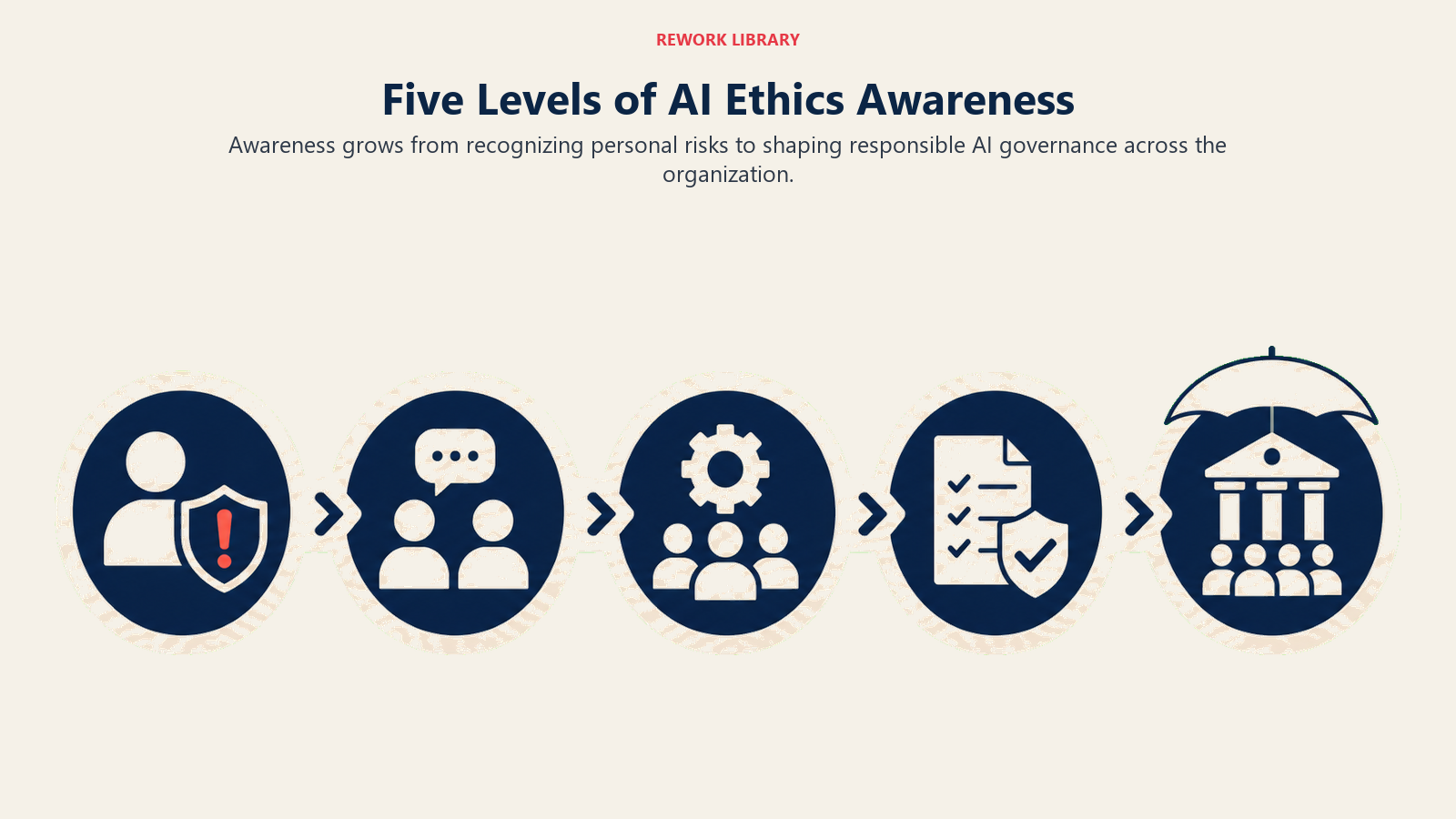
Level 1: AI Ethics Novice (Just Starting)
You're at this level if: You use AI tools but haven't thought much about their ethical implications, you trust AI outputs without questioning them, and you're unsure what company policies exist around AI use.
Behavioral Indicators:
- Uses AI tools as instructed without questioning outputs
- Follows explicit AI policies when reminded
- Asks basic questions about what's allowed
- Recognizes that AI can make mistakes
- Understands that AI ethics is becoming important
Assessment Criteria:
- Can name at least one ethical concern with AI
- Knows where to find company AI use policies
- Understands that AI outputs need verification
- Aware that bias can exist in AI systems
- Seeks guidance when unsure about AI use
Development Focus: Build foundational awareness. Your goal is to understand that AI ethics exists as a domain and start recognizing ethical dimensions in your AI interactions.
Quick Wins at This Level:
- Read your company's AI use policy from start to finish
- Verify one AI output this week using original sources
- Ask your manager what AI tools are approved for your role
- Notice when AI makes mistakes and document what you observe
- Connect AI ethics to your existing professional ethics foundation
Success Markers: You stop accepting AI outputs at face value, you know who to ask about AI questions, and you've started noticing news stories about AI ethics issues.
Level 2: AI Ethics Aware (1-2 years of practice)
You're at this level if: You regularly question AI outputs, understand common types of AI bias, and can identify obvious ethical issues with AI applications.
Behavioral Indicators:
- Reviews AI outputs for obvious errors and biases
- Asks questions about data sources and model limitations
- Considers privacy implications before sharing data with AI
- Follows AI policies consistently without reminders
- Raises concerns about problematic AI outputs
Assessment Criteria:
- Identifies at least three types of AI bias
- Understands basic data privacy principles
- Knows when to disclose AI involvement
- Can explain why AI ethics matters
- Applies judgment to AI recommendations
Development Focus: Build consistent ethical habits. Focus on creating reliable practices for evaluating AI outputs and protecting sensitive information.
Quick Wins at This Level:
- Create a personal AI ethics checklist for reviewing outputs
- Learn to identify selection bias, confirmation bias, and representation bias in AI
- Practice data minimization by sharing only necessary information with AI tools
- Build the habit of verification before acting on AI recommendations
- Develop your decision-making skills to evaluate AI suggestions critically
Success Markers: You catch errors others miss, colleagues ask for your input on AI-related decisions, and you feel confident explaining basic AI ethics concepts.
Level 3: AI Ethics Proficient (2-5 years of experience)
You're at this level if: You proactively identify ethical risks in AI applications, help others navigate AI ethics questions, and contribute to responsible AI practices in your team.
Behavioral Indicators:
- Evaluates AI tools and vendors for ethical practices
- Mentors others on responsible AI use
- Identifies systemic bias patterns in AI applications
- Designs workflows that incorporate ethical checkpoints
- Advocates for transparency in AI-assisted decisions
Assessment Criteria:
- Applies multiple ethical frameworks to AI questions
- Conducts basic impact assessments for AI use cases
- Creates guidelines for team AI use
- Balances AI efficiency with ethical considerations
- Influences AI adoption decisions constructively
Development Focus: Become a go-to resource for others. Focus on translating AI ethics principles into practical team processes and helping colleagues build their own awareness.
Quick Wins at This Level:
- Develop an AI ethics review process for your team's common use cases
- Create a decision tree for when AI use requires additional scrutiny
- Document bias examples you've encountered to help train others
- Build relationships with compliance and legal teams
- Practice systems thinking to understand downstream impacts of AI decisions
Success Markers: Your team has fewer AI-related incidents, you're consulted on AI tool evaluations, and your ethical review processes get adopted more widely.
Level 4: AI Ethics Advanced (5-10 years of experience)
You're at this level if: You shape AI ethics policies, lead cross-functional initiatives on responsible AI, and influence how your organization approaches AI governance.
Behavioral Indicators:
- Develops organizational AI ethics frameworks
- Leads AI impact assessments for significant initiatives
- Advises leadership on AI ethics strategy
- Builds partnerships with external AI ethics experts
- Creates training programs for AI ethics awareness
Assessment Criteria:
- Designs comprehensive AI governance structures
- Measures and reports on AI ethics metrics
- Integrates AI ethics into business processes
- Navigates complex multi-stakeholder AI decisions
- Anticipates emerging AI ethics challenges
Development Focus: Shape organizational capability. Focus on building systems, policies, and cultures that promote responsible AI use at scale.
Quick Wins at This Level:
- Establish an AI ethics council or review board
- Create an AI ethics incident reporting system
- Develop AI vendor assessment criteria including ethics requirements
- Build AI ethics into performance reviews and recognition programs
- Connect AI ethics to business acumen by quantifying risk and opportunity
Success Markers: Your organization's AI ethics posture measurably improves, you're recognized as a leader in responsible AI, and your frameworks get adopted industry-wide.
Level 5: AI Ethics Expert (10+ years of experience)
You're at this level if: You're a recognized authority on AI ethics, contribute to industry standards, and shape the broader conversation about responsible AI.
Behavioral Indicators:
- Publishes thought leadership on AI ethics
- Advises multiple organizations on AI governance
- Contributes to regulatory and standards discussions
- Pioneers new approaches to AI ethics challenges
- Develops next-generation AI ethics practitioners
Assessment Criteria:
- Recognized industry expert in AI ethics
- Published author or speaker on AI responsibility
- Advisory board member for AI initiatives
- Track record of transformational AI ethics work
- Influences policy and regulation
Development Focus: Advance the field. Focus on addressing systemic challenges, developing new frameworks, and shaping how society governs AI.
Quick Wins at This Level:
- Contribute to industry standards bodies working on AI ethics
- Mentor emerging AI ethics leaders across organizations
- Publish case studies on AI ethics successes and failures
- Build cross-sector coalitions for responsible AI
Success Markers: Your work shapes industry practices, regulators seek your input, and you've created lasting impact on how organizations approach AI ethics.
Understanding AI Bias: How It Happens and How to Spot It
AI bias isn't mysterious. It follows predictable patterns you can learn to recognize. Understanding these patterns turns you from a passive AI user into an informed critic.
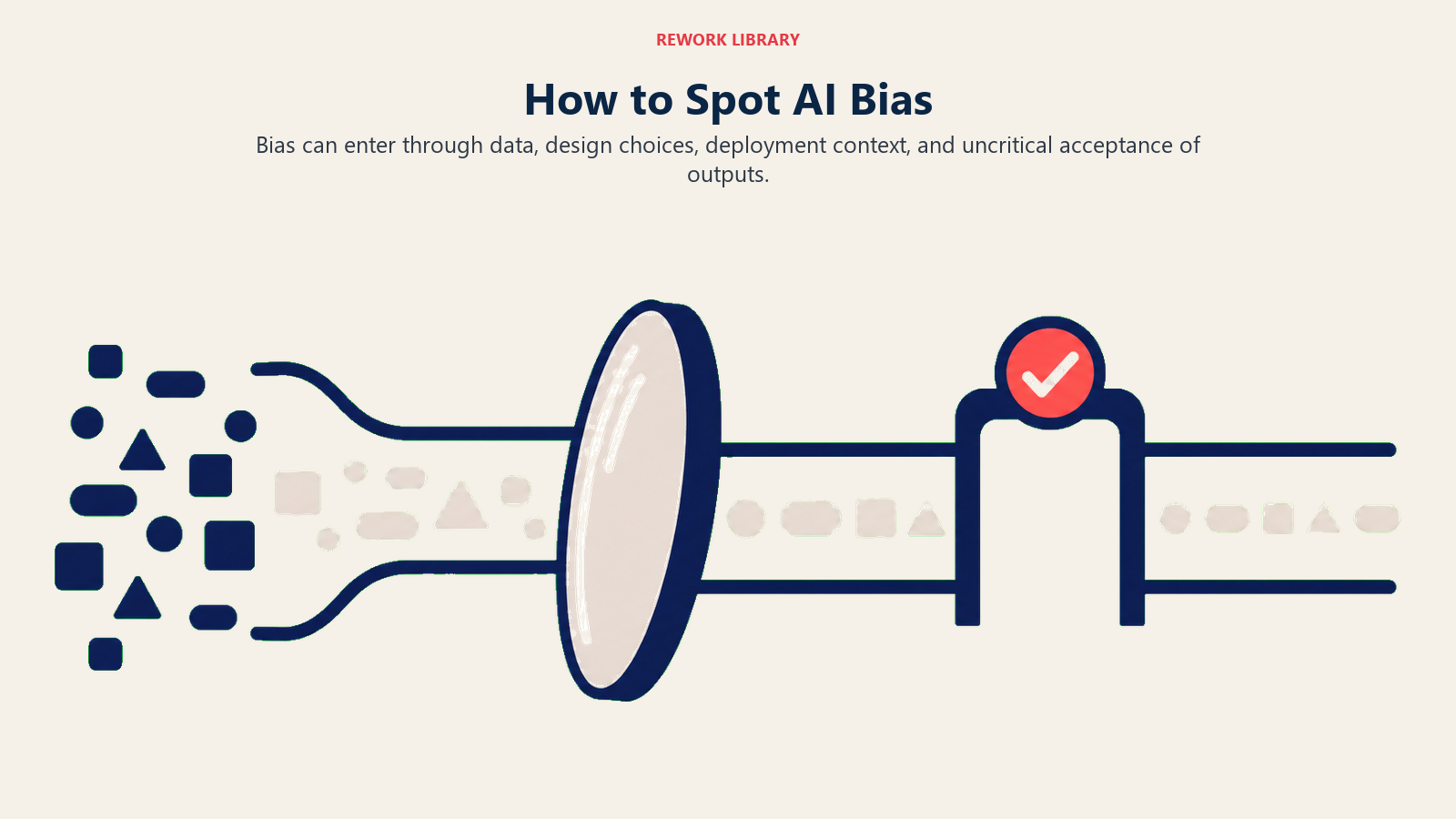
Training Data Bias
AI systems learn from historical data. If that data reflects historical inequities, the AI will perpetuate them. An AI trained on past hiring decisions will replicate past discrimination. An AI trained on medical data from predominantly white populations will perform worse for other groups.
How to spot it: Ask what data the AI was trained on. Look for underrepresentation of certain groups in training data. Notice when AI performs differently for different populations.
Scenario: Your marketing team's AI tool recommends targeting luxury product ads exclusively to ZIP codes with high average incomes. The AI learned this pattern from historical campaign data. But you realize this effectively excludes high-income individuals who live in diverse neighborhoods, and reinforces assumptions about who "deserves" to see certain products.
Selection Bias
The data used to train AI often doesn't represent the full population it will affect. Facial recognition trained mostly on lighter-skinned faces fails on darker-skinned faces. Voice assistants trained on certain accents struggle with others.
How to spot it: Consider who was included in the training data and who was left out. Test AI performance across different user groups. Notice patterns in where the AI fails.
Scenario: Your customer service AI chatbot handles complaints effectively from your longtime customers but struggles with newer customers from recently acquired markets. The AI was trained on support tickets from your original customer base, and it hasn't learned the communication patterns of your expanded market.
Confirmation Bias
AI systems can create feedback loops that reinforce existing patterns. A news recommendation algorithm shows you content similar to what you've clicked before, narrowing your information exposure. A predictive policing AI sends officers to historically over-policed neighborhoods, generating more arrests, which trains the AI to send even more officers.
How to spot it: Look for feedback loops where AI recommendations influence future training data. Notice when AI seems to be narrowing rather than expanding options. Question whether patterns the AI found are ones you want to amplify.
Scenario: Your sales team's lead scoring AI consistently ranks leads from certain industries higher. When you investigate, you find the AI learned this pattern because your sales reps historically spent more time with those industries, creating more data points about successful conversions there. The AI isn't identifying better leads; it's reflecting where effort was already concentrated.
Automation Bias
This isn't a bias in the AI itself; it's a human tendency to over-trust automated systems. When AI provides an answer, people often accept it without sufficient scrutiny, especially when the AI seems confident.
How to spot it: Notice when you or others accept AI recommendations without verification. Watch for situations where human expertise is overruled by AI suggestions. Pay attention to your own comfort level questioning AI outputs.
Scenario: A loan officer reviews an application the AI flagged as high risk. The applicant has an excellent credit history, but the AI's risk score gives her pause. She follows the AI recommendation and denies the loan, without investigating what factors drove the risk assessment. Later, she learns the AI weighted the applicant's neighborhood heavily in its risk calculation.
Data Privacy and Confidentiality with AI Tools
Every time you interact with an AI tool, you're potentially sharing data. Understanding what happens to that data is essential for responsible AI use.
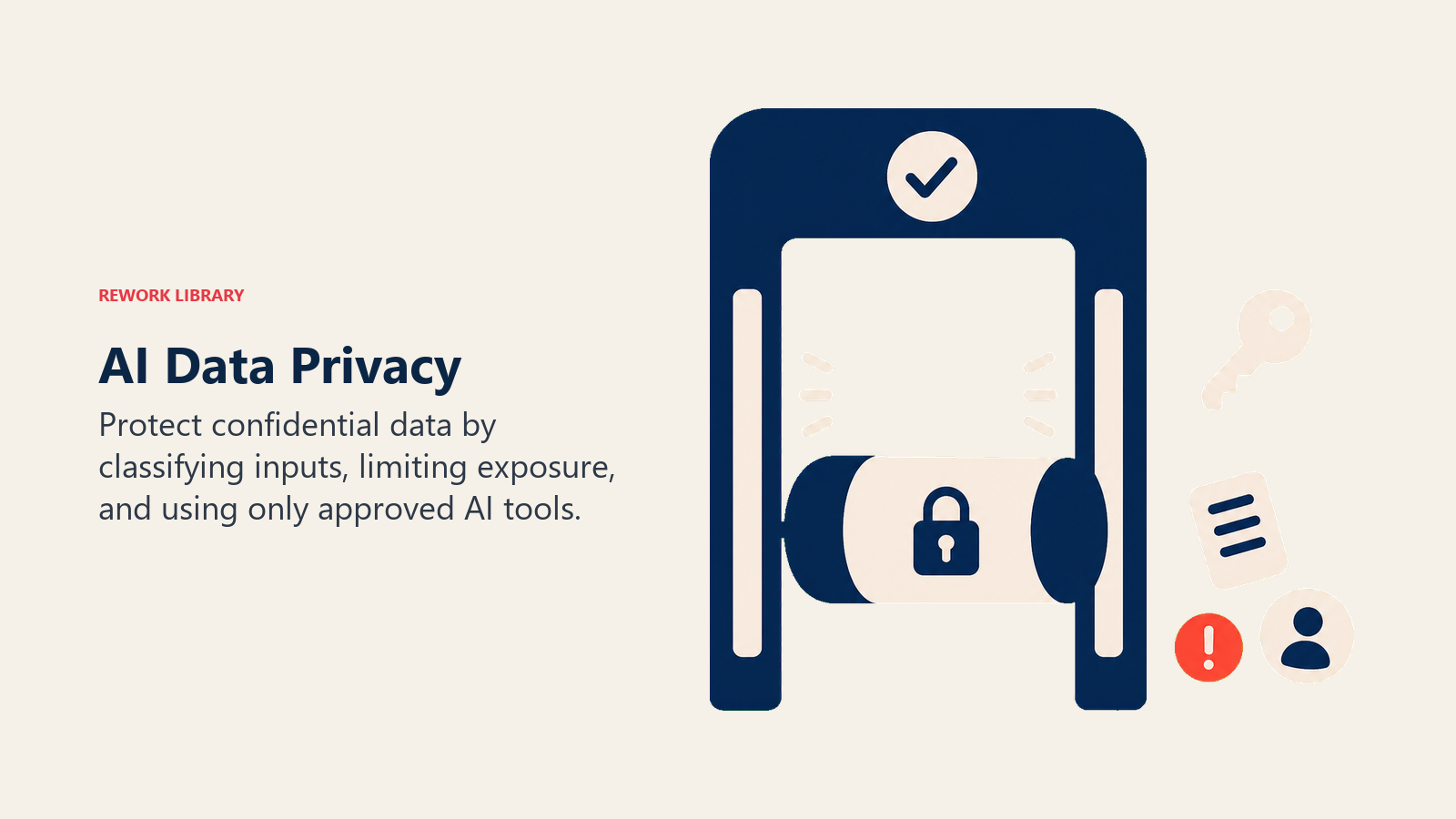
Know What You're Sharing
When you paste text into an AI chatbot, upload a document for analysis, or provide customer data for AI processing, ask yourself:
- What specific data am I sharing? Be precise. Not just "a document" but "customer names, email addresses, purchase history, and support ticket contents."
- Who has access to this data now? The AI provider, their subcontractors, potentially future trainers of the model.
- How long will this data be retained? Some AI tools store inputs indefinitely. Others delete after processing.
- Could this data be used to train future models? Your confidential information could become part of the AI's general knowledge.
The Confidentiality Checklist
Before sharing information with any AI tool, run through this checklist:
- Is this information confidential? Customer data, employee records, financial information, trade secrets, strategic plans.
- Do I have authorization to share this? Just because you can access data doesn't mean you can share it with third-party AI systems.
- What does my company policy say? Most organizations have specific guidelines about what can be processed by external AI tools.
- What are the contractual obligations? Client contracts often restrict how their data can be used.
- What's the worst case if this data leaked? If you can't accept that outcome, don't share the data.
Practical Data Protection Strategies
Anonymize before you analyze. Remove names, specific identifiers, and unique details before feeding data to AI tools. Instead of "John Smith's account at Acme Corp has $450,000 in overdue invoices," try "A customer account has significant overdue invoices."
Use enterprise AI solutions when possible. Many organizations now offer AI tools with stronger privacy protections, including guarantees that your data won't be used for model training.
Be especially careful with sensitive categories. Health information, financial data, employment records, and anything involving minors requires extra caution.
Remember that AI outputs can leak inputs. If you ask an AI to write a report using confidential data, that report might contain patterns or details that reveal the original information.
Transparency and Disclosure: When to Tell People AI Was Used
One of the trickier aspects of AI ethics is knowing when you need to disclose AI involvement. The answer depends on context, but some principles apply broadly.
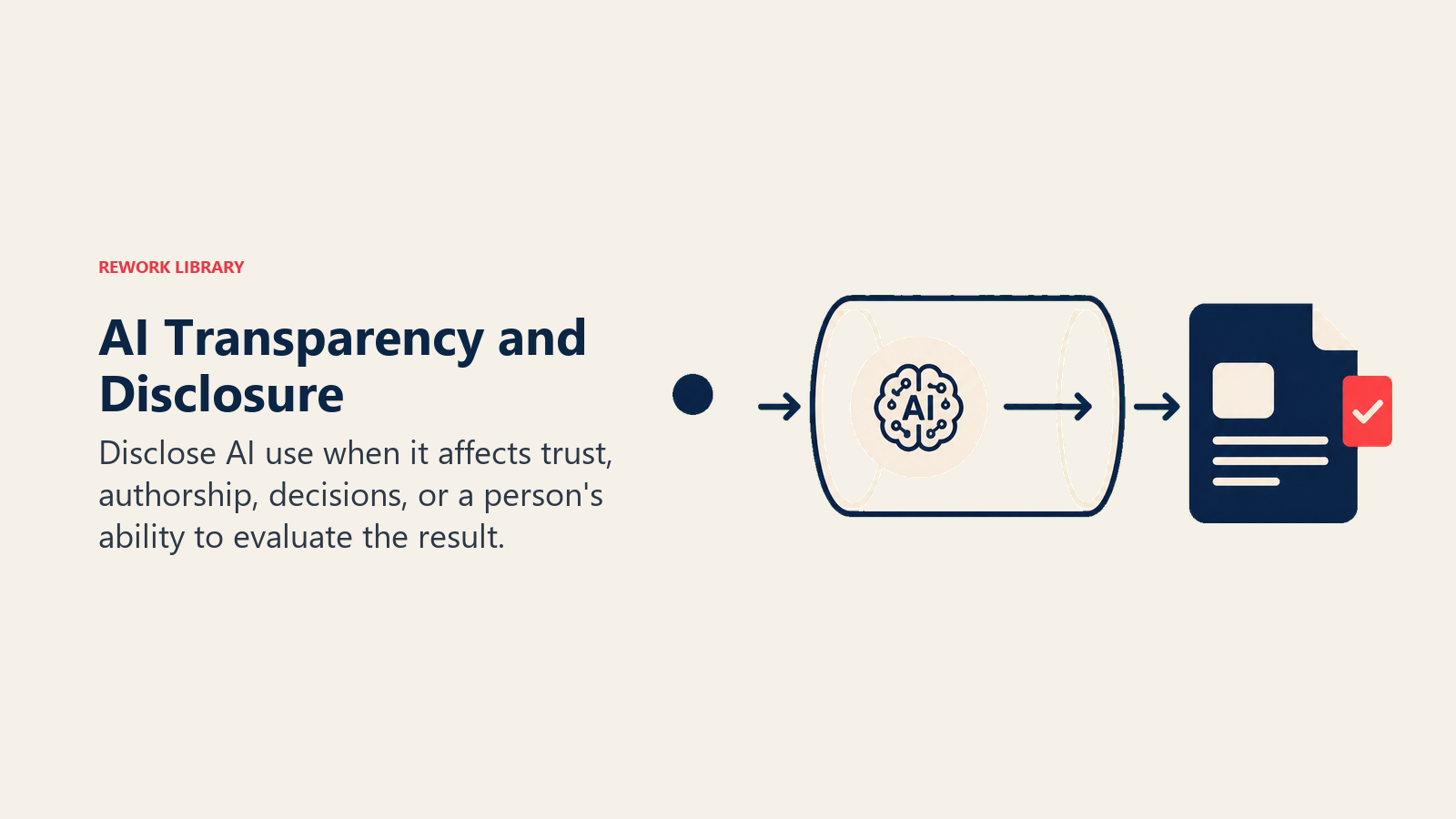
When Disclosure Is Usually Required
Legal and regulatory contexts. Many jurisdictions now require disclosure when AI influences decisions about employment, credit, insurance, or housing. If AI helped screen resumes, score loan applications, or set insurance premiums, disclosure is typically required.
Customer-facing interactions. When customers believe they're interacting with a human but actually communicating with an AI, disclosure prevents deception. Chatbots should identify themselves as automated.
Creative and professional work. When AI substantially contributed to a deliverable, clients and stakeholders deserve to know. This includes AI-generated text, images, code, and analysis.
Decisions affecting individuals. When AI recommendations influence decisions about specific people, those individuals often have a right to know and sometimes a right to human review.
When Disclosure Is Good Practice
Internal reports and analysis. Even when not required, noting that AI assisted with research, drafting, or analysis helps colleagues calibrate their trust appropriately.
Collaborative work. When you're contributing to a team project, letting colleagues know which parts were AI-assisted enables appropriate review.
Learning and development. Submitting AI-generated work as your own in training or educational contexts undermines your development and may violate policies.
How to Disclose Effectively
Simple, clear language works best. "This analysis was drafted with AI assistance and reviewed for accuracy" or "Our initial screening used an automated system; human recruiters review all shortlisted candidates."
Avoid both over-disclosure (exhaustively detailing every AI interaction) and under-disclosure (hiding AI involvement that affected outcomes). Focus on what a reasonable person would want to know.
Environmental Considerations of AI Use
AI's environmental impact is real and growing. Training large AI models consumes enormous amounts of energy, and running those models for inference uses power too. As a responsible AI user, this is something you should think about.
The Scale of AI's Environmental Footprint
Training a single large language model can emit as much carbon as five cars over their entire lifetimes. Running AI services at scale requires data centers that consume significant electricity and water for cooling. And as AI adoption grows, so does this footprint.
What Individual Employees Can Do
Choose efficient options when available. Smaller, specialized AI models often perform specific tasks better than general-purpose models while using less energy.
Avoid unnecessary AI use. Not every task needs AI. If a simple search or traditional tool works, use that instead of spinning up AI resources.
Batch your AI requests. Multiple smaller requests often consume more resources than one well-structured larger request.
Advocate for sustainable AI. Ask vendors about their environmental practices. Support organizational choices that prioritize efficient AI solutions.
This doesn't mean avoiding AI entirely. AI can also enable environmental benefits through optimization, efficiency improvements, and better decision-making. The goal is thoughtful use that weighs environmental costs alongside benefits.
Company Policies and Responsible Use Guidelines
Most organizations are developing AI governance frameworks. Understanding and following your organization's approach is key to responsible AI use.
What Good AI Policies Typically Cover
Approved tools and use cases. Which AI systems are sanctioned for which purposes.
Data handling requirements. What information can and cannot be processed by AI tools.
Review and approval processes. When AI use requires additional oversight.
Disclosure requirements. When and how to communicate AI involvement.
Incident reporting. How to report AI errors, biases, or other concerns.
Accountability structures. Who is responsible for AI-related decisions and outcomes.
When Policies Don't Exist or Don't Address Your Situation
Many organizations are still developing their AI governance. If you face an AI ethics question your policies don't cover:
- Apply general ethics principles. Would a reasonable person consider this use appropriate? Does it align with your organization's values?
- Consult with relevant experts. Legal, compliance, IT security, and HR may all have relevant perspectives.
- Document your reasoning. If you proceed without explicit guidance, note your rationale for future reference.
- Advocate for policy development. Use your question as evidence that clearer guidelines would help.
Building Your Own Ethical Framework
Even with organizational policies, you need personal ethical guidelines. Consider:
What are my red lines? What AI uses would you refuse regardless of instruction? Discriminatory screening? Deceptive content? Privacy violations?
How do I handle uncertainty? When you're unsure whether something is ethical, what's your default? Proceeding with caution? Seeking guidance? Erring toward transparency?
What's my responsibility? If AI produces harmful outputs, how much responsibility do you bear? How does that change your behavior?
Who can I consult? Who are your trusted advisors for AI ethics questions?
Taking Action: Your AI Ethics Development Path
Days 1-30: Build Foundation
- Read your organization's AI use policies thoroughly
- Identify which AI tools you use and what data flows through them
- Start noticing AI outputs that feel "off" even if you can't articulate why
- Complete any AI ethics training your organization offers
- Find one colleague or mentor to discuss AI ethics questions with
Days 31-60: Develop Practice
- Create your personal AI ethics checklist
- Practice verifying AI outputs before acting on them
- Learn to recognize three types of bias in AI outputs
- Review your data sharing practices with AI tools
- Raise one AI ethics concern through appropriate channels
Days 61-90: Extend Impact
- Help a colleague navigate an AI ethics question
- Propose one improvement to your team's AI use practices
- Document an AI bias or error you identified and how you addressed it
- Contribute to organizational discussions about AI governance
- Identify your next learning priority in AI ethics
Learn More: Related Competencies for AI Ethics
Building AI ethics awareness connects to other competencies that strengthen your professional judgment:
Ethical Foundation
- Professional Ethics - Apply general ethical principles that inform AI ethics decisions
- Accountability - Take responsibility for AI-assisted decisions and their outcomes
- Self-Awareness - Recognize your own biases and how they interact with AI
Critical Skills
- Critical Thinking - Evaluate AI outputs and recommendations skeptically
- Decision Making - Balance AI recommendations with human judgment
- Systems Thinking - Understand how AI decisions create cascading effects
Technical Context
- Digital Literacy - Build the technical foundation for understanding AI capabilities
- Data Analysis - Develop skills to evaluate AI data inputs and outputs
- Research Skills - Verify AI claims and understand AI limitations
Organizational Impact
- Communication - Articulate AI ethics concerns effectively
- Influencing Skills - Advocate for responsible AI practices
- Change Agility - Adapt as AI technology and ethics standards evolve

Senior Customer Retention Strategist
On this page
- Why AI Ethics Matters for Every Employee
- The 5-Level AI Ethics Awareness Framework
- Level 1: AI Ethics Novice (Just Starting)
- Level 2: AI Ethics Aware (1-2 years of practice)
- Level 3: AI Ethics Proficient (2-5 years of experience)
- Level 4: AI Ethics Advanced (5-10 years of experience)
- Level 5: AI Ethics Expert (10+ years of experience)
- Understanding AI Bias: How It Happens and How to Spot It
- Training Data Bias
- Selection Bias
- Confirmation Bias
- Automation Bias
- Data Privacy and Confidentiality with AI Tools
- Know What You're Sharing
- The Confidentiality Checklist
- Practical Data Protection Strategies
- Transparency and Disclosure: When to Tell People AI Was Used
- When Disclosure Is Usually Required
- When Disclosure Is Good Practice
- How to Disclose Effectively
- Environmental Considerations of AI Use
- The Scale of AI's Environmental Footprint
- What Individual Employees Can Do
- Company Policies and Responsible Use Guidelines
- What Good AI Policies Typically Cover
- When Policies Don't Exist or Don't Address Your Situation
- Building Your Own Ethical Framework
- Taking Action: Your AI Ethics Development Path
- Days 1-30: Build Foundation
- Days 31-60: Develop Practice
- Days 61-90: Extend Impact
- Learn More: Related Competencies for AI Ethics
- Ethical Foundation
- Critical Skills
- Technical Context
- Organizational Impact