Coaching Skills: How to Coach Your Team Effectively
Turn this article into takeaways for your work.


Each assistant summarizes the article only for you and suggests best practices for your work.
Coaching skills are the single most underrated thing a manager can build. Most leaders know how to direct, how to delegate, and how to evaluate. Far fewer know how to ask the question that makes someone think differently about their own work.
That gap is costly. Teams that get directed stay dependent. Teams that get coached start solving problems before the manager even hears about them.
What are coaching skills?
Coaching skills are the abilities a manager or leader uses to help people improve their own performance through questions, feedback, and goal-setting rather than simply giving instructions. The coach's job is not to have all the answers. It's to help the other person find theirs.
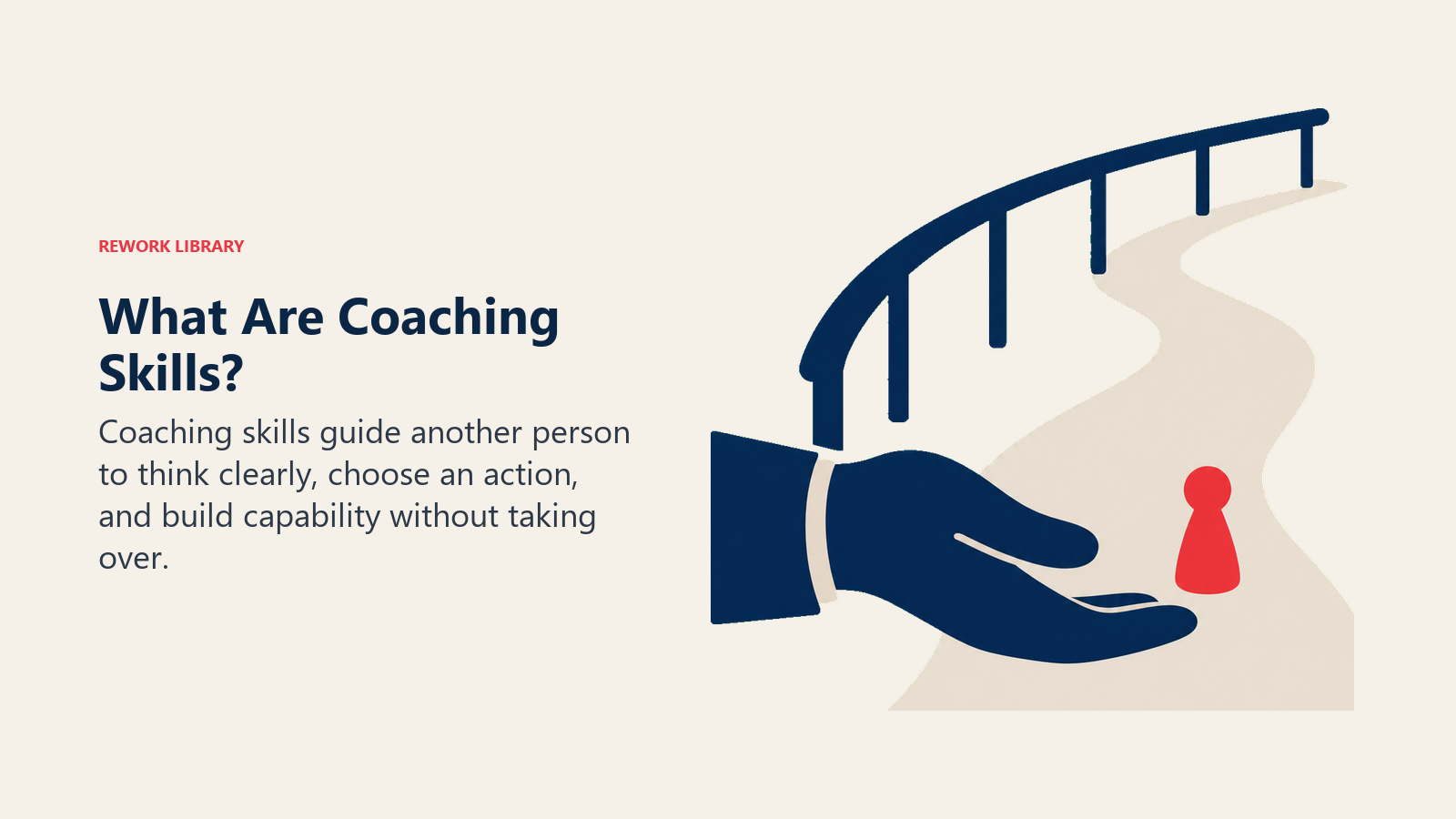
Where a manager tells, a coach asks. Where a manager diagnoses, a coach listens first. The aim is to build the other person's capability so they can handle similar situations independently next time.
Key terms to know:
- Coachee: the person being coached
- Coaching conversation: a structured dialogue focused on the coachee's goals and growth, not just task updates
- Coaching stance: the posture of curiosity and non-judgment a coach holds throughout the conversation
Coaching doesn't replace direction. New hires or genuinely complex situations still need clear instruction. But for most development challenges, coaching produces faster growth and higher engagement than telling people what to do.
Key Facts
Research consistently backs up the case for coaching at work:
- Employees who receive regular coaching are 3x more likely to be engaged at work than those who don't (Gallup, State of the American Manager, 2015)
- Companies with strong coaching cultures report 62% of employees as highly engaged, compared to 50% at companies without one (International Coaching Federation / HCI, Building a Coaching Culture, 2014)
- Managers who practice coaching behaviors see up to 20% better performance outcomes on their teams, compared to purely directive leadership styles (Corporate Leadership Council, 2004)
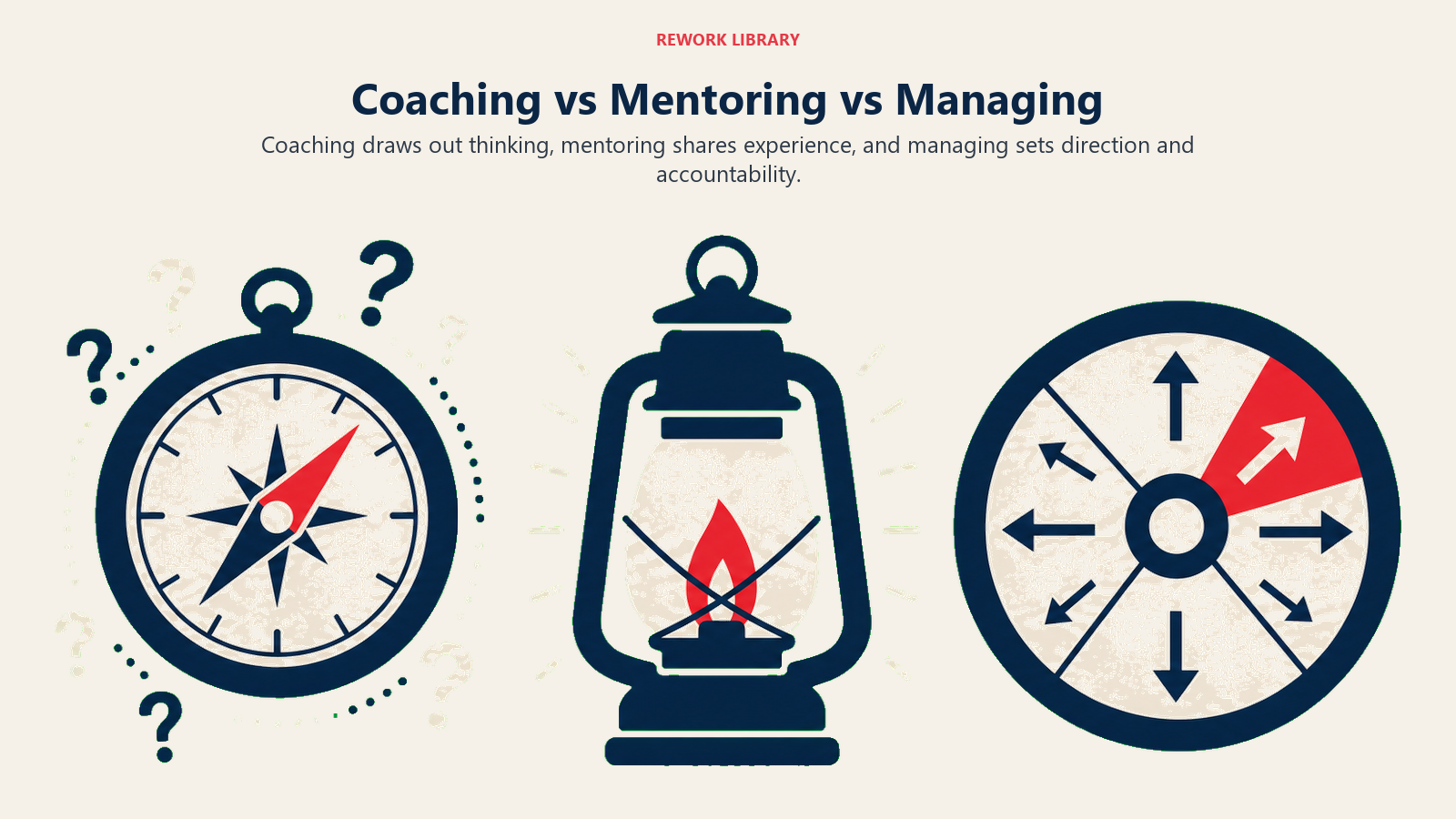
Coaching vs mentoring vs managing
These three roles overlap, but they're not the same. Confusing them is one of the most common reasons managers struggle to coach effectively.
| Dimension | Coaching | Mentoring | Managing |
|---|---|---|---|
| Primary focus | Specific performance or skill goal | Long-term career and professional growth | Day-to-day task delivery and team output |
| Time horizon | Short to medium term | Long term (months to years) | Ongoing and immediate |
| Who leads the agenda | The coachee | The mentee (guided by mentor) | The manager |
| Core method | Questions, reflection, and feedback | Advice, stories, and relationship | Direction, planning, and accountability |
| Success signal | Coachee solves independently next time | Mentee navigates career with confidence | Team hits targets reliably |
| Role expertise required | Process skills (listening, questioning) | Relevant experience in the field | Role and domain knowledge |
A manager can play all three roles with the same person at different moments. But they need to be clear about which role they're in during any given conversation.
Core coaching skills
These six abilities make up the foundation of effective coaching. A strong coach doesn't necessarily master them all at once, but they're aware of which one is weakest and actively working on it.
| Skill | What it looks like in practice |
|---|---|
| Active listening | Giving full attention, not planning your next point while someone talks; reflecting back what you heard before responding |
| Powerful questioning | Asking open-ended questions that prompt reflection: "What do you think is driving that?", "What have you already tried?" |
| Giving feedback | Delivering specific, behavior-based observations tied to the goal, not general praise or vague criticism |
| Goal-setting | Helping the coachee define a clear outcome with a real deadline and success criteria they can measure |
| Building trust | Creating a space where the coachee feels safe to admit mistakes, uncertainty, and genuine struggles |
| Holding accountability | Following up on what was agreed, naming gaps directly, and helping the coachee recommit when they've slipped |
The most common weakness for new coaching managers is the last one. They set the goal and hold the conversation, but then let follow-up slide when things get busy. Accountability is what turns a good coaching conversation into real behavior change.
The GROW coaching model
GROW is the most widely used coaching framework in workplace settings, originally developed by Sir John Whitmore in the 1980s. It gives a coaching conversation a clear shape without making it feel scripted.
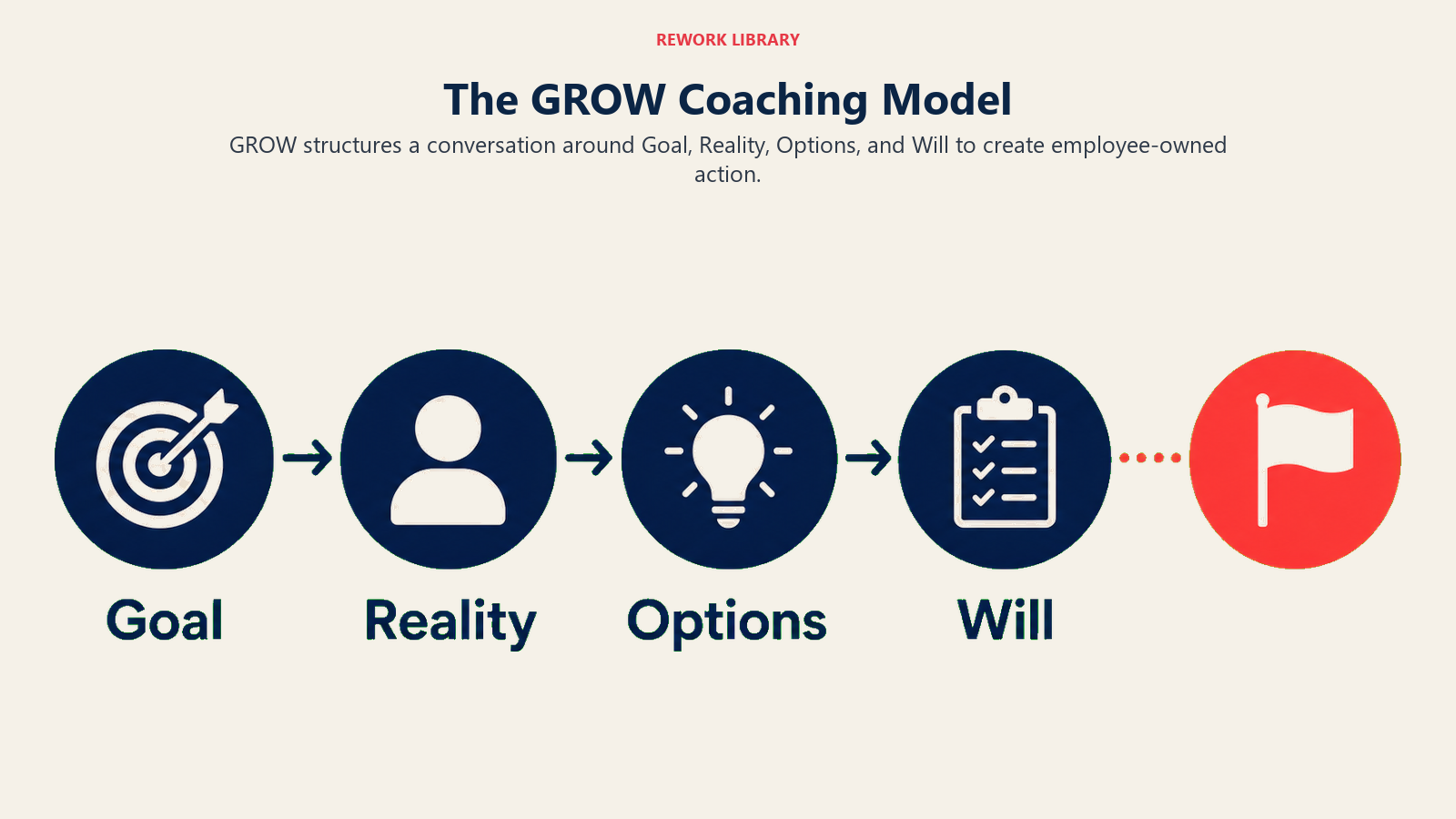
Goal: What does the coachee want to achieve? This is the outcome for this conversation (not just life in general). It should be specific: not "I want to improve my presentations" but "I want to deliver my next board update without losing my thread in the Q&A."
Reality: Where are things right now? What's actually happening, not what the coachee wishes were happening. Honest reality-checking is where most coaching conversations stall, because it requires admitting the gap.
Options: What could the coachee do? This is a brainstorm phase. The coach does not pick the solution. They ask: "What else could you try?", "What would you do if you couldn't take that route?", "Who has handled something similar that you could talk to?"
Will: What will the coachee actually do, and by when? This is the commitment step. A GROW conversation without a specific action and date produces reflection without change.
Worked example: A team lead, Priya, tells her manager she feels stuck in her role. Using GROW:
- Goal: "What would 'not stuck' look like for you in 90 days?"
- Reality: "What does your day actually look like now that makes it feel that way?"
- Options: "What types of work energize you? What's one project you'd jump at if it landed on your desk?"
- Will: "Based on that, what's one thing you could propose to me by Friday that would shift your next quarter?"
Priya leaves with a specific proposal to write, not just a feeling that someone listened to her.
How to coach your team effectively
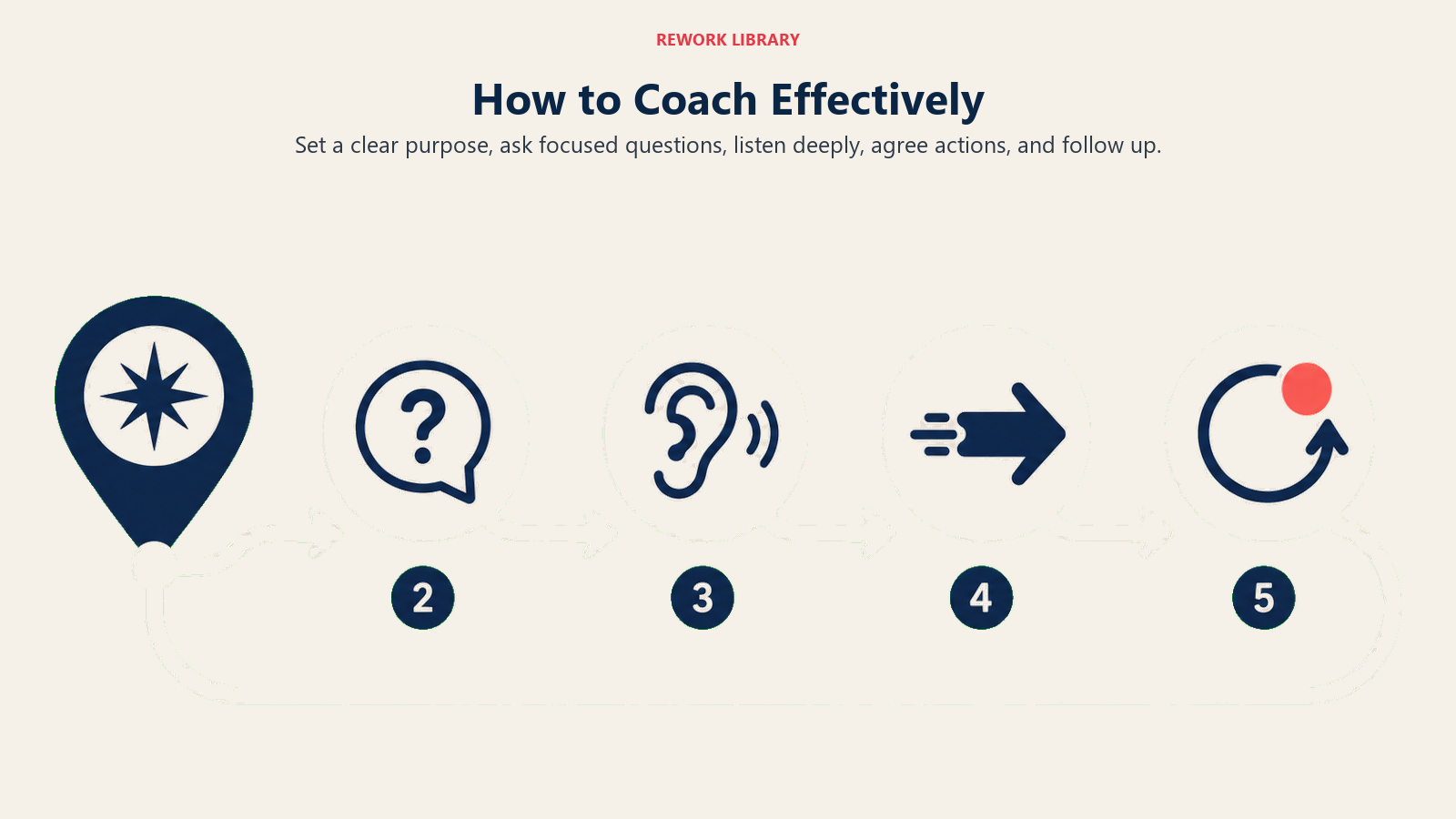
Step 1: Build a regular 1:1 rhythm
Coaching doesn't happen well in the margins. It needs a dedicated slot. Weekly or fortnightly 1:1s that are explicitly for the team member, not for status updates, are the foundation. Open each one with: "What's on your mind this week?" or "What do you want to work on today?"
Step 2: Ask before you tell
This is the hardest shift for most managers. When someone brings you a problem, the instinct is to solve it. Resist that. Before offering your view, ask: "What have you already considered?", "What's your read on the situation?", "What would you do if I weren't here?" You'll often find they already know the answer.
Step 3: Listen actively
Active listening means more than staying quiet while someone talks. It means paying attention to what isn't being said, noticing when someone's energy shifts, and reflecting back before responding. Try: "So what I'm hearing is that you feel the scope keeps changing and you don't know who to escalate to. Is that right?" That one sentence often unlocks 10 minutes of useful conversation.
Step 4: Set clear, coachee-owned goals
A goal you give someone is a target. A goal they set themselves is a commitment. Use goal-setting conversations to help them define what good looks like, how they'll measure it, and what might get in the way. Then write it down together. Coaching goals that aren't written down rarely survive the week.
Step 5: Give specific, timely feedback
Giving feedback well is a skill on its own. In a coaching context, the best feedback is tied to a specific observation (not a pattern or a general impression) and delivered close to the event. "In this morning's meeting, when you walked through the timeline, the room seemed confused. What was going on from your end?" is more useful than "You need to communicate more clearly."
Step 6: Follow up and hold accountability
Agree on a specific action and check in on it at the next 1:1. Not aggressively, but clearly. If the action didn't happen, don't ignore it. Ask: "Last week you planned to reach out to the design team. How did that go?" If they didn't do it, explore what got in the way. Accountability held with curiosity, rather than blame, is how trust and results coexist.
Coaching examples by situation
| Situation | Coaching goal | Key question to open with |
|---|---|---|
| Underperformance | Close the gap between current output and expected standard | "What does good look like to you in this role?" |
| New hire ramp | Build confidence and independent problem-solving in first 90 days | "What's been the hardest thing to figure out so far?" |
| High-potential growth | Expand scope, visibility, and strategic thinking | "What kind of work would stretch you in the next six months?" |
| Skill gap | Develop a specific capability the role needs more of | "Where do you feel least confident right now, and what would help?" |
| After a failure | Extract learning and rebuild motivation | "What would you do differently, and what would you keep?" |
The question you open with determines the quality of the conversation that follows. Generic prompts ("How's it going?") produce generic answers. Specific prompts tied to the person's situation produce real material to work with.
Common coaching mistakes
Giving the answer too fast. The moment you solve the problem for someone, the coaching conversation ends and a status update begins. If someone is stuck, sit with the discomfort a little longer before offering your view. Ask one more question first.
No follow-through on agreed actions. A coaching conversation without follow-up is just a nice chat. The accountability loop, checking in on what was agreed, is what produces real change. Skipping it signals that the commitments weren't serious.
Coaching only poor performers. This is a mistake many managers make without realizing it. When coaching is reserved for problems, high performers start to see it as a warning sign. Coaching is for growth, not just remediation. Your best people often have the most to gain from a well-run conversation.
Coaching in the wrong moment. If someone is in crisis, actively overwhelmed, or dealing with a personal emergency, they need support, not a GROW model. Emotional intelligence means reading when to coach and when to just listen.
Conflating coaching with performance management. Coaching is a developmental tool. If someone is underperforming and consequences are on the table, that conversation has a different structure. Mix the two without warning and you'll damage the trust that makes coaching work.
Coaching skills develop the same way every other competency does: through practice, feedback, and honest reflection on what's working. The managers who get good at coaching don't do it because they read a framework. They do it because they ran the conversation, noticed what happened, and showed up differently next time.
That's the work. And it's the highest-return investment most managers never quite make.

Senior Customer Retention Strategist
On this page
- What are coaching skills?
- Coaching vs mentoring vs managing
- Core coaching skills
- The GROW coaching model
- How to coach your team effectively
- Step 1: Build a regular 1:1 rhythm
- Step 2: Ask before you tell
- Step 3: Listen actively
- Step 4: Set clear, coachee-owned goals
- Step 5: Give specific, timely feedback
- Step 6: Follow up and hold accountability
- Coaching examples by situation
- Common coaching mistakes