Coachability: Why It Matters and How to Develop It
Turn this article into takeaways for your work.


Each assistant summarizes the article only for you and suggests best practices for your work.
Coachability is the skill that decides whether feedback actually changes anything. You can hire the most talented person in the room, but if they can't hear that their approach isn't working, all that talent stalls out at whatever level it started. Coachability is what lets skill compound instead of plateau.
It's also more measurable than most people assume. Leadership IQ's landmark study of over 20,000 new hires found that poor coachability, not a skills gap, was the single biggest reason new employees failed in their first 18 months. If you're building a team, hiring, or trying to get promoted yourself, this is the competency worth understanding first.
Key Facts
Key Facts: Coachability
- Leadership IQ's study of more than 20,000 new hires found 26% of failures within the first 18 months came down to poor coachability (the inability to accept and act on feedback), more than double the failure rate from lacking technical skill (11%).
- Gallup research finds employees who strongly agree they receive valuable feedback from the people they work with are five times as likely to be engaged, 57% less likely to be burned out, and 48% less likely to be job hunting.
- Zenger Folkman's coachability research found highly coachable people are 4 times more likely to be rated highly effective and score 3 times higher on engagement than people who resist feedback.
- Gallup's State of the Global Workplace 2026 puts manager engagement at 22% in 2025, down nine points from 31% in 2022, straining the exact people responsible for coaching everyone else.
What is coachability?
Coachability is the willingness and ability to accept feedback, especially the kind that stings a little, and turn it into a change in behavior. It's not the same as being agreeable or easy to manage. A coachable person can disagree, push back, and ask hard questions. What makes them coachable is that they don't shut down or get defensive when someone points out a gap between how they see themselves and how their work actually lands.
The distinction matters because coachability gets confused with three related but different things:
- Compliance is doing what you're told. It doesn't require any internal shift, just obedience.
- Openness is being willing to hear an idea. It's necessary but not sufficient: plenty of people listen politely and change nothing.
- Coachability is hearing feedback, believing it might be true, and doing something different because of it.
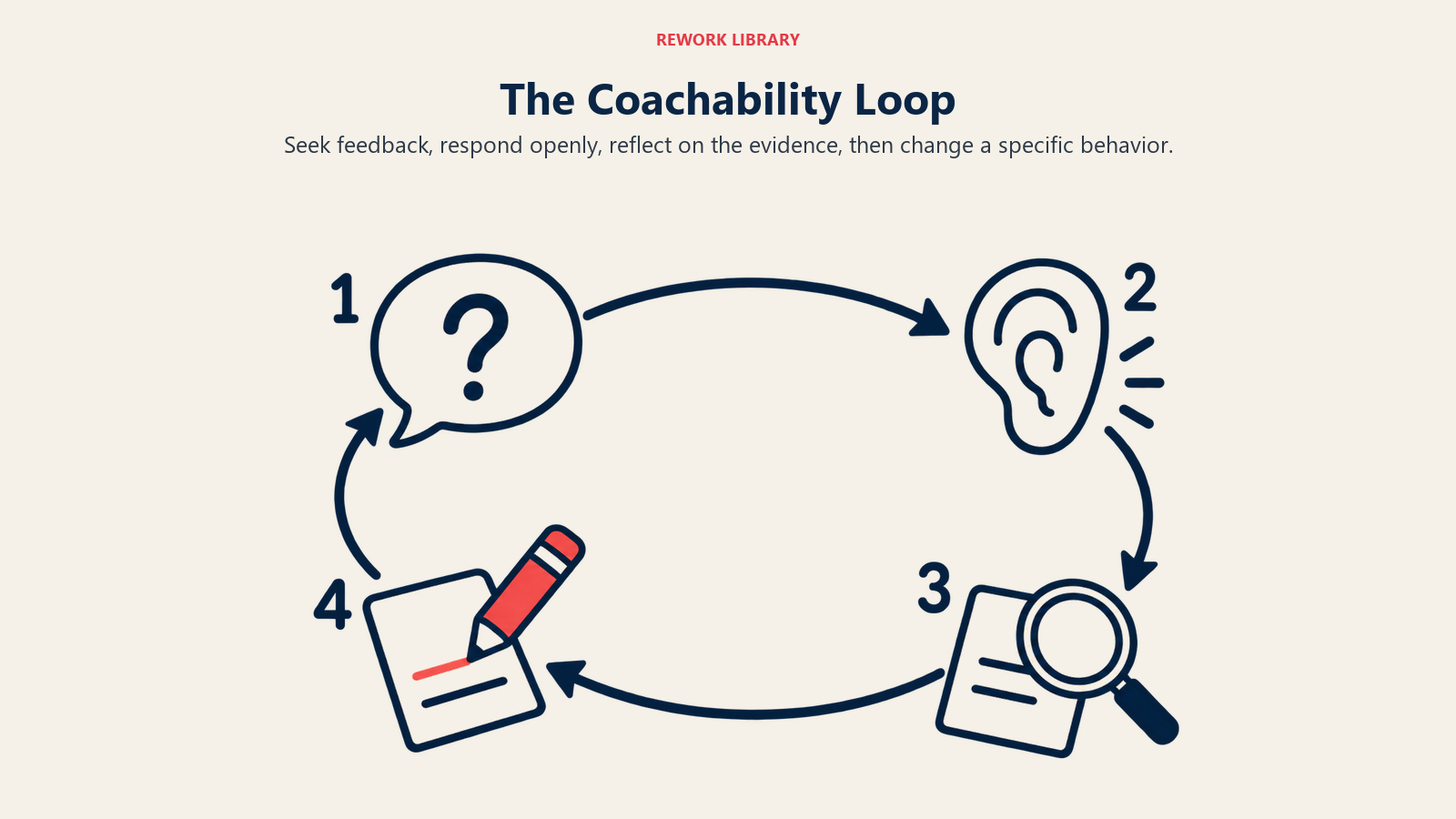
Researchers at Zenger Folkman frame coachability as a four-part loop, not a single trait.
The coachability loop
| Stage | What it looks like | What it is not |
|---|---|---|
| Seek | Asking for feedback before it's offered: after a pitch, a rough meeting, or a review | Waiting silently for someone else to bring it up first |
| Respond | Listening fully, asking a clarifying question, resisting the urge to explain yourself | Interrupting to justify the decision the feedback is questioning |
| Reflect | Sitting with the feedback for a beat, checking it against other signals before dismissing it | Deciding in the first ten seconds whether the feedback is "fair" |
| Act | Changing a specific behavior, then checking back later to see if it landed | Saying "noted" and doing the same thing next time |
People who are strong at seeking and responding but weak at reflecting and acting aren't actually coachable, they're just polite. Self-awareness is what makes the reflect stage possible: you can't act on a gap you can't see.
Why coachability matters, for your career and your team
Coachability shows up first in how fast someone improves. Two people can start a job with identical skill levels, and eighteen months later one of them is meaningfully better while the other has flatlined. The difference is almost never raw ability. It's whether they took the feedback that would have closed the gap.
The Leadership IQ numbers above make the career stakes concrete: coachability outranked technical skill, motivation, and temperament combined as a reason new hires failed. According to the study, 82% of the managers involved said, in hindsight, the interview process had shown subtle signs the hire would struggle. Coachability gaps tend to be visible earlier than most hiring processes are built to catch.
At the team level, the effect compounds. A manager who has to repeat the same feedback three times before it sticks is spending coaching capacity on one person that could have gone to five others. Coaching skills only produce a return when the person on the receiving end is coachable; a strong coach paired with an uncoachable report still gets nowhere.
There's also a retention angle that's easy to miss. Gallup's research on feedback and engagement found employees who feel they get valuable feedback are far less likely to be job hunting. That works both directions: coachable people extract more value from the feedback they already get, which means they grow faster in place instead of concluding they need to leave to develop.
What coachable vs uncoachable behavior actually looks like
Coachability is easiest to describe in the abstract and hardest to spot in the room. Here's what separates the two in situations that come up constantly at work.
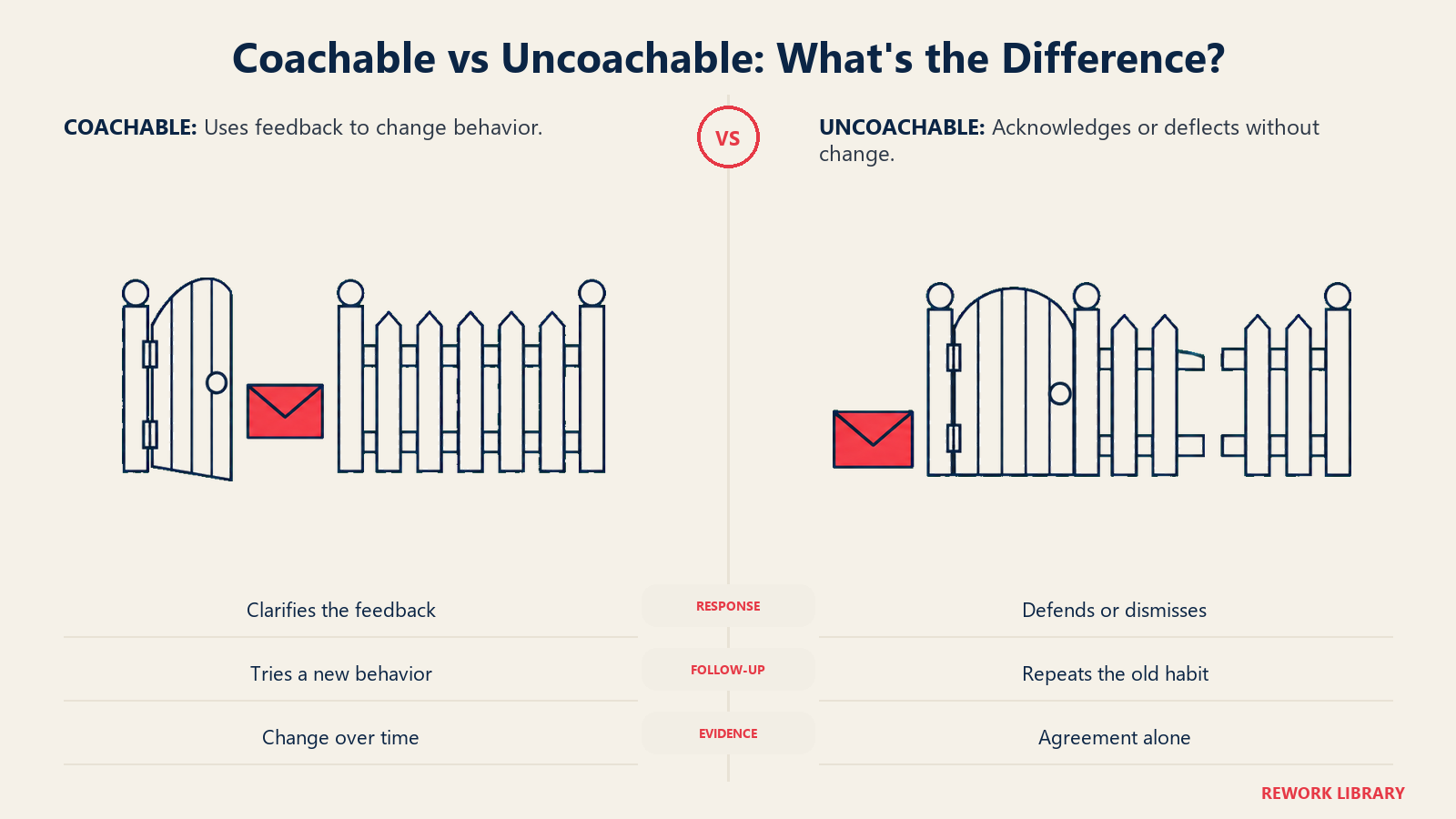
| Situation | Coachable response | Uncoachable response |
|---|---|---|
| A manager flags a mistake in front of the team | Owns it, asks what to do differently next time | Explains why it wasn't really a mistake |
| A peer gives unsolicited feedback | Says thanks, follows up with a question later | Gets quiet, avoids that peer afterward |
| A performance review includes a growth area | Writes it down, brings it up again in 30 days | Argues the rating, drops the topic once the meeting ends |
| The same feedback comes up twice | Treats the repeat as a signal something needs to change | Treats the repeat as the other person being unfair or picky |
| A project doesn't go well | Asks what they could have done differently | Points to factors outside their control first |
None of these responses are about talent. They're about what someone does with information that's uncomfortable to hear. Emotional intelligence is what keeps the sting of critical feedback from triggering a defensive reaction before the message even lands.
One pattern worth naming: uncoachable people aren't always hostile about it. The most common uncoachable response is quiet agreement in the room and zero behavior change afterward. That's harder to catch than an argument, and it's why "did they say the right thing" is a weaker signal than "did their behavior actually change three weeks later."
How to develop coachability in 7 ways
Coachability is trainable. Zenger Folkman's coachability research found something encouraging here: coachability tends to decline with seniority and age (the more experience someone has, the more defensive they can get about feedback), but that decline isn't fixed. People who deliberately practice the behaviors below reverse it.
1. Ask for feedback before you need it. Don't wait for a review cycle. Ask a specific question after a meeting, a pitch, or a rough week: "What's one thing I could have done differently there?" A specific question gets a specific, usable answer. A vague "any feedback?" gets a vague, useless one.
2. Build a five-second delay before you respond. The instinct to explain, justify, or defend fires fast. Counting to five before responding to critical feedback is often enough to swap a defensive reply for a curious one. This small habit has outsized returns, because the first ten seconds of a feedback conversation usually determine whether it goes anywhere.
3. Separate the feedback from the feeling. Feedback about your work can feel like feedback about your worth. It usually isn't. Practice writing feedback down in neutral language before deciding whether to act on it: "The report was hard to follow" instead of "I'm bad at reports."
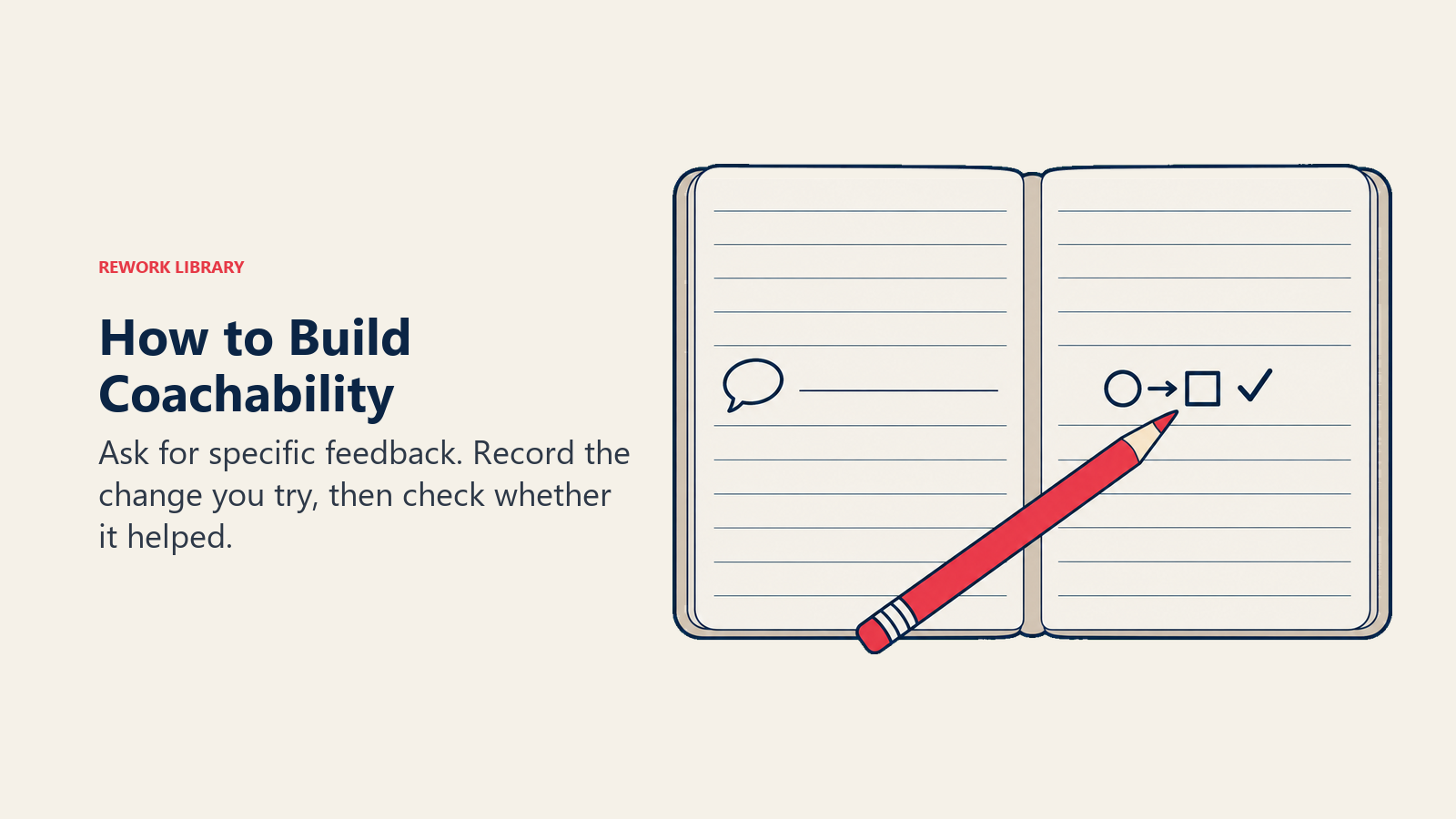
4. Track what you actually change, not what you agree with. Nodding along in the meeting is cheap. Keep a running list of feedback you've received and check it monthly: did the behavior actually change? Accountability is what turns a good feedback conversation into a real improvement instead of a nice chat that changes nothing.
5. Get feedback from more than one source. A single data point is easy to dismiss as one person's opinion. The same observation from three different people in three different contexts is a pattern. Active listening during those conversations, rather than mentally drafting your rebuttal, is what lets the pattern actually register.
6. Stay curious about your blind spots on purpose. People who treat "what am I missing?" as a genuine, recurring question catch gaps earlier than people who only think about it after something goes wrong. Curiosity at work about your own performance, not just about the work itself, is a big part of what separates people who keep growing from people who plateau at the level they hit three years in.
7. Expect the discomfort and act anyway. Coachability isn't the absence of a defensive reaction. It's acting on the feedback despite having one. Resilience is what carries someone through the sting of a hard review long enough to actually apply what they heard, instead of shutting down for the rest of the week.
How managers assess and build coachability in their teams
Google's Project Oxygen research, one of the most cited studies on what separates good managers from great ones, lists "is a good coach" first among the ten behaviors shared by the company's highest-rated managers. But coaching only works on people willing to be coached, which is why assessing coachability early, in hiring and in the first few months on a team, saves months of wasted coaching effort later.
Assessing coachability
You can't ask someone "are you coachable?" and get a useful answer; nobody says no. Better signals come from asking about specific past experiences:
- "Tell me about the last time someone gave you feedback you didn't want to hear. What did you do with it?"
- "What's something you used to do at work that you don't do anymore, because of feedback?"
- "Describe a time your first reaction to feedback was wrong. What changed your mind?"
Answers that include a specific behavior change are a stronger signal than answers that stay abstract ("I always try to grow from feedback"). Guidance from SHRM on hiring for coachability points to executive coach Marshall Goldsmith's three traits worth listening for in these answers: courage to try something different, humility to accept that someone else's read might be right, and the discipline to sustain the change past the first week.
Building coachability on a team
| Manager practice | What it does |
|---|---|
| Give feedback in small, frequent doses | Lowers the stakes of any single piece of feedback, so it stops feeling like a verdict |
| Model being coached yourself | Ask your own team for feedback openly, so accepting it looks normal, not risky |
| Separate the feedback conversation from the consequence conversation | Keeps people from treating every piece of feedback as a threat to their standing |
| Follow up on old feedback | Signals that feedback is expected to produce a change, not just get acknowledged |
| Reward the behavior change, not just the apology | Reinforces that acting on feedback, not agreeing with it, is what gets noticed |
There's a constraint worth naming here: managers can only coach as well as their own capacity allows, and that capacity is under real pressure. Gallup's State of the Global Workplace 2026 found manager engagement fell to 22% in 2025, down nine points from 31% in 2022. A stretched, disengaged manager has less bandwidth to give the specific, frequent feedback that builds coachability in the first place. Mentoring skills can partly fill that gap: pairing a coachable junior employee with a peer mentor spreads the coaching load beyond one overloaded manager.
Coachability by career stage
Coachability isn't fixed at hire, and it doesn't move in one direction. It typically shifts as people gain seniority, unless they actively work against the drift.
| Career stage | Typical coachability pattern | What to watch for |
|---|---|---|
| Early career | Usually high; feedback is frequent and expected as part of learning the role | Coachable but sometimes over-corrects on every piece of feedback without judgment |
| Mid-career | Starts to dip; feedback gets rarer and identity gets tied to being "good at the job" | Defensiveness creeping into how feedback conversations get received |
| Senior / leadership | Often lowest without deliberate effort; fewer people feel safe giving honest feedback upward | Silence mistaken for agreement; nobody is telling the leader what they need to hear |
The pattern isn't destiny. Growth mindset, the belief that ability keeps developing with effort, is what makes it possible to stay coachable past the point where most people's guard goes up. Leaders who explicitly ask for upward feedback, and visibly act on it, are the exception to the pattern above, not a contradiction of it.
How to show coachability in interviews and reviews
Coachability is easy to claim and hard to prove, so specifics matter more than the word itself.
Resume and review examples:
- Took feedback on a stalled proposal, rewrote the approach within a week, and closed a deal that had been stuck for a quarter
- Asked for a mid-project check-in after a manager flagged early concerns, adjusted scope, and delivered on the revised timeline
- Requested feedback outside the standard review cycle and changed two specific meeting habits as a result
- Incorporated customer feedback into a redesigned onboarding flow within two release cycles instead of waiting for the next roadmap
- Asked a skip-level manager for a blind-spot check, then changed a delegation habit that had been slowing the team down
Interview and review Q&As:
- "Tell me about feedback you initially disagreed with." Walk through the disagreement honestly, then explain what changed your mind and what you did differently afterward. The value is in showing you didn't just come around eventually; you can name the specific thing that shifted your view.
- "How do you ask for feedback?" Vague answers ("I'm always open to feedback") are a weaker signal than a specific habit, like asking a direct question after every major deliverable or requesting input once a quarter outside the formal review.
- "Describe a time you had to unlearn something." This question tests whether you can let go of an approach that used to work. Naming the old habit and the new one, specifically, is what makes the answer credible.
Coachability doesn't show up on a resume as a line item, but it's the trait that decides whether everything else on that resume keeps getting better. The people who compound their skills fastest aren't the ones who never get hard feedback. They're the ones who ask for it, sit with the discomfort of it, and change something because of it. Build that habit early, and it pays out for the rest of a career.

Senior Customer Retention Strategist
On this page
- Key Facts
- What is coachability?
- The coachability loop
- Why coachability matters, for your career and your team
- What coachable vs uncoachable behavior actually looks like
- How to develop coachability in 7 ways
- How managers assess and build coachability in their teams
- Assessing coachability
- Building coachability on a team
- Coachability by career stage
- How to show coachability in interviews and reviews