Problem-Solving Skills: Definition and How to Improve
Turn this article into takeaways for your work.


Each assistant summarizes the article only for you and suggests best practices for your work.
Problem-solving skills are the competencies that let professionals move from a broken state to a working one, without spinning for weeks or escalating every obstacle. Organizations that build these skills into teams consistently outperform those that rely on individual heroics.
What are problem-solving skills?
Problem-solving skills are the ability to identify a problem, analyze its root causes, evaluate options, and implement a solution that sticks. They sit at the intersection of analytical thinking (breaking a situation into its parts), creative thinking (generating options beyond the obvious), and decision-making (choosing the right path given constraints).
They differ from raw intelligence. A high-IQ employee who freezes under ambiguity, or jumps straight to the first fix that comes to mind, scores low on this competency. Someone who may be slower analytically but works through uncertainty methodically will consistently deliver better outcomes.
Key Facts
WEF Future of Jobs Report 2025: Analytical thinking tops the list of core skills employers plan to prioritize, ahead of AI literacy and creative thinking.
LinkedIn 2024 Most In-Demand Skills: Problem solving ranks in the global top 10 across all roles and seniority levels, the only non-technical skill to hold that position since 2022.
McKinsey Global Institute 2024: 87% of executives report skill gaps in critical thinking and problem solving as a primary barrier to organizational growth.
The 4 components of problem-solving skills
Analytical thinking
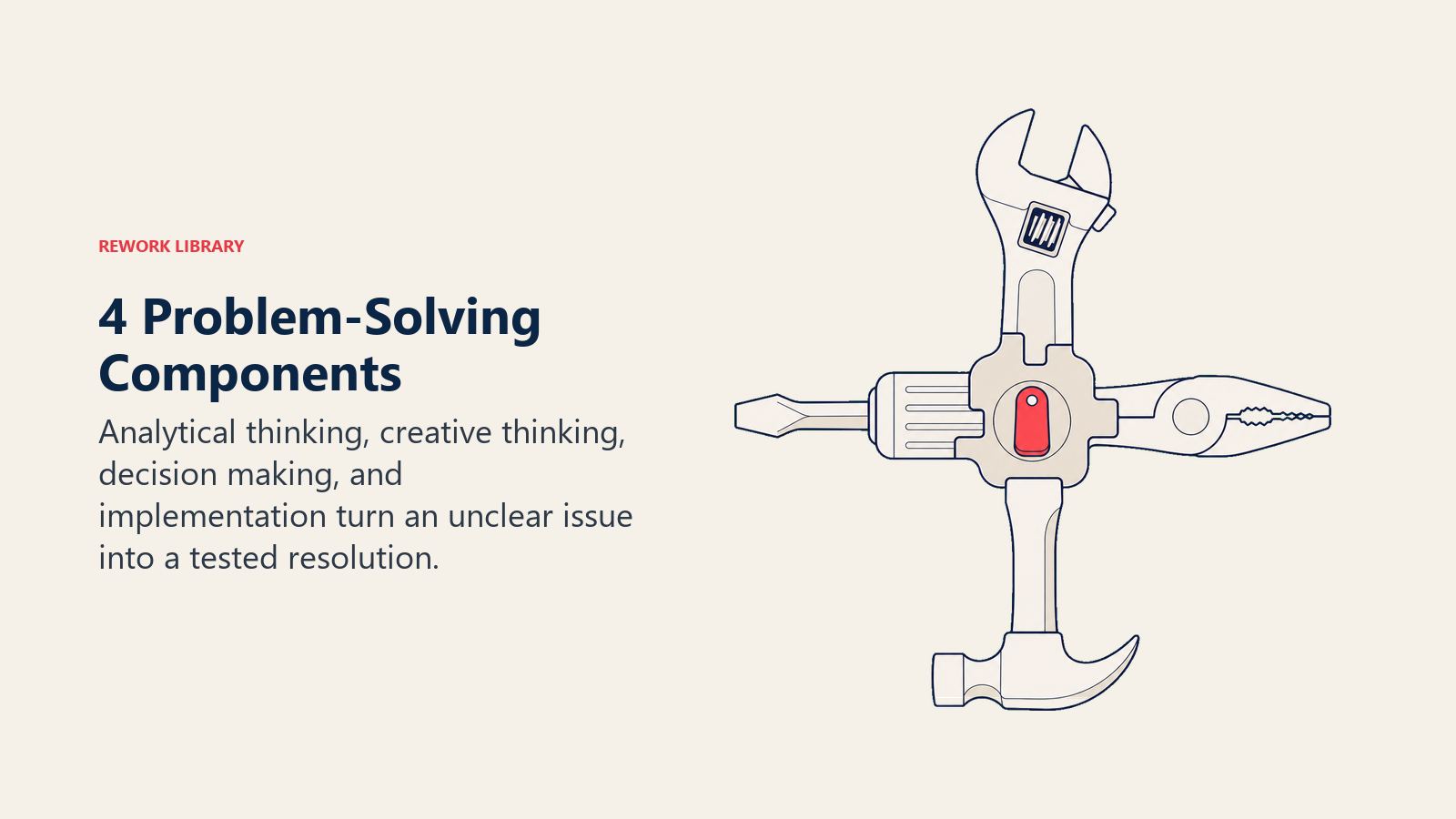
Analytical thinking is the ability to break a problem into smaller pieces, examine each piece, and find patterns across them. A supply chain manager who looks at a delivery delay and traces it through carrier data, warehouse scan logs, and order volume spikes rather than calling the carrier to complain is exercising analytical thinking.
Creative thinking
Creative thinking generates options that weren't obvious from the data alone. When a product team's A/B test produces no winner, the analytical thinker digs into the data. The creative thinker asks whether the test is even measuring the right thing, and proposes an entirely different experiment. Both types of thinking belong in the same person.
Decision-making
Good decision making under uncertainty is a skill in itself. It requires weighing evidence, accepting that perfect information rarely exists, and committing to a course of action before confidence is 100%. Teams that wait for certainty before deciding are trading speed for comfort, and often make the same decision later with less time to execute.
Implementation
Knowing what to do and doing it are different skills. Implementation involves breaking a chosen solution into tasks, assigning owners, setting timelines, and tracking progress until the result is confirmed. Many problem-solving frameworks collapse here because organizations invest heavily in diagnosis and neglect execution. Initiative is the character trait that closes this gap.
Problem-solving vs critical thinking vs decision-making
| Skill | What it answers | Output | Example |
|---|---|---|---|
| Problem-solving | "What's wrong and how do I fix it?" | A resolved issue | Reducing customer churn from 9% to 6% in one quarter |
| Critical thinking | "Is this claim or assumption true?" | A verified position | Confirming that churn is driven by onboarding, not pricing |
| Decision making | "Which option should I choose?" | A committed course of action | Choosing to rebuild onboarding rather than add a discount tier |
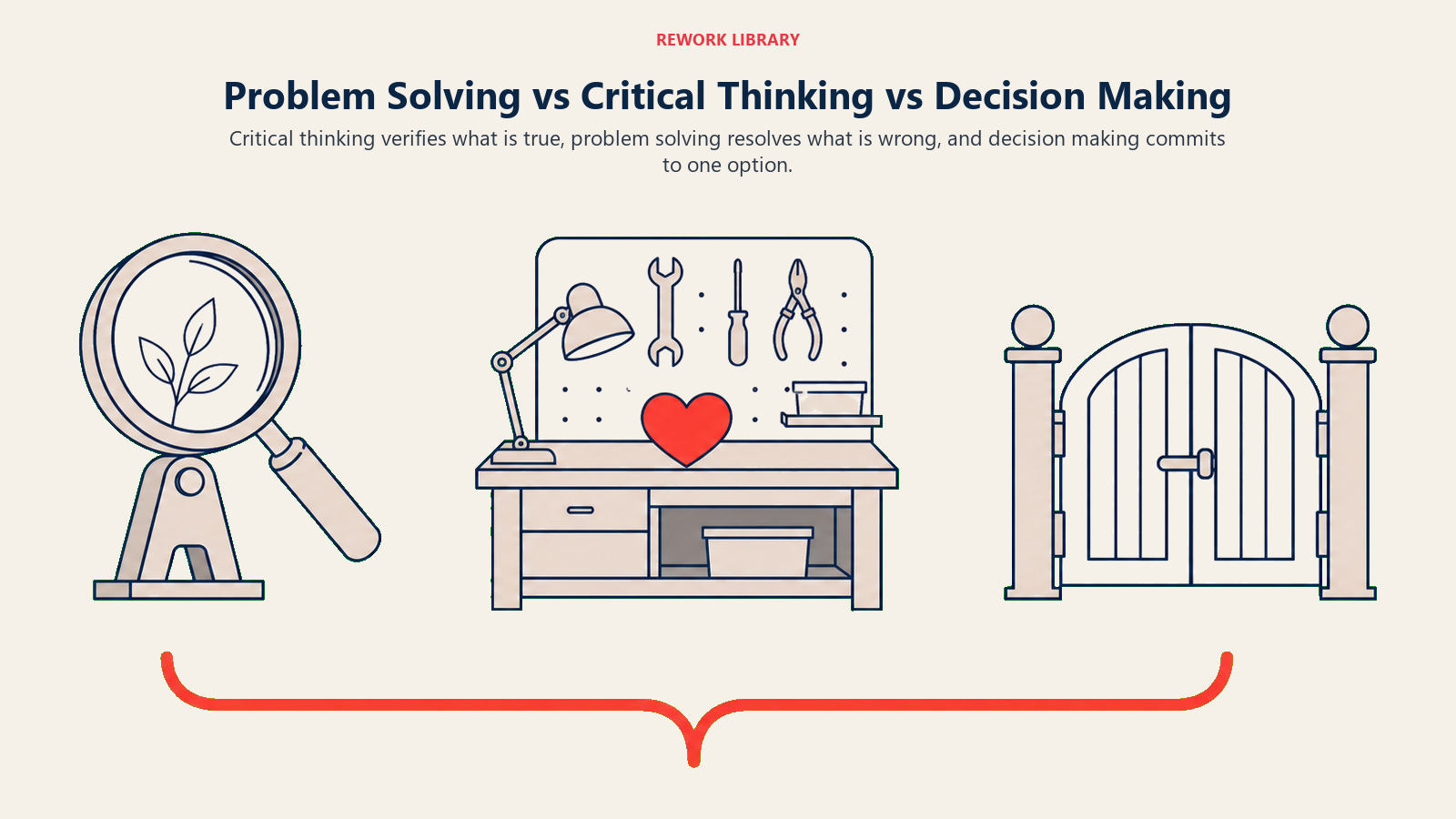
These three overlap constantly. Critical thinking feeds problem-solving by separating real root causes from assumed ones. Decision-making is a required step inside most problem-solving frameworks. Treat them as related muscles, not competing ones.
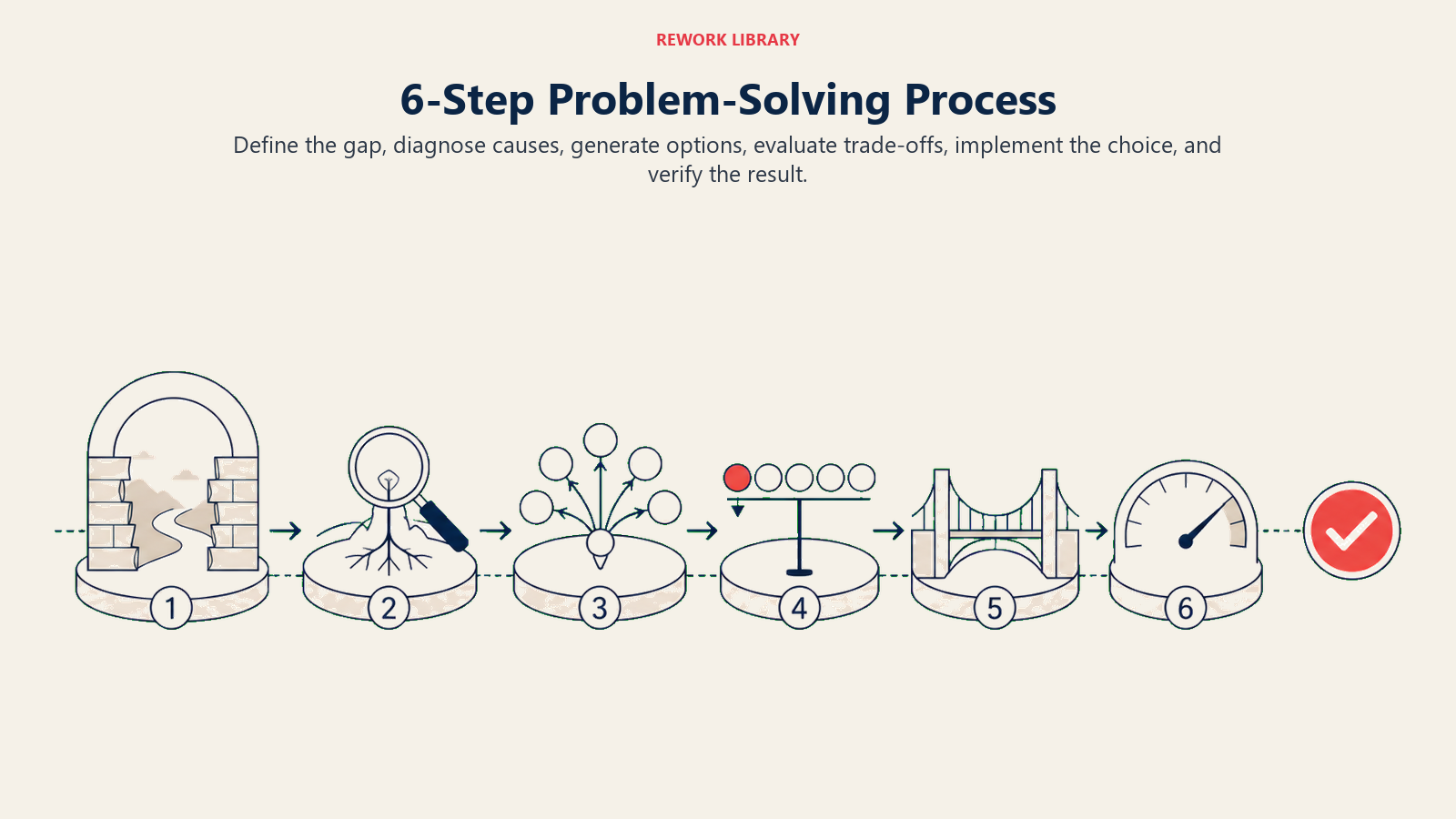
The 6-step problem-solving process
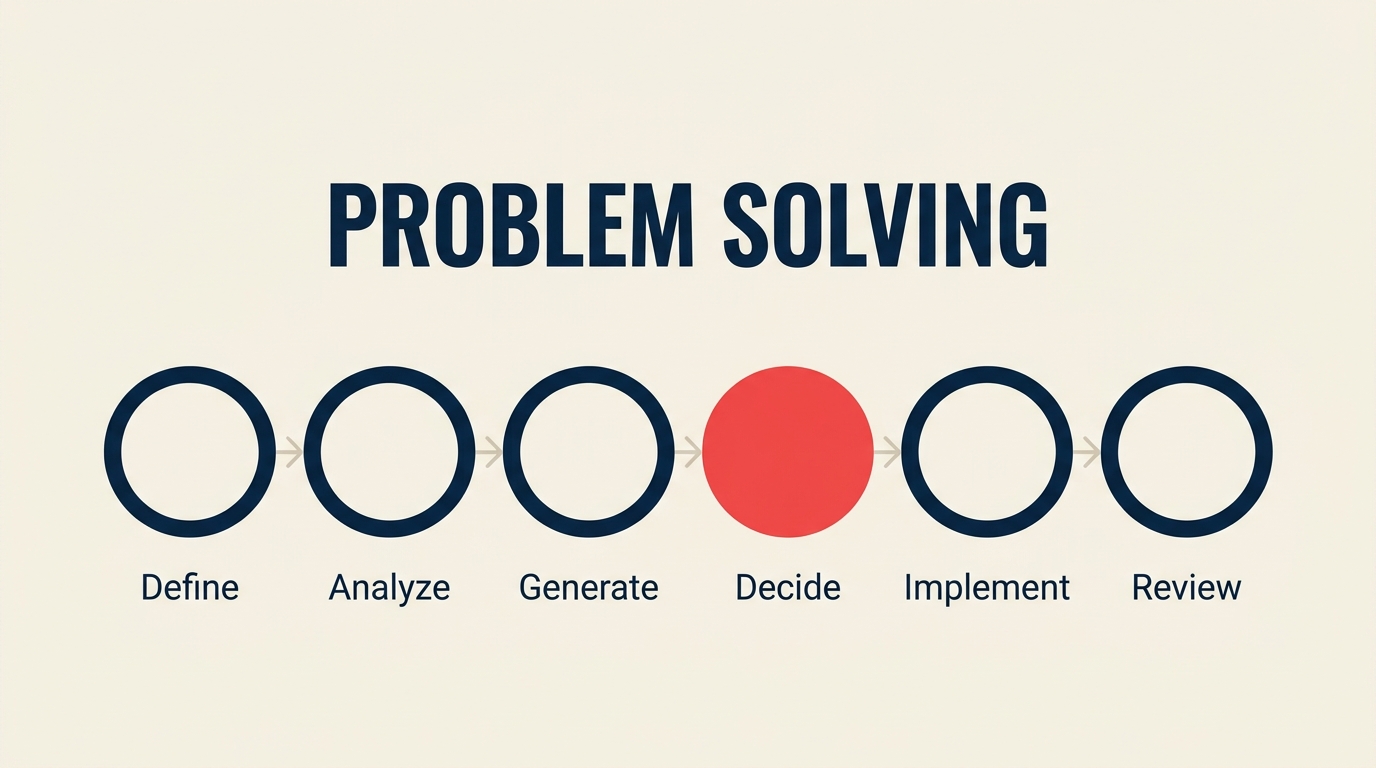
Step 1: Define the problem
A vague problem produces a vague solution. Start by writing the problem in one sentence that includes who is affected, what the gap is, and why it matters.
- State the problem as a gap: "X is happening; we need Y."
- Quantify the impact where possible (cost, time, revenue, customer count).
- Confirm the problem with the people closest to it before moving on.
Step 2: Analyze the root cause
Don't fix symptoms. Use structured methods (5 Whys, fishbone diagram) to find what is actually causing the problem.
- Ask "why" at least five times before accepting a cause as root.
- Involve subject matter experts who see the system from different angles.
- Document hypotheses and the evidence that confirms or eliminates each one.
Step 3: Generate options
Get three or more possible solutions before evaluating any of them. Evaluating too early kills creative options.
- Set a time box (15-20 minutes) and generate freely without judging.
- Include low-effort quick fixes alongside structural changes.
- Ask "what would someone from a different department suggest?"
Step 4: Evaluate and choose
Compare your options against consistent criteria: cost, time to implement, risk, reversibility, and alignment with strategic thinking priorities.
- Use a decision matrix to score options objectively.
- Consider what happens if the chosen option fails (can you reverse it?).
- Document the rationale, not just the decision itself.
Step 5: Implement the solution
Turn the decision into an action plan with clear owners and deadlines.
- Break the solution into tasks small enough to track weekly.
- Assign a single owner per task, not a team.
- Set a mid-point check-in to catch implementation drift early.
Step 6: Review and learn
The loop closes only when you verify that the solution worked and capture what you learned.
- Measure against the gap you defined in Step 1.
- Run a short retrospective: what worked, what didn't, what changes the next time.
- Update playbooks, templates, or training materials with new findings.
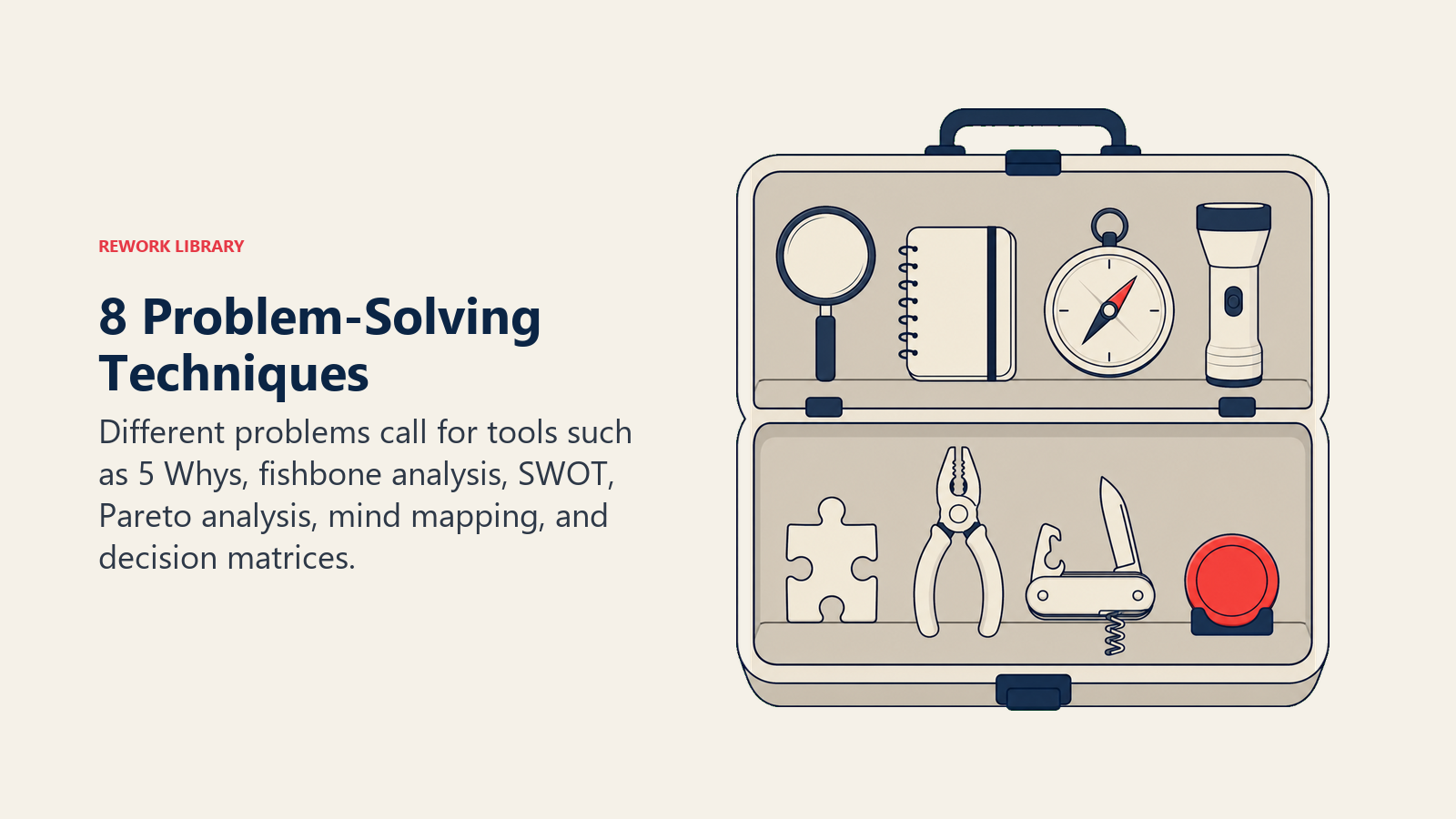
8 problem-solving techniques every professional should know
5 Whys
Ask "why" five times in sequence, with each answer becoming the next question. Use it when you have a clear symptom but an unknown root cause. A customer success team member who gets "client churned" can use 5 Whys to reach "onboarding skipped the admin setup step" inside ten minutes.
Fishbone (Ishikawa) diagram
Map causes visually by branching categories (people, process, technology, environment) from a central problem spine. Best for complex problems with multiple possible causes, especially in manufacturing, operations, or engineering incident reviews.
SWOT analysis
Assess Strengths, Weaknesses, Opportunities, and Threats relative to a problem or decision. Works well in strategic contexts where the right path depends on internal capability as much as external factors. Pair it with the innovation mindset framework to push beyond the obvious options.
Decision matrix
List options as rows, evaluation criteria as columns, and score each cell. Weight criteria by importance and compare totals. Removes emotion from decisions where multiple options look equally good on the surface.
Pareto (80/20) rule
80% of problems usually come from 20% of causes. Prioritize by identifying which small set of root causes, customers, or process steps generates most of the pain. A support team that handles 200 ticket types can often eliminate 60% of volume by fixing the top 10.
SCAMPER
A creative prompt checklist: Substitute, Combine, Adapt, Modify/Magnify, Put to other uses, Eliminate, Reverse. Run a team through it when the problem is "we need a better version of what we already have" rather than something broken.
Mind mapping
Start with the problem in the center and branch out freely to related causes, constraints, and ideas. Better than a linear list for early-stage problems where the shape of the issue is still unclear. Many teams use this in a whiteboard session before switching to more structured tools.
A/B testing
When the problem is "we don't know which approach works better," test both in parallel on a real but controlled audience. Standard in product and marketing but underused in operations and customer success, where small workflow changes are rarely measured.
Problem-solving examples by role
Sales: Lost deal analysis
| Problem | Approach | Tools used | Outcome |
|---|---|---|---|
| Win rate dropped 12 points in one quarter | 5 Whys + CRM data review | Fishbone, call recordings, deal stage data | Identified that demo-to-proposal gap was 3x longer than competitors; shortened it with a new proposal template |
Customer success: Escalation triage
| Problem | Approach | Tools used | Outcome |
|---|---|---|---|
| Executive escalations consuming 40% of CS team time | Pareto analysis on escalation drivers | Ticket tags, CSAT data, account health scores | Found 3 implementation gaps causing 70% of escalations; fixed in onboarding playbook |
Engineering: Incident post-mortem
| Problem | Approach | Tools used | Outcome |
|---|---|---|---|
| Production outage affecting 8,000 users for 3 hours | PDCA cycle + 5 Whys | Incident log, dependency map, alert history | Traced to a missing circuit breaker in one microservice; added automated failover and updated runbooks |
The Kaizen approach applies across all three: treat every problem not just as something to fix, but as a signal that a process needs a permanent improvement.
How to improve your problem-solving skills
Practice structured diagnosis. When something goes wrong, resist the urge to fix it immediately. Spend five minutes writing down the gap, who it affects, and three possible causes before acting. This habit alone separates reactive from proactive professionals.
Work through case studies from other industries. Supply chain decisions, emergency room triage systems, and aviation safety protocols all contain transferable frameworks. Reading them broadens your option set when your own domain runs out of answers.
Build a personal toolkit. Pick two or three techniques from the list above and use them consistently until they're automatic. A decision matrix takes 20 minutes the first time and 5 minutes after you've run ten of them.
Run retrospectives on your own decisions. After a project closes, spend 30 minutes comparing what you predicted would happen to what did. The gaps reveal your blind spots and sharpen pattern recognition for the next problem.
Seek out cross-functional problems. The hardest problems involve people who disagree on the root cause because they see different parts of the system. Volunteering for cross-functional working groups builds both analytical and interpersonal problem-solving skills at the same time.
Read adversarial perspectives. If you think the problem is X, actively look for evidence that it's not X. Confirmation bias is the most common reason smart people solve the wrong problem with perfect execution.
Common problem-solving traps to avoid
Jumping to solutions. The first solution that comes to mind is usually the most familiar one, not the best one. Invest time in diagnosis before generating options.
Anchoring. The first number, date, or frame that enters a conversation tends to anchor all subsequent thinking. Watch for anchors in meeting openers and push back by naming them explicitly.
Sunk cost fallacy. Past investment in a path is not a reason to continue it. If the evidence says a solution isn't working, the cost of the wrong fix compounds faster than the cost of changing course.
Confirmation bias. Teams tend to seek information that confirms the diagnosis they already have. Assign someone explicitly to argue for an alternative root cause in every analysis session.
Analysis paralysis. More data reduces uncertainty but never eliminates it. Set a decision deadline before starting analysis so the team knows when "good enough to decide" arrives.
How to show problem-solving skills on a resume and in interviews
Resume bullets using STAR format:
- Diagnosed a 23% drop in lead conversion using a 5 Whys analysis; identified a broken CRM routing rule and fixed it within 48 hours, restoring pipeline to target within two weeks.
- Led a cross-functional root cause session for a missed product launch; restructured the QA sign-off process and cut launch delays by 40% over the next three cycles.
- Reduced customer escalations by 35% in one quarter by building a Pareto model that surfaced three onboarding gaps and redesigning the affected workflows.
- Applied a decision matrix to evaluate four vendor options for a $1.2M infrastructure upgrade; the chosen vendor came in 18% under budget and met all SLA targets.
- Identified a recurring billing error affecting 4% of accounts through anomaly detection in the monthly reconciliation data; created a validation script that prevented 87 future errors.
Interview questions with sample answers:
"Tell me about a time you solved a problem with limited information." "Our NPS score dropped 8 points in one month, and we had no direct survey data on why. I pulled CSAT ticket tags and support call transcripts, found a spike in complaints about one specific feature, and built a hypothesis. I ran a targeted 5-question survey to 200 affected users, confirmed the cause within four days, and escalated to product with a clear fix request. The feature patch shipped three weeks later and NPS recovered the following month."
"How do you handle a problem where team members disagree on the root cause?" "I map each person's hypothesis to the evidence they're using to support it. Usually the disagreement comes from people seeing different parts of the system. I then look for data that would exist if one hypothesis were true and not the other, and we go find it together. It reframes a debate about opinions into a shared search for facts."
"What's your process when you're given a problem you've never seen before?" "I start with the 5 Whys to get a working hypothesis, then I look for analogous problems in other domains. Most problems have been solved somewhere else in a different form. I pull together three or four people with adjacent expertise, map the problem on a whiteboard, and generate options before committing to any direction. The first hour of structured diagnosis usually saves two weeks of rework."
Frequently Asked Questions about Problem-Solving Skills
Are problem-solving skills the same as critical thinking?
They overlap but aren't the same. Critical thinking is the discipline of evaluating claims, assumptions, and evidence. Problem-solving uses critical thinking as a tool inside a broader process that also includes generating options, deciding, and implementing. You need critical thinking to solve problems well, but critical thinking alone won't close the loop.
Can problem-solving skills be learned?
Yes. Problem-solving is a set of habits and techniques, not a fixed trait. Deliberate practice with frameworks like 5 Whys, fishbone diagrams, and decision matrices builds speed and accuracy over time, just as practicing any structured skill does. Most professionals who describe themselves as "natural problem solvers" have simply run enough repetitions to make the process feel automatic.
What problem-solving techniques work best in a team setting?
Fishbone diagrams and mind maps work well for early-stage diagnosis because they surface different perspectives at once. Decision matrices work well when the team needs to agree on a choice without the loudest voice winning. For retrospectives, the 5 Whys structured as a shared writing exercise (rather than a verbal discussion) reduces HiPPO effect and produces more honest root cause analysis.
How do I demonstrate problem-solving in a job interview?
Use specific examples with numbers. State the problem, the method you used, the decision you made, and the outcome with a measurable result. Interviewers aren't looking for perfect outcomes. They're assessing whether you used a disciplined process and whether you learned from what happened.
What jobs need the strongest problem-solving skills?
Product management, consulting, engineering, operations, and customer success all rank these skills at the top of their hiring criteria. But the truth is that any role above entry level requires problem-solving. The difference is the type: operations roles lean on analytical and process-based techniques, while product and strategy roles lean on creative and systems-thinking approaches. Strong problem-solving skills compound over time. Every problem you work through using a structured process builds a pattern library that makes the next problem faster to diagnose and cheaper to fix. Start with one technique, use it consistently, and add the next when it becomes automatic.

Senior Customer Retention Strategist
On this page
- What are problem-solving skills?
- Key Facts
- The 4 components of problem-solving skills
- Analytical thinking
- Creative thinking
- Decision-making
- Implementation
- Problem-solving vs critical thinking vs decision-making
- The 6-step problem-solving process
- Step 1: Define the problem
- Step 2: Analyze the root cause
- Step 3: Generate options
- Step 4: Evaluate and choose
- Step 5: Implement the solution
- Step 6: Review and learn
- 8 problem-solving techniques every professional should know
- 5 Whys
- Fishbone (Ishikawa) diagram
- SWOT analysis
- Decision matrix
- Pareto (80/20) rule
- SCAMPER
- Mind mapping
- A/B testing
- Problem-solving examples by role
- How to improve your problem-solving skills
- Common problem-solving traps to avoid
- How to show problem-solving skills on a resume and in interviews