Curiosity at Work: Why It Matters and How to Foster It
Turn this article into takeaways for your work.


Each assistant summarizes the article only for you and suggests best practices for your work.
Curiosity at work is the drive to ask one more question before you act on the first answer. It sounds small. It isn't. Teams that ask more questions catch mistakes before they ship, spot opportunities before a competitor does, and build institutional knowledge that survives a reorg.
Most organizations say they want curious employees. Few actually reward the behavior. Research by Harvard Business School professor Francesca Gino, surveying more than 3,000 employees, found that only 24% said they regularly feel curious in their job, and almost 70% said they face barriers to asking more questions at work. That gap between stated value and lived experience is the problem this article solves, at both the individual and team level.
Key Facts
Key Facts: Curiosity at Work
- Only 24% of employees report feeling curious in their job on a regular basis, and nearly 70% said they face barriers to asking more questions at work, per Francesca Gino's survey of more than 3,000 employees for Harvard Business Review (Harvard Business Review).
- 60% of U.S. workers identify as strongly curious, but only 30% say their workplace strongly rewards curiosity, a 30-point gap between trait and culture (SurveyMonkey, State of Curiosity 2026).
- 50% of workers say they have redone work because a question went unasked at the start of a project (SurveyMonkey, State of Curiosity 2026).
- The World Economic Forum's Future of Jobs Report 2025 ranks curiosity and lifelong learning among the top 10 core skills employers expect to grow in importance through 2030 (World Economic Forum).
- A brief experience of curiosity boosts mental and physical energy by 20% more than recalling a moment of profound happiness (Harvard Business Review, "The Five Dimensions of Curiosity").
What is curiosity at work, and what it is not
Curiosity at work is the willingness to notice a gap in your understanding and act on it: asking a question, testing an assumption, or looking one layer deeper before you commit to a plan. It's a behavior you can observe, not a personality label you either have or don't. A curious employee asks "what would have to be true for this to fail?" before a launch. An incurious one nods along and finds out at the postmortem.
It gets confused with three neighboring traits, and the mix-up causes real damage in how people get hired, coached, and reviewed:
- Curiosity is not creativity. Creativity generates new ideas. Curiosity is what feeds it: the raw questions and gap-noticing that give creativity something to work with. You can be curious without producing an original idea, and churn out ideas without asking a real question first.
- Curiosity is not critical thinking. Critical thinking evaluates claims that already exist. Curiosity generates the claims worth evaluating in the first place, by surfacing the questions nobody thought to ask.
- Curiosity is not busyness. Someone who reads ten articles a day but never changes a decision based on what they learned is consuming information, not practicing curiosity. Curiosity closes a loop: notice a gap, investigate, update your thinking or your plan.
| Trait | What it does | The question it asks |
|---|---|---|
| Curiosity | Surfaces gaps and generates questions | What don't I know here? |
| Creativity | Generates new ideas from raw material | What could we try? |
| Critical thinking | Tests claims and filters options | Is this actually true? |
| Adaptability | Adjusts behavior once new information arrives | What do I do differently now? |
Curiosity is the entry point. It's the competency that decides whether the other three ever get triggered, because none of them fire without a question first.
Why curiosity matters commercially, not just personally
Leaders tend to file curiosity under "nice culture trait" rather than "business risk control." That's a mistake, and the cost shows up in specific, countable ways.
Fewer errors reach production. A curious engineer who asks "what happens if this input is empty?" catches the bug in code review instead of in an outage. A curious account manager who asks "why did this renewal stall?" instead of assuming price sensitivity finds the real objection before the deal is dead. Curiosity is a cheap, distributed error-correction system that works before a mistake compounds, not after.
Groupthink loses its grip. Teams that reward the first plausible answer converge fast and wrong. Teams that reward one more question surface the objection someone was afraid to raise. SurveyMonkey's 2026 data is blunt: only 38% of workers describe most of their meetings as open discussion rather than status reporting, and that number drops to 15% in what the report calls low-capacity cultures.
Opportunities get noticed earlier. Curiosity is what makes someone dig into a support ticket pattern before it becomes a churn wave, or ask a customer an open-ended question that surfaces a use case the roadmap never planned for. Research skills turn that noticing into something usable, but curiosity is what triggers the digging in the first place.
Talent stays engaged longer. People who feel free to ask questions report higher job satisfaction and are more likely to stay through a hard stretch, because they feel ownership over the "why," not just the "what." A workplace that punishes questions quietly trains its best people to stop asking, often the first sign of disengagement before someone resigns.
| Function | What curiosity catches | What its absence costs |
|---|---|---|
| Engineering | Edge cases, brittle assumptions, silent failure modes | Production incidents, technical debt nobody flagged |
| Sales | The real objection behind a stalled deal | Lost renewals attributed to the wrong cause |
| Support | Patterns across tickets that signal a bigger issue | A churn wave that looked like isolated complaints |
| Product | Use cases the roadmap never anticipated | Features that ship and go unused |
| Finance | Cost structures nobody questioned in years | Budget waste hiding in "how we've always done it" |
| People ops | Why an exit interview answer doesn't match the stay interview | Attrition patterns that repeat every cycle |
The types of curiosity: it is not one trait
Treating curiosity as a single dial ("some people have it, some don't") misses how differently it shows up. Two frameworks from psychology explain why a "curious" hire can still be a bad fit for a specific role.
Kashdan's five dimensions of curiosity
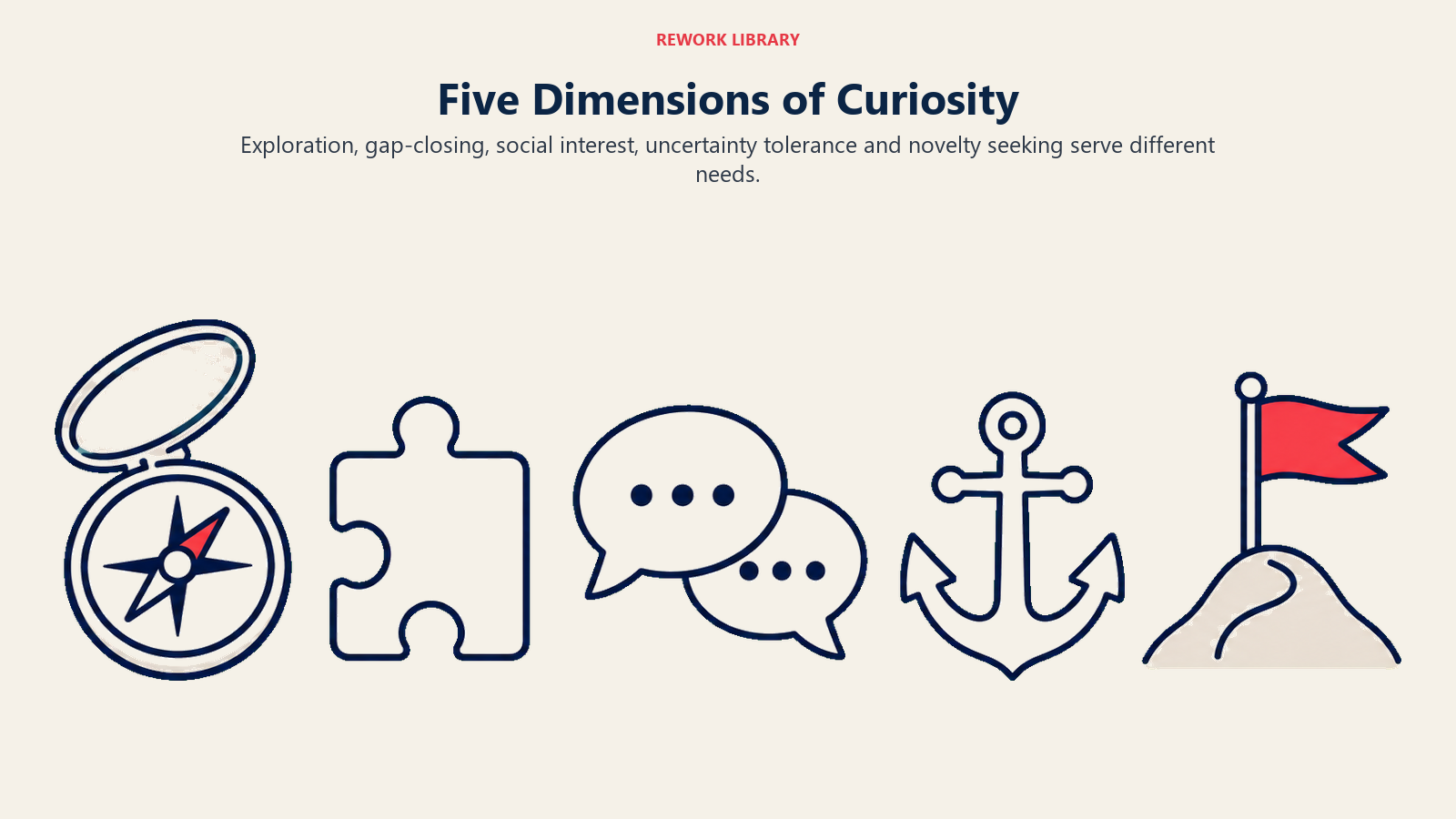
Psychologist Todd Kashdan and colleagues broke curiosity into five distinct dimensions in research published through Harvard Business Review. Knowing which dimension someone leans on tells you where they'll add value, and where they might need a nudge.
| Dimension | What it looks like | Where it helps most at work |
|---|---|---|
| Joyous exploration | Genuine delight in learning how things work | R&D, product discovery, early-stage strategy |
| Deprivation sensitivity | Discomfort with a known gap, driven to close it | Debugging, audits, root-cause investigations |
| Social curiosity | Interest in what makes other people tick | Sales discovery, management, customer research |
| Stress tolerance | Comfort sitting with the anxiety of the unknown | Crisis response, ambiguous or 0-to-1 projects |
| Thrill seeking | Drawn to novel, intense, uncertain experiences | New markets, risky bets, fast-moving pivots |
A team of five joyous explorers will generate plenty of ideas and struggle to ship any of them. Pair that dimension with someone strong in deprivation sensitivity, who needs the gap closed before they can move on, and you get both the spark and the follow-through.
Diversive vs. specific curiosity
Psychologist Daniel Berlyne's classic framework splits curiosity along a second axis: diversive curiosity is exploratory behavior that "arises from boredom and seeks novelty," the kind that shows up as boredom-driven browsing. Specific curiosity is exploration "which aims to resolve uncertainty or conflict," the kind that keeps someone at a whiteboard past the meeting's official end time.
Diversive curiosity is useful for scanning: keeping up with a market, noticing a competitor's move, staying current on a field. Specific curiosity is what actually solves the problem in front of you. A team heavy on diversive curiosity and light on specific curiosity will know about everything and finish nothing. Recognizing which mode someone (or you) is in changes what kind of task to hand them next.
What blocks curiosity in organizations
Curiosity doesn't disappear because people stop being curious. It gets trained out of them by the environment. The SurveyMonkey 2026 data maps three specific mechanisms, on top of the classic hierarchy problem Gino's research identified.
| Blocker | What it looks like | The fix |
|---|---|---|
| Fear of looking incompetent | 40% admit pretending they understood something instead of asking a clarifying question | Leaders ask the "obvious" question first, out loud, in the meeting |
| The efficiency squeeze | Back-to-back meetings leave no room for open discussion; only 38% call their meetings exploratory | Protect 10 minutes at the start of key meetings for "what are we assuming here" |
| The AI middleman | Leaders turn to AI instead of asking a teammate at nearly 3x the rate of individual contributors | Route ambiguous questions to a person first when the answer affects a decision, not just a fact |
| Premature closure | The first plausible answer ends the discussion before alternatives surface | Require one dissenting or alternative view before a decision is finalized |
| Hierarchy and status | Junior employees read "asking questions" as a signal of weakness in front of senior staff | Leaders visibly ask questions they could look up themselves, to reset the norm |
None of these are personality problems. They're environment problems, which is the useful part: environment is something a manager can change without waiting for a personality to shift.
How individuals build curiosity at work
Curiosity is trainable the same way any other competency is: through repeated, deliberate practice, not through waiting to feel inspired. It also compounds with coachability: asking the question is only half of it, and the people who grow fastest are the ones who then act on the answer instead of filing it away.
1. Ask "what am I missing?" before you finalize anything. Build this into your own checklist for decisions, emails, and plans. It's a small habit with an outsized catch rate for blind spots you'd otherwise ship.
2. Keep a running question log. When something doesn't fully make sense, write the question down instead of letting it dissolve into "I'll figure it out later." Review the log weekly: written questions get chased, half-noticed ones don't.
3. Practice the five whys on your own work, not just on incidents. Ask "why" five times on a routine decision, not just a postmortem. Most people save root-cause thinking for failures; applying it to ordinary choices surfaces assumptions before they become one.
4. Read one level outside your domain every week. Continuous learning inside your lane keeps you current. Reading outside it is what builds the cross-domain connections that make curiosity generative instead of just informational.
5. Sit with an unanswered question for a day before you Google it. Deprivation sensitivity, the discomfort of not knowing, is the engine behind real investigation. Resolving every gap instantly with a quick search trains that discomfort out of you, the same discomfort a genuinely hard problem requires.
6. Seek out the answer that would prove you wrong. Confirmation bias is curiosity's opposite: looking only for evidence that supports what you already believe. Searching deliberately for the disconfirming case is a learnable habit, not a fixed trait. Critical thinking is what you do once you find it.
7. Debrief your own misses without self-punishment. When a decision goes wrong, ask what you didn't know at the time, not just what you did wrong. The first question builds curiosity for next time. The second just builds defensiveness.
How leaders foster curiosity on a team
Individual habits only survive in a culture that rewards them. Six practices consistently show up in teams where curiosity is actually part of how work gets done, not just a value on a wall.
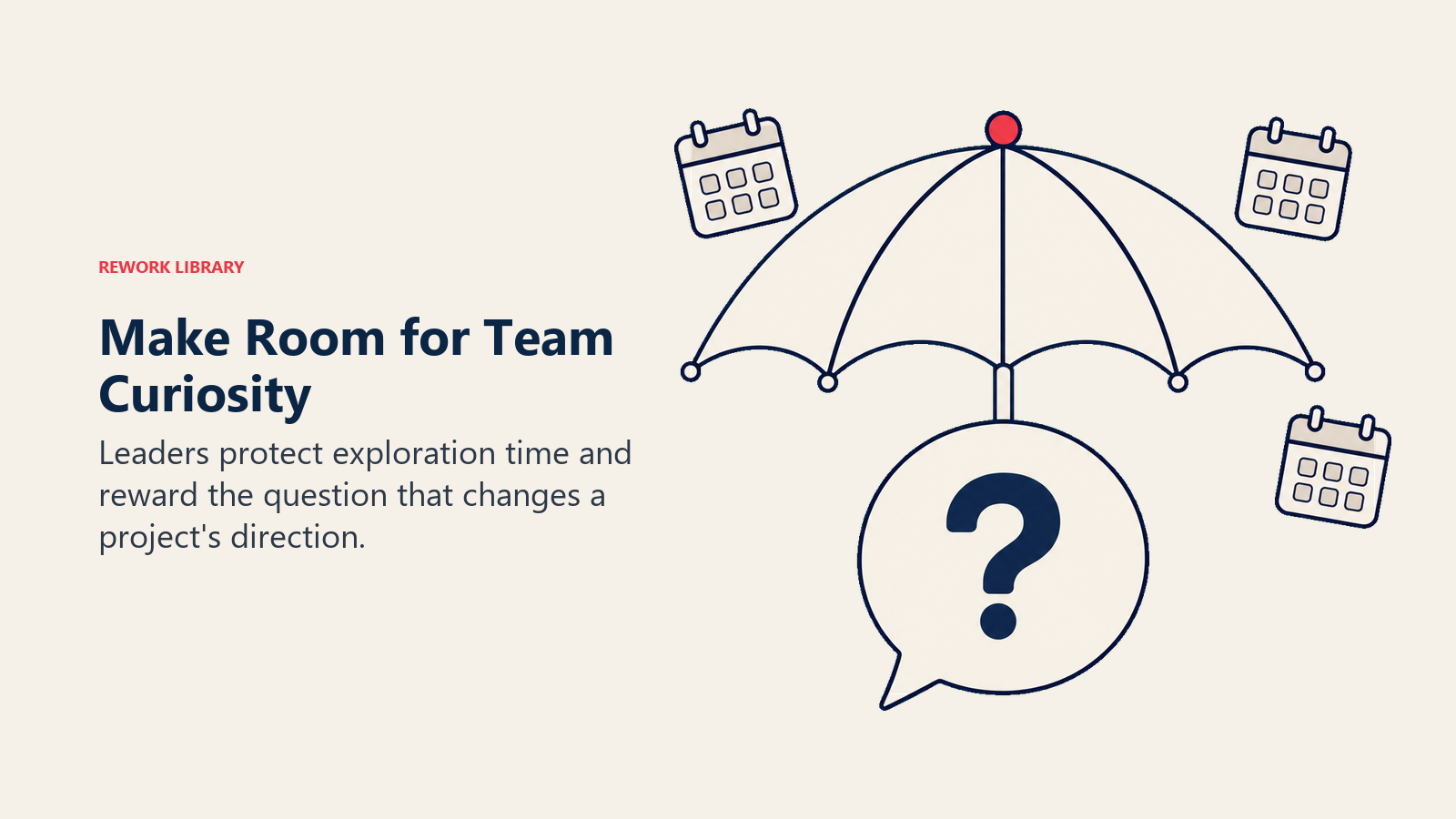
- Reward the question, not just the answer. If credit only flows to whoever solved the problem, people stop surfacing problems they can't solve alone. Publicly name whoever asked the question that changed a project's direction, not just whoever executed it.
- Model not-knowing out loud. When a leader says "I don't know, let's find out" instead of guessing to preserve authority, it gives everyone else permission to do the same. Status damage from admitting a gap is almost always imagined, not real.
- Run blameless retrospectives. If asking "why did this happen" gets treated as an accusation, people stop asking it. Separate the investigation from the performance conversation onto a different day, with a different framing.
- Protect unstructured time on the calendar. Deprivation sensitivity and deep questions don't survive a schedule packed wall to wall. Even 30 minutes of unscheduled time a week gives someone room to chase a thread they'd otherwise drop.
- Assign a "devil's advocate" role in high-stakes meetings. Rotating this role removes the personal risk of being the one who always pushes back, and normalizes the behavior for everyone else watching.
- Hire and promote people who ask good questions, not just people who have good answers. This one closes the loop, because it changes who ends up setting the tone for the next generation of hires.
A team with a strong growth mindset at the leadership level, the belief that ability expands through effort rather than being fixed at hire, is what makes all six of these sustainable instead of a one-off initiative that fades after a quarter.
How to show curiosity in hiring and performance reviews
Curiosity is easy to claim on a resume and hard to fake in an actual conversation, which makes it one of the more reliable interview signals when you know what to listen for.
| Interview prompt | What a strong answer reveals |
|---|---|
| "Tell me about a time you were wrong about something at work and found out." | Whether they seek disconfirming evidence or defend the original position |
| "What's something outside your field you've taught yourself recently?" | Diversive curiosity and whether learning happens without being assigned |
| "Describe a project where the real problem turned out to be different from the stated one." | Deprivation sensitivity: did they stop at the surface or dig for the actual cause |
| "What question do you wish more people asked in your last role?" | Awareness of where curiosity is missing on a team, not just in themselves |
| "Walk me through how you'd ramp up on a topic you know nothing about." | A repeatable process, not a vague claim of being a "fast learner" |
In performance reviews, curiosity shows up as specific, observable behavior rather than a rating on a 1-to-5 scale: the number of times someone asked a clarifying question before starting work that saved rework later, whether they proactively investigated a metric that looked off before being asked to, or whether they brought an unprompted question to a 1:1 in the last quarter. Reviewers who can only cite "is curious" without an example are grading a vibe, not a competency, and the employee will correctly read it as filler feedback.
Frequently Asked Questions about Curiosity at Work
Is curiosity at work a trainable skill or a fixed personality trait?
It's trainable. Curiosity behaves like a habit built through repeated practice, such as asking "what am I missing" before finalizing decisions or deliberately seeking disconfirming evidence, rather than a trait fixed at birth. Some people start with a stronger baseline, but the gap closes with consistent practice.
What is the difference between curiosity and creativity at work?
Curiosity notices gaps and generates questions. Creativity uses that raw material to generate new ideas. You need curiosity first: it's what surfaces the problem worth being creative about. A team can be curious without producing many original ideas, but a team rarely produces good ideas without first asking good questions.
Why do so few employees feel curious at work if most leaders say they value it?
Because stated values and daily incentives often disagree. Research from Harvard Business School found leaders frequently stifle curiosity in practice, fearing it slows decisions or invites risk, even while claiming to want inquisitive employees. The fix is structural (protected time, rewarded questions, blameless retrospectives), not a slogan on a values page.
How do I measure curiosity on my team if it is not a number on a scorecard?
Track proxies instead of trying to score the trait directly: how many clarifying questions get asked before work starts, how often someone investigates an anomaly without being told to, and whether meetings function as open discussion or one-way status reports. Consistent proxies beat a single subjective rating.
Does curiosity slow teams down by encouraging too many questions?
The opposite, in the cases that matter most. A question asked before work starts prevents the far more expensive cost of redone work: half of workers in a 2026 workplace survey reported redoing work because a question went unasked at the outset of a project. The risk isn't too many questions; it's the wrong timing for the ones that do get asked.
Curiosity at work is not a soft trait you either have or don't. It's a behavior with a measurable payoff: fewer errors, fewer blind spots, and a team that catches its own mistakes before a customer does. Organizations that treat it as infrastructure, protected time, rewarded questions, leaders who model not-knowing, build a durable advantage over the ones that only claim to value it.
Learn More
- Creativity at Work: Why It Matters and How to Build It
- What Is Critical Thinking? A Guide for the Workplace
- Continuous Learning at Work: Why It Matters and How to Build It
- Growth Mindset at Work: What It Is and How to Build It
- Adaptability at Work: Why It Matters and How to Build It
- Research Skills at Work: Why They Matter and How to Build Them
- Active Listening at Work: Why It Matters and How to Build It
- Innovation Mindset: What It Is and How to Build It
- Problem Solving at Work: Why It Matters and How to Build It

Senior Customer Retention Strategist
On this page
- Key Facts
- What is curiosity at work, and what it is not
- Why curiosity matters commercially, not just personally
- The types of curiosity: it is not one trait
- Kashdan's five dimensions of curiosity
- Diversive vs. specific curiosity
- What blocks curiosity in organizations
- How individuals build curiosity at work
- How leaders foster curiosity on a team
- How to show curiosity in hiring and performance reviews
- Learn More