Supply Chain Advantage: How Leaders Turn Operations into Strategic Leverage

Turn this article into takeaways for your work.

Each assistant summarizes the article only for you and suggests best practices for your work.
Most executives think about the supply chain defensively: minimize cost, avoid disruption, maintain service levels. This is necessary but not sufficient. The leaders who create lasting competitive advantages often do so by treating the supply chain as a strategic instrument, not just an operational overhead.
Supply chain advantage is the ability to consistently deliver what customers value, at a cost structure and reliability level that competitors struggle to match. It is built through deliberate choices about supplier relationships, inventory positioning, logistics investment, and information systems, all aligned to create a capability that is genuinely difficult to replicate.
What Makes Supply Chain a Strategic Asset
A supply chain is strategic when it enables the business to deliver something customers value that competitors cannot easily match. This can take several forms.
Speed. The ability to fulfill customer needs faster than alternatives. Speed advantage is most valuable in markets where customers pay a premium for rapid availability, where demand is unpredictable, or where being first with a new product or SKU creates a meaningful market position.
Reliability. Consistently delivering what was promised, when promised, with the expected quality. Reliability advantage is most valuable in B2B markets where supply chain failure has costly downstream consequences for customers. A customer who depends on your components for their manufacturing process values consistent delivery over price optimization.
Cost. Delivering comparable value at a lower total cost than competitors. Cost advantage in supply chain is sustainable only when it comes from structural advantages (unique supplier relationships, proprietary logistics infrastructure, scale-driven procurement leverage) rather than temporary pricing that can be matched.
Flexibility. The ability to respond to demand changes, product variations, or supply disruptions faster and at lower cost than alternatives. Flexibility advantage is most valuable in markets with high demand volatility, short product life cycles, or significant customization requirements.
Choosing which type of supply chain advantage to pursue is a strategic decision, not an operational one. The investments, organizational capabilities, and supplier relationships that build speed advantage are different from those that build reliability or flexibility advantage. And pursuing all simultaneously usually means achieving none of them well.
The Architecture of Supply Chain Strategy
A supply chain strategy has three structural elements: the supplier network, the inventory and logistics architecture, and the information and coordination systems. Decisions in each domain shape the type of advantage you can build.
Supplier Network Design
Your supplier network determines what capabilities you can access, at what cost, and with what risks.
Single-source versus multi-source decisions. Single sourcing concentrates volume with one supplier, often yielding better pricing, stronger relationship investment, and deeper collaboration. But it concentrates risk: if the supplier fails to deliver, you have no backup. Multi-sourcing maintains optionality but fragments volume and can result in weaker relationships with all suppliers.
The right choice varies by component criticality and supplier market structure. For a commodity component with multiple equivalent suppliers, multi-sourcing is usually appropriate. For a specialized component where switching costs are high and supplier capability differences are significant, single sourcing often makes more strategic sense if accompanied by robust supplier relationship management and contingency planning.
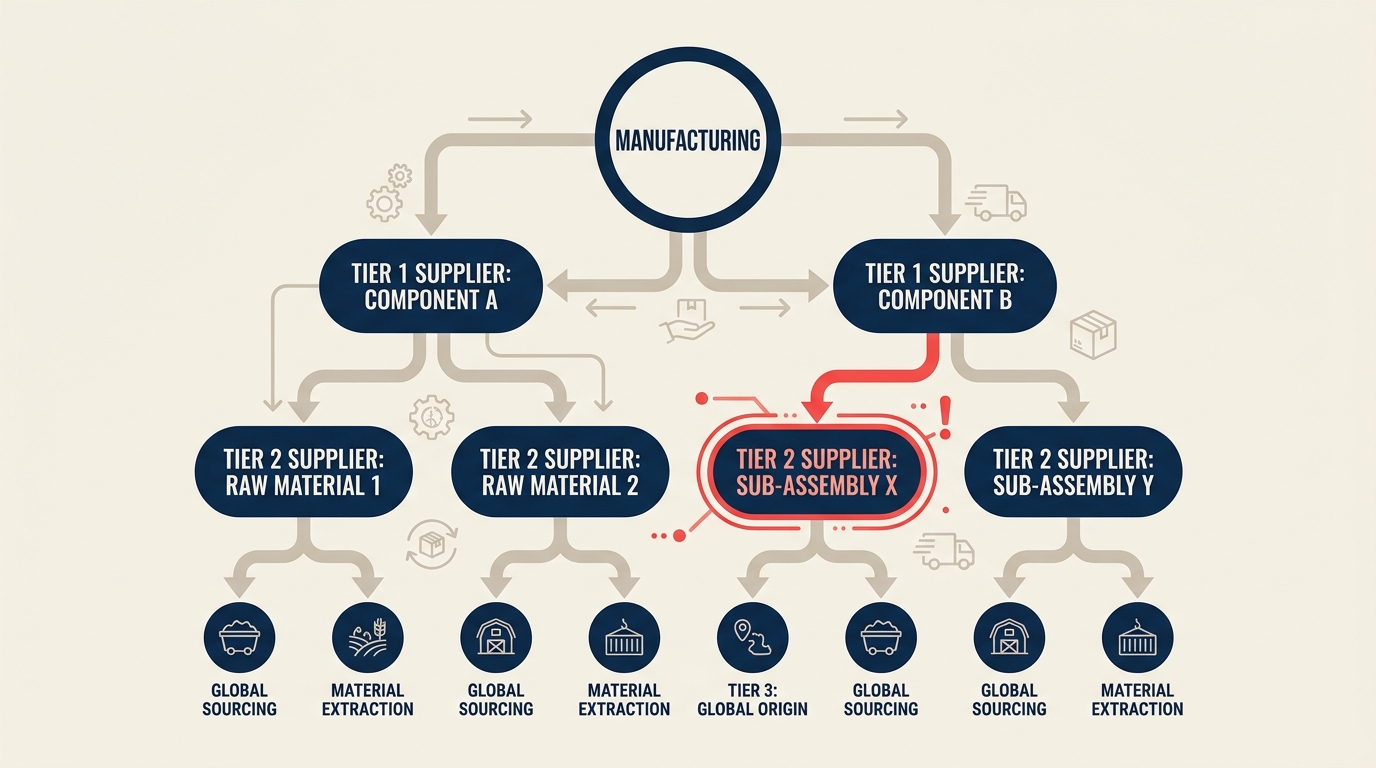
Supplier tier visibility. Many supply chain disruptions originate not with direct (Tier 1) suppliers but with their suppliers (Tier 2 and beyond). Leaders who have mapped their supply network beyond Tier 1 have earlier warning of potential disruptions and more options for responding.
This visibility is not free. It requires investment in supplier data collection, relationship management, and analytical capability. But for critical components where a disruption would be very costly, the investment typically pays off quickly.
Strategic supplier relationships. Some suppliers are more than vendors. They are partners in product development, innovation, and process improvement. Treating these relationships as strategic means investing in them differently: sharing demand forecasts, involving suppliers in new product design, committing to longer-term contracts that justify their investment, and developing governance structures that support joint problem-solving.
Strategic supplier relationships are difficult to build and easy to damage. Suppliers who have been treated as strategic partners and then subjected to unilateral price renegotiation or sudden volume changes do not quickly re-engage as partners. The trust built through consistent treatment over time is the actual asset.
Inventory and Logistics Architecture
Where inventory is held, how much, and how it moves through the network are foundational decisions that shape both cost and capability.
Centralized versus distributed inventory. Centralized distribution concentrates inventory, allowing higher fill rates from a smaller total inventory position. It is more cost-efficient when transportation costs are manageable relative to holding costs. Distributed inventory moves stock closer to end customers, enabling faster fulfillment and reducing dependence on a single facility. It is more expensive to hold but can be worth it in markets where delivery speed matters or where a centralized facility disruption would be catastrophic.
Make-to-order versus make-to-stock. Make-to-stock produces inventory in advance of demand, enabling immediate availability but carrying the risk of obsolete or excess inventory. Make-to-order produces only when a customer order exists, eliminating inventory risk but extending lead times. Hybrid approaches (producing semi-finished goods in advance, completing them to specification on order) are common in markets with product variety and unpredictable mix.
Logistics network design. The choice of transportation modes, distribution center locations, and delivery service levels has significant cost and capability implications. Logistics is often treated as a cost to be minimized, but in markets where delivery speed or reliability is a competitive differentiator, logistics investment is a source of advantage.
Information and Coordination Systems
Supply chain visibility and coordination depend on information systems that connect suppliers, internal operations, and customers.
The most important information capability is demand signal quality: how accurately and quickly do you understand what customers are buying or will buy, and how quickly does that signal reach the parts of your supply chain that need to respond?
Poor demand signal propagation is the root cause of a common supply chain pathology called the bullwhip effect: small fluctuations in end-customer demand become increasingly amplified as they travel upstream through the supply chain. Each layer in the chain adds its own safety stock in response to perceived uncertainty, causing demand variability to grow at each tier. The result is large inventory positions at upstream suppliers despite modest volatility in actual end-customer demand.
Reducing the bullwhip effect requires sharing demand information more directly with upstream suppliers rather than passing order signals that have already been distorted by intermediate safety stock decisions.
Building Supply Chain Resilience
The disruptions of the past decade have elevated supply chain resilience from an operational concern to a board-level agenda item. But resilience is often discussed without clarity about what it actually requires.
Resilience is the ability to absorb disruptions and recover to normal performance levels without catastrophic business impact. It is built through a combination of risk identification, risk mitigation investment, and response capability.
Risk identification. You cannot manage risks you do not know about. Systematic supply chain risk identification maps potential disruption sources (supplier failure, logistics disruption, geopolitical risk, natural disaster exposure, cyber risk) and assesses the probability and impact of each. The result is a prioritized view of where risk mitigation investment is most justified.
Risk mitigation investment. Common mitigation approaches include: inventory buffers for high-risk, hard-to-substitute components; alternative supplier qualification (even if the alternative is not used in normal conditions); geographic diversification of supplier networks; and contractual provisions that define supplier obligations in disruption scenarios.
The cost of resilience is real. Buffer inventory consumes working capital. Qualifying alternative suppliers takes time and resources. Geographic diversification of supply chains often increases unit costs. Leaders need to be clear-eyed about these costs and make deliberate tradeoffs rather than treating resilience as cost-free.
Response capability. When disruptions occur despite mitigation, the ability to detect them quickly, mobilize a response team, and implement contingency plans determines how quickly the business recovers. Organizations with documented contingency plans, clear escalation procedures, and practiced crisis response protocols recover faster than those that improvise. Supply chain resilience drills (analogous to fire drills) that test response protocols before a real disruption are used by operationally mature organizations.
The Technology Dimension
Supply chain technology has advanced rapidly. Capabilities that were limited to large enterprises are now accessible to mid-market companies.
Demand forecasting tools using machine learning can incorporate more variables and update more frequently than traditional statistical models, producing more accurate demand signals, particularly for products with irregular demand patterns.
Supply chain visibility platforms aggregate data from multiple suppliers and logistics providers to give a consolidated view of where inventory is, how orders are progressing, and where risks are developing.
Procurement analytics tools analyze spend patterns, benchmark prices against market rates, and identify opportunities to consolidate purchasing for volume leverage or to qualify new suppliers.
Technology is an enabler, not a substitute for strategy. The organizations that get the most from supply chain technology are those that have already defined what advantage they are trying to build and invest in technology that supports that specific capability.
Key Facts
- Supply chain advantage is most durable when it is built on relationships and organizational capabilities rather than technology. Technology can be purchased. The judgment, relationships, and organizational routines that make supply chain excellence possible take years to develop and are much harder to copy.
- The most expensive supply chain decisions are the ones made in a crisis. Premium freight, emergency supplier sourcing, and expediting fees are often multiples of the cost of the buffer inventory or supplier qualification investments that would have prevented the crisis. The economics of resilience investment usually look much better after an incident than before one.
- Inventory is a form of embedded risk. Excess inventory represents a bet that demand will materialize and that the product will not become obsolete. Leaders who understand their inventory not just as an asset but as a liability hedge have a more accurate view of their actual risk exposure.
FAQ
What is the difference between supply chain management and supply chain strategy? Supply chain management is the day-to-day operational work of running the network: purchasing, logistics, inventory management, supplier communication. Supply chain strategy is the set of decisions about how to design and position the network to deliver competitive advantage. The difference is between managing what exists and deciding what should exist.
How do mid-market companies build supply chain advantage without enterprise resources? Focus. Mid-market companies cannot build advantage across all dimensions simultaneously. Choose one dimension (reliability, speed, or flexibility) that is most valued by your target customers and invest disproportionately in it. Depth of advantage in one dimension often outperforms shallow investment across all dimensions.
What is the most underinvested area in most supply chains? Supplier relationship management. Most organizations spend significantly on procurement (reducing input costs) and logistics (efficient physical movement) but underinvest in the relationship capabilities that convert a supplier network into a strategic asset. Supplier development, information sharing, and joint problem-solving are consistently found to generate value that more than offsets their cost.
How should leaders think about the tradeoff between supply chain efficiency and resilience? As a portfolio decision rather than a binary choice. Some components are critical enough and risky enough to justify significant resilience investment even at the cost of efficiency. Others are commodity inputs with many alternatives where lean efficiency is appropriate. The mistake is applying the same philosophy to all supply chain decisions rather than matching the investment level to the risk and criticality profile of each input.
Related Reading

Co-Founder & CMO, Rework