日本語

Full Range Leadership Model Explained

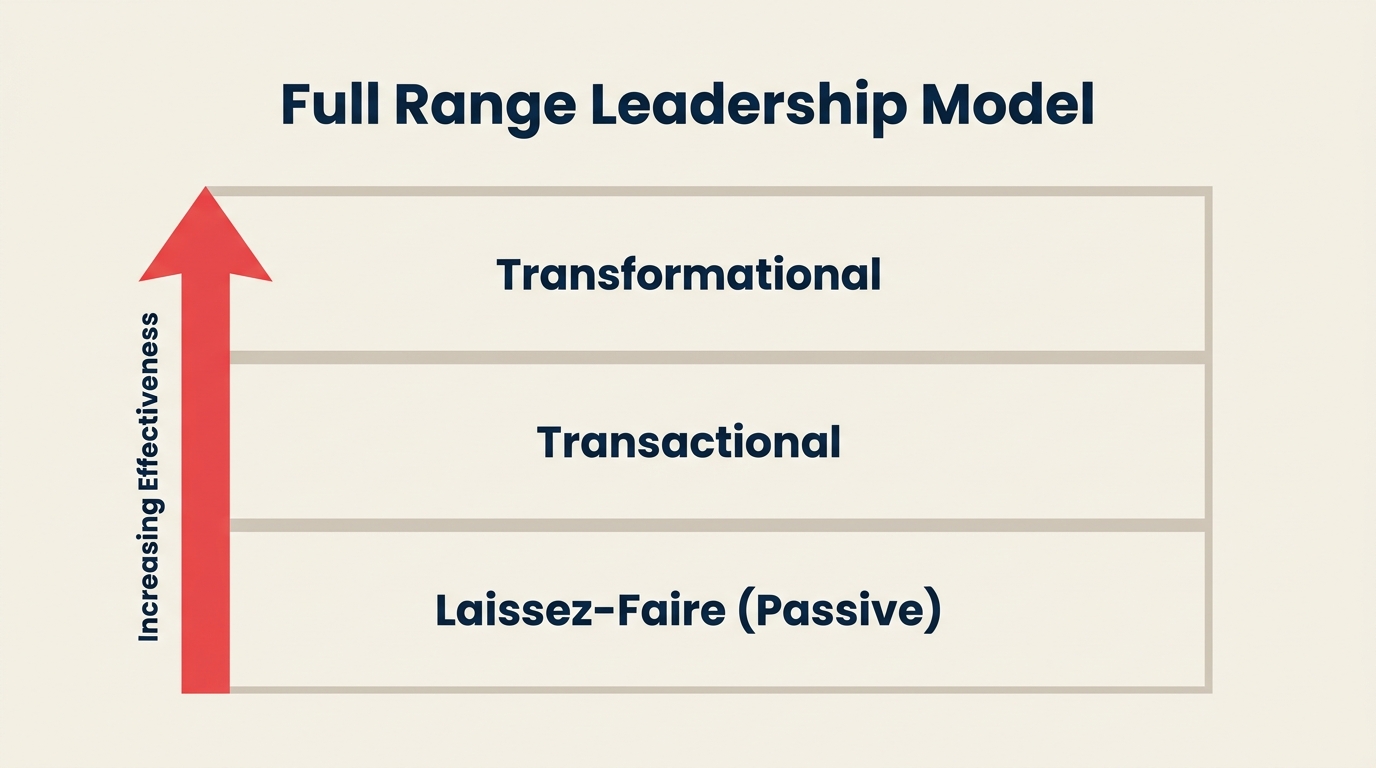
Full range leadership model diagram showing three stacked bands: laissez-faire, transactional, and transformational with an upward effectiveness arrow

The full range leadership model is one of the most comprehensive frameworks for understanding how leaders actually behave, not just how they ought to. Developed by Bernard Bass and Bruce Avolio in the early 1990s, it arranges every observable leadership behavior on a continuum that runs from complete avoidance at one end to deeply inspiring, values-driven leadership at the other. If you manage a team and want to understand why some of your habits produce results while others stall them, this model gives you a concrete map.

What makes it practical is that it doesn't describe a fixed personality type. It describes behaviors you can observe, measure, and change. And research consistently shows that leaders who shift toward the upper end of the continuum get better outcomes: higher team performance, stronger engagement, and lower turnover.

What Is the Full Range Leadership Model?

The full range leadership model is a behavioral framework developed by Bernard Bass and Bruce Avolio in the early 1990s that categorizes all leadership behaviors into three broad styles arranged on a continuum of effectiveness: laissez-faire (non-leadership), transactional leadership, and transformational leadership. The model is most commonly measured using the Multifactor Leadership Questionnaire (MLQ), a validated psychometric instrument that assesses how leaders and their followers perceive leadership behaviors in practice.

The "full range" in the name is deliberate. Bass and Avolio argued that previous leadership frameworks captured only part of the picture, focusing on either task-based management or inspirational vision, but not both. Their model places all known leadership behaviors on a single spectrum, from the leader who does nothing to the one who raises followers to their full potential.

Key Facts

  • Bass and Avolio first published the full range leadership model in their 1994 book Improving Organizational Effectiveness Through Transformational Leadership.
  • The Multifactor Leadership Questionnaire (MLQ), the primary instrument for measuring the model, has been used in thousands of studies across more than 100 countries since its development in the 1980s.
  • A meta-analysis published in The Leadership Quarterly found transformational leadership to be positively correlated with follower satisfaction, motivation, and effectiveness, while laissez-faire leadership showed consistent negative correlations with those outcomes.

The Three Leadership Styles

The model organizes behaviors into three broad styles, each containing specific sub-components. Here is how they compare:

Style Components Typical Effect on Team
Laissez-faire Non-leadership, avoidance of decisions, absence when needed Low performance, confusion, disengagement
Transactional Contingent reward, management-by-exception (active), management-by-exception (passive) Adequate performance within defined parameters, but limited growth
Transformational Idealized influence, inspirational motivation, intellectual stimulation, individualized consideration High performance, strong engagement, follower development

Laissez-faire leadership

Laissez-faire is the absence of leadership rather than a style. The leader avoids making decisions, delays responses, and is frequently absent when the team needs direction. It is the least effective position on the continuum. Followers left without guidance tend to fill the vacuum themselves, but inconsistently, and accountability deteriorates quickly. For a deeper look at how this plays out, see Laissez-Faire Leadership.

Transactional leadership

Transactional leadership is built on exchange: the leader sets expectations and rewards compliance or corrects deviation. It is more effective than laissez-faire but still limited. The three sub-components are:

  • Contingent reward: the leader clarifies what is expected and what the follower will receive for meeting those expectations. This is the most effective component of transactional leadership.
  • Management-by-exception (active): the leader monitors for mistakes and intervenes before problems escalate.
  • Management-by-exception (passive): the leader waits for problems to become serious before stepping in.

Transactional behaviors are good at maintaining standards and managing predictable work. They are weak at building commitment, developing people, or navigating change. See What Is Transactional Leadership Theory for the full framework.

Transformational leadership

Transformational leadership sits at the top of the continuum and is associated with the highest levels of follower performance and satisfaction. It operates through the four I's (covered in the next section). For the full theory, see What Is Transformational Leadership Theory.

The Four I's of Transformational Leadership

The four I's are the core operating mechanisms of transformational leadership. Each one targets a different aspect of the follower's motivation and development.

Component What the leader does Why it works
Idealized Influence Acts as a role model, holds high ethical standards, earns trust and respect Followers identify with and emulate the leader
Inspirational Motivation Communicates a compelling vision, sets high expectations, uses symbols and language to inspire Creates meaning and purpose beyond task completion
Intellectual Stimulation Challenges assumptions, encourages creative problem-solving, welcomes unconventional ideas Builds follower capability and ownership
Individualized Consideration Coaches and mentors each follower based on their individual needs and aspirations Increases follower development and loyalty

The first two I's (idealized influence and inspirational motivation) are sometimes grouped under the label "charismatic leadership" in earlier literature. Bass and Avolio separated them to make measurement more precise. The latter two (intellectual stimulation and individualized consideration) are where sustained development happens and are often underdeveloped even in leaders who are naturally inspiring.

Common Mistakes

Most leaders cluster in the middle of the continuum, using contingent reward and management-by-exception as their primary tools. That works reasonably well in stable environments. But there are several patterns that hold leaders back.

Treating transactional and transformational as either/or. They are not mutually exclusive. Bass and Avolio were explicit: effective leaders use both, with transformational behaviors augmenting, not replacing, transactional ones. Setting clear expectations (contingent reward) while also coaching and inspiring is the target state.

Overusing management-by-exception (passive). Waiting for things to go wrong before intervening is a common default, especially among technically skilled leaders who find managerial tasks uncomfortable. Over time, it trains teams to expect no feedback unless there's a crisis.

Neglecting individualized consideration. Leaders who are good at inspiring a group often fail to adapt to the individual. The team meeting is energizing, but the one-on-one development conversation never happens. This limits how much each person grows.

Confusing idealized influence with self-promotion. Idealized influence is about demonstrating values consistently, not projecting an image. Followers distinguish between leaders who live their stated values and those who perform them.

Skipping intellectual stimulation under time pressure. When deadlines tighten, leaders often revert to giving answers instead of asking questions. This is efficient in the short term but erodes the team's problem-solving capacity over time.

How to Apply the Full Range Leadership Model

Moving toward transformational leadership is a behavioral shift, not a personality change. These steps give you a structured way to start.

Step 1: Baseline your current behaviors

Use the MLQ (or a simpler self-assessment version) to identify where your behaviors currently sit. Ask your team for honest input. Most leaders overestimate their transformational behaviors and underestimate how much they rely on management-by-exception. Compare your self-rating with follower ratings to see the gap.

Step 2: Map your behaviors to the continuum

Take the feedback and place specific recurring behaviors on the three-style spectrum. For example: "I tend to wait for problems to escalate before addressing them" maps to management-by-exception (passive). "I rarely explain why a goal matters beyond the task itself" points to low inspirational motivation.

Step 3: Set one transformational behavior to practice per month

Don't try to shift everything at once. Pick one of the four I's and commit to concrete actions. If you choose individualized consideration, schedule monthly one-on-ones with each direct report and focus on their professional development, not just task status.

Step 4: Shore up your transactional foundation

Transformational behaviors are most effective when built on a solid transactional base. If your team doesn't have clear role expectations, a working feedback loop, and consistent accountability, start there. Contingent reward is not a low-ambition goal; it is a prerequisite.

Step 5: Measure and iterate

Re-run the MLQ or a simpler 360 review every six months. Track whether follower-rated scores on the transformational components are shifting. Use the data to adjust which behaviors you are developing.

Full Range Leadership Model Example

Consider a mid-sized software company going through a product pivot. The VP of Engineering, Dani, has always been technically strong and task-focused. Her team respects her expertise but describes her as hard to read and rarely present for one-on-ones.

Before applying the model:

Behavior Current style Effect
Delegates tasks with deadlines but no context Transactional (contingent reward, partial) Team delivers but lacks ownership
Addresses bugs only when escalated Management-by-exception (passive) Problems grow before they're caught
Rarely shares the product vision Low inspirational motivation Team doesn't understand the pivot's purpose
Coaches the same 2 top performers Partial individualized consideration Mid-level contributors stagnate

After a deliberate six-month shift toward transformational behaviors:

New behavior Transformational component Effect
Hosts monthly "why we're building this" sessions Inspirational motivation Team alignment improves; attrition drops
Runs biweekly one-on-ones with all direct reports Individualized consideration Mid-level engineers start taking on more ownership
Invites junior engineers to challenge architecture decisions in retros Intellectual stimulation Two process improvements adopted that save 15% of sprint time
Shares her own career setbacks openly in team meetings Idealized influence Psychological safety increases; more honest status reporting

Dani didn't abandon transactional behaviors. She kept sprint goals, performance expectations, and code review standards. But she layered transformational behaviors on top, and the cumulative effect was measurable.

Best Practices

  • Use the model as a diagnostic, not a label. The point is to identify which specific behaviors to develop, not to decide what type of leader you are.
  • Anchor transformational behaviors in context. Inspirational motivation during a routine quarter looks different from inspirational motivation during a company restructure. The behavior is the same; the application adapts.
  • Develop all four I's, not just the visible ones. Idealized influence and inspirational motivation are visible and get credit. Intellectual stimulation and individualized consideration require more sustained effort and are often where the real development gaps sit.
  • Train the whole leadership layer, not just senior executives. Bass and Avolio's research found that transformational behaviors have the strongest impact when modeled consistently at every level, from frontline managers up. A single transformational CEO surrounded by passive-avoidant managers gets limited results.
  • Pair this model with situational judgment. The full range model tells you which behaviors produce better outcomes. The Tannenbaum-Schmidt Leadership Continuum and 5 Levels of Leadership add useful situational and developmental lenses. For an overview of where this model fits among others, see What Is Leadership Theories.

Frequently Asked Questions

What is the full range leadership model in simple terms? It is a framework that maps all leadership behaviors on a spectrum from avoidance (laissez-faire) through exchanges (transactional) to inspiration and development (transformational). Leaders can use it to identify which behaviors they rely on and which ones they need to build.

Who created the full range leadership model? Bernard Bass developed the foundational theory of transformational leadership in the 1980s, drawing on James MacGregor Burns's earlier work. Bass and Bruce Avolio refined and formalized it into the full range model in the early 1990s, publishing the definitive version in their 1994 book on organizational effectiveness.

What is the difference between transactional and transformational leadership in this model? Transactional leadership works through incentives and corrections: do the task, get the reward, or face the consequence. Transformational leadership works through meaning, development, and trust: followers are motivated by purpose and grow in capability over time. The two are not opposites; effective leaders use both. For a direct comparison, see Transformational vs Transactional Leadership.

Is laissez-faire leadership ever appropriate? Rarely, and only with highly experienced, fully autonomous professionals who need no direction. Even then, regular check-ins are better than complete absence. In most organizational contexts, laissez-faire behavior is associated with negative team outcomes.

How is the full range leadership model measured? The primary instrument is the Multifactor Leadership Questionnaire (MLQ), which collects ratings from the leader and their followers on 36 behavioral items, each mapped to a component of the model. The gap between self-ratings and follower ratings is often as informative as the scores themselves.

The full range leadership model remains one of the most empirically supported frameworks in organizational behavior. Its value is not in the labels but in the behavioral specificity: it turns "be a better leader" into a set of measurable, developable practices. Leaders who engage seriously with it, particularly those willing to confront honest feedback from their teams, consistently report it as one of the most useful development tools available.