日本語

Democratic vs Autocratic Leadership Compared

Democratic vs autocratic leadership compared with shared versus top-down decision making

The tension between democratic vs autocratic leadership shows up in every organization: do you gather the team's input before deciding, or make the call yourself and direct execution? Both approaches have clear use cases. Neither is universally right. The leaders who understand both styles and know when to switch between them consistently outperform those locked into one.

What Is the Difference Between Democratic and Autocratic Leadership?

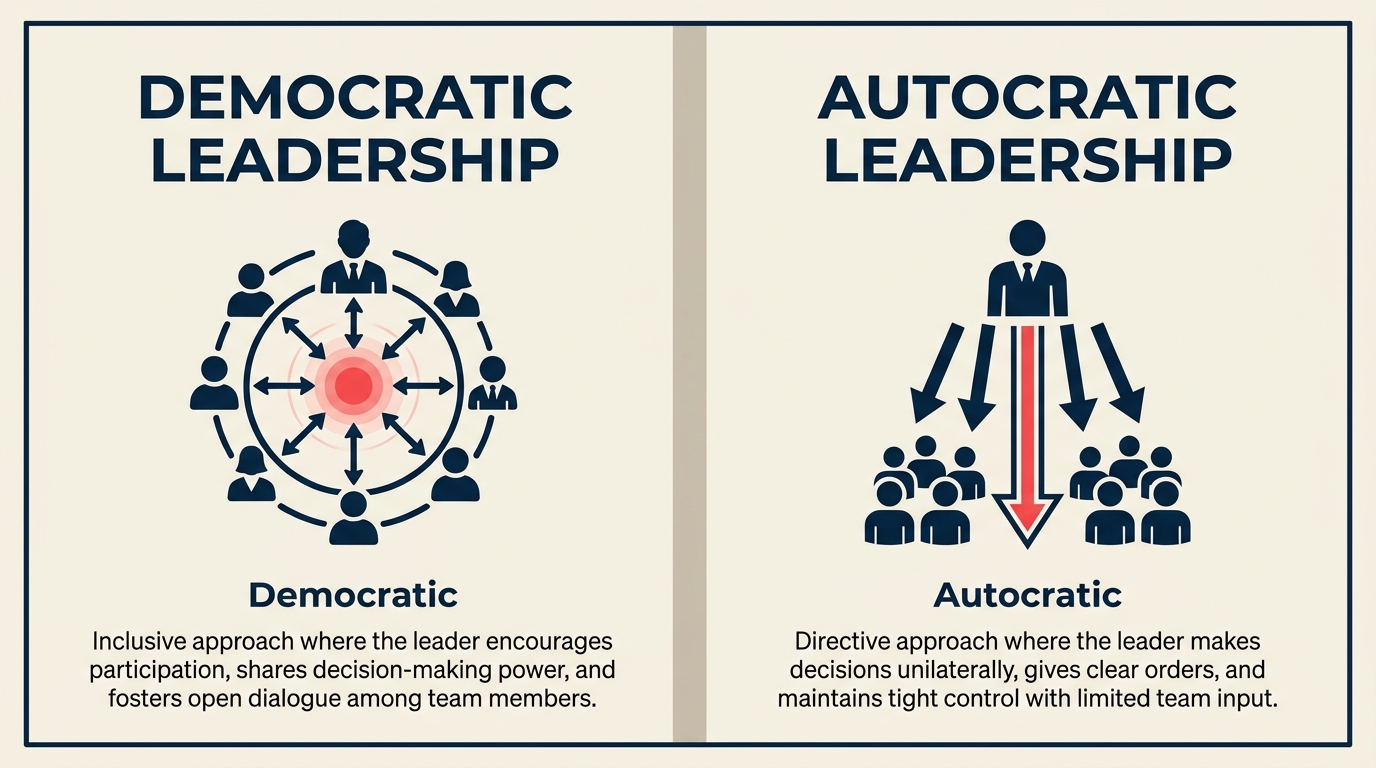
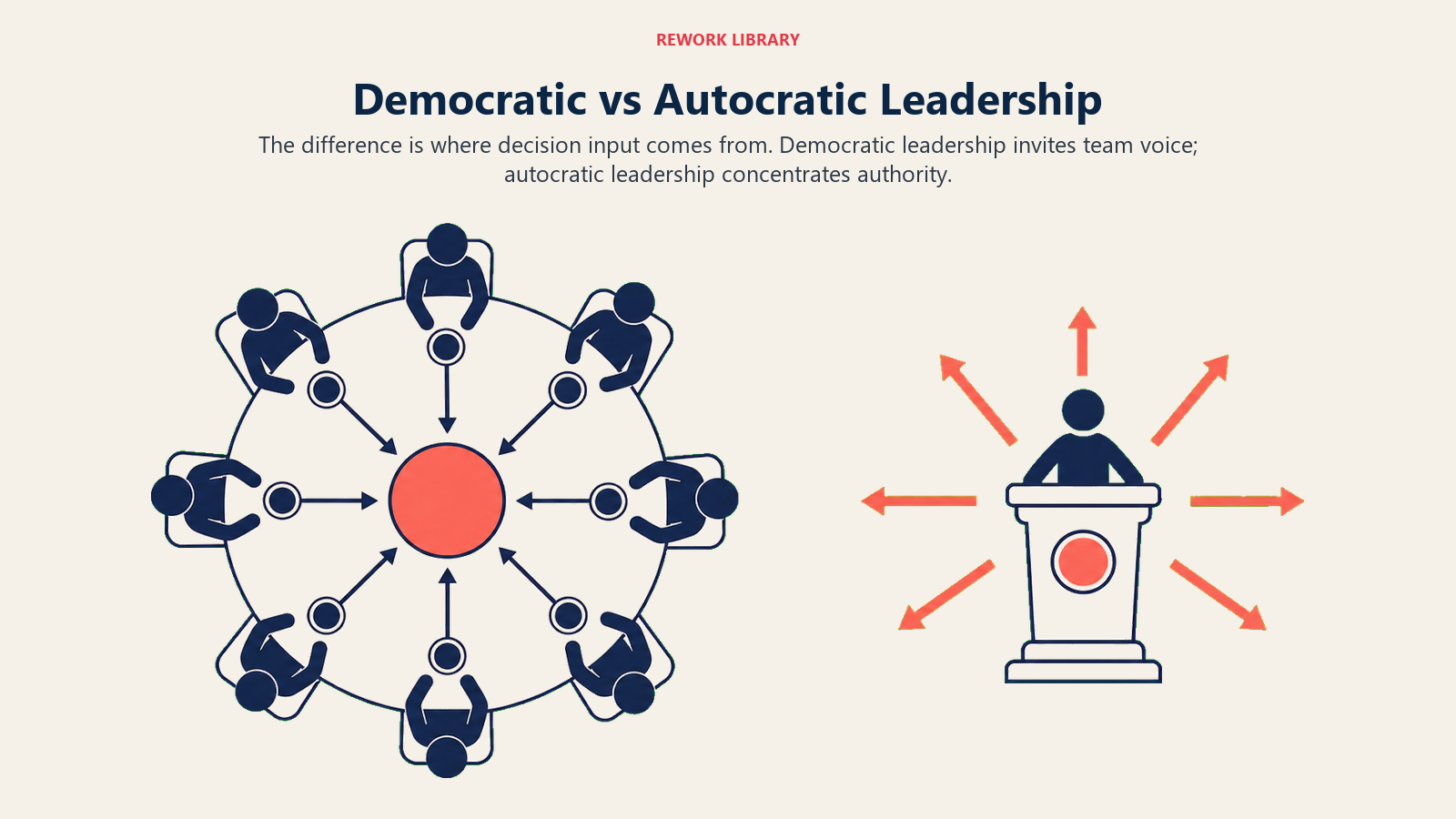
Democratic leadership (also called participative leadership) is a style where the leader actively gathers team input before making a final decision. The leader retains authority but uses shared deliberation to improve decisions and build team commitment to the outcome.

Autocratic leadership is the opposite: the leader makes decisions alone, without soliciting group input, then directs the team to execute. Speed and clarity are the defining advantages. Dependence and suppressed voice are the defining risks.

Both styles trace directly to psychologist Kurt Lewin's landmark 1939 University of Iowa study (co-conducted with Ronald Lippitt and Ralph White). Lewin's team identified three distinct leadership styles: autocratic, democratic, and laissez-faire. That study remains one of the most-cited foundations in leadership research.

Key Facts

  • Lewin, Lippitt, and White (1939) found that groups under democratic leadership produced higher-quality work than autocratic groups, and maintained performance when the leader stepped away. Autocratic groups produced more output in the short term but showed hostility and dependency. (Lewin, Lippitt, and White, "Patterns of aggressive behavior in experimentally created social climates," Journal of Social Psychology, 1939)
  • Gallup's State of the Global Workplace 2023 report found that managers account for approximately 70% of the variance in team engagement scores. The more autonomy and voice employees have, the higher their engagement.
  • A 2011 meta-analysis by Sauer in The Leadership Quarterly found that participative leadership has a significant positive effect on group performance, particularly in tasks requiring creativity and complex problem-solving.

"The best leaders don't pick a style. They pick the situation that calls for one."

What Is Democratic Leadership?

Democratic leadership involves leaders creating deliberate structures for team input before decisions are finalized. The leader asks for perspectives, runs deliberation, and then makes the call. It's not a vote. It's not a committee. The leader is still accountable for the final decision. But they decide with the team, not instead of it.

Traits of democratic leaders:

  • Invite team input before committing to a direction
  • Explain reasoning behind decisions, including why some input was or wasn't incorporated
  • Build psychological safety so people will actually speak up
  • Distribute ownership across the team, not just accountability at the top
  • Use structured processes (retrospectives, pre-mortems, async input) so participation is consistent, not ad hoc

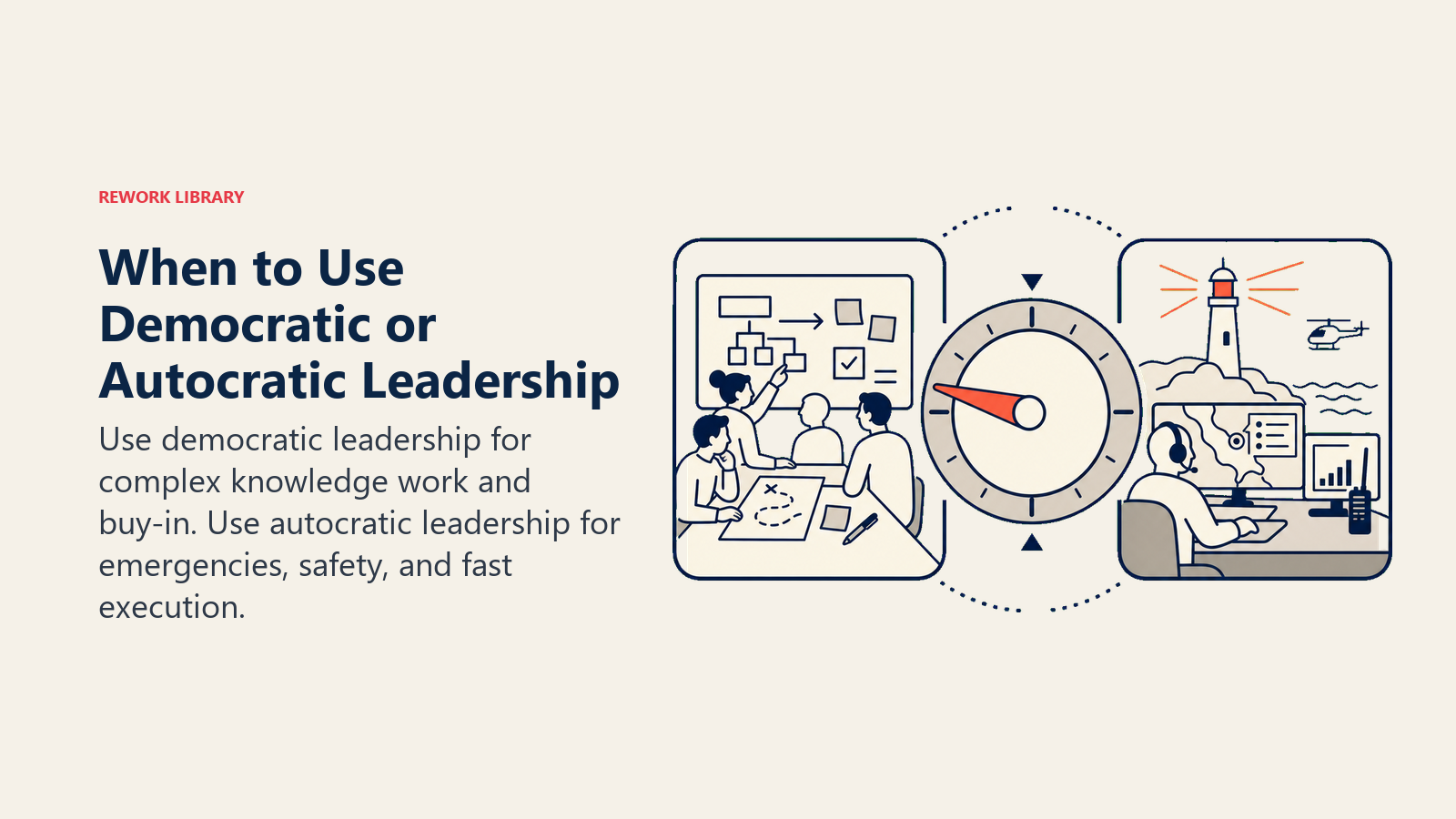
Where democratic leadership works best: knowledge work, strategic planning, product development, change initiatives, and any context where the team holds expertise the leader doesn't have.

What Is Autocratic Leadership?

Autocratic leadership concentrates decision authority at the top. The leader sets direction, defines rules, and expects the team to execute without pushback. Input channels are limited. Speed and consistency are the payoffs.

Traits of autocratic leaders:

  • Make decisions without group consensus
  • Issue specific, unambiguous instructions
  • Maintain close oversight of execution
  • Hold centralized accountability for outcomes
  • Prioritize task completion over relationship dynamics

Where autocratic leadership works best: emergencies, safety-critical environments (surgery, aviation, military operations), highly structured or low-skill roles, and execution phases of a project where a direction has already been decided.

Democratic vs Autocratic: Side-by-Side Comparison

The clearest way to see the difference between these two styles is to put them directly next to each other across six key dimensions.

Dimension Democratic Leadership Autocratic Leadership
Decision-making Leader gathers team input, then decides Leader decides alone
Speed Slower (input and deliberation take time) Fast (no input cycle needed)
Team morale Higher long-term (people feel heard and included) Lower over time (voice is suppressed)
Best context Knowledge work, strategy, innovation, strong teams Crisis, safety-critical, new or low-skill teams, fast execution
Key risks Analysis paralysis, slower decisions, process fatigue Low morale, dependency, suppressed innovation
Communication direction Two-way (leader asks as well as tells) Top-down (leader directs, team executes)

Neither style wins outright. Context determines which one fits. A surgeon in the operating room needs autocratic clarity. A product team deciding which features to build next needs democratic input. The mistake is treating either style as a permanent identity rather than a situational tool.

When to Use Each Style

Use autocratic leadership when:

  • A genuine emergency requires fast, coordinated action with no time for input gathering
  • The environment is life-safety critical (aviation, surgery, construction, military) and unclear authority creates real danger
  • The team is new, low-skill, or in a high-turnover role where clear direction reduces errors
  • The execution phase of an already-decided plan is underway and switching back to participative input creates delay and mixed signals
  • A regulatory or compliance requirement removes discretion entirely

Use democratic leadership when:

  • Your team holds expertise or on-the-ground knowledge you don't have access to
  • Commitment to the decision is critical for implementation (change initiatives, new processes, cultural shifts)
  • You're working through strategy, product direction, or complex trade-offs with real ambiguity
  • You need to develop your team's judgment and initiative over time
  • Morale or engagement has been declining and people feel unheard
  • You're in a stable environment where a slightly slower decision is worth a much better one

The middle path: Many effective leaders operate autocratically in defined windows (a crisis, a crunch sprint, a high-stakes safety situation) while defaulting to democratic participation outside those windows. Being clear with the team about which mode you're in, and why, is what makes this work.

How to Choose the Right Style for a Situation

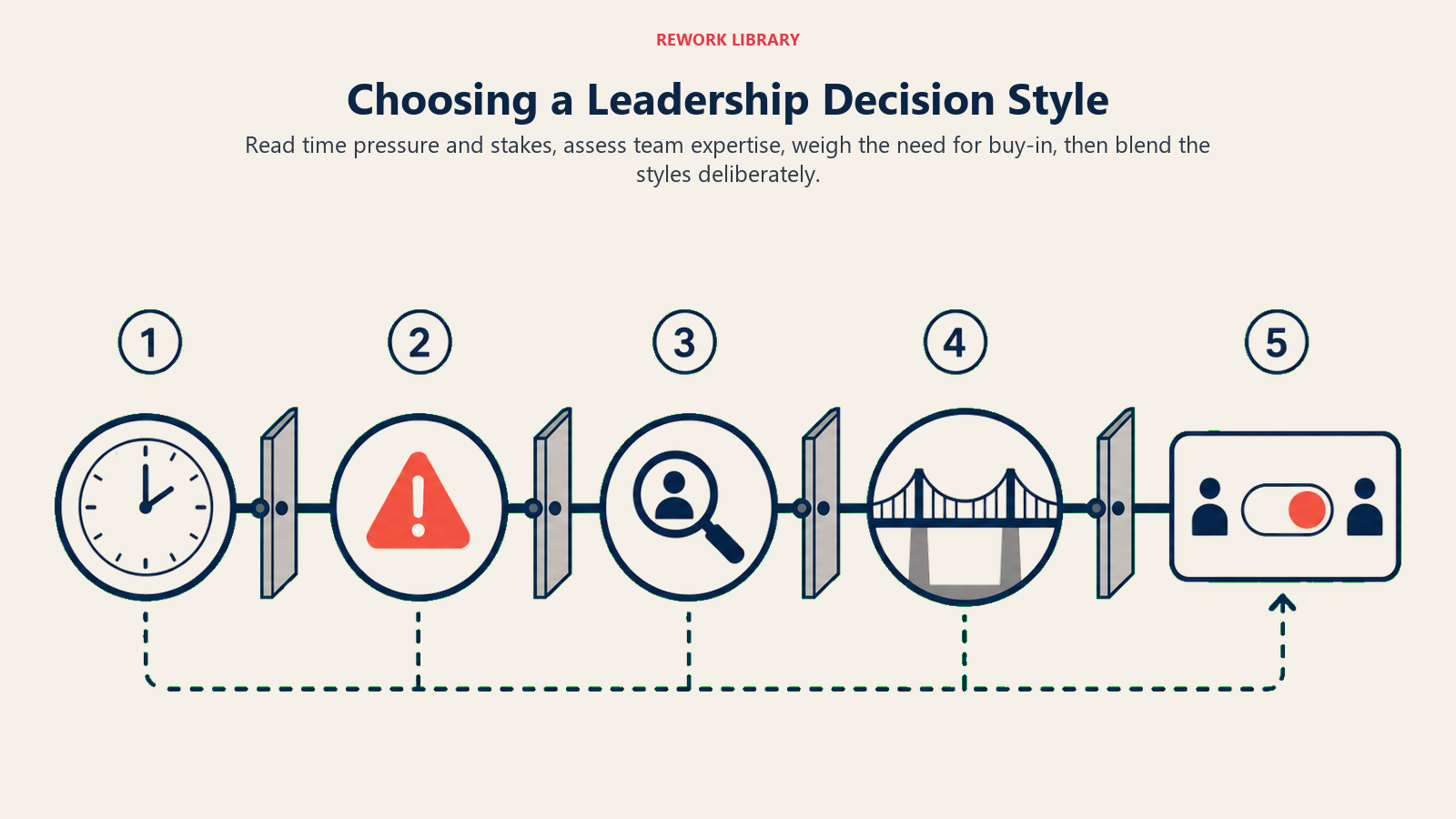
Picking between democratic and autocratic leadership isn't a personality quiz. It's a situational read. These four steps make the decision explicit.

Step 1: Read the Stakes and Time Pressure

If a wrong decision has catastrophic consequences and needs to be made in seconds or minutes, you're in autocratic territory. If the decision has significant long-term impact and time allows for input, lean democratic. The combination of high stakes and low time pressure is where democratic leadership creates the most value.

Step 2: Assess Team Expertise

Ask honestly: does this team know things I don't that would change this decision? If yes, you need their input. If the team is new, undertrained, or simply doesn't have relevant domain knowledge on this particular question, gathering input may slow things down without improving the outcome.

Step 3: Weigh the Need for Buy-In

Will this decision require people to change their behavior? If the answer is yes, democratic process isn't just nice to have. It's a performance lever. People implement decisions they helped shape with far more commitment than decisions handed down from above. If the decision is purely operational and behavioral change isn't required, autocratic speed may be the better call.

Step 4: Blend Deliberately

Rarely is a situation purely one style or the other. You can make a fast autocratic call in a crisis and then run a democratic retrospective immediately after. You can use democratic input to shape strategy and autocratic clarity to drive execution. The skill is in being explicit about which mode you're in so the team knows what kind of response is expected.

Examples by Scenario

Seeing both styles in action across different contexts makes the choice more concrete.

Scenario Better Style Why
ER physician directing a trauma team Autocratic Speed and clarity matter more than buy-in; second-guessing in the moment is dangerous
Product team defining roadmap priorities Democratic Engineers and designers hold information the leader needs; commitment drives delivery
Factory floor safety drill Autocratic Consistent, non-negotiable compliance is the goal; deviation is risky
Marketing team developing campaign strategy Democratic Creative quality improves with diverse input; buy-in drives execution effort
CEO during a data breach Autocratic Crisis response needs single-point command and speed
Leadership team planning annual strategy Democratic Long-term direction benefits from distributed knowledge and cross-functional ownership
New hire onboarding in a fast-food role Autocratic Clear direction gets people functional fast; open-ended input adds confusion
Remote team building a new product feature Democratic Distributed teams need voice to maintain engagement; knowledge is dispersed

Common Mistakes

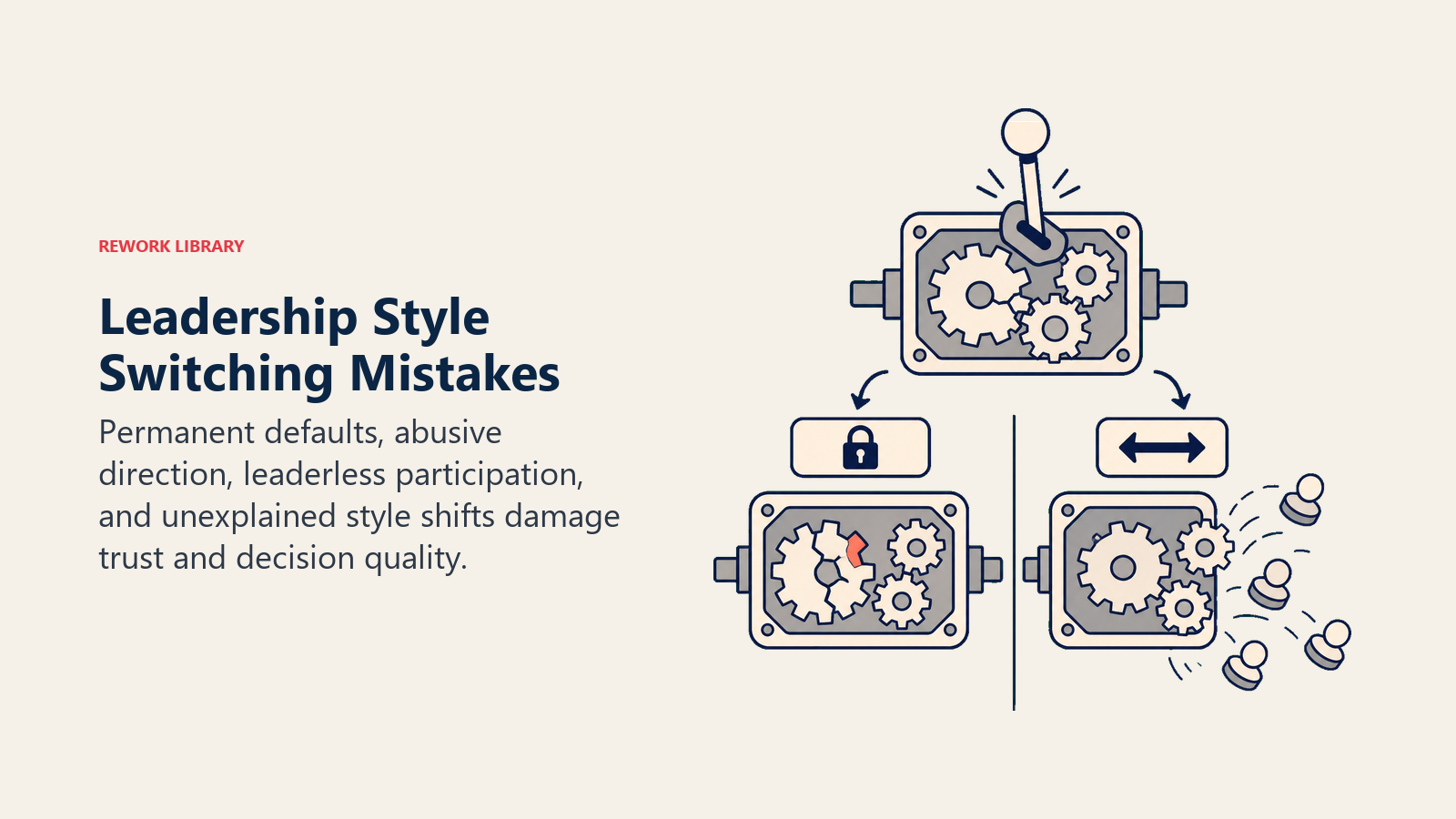
Defaulting to one style permanently. The most common failure is treating your preferred style as the only style. Autocratic leaders in knowledge-work environments eventually lose their best people. Democratic leaders in crisis environments create dangerous delays. Situational leadership frameworks exist precisely because context changes.

Confusing autocratic with abusive. Being directive is not the same as being dismissive, demeaning, or unpredictable. Autocratic leadership at its best means clear authority, fast decisions, and genuine accountability. At its worst, it becomes a cover for micromanagement and ego protection. The distinction matters: an autocratic leader can still explain decisions, hold themselves accountable, and treat people with respect.

Mistaking democratic for leaderless. The other common error is using a democratic process to avoid making hard calls. Gathering input and then never deciding, or deciding by committee consensus, is not democratic leadership. It's abdication. Democratic leadership still requires the leader to make the call, own the outcome, and close the loop with the people who gave input.

Switching styles without signaling. Teams get confused when a leader who normally runs participative processes suddenly goes autocratic without explaining why. The style shift itself isn't the problem. The silence around it is. Being clear, as in "we're in execution mode for the next two weeks, decisions are mine, we'll debrief after" avoids the trust damage that comes from unexplained shifts in behavior.

Frequently Asked Questions

Is democratic leadership better than autocratic leadership?

Neither is universally better. Democratic leadership produces better outcomes in knowledge work, complex strategy, and situations where team buy-in determines success. Autocratic leadership produces better outcomes in emergencies, safety-critical environments, and fast-execution phases. Research including Lewin's 1939 study confirms both styles have legitimate domains. The real skill is knowing which fits the situation in front of you.

Who defined democratic and autocratic leadership?

Both terms come from psychologist Kurt Lewin, who along with Ronald Lippitt and Ralph White conducted the foundational leadership styles study at the University of Iowa in 1939. The researchers observed boys' clubs under three conditions: autocratic, democratic, and laissez-faire leaders. The results showed that democratic groups produced higher-quality work and greater cohesion, while autocratic groups produced more short-term output but showed more aggression and dependency. That research shaped nearly every subsequent theory of leadership style.

Can a leader use both democratic and autocratic styles?

Yes, and the best leaders do. Switching between styles is the core concept behind frameworks like situational leadership and Blake-Mouton's managerial grid. The key is being intentional and transparent: defining for yourself which context calls for which mode, communicating clearly to your team when and why you're operating in a directive versus participative mode, and building the skills to execute both well.

What is the third style in Lewin's original study?

Laissez-faire leadership: a style where the leader provides minimal direction and leaves individuals to make their own decisions. In Lewin's study, laissez-faire groups produced lower-quality work than both democratic and autocratic groups and showed more frustration and inconsistency. Laissez-faire leadership has a narrow legitimate use case with highly expert, autonomous professionals. It tends to fail when teams need coordination or are working on interdependent tasks.

Is autocratic leadership the same as authoritarian leadership?

Not exactly. Autocratic leadership refers specifically to centralized decision-making without team input. Authoritarian leadership typically implies broader control: over behavior, information access, dissent, and consequences. All authoritarian leaders are autocratic, but not all autocratic leaders are authoritarian. An autocratic leader can still explain decisions, hold themselves accountable, and maintain professional respect. What makes a leader authoritarian is the use of control and fear as the primary management mechanism.

Most leaders who find themselves defaulting to one style have never been asked to think explicitly about the trade-offs. But the leaders who build deliberate range, who know how to run a genuine democratic process and how to make a fast autocratic call when a situation demands it, are the ones whose teams trust them in both modes. That range is learnable. It starts with the habit of asking, before the next significant decision, which style this situation actually calls for.

For broader context on how these styles fit into the full spectrum of leadership approaches, see what is leadership and servant vs transformational leadership.