日本語

Great Man Theory of Leadership: Definition and Criticisms

Great Man Theory of leadership concept illustration

The Great Man Theory is one of the oldest ideas in leadership studies, and also one of the most contested. It holds that history's great leaders were born, not made: exceptional individuals who arrived with the right traits already in place, destined to rise to power regardless of circumstance. Thomas Carlyle put this idea into sharp focus in the 1840s, and it shaped how organizations thought about leadership for over a century. Today the theory is largely discredited by researchers, but its shadow still falls across boardrooms, hiring decisions, and popular culture.

Understanding where it came from, what it actually claims, and why it breaks down is useful for any manager or executive trying to build a more rigorous view of leadership development.

What Is the Great Man Theory?

The Great Man Theory holds that leaders are born with innate qualities that make them suited for greatness. On this view, exceptional individuals possess a fixed set of heroic traits from birth, and these traits alone account for their rise to leadership and their historical impact. The theory treats leadership as a property of the person, not the situation, the team, or the organization.

Several assumptions flow from this core claim. Leaders are naturally exceptional, not ordinary people who developed skills over time. Their traits are relatively stable and not learned. And historically, the theory framed these exceptional individuals in explicitly masculine and often aristocratic terms (hence the name "Great Man" rather than "great person").

It's one of the earliest formal attempts to explain leadership scientifically, and it set the stage for everything that came after. Most subsequent leadership theories can be read as a response to it.

Key Facts

  • The term was popularized by the Scottish philosopher Thomas Carlyle, whose 1841 work On Heroes, Hero-Worship, and the Heroic in History argued that "the history of the world is but the biography of great men."
  • The English philosopher Herbert Spencer published a direct rebuttal in 1860, arguing in The Study of Sociology that great leaders are products of their social environment, not its independent cause.
  • The theory influenced early 20th-century leadership research, which attempted to catalog the universal traits of effective leaders. That research program largely failed to produce a consistent list.

Origins and History

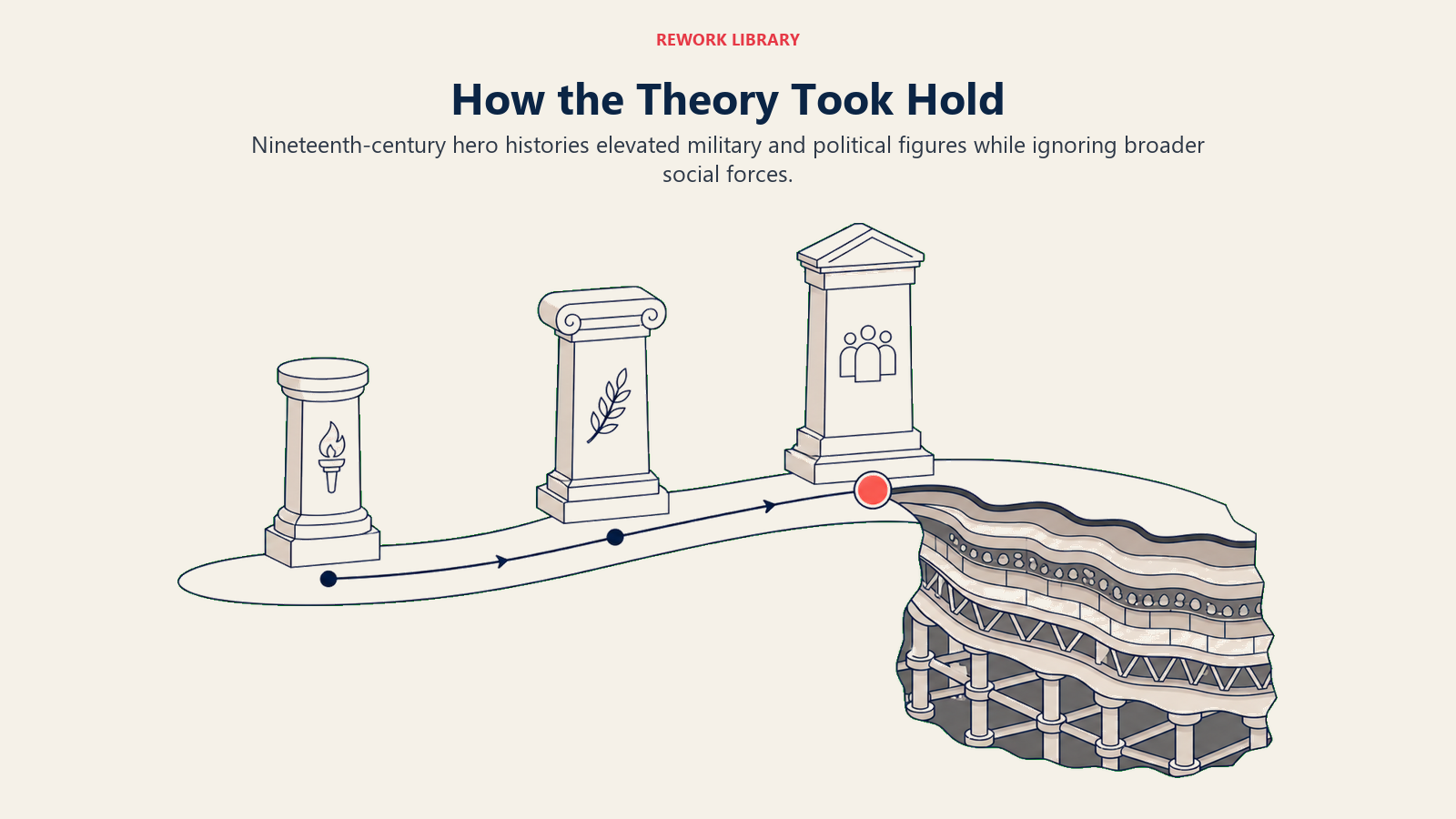
Carlyle was reacting to a specific intellectual moment. In the 1840s, Europe was in upheaval, and the question of what drove historical change felt urgent. Carlyle's answer was the heroic individual: Napoleon, Shakespeare, Cromwell, figures whose personal qualities bent history to their will. For Carlyle, studying great men was almost a spiritual project. He thought society needed to identify and follow these natural leaders.

This idea found a receptive audience. It fit neatly with the social attitudes of the era, including beliefs about aristocracy, masculinity, and the natural order of things. It also had practical appeal for organizations beginning to scale in the industrial era. If you could identify the right individual, you could put him in charge and expect great things.

Early academic leadership research in the late 19th and early 20th centuries inherited this framework. Researchers tried to catalog the traits that separated leaders from followers, assuming those traits would be universal. This project fed directly into what later became Trait Theory, which is the more rigorously formulated descendant of Great Man thinking.

Spencer's 1860 challenge was influential but didn't immediately dislodge the theory. The "born leader" idea was too convenient and too culturally embedded to disappear quickly. It persisted in popular discourse and shaped hiring and promotion practices well into the 20th century.

Great Man Theory vs Trait Theory vs Other Theories

The Great Man Theory didn't die cleanly. It evolved into Trait Theory, and both now stand in contrast to later behavioral and situational approaches. The differences matter for how organizations approach leadership development.

Theory Core claim Is leadership learnable? Focus
Great Man Theory Leaders are born with heroic, innate qualities No The exceptional individual
Trait Theory Certain measurable traits predict leadership effectiveness Partially (traits can be developed to a degree) Specific personal characteristics
Behavioral Theory Leadership is defined by observable behaviors, not fixed traits Yes What leaders do
Situational Theory Effective leadership depends on the context and follower readiness Yes Leader-situation fit
Contingency Theory No single style works everywhere; fit between leader and context matters Yes Matching style to conditions

The shift from Great Man to Trait Theory was largely methodological: researchers wanted to test the claims empirically. The shift from Trait to Behavioral and Situational theories reflected what that testing actually found. For a full overview of this progression, see what is leadership theories.

Core Assumptions of the Theory

Breaking the Great Man Theory into its specific claims makes it easier to evaluate where it goes wrong.

Leaders are exceptional individuals. The theory treats leadership capacity as rare and concentrated in specific people. It doesn't consider that effective leadership might be widely distributed or situationally dependent.

Leadership traits are innate. The characteristics that make someone a great leader, on this view, are present from birth or early in life, not acquired through experience or training.

Context is secondary. The Great Man Theory doesn't give much weight to circumstances. The truly great leader, in this framework, would succeed in any situation.

History is shaped by individuals, not structures. The underlying historical claim is that social change is driven by extraordinary people, not by economic forces, institutions, or collective action.

The framing is explicitly gendered. The original theory referred to men because it assumed leadership was a masculine domain. This wasn't incidental; it reflected and reinforced the exclusions of its era.

Criticisms and Limitations

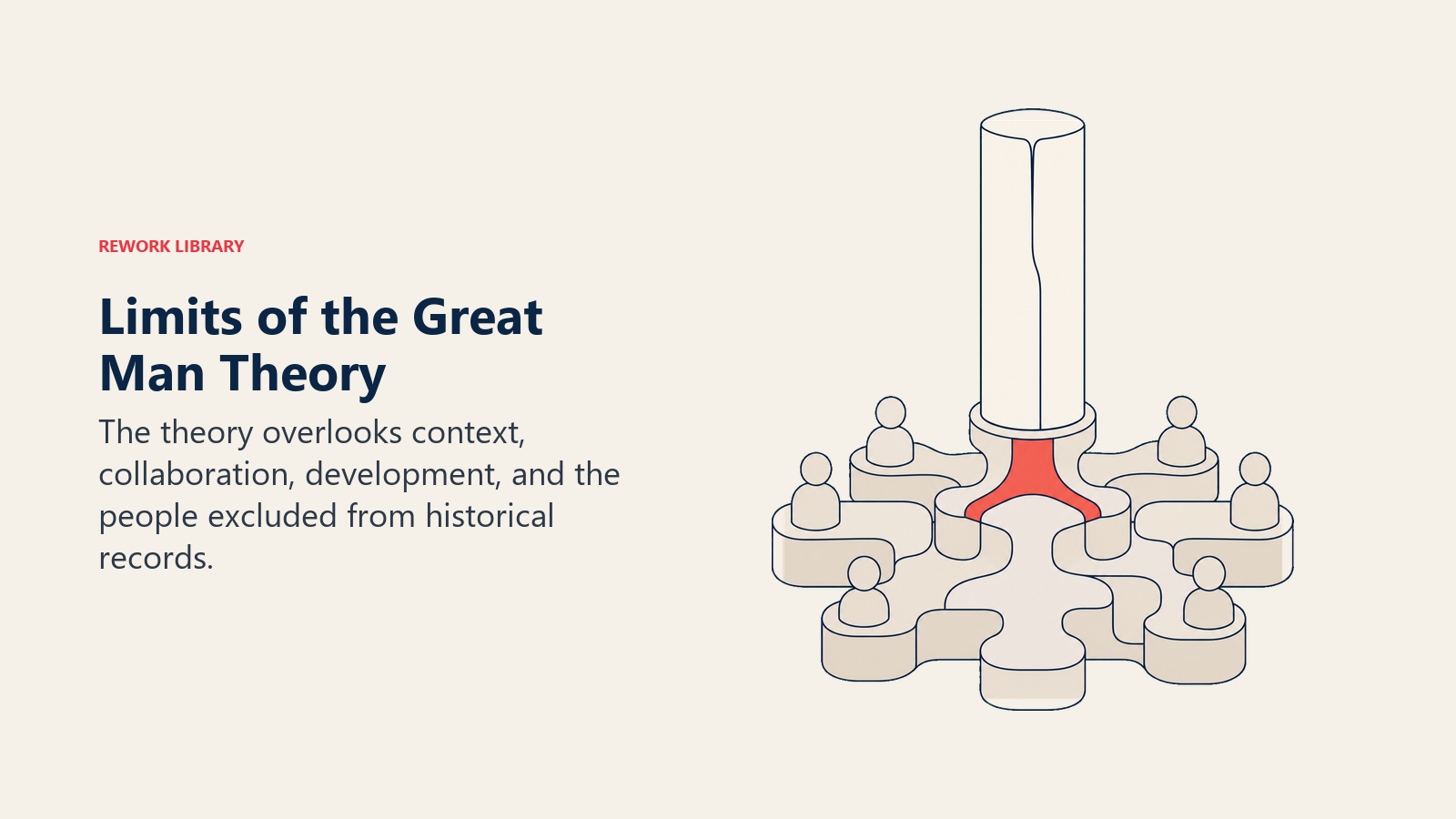
The Great Man Theory has attracted criticism from multiple directions, and the cumulative case against it is strong.

Herbert Spencer's structural rebuttal. Spencer pointed out the logical problem with Carlyle's view: if great leaders shape history, who shapes the great leaders? His answer was society itself. The conditions that produce a Napoleon or a Lincoln, on Spencer's view, are social and historical, not individual. The Great Man Theory mistakes the product for the cause.

Gender and exclusion bias. The theory was built on assumptions that excluded women, people from non-elite backgrounds, and anyone outside a narrow cultural template. It didn't just describe leadership as it was but rationalized existing hierarchies as natural outcomes of innate superiority. Modern leadership research has consistently found that traits associated with effective leadership are not concentrated in any demographic group.

Survivorship bias. We remember the leaders who succeeded. We don't observe the individuals with similar traits who failed due to circumstance, poor timing, or bad luck. The Great Man Theory selects on the outcome and then reads back a cause.

No consistent trait list. Research programs attempting to catalog universal leadership traits repeatedly failed to produce a stable, agreed-upon inventory. Different studies produced different lists, and the traits that predicted effectiveness in one context often failed to do so in another. This was the finding that accelerated the shift toward behavioral leadership theory.

Leadership can be developed. A substantial body of research now shows that leadership skills, including self-awareness, communication, decision-making under uncertainty, and the ability to build trust, can be trained. Executive coaching, mentorship, feedback systems, and deliberate practice all produce measurable improvements. If leadership traits were purely innate, none of this would work.

Context shapes outcomes. Research on situational leadership shows that effectiveness depends on the match between a leader's style and the specific demands of the situation, including team composition, task complexity, and organizational culture. A style that works in a startup often fails in a regulated enterprise, and vice versa.

Great Man Theory Examples

Certain historical figures come up repeatedly in Great Man Theory discussions, usually as evidence that exceptional individuals really can bend history.

Abraham Lincoln is often cited for holding the United States together during the Civil War. The standard Great Man framing credits his personal character: moral resolve, political skill, a capacity for empathy combined with firm purpose. But historians also point to structural factors: the economic tensions between industrializing North and agrarian South, the political coalitions Lincoln inherited and cultivated, and the ways the war itself created the conditions for the Emancipation Proclamation.

Winston Churchill is another common example, particularly for his leadership during the Second World War. His personal qualities, the speeches, the stubbornness, the instinct for public morale, were real and consequential. But the Great Man framing tends to minimize the role of the broader Allied coalition, the strategic errors of the Axis powers, industrial capacity, and Churchill's own significant failures in other contexts (his disastrous decisions around the Bengal famine, for instance).

Napoleon Bonaparte is perhaps the purest Great Man Theory example: a military and political genius who rose from relatively modest origins to reshape Europe. And yet Napoleonic history also demonstrates the limits of the theory. His eventual defeat came from a combination of overreach, coalition opposition, Russian winter, and supply failures that no individual's traits could overcome.

The pattern is consistent: when examined closely, these cases show exceptional individuals operating within conditions that both enabled and constrained them. That's a more complicated picture than the Great Man Theory allows.

Why It Still Matters Today

The Great Man Theory is formally discredited in academic leadership research. But its assumptions persist in ways that have real organizational consequences.

The "born leader" myth still shapes hiring and promotion. When organizations make leadership decisions based on gut feel about who "looks like a leader," they're often drawing on the same assumptions Carlyle encoded in 1841. The result is that leadership roles skew toward candidates who fit a familiar cultural template, which tends to be narrow.

The theory's legacy also shows up in how organizations invest (or don't invest) in leadership development. If leadership is innate, training is largely wasted. If leadership is partly learned, every dollar spent on good development programs has a return. The empirical evidence strongly supports the second view.

There's also a connection to Trait Theory, which salvaged some of the Great Man idea by making it more rigorous. Trait Theory acknowledges that certain characteristics are associated with effective leadership, but treats them as measurable and partially developable rather than fixed at birth. Understanding Great Man Theory helps clarify what Trait Theory improved and where it still faces its own limitations.

For teams using structured leadership frameworks, like the 5 Levels of Leadership or the Leader-Member Exchange approach, the Great Man critique is a useful anchor. These models treat leadership as a relationship and a practice, not a fixed property of heroic individuals.

The Skills Theory of Leadership takes the argument further, mapping the specific competencies that leaders need at different levels and showing how those competencies can be built over time. It's almost a direct inverse of the Great Man view.

Frequently Asked Questions

Who created the Great Man Theory of leadership?

The theory is most closely associated with the Scottish philosopher Thomas Carlyle, whose 1841 book On Heroes, Hero-Worship, and the Heroic in History argued that history is shaped by extraordinary individuals with unique innate qualities. The phrase "Great Man Theory" was later applied to this general view by other scholars. William James, the American philosopher and psychologist, wrote an 1880 essay titled "Great Men, Great Thoughts, and the Environment" that engaged critically with Carlyle's position.

Is the Great Man Theory still valid?

Not in the academic literature. Decades of empirical research have failed to find a universal set of innate traits that reliably predict leadership effectiveness across all contexts. The theory's assumption that leaders are born rather than developed has been contradicted by research showing that leadership skills can be trained. Its gender and class biases are also broadly rejected. Some elements, like the observation that certain personal characteristics correlate with leadership effectiveness, survived by migrating into Trait Theory and later frameworks. But the original Great Man claim, that great individuals are the primary driver of historical and organizational outcomes, is not well supported.

How is the Great Man Theory different from Trait Theory?

They're related but distinct. The Great Man Theory is the broader historical claim: great leaders are born, their qualities are heroic and innate, and they shape history. Trait Theory is the attempt to study leadership traits empirically and systematically. Trait Theory dropped the "born" assumption to some degree and asked instead: which measurable characteristics predict effective leadership? It's more falsifiable and more useful than Great Man Theory. Both theories focus on the individual rather than the context, which is the main limitation they share.

What replaced the Great Man Theory?

Several theories developed in reaction to it. Trait Theory tried to make the individual-focused approach more rigorous. Behavioral Theory shifted the focus to what leaders do rather than who they are. Situational and Contingency theories brought context into the picture, arguing that effective leadership depends on the fit between a leader's style and the demands of the situation. Each of these represents a step toward a more complete and more empirically grounded understanding of leadership.

Can the Great Man Theory teach us anything useful?

Yes, as a historical artifact and as a prompt for critical thinking. It illustrates how powerful and persistent assumptions about leadership can be, even when the evidence doesn't support them. It also surfaces real questions about individual agency: do exceptional individuals matter? Research says yes, individual leaders have genuine impact, particularly in ambiguous high-stakes situations. What the Great Man Theory gets wrong is the mechanism (innate traits rather than developed skills and contextual fit) and the exclusions it built into that mechanism.

The theory is most useful today as a lens for examining the unstated assumptions behind leadership decisions. When an organization promotes someone because they "seem like a natural leader," it's worth asking what that actually means and whose template it's drawing on.

Modern frameworks like the Leader-Member Exchange Theory and Behavioral Leadership Theory offer more actionable alternatives. They treat leadership as something built through relationships and behavior, which gives managers something concrete to work on.