Total Quality Management (TQM): Grundprinzipien und Beispiele
Turn this article into takeaways for your work.


Each assistant summarizes the article only for you and suggests best practices for your work.
Total Quality Management (TQM) ist die Unternehmensphilosophie, die Qualität zur Verantwortung jeder einzelnen Person in einer Organisation macht, nicht nur des Prüfteams am Ende der Linie. Es ist das Framework hinter einigen der beeindruckendsten Kehrtwenden in der Fertigung, im Gesundheitswesen und in Dienstleistungsbranchen der vergangenen fünf Jahrzehnte.
Was ist Total Quality Management?
Total Quality Management ist ein Managementansatz, der auf langfristigen Erfolg durch Kundenzufriedenheit ausgerichtet ist. Er wird erreicht, indem alle Mitglieder einer Organisation in die Verbesserung von Prozessen, Produkten, Dienstleistungen und der Unternehmenskultur eingebunden werden.
Die intellektuelle Grundlage lieferten zwei amerikanische Berater, die ihr größtes Publikum im Japan der Nachkriegszeit fanden. W. Edwards Deming brachte Statistical Process Control und eine systemische Sichtweise auf Qualität zu japanischen Herstellern in den frühen 1950er Jahren und argumentierte, dass die meisten Fehler aus fehlerhaften Prozessen stammen, nicht von unachtsamen Arbeitern. Joseph Juran folgte und trug die Qualitätstrias (Planung, Kontrolle und Verbesserung) sowie das Konzept der "vital few" Ursachen bei, die den Großteil der Qualitätsprobleme verursachen. Die japanische Industrie integrierte beide Frameworks in das, was zum Toyota Production System und schließlich zur TQM-Bewegung wurde, die in den 1980er Jahren in westliche Unternehmen zurückgespiegelt wurde.
Der Begriff "Total Quality Management" wurde in den 1980er Jahren in den Vereinigten Staaten popularisiert, als das Verteidigungsministerium begann, von Lieferanten die Einführung von Qualitätsmanagementpraktiken zu fordern. In den 1990er Jahren war TQM in der Fertigung, im Gesundheitswesen und in Finanzdienstleistungen zum Standardvokabular geworden.
Zahlen und Fakten
Die Kosten schlechter Qualität (COPQ) belaufen sich typischerweise auf 15-20 % des Umsatzes in der Fertigung und bis zu 40 % in Dienstleistungsorganisationen, laut der American Society for Quality (ASQ). Unternehmen, die TQM-Programme implementieren, haben berichtet, COPQ innerhalb von drei Jahren um 50 % zu senken.
Organisationen mit ausgereiften Qualitätsmanagementprogrammen zeigen ein 3-4-fach höheres Umsatzwachstum im Vergleich zu Wettbewerbern ohne formelle Qualitätssysteme, basierend auf einer ASQ Global State of Quality Research-Studie aus 2019, die 1.600 Organisationen in 22 Ländern umfasste.
Der Malcolm Baldrige National Quality Award, 1987 als höchste US-amerikanische Auszeichnung für Leistungsexzellenz eingerichtet, hat TQM-getriebene Organisationen ausgezeichnet, darunter Motorola, Ritz-Carlton und Boeing, die alle messbare finanzielle Verbesserungen nachweisen konnten, die direkt mit der Einführung von Qualitätssystemen zusammenhingen (NIST, Baldrige-Programmdaten).
Die 8 Grundprinzipien von Total Quality Management
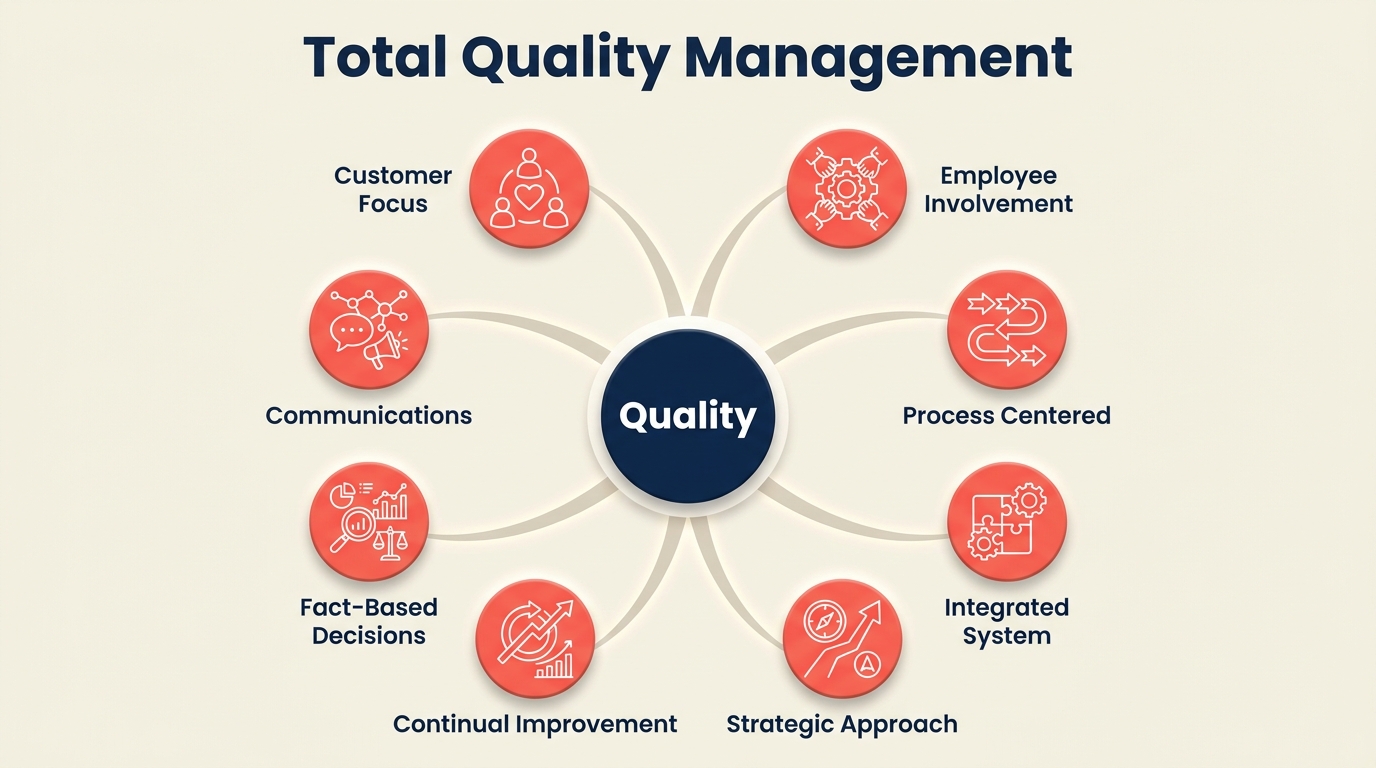
Die International Organization for Standardization (ISO-9000-Familie) und Qualitätspraktiker einigen sich auf acht grundlegende Prinzipien. Keines von ihnen ist für sich genommen kompliziert. Die Schwierigkeit liegt darin, alle acht gleichzeitig und konsequent in der gesamten Organisation anzuwenden.
| Prinzip | Was es bedeutet | In der Praxis |
|---|---|---|
| Kundenorientierung | Qualität wird durch das definiert, was Kunden wertschätzen, nicht durch interne Spezifikationen | Kunden vierteljährlich befragen; CTQ (Critical-to-Quality)-Anforderungen auf jeden Prozessoutput abbilden |
| Totale Mitarbeiterbeteiligung | Alle vom CEO bis zum Linienarbeiter sind für Qualität verantwortlich; es ist keine Abteilung | Alle Mitarbeiter in grundlegenden Qualitätswerkzeugen schulen; Verbesserungsmetriken an die Ziele jeder Rolle knüpfen |
| Prozessorientiertes Denken | Ergebnisse kommen aus Prozessen, nicht allein aus individuellem Einsatz | Jeden Kernprozess dokumentieren; Inputs und Outputs messen, nicht nur Endergebnisse |
| Integriertes System | Alle Funktionen (Vertrieb, Operations, HR, Finanzen) sind mit einem einzigen Qualitäts-Framework verbunden | Ein Qualitätsmanagementsystem (QMS) verwenden, das Prozesse über Abteilungen hinweg verbindet |
| Strategischer und systematischer Ansatz | Qualitätsverbesserung wird wie jedes andere Geschäftsziel geplant und gemanagt | Qualitätsziele in den Jahresplan aufnehmen; Budget, Verantwortliche und Zeitpläne zuweisen |
| Kontinuierliche Verbesserung | Der aktuelle Zustand ist immer der Ausgangspunkt für den nächsten Verbesserungszyklus | Strukturierte Kaizen-Events und PDCA-Zyklen in regelmäßigen Abständen durchführen |
| Faktenbasierte Entscheidungsfindung | Entscheidungen basieren auf Daten, nicht auf Intuition oder Hierarchie | Dashboards für wichtige Qualitätsmetriken aufbauen; Daten vor der Genehmigung von Prozessänderungen erfordern |
| Kommunikation | Qualitätsziele, Fortschritte und Probleme werden offen und häufig geteilt | Wöchentliche Qualitäts-Standup-Meetings abhalten; Fehler- und Kundenzufriedenheitstrends unternehmensweit veröffentlichen |
Das Prinzip, in das die meisten Organisationen zu wenig investieren, ist die totale Mitarbeiterbeteiligung. Kundenorientierung und datengetriebene Entscheidungen erhalten Führungsaufmerksamkeit. Aber der Frontline-Mitarbeiter, der um 7 Uhr morgens einen wiederkehrenden Fehler bemerkt und keinen Kanal hat, diesen zu eskalieren, ist das mit Abstand größte ungenutzte Qualitätspotenzial in den meisten Unternehmen. TQM funktioniert nur, wenn dieser Mitarbeiter eine Stimme und einen Prozess hat, auf das zu reagieren, was er sieht.
TQM vs. Six Sigma vs. Lean
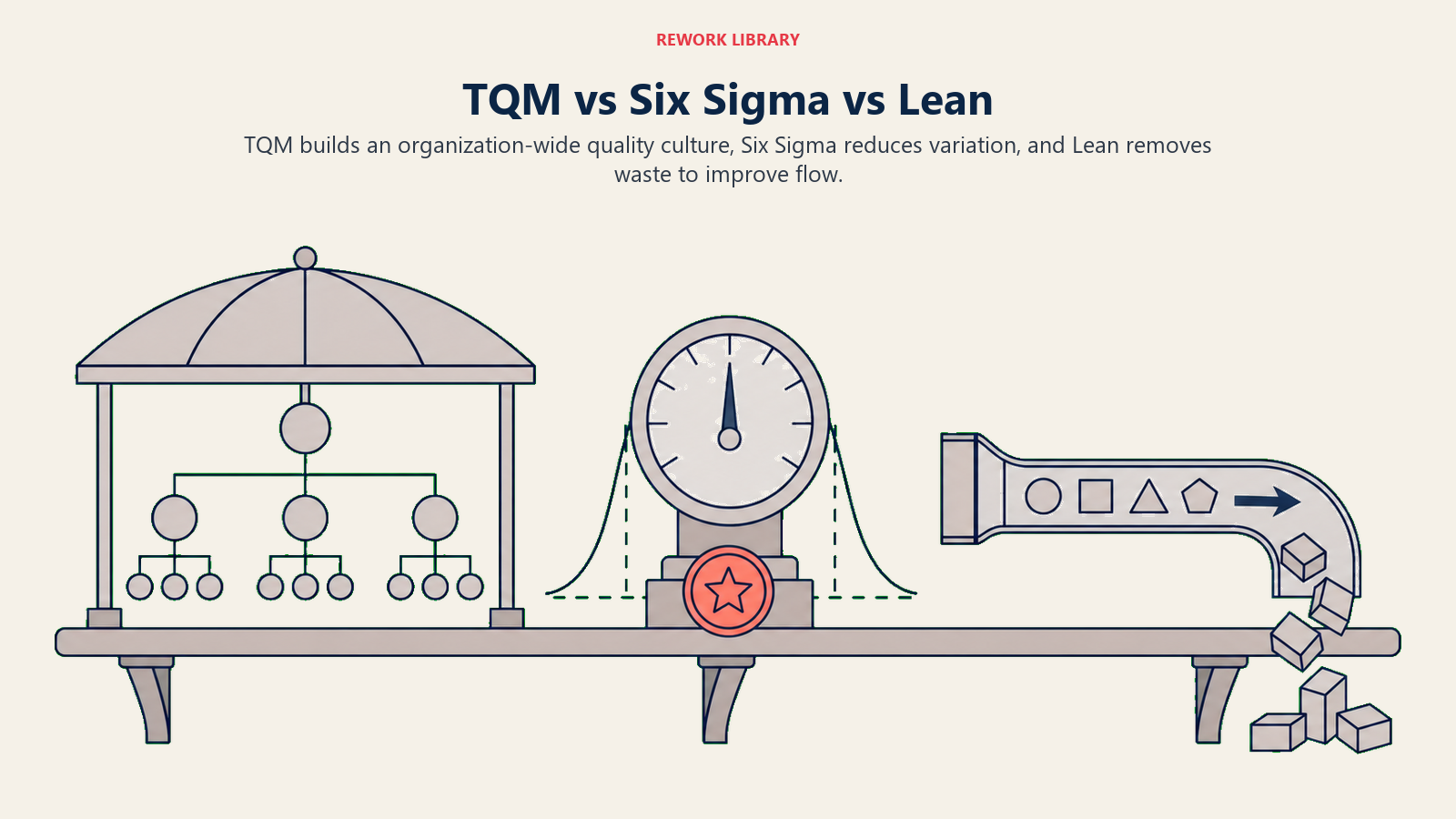
Diese drei Frameworks werden oft in einen Topf geworfen, und sie ergänzen sich, beginnen aber von unterschiedlichen Ausgangspunkten und verwenden unterschiedliche primäre Werkzeuge.
| Kriterium | TQM | Six Sigma | Lean |
|---|---|---|---|
| Primärer Fokus | Organisationsweite Qualitätskultur | Fehler- und Streuungsreduzierung durch Statistik | Verschwendungsbeseitigung und Geschwindigkeit |
| Ursprung | Deming, Juran (1950er-80er) | Motorola (1986), GE (1990er) | Toyota Production System (1940er-80er) |
| Umfang | Gesamte Organisation; Kulturwandel | Projekt-für-Projekt-Verbesserung | Wertstrom und Prozessfluss |
| Primäre Werkzeuge | Qualitätszirkel, SPC, Policy Deployment | DMAIC, DMAIC-Methodik, Regelkarten | Wertstromkarten, Kanban, 5S |
| Messschwerpunkt | Kundenzufriedenheit, Fehlerraten, Kultur | Sigma-Level, DPMO, Prozessfähigkeit | Durchlaufzeit, Flusseffizienz, unfertige Bestände |
| Zertifizierung | ISO-9001-Audits, Baldrige-Kriterien | Green Belt, Black Belt, Master Black Belt | Lean Practitioner, Lean Leader |
Kurz gesagt: TQM ist die Kultur und das Managementsystem. Six Sigma ist eine statistische Problemlösungsmethodik, die innerhalb dieser Kultur angewendet wird. Lean ist eine Verschwendungsreduzierungsphilosophie, die auf Prozessebene operiert.
Die meisten großen Organisationen verwenden alle drei: TQM liefert den strategischen Rahmen und die Werte, Lean verbessert den Fluss und Six Sigma beseitigt Fehler-Grundursachen. Six Sigma oder Lean ohne die darunter liegende TQM-Kultur zu betreiben, führt oft zu guten Projektergebnissen, die nicht halten, weil das Managementsystem und die täglichen Gewohnheiten zu den alten Mustern zurückkehren.
Vorteile von TQM
Wenn TQM wirklich Fuß fasst und nicht nur als Plakat an der Wand hängt, verzeichnen Organisationen konkrete Gewinne in mehreren Dimensionen:
Kundenzufriedenheit und -bindung. Wenn jeder Prozess darauf ausgelegt ist, was der Kunde schätzt, sinken Fehler und steigt die Konsistenz. Kunden bemerken das. Wiederkaufquoten und Net Promoter Scores tendieren dazu, gemeinsam zu steigen, weil die zugrundeliegende Ursache beider dieselbe ist: weniger schlechte Erfahrungen.
Niedrigere Qualitätskosten. Qualitätsprobleme sind teuer, auf eine Weise, die nicht immer in einer einzigen Budgetzeile auftaucht. Nacharbeit, Ausschuss, Garantieansprüche, Kundendienstanrufe, verlorene Accounts und Bußgelder fallen alle in den COPQ-Bereich. TQM greift die Grundursachen systematisch an, statt die Symptome zu managen.
Mitarbeiterengagement. Personen, die den Zusammenhang zwischen ihrer täglichen Arbeit und den Qualitätsergebnissen der Organisation erkennen, kümmern sich mehr darum. Qualitätszirkel und Verbesserungsteams geben dem Frontline-Personal eine echte Stimme bei der Gestaltung der Arbeit. Das motiviert auf eine Weise, wie es Performance-Reviews nicht tun.
Wettbewerbsdifferenzierung. In Commoditymärkten wird Qualität zur entscheidenden Variable. Ein Hersteller, der spezifikationsgerechte Produkte ohne Fehler, pünktlich, in jedem Zyklus liefert, erlangt den Status eines bevorzugten Lieferanten, den ein preislich günstigerer Wettbewerber nur schwer verdrängen kann.
Akkumulation von Prozesswissen. TQM zwingt Organisationen dazu, ihre Prozesse tiefgehend zu dokumentieren, zu messen und zu verstehen. Dieses institutionelle Wissen wächst mit der Zeit. Neue Mitarbeiter werden schneller eingearbeitet. Prozessprobleme werden aus der Grundursache heraus gelöst, statt durch wiederholte Workarounds. Standard Operating Procedures werden zu lebenden Dokumenten statt zu Ordnern im Regal, die niemand liest.
Häufige Herausforderungen
TQM hat eine starke Erfolgsbilanz, aber viele Organisationen investieren darin und sehen nur geringe Ergebnisse. Die Versagenspunkte sind vorhersehbar.
Führungsengagement, das nachlässt. TQM beginnt mit Führungsbegeisterung und einer unternehmensweiten Kickoff-Veranstaltung. Achtzehn Monate später hat sich der Lenkungsausschuss zwei Monate nicht mehr getroffen und die Qualitätsmetriken erscheinen nicht mehr in den Board-Präsentationen. Qualitätskultur erfordert anhaltende Aufmerksamkeit von oben; sie kann nicht vollständig an eine Qualitätsabteilung delegiert werden.
TQM als Programm statt als System behandeln. Ein "TQM-Programm" endet. Ein Qualitätsmanagementsystem nicht. Organisationen, die es als zeitlich begrenztes Vorhaben behandeln, durchlaufen den klassischen Verbesserungs-Rückfall-Zyklus: messbare Gewinne während des Programms, stille Erosion danach.
Unzureichende Schulungsinvestitionen. TQM-Werkzeuge (Fishbone-Diagramme, Regelkarten, Ursachenanalyse) erfordern echte Schulung, um sie gut anzuwenden. Sie mit einem halbtägigen Workshop einzuführen produziert Personen, die das Vokabular gehört, es aber nicht anwenden können. Effektive TQM-Programme behandeln Schulung als Infrastruktur, nicht als Gemeinkosten.
Aktivitäten statt Ergebnisse messen. Teams zählen die Anzahl der abgeschlossenen Verbesserungsprojekte oder der abgehaltenen Qualitätszirkel. Das sind Aktivitätsmetriken. Die Ergebnismetriken sind Fehlerraten, Kundenzufriedenheitswerte und Qualitätskosten. Wenn das Scoreboard Inputs statt Outputs verfolgt, optimiert die Organisation für Beschäftigung statt für Verbesserung.
Siloisierter Besitz. Wenn Qualität der Qualitätsabteilung gehört, behandelt jede andere Abteilung sie als Problem von jemand anderem. TQM erfordert verteilten Besitz, was geteilte Metriken, funktionsübergreifende Verbesserungsteams und Manager in Operations, Vertrieb und Finanzen bedeutet, die sich für Qualitätsergebnisse verantwortlich fühlen, nicht nur für ihre eigenen funktionalen KPIs.
Ungeduld mit dem Zeitplan. Kulturwandel dauert Jahre, nicht Quartale. Organisationen, die erwarten, dass TQM innerhalb von 12 Monaten dramatischen ROI zeigt, werden enttäuscht und werden die Bemühungen wahrscheinlich aufgeben, bevor die kumulierenden Vorteile eintreffen.
So implementieren Sie Total Quality Management
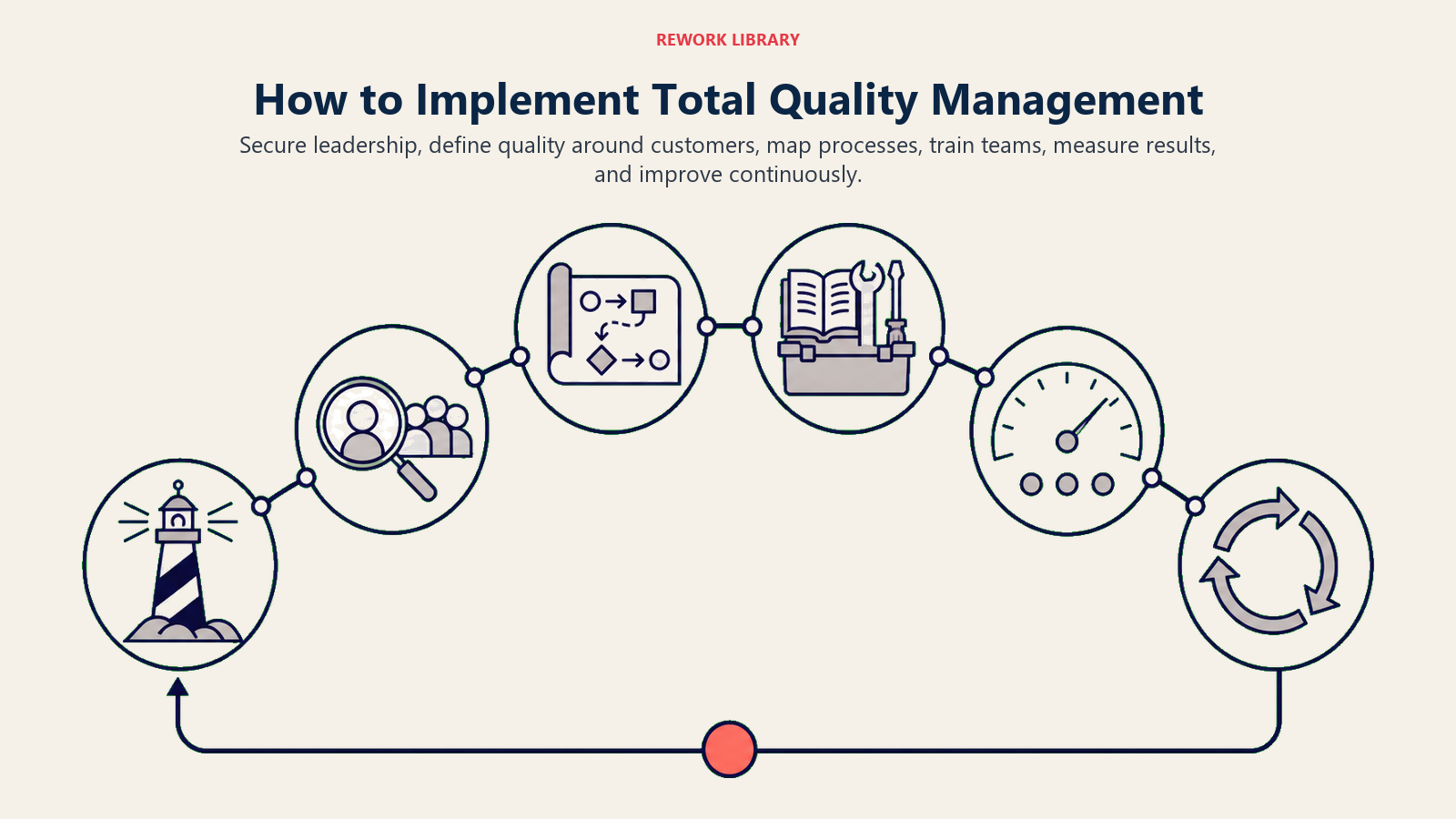
Die Umsetzung funktioniert am besten, wenn Führungsengagement, Ist-Analyse und Mitarbeiterbeteiligung bewusst nacheinander geplant werden, statt als getrennte Qualitätsinitiativen zu laufen.
Schritt 1: Echtes Führungsengagement sicherstellen
TQM beginnt an der Spitze oder gar nicht. "Echtes" Engagement bedeutet, dass die Führungskräfte Qualität öffentlich als strategische Priorität formulieren, echte Budgets für Schulung und Werkzeuge bereitstellen, an Qualitätsreviews teilnehmen und Manager für Qualitätsergebnisse neben finanziellen Ergebnissen zur Rechenschaft ziehen. Ein Qualitätslenkungsausschuss mit Führungsvertretung sollte zu festgelegten Zeiten tagen und die Befugnis haben, organisatorische Hindernisse zu beseitigen.
Schritt 2: Ist-Zustand bewerten
Bevor Ziele gesetzt werden, messen Sie, wo Sie stehen. Führen Sie ein Qualitätsaudit durch, das aktuelle Fehlerraten, Qualitätskosten, Kundenzufriedenheitswerte und die Reife der Prozessdokumentation abdeckt. Verwenden Sie ein strukturiertes Framework wie die Baldrige-Kriterien oder eine ISO-9001-Lückenanalyse. Kartieren Sie Ihre kritischsten Prozesse mit einem Prozessabbildungsansatz, um Übergaben, Engpässe und undokumentierte Workarounds aufzudecken.
Schritt 3: Qualitätsziele und eine Richtlinie definieren
Übersetzen Sie die Ist-Zustand-Bewertung in spezifische, messbare Ziele. Verfassen Sie eine Qualitätsrichtlinie: eine kurze Aussage über das Bekenntnis der Organisation zu Qualität und die Prinzipien, nach denen sie handelt. Kaskadieren Sie Ziele von der Organisationsebene auf jede Abteilung und jedes Team. Dieser Policy-Deployment-Schritt (auf Japanisch "Hoshin Kanri" genannt) richtet die tägliche Arbeit auf strategische Qualitätsziele aus.
Schritt 4: Fähigkeiten durch Schulung aufbauen
Jede Person in der Organisation benötigt Schulung für das Qualitätsbewusstsein. Personen in Verbesserungsrollen (Teamleiter, Prozessverantwortliche, Qualitätszirkel) benötigen Werkzeugschulung: Wie man eine Ursachenanalyse durchführt, wie man eine Regelkarte liest, wie man ein Fishbone-Diagramm oder ein SIPOC-Diagramm verwendet. Laden Sie nicht alle Schulungen vor, bevor irgendwelche Verbesserungsarbeiten beginnen. Führen Sie Schulungen in Kohorten durch, die an aktive Verbesserungsprojekte geknüpft sind, damit das Wissen haften bleibt.
Schritt 5: Qualitätssysteme und -werkzeuge implementieren
Etablieren Sie die Prozesse, die TQM operativ machen: ein Dokumentenkontrollsystem für Standard Operating Procedures, einen Korrektur- und Vorbeugemaßnahmenprozess (CAPA) für Fehler, Statistical Process Control (SPC) für wichtige Ausgangsmetriken und einen strukturierten Verbesserungsprozess (wie PDCA oder DMAIC) zur Problemlösung. Richten Sie Qualitätszirkel ein: kleine funktionsübergreifende Teams, die sich regelmäßig treffen, um lokale Qualitätsprobleme zu identifizieren und zu lösen.
Schritt 6: Überwachen, überprüfen und aufrechterhalten
Qualitätssysteme verfallen ohne aktive Pflege. Veröffentlichen Sie ein Qualitäts-Dashboard und überprüfen Sie es in Führungsmeetings. Führen Sie interne Audits durch. Führen Sie Management-Reviews durch, die den Fortschritt gegenüber Qualitätszielen bewerten, nicht nur finanzielle Metriken. Erkennen und feiern Sie Verbesserungsergebnisse öffentlich. Speisen Sie Erkenntnisse in Schulungen und Prozessdokumentation zurück. Und wiederholen Sie dann: Der PDCA-Zyklus läuft auf Programmebene kontinuierlich, genau wie auf der Ebene des einzelnen Prozesses.
TQM-Beispiele
Toyota: Das ursprüngliche Modell
Toyotas Qualitätskultur ist das am häufigsten untersuchte Beispiel in der Unternehmensgeschichte. Das Toyota Production System, das ab den 1950er Jahren unter starkem Einfluss von Demings Besuchen in Japan entwickelt wurde, verankert TQM-Prinzipien auf jeder Ebene. Jeder Produktionsarbeiter hat die Befugnis, die Linie anzuhalten (Andon-Kabel), wenn er einen Fehler entdeckt. Probleme tauchen sofort auf, statt sich durch die Schicht aufzustauen. Fehler werden als Lernereignisse behandelt: Das Team kommt zusammen, identifiziert die Grundursache, aktualisiert den Standard und startet neu. Toyotas Fehlerraten und Garantiekosten lagen jahrzehntelang deutlich unter dem Branchendurchschnitt, und das Unternehmen gehört in den J.D. Power-Qualitätsumfragen Jahr für Jahr zu den am höchsten bewerteten Herstellern.
Gesundheitswesen: Virginia Mason Medical Center
Das Virginia Mason Medical Center in Seattle wandte TQM-Prinzipien ab 2001 durch das Toyota Production System an. Das Krankenhaus kartierte seine Patientenversorgungsprozesse von Anfang bis Ende, identifizierte Verschwendungs- und Fehlerpunkte und gab Pflegepersonal und Ärzten strukturierte Kanäle, um Qualitätsbedenken zu äußern. Ein frühes Projekt gestaltete den Ablauf für Patienten im Krebszentrum neu. Durch die Eliminierung von Wartezeiten und redundanten Schritten verkürzte das Zentrum die Patientendurchlaufzeit von mehreren Tagen auf einen einzigen Tag in einigen Pfaden. Patientenzufriedenheitswerte stiegen. Mitarbeiter berichteten, mehr Zeit für direkte Pflege und weniger für administrative Workarounds aufzuwenden. Virginia Masons Ansatz wurde zum Referenzmodell für Qualitätsverbesserungen im US-amerikanischen Gesundheitswesen.
Finanzdienstleistungen: Eine Regionalbank im Kreditbereich
Eine mittelgroße Regionalbank wandte TQM auf ihren Kreditorigination-Prozess an, nachdem Kundenbeschwerden über Fehlerquoten und Bearbeitungszeiten einen Schwellenwert erreicht hatten, der die Kundenbindung bedrohte. Das Verbesserungsteam kartierte den 23-Schritte-Prozess, stellte fest, dass 8 Schritte Nacharbeit aus vorgelagerten Fehlern beinhalteten, und führte die meisten Fehler auf drei undokumentierte Übergabepunkte zurück, an denen zwischen Teams Kontext verloren ging. Sie standardisierten die Übergabedokumentation, bauten eine Checkliste in das Prozessmanagementsystem ein und schulten Kreditberater in der Fehlererkennung an der Quelle. Die Fehlerquoten im Origination-Prozess sanken innerhalb von 8 Monaten um 62 %. Die Bearbeitungszeit fiel von 18 Tagen auf 11 Tage. Die Bank dehnte dieselbe Prozessdisziplin in den folgenden zwei Jahren auf ihre Hypotheken- und Kleinunternehmenskreditaktivitäten aus.
Best Practices
Beginnen Sie mit der Qualitätsdefinition des Kunden. Interne Qualitätsmetriken, die sich nicht auf die Kundenerfahrung abbilden lassen, schaffen Organisationen, die in Dingen exzellent sind, die Kunden nicht interessieren. Führen Sie Voice-of-Customer-Forschung durch, bevor Sie Qualitätsziele definieren.
Qualitätskosten sichtbar messen. Die meisten Organisationen unterschätzen COPQ, weil die Kosten über Abteilungen verteilt sind. Ein zentralisierter Qualitätskostenbericht, der Nacharbeit, Ausschuss, Garantie, Beschwerdebearbeitung und Umsatzverluste zusammenfasst, macht die finanziellen Einsätze konkret und motiviert zur Prävention.
Qualitätszirkel schützen und ausbauen. Qualitätszirkel, kleine Gruppen von Frontline-Mitarbeitern, die sich regelmäßig zur Lösung lokaler Probleme treffen, werden oft als erstes gestrichen, wenn Budgetdruck entsteht. Sie sind auch der Mechanismus, der totale Mitarbeiterbeteiligung real statt nur angestrebt macht. Schützen Sie sie.
Verbesserungsarbeit mit Strategie verbinden. Ad-hoc-Verbesserungsprojekte, die nicht mit strategischen Prioritäten verknüpft sind, lassen sich leicht deprioritisieren. Verwenden Sie Policy Deployment (Hoshin Kanri), um Qualitätsziele auf jeder Ebene sichtbar zu machen, und machen Sie Fortschrittsreviews zu einem festen Tagesordnungspunkt in Führungsmeetings.
TQM mit strukturierten Problemlösungswerkzeugen kombinieren. Der kulturelle Rahmen benötigt methodologische Strenge im Hintergrund. Organisationen, die TQM-Werte mit PDCA, DMAIC und Ursachenanalysewerkzeugen wie dem Fishbone-Diagramm kombinieren, lösen Probleme schneller und dauerhafter als Organisationen, die sich allein auf kulturelles Engagement verlassen.
Häufig gestellte Fragen
Wer hat TQM entwickelt?
Keine einzelne Person hat TQM entwickelt. W. Edwards Deming und Joseph Juran lieferten die theoretischen Grundlagen in den 1950er Jahren und arbeiteten eng mit japanischen Herstellern zusammen. Armand Feigenbaum prägte 1956 den Begriff "Total Quality Control", der sich zu Total Quality Management weiterentwickelte. Kaoru Ishikawa adaptierte und erweiterte die Frameworks für die japanische Industrie und trug Werkzeuge wie das Fishbone-Diagramm bei. Die TQM-Bewegung in den Vereinigten Staaten wurde maßgeblich durch das Verteidigungsministerium und die Einrichtung des Malcolm Baldrige National Quality Award im Jahr 1987 vorangetrieben.
Ist TQM heute noch relevant?
Ja, obwohl das Vokabular sich verschoben hat. ISO 9001, Lean Six Sigma, Operational Excellence und Programme zur kontinuierlichen Verbesserung sind alle Weiterentwicklungen von TQM-Prinzipien. Die Kernideen, Kundenorientierung, faktenbasierte Entscheidungen, Prozessdisziplin und Mitarbeiterbeteiligung, sind heute relevanter denn je in einer Umgebung, in der Kunden mehr Auswahl haben und Wettbewerbszyklen kürzer sind. Digitale Werkzeuge (Process Mining, Echtzeit-Dashboards, KI-gestützte Qualitätsüberwachung) haben die für TQM erforderliche Dateninfrastruktur günstiger und schneller aufzubauen gemacht.
Was ist der Unterschied zwischen TQM und ISO 9001?
TQM ist eine Managementphilosophie. ISO 9001 ist ein prüfbarer Standard für Qualitätsmanagementsysteme. Eine ISO-9001-Zertifizierung belegt, dass eine Organisation ein Qualitätsmanagementsystem dokumentiert, implementiert und aufrechterhalten hat, das spezifische Anforderungen erfüllt. Sie basiert stark auf TQM-Prinzipien, ist aber präskriptiver und extern verifiziert. Viele Organisationen streben eine ISO-9001-Zertifizierung als strukturierten Weg zur Implementierung von TQM an.
Wie lange dauert es, bis TQM Ergebnisse zeigt?
Frühe Verbesserungen auf Prozessebene (Zykluszeit, Fehlerrate bei spezifischen Prozessen) können innerhalb von 3 bis 6 Monaten fokussierter Arbeit messbare Ergebnisse zeigen. Kulturwandel, also der Punkt, an dem Qualitätsdenken in täglichen Entscheidungen auf allen Ebenen verankert ist, dauert typischerweise 3 bis 5 Jahre konsequenter Investition. Organisationen, die im ersten Jahr eine vollständige kulturelle Transformation erwarten, geben die Bemühungen in der Regel auf, bevor die kumulierenden Vorteile eintreffen.
Können kleine Unternehmen TQM verwenden?
Absolut. Die Prinzipien skalieren sauber nach unten. Ein 10-Personen-Fertigungsbetrieb kann Kundenorientierung anwenden, seine Kernprozesse dokumentieren, monatliche Qualitätsreviews durchführen und einen einfachen PDCA-Zyklus zur Problemlösung verwenden, ohne eine dedizierte Qualitätsabteilung oder ein sechsstelliges Beratungsengagement. Die Werkzeuge vereinfachen sich; die Prinzipien ändern sich nicht. Viele kleine Hersteller verwenden TQM als Weg zur ISO-9001-Zertifizierung, die oft für Enterprise- und Behördenverträge erforderlich ist. TQM ist kein Programm, das endet. Die Organisationen, die dauerhaft Ergebnisse daraus erzielen, sind die, die schließlich aufhören, es als Initiative zu betrachten. Qualität wird zur Art, wie Entscheidungen getroffen werden, wie Probleme gelöst werden und wie Menschen über ihre Arbeit sprechen. Dieser Wandel braucht Zeit, ist aber der dauerhafteste Wettbewerbsvorteil, den ein Operations-Team aufbauen kann.
Weiterführende Lektüre
- Six Sigma: Grundprinzipien, Belt-System und DMAIC erklärt - die statistische Ergänzung zu TQM zur Fehlerreduzierung
- Lean Methodology: Grundprinzipien und die 8 Verschwendungsarten - Verschwendungsbeseitigung und Fluss, der Geschwindigkeitspartner zur TQM-Qualität
- DMAIC: Ein schrittweises Problemlösungs-Framework - die strukturierte Verbesserungsmethode, die innerhalb einer TQM-Kultur läuft
- Was ist PDCA? - der Plan-Do-Check-Act-Zyklus, der kontinuierliche Verbesserung antreibt
- Fishbone-Diagramm - Ursachenanalysewerkzeug, das in TQM-Qualitätszirkeln verwendet wird
- Business Process Mapping - wie man Prozesse dokumentiert, bevor man sie verbessert
- Standard Operating Procedure - der Dokumentationsoutput, der TQM-Verbesserungen festschreibt
- Was ist Prozessmanagement? - das übergeordnete System, in dem TQM operiert

Customer Success Operations Manager
On this page
- Was ist Total Quality Management?
- Die 8 Grundprinzipien von Total Quality Management
- TQM vs. Six Sigma vs. Lean
- Vorteile von TQM
- Häufige Herausforderungen
- So implementieren Sie Total Quality Management
- Schritt 1: Echtes Führungsengagement sicherstellen
- Schritt 2: Ist-Zustand bewerten
- Schritt 3: Qualitätsziele und eine Richtlinie definieren
- Schritt 4: Fähigkeiten durch Schulung aufbauen
- Schritt 5: Qualitätssysteme und -werkzeuge implementieren
- Schritt 6: Überwachen, überprüfen und aufrechterhalten
- TQM-Beispiele
- Toyota: Das ursprüngliche Modell
- Gesundheitswesen: Virginia Mason Medical Center
- Finanzdienstleistungen: Eine Regionalbank im Kreditbereich
- Best Practices
- Weiterführende Lektüre