Maslows Bedürfnispyramide erklärt
Turn this article into takeaways for your work.


Each assistant summarizes the article only for you and suggests best practices for your work.
Maslows Bedürfnispyramide ist das meistzitierte Motivationsframework in der Managementgeschichte, und dennoch verwenden die meisten Führungskräfte nur das Etikett, nicht das Modell. Abraham Maslow veröffentlichte die Theorie 1943. Seine Kernaussage: Menschliche Motivation folgt einer vorhersagbaren Reihenfolge, von grundlegenden Überlebensbedürfnissen bis zur persönlichen Erfüllung. Wenn ein niedrigeres Bedürfnis nicht erfüllt ist, können Menschen sich auf nichts Höheres konzentrieren.
Für Führungskräfte hat diese Aussage einen praktischen Vorteil. Wenn das Team keine Miete zahlen kann, kommen Karriereentwicklungsgespräche nicht an. Wenn Menschen sich bei der Arbeit nicht sicher fühlen, wird keine Menge Anerkennung die Engagement-Werte verbessern.
Was ist Maslows Bedürfnispyramide?
Key Facts
- Maslow stellte die Bedürfnispyramide in seinem 1943er Aufsatz „A Theory of Human Motivation" in Psychological Review vor (Maslow, 1943).
- Nach Maslows eigener Schätzung erreichen nur etwa 1 % der Erwachsenen Selbstverwirklichung (Maslow, 1954).
- Gallups Bericht State of the Global Workplace 2023 ergab, dass 59 % der Mitarbeitenden „quiet quitting" betreiben, ein Signal dafür, dass Wertschätzungs- und Zugehörigkeitsbedürfnisse für die meisten Arbeitnehmenden unerfüllt bleiben (Gallup, 2023).
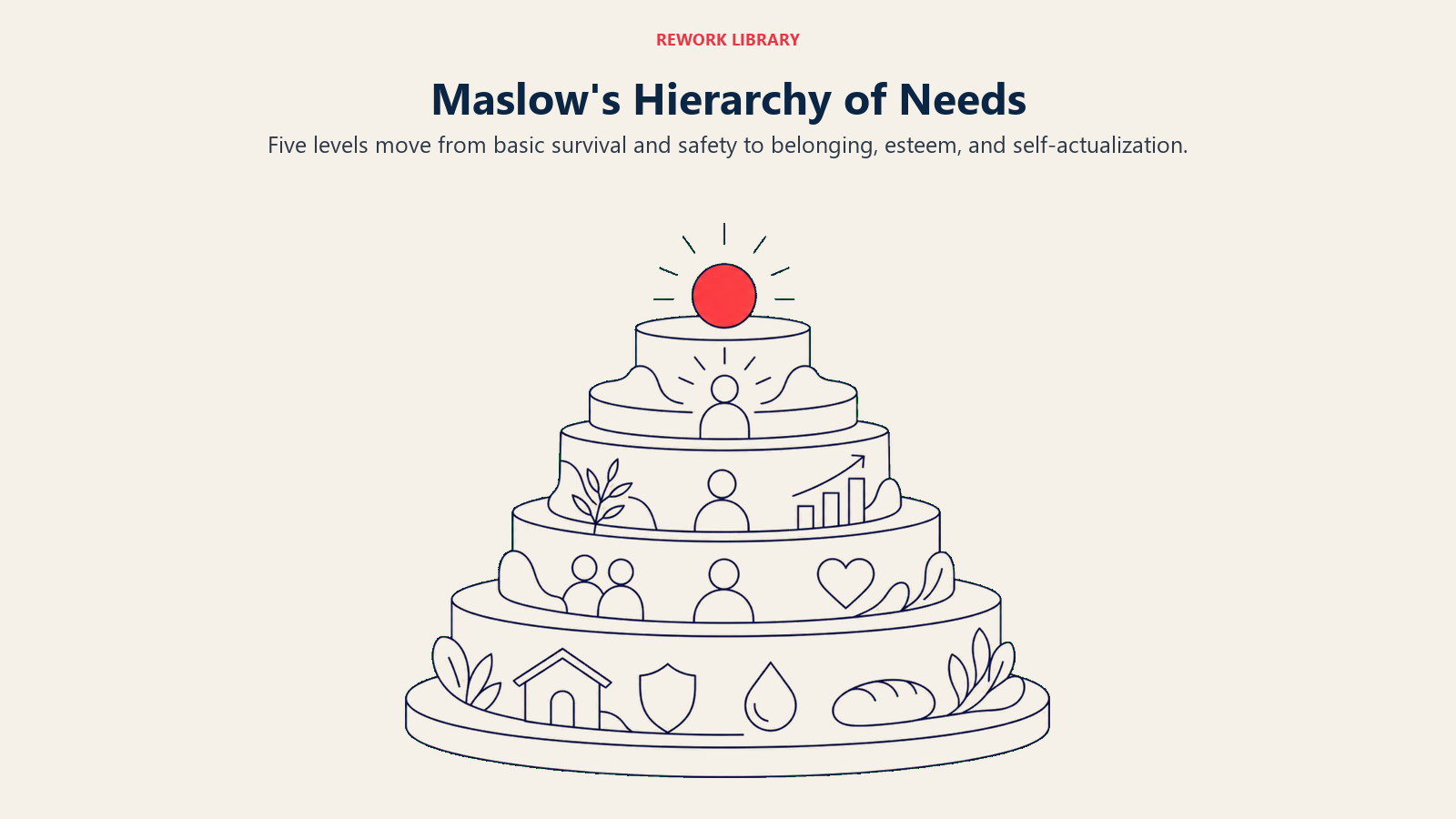
Maslows Bedürfnispyramide ist eine Motivationstheorie, die als fünfstufige Pyramide aufgebaut ist. Jede Stufe stellt eine Kategorie menschlicher Bedürfnisse dar, geordnet von den grundlegendsten (Nahrung, Unterkunft) bis zu den anspruchsvollsten (persönliches Wachstum und Sinn).
Das ursprüngliche Framework erschien in Maslows Aufsatz von 1943 „A Theory of Human Motivation". Er erweiterte es später in seinem Buch von 1954 Motivation and Personality. Die Pyramidenform ist eine spätere visuelle Interpretation; Maslow selbst schrieb in Begriffen der Prepotenz, was bedeutet, dass niedere Bedürfnisse Vorrang vor höheren haben, wenn sie unerfüllt sind.
Die fünf Ebenen, von unten nach oben:
- Physiologische Bedürfnisse (Nahrung, Wasser, Schlaf, Unterkunft)
- Sicherheitsbedürfnisse (Sicherheit, Stabilität, Gesundheit)
- Liebes- und Zugehörigkeitsbedürfnisse (Beziehungen, Gemeinschaft, Akzeptanz)
- Wertschätzungsbedürfnisse (Leistung, Respekt, Anerkennung)
- Selbstverwirklichungsbedürfnisse (Sinn, Wachstum, kreative Erfüllung)
Maslows große Erkenntnis: Man überspringt keine Ebenen. Eine hungrige Person wendet keine Energie auf Selbstwertgefühl auf. Eine Person, die sich körperlich unsicher fühlt, baut keine starken Beziehungen auf. Das Verständnis der Reihenfolge ist der Punkt, an dem die Theorie für Führungskräfte praktisch wird.
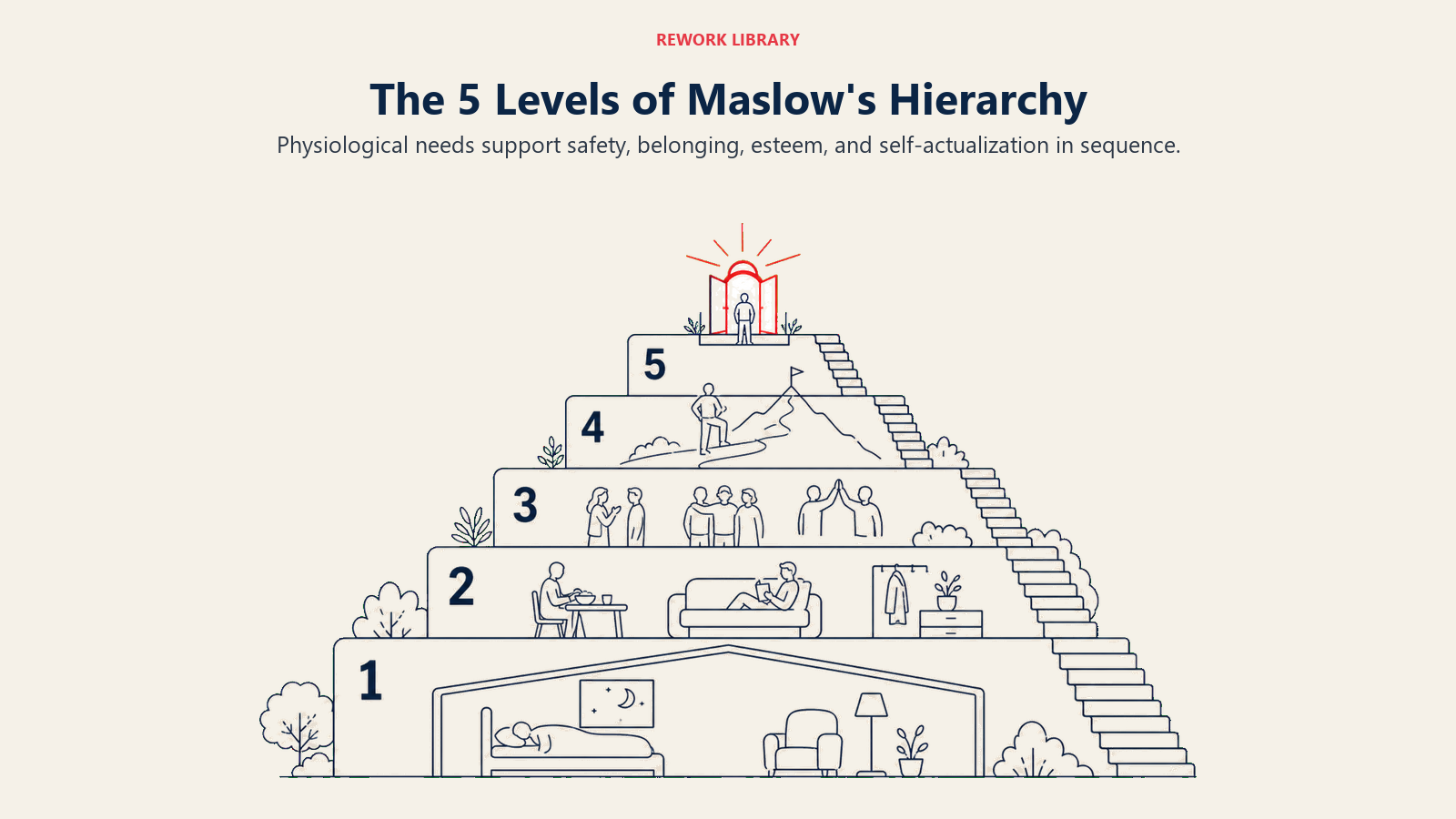
Die 5 Ebenen der Bedürfnisse
Was jede Ebene in klarer Sprache bedeutet, gepaart mit dem, wie sie in einem Arbeitsplatzkontext aussieht.
| Ebene | Bedarfskategorie | Kernfrage | Arbeitsplatzbeispiel |
|---|---|---|---|
| 1 | Physiologisch | „Kann ich überleben?" | Faires Gehalt, das die Lebenshaltungskosten deckt, Pausen, körperliche Komfort am Arbeitsplatz |
| 2 | Sicherheit | „Bin ich sicher?" | Arbeitsplatzsicherheit, klare Erwartungen, psychologische Sicherheit, Gesundheitsleistungen |
| 3 | Liebe / Zugehörigkeit | „Gehöre ich dazu?" | Teamkultur, Vorgesetztenbeziehungen, Inklusion, in Meetings gehört werden |
| 4 | Wertschätzung | „Werde ich wertgeschätzt?" | Anerkennung, Aufstiegsmöglichkeiten, Autonomie, Titel, Leistungs-Feedback |
| 5 | Selbstverwirklichung | „Wachse ich?" | Herausfordernde Arbeit, kreativer Spielraum, Mentoring, bedeutsamer Beitrag |
Ebene 1: Physiologische Bedürfnisse. Die Grundlage. Mitarbeitende brauchen Gehälter, die ihre Rechnungen tatsächlich decken. Sie brauchen einen Arbeitsplatz, der keine Gesundheitsgefahr darstellt. Sie brauchen Zeit zum Essen. Hier zu vernachlässigen lässt alles andere scheitern.
Ebene 2: Sicherheitsbedürfnisse. Körperliche Sicherheit ist wichtig, aber in Büroumgebungen ist die größere Frage die psychologische Sicherheit. Kann das Team Bedenken äußern, ohne Karrierenachteile zu befürchten? Kann es Projekte übernehmen, die möglicherweise nicht erfolgreich sind? Ohne das spielen Menschen auf Sicherheit, verstecken Probleme und innovieren nicht.
Ebene 3: Liebe und Zugehörigkeit. Menschen müssen das Gefühl haben, Teil von etwas zu sein. Isolation demotiviert stark, egal ob remote oder im Büro. Teamrituale, 1:1s und echte Inklusion bei Meetings sprechen diese Ebene direkt an.
Ebene 4: Wertschätzung. Zwei Teile: das Bedürfnis, sich kompetent zu fühlen, und das Bedürfnis, von anderen anerkannt zu werden. Hochleistende, die weder Anerkennung noch Autonomie bekommen, beginnen unabhängig vom Gehalt nach Ausstiegsmöglichkeiten zu suchen.
Ebene 5: Selbstverwirklichung. Der Gipfel. Mitarbeitende hier erledigen Arbeit, die sie genuinen Sinn gibt, und wachsen als Menschen. Hier lebt der freiwillige Mehreinsatz. Aber man gelangt nicht dorthin, indem man die anderen vier überspringt.
Maslows Bedürfnispyramide vs. Herzbergs Zwei-Faktoren-Theorie
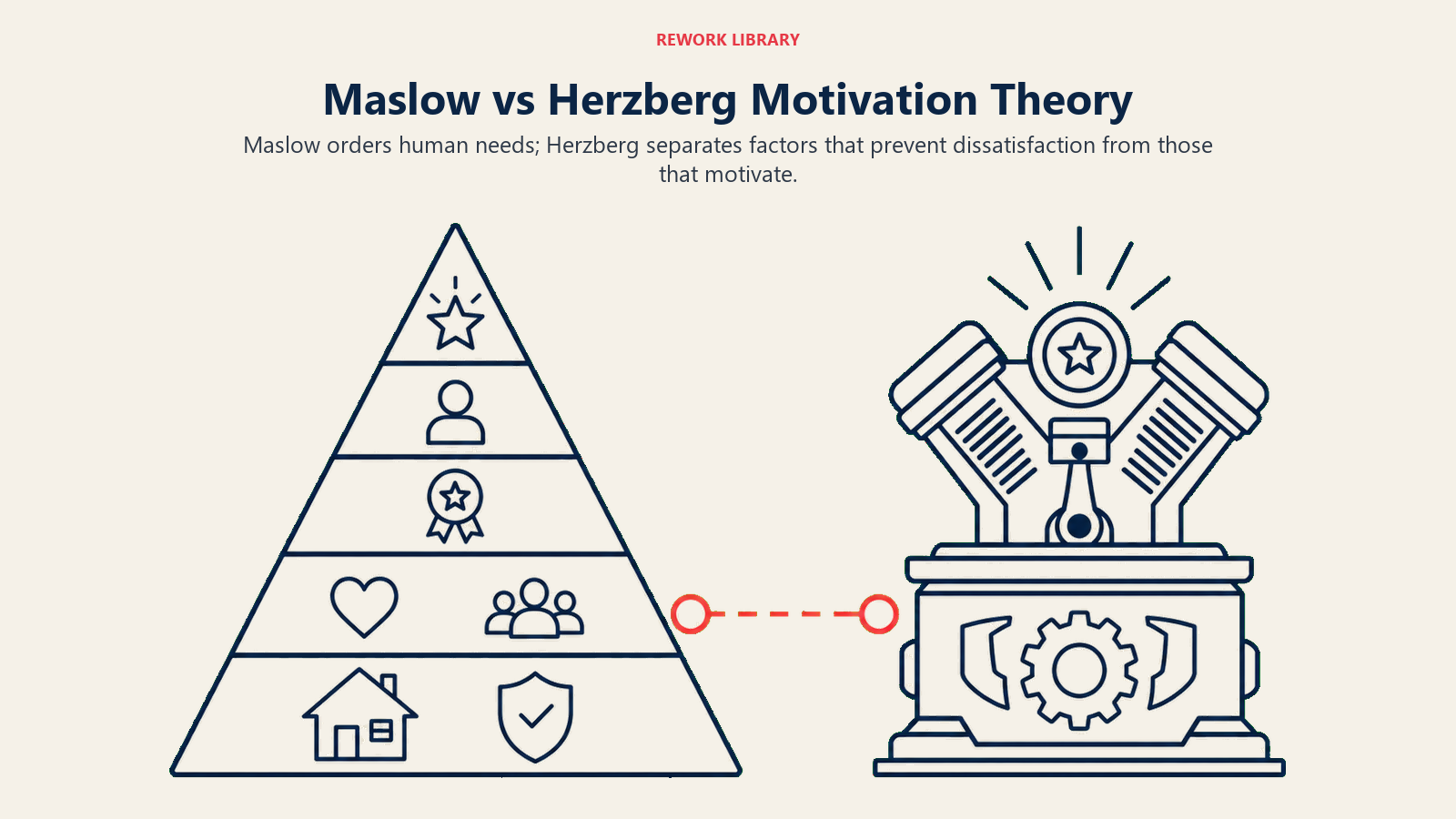
Sowohl Maslow als auch Frederick Herzberg versuchten zu erklären, was Motivation bei der Arbeit antreibt, und ihre Theorien überlappen sich genug, um Verwirrung zu stiften. Sie beantworten eigentlich verschiedene Fragen. Maslow beschreibt eine Abfolge von Bedürfnissen über das Leben; Herzberg konzentriert sich speziell darauf, was Arbeitszufriedenheit oder -unzufriedenheit verursacht.
Mehr Details zu Herzbergs Modell finden sich unter Herzbergs Zwei-Faktoren-Theorie.
| Dimension | Maslows Bedürfnispyramide | Herzbergs Zwei-Faktoren-Theorie |
|---|---|---|
| Fokus | Universelle menschliche Bedürfnisse, jeder Kontext | Arbeitsspezifische Zufriedenheit und Unzufriedenheit |
| Struktur | 5-stufige Hierarchie (sequenziell) | 2 Kategorien: Hygienefaktoren und Motivatoren |
| Kernaussage | Niedere Bedürfnisse müssen zuerst erfüllt werden | Hygienefaktoren verhindern Unzufriedenheit; Motivatoren schaffen Zufriedenheit |
| Hygiene-Äquivalent | Ebenen 1-2 (physiologisch, Sicherheit) | Gehalt, Unternehmenspolitik, Arbeitsbedingungen, Arbeitsplatzsicherheit |
| Motivator-Äquivalent | Ebenen 4-5 (Wertschätzung, Selbstverwirklichung) | Leistungserfolg, Anerkennung, Wachstum, Verantwortung |
| Zugehörigkeit (Ebene 3) | Eigenständige Ebene bei Maslow | Nicht sauber zugeordnet; teils Hygiene, teils Motivator |
| Empirische Stärke | Begrenzt (größtenteils selbstberichtet) | Ebenfalls begrenzt; Replikationen uneinheitlich |
| Bester Einsatz für Führungskräfte | Den Zustand und die Abfolge der Mitarbeitenden verstehen | Diagnostizieren, was Zufriedenheit reduziert vs. was sie aufbaut |
Der praktische Unterschied: Herzberg sagt, dass das Beheben von Hygienefaktoren (schlechtes Gehalt, schlechte Vorgesetztenbeziehungen) Menschen nicht motiviert. Es lässt sie nur aufhören, aktiv unglücklich zu sein. Maslow sagt, dass Menschen sich nicht mit Motivatoren beschäftigen, bis ihre grundlegenden Bedürfnisse erfüllt sind. Beide zusammen verwenden ergibt ein klareres Bild davon, was tatsächlich passiert.
Warum Maslows Bedürfnispyramide für Führungskräfte wichtig ist
Die Beständigkeit der Theorie beruht nicht auf wissenschaftlicher Präzision. Sie kommt von der diagnostischen Klarheit, die sie Führungskräften gibt, die noch nie eine Sprache dafür hatten, warum ihr Team scheinbar abgekoppelt ist.
Sie deutet Desengagement um. Wenn jemand unterdurchschnittlich leistet oder desengagiert ist, greifen die meisten Führungskräfte standardmäßig zu Motivationstaktiken: einem aufmunternden Gespräch, einem Bonus, mehr Autonomie. Maslow regt eine andere Frage an: Welches Bedürfnis wird nicht erfüllt? Wenn die Antwort Sicherheit oder Zugehörigkeit lautet, wird keine Motivationstaktik es beheben.
Sie erklärt, warum Gehalt nicht die einzige Antwort ist. Sobald Löhne die Grundbedürfnisse decken (Ebene 1) und Mitarbeitende sich finanziell sicher fühlen (Ebene 2), haben höhere Gehälter abnehmende Erträge auf die Motivation. Daher verlassen Ingenieure gut bezahlte Unternehmen für Startups, die niedrigere Gehälter bieten: Sie optimieren für Wertschätzung und Selbstverwirklichung, nicht für physiologische Sicherheit.
Sie verbindet direkt mit der Engagementtheorie. Gallups vier Kernengagement-Treiber (psychologische Sicherheit, Zugehörigkeit, Anerkennung, Wachstumsmöglichkeiten) ordnen sich sauber Maslows Ebenen 2 bis 5 zu. Führungskräfte, die die Hierarchie verstehen, können sehen, welchen Engagement-Hebel sie zuerst betätigen sollen.
Für einen umfassenderen Blick darauf, wie Motivationstheorien mit Führungsstilen zusammenhängen, siehe Was sind Führungstheorien?.
Wie man Maslows Bedürfnispyramide bei der Arbeit anwendet
Hier verdient das Framework seinen Platz. Ein Schritt-für-Schritt-Ansatz, abgestimmt auf jede Ebene.
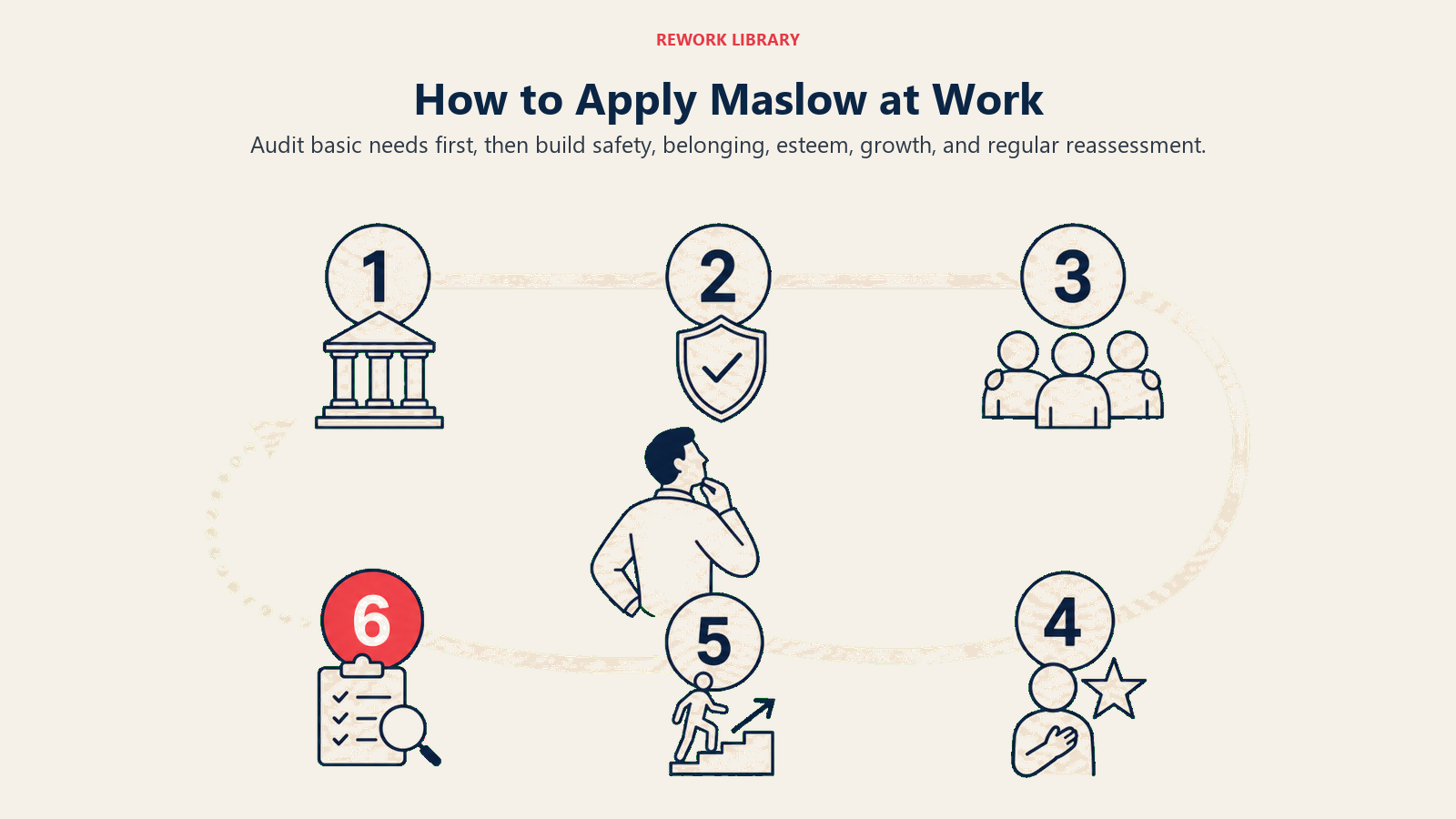
Schritt 1: Ebene 1 überprüfen (Physiologisch). Sind die Gehälter auf Ihrem Markt wirklich existenzsichernd? Ist die physische Umgebung funktional, nicht nur technisch sicher? Remote-Teams müssen prüfen: Ist das Homeoffice-Setup abgedeckt? Ergonomie, Internetzugang und Ausrüstung sind Ebene-1-Fragen für Remote-Mitarbeitende.
Schritt 2: Ebene 2 aufbauen (Sicherheit). Klare Erwartungen setzen, damit die Menschen wissen, wie „gut" aussieht. Willkürliche Änderungen an Rollen oder Aufgabenbereich reduzieren. Explizite psychologische Sicherheit schaffen, indem man selbst Verletzlichkeit vorlebt. Wenn man offen sagt „Ich habe das falsch gemacht", gibt man dem Team die Erlaubnis, dasselbe zu tun.
Schritt 3: In Ebene 3 investieren (Zugehörigkeit). Nicht davon ausgehen, dass Kultur sich selbst aufbaut. Strukturierte 1:1s, Teamrituale (selbst kurze) und echte Inklusion bei Entscheidungen signalisieren, dass jede Person dazugehört. Für Remote-Teams erfordert Zugehörigkeit bewusste Anstrengung, nicht nur einen Slack-Kanal.
Schritt 4: Ebene 4 ansprechen (Wertschätzung). Anerkennung muss spezifisch und zeitnah sein. „Gute Arbeit letztes Quartal" ist Rauschen. „Die Art, wie Sie diese Kundensituation im Februar gehandhabt haben, hat den Account gerettet" trifft. Anerkennung mit echter Autonomie paaren: Eigentümerschaft über Projekte geben, nicht nur Aufgaben.
Schritt 5: Ebene 5 ermöglichen (Selbstverwirklichung). Menschen helfen, ihre tägliche Arbeit mit einem größeren Zweck zu verbinden. In Richtung ihrer Entwicklungsziele coachen, nicht nur die Ziele dieses Quartals. Stretch-Projekte zuweisen, bei denen die Person echten Spielraum hat, zu entscheiden, wie das Problem gelöst wird.
Schritt 6: Regelmäßig neu bewerten. Bedürfnisse ändern sich. Die Ebene-1- und Ebene-2-Bedürfnisse einer neuen Mutter oder eines neuen Vaters können gestiegen sein. Ein langjähriger Mitarbeitender steckt möglicherweise bei Ebene 4 fest und ist bereit für ein Gespräch über Ebene-5-Arbeit. Ein vierteljährliches 1:1-Check-in mit der Frage „Was ist Ihnen gerade am wichtigsten?" gibt die benötigten Daten.
Führungskräfte, die dieser Reihenfolge folgen, stellen fest, dass ihre Coaching-Gespräche gezielter werden und ihre Interventionen tatsächlich wirken. Für ein ergänzendes Framework, das erklärt, wie Menschen berechnen, ob sich der Einsatz lohnt, siehe Erwartungstheorie.
Arbeitsplatzbeispiele nach Ebene
| Ebene | Signal für unerfülltes Bedürfnis | Reaktion der Führungskraft |
|---|---|---|
| 1 - Physiologisch | Mitarbeitende erwähnt finanzielle Belastung; chronische Müdigkeit | Gehalts-Benchmarks überprüfen; Arbeitsbelastung und Pausenzeiten prüfen |
| 2 - Sicherheit | Zurückhaltung beim Teilen von Problemen; Angst vor Schuldzuweisungen in Retrospektiven | Psychologische Sicherheit vorleben; Arbeitsplatzsicherheit klären; Mehrdeutigkeiten reduzieren |
| 3 - Zugehörigkeit | Sozialer Rückzug; Auslassen von Teammeetings; Gefühl ein Außenseiter zu sein | Mehr 1:1s; Teamrituale aufbauen; Inklusionspraktiken verbessern |
| 4 - Wertschätzung | Geringe Initiative trotz Fähigkeiten; häufige Rückversicherung suchen | Spezifische Anerkennung geben; Autonomie erhöhen; klaren Wachstumspfad bereitstellen |
| 5 - Selbstverwirklichung | Langeweile bei kompetenter Arbeit; Interesse an angrenzenden Projekten | Strategische Stretch-Projekte zuweisen; Lernen unterstützen; mit Mission verbinden |
Kritik und Grenzen
Maslows Bedürfnispyramide ist tatsächlich nützlich, hat aber reale Probleme, die es wert sind, bekannt zu sein.
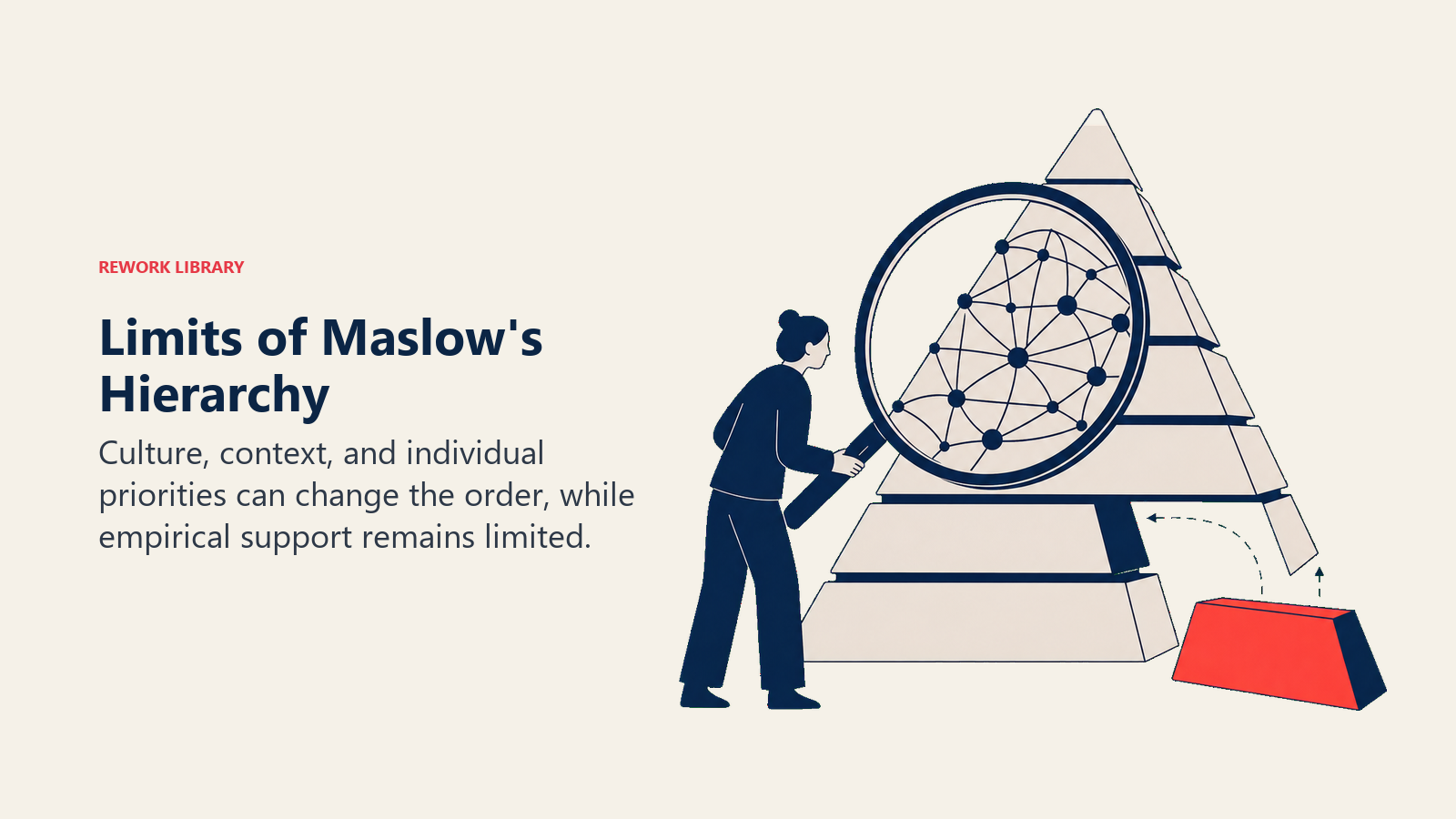
Die sequenzielle Reihenfolge ist nicht universell. Maslow argumentierte, dass Bedürfnisse in der Reihenfolge erfüllt werden müssen. Aber kulturübergreifende Forschung zeigt, dass das nicht immer zutrifft. In vielen kollektivistischen Kulturen hat Zugehörigkeit (Ebene 3) Vorrang vor Wertschätzung (Ebene 4) und manchmal vor Sicherheit (Ebene 2). Künstler und Aktivisten haben historisch gesehen physiologische Sicherheit für Selbstverwirklichung geopfert. Die Hierarchie beschreibt ein gängiges Muster in westlichen, individualistischen Gesellschaften. Sie ist kein Gesetz.
Die empirische Unterstützung ist dünn. Maslow baute seine Theorie größtenteils auf biografischen Analysen von Menschen auf, die er als selbstverwirklicht betrachtete, darunter Abraham Lincoln und Albert Einstein. Das ist keine wissenschaftliche Stichprobe. Versuche, die Fünf-Ebenen-Struktur durch kontrollierte Studien zu validieren, haben gemischte Ergebnisse geliefert. Einige Forschende haben Unterstützung für eine Zwei-Faktoren-Version gefunden (Defizitbedürfnisse vs. Wachstumsbedürfnisse), aber nicht die fünfstufige Pyramide.
Selbstverwirklichung ist schwer zu definieren. Was als Selbstverwirklichung gilt, hängt von der Person ab. Es ist die am wenigsten operationalisierbare Ebene, was sie nahezu unmöglich zu empirisch zu untersuchen macht und in der Praxis schwer über „Menschen helfen zu wachsen" hinaus anzuwenden ist.
Sie unterschätzt sozialen Kontext. Maslows ursprüngliches Framework behandelt Bedürfnisse als individuell. Aber Motivation wird auch durch Kontext geprägt: Teamkultur, Marktbedingungen, Familiensituation, Identität. Zwei Personen mit demselben Gehalt und demselben Vorgesetzten können sich aufgrund von Lebensumständen außerhalb der Arbeit auf völlig verschiedenen Ebenen befinden.
Keine dieser Kritikpunkte macht das Framework nutzlos. Sie bedeuten, dass es als diagnostische Linse, nicht als wissenschaftliches Gesetz behandelt werden sollte. Es verwenden, um Hypothesen darüber zu generieren, was Motivation blockiert. Diese Hypothesen dann in echten Gesprächen testen.
Für eine ergänzende Perspektive zu Maslows höheren Ebenen, siehe Transformationale vs. transaktionale Führung, das dem Unterschied zwischen dem Erfüllen niederer Bedürfnisse (transaktional) und dem Freischalten höherer (transformational) entspricht.
Best Practices
- Mit Diagnose beginnen, nicht mit Vorschrift. Vor der Anwendung einer Motivationstaktik identifizieren, welche Ebene unerfüllt ist. Die falsche Intervention verschwendet Zeit und untergräbt Vertrauen.
- Nicht davon ausgehen, dass das Team auf Ebene 4 ist. Viele Führungskräfte agieren so, als ob alle bereit für Wertschätzungsarbeit wären, wenn Sicherheits- oder Zugehörigkeitslücken noch bestehen. Erst die Ebene-2- und Ebene-3-Arbeit leisten.
- In 1:1s nutzen, nicht nur in Strategiedokumenten. Die Hierarchie ist am nützlichsten in einem 30-minütigen Gespräch mit offenen Fragen und Zuhören. „Was ist Ihnen in Ihrer Rolle gerade am wichtigsten?" ist eine der nützlichsten Fragen, die eine Führungskraft stellen kann.
- Mit Herzberg kombinieren. Herzbergs Zwei-Faktoren-Theorie verwenden, um zu identifizieren, was aktiv Unzufriedenheit erzeugt (Hygienelücken) vs. was echte Motivation aufbaut. Sie ergänzen sich.
- Vierteljährlich neu bewerten. Bedürfnisse ändern sich mit Lebensereignissen, Karrierestufe und Teamdynamik. Ein Framework, das einmal beim Onboarding verwendet wurde, ist 18 Monate später nicht mehr aktuell.
- Für den eigenen Kontext kalibrieren. Bei der Führung in einer kollektivistischen Kultur erwarten, dass Zugehörigkeit im Verhältnis zu individuellem Wertschätzungsgefühl höher priorisiert wird. Bei Startups mit hoher Jobungewissheit können Ebene-2-Probleme selbst für gut bezahlte Führungskräfte dominieren.
Motivation zu verstehen ist nur ein Teil von Leadership. Wie Autorität strukturiert wird, wie sehr Menschen vertraut wird, sich selbst zu steuern, und wie auf Rückschläge reagiert wird, prägen die Entwicklung des Teams ebenso wie jedes Bedürfnis-Framework. Für die zugrundeliegenden Annahmen, die Managementverhalten antreiben, siehe McGregors Theorie X und Theorie Y, das direkt unterhalb Maslows in der Linie der humanistischen Managementtheorie steht. Für einen Leitfaden zum Aufbau des Einflusses, der alle fünf Ebenen anspricht, ist 5 Führungsebenen die nächste empfehlenswerte Lektüre.

Senior Operations & Growth Strategist
On this page
- Was ist Maslows Bedürfnispyramide?
- Die 5 Ebenen der Bedürfnisse
- Maslows Bedürfnispyramide vs. Herzbergs Zwei-Faktoren-Theorie
- Warum Maslows Bedürfnispyramide für Führungskräfte wichtig ist
- Wie man Maslows Bedürfnispyramide bei der Arbeit anwendet
- Arbeitsplatzbeispiele nach Ebene
- Kritik und Grenzen
- Best Practices