Blake-Mouton Managerial Grid: Die 5 Führungsstile
Turn this article into takeaways for your work.


Each assistant summarizes the article only for you and suggests best practices for your work.
Das Blake-Mouton Managerial Grid ist eines der praktischsten je entwickelten Werkzeuge, um zu verstehen, wie eine Führungskraft tatsächlich führt und nicht nur, wie sie zu führen glaubt. Es bildet jedes Führungsverhalten auf zwei Achsen ab und liefert eine Koordinate, die Sie in einen von fünf klar umrissenen Stilen einordnet. Kein Persönlichkeitsquiz erforderlich. Nur ehrliche Reflexion darüber, worauf Sie Ihre Aufmerksamkeit richten.
Was ist das Blake-Mouton Managerial Grid?
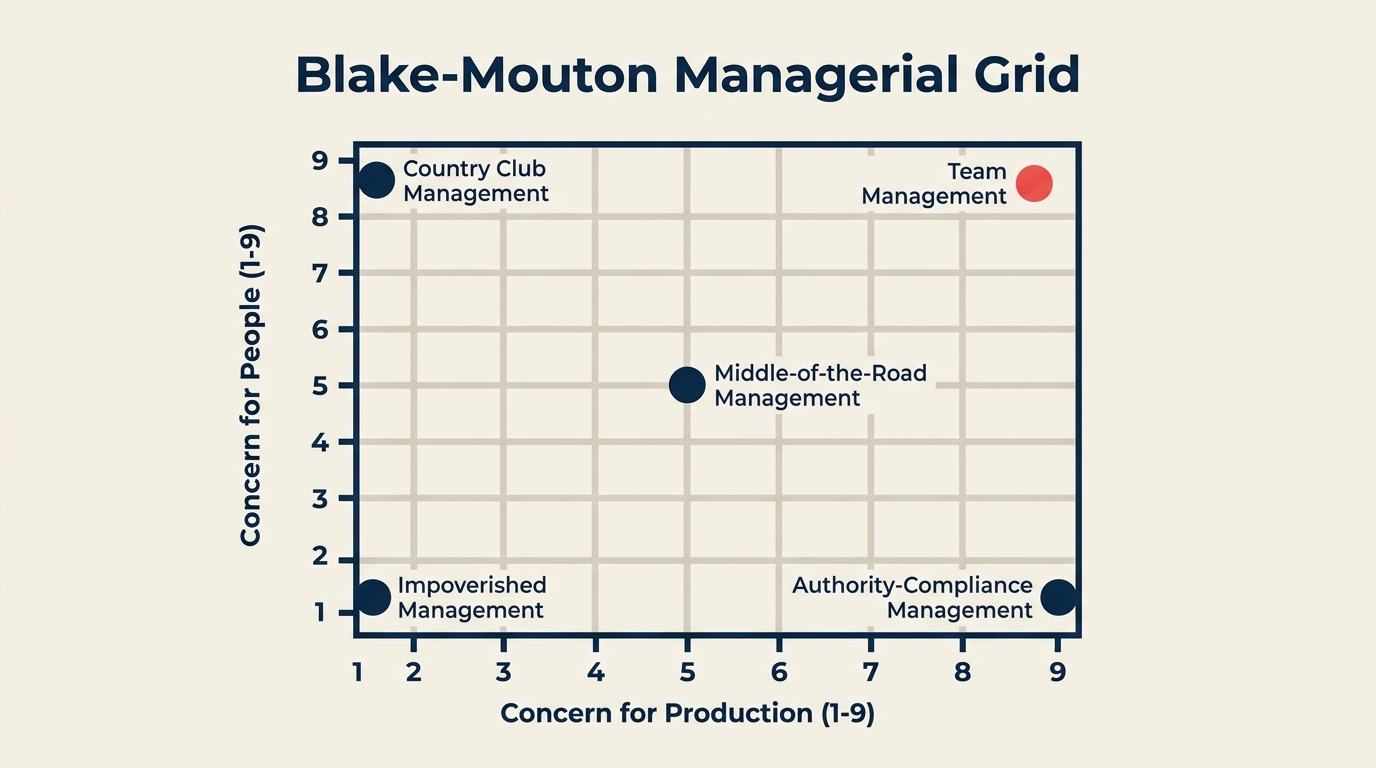
Das Blake-Mouton Managerial Grid ist ein verhaltensorientiertes Führungsframework, das den Führungsstil einer Führungskraft auf einer 9x9-Matrix anhand zweier Variablen abbildet: Mitarbeiterorientierung und Aufgabenorientierung. Jede Achse läuft von 1 (geringe Ausprägung) bis 9 (hohe Ausprägung) und ergibt 81 mögliche Koordinaten. Fünf dieser Koordinaten repräsentieren die prägenden Führungsarchetypen.
Wichtige Fakten
- Das Grid wurde erstmals in Robert Blake und Jane Moutons Buch „The Managerial Grid" von 1964 veröffentlicht und in mehreren Auflagen neu herausgegeben, zuletzt als „Leadership Dilemmas Grid Solutions" (Gulf Publishing, 1991).
- Studien zeigen, dass Teamführung (9,9) über einen Zwölfmonatszeitraum mit 20-30 % höheren Team-Engagement-Werten korreliert als autoritätsorientierte Führung (9,1) (Gallup State of the Workplace, 2024).
- Das Modell beeinflusste spätere verhaltensorientierte Führungsframeworks, darunter die Ohio State Leadership Studies und Hersey-Blanchard Situational Leadership (Journal of Leadership Studies, 2018).
Die Psychologen Robert Blake und Jane Mouton stellten das Modell 1964 an der Universität von Texas vor. Ihr zentrales Argument war klar: Wirksame Führung ist keine Persönlichkeitseigenschaft, mit der man geboren wird. Es ist ein Verhaltensmuster, das man messen, abbilden und bewusst verändern kann. Diese Positionierung machte das Grid zu einem Grundpfeiler der verhaltensorientierten Führungstheorie für Jahrzehnte.
Das Grid unterscheidet sich von eigenschaftsbasierten Modellen (die fragen: „Wer bist du?"), indem es fragt: „Was tust du tatsächlich?" Und es unterscheidet sich von der situativen Führungstheorie, weil es argumentiert, dass ein Stil, nämlich Teamführung bei 9,9, universell überlegen ist und nicht kontextabhängig.
Die zwei Achsen: Mitarbeiterorientierung vs. Aufgabenorientierung
Blake und Mouton wählten bewusst die Formulierung „Orientierung auf" statt „Ergebnisse bei". Eine Führungskraft kann sich tief um Menschen sorgen, ohne ein glückliches Team zu produzieren. Eine Führungskraft kann auf Leistung drängen, ohne Output zu liefern. Die Achsen messen Orientierung und Absicht, keine Ergebnisse.
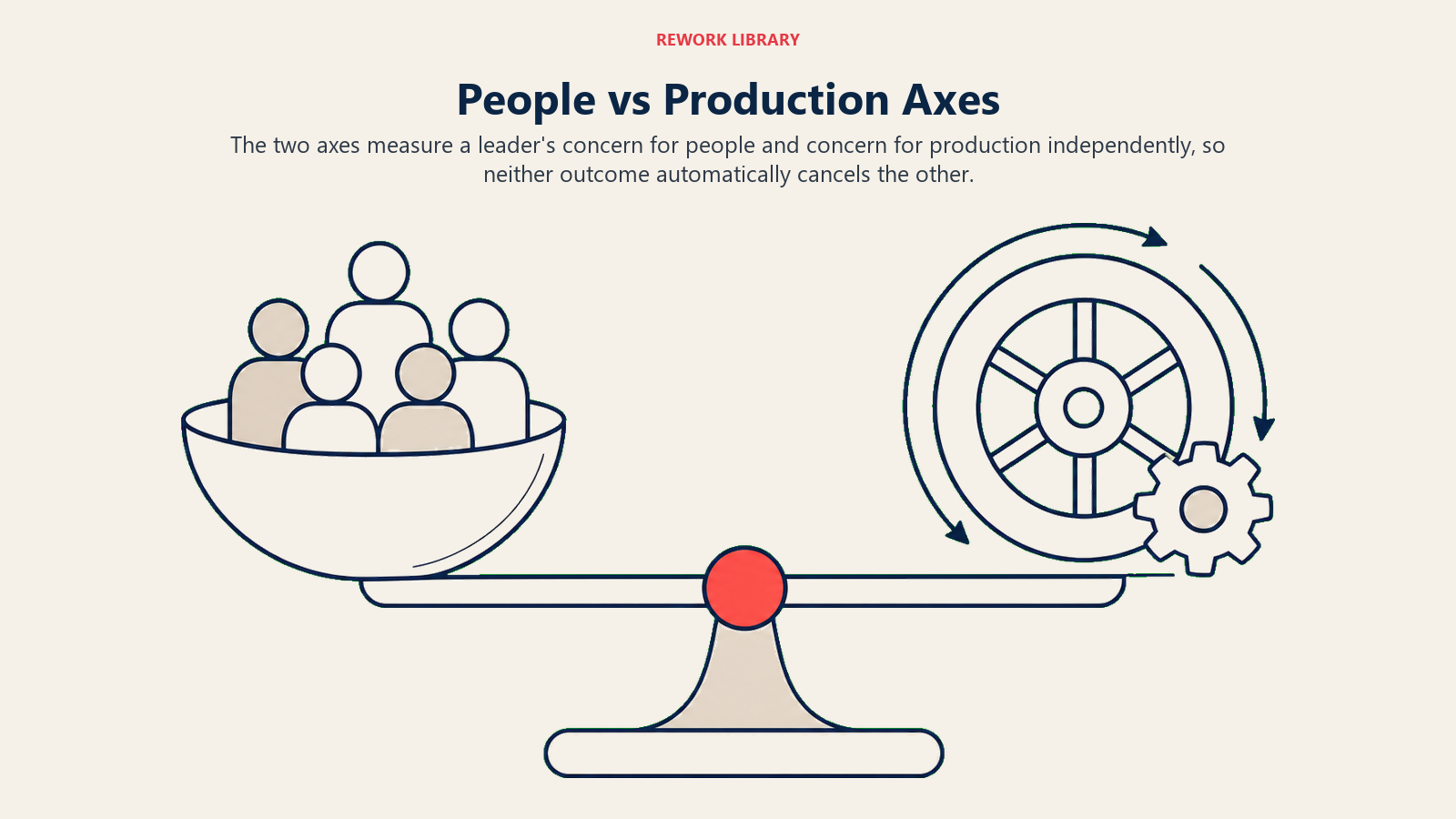
Mitarbeiterorientierung umfasst, inwieweit eine Führungskraft die Bedürfnisse der Teammitglieder, ihre Moral, ihre Arbeitszufriedenheit, Beziehungen und Entwicklung priorisiert. Ein hoher Wert hier bedeutet nicht Weichheit. Er bedeutet, dass die Führungskraft menschliches Wohlbefinden wirklich in jede Entscheidung einfließen lässt.
Aufgabenorientierung umfasst, inwieweit eine Führungskraft Output, Effizienz, Qualität, Fristen und messbare Ergebnisse priorisiert. Ein hoher Wert hier bedeutet nicht Kälte. Er bedeutet, dass die Führungskraft die Aufgabenerfüllung als ernsthafte Verantwortung betrachtet.
Beide Achsen laufen von 1 bis 9. Ein Wert von 1 signalisiert kaum Ausprägung; ein Wert von 9 signalisiert maximale Ausprägung. Die meisten realen Führungskräfte clustern irgendwo in der Mitte, weshalb die Koordinate 5,5 zum eigenen benannten Stil wurde.
Die eigentliche Stärke des Frameworks liegt darin, dass die beiden Achsen unabhängig sind. Sie müssen nicht eine für die andere opfern. Das ist die zentrale Behauptung von Blake und Mouton: Man kann mit maximaler Orientierung auf beide gleichzeitig führen, und die Koordinate 9,9 ist, wo das gelingt.
Die fünf Führungsstile
Blake und Mouton benannten fünf Koordinaten als die prägenden Stile. Jede zu verstehen erfordert, den Antrieb dahinter zu betrachten, wo er natürlich auftaucht und was er das Team im Laufe der Zeit kostet.
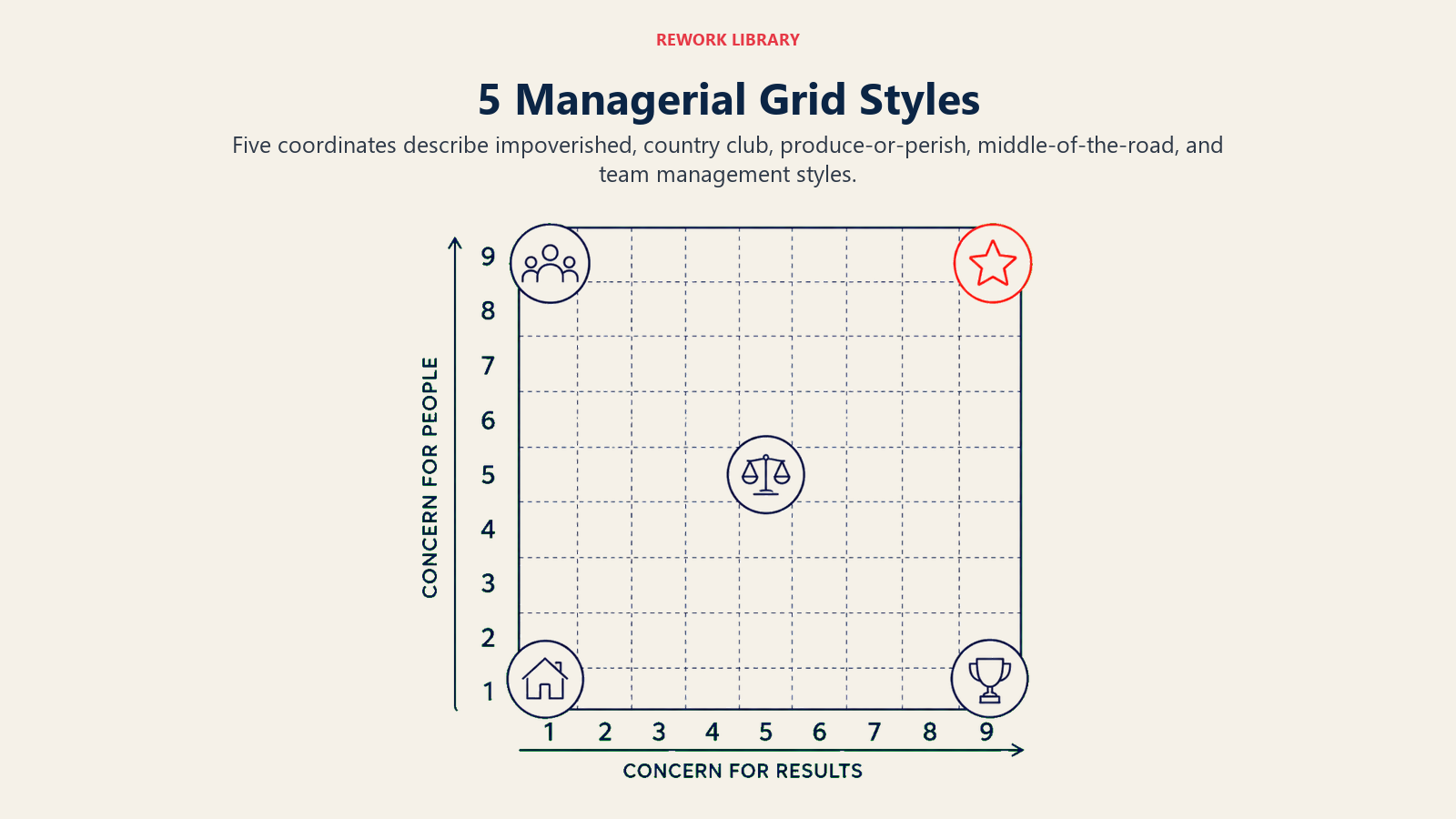
Impoverished Management (1,1): Geringe Menschen-, geringe Aufgabenorientierung
Impoverished Management ist der Stil einer Führungskraft, die sich weitgehend von Mitarbeitenden und Arbeit gleichermaßen distanziert hat. Sie tut das Minimum, um eine Position zu halten: leitet Anweisungen von oben weiter, bleibt aus Konflikten heraus und meidet Verantwortlichkeit.
Dieser Stil tritt in Organisationen auf, in denen eine Führungskraft zu oft übergangen wurde, die Zeit bis zur Rente zählt oder schlicht ausgebrannt ist. Er erscheint auch in bürokratischen Umgebungen, in denen Beschäftigungssicherheit von der Leistung entkoppelt ist.
Stärken? Fast keine. Es gibt keine zwischenmenschliche Reibung, weil es kein echtes Engagement gibt. Aber das ist keine Stärke, sondern ein Mangel.
Die Schwächen sind gravierend. Teammitglieder erhalten weder Orientierung noch Unterstützung. Qualität nimmt ab. Die fähigsten Menschen gehen zuerst, weil sie wachsen wollen. Was bleibt, ist ein Team, das auf Trägheit läuft.
Eine Vertriebsleitung in einer Altdivision, die auf jede Frage mit „folgen Sie einfach dem Playbook" antwortet und nie an Pipeline-Reviews teilnimmt, ist in der Praxis bei 1,1, unabhängig von der Berufsbezeichnung.
Country Club Management (1,9): Hohe Menschen-, geringe Aufgabenorientierung
Country Club Management priorisiert Beziehungen und Harmonie über alles andere. Diese Führungskraft möchte, dass sich Menschen bei der Arbeit wohlfühlen, meidet schwierige Gespräche und schützt die Teammoral selbst auf Kosten der Ergebnisse.
Es tritt in Umgebungen auf, in denen eine Führungskraft wegen ihrer Beliebtheit und nicht wegen ihrer Erfolgsbilanz befördert wurde, oder in Kulturen, in denen Konfliktvermeidung belohnt wird. Es ist auch häufig bei Führungskräften, die kürzlich ein kämpfendes Team geerbt haben und überkompensieren, indem sie sich ausschließlich auf die Moral konzentrieren.
Die Stärke ist real: Menschen mögen es, für diese Führungskraft zu arbeiten. Psychologische Sicherheit ist hoch, die Fluktuation kann gering sein, und das Team fühlt sich unterstützt.
Aber die Leistung leidet. Hartes Feedback wird nicht gegeben. Schwache Leistungsträger bleiben zu lange. Fristen werden nicht eingehalten, weil die Führungskraft nicht zurückschiebt, wenn jemand mehr Zeit braucht. Im Laufe der Monate erodiert der Output des Teams, auch wenn die Zufriedenheitswerte stabil bleiben. Es ist ein Modell, das kurzfristig gut aussieht und langfristig scheitert.
Eine Produktmanagerin, die die Schätzungen eines Teammitglieds nie hinterfragt und immer die Seite des Teams gegenüber Stakeholdern einnimmt, auch wenn das Team offensichtlich vom Kurs abgekommen ist, agiert bei 1,9.
Authority-Compliance (9,1): Geringe Menschen-, hohe Aufgabenorientierung
Authority-Compliance Management betrachtet die Aufgabe als alles und die Person als Ressource. Diese Führungskraft treibt hart auf Ergebnisse hin, setzt anspruchsvolle Standards und erwartet Compliance ohne viel Erklärung oder Empathie.
Es tritt in Hochdruckumgebungen auf: Turnarounds, militärähnliche Operationen, Krisensituationen oder Kulturen, in denen nur Zahlen zählen. Einige Führungskräfte landen bei 9,1, weil sie wirklich glauben, Ergebnisse sprächen für sich und weiche Anliegen seien Ablenkungen.
Die Stärke ist echter Output. Kurzfristige Produktivität ist oft hoch. Klare Erwartungen und Verantwortlichkeitsstrukturen bedeuten, dass Arbeit erledigt wird.
Aber die Kosten summieren sich. Talentierte Menschen bleiben nicht, wo sie sich wie Personalaufwand fühlen. Moral sinkt, Vertrauen erodiert und schließlich schnellt die Fluktuation in die Höhe. Wenn Schlüsselpersonen gehen, verlässt das Wissen, das sie tragen, das Unternehmen mit ihnen. Die Führungskraft interpretiert Abgänge oft als Schwäche des Mitarbeitenden und nicht als Signal aus dem System.
Eine Produktionsleiterin, die jede Quartalskennzahl erreicht, aber eine jährliche Personalfluktuation von 40 % sieht, ist wahrscheinlich bei 9,1. Die Produktionsdaten sehen großartig aus, bis Rekrutierungskosten und Einarbeitungszeit die P&L treffen.
Middle-of-the-Road (5,5): Ausgewogener Kompromiss
Middle-of-the-Road Management ist der Stil des gewissenhaften Kompromisslers. Diese Führungskraft versucht, Menschen und Aufgaben zu balancieren, indem sie bei beidem den Mittelweg geht. Sie maximiert nichts, ignoriert aber auch nichts.
Es ist der häufigste Stil in großen Organisationen, besonders dort, wo politisches Überleben genauso wichtig ist wie tatsächliche Leistung. Die 5,5-Führungskraft macht selten Feinde und selten Durchbrüche.
Die Stärke ist Stabilität. Dieser Stil liefert konsistente, vorhersehbare, ausreichende Ergebnisse. Er explodiert nicht, und er inspiriert nicht.
Die Schwäche ist die Decke. „Ausreichend" ist der Feind von Exzellenz. In wettbewerbsintensiven Märkten ist 5,5-Management eine Strategie, um in Zeitlupe Boden zu verlieren. Die Führungskraft findet immer den Kompromiss, der alle gerade zufrieden genug hält zu bleiben, aber niemand leistet seine beste Arbeit. Im Laufe der Zeit etabliert sich die Kultur mit „gut genug" als Standard.
Ein Abteilungsleiter, der immer 70 % der Budgetanfragen genehmigt, keine Initiative vollständig unterstützt oder abbricht und seinen Führungsstil als „ausgewogen" beschreibt, sitzt wahrscheinlich bei 5,5.
Teamführung (9,9): Hohe Menschen-, hohe Aufgabenorientierung
Teamführung ist der Stil, den Blake und Mouton als ideal identifizierten. Diese Führungskraft hält maximale Orientierung auf Menschen und Ergebnisse aufrecht und behandelt sie nicht als konkurrierende Prioritäten, sondern als sich gegenseitig verstärkende. Sie glaubt, dass engagierte, unterstützte Menschen außergewöhnliche Ergebnisse erzielen.
Es zeigt sich in hochleistenden Teams, in denen die Führungskraft die Arbeit geleistet hat, echtes Vertrauen aufzubauen, klare Erwartungen zu setzen, echte Beteiligung an Entscheidungen einzuladen und an Standards festzuhalten, ohne Respekt zu opfern.
Die Stärke ist kumulativ. Dieser Stil baut Teamfähigkeiten im Laufe der Zeit auf. Menschen wachsen, Mitarbeiterbindung verbessert sich, Leistung steigt, und das Team kann mit mehr Komplexität umgehen als ein Team, das unter einem anderen Stil zusammengestellt wurde.
Die Schwäche, wenn man sie so nennen kann, ist der Aufwand. Dieser Stil erfordert emotionale Intelligenz, konsistente Präsenz und eine langfristige Sichtweise. Er ist schwieriger unter Druck aufrechtzuerhalten als einfach auf Output zu drängen (9,1) oder sich in Freundlichkeit zurückzuziehen (1,9).
Eine Engineering-Direktorin, die wöchentliche 1:1s führt, für die Ressourcen des Teams gegenüber der Geschäftsleitung eintritt, hartes Feedback mit Konkretheit gibt und dennoch vorhersehbar liefert, demonstriert 9,9 in der Praxis.
Vergleich der fünf Stile
Die fünf Stile unterscheiden sich am deutlichsten darin, wie sie Moral, Standards, Nachhaltigkeit und kurzfristigen Output gegeneinander abwägen.
| Stil | Koordinaten | Stärken | Schwächen | Kurzfristiges Ergebnis | Langfristiges Ergebnis |
|---|---|---|---|---|---|
| Impoverished | (1,1) | Vermeidet Konflikte | Keine Orientierung, keine Unterstützung | Trägheit | Zusammenbruch |
| Country Club | (1,9) | Hohe Moral, geringe Fluktuation | Schwache Verantwortlichkeit, weicher Output | Zufriedenes Team | Verfehlte Ziele |
| Authority-Compliance | (9,1) | Hoher Output, klare Standards | Burnout, hohe Fluktuation | Starke Zahlen | Talentabgang |
| Middle-of-the-Road | (5,5) | Stabil, wenig Drama | Mittelmäßige Decke, Drift | Ausreichende Ergebnisse | Wettbewerblicher Rückgang |
| Teamführung | (9,9) | Hoher Output und hohe Moral | Erfordert anhaltenden Einsatz | Starke Ergebnisse | Wachstum und Mitarbeiterbindung |
Die Tabelle macht die Abwägungen sichtbar. Country Club und Authority-Compliance sind Spiegelbilder: Jeder maximiert eine Achse auf Kosten der anderen. Impoverished ignoriert beide. Middle-of-the-Road weicht aus. Teamführung ist der einzige Stil, der die Abwägung als unvermeidlich ablehnt.
Ein praktischer Hinweis für Führungskräfte: Die meisten Menschen fallen unter Druck in einen der vier nicht-idealen Stile zurück. Die 9,1-Führungskraft wird enger, wenn etwas schiefläuft. Die 1,9-Führungskraft wird weicher. Das eigene Rückfallmuster unter Stress zu kennen ist mindestens genauso nützlich wie den normalen Betriebsstil zu kennen.
Wie Sie Ihren Stil identifizieren
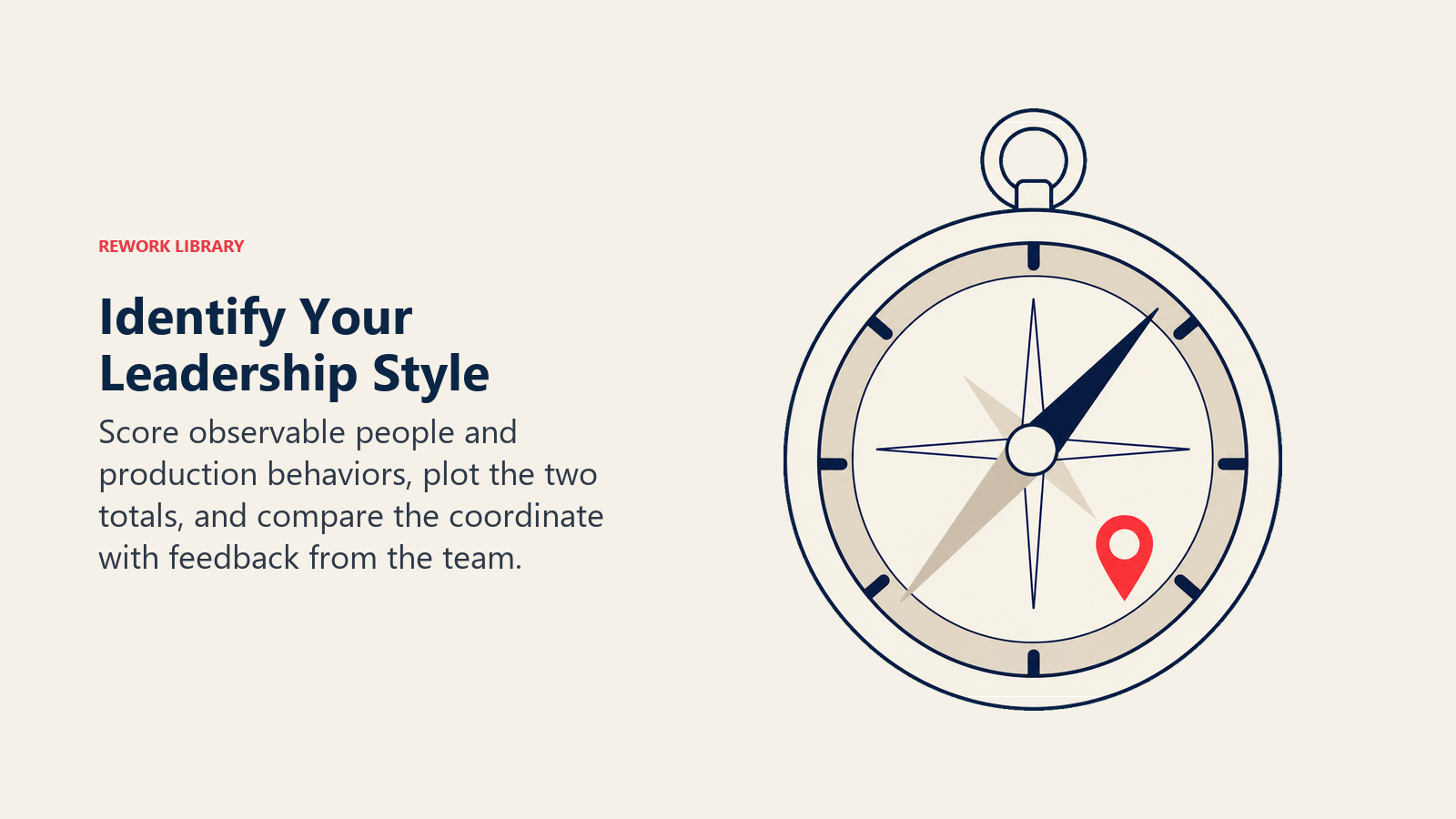
Der einfachste Weg, Ihre Koordinate zu finden, ist, sechs Fragen ehrlich zu beantworten. Bewerten Sie jede von 1 (selten) bis 5 (fast immer).
| # | Frage | Achse |
|---|---|---|
| 1 | Ich erkundige mich mindestens wöchentlich bei Teammitgliedern nach ihrer Arbeitsbelastung und ihrem Wohlbefinden. | Menschen |
| 2 | Ich passe meine Pläne oder Zeitrahmen an, wenn ein Teammitglied persönlich in Schwierigkeiten ist. | Menschen |
| 3 | Ich priorisiere das Einhalten von Fristen, auch wenn das Team unter Druck steht. | Aufgabe |
| 4 | Ich verfolge Leistungskennzahlen und bespreche sie regelmäßig mit dem Team. | Aufgabe |
| 5 | Ich führe direkte Gespräche mit Personen, die schwache Leistung zeigen, statt um sie herumzuarbeiten. | Beide |
| 6 | Ich widerspreche der Unternehmensleitung, wenn ich denke, ein Ziel ist für mein Team unrealistisch. | Beide |
Auswertungshinweise:
- Addieren Sie Ihre Punkte für Fragen 1, 2 und die Hälfte von 5 und 6. Skalieren Sie auf 1-9. Das ist Ihr Mitarbeiterorientierungs-Wert.
- Addieren Sie Ihre Punkte für Fragen 3, 4 und die Hälfte von 5 und 6. Skalieren Sie auf 1-9. Das ist Ihr Aufgabenorientierungs-Wert.
Tragen Sie das Ergebnis als (Aufgabe, Menschen) auf dem 9x9-Raster ein. Wenn Sie (7,6) erzielen, tendieren Sie zur Teamführung mit leichter Aufgabenbetonung. Bei (3,7) liegen Sie näher am Country Club. Wenn beide Werte unter 4 liegen, befinden Sie sich im Impoverished-Bereich.
Betrachten Sie den Wert nicht als Urteil. Betrachten Sie ihn als Ausgangspunkt. Der Zweck des Grids ist nicht, Sie zu etikettieren. Es geht darum zu zeigen, wo Sie Spielraum haben, sich zu entwickeln.
Ein ehrlicher Vorbehalt: Selbsteinschätzung zum Führungsstil ist notorisch optimistisch. Bitten Sie, wenn möglich, ein vertrauenswürdiges Teammitglied, Sie nach denselben Fragen zu bewerten. Die Lücke zwischen Ihrer Selbstwahrnehmung und deren Wahrnehmung ist nützlicher als jeder einzelne Wert allein.
Blake-Mouton vs. andere Führungsmodelle
| Dimension | Blake-Mouton Managerial Grid | Hersey-Blanchard Situational Leadership | Lewins 3 Führungsstile |
|---|---|---|---|
| Kernthese | Ein bester Stil (9,9) existiert | Stil an Reifegrad der Mitarbeitenden anpassen | Drei klar abgegrenzte Stile, situative Wahl |
| Achsen | Mitarbeiterorientierung / Aufgabenorientierung | Aufgabenverhalten / Beziehungsverhalten | Autokratisch / demokratisch / Laissez-faire |
| Am besten für | Aktuellen Stil diagnostizieren, Entwicklungsziele setzen | Tägliche Stilanpassung pro Teammitglied | Direktive vs. partizipative Dynamiken verstehen |
| Kritik | Ignoriert Kontext und Mitarbeitendenvariablen | Komplex konsistent anzuwenden | Vereinfacht moderne Führungsanforderungen |
| Ursprung | Blake und Mouton, 1964 | Hersey und Blanchard, 1969 | Kurt Lewin, 1939 |
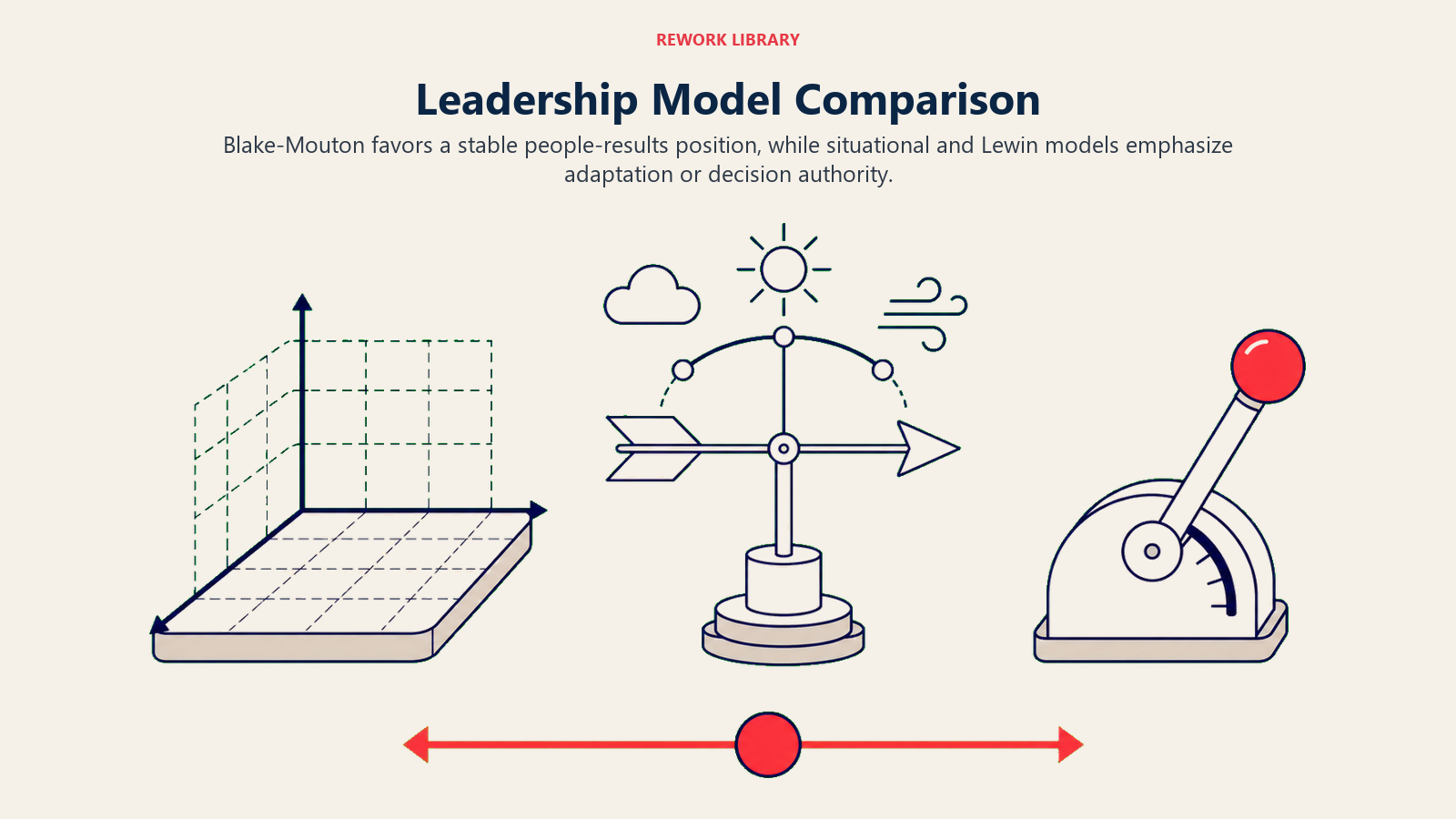
Blake-Mouton und Hersey-Blanchard teilen dieselben zwei Achsen unter verschiedenen Namen (Aufgabenverhalten entspricht Aufgabenorientierung; Beziehungsverhalten entspricht Mitarbeiterorientierung). Sie kommen aber zu entgegengesetzten Schlussfolgerungen. Hersey-Blanchard sagt, der richtige Stil hängt davon ab, wen Sie führen. Blake-Mouton sagt, 9,9 ist immer das Ziel, unabhängig vom Kontext.
Diese Meinungsverschiedenheit ist ernst zu nehmen. Wollen Sie ein Framework, das Ihre allgemeine Führungsphilosophie durchleuchtet, ist Blake-Mouton klarer. Wollen Sie ein Framework für die Anpassung Ihres Ansatzes von einem Teammitglied zum nächsten, passt situative Führung besser.
Einen breiteren Überblick darüber, wo diese Modelle in die Geschichte der Führungstheorien passen, bieten jene Texte. Die von Blake und Mouton vertretene verhaltensorientierte Tradition war selbst eine Reaktion auf die Eigenschaftstheorie, die argumentierte, Führungskräfte würden geboren, nicht gemacht.
Kritik und Grenzen
Das Blake-Mouton Grid hat 60 Jahre überdauert, ist aber ernsthafter Kritik nicht entkommen.
- Es setzt ein universales Ideal voraus. Der Anspruch, dass 9,9 immer das Beste ist, ignoriert reale Kontexte, in denen hohe Aufgabenorientierung und geringere Beziehungsinvestition völlig angemessen ist, etwa bei einem kurzfristigen Krisenteam, das für einen einzigen Sprint zusammengestellt wurde.
- Es misst Orientierung, keine Kompetenz. Eine Führungskraft kann 9,9 anstreben und dennoch scheitern. Hohe Orientierung entspricht nicht hoher Kompetenz. Das Grid hilft nicht dabei zu verstehen, wie man jede Achse entwickelt.
- Kultureller Kontext fehlt. In manchen Organisationskulturen ist ein 9,1-Stil akzeptiert oder sogar erwartet. Ein westliches Modell von „idealer" Führung auf jeden Kontext anzuwenden ist eine bedeutende Einschränkung.
- Die Achsen sind nicht wirklich unabhängig. In der Praxis kann sehr hohe Mitarbeiterorientierung in einer Kultur mit geringem Vertrauen und geringer Verantwortlichkeit die Aufgabenleistung untergraben, und sehr hohe Aufgabenorientierung in einem ausgebrannten Team kann beides untergraben. Das saubere Grid impliziert mehr Trennung als die Realität liefert.
- Selbstberichtsbias ist eingebaut. Die meisten Instrumente zur Positionsbestimmung auf dem Grid stützen sich auf Selbsteinschätzung, die laut Forschung konsistent zu schmeichelhafter Selbstpositionierung tendiert, üblicherweise in Richtung 9,9.
Das sind keine Gründe, das Modell zu verwerfen. Es sind Gründe, es als Denkwerkzeug und nicht als Diagnoseinstrument zu verwenden.
Best Practices, um sich in Richtung 9,9 Teamführung zu bewegen
Den eigenen Führungsstil in Richtung 9,9 zu verschieben ist keine Frage des Aufwands allein. Es geht darum, konkrete Verhaltensweisen zu verändern.
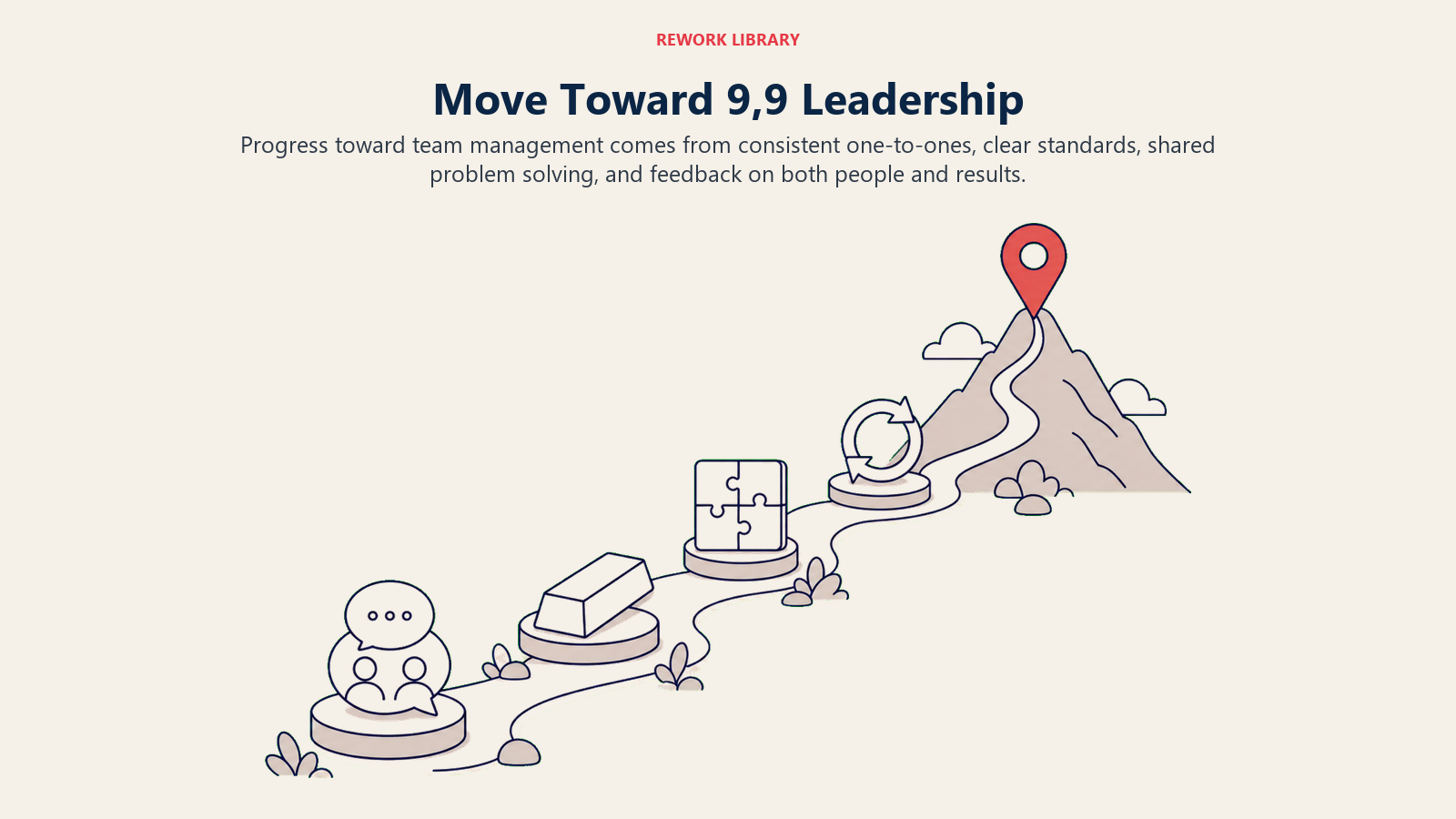
- Machen Sie 1:1s zu einem festen Bestandteil. Ein wöchentliches 30-minütiges Gespräch mit jedem Teammitglied ist die einzelne wirkungsvollste Praktik, um Ihren Mitarbeiterorientierungswert zu erhöhen, ohne den Aufgabenfokus zu verringern.
- Setzen Sie Standards öffentlich, nicht nur privat. Hohe Aufgabenorientierung bedeutet, dass das Team weiß, wie Exzellenz aussieht. Dokumentieren Sie es. Teilen Sie es. Überprüfen Sie es.
- Geben Sie Feedback, das konkret und zeitnah ist. Vage Jahresgespräche sind ein 5,5-Verhalten. Direktes, spezifisches, nahezu zeitgleiches Feedback ist 9,9.
- Beziehen Sie das Team in die Zielsetzung ein. Wenn Menschen die Ziele mitgestalten, wird Aufgabenorientierung zu gemeinsamem Eigentum und nicht zu Vorgabe.
- Schützen Sie Ihr Team von oben. Gegen die Unternehmensleitung zu widersprechen, wenn eine Anforderung unrealistisch ist, signalisiert sowohl, dass Sie das Wohlbefinden des Teams schätzen, als auch dass Sie es ernst meinen, das tatsächlich Erreichbare zu liefern.
- Feiern Sie Ergebnisse und die Menschen dahinter. Anerkennung ist kein Gegenteil von Aufgabenmanagement. Sie ist Teil davon.
- Überprüfen Sie Ihr Rückfallverhalten unter Druck. Die Bewegung in Richtung 9,9 ist nicht linear. Die meisten Führungskräfte fallen unter Stress zurück. Kennen Sie Ihr Rückfallmuster und bauen Sie einen Reflexionspunkt dafür ein.
Einen vollständigeren Blick darauf, wie dienende Führung Mitarbeiterorientierung auf Organisationsebene operationalisiert, oder wie demokratische Führung Teambeteiligung an Entscheidungen handhabt, bieten diese Modelle ergänzende Ansätze.
Weiterführendes
Der echte Wert des Blake-Mouton Grids liegt nicht im Grid selbst. Es liegt in der dahinterstehenden Frage: Behandeln Sie Mitarbeiterorientierung und Aufgabenorientierung als Konkurrenten oder als Partner?
Die meisten Führungskräfte verbringen ihre Karriere in der 5,5-Zone, nicht weil sie gleichgültig wären, sondern weil der Zug und Gegenzug des Organisationslebens sie trainiert, standardmäßig Kompromisse zu machen. Das Grid gibt Ihnen die Möglichkeit, das klar zu sehen und zu entscheiden, ob Sie so weiter agieren möchten.
Wer tiefer in die Frage eintauchen möchte, wie Führungsstil das Teamverhalten prägt, oder wie emotionale Intelligenz sich mit der Mitarbeiterachse überschneidet, findet in der verhaltensorientierten Tradition, die Blake-Mouton mitbegründete, jahrzehntelange Folgeforschung. Für Führungskräfte, die neu in den Frameworks sind, bieten Was ist Führung und die 5 Ebenen der Führung nützlichen Kontext dafür, wo verhaltensorientierte Modelle in das breitere Feld passen.

Senior Operations & Growth Strategist
On this page
- Was ist das Blake-Mouton Managerial Grid?
- Die zwei Achsen: Mitarbeiterorientierung vs. Aufgabenorientierung
- Die fünf Führungsstile
- Impoverished Management (1,1): Geringe Menschen-, geringe Aufgabenorientierung
- Country Club Management (1,9): Hohe Menschen-, geringe Aufgabenorientierung
- Authority-Compliance (9,1): Geringe Menschen-, hohe Aufgabenorientierung
- Middle-of-the-Road (5,5): Ausgewogener Kompromiss
- Teamführung (9,9): Hohe Menschen-, hohe Aufgabenorientierung
- Vergleich der fünf Stile
- Wie Sie Ihren Stil identifizieren
- Blake-Mouton vs. andere Führungsmodelle
- Kritik und Grenzen
- Best Practices, um sich in Richtung 9,9 Teamführung zu bewegen
- Weiterführendes