Product Development Strategy: Framework and Examples
Turn this article into takeaways for your work.


Each assistant summarizes the article only for you and suggests best practices for your work.
Your best customers already pay you. Support tickets keep asking for one thing the product doesn't do. Someone in the roadmap review says the obvious next move: build it. That sentence is where a lot of budgets quietly go to die, not because the engineering was bad, but because nobody tested whether it was actually true before funding it.
Product development strategy is the growth bet where the product is new and the market is existing: something you haven't built yet, sold to people who already buy from you. It sits in a specific quadrant of Igor Ansoff's 1957 growth model, and it answers a leadership question, not a build question: does this deserve real money and a real deadline. The build question, backlogs, sprints, release notes, comes after, not instead of it. Confusing the two is how a company ends up with a shipped feature nobody asked for and a leadership team that can't explain why it got funded.
This page draws a specific boundary, because seven sibling pages already own pieces of this shelf. Ansoff matrix owns the full four-quadrant overview. Market penetration strategy owns selling more to the customers you have. Market development strategy owns the mirror image of this page: the same product, sold into a market you haven't earned yet. Diversification strategy owns the highest-risk quadrant, product and market both new at once. Jobs to be done owns the customer-motivation lens this page borrows. Product life cycle owns where an existing product sits in its own life, often the signal that triggers this decision. Disruptive innovation owns a simpler product moving upmarket to displace an incumbent. Build, borrow, or buy owns building a capability versus partnering versus acquiring it.
What this page owns: the ladder of new-product types, whether product development beats the alternatives on the growth menu, where legitimate ideas come from, the funding and kill process that separates a real bet from a pet project, how build-borrow-or-buy changes the math here, why most new products fail and which causes are preventable, portfolio balance, worked examples done well and badly, and the metrics that tell you it's working before revenue does.
Key Facts: Product Development Strategy
- Robert G. Cooper's Stage-Gate model, first published in 1988, splits a new-product project into stages separated by gates that assess "business value, readiness, and continued alignment with business priorities," each ending in Go, Kill, Hold, or Recycle. (Stage-Gate International)
- Abbie Griffin's 1997 PDMA benchmarking research found nearly 60% of firms used some form of a Stage-Gate process, and Stage-Gate's own methodology team still cites that study as its baseline adoption figure. (Stage-Gate International, citing Griffin/PDMA 1997)
- Coca-Cola's New Coke launched April 23, 1985, the first formula change in 99 years, and was pulled just 79 days later after the consumer hotline went from 400 calls a day to 1,500. (The Coca-Cola Company)
- Gillette's Mach3 took seven years and $750 million to develop, plus another $300 million to market, "the world's only billion-dollar razor," before Gillette replaced it with the five-blade Fusion for the same customer base. (strategy+business, 1998)
- The first Kindle sold out in 5.5 hours on November 19, 2007, and stayed out of stock for nearly five months, an early sign Amazon had underpriced the demand already sitting inside its own customer base. (Amazon, "Kindle at 10")
What Is Product Development Strategy?
Product development strategy is the Ansoff quadrant where a company builds something new and sells it to a market it already serves. The customer relationship is the known variable. The product is the bet.
| Ansoff quadrant | Product | Market | Where it's covered |
|---|---|---|---|
| Market penetration | Existing | Existing | Market Penetration Strategy |
| Market development | Existing | New | Market Development Strategy |
| Product development | New | Existing | This page |
| Diversification | New | New | Diversification Strategy |
"Product development" also gets used two different ways in most companies, treated as the same conversation when it isn't.
| Term | The question it answers | Who owns the answer |
|---|---|---|
| Product development strategy | Should we build this, for this base, and fund it like a real bet? | Leadership: product, finance, whoever owns the P&L |
| Product development process | How do we design, build, test, and ship it well? | Product and engineering, once strategy is answered |
This page is about the first question. Most failures in this quadrant happen where the two overlap: a flawless build process on a product nobody validated the strategy question for.
The Ladder of New Product Types
Not every "new product" carries the same risk, even inside this one quadrant. The ladder runs from a small variation on something you already sell to something nobody, anywhere, has built before. Each rung keeps market risk close to zero, because the buyer is already yours, while R&D and adoption risk climb with every step up.
| Rung | What actually changes | Risk relative to your core product | Example |
|---|---|---|---|
| Line extension | A variant of what you sell: new size, flavor, tier, or feature set | Low, mostly execution and cannibalization risk | Diet Coke (1982), the first product ever to carry the Coca-Cola trademark alongside the original |
| Next-generation replacement | A new version that replaces the current product for the same buyer | Moderate. Real R&D risk, but the job is already proven | Gillette's Mach3 to Fusion succession, seven years and $750 million in R&D before Mach3 shipped (strategy+business, 1998) |
| New-to-the-company category | New to your company, not new to the world, sold through the relationship you already have | Moderate to high, you're building a capability you lacked | Amazon's Kindle (2007), hardware from a company that had never made hardware, sold to an existing retail base |
| Platform | Turns your existing product into something others build on top of | High, depends on partners and an ecosystem you don't fully control | Salesforce's AppExchange (January 2006), a marketplace TechCrunch called unlike anything else at the time |
| New-to-the-world | Nobody has built this before, and you sell the first wave to your own base to de-risk demand | Highest inside this quadrant, softened only by a known buyer | Apple's iPad (2010), launched to roughly 125 million credit-card-linked iTunes accounts before it reached a new buyer (TechCrunch, 2011) |
The ladder tells you how much evidence to demand before funding something. A line extension can run on a smaller, faster gate process. A new-to-the-world bet needs the full weight of the process covered later in this page, because the cost of being wrong is an order of magnitude higher, even though the market risk never really moves.
Deciding Whether Product Development Is the Right Bet
Most of the evidence for whether this is the right quadrant is already sitting in a company's own numbers, not the meeting where a growth path gets picked for sounding most exciting.
| Evidence already sitting in your data | What it points toward |
|---|---|
| Customers keep asking for a capability adjacent to what you sell | Product development: build it for the base you have |
| Retention is strong, but share of the current segment is still low | Market penetration strategy probably has more near-term headroom |
| Growth has stalled, and prospects in new geographies are pulling at you | Market development strategy, not a new product |
| The target needs a new product AND a genuinely new buyer | Diversification strategy, a board-level risk decision |
| The capability gap is real but too large to build in time | Build, borrow, or buy: check the alternative first |
| The existing product is deep into maturity or decline | Product life cycle helps confirm that stage before a new product covers for a dying one |
Worth naming directly: a team often picks product development because it feels most like "real strategy," skipping cheaper, faster options sitting one row up the table. Penetration and development plays are frequently available at the same time a new-product idea gets pitched, and they cost less to test.
Where Legitimate Product Ideas Actually Come From
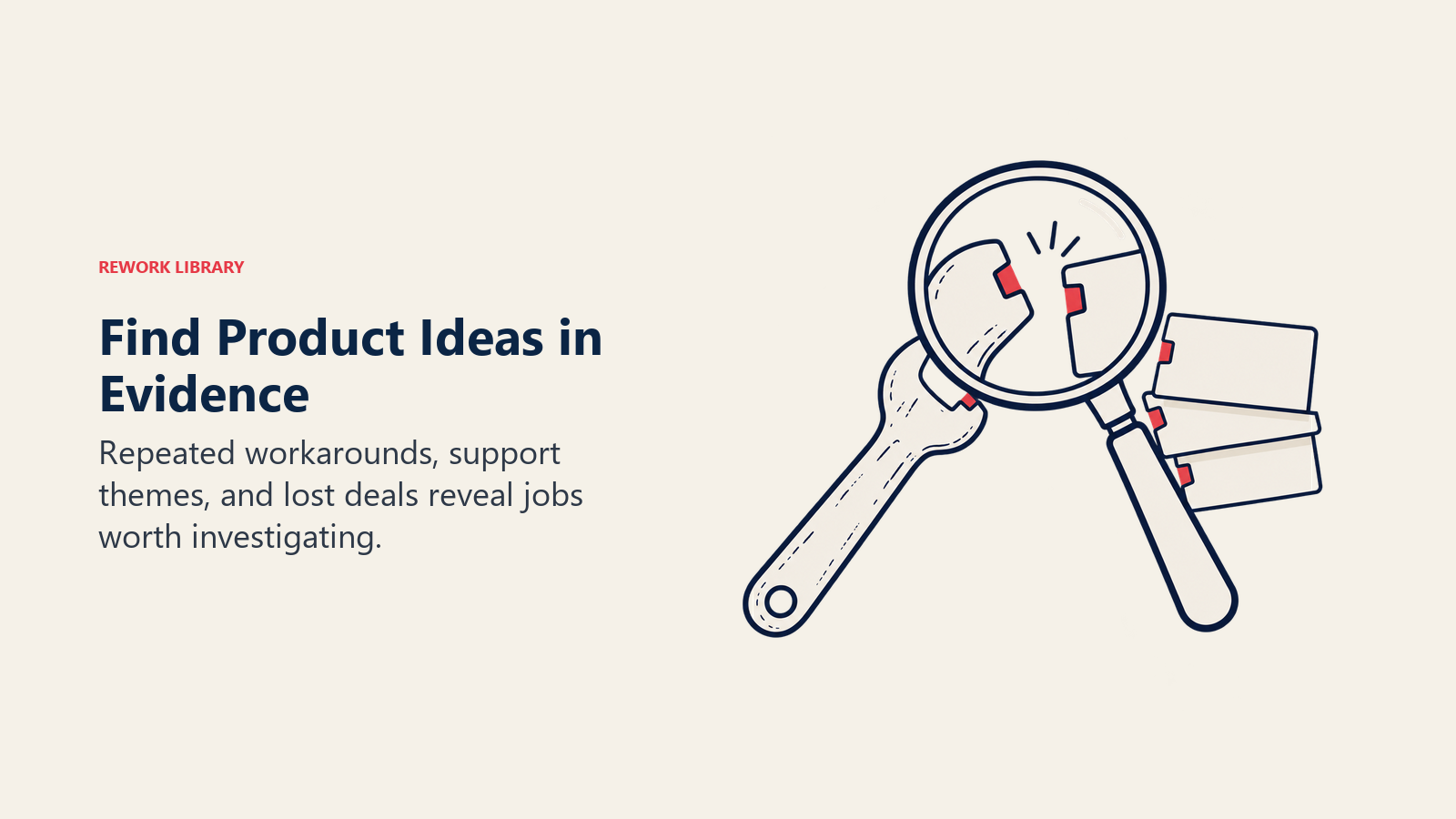
The riskiest new products start from a single executive's hunch. The ones that work start from evidence a company already has, just not organized into a decision yet.
| Source | What it actually surfaces | Why it beats guessing |
|---|---|---|
| Direct customer requests | What people think they want, in their own words | Fast, but needs filtering: the loudest request isn't automatically the most valuable one |
| Support ticket themes | What the product can't do today, grouped by frequency | Scale: one complaint reads differently from a hundred tickets naming the same gap |
| Churn and exit interviews | The job the product failed at, from someone who already left | The most honest signal available, the relationship is already over |
| Sales-loss reasons | Where a competitor, or "doing nothing," beat you | Ties straight to revenue instead of stopping at satisfaction |
| Usage data and workarounds | What customers build around a gap themselves: spreadsheets, integration chains, manual steps | A workaround is a customer handing you a product spec for free |
This is also where jobs to be done earns its keep as a filter. A feature request describes a solution a customer imagined; a job describes the progress they were actually trying to make. MIT's Eric von Hippel calls the sharpest version of this signal lead users: customers living a need before the market catches up, whose workarounds often beat anything a roadmap review produces alone. Ideas sourced this way still need validation, but they start from evidence, not a hunch.
The Stage-Gate Decision Process: Funding and Killing New Products
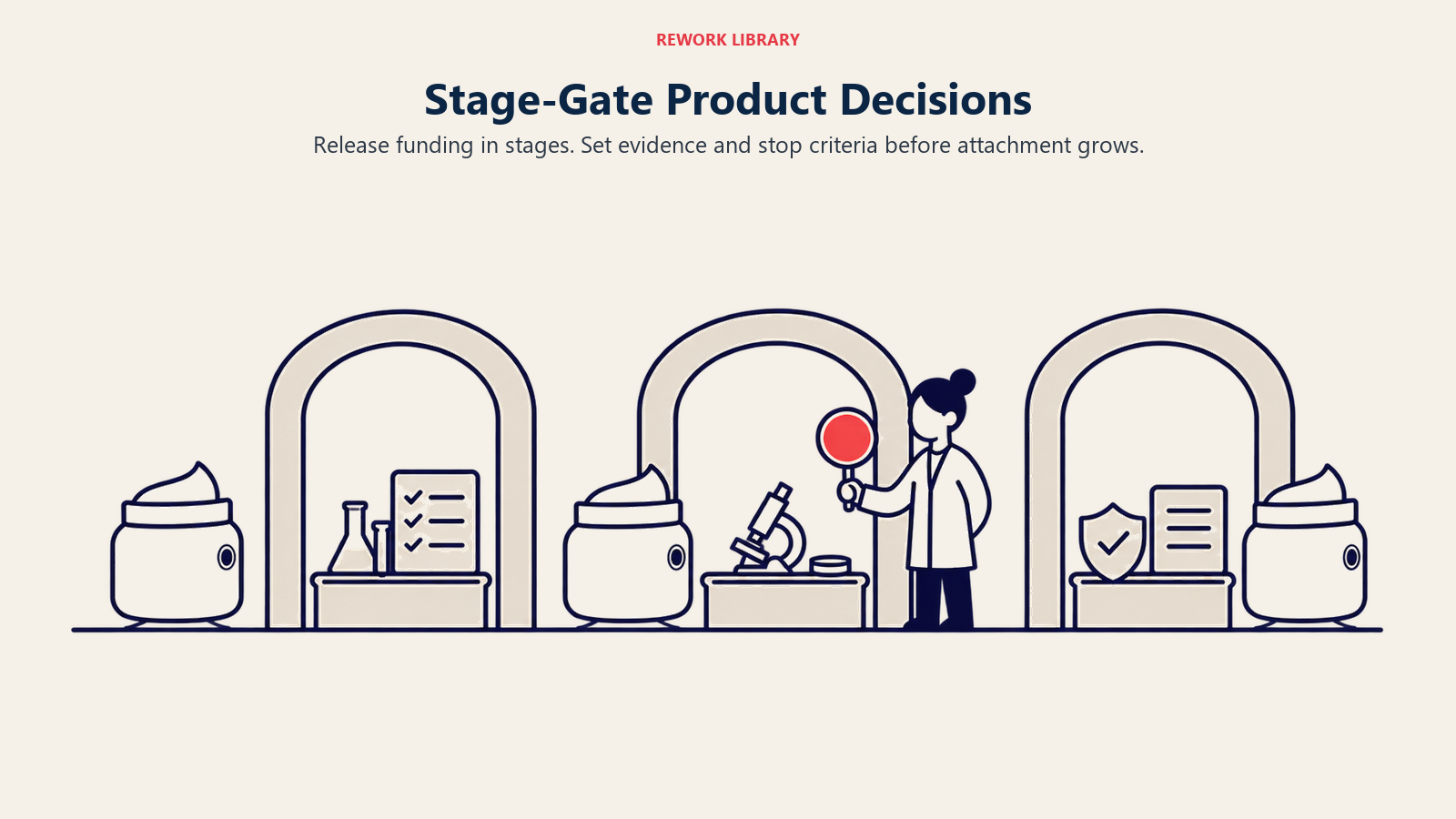
Once an idea clears the screen, it needs a process that can fund it in stages and kill it honestly if the evidence stops showing up. Robert Cooper's Stage-Gate model, first published in 1988, is still the dominant framework for this, built around a simple discipline: a gate is not a status update, it's a forward-looking decision about whether more money gets committed.
| Gate | Central question | Evidence needed to pass | Common kill criterion |
|---|---|---|---|
| Idea screen | Is this worth a small discovery budget? | A named source (support data, a churn interview, a sales-loss pattern), not just an opinion | No repeatable evidence, just one loud voice |
| Business case | Will this pay back, and who's accountable? | A sized opportunity, a cost estimate, a named owner willing to be judged on it | Nobody willing to put their name on the return |
| Development gate | Is the build tracking to the approved case? | A working prototype, cost and timeline inside the funded range | Scope has crept past what the case paid for, with no new evidence |
| Testing and validation | Do real customers actually use it, not just say they like it? | A paid pilot or presale conversion, real usage depth, not stated enthusiasm | Prospects like the idea in a survey but won't commit real money |
| Launch gate | Is this ready for the whole base, not just a friendly pilot group? | Support and onboarding capacity in place, pricing finalized | The pilot cohort needed hand-holding the rest of the base won't get |
Every gate does the same job in a different disguise: forcing a decision with evidence that exists right now, not a hope it shows up later. The kill criterion is the part most companies skip, because writing "here's what would make us stop" feels like planning for failure. It's the opposite: written before anyone is attached to a project, it's the only version anyone actually honors once money has been spent.
Build, Borrow, or Buy: How It Changes the Calculus
Being inside this quadrant doesn't mean building every rung yourself. Line extensions and next-generation replacements are almost always a build decision, running on knowledge a company already owns. New-to-the-company categories and platform plays are where the math shifts: the capability gap is real, and the existing customer base, not unbuilt technology, is the actual asset being leveraged.
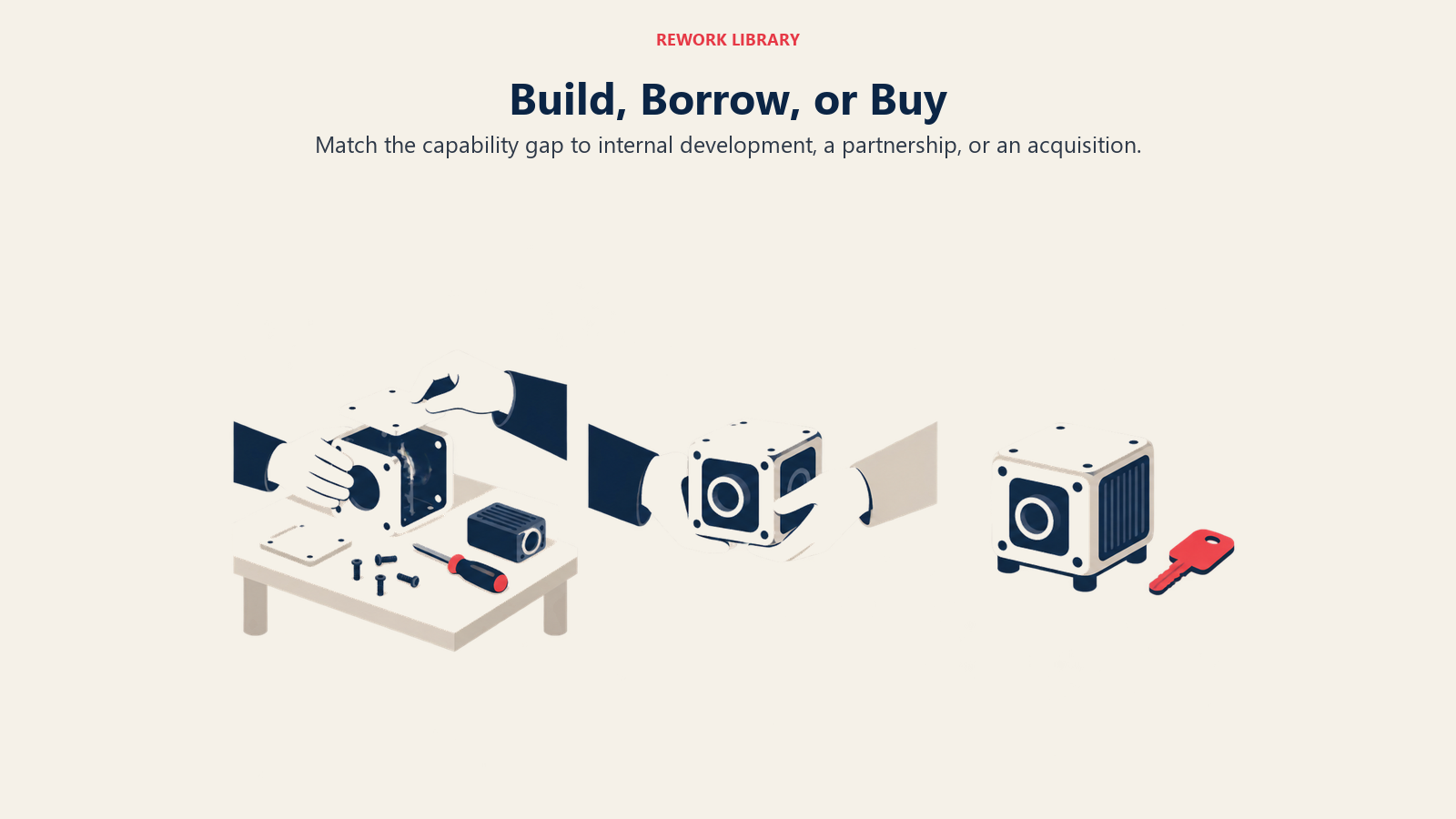
Build, borrow, or buy is the full framework, but the shorthand here: the closer a new product sits to your existing one, the more building it yourself makes sense, you already have the muscle. The further it drifts into a category you've never operated in, hardware for a software company, a payments rail for a retailer, the more seriously "borrow" (a partnership) or "buy" (an acquisition) deserve a hearing before defaulting to building from zero. Teams excellent at their existing product routinely overestimate how fast they'll become excellent at an adjacent one, and the business case gate should force that question, not two years of a team learning a discipline it didn't have.
Why Most New Products Fail, and Which Causes Are Preventable
This section skips the famous failure-rate numbers quoted everywhere, 95%, 80%, 40%, because they trace back to studies that measured different things, in different industries, decades apart, and the most-repeated figure is the hardest to trace to an actual methodology. Better documented is the gap between companies that run this quadrant well and those that don't. Research cited by the International Network for SMEs, drawn from the Product Development and Management Association's 2012 benchmarking study, found top-performing firms needed an average of 4.5 new product ideas to produce one commercial success, against 11.3 for everyone else. (INSME, citing PDMA CPAS 2012) That gap is process discipline, not talent: killing weak ideas early instead of letting them survive on momentum.
New Coke is the clearest documented case of a preventable cause hiding inside evidence that looked solid. Coca-Cola tested the new formula against nearly 200,000 consumers in blind taste tests before launching it on April 23, 1985, and it won on taste. What the test never measured was the identity-based relationship people had with the original, the job the brand did beyond flavor. By June, the hotline was fielding 1,500 calls a day, up from 400, and on July 11, seventy-nine days after launch, Coca-Cola brought the original formula back as Coca-Cola classic. (The Coca-Cola Company) The research wasn't fake or small. It measured the wrong thing.
| Preventable cause | What it looks like in practice | Where the process should have caught it |
|---|---|---|
| Testing measures the wrong thing | New Coke's taste tests won on flavor alone, never on brand identity | The testing gate needs a job-based test, not a preference score alone |
| Enthusiasm gets mistaken for demand | Pilot customers say they love it, then never convert to paying | Gate on paid pilots or presale conversion, not stated intent |
| No named, accountable owner | Everyone agrees the bet matters, no one's comp depends on it | The business case gate should require a name, not a line item |
| Kill criteria set after the bet is already loved | An underperforming product keeps getting funded, killing it feels like admitting failure | Kill criteria written at the business case gate, before anyone is attached to the outcome |
| Shipping to the whole base before support is ready | The pilot group tolerated hand-holding the full base never will | The launch gate checks onboarding capacity, not just working code |
None of these five require a friendlier market to fix. Every one is a decision inside the company's own process, which is why the gap between the best firms and the rest is a process gap, not a luck gap. There is a sixth cause that sits earlier than any gate: shipping a new product without a defensible value proposition of its own, on the assumption it inherits the parent product's. A buyer who already owns the parent still asks why this new thing is worth a separate line on the invoice.
Portfolio Balance Across Horizons
A company that bets its entire roadmap on new-to-the-world swings starves the revenue funding those swings. A company that only ever ships line extensions guarantees its own stagnation once the core product matures. Both are the same mistake from opposite directions: treating one rung of the ladder as the whole strategy.
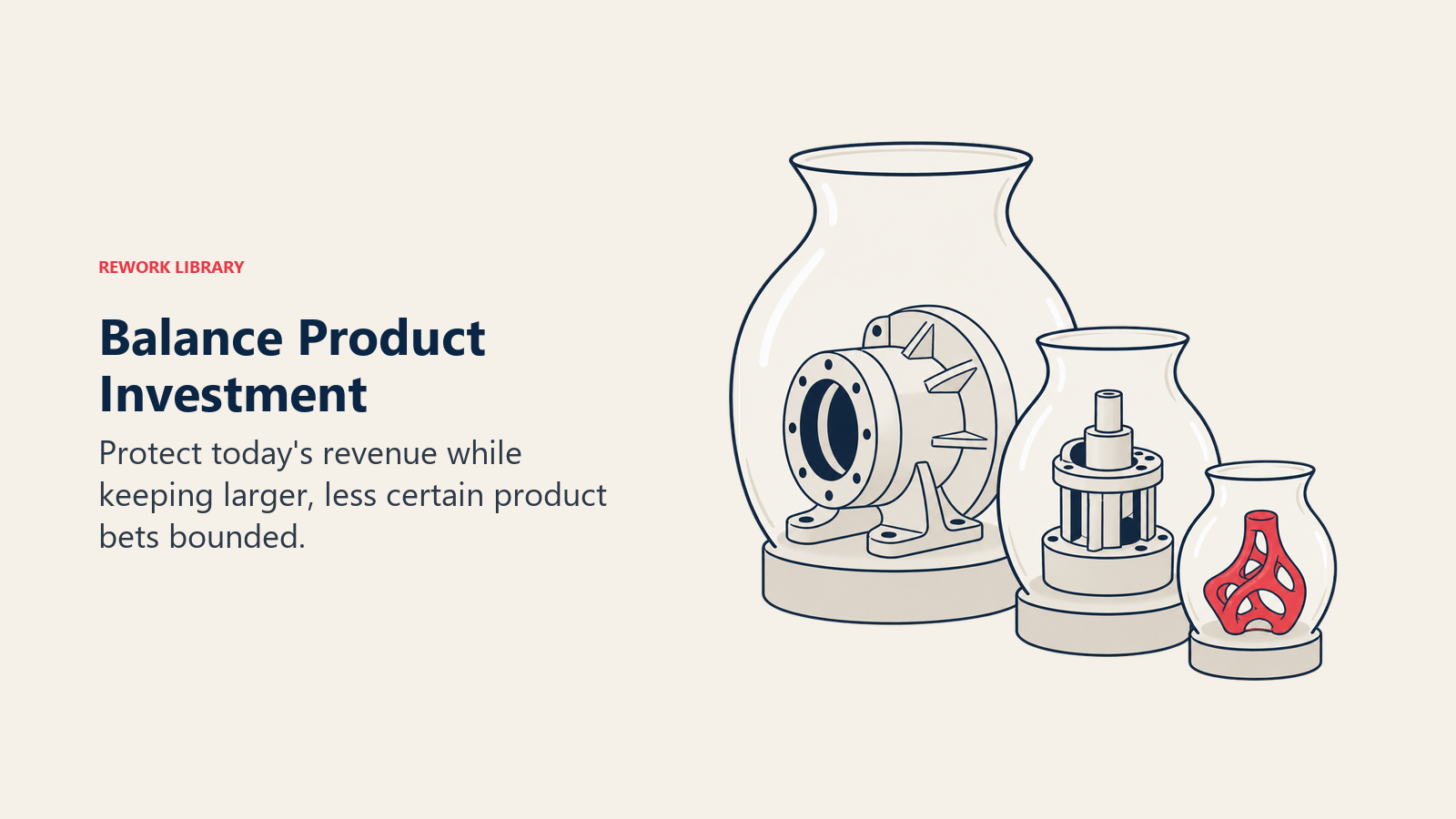
The fix is to size investment by rung, the same discipline three horizons of growth applies to a growth portfolio more broadly. Most of a roadmap's budget belongs in line extensions and next-generation replacements, protecting revenue you already have. A smaller, bounded share belongs in new-to-the-company or platform bets, reviewed on their own timeline instead of folded into quarterly targets. The smallest share, with the most disciplined gate process, belongs to genuine new-to-the-world bets, where being wrong costs the most and the evidence is thinnest going in.
Worked Examples: Product Development Done Well and Done Badly
The ones that worked started from a known customer job and passed a real evidence bar before going wide. The one that didn't skipped the second part.
| Company / product | Rung on the ladder | What happened | Evidence |
|---|---|---|---|
| Coca-Cola, Diet Coke (1982) | Line extension | First product ever to carry the Coca-Cola trademark alongside the original; the top-selling diet soft drink in the US by the end of 1983 and third best-selling soft drink overall, ahead of 7UP, by the end of 1984 | Coca-Cola Company |
| Gillette, Mach3 to Fusion | Next-generation replacement | Mach3 took seven years and $750 million in R&D, plus $300 million in marketing; replaced by the five-blade Fusion for the same shaving base on September 14, 2005 | strategy+business, 1998 |
| Amazon, Kindle (2007) | New-to-the-company category | Amazon's first hardware product, sold through its retail relationship, sold out in 5.5 hours and stayed out of stock nearly five months | Amazon, "Kindle at 10" |
| Salesforce, AppExchange (2006) | Platform | Turned an existing CRM base into a platform business; TechCrunch called it a marketplace with nothing comparable at the time | TechCrunch, 2016 |
| Apple, iPad (2010) | New-to-the-world | Launched to roughly 125 million credit-card-linked iTunes accounts, letting buyers sync content already bought for their iPhone or iPod touch from day one | Apple Newsroom, 2010; TechCrunch, 2011 |
| Coca-Cola, New Coke (1985) | Next-gen replacement, done badly | Replaced the original formula for the whole base based on taste tests that never measured brand identity; reversed 79 days later after hotline volume nearly quadrupled | Coca-Cola Company |
The pattern across the five that worked: each reduced market risk to almost nothing by selling into a relationship that already existed, then earned its way up the ladder with real evidence. New Coke had the relationship too. What it skipped was testing the actual job before removing the option to keep doing things the old way.
Metrics That Show It's Working Before Revenue Does
Revenue is the slowest signal a new product can send. Because this quadrant sells into an existing base, the leading indicators are sharper and faster to read than they are for a brand-new market.
| Leading indicator | What it tells you | Review cadence |
|---|---|---|
| Attach rate: share of the base that tries the new product within a set window | Whether the base actually wants it, not just says so in a survey | Monthly |
| Pilot-to-paid conversion | Whether interest turns into money, the gate between "liked it" and "bought it" | Monthly |
| Support tickets on the original gap the product targets | Whether it's actually closing the job it was funded to close | Monthly |
| Usage depth of adopters versus non-adopters | Whether it's a habit or something opened once and abandoned | Quarterly |
| Share of total account revenue from the new product | Whether the bet is a real line of business or a permanent pilot | Quarterly |
A strong attach rate with weak pilot-to-paid conversion is a pricing problem, not a product problem. Strong conversion with flat support-ticket improvement means it shipped but isn't closing the job it was built for, usually the first sign a launch gate passed on hope instead of evidence.
Conclusion
The new products that survive this quadrant share a pattern that has nothing to do with how clever the idea sounded in a roadmap review. They start from evidence already sitting in support tickets, churn interviews, and sales losses, not a hunch. They climb the ladder only as far as the evidence justifies, because low market risk is the entire reason to be in this quadrant instead of diversification. They pass through gates with a real evidence bar and a kill criterion written down before anyone is attached to the outcome, and they get judged on adoption inside the existing base months before revenue tells the same story, the way Diet Coke, the Kindle, and the iPad all did, and the way New Coke's own research should have, if anyone had tested the job instead of the taste.
Related Reading
- Ansoff Matrix: the full four-quadrant framework this page's quadrant sits inside.
- Market Penetration Strategy: the lower-risk path of selling more to customers you already have, worth checking before funding a new product.
- Market Development Strategy: the mirror image of this page, the same product sold into a market you haven't earned yet.
- Diversification Strategy: the highest-risk quadrant, where product and market are both new at once.
- Jobs to Be Done: the customer-motivation lens behind where legitimate product ideas come from.
- Product Life Cycle: recognizing when an existing product's own maturity is the real signal to build something new.
- Disruptive Innovation: the pattern where a simpler product moves upmarket and displaces an incumbent.
- Build, Borrow, or Buy: the full framework for when a new-to-the-company or platform bet should be built, partnered, or acquired instead.
- Growth Strategy: the layer above this page, choosing which growth path to fund and sequencing it into a real plan.
- Three Horizons of Growth: the portfolio model behind balancing line extensions, platform bets, and new-to-the-world swings at once.
- Strategic Fit: the test for whether your existing capabilities genuinely transfer to the new product you're funding.
- Value Proposition: the claim a new product has to earn on its own rather than inherit from the parent line.

Co-Founder & COO
On this page
- What Is Product Development Strategy?
- The Ladder of New Product Types
- Deciding Whether Product Development Is the Right Bet
- Where Legitimate Product Ideas Actually Come From
- The Stage-Gate Decision Process: Funding and Killing New Products
- Build, Borrow, or Buy: How It Changes the Calculus
- Why Most New Products Fail, and Which Causes Are Preventable
- Portfolio Balance Across Horizons
- Worked Examples: Product Development Done Well and Done Badly
- Metrics That Show It's Working Before Revenue Does
- Conclusion
- Related Reading