Core Competencies: How to Identify Your Company's Strengths

Turn this article into takeaways for your work.


Each assistant summarizes the article only for you and suggests best practices for your work.
Core competencies are the deep capabilities that let a company do something better than any competitor can, and that customers genuinely care about. Every business has resources. Far fewer have core competencies. Knowing the difference is what separates companies that build durable strategies from ones that chase market trends and wonder why nothing sticks.
What Are Core Competencies?
C.K. Prahalad and Gary Hamel introduced the concept in their landmark 1990 Harvard Business Review article, "The Core Competence of the Corporation." Their argument was direct: the real source of competitive advantage isn't a company's products. It's the underlying capabilities that make those products possible.
They defined a core competency as a bundle of skills and technologies that represents the sum of learning across individual skill sets and organizational units. It's not a single department's expertise or one product feature. It's a company-wide capability that's taken years to build and can't be acquired off the shelf.
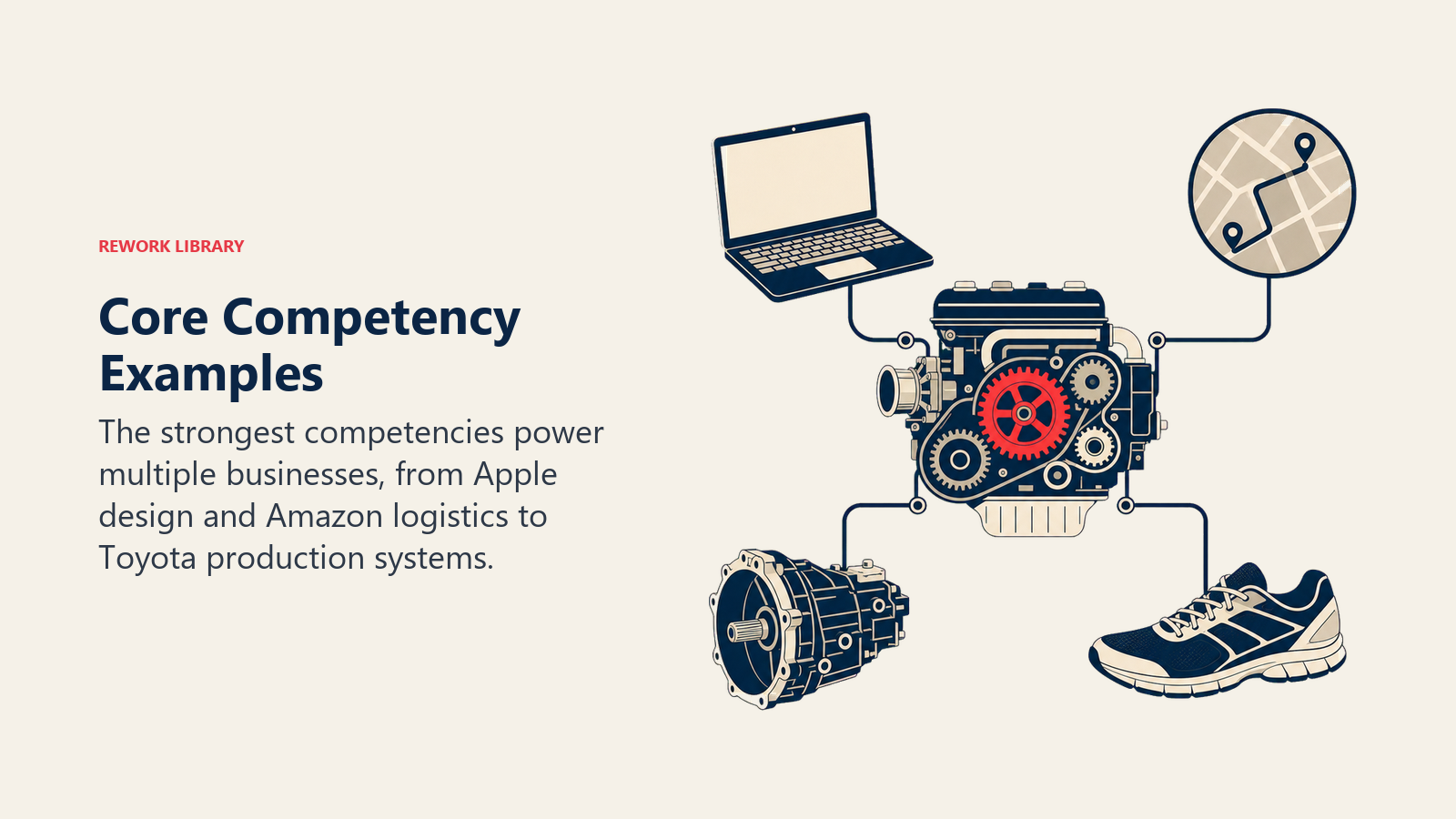
Honda's core competency, in Prahalad and Hamel's original framing, wasn't "cars." It was engine and powertrain engineering. That competency powered cars, motorcycles, lawn mowers, generators, and marine engines. The product lines look different; the underlying capability is the same.
Key Facts
- Prahalad and Hamel (HBR, 1990) estimated that a company typically has five or six core competencies at most, and that most managers can't identify them clearly when asked.
- Companies that explicitly link strategy to core competencies outperform peers by 20-30% on long-run total shareholder return, according to Bain & Company's Repeatable Model research (2012).
- In Prahalad and Hamel's original study, NEC's deliberate investment in computing and communications competencies allowed it to outmaneuver GTE, which had similar starting assets but no explicit competency strategy.
The 3 Tests of a Core Competency
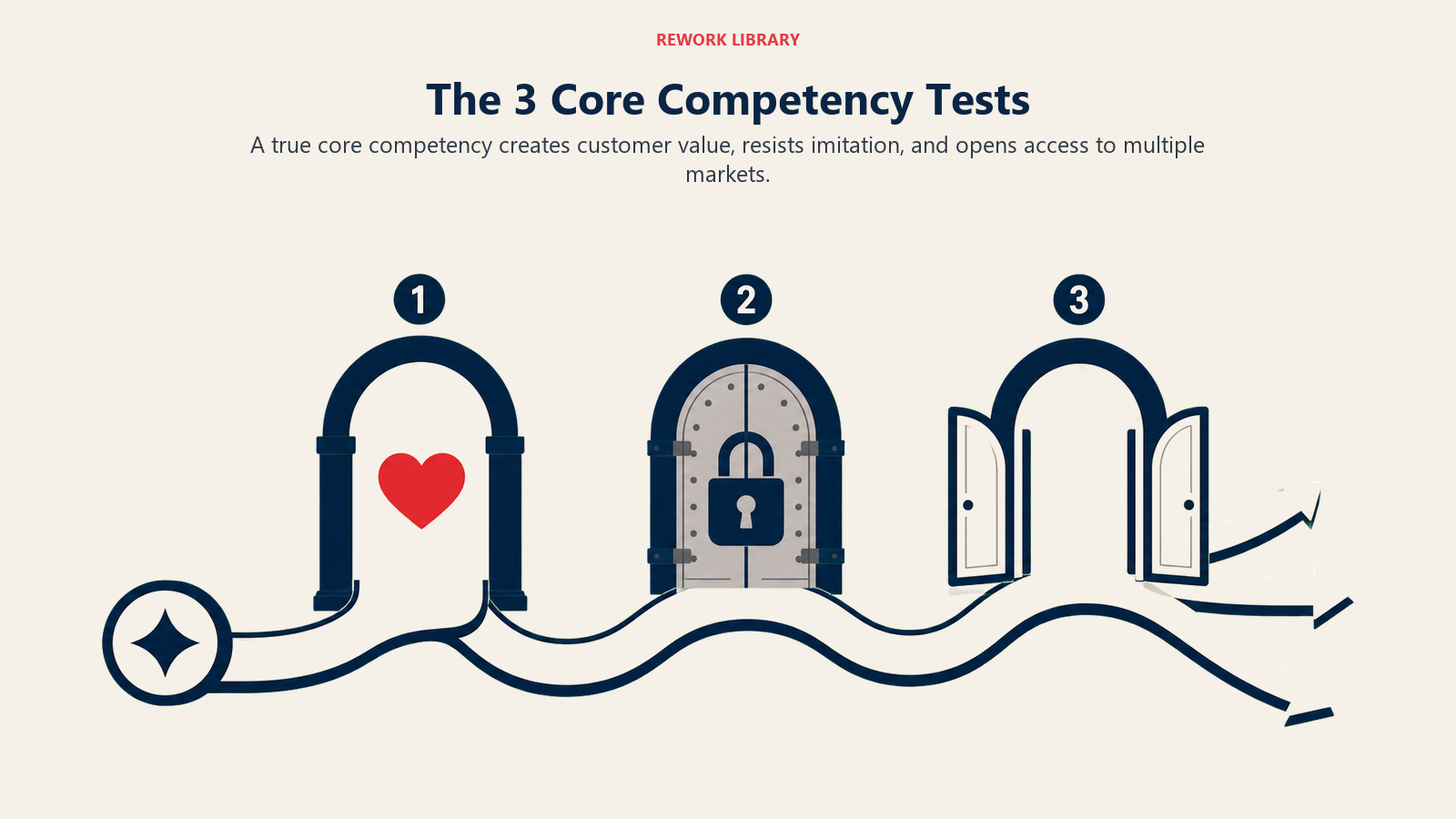
Not every capability qualifies. Prahalad and Hamel proposed three tests. A genuine core competency passes all three. Fail any one and you're dealing with a regular capability, which matters for operations but won't drive lasting competitive advantage.
| Test | What it means | Example (pass) | Example (fail) |
|---|---|---|---|
| 1. Provides customer value | Customers must perceive a real, meaningful benefit from it, not just internally efficient processes | Apple's industrial design creates products customers pay premiums for | A retailer's internal inventory system (customers don't notice or care) |
| 2. Hard for competitors to imitate | It must be difficult to copy, buy, or reverse-engineer in any short window | Amazon's fulfillment and logistics network, built over 25 years with proprietary systems, routing algorithms, and physical infrastructure | A well-designed website (any company can replicate in months) |
| 3. Applies to many products/markets | It must be portable across multiple product lines or market entries, not locked to one offering | Google's data processing and ranking algorithms power Search, Maps, Ads, and YouTube | A patent on a single drug compound (valuable but narrow) |
If a capability only clears one or two of these, it still belongs in your strategy. But don't confuse it with a core competency. The distinction matters because core competencies warrant long-term investment and protection; ordinary capabilities get managed as costs.
Core Competencies vs Competitive Advantage vs Capabilities
These three terms get used interchangeably in strategy meetings. They mean different things.
| Concept | Definition | Time horizon | Example |
|---|---|---|---|
| Capability | A specific organizational skill or process | Operational (months to maintain) | Running fast sales cycles, deploying software quickly |
| Core Competency | A bundle of capabilities that passes all three Prahalad-Hamel tests | Strategic (years to build) | Amazon's supply chain, Apple's design process |
| Competitive Advantage | The market outcome produced when a competency is deployed well | Positional (until copied or disrupted) | Apple's ability to charge premium prices; Amazon's ability to undercut on delivery speed and cost |
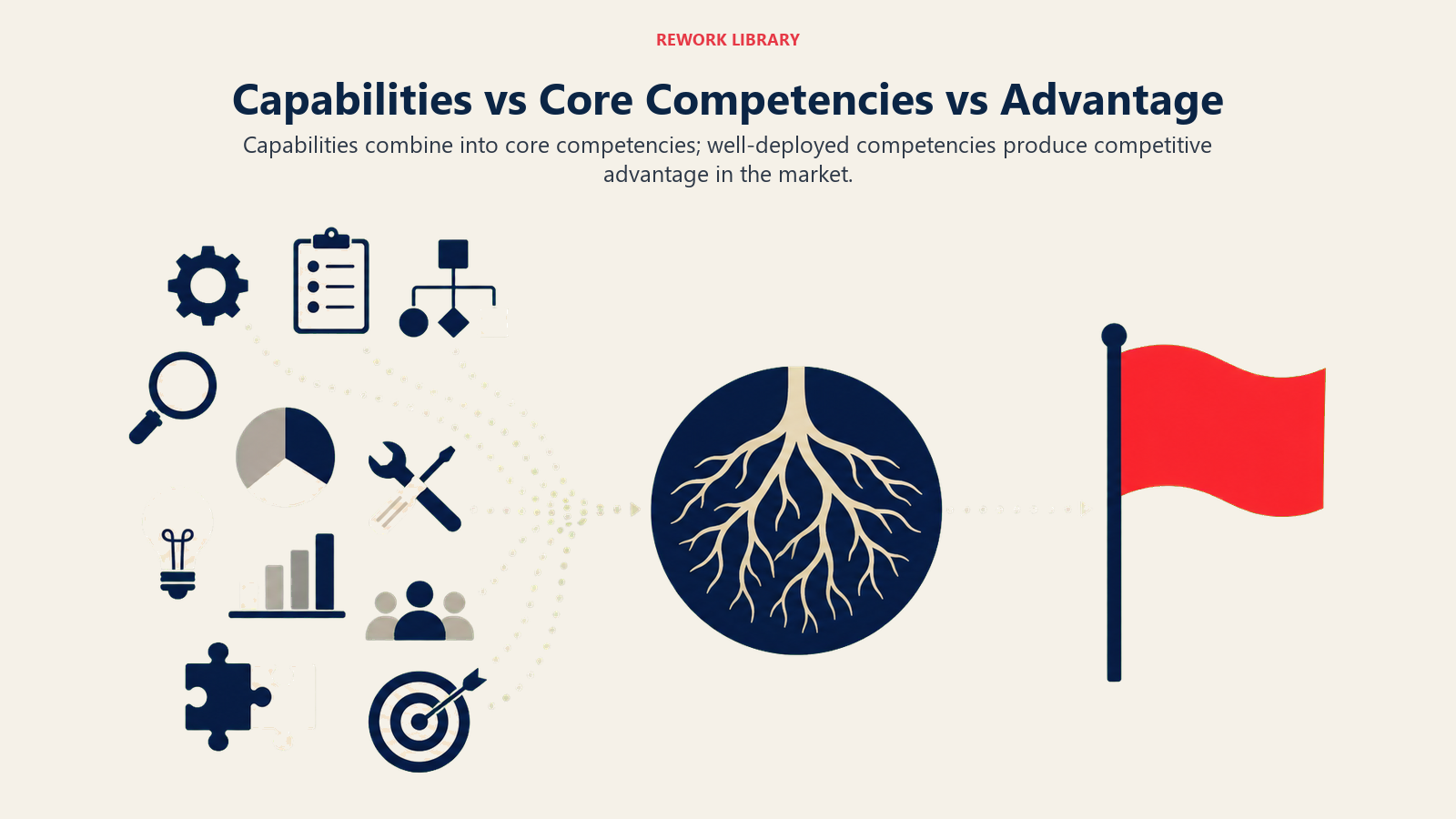
Think of it as a chain: capabilities feed core competencies, and core competencies produce competitive advantage. You can have competitive advantage without a recognized core competency (timing, market luck, regulatory moats). But durable, repeatable competitive advantage almost always traces back to one or two core competencies that competitors genuinely can't replicate.
For a deeper look at where competitive advantage comes from and how to sustain it, see Competitive Advantage: Types and How to Build One.
Why Core Competencies Matter
The strategic logic is simple. Companies that don't know their core competencies tend to diversify into markets where those competencies don't apply, stretch resources across too many products, and eventually lose ground to focused rivals who've built depth in one area.

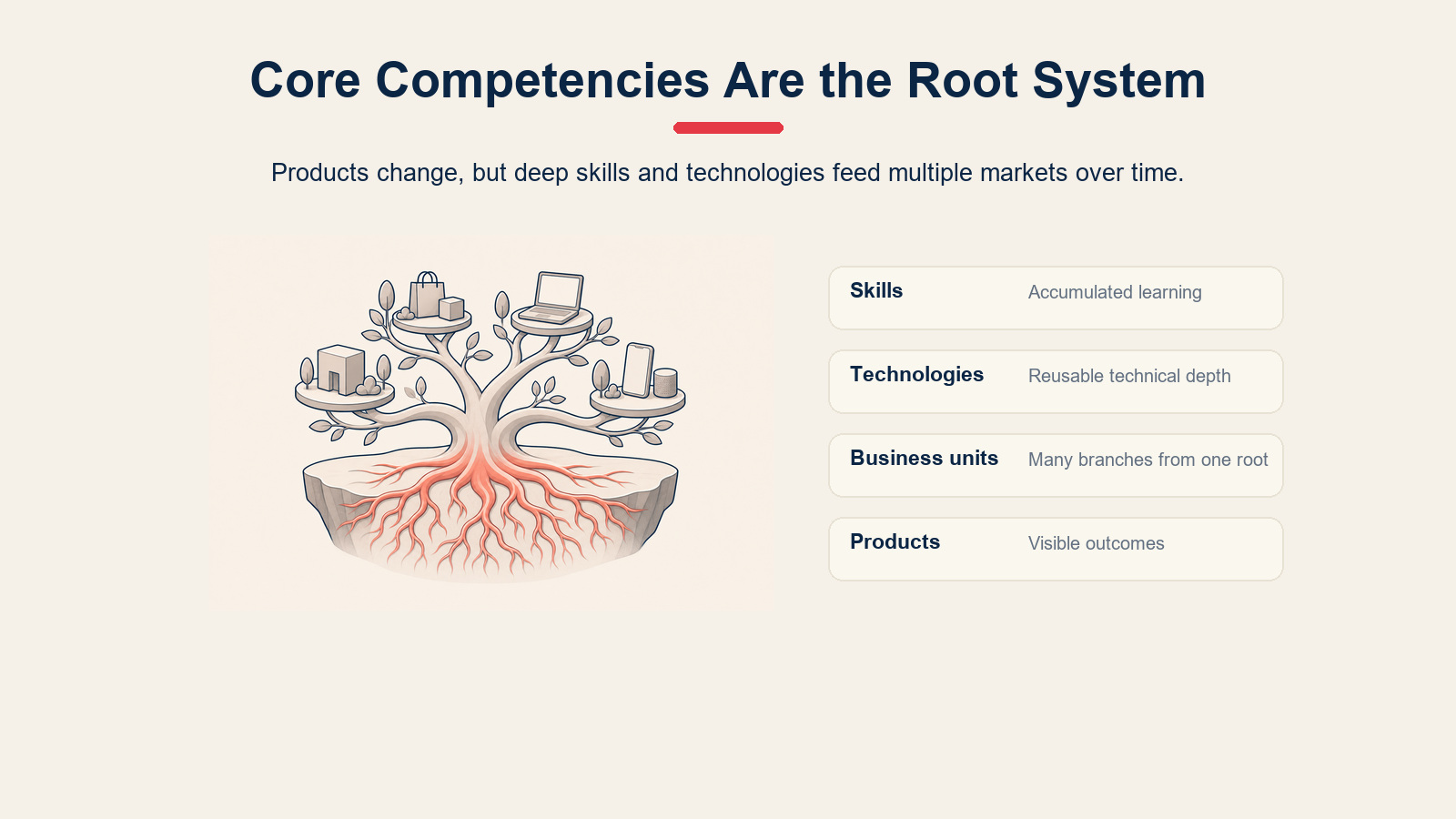
Prahalad and Hamel used the analogy of a tree. The trunk and major limbs are core products. The branches are business units. The leaves are end products. But the root system, feeding everything, is the core competencies. If you neglect the roots while obsessing over the leaves, the whole tree weakens.
This matters for resource allocation more than anything else. When you know what your core competencies are, you know where to invest. You protect the capabilities that make your best products possible. You don't outsource them, you don't underfund them, and you don't let them erode through talent loss or distraction.
It also matters for strategic planning. The VRIO Framework is the most rigorous tool for testing whether a resource or capability truly creates sustained advantage. Combining VRIO with core competency identification gives you a complete picture: what you're good at (competency mapping) and which of those capabilities will actually hold up under competitive pressure (VRIO).
And it matters for growth. Core competencies should open new markets. If your competency is genuinely portable, you can enter adjacencies with real advantages instead of starting from scratch every time.
How to Identify Your Core Competencies
Most companies discover their core competencies by looking backward at what made past successes possible, then testing whether those underlying skills pass the three-test framework. Here's a practical process.
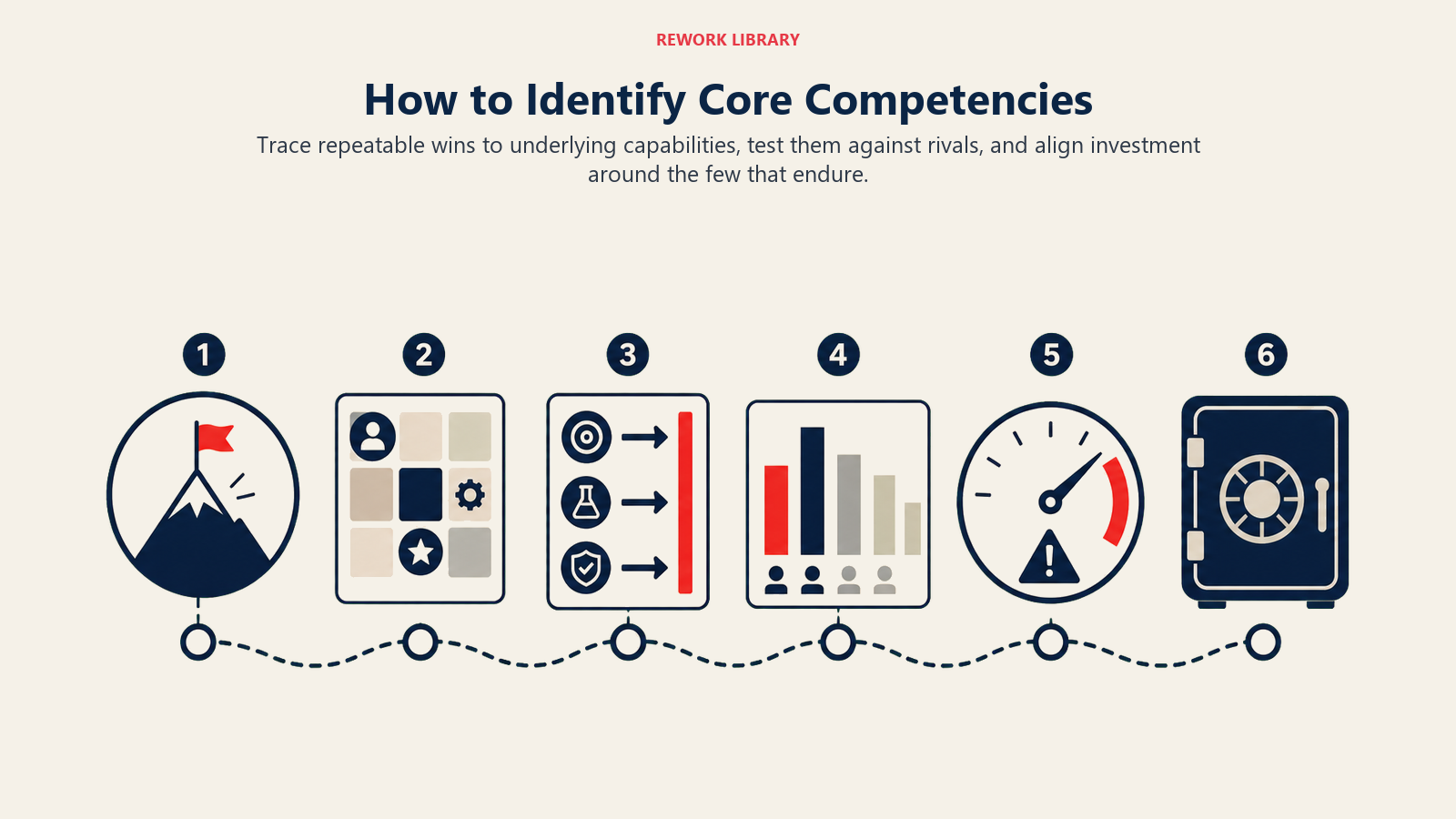
Step 1: List what your company does better than most competitors
Start with product and market performance. Where do you win consistently? Where do customers come back? What do customers praise that competitors rarely match? Don't start with capabilities in the abstract. Start with outcomes and work backward.
Step 2: Map the underlying capabilities behind those wins
For each area where you consistently outperform, ask: what skills, processes, technologies, or institutional knowledge make this possible? You're looking for the repeatable patterns underneath the results. A company that wins on fast product iteration usually has underlying capabilities in cross-functional communication, rapid prototyping, and customer feedback integration. The wins are visible; the capability is the root.
Step 3: Apply the three Prahalad-Hamel tests
Take each candidate capability and ask all three questions: Does it deliver customer-perceived value? Could a competitor replicate it in three to five years? Can it apply beyond your current product lines? Be honest. Most capabilities will fail at least one test. The ones that pass all three are your true core competencies.
Step 4: Benchmark against competitors
Talk to customers, read analyst reports, track competitor job postings (they reveal what skills companies are building), and assess where rivals are investing. A capability you think is distinctive might already exist at comparable depth in two or three competitors. That's useful to know before you build strategy around it.
A SWOT Analysis is a good companion here because it surfaces internal strengths and external threats simultaneously. Combined with a Value Chain Analysis, it shows which activities in your value creation process actually generate the competency.
Step 5: Stress-test for sustainability
Ask what would need to change for a competitor to neutralize this capability in five years. Technology shifts, talent markets, regulatory changes, or new business models could each erode something you consider core today. Competencies aren't permanent. But the best ones are protected by network effects, proprietary data, institutional knowledge, or cultural practices that take a long time to build and can't be bought.
Step 6: Align investment and protection
Once you've identified your core competencies, make sure your capital allocation, hiring, and organizational design reflect them. This is where McKinsey's 7S Framework is useful: it checks whether your strategy, structure, systems, staff, skills, style, and shared values are actually aligned around your identified competencies. Misalignment is common and expensive.
Core Competencies Examples
| Company | Core Competency | Why it qualifies | Products it powers |
|---|---|---|---|
| Apple | Human-centered industrial design and vertical hardware-software integration | Customers pay 20-40% premiums for the experience; no competitor has matched the depth of the design process; applies across iPhone, Mac, iPad, Watch, AirPods | Every hardware product line and the ecosystem that locks in users |
| Amazon | Fulfillment, logistics, and large-scale distributed computing infrastructure | Built over 25+ years; competitors struggle to replicate at cost parity; applies to e-commerce, AWS cloud, Kindle, Alexa, advertising | Retail, AWS, third-party marketplace, Prime, Alexa |
| Large-scale data processing and machine learning at consumer product scale | Backed by proprietary infrastructure, datasets, and research; feeds products across entirely different verticals | Search, Maps, Gmail, YouTube, Android, Google Ads, Waymo | |
| Toyota | Lean manufacturing (Toyota Production System) | The TPS took decades to develop; it's been widely studied but rarely replicated at Toyota's quality consistency; applies across every vehicle line | All vehicle lines, supply chain management, quality systems |
| Nike | Brand building and athlete-storytelling marketing | Customers buy the identity as much as the product; Nike's ability to connect performance with aspiration is decades of craft | Footwear, apparel, equipment, digital fitness platforms |
One pattern stands out: every company on this list built its core competency through sustained, deliberate investment over years. None of them stumbled into it. Apple hired and retained industrial design talent at a time when most tech companies treated design as marketing decoration. Amazon invested in logistics infrastructure when analysts questioned whether the capital was justified. Competencies are built, not found.
Common Mistakes
Confusing activities with competencies. Running quarterly reviews, having a sales process, or maintaining good customer service are activities. They're important. But if every competitor does them roughly as well, they're not competencies.
Listing too many. Prahalad and Hamel's original research suggested most companies have five or six core competencies at most. If your list has twenty, you've described an operations manual, not a strategy. The discipline is in being selective.
Treating competencies as static. Markets shift, technologies change, and what was genuinely hard to imitate in 2010 might be a commodity skill today. Competency identification isn't a one-time workshop output. It's a recurring strategic question.
Outsourcing competency-adjacent work. Companies sometimes outsource activities that sit close to their core competencies to cut costs, without recognizing that the adjacent work is what maintains the competency itself. If your core competency is customer experience design and you outsource all customer research, you've removed the feedback loop that keeps the competency sharp.
Building competencies without market demand. The first Prahalad-Hamel test says it must deliver customer-perceived value. Rare and hard-to-imitate aren't enough on their own. Some companies build deep internal capabilities in areas customers don't actually value, then wonder why the investment didn't translate into competitive advantage.
Best Practices
Link competencies to portfolio decisions. When evaluating whether to enter a new market or launch a new product, the first question should be: does this play to an existing core competency, or does it require building a new one from scratch? Neither answer is automatically wrong, but the second requires much more time, capital, and risk tolerance.
Protect competencies during downturns. When budget pressure hits, competency-related talent and programs are often among the first to be cut because their contribution to current-quarter revenue is hard to measure. This is a strategic mistake. Competency investment compounds slowly and erodes quickly.
Use Porter's Five Forces to evaluate whether your competencies actually hold. If a new entrant or substitute product could replicate your position cheaply, your competency may not be as durable as you think. Five Forces stress-tests the competitive landscape your competency has to survive in.
Frame competencies for your team, not just the executive suite. Employees who understand what the company is genuinely best at make better decisions at every level, from how they allocate time to which partnerships they pursue. Competency clarity isn't just a C-suite exercise.
Pair competency analysis with Blue Ocean Strategy. Blue Ocean asks where you can create uncontested market space. Core competency analysis tells you which capabilities you'd bring into that space. Together they answer both the "where to play" and "right to win" questions in a strategy. Lafley and Martin's Playing to Win cascade builds a whole strategy around those questions.
Frequently Asked Questions about Core Competencies
What's the difference between a core competency and a strength?
A strength is any area where a company performs well relative to internal benchmarks. A core competency is a specific subset of strengths that (a) customers care about, (b) competitors can't easily replicate, and (c) applies across multiple markets or products. All core competencies are strengths; very few strengths are core competencies.
How many core competencies should a company have?
Prahalad and Hamel's research suggested five or six is typical for a large, diversified company. Smaller companies may have two or three. If you're identifying more than eight, you're likely including capabilities that don't pass all three tests. Fewer, deeper competencies are more defensible than a long list of moderate strengths.
Can core competencies become obsolete?
Yes. Kodak had genuine core competencies in film chemistry and photo processing. Both became obsolete as digital photography removed the underlying market need. Competencies built around technologies, regulatory positions, or distribution advantages are most vulnerable to disruption. Competencies built on institutional knowledge, culture, and deeply embedded learning processes tend to be more durable.
How do core competencies relate to the VRIO Framework?
They're complementary, not competing. Core competency analysis identifies what a company does distinctively well and whether it clears the three Prahalad-Hamel tests. VRIO then applies four additional filters (Valuable, Rare, Costly to Imitate, Organized) to determine whether a competency produces sustained competitive advantage or just a temporary edge. Running both analyses on the same resource gives you the most complete strategic picture.
Should small companies use core competency analysis?
Yes, and arguably it matters more for smaller companies than large ones. A startup or mid-market business that tries to compete on every front runs out of resources fast. Knowing which one or two capabilities you're genuinely building at world-class level helps you make hard choices: where to hire, where to invest, where to say no.
The Root System That Holds Everything Up
Prahalad and Hamel's tree analogy holds up thirty years later. Products grow and die with market cycles. Business units get restructured, sold, or shut down. But the root system, the core competencies that took a decade to build, can seed the next generation of products and markets if you protect it.
The companies that consistently reinvent themselves, Apple from computers to consumer electronics to services, Amazon from bookseller to cloud infrastructure to advertising, did it by understanding what they were genuinely best at and investing in those capabilities long before the market rewarded them. They didn't diversify away from their competencies. They found new markets where those same capabilities could win.
That's the payoff of knowing your core competencies. Not a cleaner strategy slide. A clearer set of choices about where to go next, and why you'd win when you get there.

Co-Founder & COO