Value Proposition: Definition, Types, and Examples
Turn this article into takeaways for your work.


Each assistant summarizes the article only for you and suggests best practices for your work.
Ask five people in the same building to define "value proposition" and you'll get five answers: a tagline, a features list, a mission statement, a pricing page, a slide from last quarter's pitch deck. None of those are wrong to have. None of them is a value proposition either.
A value proposition is narrower and more useful than any of those. It's the specific reason a defined customer chooses your offer over the alternative they'd otherwise pick, including doing nothing at all. That last clause matters more than it looks. Plenty of B2B deals don't get lost to a competitor. They get lost to the status quo: a spreadsheet, a manual workaround nobody loves but everyone tolerates. A value proposition that can't beat "we'll just keep doing what we're doing" isn't finished yet.
This page owns the core concept: what a value proposition actually is, the levels it works at, its five working parts, the kinds of value it carries, and the tests a candidate has to survive before it reaches a homepage. Three neighbors already do deeper work nearby, so this page routes to them instead of repeating them. Value proposition canvas owns Alexander Osterwalder's structured method for mapping customer jobs, pains, and gains against what you build. Unique selling proposition owns the one advertising-strength sentence you compress a value proposition down to. Competitive positioning owns where you choose to stand relative to named rivals.
Key Facts: Value Propositions
- B2B buyers are almost 50% more likely to buy when they see personal value in a business purchase, such as career advancement or confidence in the choice, and 8 times more likely to pay a premium for comparable products when that personal value is present. (Google, CEB and Motista, "From Promotion to Emotion," 2013)
- Bain's B2B Elements of Value framework maps 40 discrete elements across five categories, sorted from objective value at the base to subjective value at the top. (Bain & Company, Explore the B2B Elements of Value)
- Companies that deliver four or more value elements their customers rate highly see a 3.5x gain in Net Promoter Score over companies delivering just one. (Bain & Company, Elements of Value)
- Juicero's Wi-Fi juicer launched at $699 and was later cut to a $399 version, but an April 2017 Bloomberg report showed the same packets could be squeezed by hand for a near-identical result, and the company shut down that September. (Fortune, September 2017)
- Quibi raised $1.75 billion, launched in April 2020, and announced its shutdown on October 21 the same year, reporting 3.5 million downloads but only 1.3 million active users, figures that didn't separate paying customers from expired free trials. (NBC News, October 2020)
What a Value Proposition Actually Is
A value proposition is the specific reason a defined customer chooses your offer over the next-best alternative, stated as the benefit they get and the proof behind it. Three words carry the real weight. "Defined customer" means one segment, not everyone who could plausibly buy. "Next-best alternative" means the comparison is never against nothing, it's against a competitor, a workaround, or the status quo. "Proof" means an assertion doesn't count until something backs it up.
Most of what gets called a value proposition fails on one of those three words, usually one of three understudies borrowing the name.
| Confused with | What it actually is | Why it isn't enough |
|---|---|---|
| A slogan or tagline | A short, memorable phrase built for brand recall | Proves nothing and could be swapped onto a rival's homepage without anyone noticing |
| A feature list | An inventory of what the product does | Doesn't say who it's for, what job it solves, or why that matters more than the alternative |
| A mission statement | Why the company exists, aimed at a long horizon | Describes the company's own motivation, not the buyer's reason to hand over money today |
A mission statement is the easiest of the three to mistake for the real thing, because it often sounds like a benefit. "We believe every business deserves modern tools" is a fine mission. It says nothing about who specifically benefits, what they're struggling with today, or why your tools beat what's on their desk right now. A value proposition has to survive a narrower, more skeptical question: why should this one buyer, with this one problem, pick this one option over what they're already doing.
The Levels a Value Proposition Has to Work At
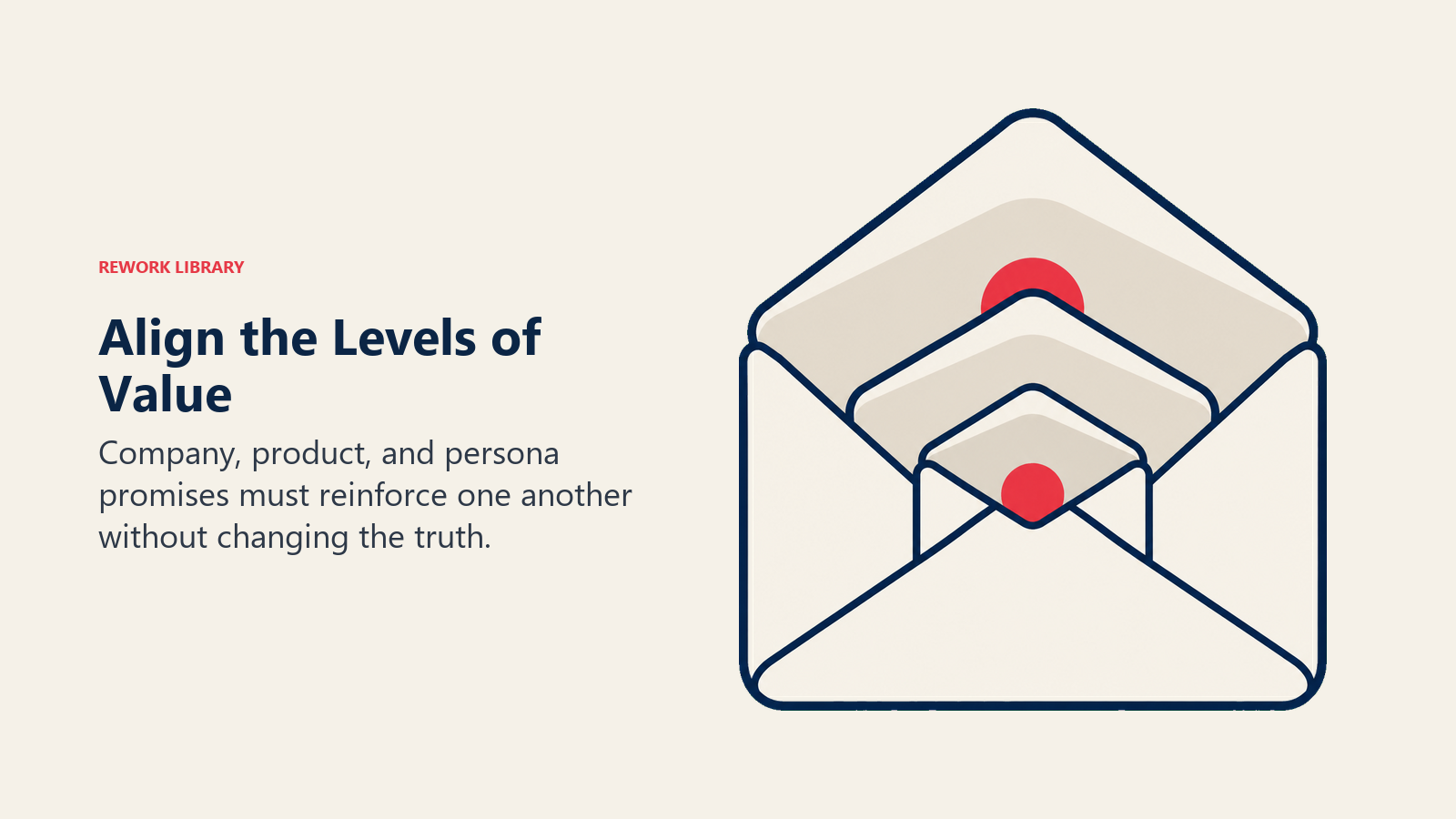
A company doesn't have one value proposition. It has a nested set of them, and the discipline is making sure they reinforce each other instead of quietly contradicting.
| Level | What it answers | Who reads it |
|---|---|---|
| Company level | Why does this company deserve to exist at all, across everything it sells | Analysts, new hires, the market broadly |
| Product or product-line level | Why does this specific product beat the alternative, inside the company's broader promise | A buyer evaluating one purchase |
| Segment or persona level | Why does this product matter to this specific role or buyer type, in their own language | The individual signing off, or using it daily |
The levels have to nest, not contradict. Picture a fictional B2B expense platform called Ledgerly. At the company level, it promises finance teams a single system that closes the expense cycle without spreadsheets stitched together by hand, broad enough to cover everything it builds. One layer down, its approvals engine has its own promise: it cuts approval time by routing spend to the right manager automatically, a specific instance of the company promise, not a different one. One layer further, the same product gets framed by reader: a CFO hears about closing the books two days faster, an employee hears about getting reimbursed without a paper trail. Same product, same benefit, different entry point.
Where this breaks is when a segment pitch quietly promises what the company-level product can't back up, a sales deck offering same-day reimbursement when engineering only supports next-business-day. Market segmentation keeps the segment layer honest: it tells you which persona cares about which benefit, so framing changes without the claim drifting into something the product doesn't do.
The Anatomy of a Value Proposition
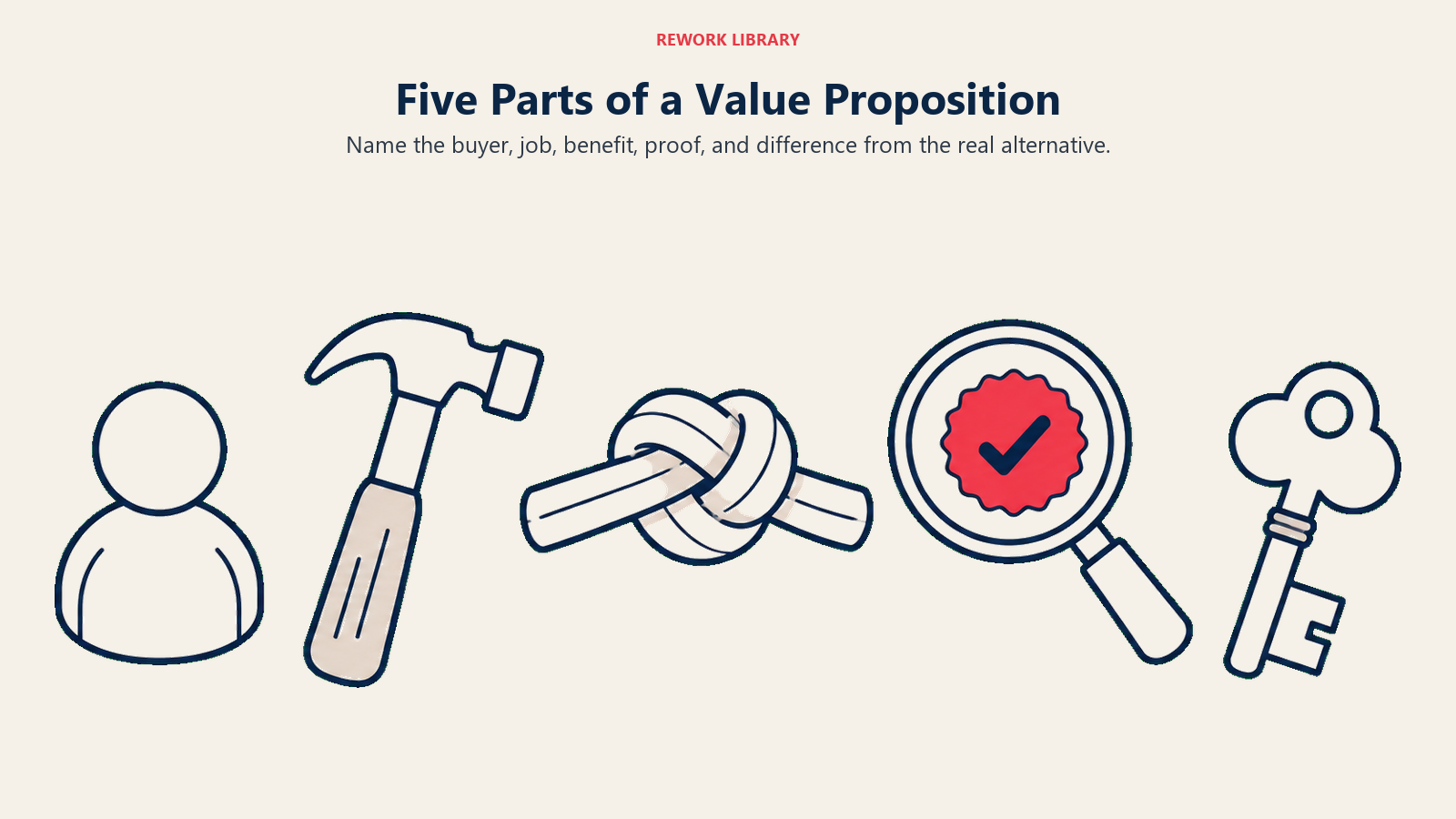
Every value proposition that holds up under questioning has the same five parts. Miss one and it reads as marketing copy instead of a reason to buy.
| Part | The question it answers | What's missing when it's weak |
|---|---|---|
| Who it's for | Which specific customer or segment is this written for | A pitch aimed at "everyone" that lands with no one in particular |
| The problem or job | What is the customer actually trying to get done | A feature described in isolation, disconnected from why anyone needs it |
| The benefit, and its size | What specifically improves, and by how much | A vague adjective ("better," "faster") standing in for a number |
| The proof | What evidence lets a skeptical buyer verify the claim themselves | A confident assertion with nothing behind it a buyer could go check |
| The point of difference | Why this beats the next-best alternative, including doing nothing | A benefit that's real but equally true of every competitor, so it changes nothing |
The second part deserves the most care, because most teams describe a feature where they should describe a job. Jobs to be done is the deeper resource here: it reframes the question from "what does our product do" to "what progress is the customer trying to make." The fifth part is where drafts go soft, since naming a real competitor is uncomfortable and "doing nothing" is easy to forget. Both comparisons have to survive: beating a named rival but not the customer's spreadsheet still loses deals.
Quantifying the third part is a discipline most teams skip, not because the number is hard to find, but because an unquantified benefit is easier to write and harder to be wrong about. "Cuts reporting time" is a claim nobody can check. "Cuts reporting time from two hours a week to under ten minutes" is a claim a skeptical buyer can ask a reference customer to confirm. The second version is riskier to publish and far more persuasive, the trade a real value proposition is supposed to make.
Types of Value: Economic, Functional, and Emotional or Social
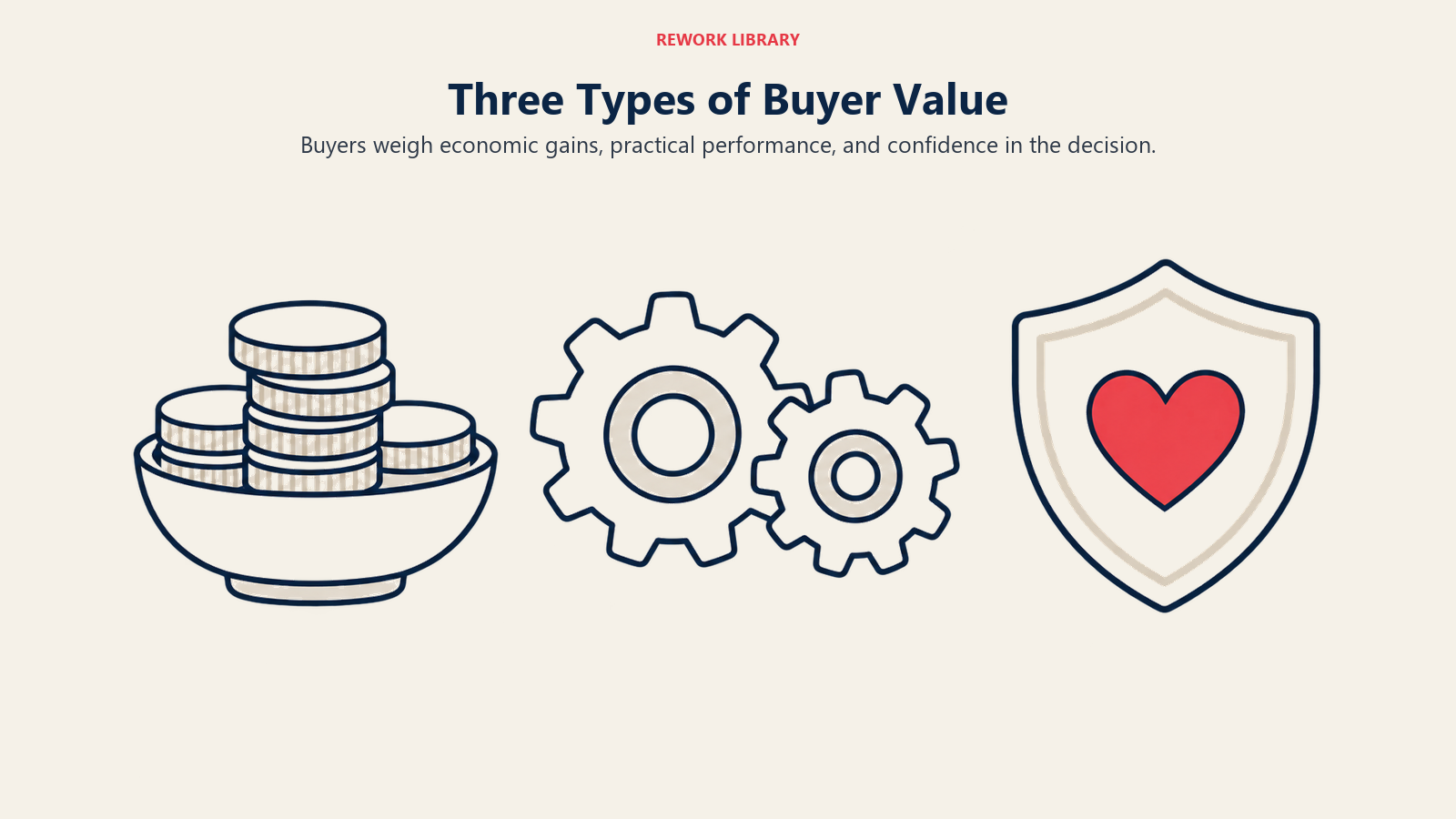
Most first drafts only reach for economic value: this saves money, makes money, or reduces risk. That's real, but incomplete, and treating it as the whole story is why a technically accurate value proposition still underperforms.
| Type of value | What it delivers | Example framing |
|---|---|---|
| Economic | Makes money, saves money, or reduces a quantifiable risk | "Cuts checkout abandonment by 12%, worth roughly $400K a year at current traffic" |
| Functional | The product simply works better on a practical dimension: faster, more reliable, easier to use | "Loads in under a second, even on a conference-room Wi-Fi connection" |
| Emotional or social | Confidence, reduced anxiety, status, or how the buyer looks to their own boss or team | "Nobody on your team gets blindsided by a number they didn't see coming" |
Bain & Company's B2B Elements of Value framework is built on exactly this layering. It sorts 40 recognized elements into five tiers, from objective value at the base (table stakes, functional, ease of doing business) up to the most subjective tier at the top, individual elements tied to "sometimes quite personal concerns that business customers bring to the purchase process," including reputation and anxiety (Bain & Company, The B2B Elements of Value). Companies that deliver four or more elements their customers rate highly see a 3.5x gain in Net Promoter Score over companies delivering just one (Bain & Company, Elements of Value).
That top tier is what most B2B teams assume doesn't apply to them, on the theory that a committee of professionals makes rational, purely economic decisions. The evidence says otherwise. CEB Marketing, working with Google and the research firm Motista, surveyed 3,000 B2B buyers across 36 brands and 7 categories and found that buyers who perceive personal value, things like career advancement or confidence and pride in the choice, are almost 50% more likely to buy and 8 times more likely to pay a premium for comparable products. The same study found seven of the nine B2B brands it measured had an emotional connection with more than half their customers, well above the 10% to 40% range Motista typically finds for consumer brands (Google, CEB and Motista, "From Promotion to Emotion," 2013). The reason one vendor wins the room is often the part that never makes the ROI slide: confidence this choice won't blow up in six months.
How to Write One: Three Templates and One Discipline
A value proposition doesn't have to come from a blank page. A handful of templates have survived decades of use because they force the same anatomy parts into a sentence whether or not the writer remembers them.
| Template | Structure | Best for |
|---|---|---|
| Geoffrey Moore's positioning statement | "For (target customer) who (need or opportunity), the (product) is a (category) that (key benefit). Unlike (primary alternative), our product (point of difference)." | A full internal positioning document, product launches, sales enablement |
| The XYZ statement | "We help (X, the customer) do (Y, the job or outcome) by (Z, how the product does it)." | An early-stage pitch, a landing page headline, a one-liner for a pitch deck |
| The quantified-benefit statement | "(Product) gets (specific buyer) to (quantified benefit) by (mechanism), something (next-best alternative) can't match because (reason)." | A sales conversation, a case study headline, anywhere the number needs to lead |
Geoffrey Moore's template, from Crossing the Chasm (HarperBusiness, 1991), is the most complete because it forces every anatomy part into one sentence: the customer, the need, the category, the benefit, the named alternative. It's an internal document meant to keep sales, marketing, and product aligned before any of them write customer-facing copy. The XYZ statement trades that completeness for speed, skipping the named competitor entirely, useful for a first pass later refined against Moore's fuller structure. The quantified-benefit statement resists the vague-adjective problem directly: it can't be filled in honestly without a number.
Whichever template a team starts with, the discipline that actually separates a working value proposition from a wish is the same one from the anatomy section: quantify the benefit, and name the real alternative it beats, including the alternative of doing nothing. A sentence that's technically true and completely unquantified will read as confident and change no one's mind.
Where the Osterwalder Canvas Fits
Everything above answers what a value proposition is and how to draft one. It doesn't answer how to systematically discover what belongs in it, a research problem, not a writing problem. That's the job of the value proposition canvas, Alexander Osterwalder's method for mapping a customer's jobs, pains, and gains against a company's products, pain relievers, and gain creators, published in Value Proposition Design (Wiley, 2014). It's also the zoomed-in view of two blocks inside the broader Business Model Canvas: Value Propositions and Customer Segments. Run the canvas first, with real interviews, and the anatomy above stops being wordsmithing and starts being a compression of research already done.
The Tests a Candidate Value Proposition Must Pass
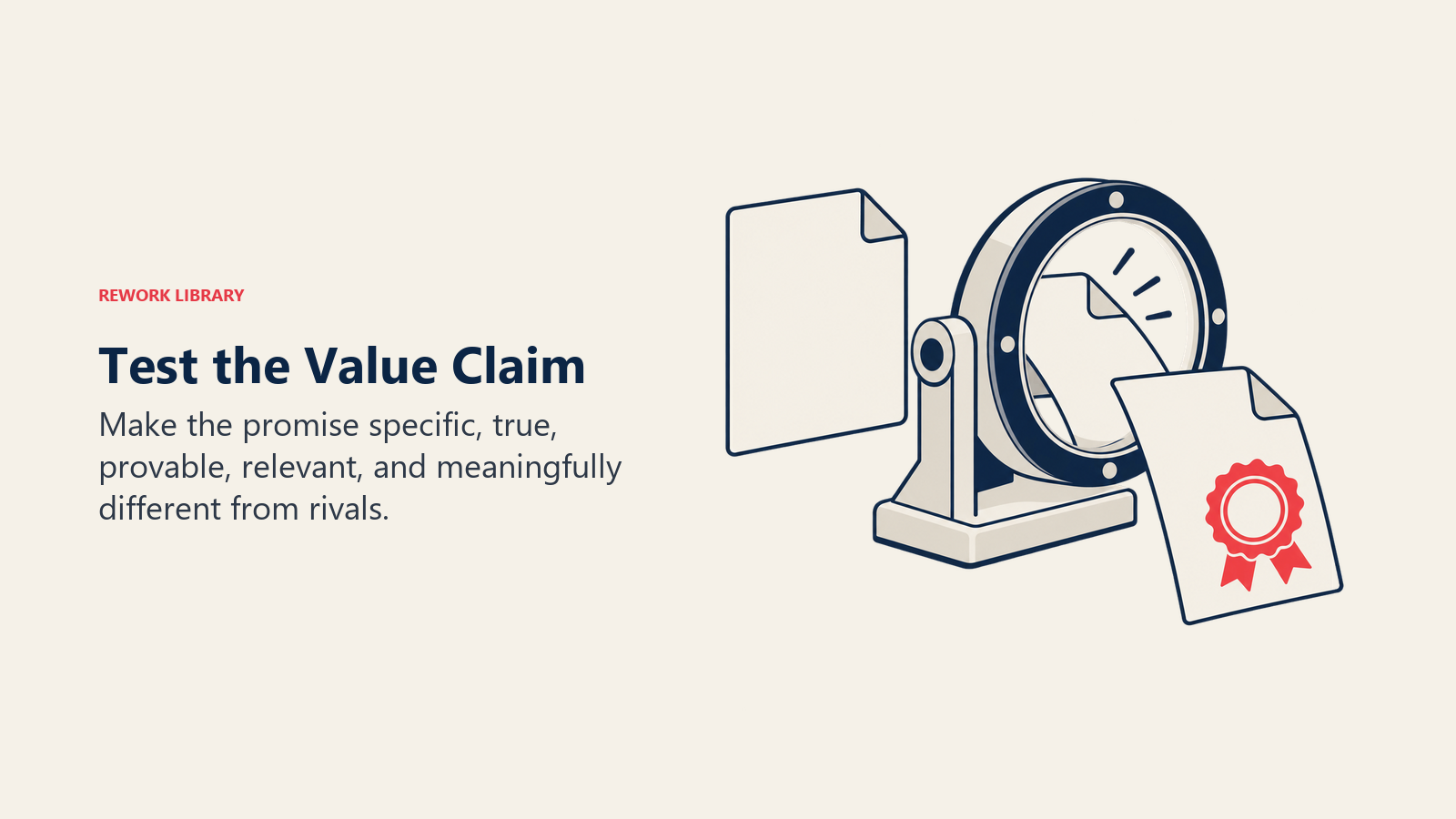
A finished-looking value proposition can still fail in the market. Running a draft through these six tests catches the failure before it ships, not after a quarter of flat pipeline.
| Test | What it checks | What failing it looks like |
|---|---|---|
| Specific | Does it name an actual customer, job, and benefit, not a mood | "Empowering your business to succeed," which names nothing |
| True | Can the company actually deliver what's claimed, today, not on the roadmap | A benefit the product will support next quarter, printed as if it's live now |
| Provable | Can a skeptical buyer verify the claim themselves | A number with no source, demo, or reference customer behind it |
| Differentiating | Would a competitor have to lie to make the same claim | A benefit that's real but equally true of the entire category |
| Relevant to the buyer's actual priority | Does it address what this buyer ranks highest, not what the team is proudest of building | A technically impressive feature the buyer never asked about |
| Survivable | Does it still mean something if a rival says the exact same sentence tomorrow | A claim so generic that a copy-paste onto a competitor's site changes nothing |
The survivability test is the one most drafts quietly fail, because it's hardest to self-assess honestly. Read the draft aloud and imagine your closest competitor's sales rep saying the identical sentence in the same meeting. If nothing about your position breaks, the sentence was carrying enthusiasm, not real weight, the same durability question competitive advantage asks about a whole business, applied to one sentence. There is a visual version of this same test: a strategy canvas plots you and your rivals against the factors buyers actually weigh, and a proposition that fails survivability shows up as a value curve sitting on top of everyone else's.
Real Value Propositions: Wins and Honest Failures
Verifiable outcomes age better than the pitch that led to them. Two held up, two didn't.
| Company | The value proposition | What happened |
|---|---|---|
| Dollar Shave Club | Cheaper, mail-order razors versus Gillette, pitched in one $4,500 video | Inventory sold out within hours; Unilever acquired the company for roughly $1 billion on July 20, 2016 (NBC News, July 2016) |
| Warby Parker | Designer prescription glasses at a flat $95 against an industry charging several hundred dollars, backed by a free home try-on program | Co-founder Neil Blumenthal: "We launched in 2010 with $95 prescription glasses with anti-scratch, anti-reflective coatings, lightweight lenses and frames," and the company still sells $95 glasses today (Fortune, August 2024). Within four weeks of opening it had a waitlist of 20,000 people (Wharton Magazine) |
| Juicero | A Wi-Fi juicer, launched at $699 and later cut to a $399 version, that pressed proprietary packets into fresh juice at the push of a button | An April 2017 Bloomberg report showed the same packets could be squeezed by hand for a nearly identical result, and the company shut down that September, about 16 months after launch (Fortune, September 2017) |
| Quibi | Premium, Hollywood-produced short video built for watching on the go | Raised $1.75 billion, launched in April 2020, and announced its shutdown on October 21 the same year, reporting 3.5 million downloads but only 1.3 million active users, and never beat the free short-video apps already on the same phone (NBC News, October 2020) |
The pattern across both failures is the same anatomy part: the point of difference was never tested against the real next-best alternative before launch. Juicero's proposition was real, but the comparison that mattered wasn't the grocery aisle, it was squeezing the same packet by hand, an alternative the company apparently never stress-tested before Bloomberg did it for them. Quibi's proposition was coherent on a slide, but it never beat the free short-form video already on the same device, competing for the same idle minutes. Dollar Shave Club and Warby Parker survive the same test in reverse: each named a specific, expensive incumbent, made one quantified claim, and let a skeptical buyer verify it in one purchase.
Where a Value Proposition Shows Up Downstream
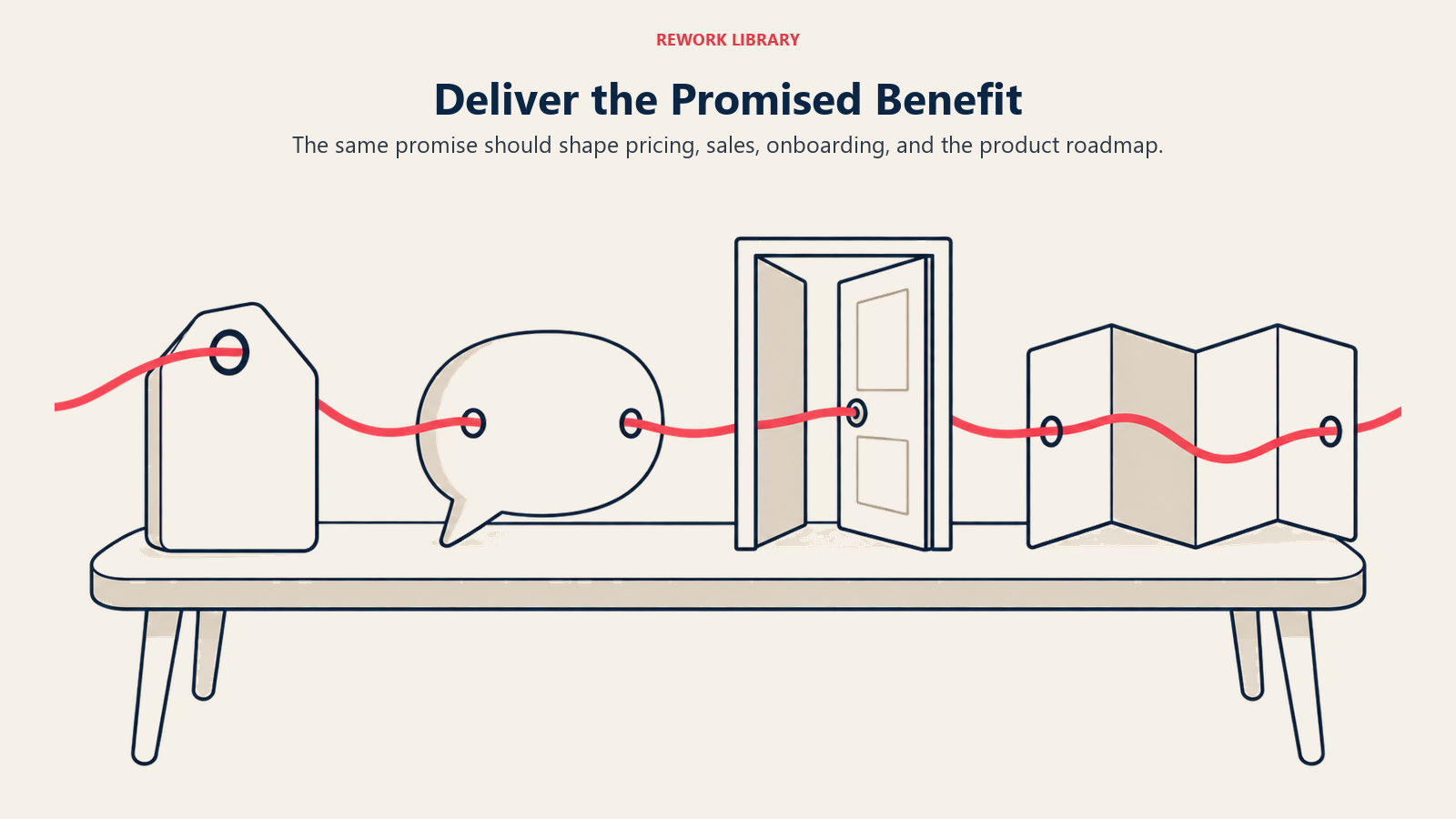
A value proposition that only lives in a slide deck isn't doing its job. It should be traceable in at least four places a buyer or new hire would actually encounter.
| Where it shows up | What changes when it's real | What it looks like when it isn't |
|---|---|---|
| Pricing | The price ties to the quantified benefit, not just to what competitors charge | A number set by matching the category average, with no line item tracing back to the benefit |
| Sales conversations | A rep states the benefit, the proof, and the point of difference in one breath | Reps default to a feature demo or a discount when a prospect asks "why you" |
| Onboarding | The first thing a new customer experiences is the specific benefit that was promised | A generic product tour that never connects back to why the buyer signed up |
| Roadmap | New features get prioritized because they strengthen the stated point of difference | Features get built because an engineer found them interesting, disconnected from the pitch that won the deal |
This is also where go-to-market strategy picks up the handoff, translating the value proposition into who gets targeted and how they're reached. A value proposition never tested against a real onboarding flow or roadmap review is still a hypothesis, no matter how many times it's repeated in a deck. It also has a shelf life per market: a company pursuing market development, taking the same product to a new geography or segment, has to rewrite the segment-level proposition for buyers whose next-best alternative is a different one entirely.
Common Mistakes
The same failure patterns show up across nearly every weak value proposition, regardless of industry or size.
- Writing for everyone. A pitch built to land with any possible buyer lands with none of them specifically. A narrower segment usually sharpens the benefit instead of shrinking it.
- Confusing a feature with a benefit. "AI-powered dashboard" describes the product. "Catches a budget overrun three weeks before it happens" describes the benefit buyers evaluate.
- Skipping the alternative comparison. A proposition drafted without naming a rival or the status quo reads as a list of good things, not a reason to switch.
- Leaving the benefit unquantified. An adjective ("better," "faster," "easier") is cheap to write and easy to disbelieve. A number is harder to write and far more persuasive.
- Treating it as permanent. A proposition that differentiated two years ago can become table stakes once competitors catch up. It needs the same revisit cadence as pricing, not a one-time workshop.
Worked Example: Building a Value Proposition End to End
Return to Ledgerly, the fictional expense platform from the levels section, and run its segment pitch to CFOs through every part covered above.
| Anatomy part | Ledgerly's answer |
|---|---|
| Who it's for | Finance leaders at 200-to-2,000-employee companies still closing expenses with spreadsheets and email approval chains |
| The problem or job | Close the monthly expense cycle without chasing approvals manually across a dozen department heads |
| The benefit, and its size | Cuts the expense-close cycle from 9 business days to 3 |
| The proof | A published case study from a 400-person logistics company showing the 9-to-3-day change over one fiscal quarter |
| The point of difference | Unlike a spreadsheet-plus-email process, or a generic approvals tool bolted onto accounting software, routing and approval are native to the expense record itself, so nothing needs re-entry |
Run through Moore's template, that becomes: "For finance leaders at mid-market companies still closing expenses by chasing approvals through email, Ledgerly is an expense-management platform that cuts the close cycle from 9 days to 3. Unlike a spreadsheet-and-email process or a bolted-on approvals tool, Ledgerly builds routing directly into the expense record, so nothing gets re-entered." Every anatomy part is present, the benefit is quantified, and the comparison names a real alternative. It passes the six tests too: specific, true, provable against a published case study, differentiating against both categories, relevant to what a finance leader is measured on, and survivable, since a rival would have to also prove a 3-day cycle, not just claim one.
Conclusion
A value proposition is a testable claim, not a mood. It names a specific buyer, states the job they're trying to get done, quantifies the benefit, backs it with proof, and beats the real alternative, including the alternative of changing nothing. Most drafts that fail aren't dishonest, they're incomplete: a slogan standing in for the whole thing, a feature list with no buyer attached, a benefit too vague to check. The fix isn't more enthusiasm on the page. It's running the anatomy and putting a number where an adjective used to be.
Related Reading
- Value Proposition Canvas: the research method for discovering what belongs in the anatomy before you write it.
- Unique Selling Proposition: the one-sentence compression a value proposition gets reduced to for advertising.
- Competitive Positioning: the broader choice of where you stand relative to named rivals.
- Jobs to Be Done: finding the real problem behind the benefit you're claiming to solve.
- Mission vs. Vision Statement: why "why we exist" isn't the same claim as "why buy from us."
- Differentiation Strategy: the company-wide strategy a strong value proposition often supports.
- Market Segmentation: knowing which persona cares about which benefit before you frame one for them.
- Business Model Canvas: the full-company view the value proposition canvas zooms in from.
- Go-to-Market Strategy: how the value proposition turns into who gets targeted and how.
- Competitive Advantage: the durability question behind the survivability test, for a whole business.
- Strategy Canvas: the picture that shows whether your proposition actually diverges from the category.
- Market Development Strategy: why the same product needs a rewritten proposition in every new market it enters.

Co-Founder & COO
On this page
- What a Value Proposition Actually Is
- The Levels a Value Proposition Has to Work At
- The Anatomy of a Value Proposition
- Types of Value: Economic, Functional, and Emotional or Social
- How to Write One: Three Templates and One Discipline
- Where the Osterwalder Canvas Fits
- The Tests a Candidate Value Proposition Must Pass
- Real Value Propositions: Wins and Honest Failures
- Where a Value Proposition Shows Up Downstream
- Common Mistakes
- Worked Example: Building a Value Proposition End to End
- Conclusion
- Related Reading