McKinsey Growth Pyramid: A Framework for Growth Strategy
Turn this article into takeaways for your work.


Each assistant summarizes the article only for you and suggests best practices for your work.
The McKinsey Growth Pyramid is one of the most practical tools a strategy team can reach for when a company needs to decide where its next phase of growth will come from. It organises seven distinct growth paths into three tiers, each tier requiring more organisational stretch than the last. If you've watched a business chase an acquisition before fixing its core operations, you've seen what happens without a framework like this.
What is the McKinsey Growth Pyramid?
The McKinsey Growth Pyramid is a strategic framework that maps seven growth options across three hierarchical levels, each level anchored in a firm's existing skills and assets. Developed by McKinsey consultants in the late 1990s and popularised through the book The Granularity of Growth, the framework argues that sustainable growth doesn't come from chasing markets at random. It comes from building outward from what you already do well.
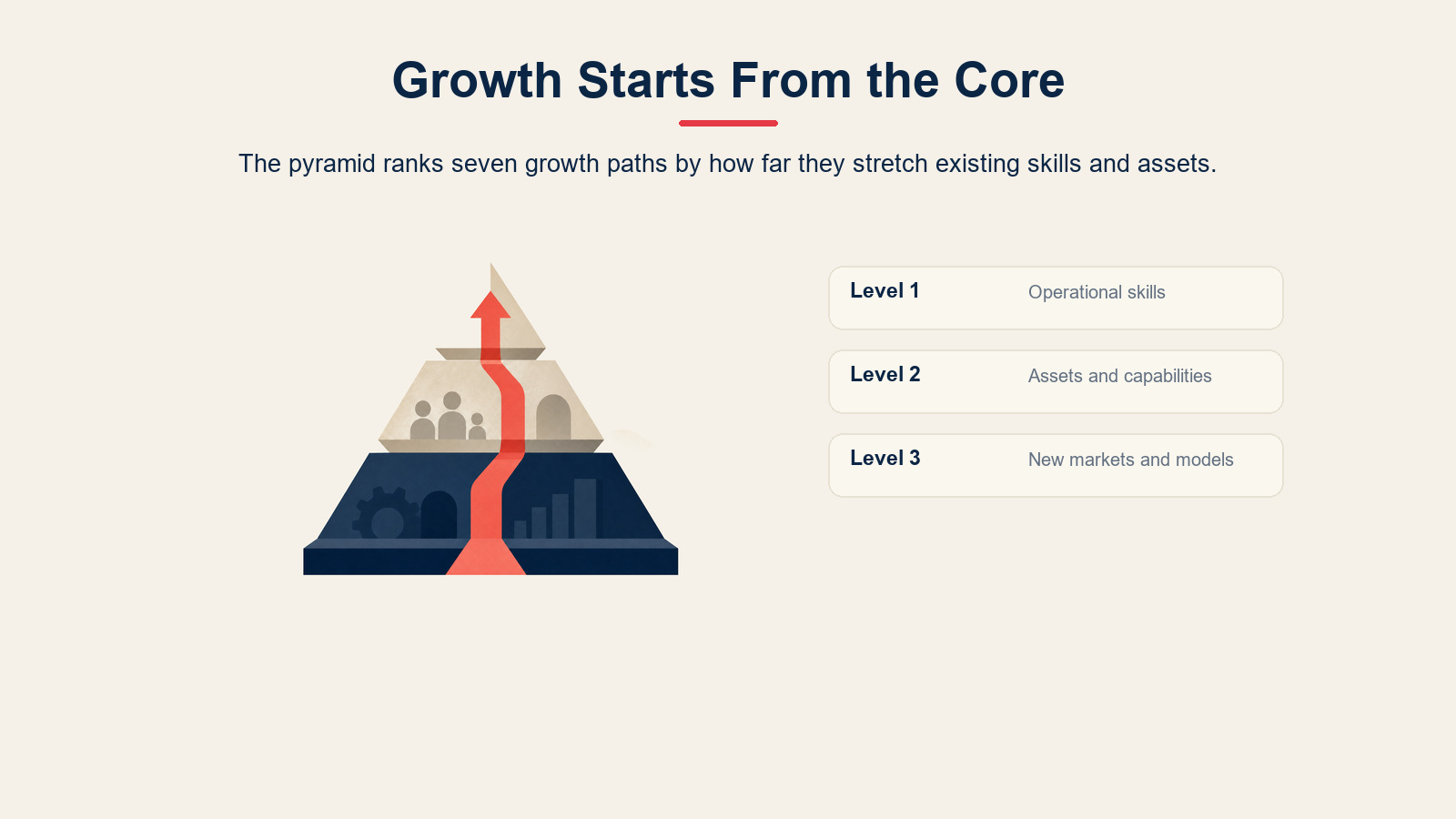
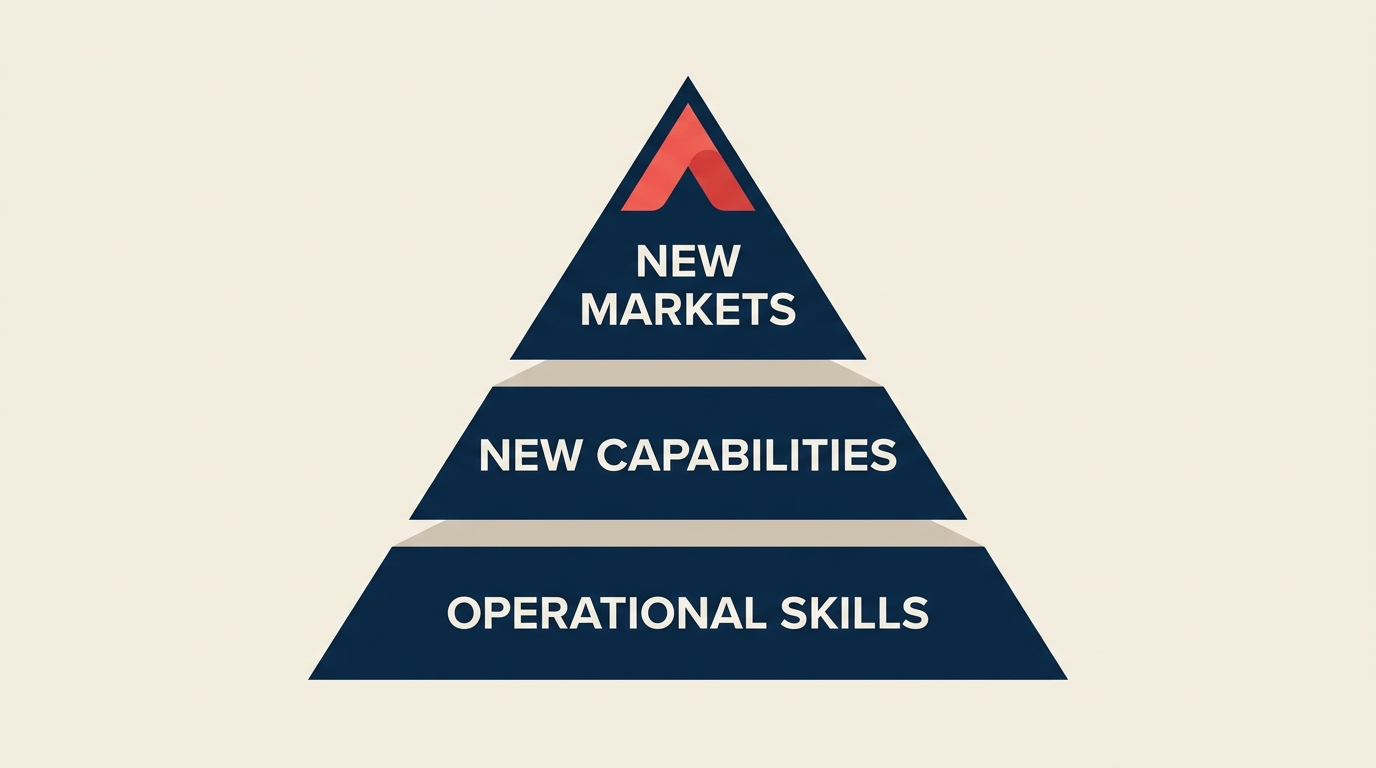
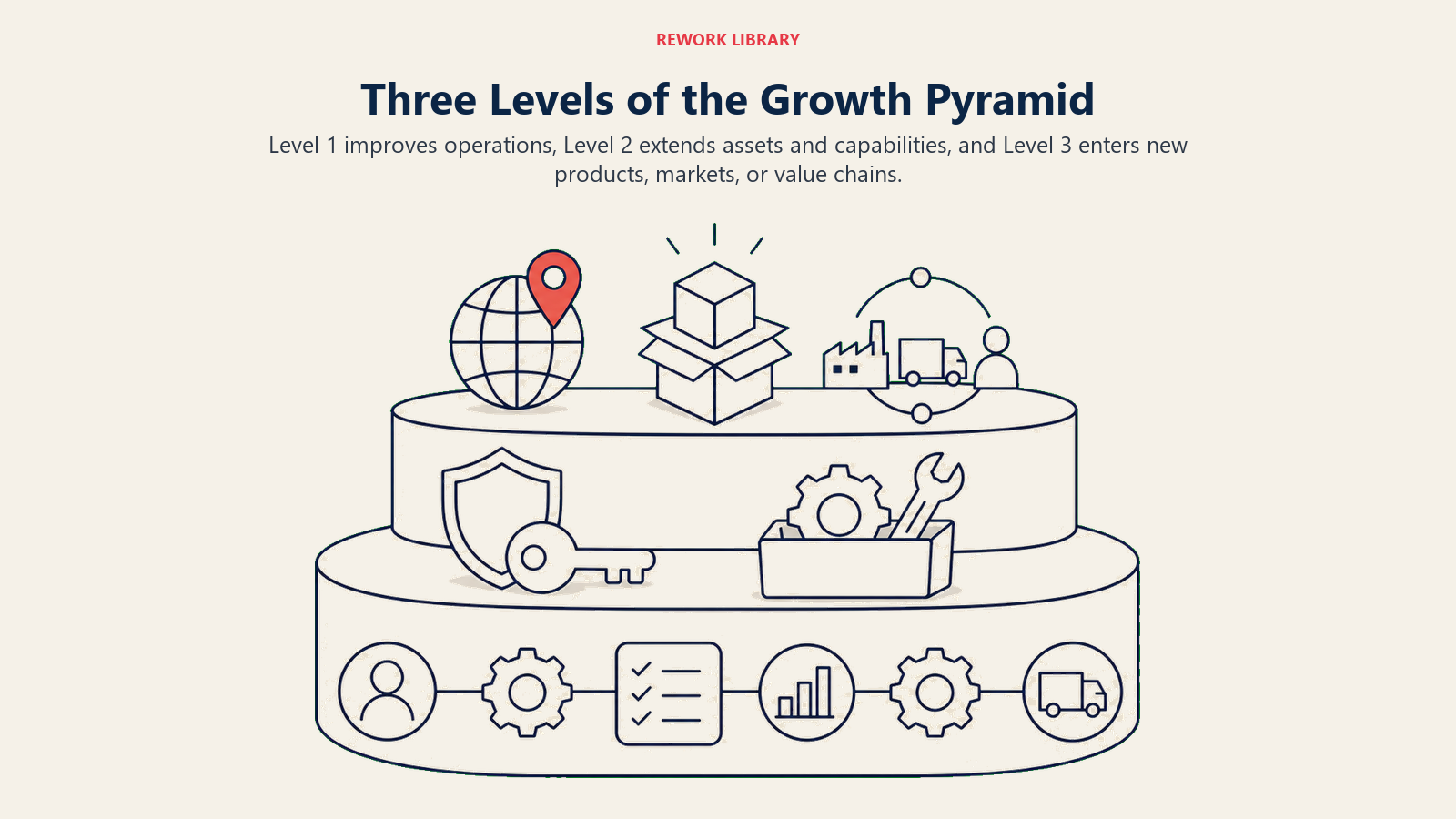
The three levels move from existing operational strengths at the base, through new capabilities and privileged assets in the middle, to new products, markets, and value-chain positions at the top. Most companies that struggle with growth are trying to operate at the top tier before they've secured the lower two.
Key terms to know:
- Seven degrees of freedom refers to the seven distinct paths the pyramid maps out.
- Privileged assets are competitive moats: brands, customer relationships, proprietary data, licences, or infrastructure that others can't easily replicate.
- Operational excellence means extracting more value from what the business already owns before buying or building anything new.
"Most growth strategies fail not because the idea is wrong, but because the underlying operational platform isn't strong enough to support it." (McKinsey Quarterly, 2004)
Key Facts
- Companies that pursue growth from a position of operational strength are 1.7x more likely to sustain above-market revenue growth for five or more years (McKinsey Global Institute, 2021).
- A 2022 Bain & Company analysis of 2,000 companies found that just 11% of all growth initiatives delivered lasting profitable growth; most were killed by execution gaps rather than strategy flaws.
- According to Harvard Business Review (2019), firms that leverage existing customer relationships for adjacent expansion outperform those chasing new segments by roughly 20% on total shareholder return over a 10-year period.
The three levels of the growth pyramid
The pyramid is best understood as a sequence. You don't skip to Level 3 without a firm foundation at Levels 1 and 2.
| Level | Name | What it means | Growth options included |
|---|---|---|---|
| Level 1 | Operational Skills | Grow by doing what you already do, but better. Extract untapped value from existing operations before investing in anything new. | (1) Improve existing operations |
| Level 2 | New Capabilities and Privileged Assets | Grow by leveraging unique assets you control (brand, distribution, data, customer trust) or by building new capabilities that let you enter adjacent spaces. | (2) Leverage privileged assets; (3) Build new skills and capabilities |
| Level 3 | New Products, Markets, and Value Chains | Grow by moving into genuinely new territory: new customer segments, new geographies, new business models, or a new position in the value chain. | (4) Enter adjacent markets; (5) New geography; (6) New products or services; (7) New business model or value chain |
A few points worth underlining:
Level 1 is often undervalued. Many boards push for acquisitions when pricing optimisation, churn reduction, or sales productivity could deliver comparable returns without the integration risk. The pyramid forces you to justify the move up before skipping ahead.
Level 2 is where most mid-market companies stall. They've optimised operations but haven't clearly defined what makes them genuinely hard to replicate. Until those privileged assets are named and defended, Level 3 moves are expensive guesses.
Level 3 carries the highest risk and the highest potential. But it also requires the strongest foundation. Amazon's move into cloud computing (AWS) looks bold in hindsight, but it was built on years of internal operational excellence in distributed systems. That's the pyramid working correctly.
McKinsey Growth Pyramid vs Ansoff Matrix vs Three Horizons
These three frameworks are often confused or treated as interchangeable. They're not.
| Framework | Core question | Unit of analysis | Best used for |
|---|---|---|---|
| McKinsey Growth Pyramid | Which of the seven paths is right for us, given what we already own? | Growth options ranked by asset proximity | Prioritising between competing growth moves |
| Ansoff Matrix | Are we selling existing or new products to existing or new customers? | Product-market combinations | Positioning a specific initiative |
| Three Horizons of Growth | When should we invest in each type of growth? | Time horizon and business lifecycle stage | Portfolio planning across near/mid/long-term |
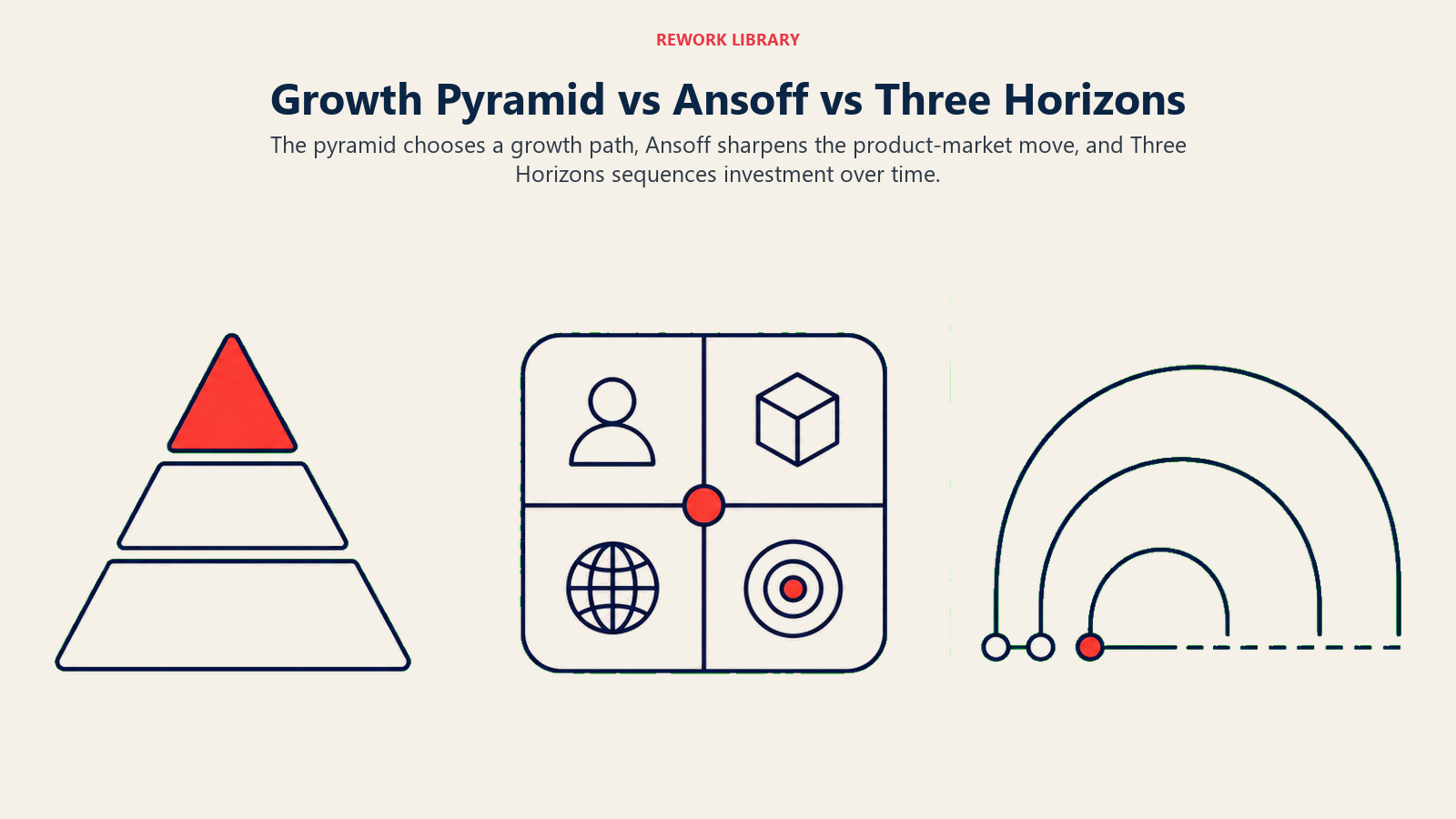
The Ansoff Matrix is narrower: it's a 2x2 that describes four product-market moves. The McKinsey Growth Pyramid gives you seven options and tells you how demanding each one is relative to your current assets. The Three Horizons framework is about timing, not path selection.
In practice, strong strategy teams use all three. The pyramid helps you pick the path, Ansoff helps you sharpen the product-market logic, and Three Horizons helps you sequence investment over time.
Benefits of the framework
It anchors ambition in reality. Growth conversations often drift toward exciting but expensive options. The pyramid redirects the conversation: what do we already own, and how far can we stretch it before we need something new?
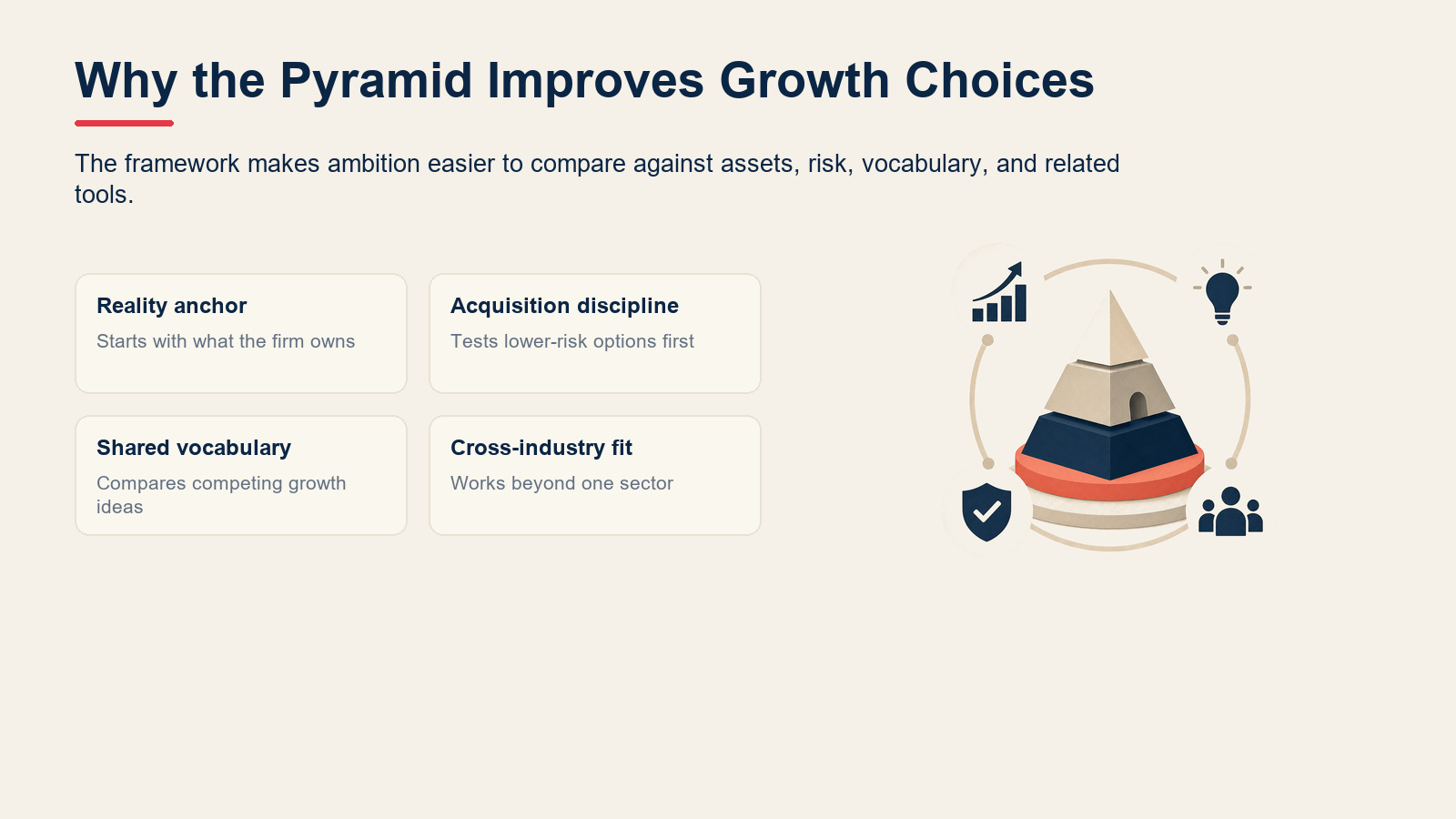
It reduces acquisition overconfidence. Level 3 moves (new geographies, new business models) are expensive and risky. By working upward from Level 1, teams are forced to exhaust lower-risk paths before reaching for the bolt-on acquisition.
It provides a common vocabulary. When a CFO says "we should leverage our distribution network" and a CMO says "we need to enter Southeast Asia," the pyramid gives both a shared frame. You can map both options, compare the capability requirements, and have a real conversation about sequencing.
It works across industries. A manufacturing firm, a SaaS company, and a retail chain all face the same fundamental question: grow from what you own, or spend to acquire something new? The pyramid handles both.
It pairs well with related frameworks. Core competencies analysis feeds directly into Level 2 (what privileged assets do we have?). Value chain analysis clarifies Level 3 options around vertical integration.
Limitations
It doesn't tell you how to execute. The pyramid identifies the path but not the capability-building roadmap to get there. A Level 2 move that depends on building new skills takes years, and the framework gives no guidance on timelines or resourcing.
"Privileged assets" can be hard to identify honestly. Companies routinely overestimate the uniqueness of their brand or customer relationships. A rigorous competitive advantage assessment is usually required alongside the pyramid to pressure-test Level 2 claims.
It can create false sequential thinking. The pyramid implies you should fully resolve Level 1 before touching Level 2. In practice, companies often need to pursue multiple levels simultaneously, especially during periods of market disruption. Treat it as a weighting guide, not a strict gate.
It was designed for large enterprises. For early-stage companies with no established operations, Level 1 barely exists yet. The framework is most useful once a business has a functioning core to optimise.
How to use the McKinsey Growth Pyramid
Step 1: Audit your Level 1 position
Before discussing where to grow, establish how well the business is running. Review key operational metrics: revenue per employee, customer retention, pricing realisation, and sales productivity. Document where operational performance is below its potential. These gaps are growth opportunities that cost less than acquisitions and carry near-zero integration risk.
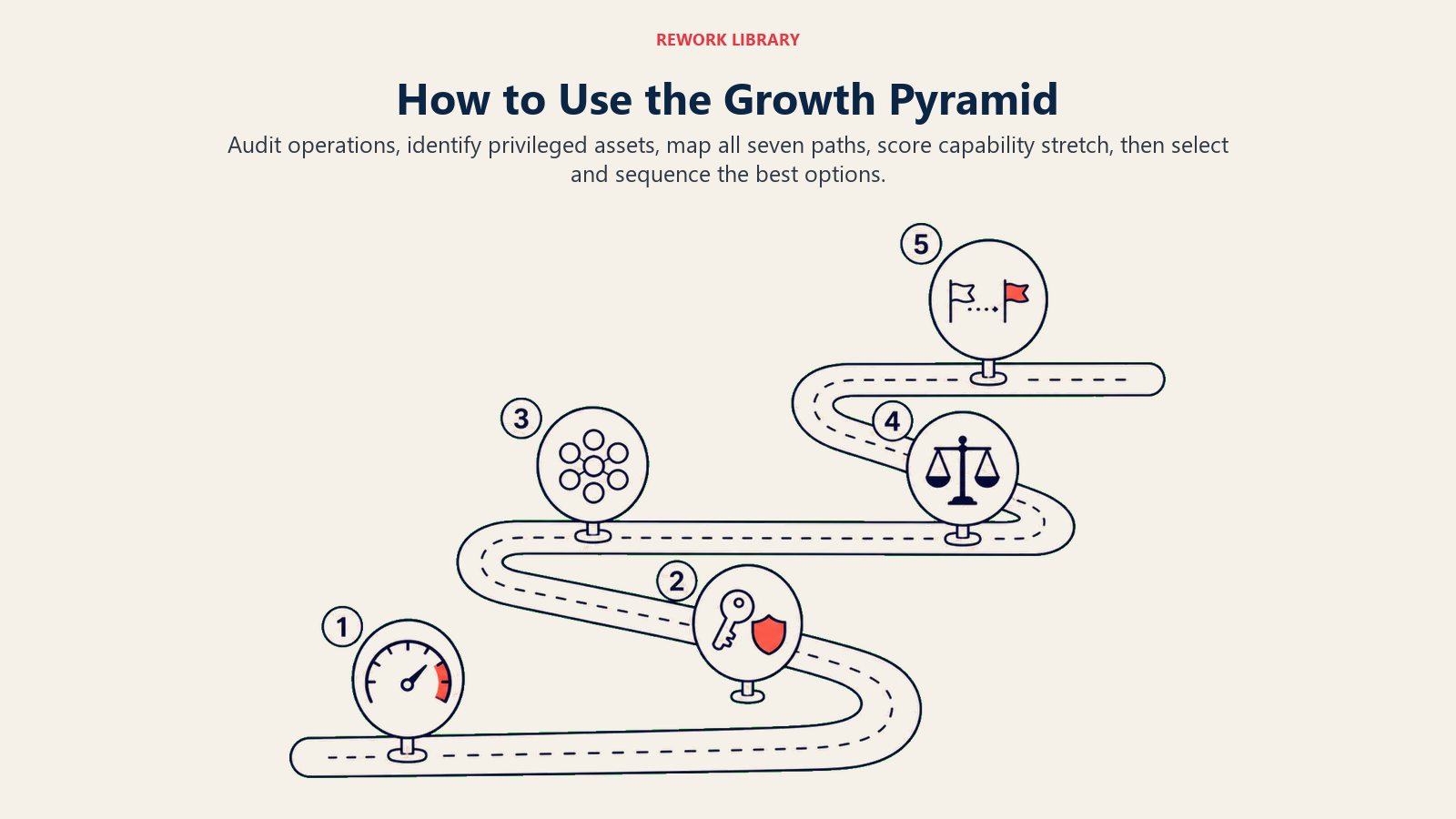
Step 2: Define your privileged assets
List every asset the business controls that a competitor would find hard to replicate in two years. Think about customer relationships, distribution access, proprietary data, regulatory licences, supplier contracts, or brand equity in a specific segment. Then stress-test the list: are these actually hard to copy, or do they just feel that way internally? A resource-based view or VRIO analysis helps here.
Step 3: Map all seven growth options
Don't pre-filter. List at least one credible idea for each of the seven degrees of freedom: improve operations, leverage privileged assets, build new capabilities, enter adjacent markets, expand geographically, launch new products or services, and explore new business models. At this stage, you're generating options, not committing.
Step 4: Score each option against capability and asset requirements
For each option, ask: what capabilities and assets does this require? Which do we already have? Which would we need to build, borrow, or buy? (For a deeper look at the build-borrow-or-buy decision, see Build, Borrow, or Buy.) Assign a rough score based on how much new capability the move requires versus what you already own. Lower-requirement options generally belong lower in the pyramid.
Step 5: Select and sequence
Choose one or two primary growth paths for the next planning cycle. Sequence them so lower-pyramid moves (which strengthen the foundation) come before higher-pyramid ones. Document the dependency clearly: "We'll launch in Southeast Asia (Level 3) only after we've stabilised our European operations and built a regional partnership model (Level 2)." Then set review checkpoints to revisit the sequencing as conditions change.
McKinsey Growth Pyramid examples
| Company | Pyramid level | Growth move | Outcome |
|---|---|---|---|
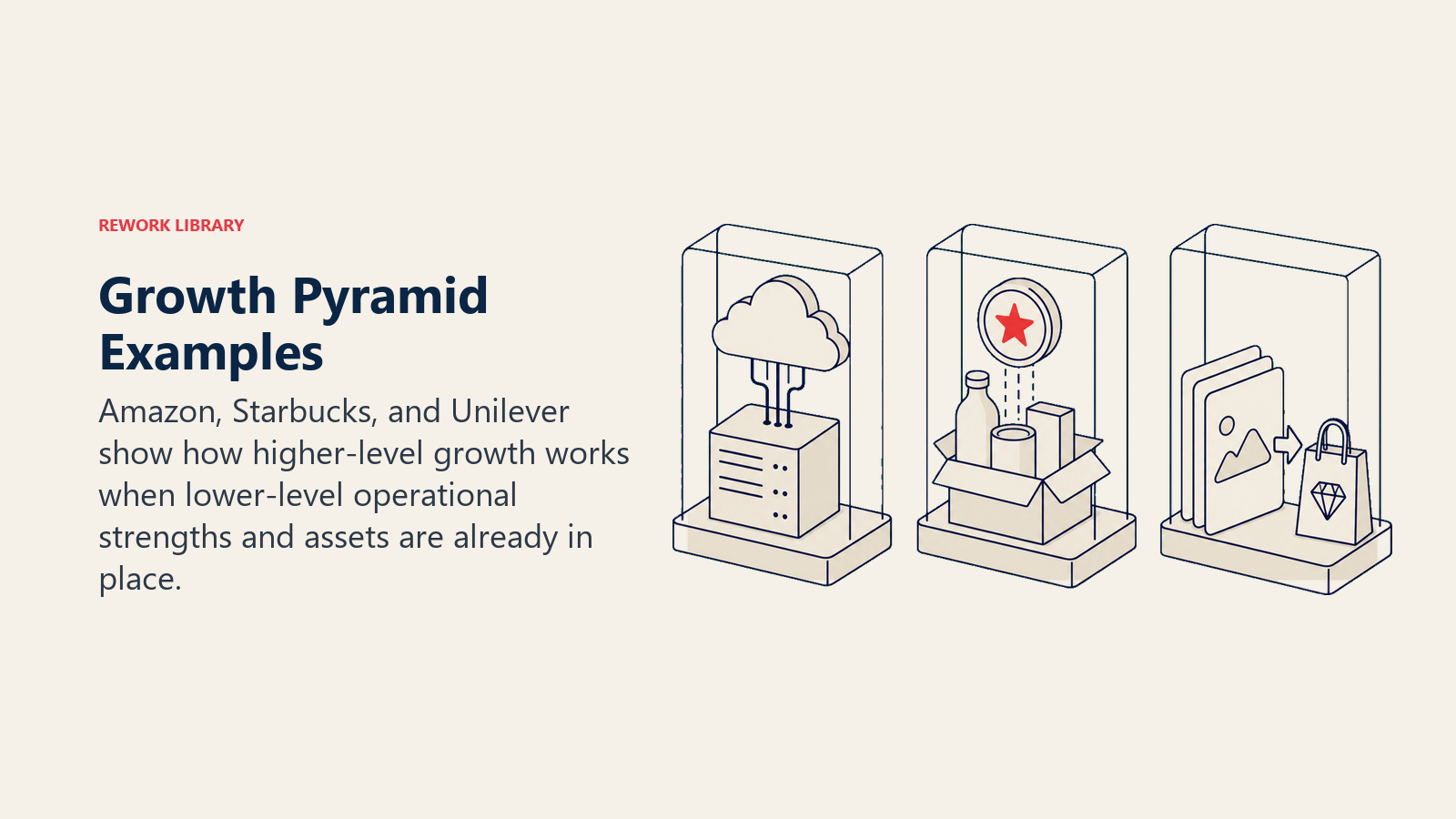
| Amazon (2006) | Level 3: New business model | Launched AWS by monetising internal infrastructure built for e-commerce operations | AWS became the most profitable division of Amazon; a pure Level 3 move enabled by years of Level 1 excellence |
| Starbucks (2010s) | Level 2: Privileged assets | Used its loyalty programme and brand to expand into packaged coffee and grocery channels | Starbucks at Home became a billion-dollar revenue stream without building new core skills |
| Unilever (2010-2020) | Level 1 to Level 2 | Stripped underperforming SKUs, improved operational margin, then used freed capital and brand equity to acquire premium personal care brands | Margin expansion at Level 1 funded Level 2 brand portfolio moves |
Each of these follows the pyramid's logic: don't reach for the top tier until the lower tiers are solid.
Best practices
Do:
- Start every annual strategy review with a Level 1 audit before discussing acquisitions or new markets.
- Name your privileged assets explicitly and validate them with external data, not just internal consensus.
- Use the pyramid alongside related tools: corporate strategy frameworks for portfolio-level decisions, the BCG matrix for business unit prioritisation, and strategic alliances analysis when a Level 2 move might be better done through a partner than built from scratch.
- Cross-reference Hoshin Kanri when deploying your chosen growth path operationally: the pyramid tells you where to go; Hoshin Kanri aligns the organisation to get there.
Don't:
- Skip Level 1 because it feels unglamorous. Operational improvements often deliver faster returns than acquisitions.
- Treat the pyramid as a strict gate. Multiple levels can be worked in parallel; the framework is a weighting guide, not a linear checklist.
- Assume a Level 3 move is automatically more "strategic." The most sustainable growth often comes from Level 1 and Level 2, where the firm's existing strengths create compounding advantages.
- Confuse the McKinsey Growth Pyramid with the McKinsey 7S framework or the Three Horizons model. They're separate tools addressing different questions.
Growth strategy is ultimately a question of sequencing. The McKinsey Growth Pyramid gives you a principled way to answer it: build from operational strength, leverage what makes you hard to replicate, and only then reach for new territory. For teams looking to apply this alongside execution frameworks, Hoshin Kanri and Porter's Diamond Model both pair naturally with the pyramid as you move from strategy to deployment.

Co-Founder & COO
On this page
- What is the McKinsey Growth Pyramid?
- The three levels of the growth pyramid
- McKinsey Growth Pyramid vs Ansoff Matrix vs Three Horizons
- Benefits of the framework
- Limitations
- How to use the McKinsey Growth Pyramid
- Step 1: Audit your Level 1 position
- Step 2: Define your privileged assets
- Step 3: Map all seven growth options
- Step 4: Score each option against capability and asset requirements
- Step 5: Select and sequence
- McKinsey Growth Pyramid examples
- Best practices