Switching Costs: How They Create Competitive Advantage
Turn this article into takeaways for your work.


Each assistant summarizes the article only for you and suggests best practices for your work.
Switching costs are the costs a customer incurs when moving from one supplier, product, or platform to another. They're one of the most underrated sources of competitive advantage in strategy. Partly because they're invisible when they're working well, and partly because competitors only notice them once they've already lost.
Understanding switching costs gives you a clearer picture of why certain businesses retain customers at extraordinary rates, command premium pricing without losing market share, and shrug off new entrants that look, on paper, like serious threats.
What Are Switching Costs?
Switching costs are the total burdens (financial, operational, psychological, and relational) that a customer bears when changing from one vendor or product to another. They don't require payment to be real. A customer might face no exit fee but still face six months of retraining, data migration, and lost productivity. That's a real switching cost.
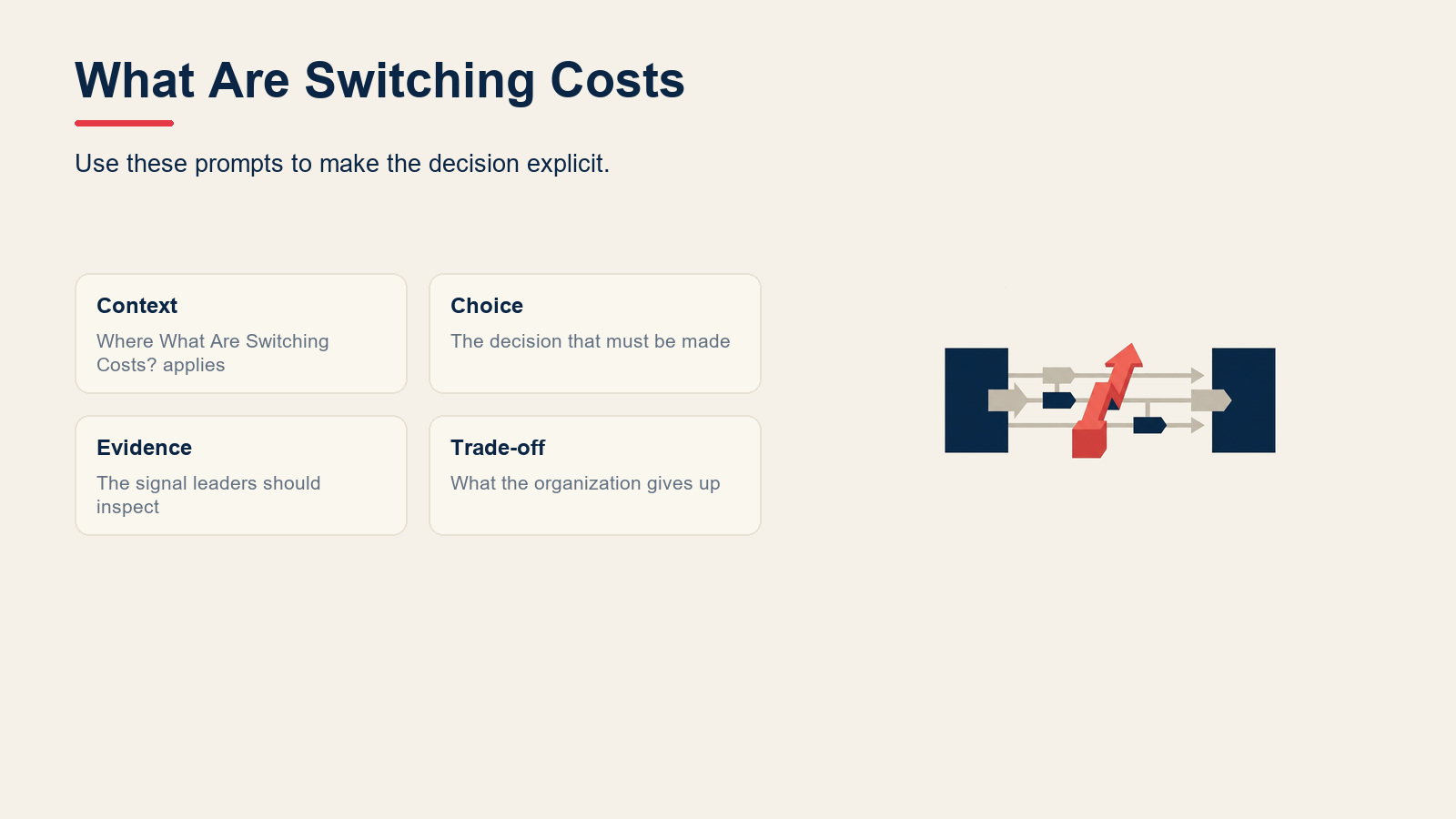
The concept sits at the heart of Porter's Five Forces: switching costs directly reduce buyer power. When costs to switch are high, buyers become less sensitive to price and less likely to defect to a rival offering a marginally better deal.
Key Facts: Switching Costs
- A Bain & Company study found that a 5% increase in customer retention produces profit increases of 25% to 95%, driven largely by the switching friction that keeps satisfied customers in place. (Bain & Company, 2020)
- Salesforce reports an average customer retention rate above 90%, a metric its leadership attributes in part to deep CRM data accumulation that makes switching platforms genuinely painful. (Salesforce Annual Report, 2023)
- Research published in the Journal of Marketing found that perceived switching costs are a stronger predictor of customer loyalty than satisfaction alone, particularly in B2B software and financial services. (Journal of Marketing, 2021)
Switching costs also feature prominently in competitive advantage analysis: they don't just retain customers, they give businesses the breathing room to invest in product improvements, price with confidence, and plan long-term without constant fear of churn.
Types of Switching Costs
Not all switching costs work the same way, and different types call for different strategic responses. Whether you're the incumbent trying to build them or the challenger trying to overcome them, understanding the taxonomy matters.
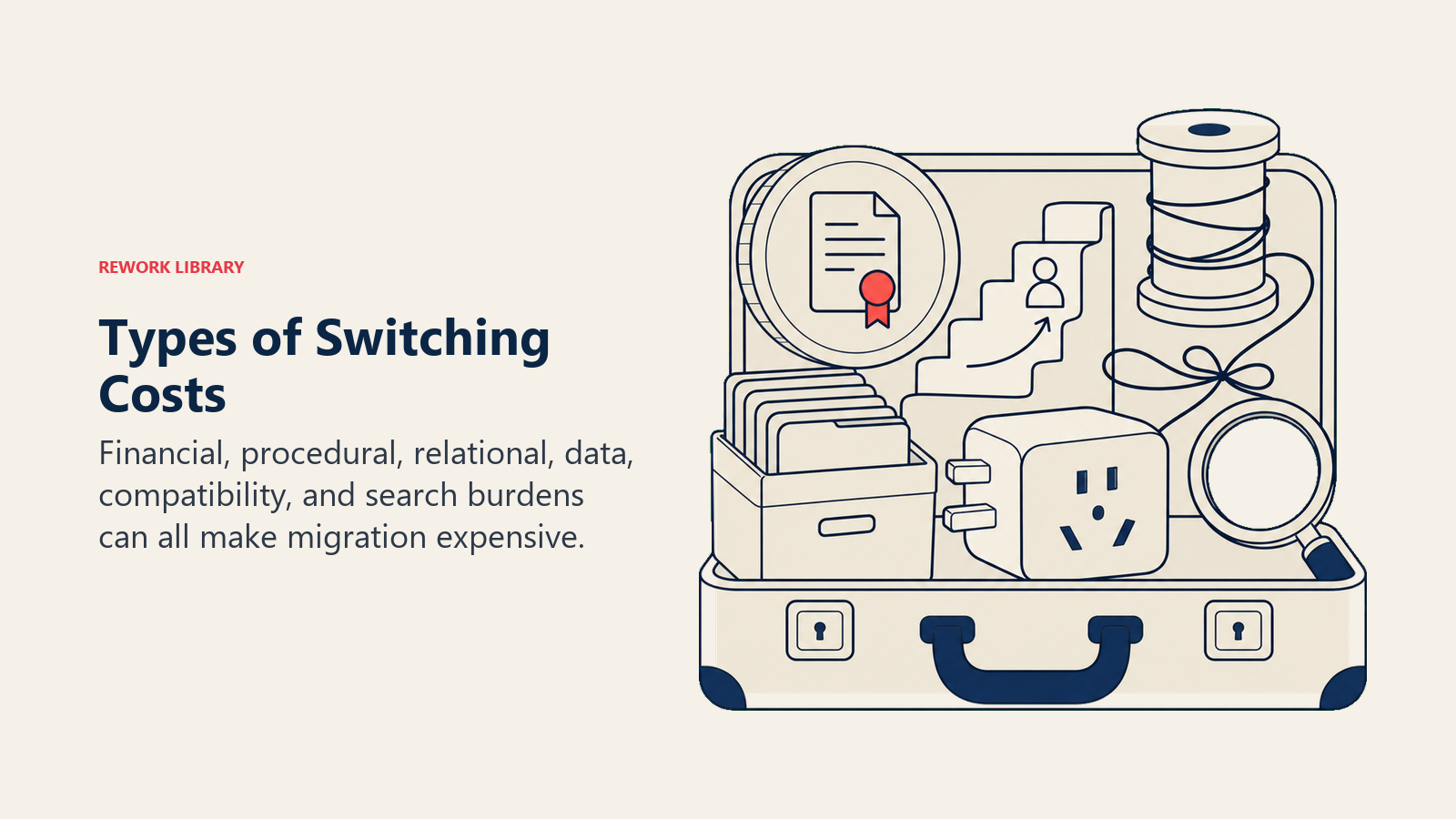
| Type | What it is | Real example |
|---|---|---|
| Financial / contractual | Direct cash costs to exit or re-enter (termination fees, setup fees, lost deposits) | Mobile phone contract early-termination fee; enterprise SaaS annual commitment |
| Procedural / learning | Time and effort to learn a new system or process | Moving from Excel to a new ERP system; retraining a team on new CRM workflows |
| Relational | Loss of accumulated trust, history, and personal relationships with the incumbent | Switching away from an accounting firm that knows your business history |
| Data and integration | Locked-in data, custom integrations, or proprietary formats | CRM data in Salesforce with custom objects; years of transactions in QuickBooks |
| Compatibility | Existing assets only work with current vendor's ecosystem | Switching from iOS to Android means repurchasing apps; Adobe CC files not fully portable |
| Search and evaluation | Time spent finding, vetting, and onboarding a replacement | Procurement process for replacing an ERP vendor can take 12-18 months |
The highest-leverage switching costs for most B2B businesses are data/integration costs and procedural costs, because they're genuinely costly to overcome and they grow over time as the customer accumulates more history with you.
Why Switching Costs Matter for Strategy
High switching costs do three things that compound over a business's lifetime.
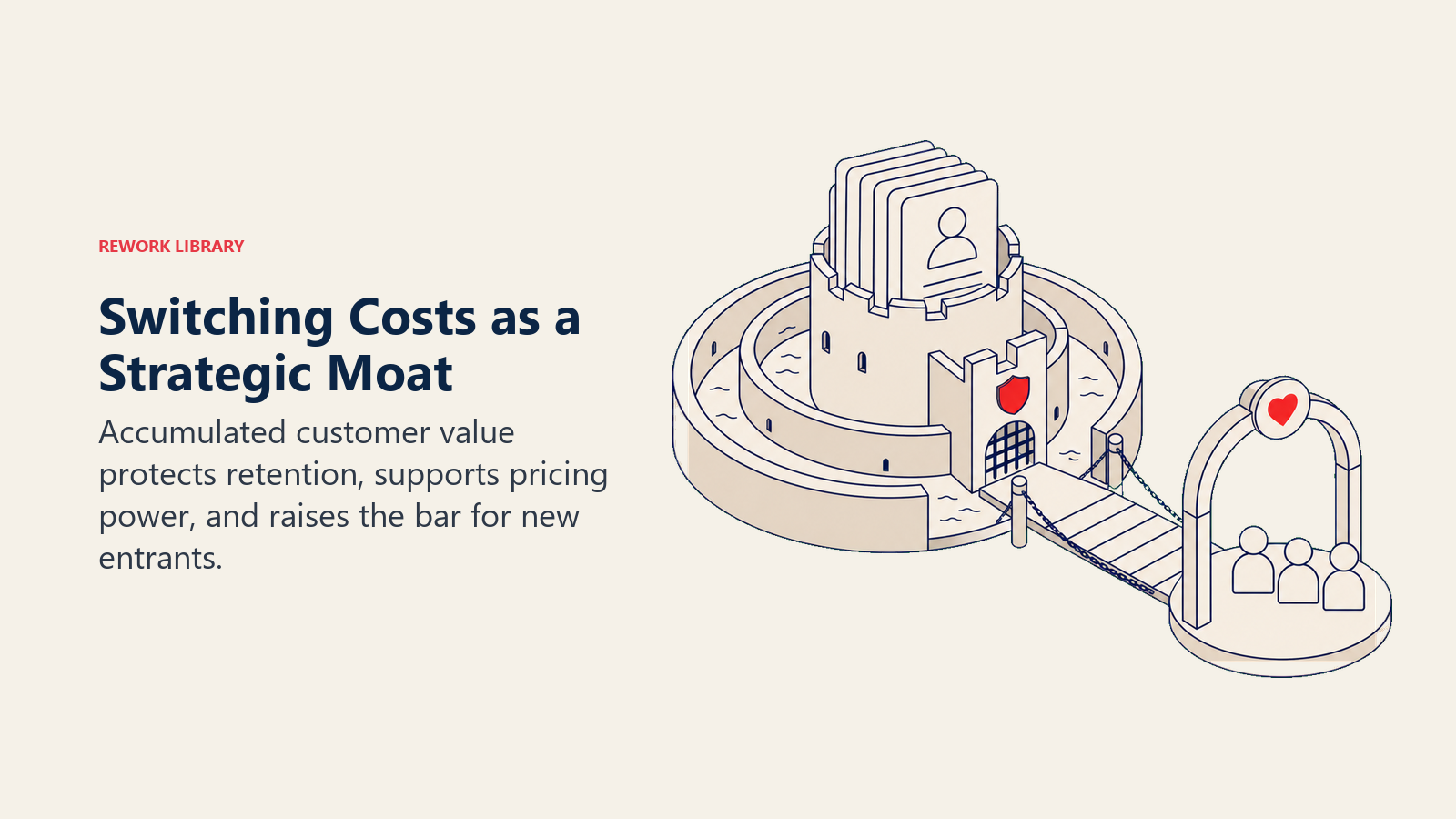
They protect retention without requiring discounting. When it costs a customer more to leave than to stay, you don't have to match a competitor's price to retain them. That's direct pricing power. Airlines with loyalty programs, banks with checking account holders, and enterprise software vendors all benefit from this dynamic.
They allow price increases over time. Software companies that build strong integration dependencies frequently raise prices 5-15% annually. Customers grumble, run the switching-cost math, and stay. Customers who haven't accumulated data or integration depth have no such calculus forcing them to stay.
They create a defensible moat. A moat is any structural feature of your business that makes competitive displacement difficult. Switching costs are one of the cleanest moats because they compound: the longer a customer stays, the higher the switching cost becomes, and the harder it is for a competitor to dislodge them with a feature advantage alone.
The VRIO Framework gives a useful lens here. Switching costs become a durable source of advantage when the capability to create them is valuable, rare, inimitable, and organizationally embedded. Companies that build switching costs through proprietary data, deep workflow integration, and accumulated user history usually satisfy all four criteria.
Switching Costs and Other Moats
Switching costs rarely operate alone. The most defensible businesses combine them with other structural advantages.
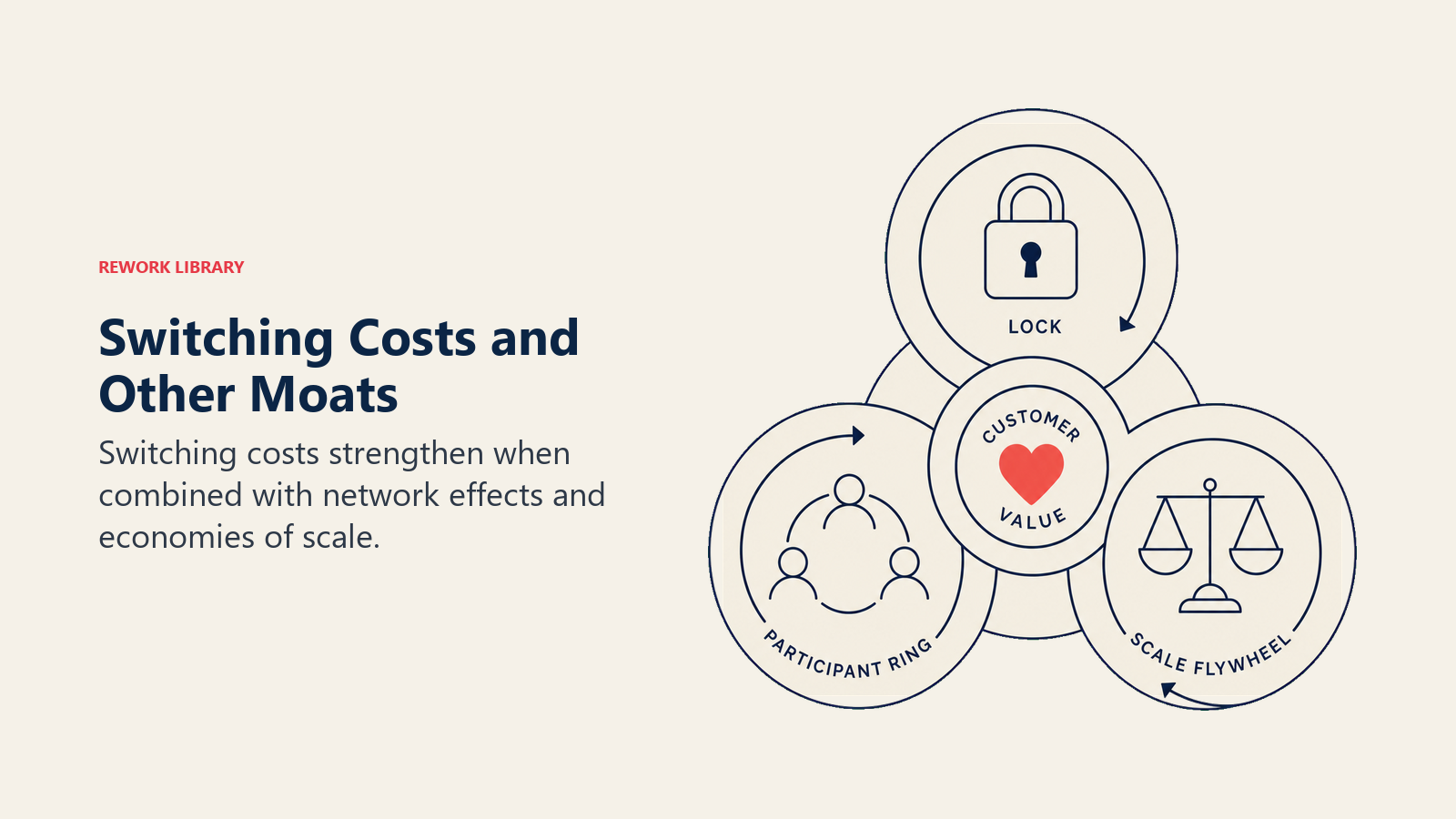
Switching costs and network effects reinforce each other powerfully. Network effects make a platform more valuable as more users join. Switching costs make it painful for any individual user to leave. Together, they create a double lock: the product gets better with more users (network effect), and each user accumulates personal data and relationships that are costly to recreate elsewhere (switching cost). Salesforce's CRM and LinkedIn's professional network are examples where both forces operate simultaneously.
Switching costs and economies of scale combine differently. Economies of scale give an incumbent a cost advantage that's hard for smaller competitors to overcome on price. When switching costs are layered on top, a competitor needs to offer not just a lower price but a low enough price to compensate for the switching burden. That's a much higher bar. This is why enterprise cloud providers with massive infrastructure scale (AWS, Azure, Google Cloud) also deliberately build switching costs through proprietary services, custom APIs, and egress pricing.
The combination of all three (switching costs, network effects, and scale economies) is what made certain platform businesses nearly impossible to displace even when well-funded rivals tried.
Switching Costs Examples by Industry
Switching costs show up in every industry, but the dominant type varies.
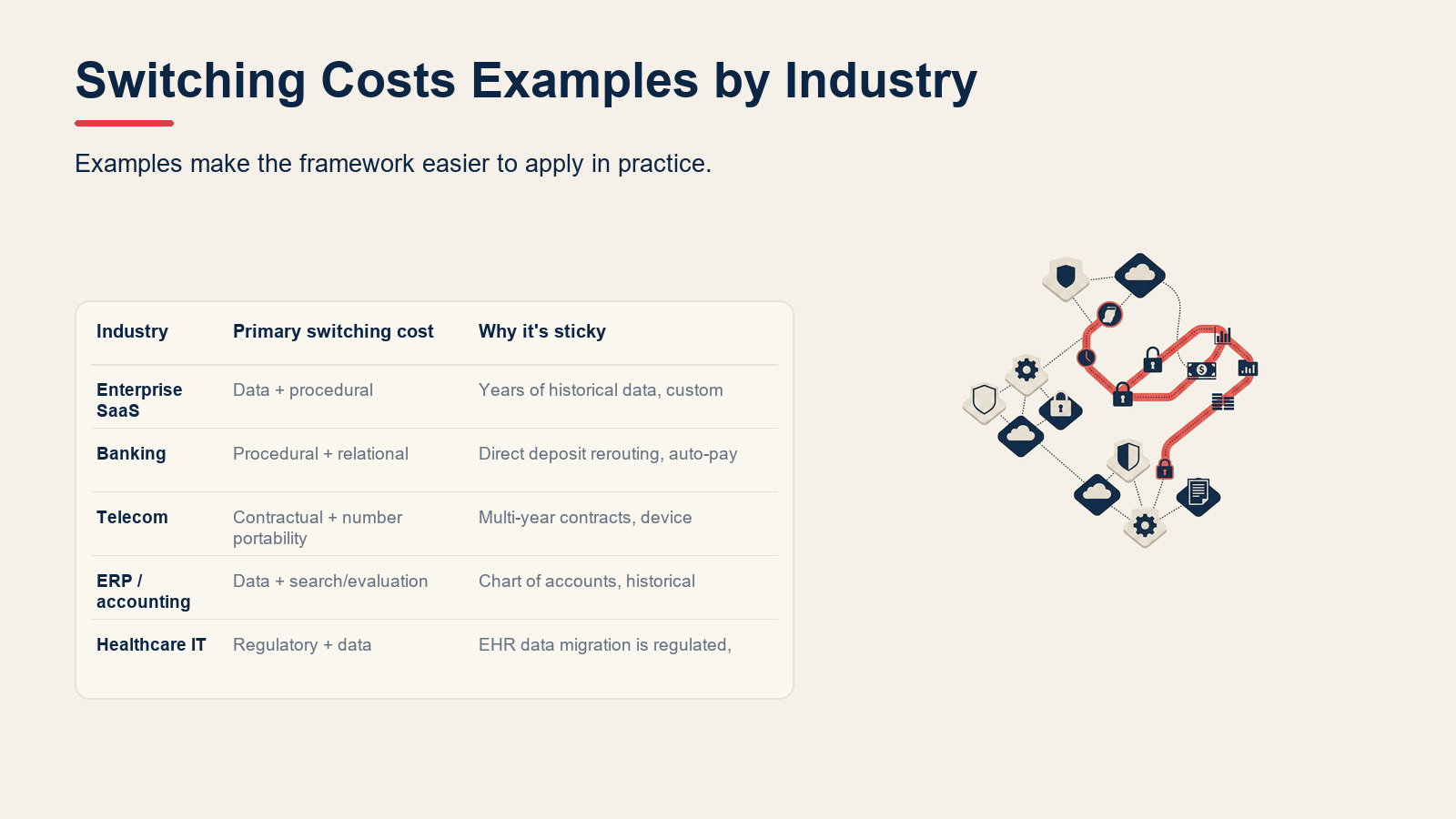
| Industry | Primary switching cost | Why it's sticky |
|---|---|---|
| Enterprise SaaS | Data + procedural | Years of historical data, custom workflows, API integrations |
| Banking | Procedural + relational | Direct deposit rerouting, auto-pay updates, branch relationships |
| Telecom | Contractual + number portability friction | Multi-year contracts, device financing, family plan bundling |
| ERP / accounting software | Data + search/evaluation | Chart of accounts, historical transactions, reporting customization |
| Healthcare IT | Regulatory + data | EHR data migration is regulated, slow, and expensive |
| Cloud infrastructure | Technical + financial | Egress fees, proprietary services, re-engineering cost |
| Professional services | Relational + search | Institutional knowledge, relationship capital, re-vetting cost |
| Loyalty programs | Financial + psychological | Accumulated points, status, sunk-cost bias |
The pattern is clear: industries with long sales cycles, complex onboarding, and data accumulation tend to have the highest switching costs. That's not an accident. B2B software vendors in particular invest heavily in onboarding depth precisely because it converts a new customer into a retained one.
How to Build Switching Costs (Ethically)
The most durable switching costs are built by genuinely adding value, not by trapping customers through bad design or contractual technicalities. Customers who feel trapped become detractors. Customers who feel invested stay willingly and refer.
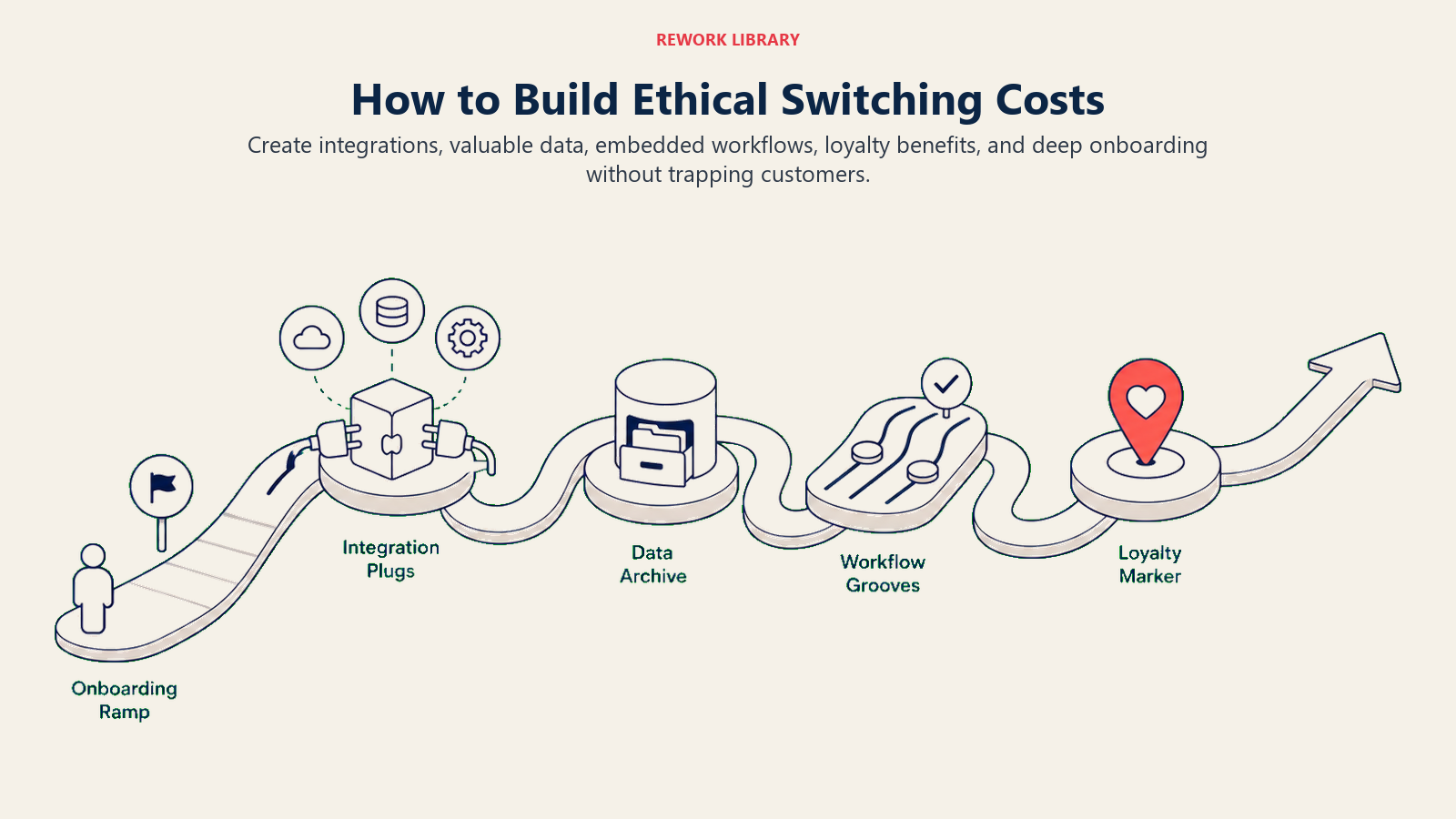
Step 1: Deepen Integrations Across the Customer's Stack
Connect your product to everything the customer already uses. Every integration is a switching cost because every integration needs to be rebuilt or replaced on migration. Salesforce's AppExchange has 3,000+ apps not because Salesforce is generous but because each integration raises the cost of leaving.
Step 2: Make Your Product the System of Record for Valuable Data
If your product accumulates data that the customer cannot get elsewhere, switching means losing that data or going through an expensive migration. CRM systems, marketing automation platforms, and analytics tools all use this principle. The longer a customer uses the product, the richer their data becomes, and the more painful migration becomes.
Step 3: Build Workflows and Habits Inside Your Platform
Workflows that live inside your product become organizational muscle memory. When teams build custom dashboards, automated sequences, approval chains, or reporting templates inside your platform, they stop thinking of switching because the alternative means rebuilding all of it. Design features that encourage customers to build inside your product, not alongside it.
Step 4: Offer Loyalty Value That Accumulates Over Time
Loyalty programs, tiered pricing based on tenure, and preferential support access all make the long-standing customer relationship more valuable than a fresh start with a competitor. The key is making sure the accumulated value is real and visible to the customer, not just an internal retention flag.
Step 5: Invest in Onboarding Depth, Not Speed
Counterintuitively, faster onboarding isn't always the right goal. Onboarding that takes longer because it's more thorough, more customized, and more deeply integrated with the customer's environment produces customers who are harder to move. Richer onboarding creates richer switching costs.
The trust caveat: every one of these steps should create genuine value for the customer, not just friction for a competitor. Switching costs built on lock-in without value erode when a competitor offers a dramatically better product. Switching costs built on accumulated value erode much more slowly.
The Buyer's View: How to Reduce Switching Costs
If you're on the buying side, evaluating a new vendor or trying to exit a current one, switching costs look very different. Here's what buyers can do to maintain leverage.
Negotiate data portability upfront. Before signing, get contractual clarity on data export: format, completeness, and timing. Vendors who resist open data-export provisions are telling you something important about their retention strategy.
Avoid proprietary formats where open standards exist. If a vendor's product can only be used with their proprietary file format or API, ask whether an open standard alternative exists. Open standards reduce future switching costs at negligible present-day cost.
Avoid single-vendor concentration for critical infrastructure. Multi-cloud strategies, multi-vendor sourcing, and open-architecture commitments all serve as hedges against future switching costs. They cost something upfront (integration complexity, governance overhead) but preserve negotiating leverage.
Factor switching costs into total cost of ownership calculations. The five-year TCO of an enterprise software contract should include the estimated cost of switching out if the vendor raises prices, changes strategy, or underdelivers. A vendor with a lower year-one price but higher switching costs can be more expensive over the contract lifetime.
Frequently Asked Questions about Switching Costs
What is an example of a switching cost?
One of the clearest examples is enterprise CRM data. A company that has used Salesforce for five years has custom objects, historical opportunity data, contact records, and email integrations all living in Salesforce. Migrating that to a competitor involves data cleansing, field remapping, workflow rebuilding, and retraining. That full burden is the switching cost. It's typically estimated at 12-24 months of equivalent software spend when you include internal labor.
Are switching costs good or bad?
It depends on which side of the transaction you're on. For businesses, high switching costs are a strategic asset: they protect retention, support pricing power, and reduce competitive vulnerability. For buyers, high switching costs are a liability: they reduce bargaining leverage and can lock you into underperforming vendors. The ethical question for businesses is whether switching costs are built on genuine accumulated value or artificial lock-in. The former is durable; the latter is a reputational risk.
How do switching costs relate to Porter's Five Forces?
In Porter's Five Forces framework, switching costs directly reduce buyer power. The higher the cost to switch, the less leverage buyers have to negotiate price or threaten to walk. They also raise barriers to entry for new competitors, since entrants must offer a large value advantage to overcome the incumbent's switching-cost protection.
Can switching costs be too high?
Yes. Switching costs that feel coercive can trigger regulatory scrutiny, brand damage, and customer resentment. The EU's Digital Markets Act and similar regulations increasingly target artificial lock-in by dominant platforms. The sustainable model is switching costs that reflect genuine value accumulation, not contractual traps or deliberate data hostility.
What's the difference between switching costs and brand loyalty?
Brand loyalty is an emotional preference for a product or brand. Switching costs are structural barriers to change. A customer who loves Apple products has both: they prefer Apple's ecosystem (brand loyalty) and face the friction of switching platforms, ecosystems, and data (switching costs). A customer who uses a specific ERP system because their accounting team has 10 years of workflow built inside it may have zero brand loyalty but very high switching costs. Switching costs aren't permanent. Technology substitution, regulatory change, and open-source alternatives have eroded switching costs that once seemed unassailable. The best long-term strategy remains the same: build switching costs on top of a product customers actually want to stay with, not on a product they're simply stuck in.
Related Reading
- Competitive Advantage: the full landscape of durable strategic positions, including how switching costs fit alongside cost leadership and differentiation.
- Network Effects: the demand-side moat that reinforces switching costs in platform businesses.
- Economies of Scale: the supply-side cost moat that combines with switching costs in the most defensible businesses.
- Porter's Five Forces: how switching costs appear across buyer power and barriers to entry.
- VRIO Framework: how to assess whether your switching-cost advantage is truly durable.

Senior Operations & Growth Strategist
On this page
- What Are Switching Costs?
- Types of Switching Costs
- Why Switching Costs Matter for Strategy
- Switching Costs and Other Moats
- Switching Costs Examples by Industry
- How to Build Switching Costs (Ethically)
- Step 1: Deepen Integrations Across the Customer's Stack
- Step 2: Make Your Product the System of Record for Valuable Data
- Step 3: Build Workflows and Habits Inside Your Platform
- Step 4: Offer Loyalty Value That Accumulates Over Time
- Step 5: Invest in Onboarding Depth, Not Speed
- The Buyer's View: How to Reduce Switching Costs
- Related Reading