Market Development Strategy: How to Enter New Markets
Turn this article into takeaways for your work.


Each assistant summarizes the article only for you and suggests best practices for your work.
The product is done. It works, customers pay for it, and nobody on the team is losing sleep over churn. But growth in the home market has flattened, and someone in the planning meeting says the thing every growth conversation eventually arrives at: what if we sold this somewhere else. Not a new product. Not a cheaper price. The same thing you already sell, aimed at people who've never heard of you.
That's market development: taking an existing product into a market you don't currently serve. It's one of four growth paths in the Ansoff matrix, and it occupies a specific, narrow lane. Selling more of what you have to the customers you already serve is market penetration strategy. Building something new for those same customers is product development strategy. Doing both at once, a new product for a market you've never touched, is diversification strategy, the highest-risk quadrant of the four. Market development changes exactly one variable: who you're selling to, not what you're selling.
That one-variable framing is also the trap. Because only the market changes, it's tempting to treat entry as a rollout: ship the same product, translate the website, hire a rep, done. The market itself is unfamiliar in ways a home-market team routinely underestimates: different buyers, different competitors, different regulation, sometimes a different reason people buy the thing at all. This page covers the decision itself: the four shapes a "new market" takes, how to tell whether market development beats the alternatives, how to size and validate a target before committing budget, the entry-mode ladder and its trade-offs, what has to be adapted versus what travels as-is, the failure patterns that repeat, and how to know entry is working before revenue proves it.
Key Facts: Market Development
- Netflix operated only in the United States before September 2010. By 2017 it was live in more than 190 countries, with roughly 73 million of its 130 million subscribers outside the U.S. by mid-2018. (Harvard Business Review, 2018)
- Bain & Company's research, still cited by Harvard Business Review two decades later, found that 70% of mergers and acquisitions wound up as failures, the entry mode with the steepest track record of the five covered here. (Harvard Business Review, 2024)
- 76% of online shoppers say they prefer buying products with information in their own language, based on a CSA Research survey of 8,709 consumers across 29 countries. (CSA Research, 2020)
- Microsoft said in 2019 that 95% of its commercial revenue flowed through its partner ecosystem, the channel entry mode other companies lean on instead of building local distribution from scratch. (Microsoft, 2019)
- Walmart booked a $1 billion pretax loss selling its 85 German stores to Metro in 2006, after nearly a decade of running its U.S. retail playbook in a market that didn't shop the way U.S. customers did. (Forbes, 2006)
What Is Market Development?
Market development is a growth strategy where a company takes a product it already sells successfully and puts it in front of a market it doesn't currently serve, without changing what the product does. Igor Ansoff named it one of four quadrants in his 1957 growth framework, plotted against market penetration, product development, and diversification depending on whether the product and market are each existing or new.
| Ansoff quadrant | Product | Market | Where it's covered |
|---|---|---|---|
| Market penetration | Existing | Existing | Market Penetration Strategy |
| Market development | Existing | New | This page |
| Product development | New | Existing | Product Development Strategy |
| Diversification | New | New | Diversification Strategy |
What makes this quadrant distinct is where the risk sits. The product already works somewhere, so the hard part shifts entirely to market-side unknowns: who buys, how they buy, who else already sells to them, and what has to change before they'll trust an outsider.
The Four Kinds of "New Market"
"New market" isn't one thing. It shows up in four distinct shapes, and mixing them up is how a market development plan ends up solving the wrong problem, translating a website when the real barrier was distribution, or signing a reseller when the real barrier was that the product didn't fit the buyer at all.
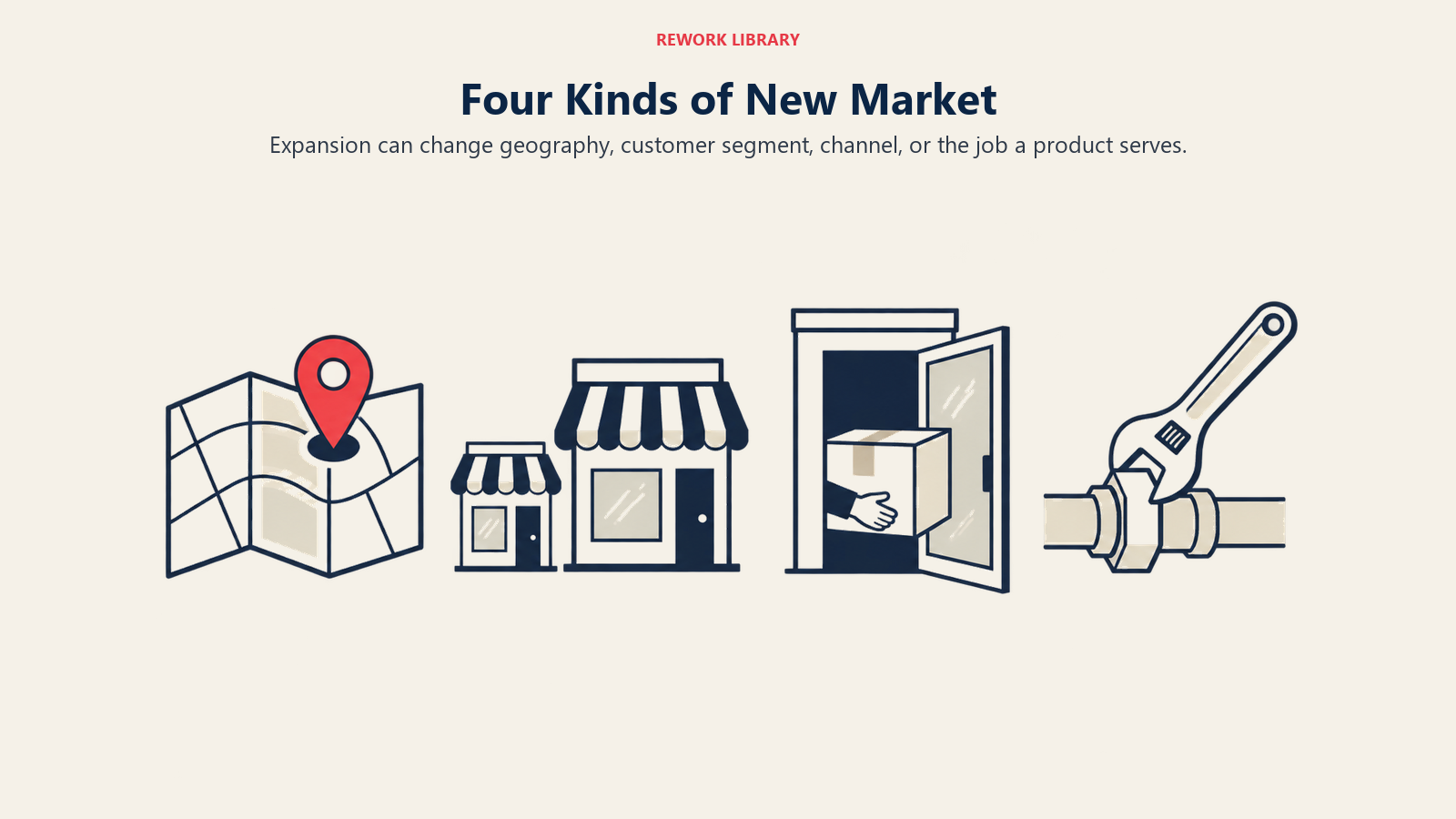
| Type of new market | What actually changes | Common trigger | Real-world anchor |
|---|---|---|---|
| New geography | Country, region, or language market | Home-market growth has plateaued, or a segment abroad looks like your existing ideal customer | Netflix moving from a single-country service to more than 190 countries |
| New customer segment | Buyer type, company size, or role, same product | The product built for one segment turns out to solve a neighboring segment's problem too | American Express building OPEN on top of its existing card infrastructure to serve small-business owners |
| New channel | How the product reaches the buyer, not who the buyer is | A direct-only company needs distribution it doesn't have in-house | Casper moving from direct-to-consumer e-commerce into physical retail |
| New use case | A different job the same product gets hired to do | Customers already use the product in a way it wasn't originally built for | Slack Connect turning an internal chat tool into a cross-company communication channel |
These four rarely arrive alone. Geographic entry is frequently paired with a channel change, because a direct-sell motion that works at home often has nowhere to plug in abroad. A new customer segment usually forces a fresh look at market segmentation: the buying committee and objections for a 50-person company aren't the same as for a 5,000-person one, even if the product doesn't move an inch. Naming which of the four types you're actually pursuing, before writing a launch plan, is the cheapest step here and the one most often skipped.
Deciding Whether Market Development Is the Right Bet
Market development gets chosen by default more often than it gets chosen deliberately. A flat quarter shows up, someone suggests "international," and the decision gets made in one meeting without comparing it against the alternatives sitting right next to it in the Ansoff matrix.
| If this is true... | ...the stronger move is usually |
|---|---|
| Home-market share is already dominant, and further gains there cost more than they return | Market development (this page) |
| Home-market share is low and largely unaddressed | Market penetration strategy |
| Customers you already serve are asking for something you don't build yet | Product development strategy |
| Neither the product nor the market is proven, and the bet genuinely requires both | Diversification strategy, approached with far more caution |
Before committing, ask whether something about your capability actually transfers, not just whether the market looks big. That's a strategic fit question: a company built around enterprise direct sales doesn't automatically win in a market where every deal closes through a local systems integrator. For geographic expansion specifically, Porter's Diamond Model is a useful gut check on the country itself: do its factor conditions, demand conditions, and competitive intensity favor an outsider, or is the market structurally built to reward local incumbents. A market can be large and still be a bad bet if nothing about your advantage survives the border.
How to Size and Validate a Target Market Before You Commit
The standard failure mode here isn't a lack of research. It's research that measures the wrong thing: a top-down market-size number pulled from an analyst report that says nothing about whether your specific product fits that specific market. Harvard Business Review's Pankaj Ghemawat put the underlying problem plainly: "Companies routinely overestimate the attractiveness of foreign markets," dazzled by raw size while losing sight of how different a market that looks similar from a distance actually is up close. (Harvard Business Review, 2001)

A believable target starts bottom-up: how many organizations or buyers in the new market actually match your ideal customer profile, not how large the total category is. That requires applying real market segmentation to unfamiliar ground; skip it and you end up marketing to an entire country instead of the few thousand companies who actually fit.
| Validation method | What it proves | What it misses |
|---|---|---|
| Bottom-up target count against your ideal customer profile | The addressable market is real, not just large on paper | Whether those buyers will actually switch to you |
| Customer discovery interviews | Real buyers describe the problem in their own words | Stated intent isn't the same as paying intent |
| Paid pilot or presale before full localization | Someone will commit money before the product is fully live in-market | Small sample size, skewed toward early adopters |
| Local competitive scan | Who you're actually displacing, and what they charge today | Doesn't tell you whether you can out-execute them |
| Channel or partner conversations | Whether distribution exists at all for your category | Partner enthusiasm in a pitch meeting isn't partner performance |
Treat the first real money, a signed pilot, a presale, a paid trial, as the actual gate. Everything before that is a hypothesis with a nice chart attached.
The Entry-Mode Ladder
Once the target market is validated, the next decision is how to get in. The five common modes run roughly from lowest to highest commitment, and commitment trades off directly against speed and reversibility: the faster and cheaper the entry, the easier it is to pull back if the bet is wrong; the deeper the commitment, the harder that becomes.
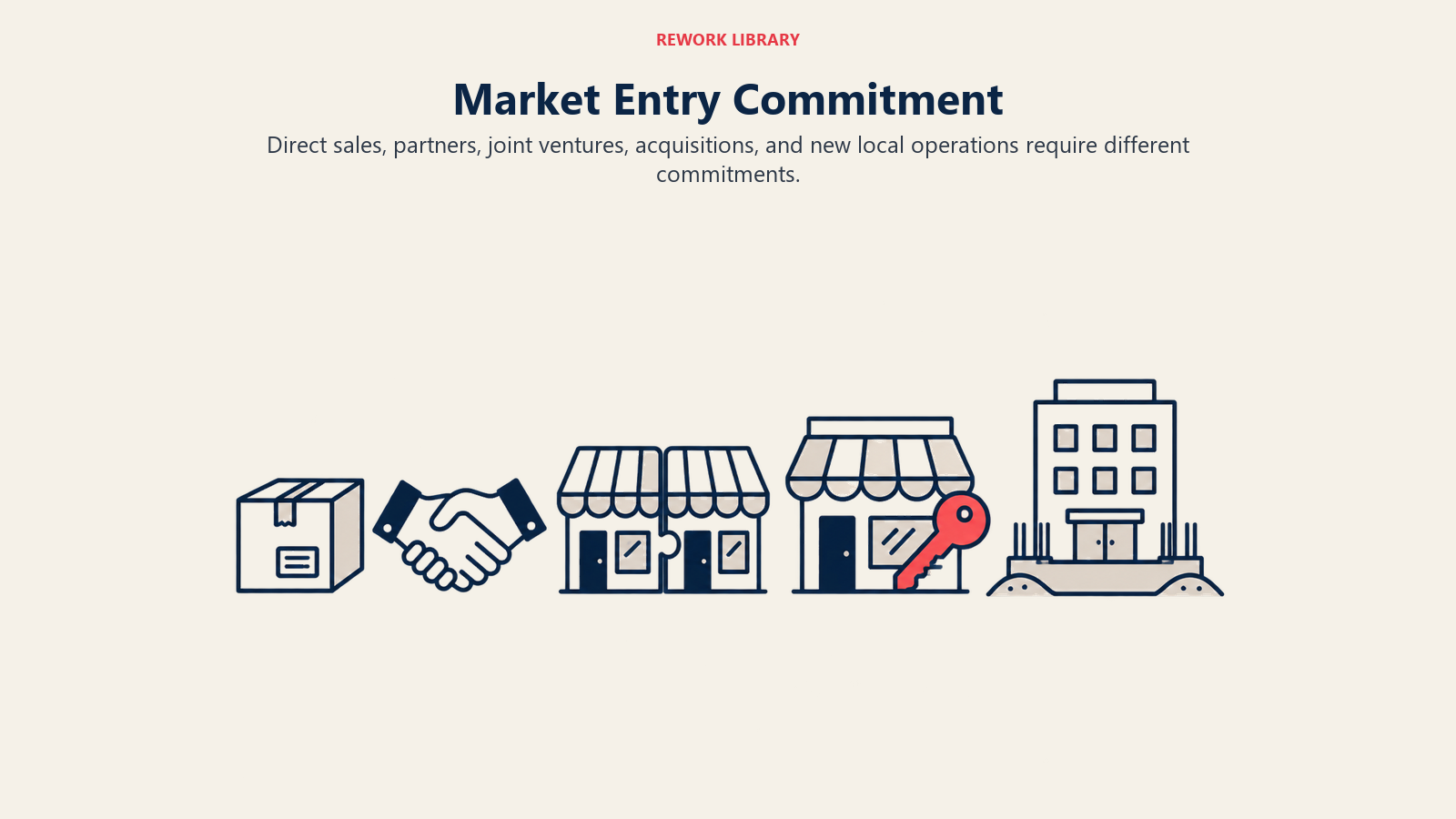
| Entry mode | Capital required | Speed to launch | Control | Reversibility |
|---|---|---|---|---|
| Export or direct sell | Low | Fast | High | High: easy to wind down |
| Channel or reseller partnership | Low to moderate | Fast | Shared, partner-dependent | Moderate: contracts still need unwinding |
| Joint venture | Moderate to high | Moderate | Shared, negotiated | Low: exit means unwinding a partner |
| Acquisition | High | Fast once closed | High after integration | Low: expensive and slow to reverse |
| Greenfield build | High | Slow | High | Low: capital is sunk in local infrastructure |
Export or Direct Sell
The lowest-commitment entry: sell directly into the new market, whether through your own site, a remote sales team, or shipped goods, without standing up a local legal entity. It's the cheapest way to test real demand, and it's the mode used to validate the pilots and presales described above. It breaks down fastest in markets that require a local presence for trust, service, compliance, or payment reasons; a product that needs someone on the ground to close deals won't scale through export alone.
Channel or Reseller Partnership
Instead of building distribution, borrow someone else's. Microsoft is the extreme version of this mode's upside. Back in 2019 the company said "95 percent of Microsoft's commercial revenue flows directly through our partner ecosystem." (Microsoft, 2019) A reseller or integrator that already has local relationships and regulatory fluency can get a product to market faster than building a local team from zero. The trade-off: margin per sale drops, the customer relationship sits partly outside your control, and the outcome depends entirely on how good a partner you pick. A strategic alliance with a mediocre partner is often worse than no entry at all, because it's your brand attached to their execution.
Joint Venture
A joint venture splits ownership and risk with a local partner who brings something you can't easily buy: a license, regulatory standing, or distribution built from years of relationships. It's common in markets with foreign-ownership caps or heavy local-content rules, where simpler modes are legally unavailable. The well-documented failure mode isn't the market; it's the partnership. Two organizations that agreed on the deal terms often diverge on what winning looks like once the market matures, and unwinding that disagreement is slower and messier than exiting a channel contract.
Acquisition
Buying an existing local player is the fastest way to get material scale: an established customer base, a team that already knows the market, and revenue on day one instead of a ramp. It's also the mode with the worst track record on paper. Bain & Company's research, still cited by Harvard Business Review, found that 70% of mergers and acquisitions wound up as failures. (Harvard Business Review, 2024) Being honest about whether you're buying a capability you should instead build or borrow is covered in build, borrow, or buy. Acquisition earns its cost only when speed and an existing customer base outweigh the integration risk, and when there's a real integration plan before the deal closes, not after.
Greenfield Build
Standing up your own local entity from scratch: your own office, your own registered business, your own hires. It's the slowest and most capital-intensive mode, and the only one that leaves nothing to unwind or integrate later. Greenfield earns its cost when the market justifies a permanent, controlled presence and no acceptable partner or acquisition target exists, or when the brand requires a level of control a partnership can't deliver.
What Actually Has to Be Localized, and What You Can Reuse
The instinct to localize everything wastes budget on changes that don't move a buying decision. The instinct to localize nothing loses deals a competitor closes by speaking the customer's language. CSA Research's survey found that 76% of online shoppers prefer buying products with information in their own language. (CSA Research, 2020) That's a demand-side fact, not a mandate to rebuild the product; it shows where the localization budget earns its keep.
| Dimension | Usually needs localizing | Usually reusable as-is |
|---|---|---|
| Product | Language, units, local payment methods, integrations with locally dominant tools | Core architecture, feature set, the underlying job the product does |
| Pricing | Currency, local willingness to pay, competitive price anchors | Pricing model and structure, whether it's seat-based, usage-based, or tiered |
| Compliance | Data residency, tax registration, labor law, industry-specific regulation | Security posture and core policies, if already built to a high bar |
| Support | Language, time-zone coverage, culturally appropriate tone | Support tooling, knowledge-base structure, the SLA framework itself |
| Go-to-market | Channel mix, messaging references, the proof points local buyers actually trust | The overall motion (self-serve versus sales-led), if it fits the new segment |
The one thing that shouldn't change market to market is the core value proposition: why the product is worth buying at all. Everything downstream of that, language, pricing display, proof points, the channel it reaches buyers through, adapts to the market. The reason itself usually shouldn't have to.
Failure Patterns
The clearest failure pattern in market development is running the home-market playbook unchanged and mistaking familiarity for fit. Walmart brought its U.S.-style big-box format, cheery greeters, and below-cost pricing straight into Germany, and ran into a market that shopped in small, frequent trips and didn't respond to the theatrics that worked at home. In July 2006, after nearly a decade of trying, Walmart sold all 85 of its German stores to rival Metro and booked a $1 billion pretax loss on the exit. (Forbes, 2006)
| Failure pattern | What it looks like | What prevents it |
|---|---|---|
| Running the home-market playbook unchanged | Format, pricing tactics, and service model copied directly into a market that shops differently | Validate actual buying behavior in-market before assuming the model travels |
| Picking the wrong entry mode for the regulatory reality | Choosing direct sell or acquisition in a market with foreign-ownership limits, license requirements, or local-content rules | Check the regulatory floor before choosing a mode, not after signing |
| No local decision-maker with real authority | Every pricing and positioning call routes back to headquarters, so the local team can't react to a competitor's move | Give the local team, or the joint-venture partner, genuine decision rights |
| Underestimating how different the market actually is | Treating the new market as a bigger version of home because it looked large on a slide, not because demand was tested | Run the sizing and validation steps before the budget is committed |
| Entering too many markets at once | A limited team and budget spread across five markets instead of proving the model in one | Sequence entries and apply what the first market taught before opening the second |
How to Measure Whether Entry Is Working Before Revenue Shows Up
A plan that only checks the revenue line finds out it's wrong months after the budget is already spent. Leading indicators catch a stalled entry while there's still time and money left to fix it.

| Leading indicator | What it tells you | When to check it |
|---|---|---|
| Qualified pipeline velocity in-market | Whether the message and ideal customer profile actually land with local buyers | First 60 to 90 days |
| Pilot or presale conversion rate | Whether people who raise a hand actually commit real money | As soon as the first pilots close, either way |
| Channel or partner engagement, if using that mode | Whether a partner is actively selling you or just holding your logo on a page | 30 days after the agreement is signed |
| Support ticket volume and type | Whether the product is genuinely usable in-market as shipped, surfacing friction sales hasn't seen yet | Ongoing from the first live customer |
| Local competitive response | Whether incumbents are reacting to you at all, a proxy for whether you're visible | 90 to 180 days |
| Time-to-first-value for new customers | Whether onboarding actually works for a buyer who isn't your home-market persona, translated or not | Every new cohort |
None of this replaces revenue eventually. It's the same discipline that strategy execution applies to any strategic bet: name the leading indicators before entry starts, not after the first miss, so a wrong bet gets caught in weeks instead of a fiscal year.
Worked Example: Four Companies, Four Kinds of Market Development
Each of the four "new market" types shows up clearly in a real, well-documented entry.
| Company | Type of new market | Entry mode | What happened |
|---|---|---|---|
| Netflix | New geography | Direct, needing no local retail footprint; sequenced from Canada (2010) to Latin America (2011) to Europe (2012 to 2014) to 130 more countries at once (January 2016) | Went from U.S.-only to more than 190 countries by 2017, with roughly 73 million of its 130 million subscribers outside the U.S. by mid-2018 (Harvard Business Review, 2018) |
| American Express | New customer segment | Direct, built on existing charge and credit-card infrastructure | Built OPEN, targeting firms with under 100 employees or under $10 million in sales, calling small business "a key growth area" in its own 10-K (American Express, FY2004 10-K) |
| Casper | New channel | Retail partnership | Moved from direct-to-consumer online sales into more than 1,200 Target stores for accessories, keeping the flagship mattress Target-exclusive online, after an earlier $1 billion acquisition offer from Target fell through (Retail Dive, 2017) |
| Slack | New use case | Direct, same product | Launched Slack Connect to move cross-company conversations with partners, clients, and vendors out of email and into Slack, a use case distinct from the internal team chat the product was originally built for (TechCrunch, 2020) |
No two of these entries used the same mode or solved the same kind of "new market" problem. The right way in depends on which of the four types you're actually facing, not a single playbook applied everywhere.
Conclusion
Market development looks like the safer growth bet because the hardest part, building a product people will pay for, is already solved. That's exactly what makes the market-side risk easy to underestimate: it's invisible until you're standing inside it, dealing with a regulator, a distribution gap, or a buying committee that doesn't work the way your home market's does. Name which of the four kinds of new market you're actually pursuing. Validate demand with real money before the budget is fully committed. Pick the entry mode that matches your risk appetite and the regulatory reality, not the one that's easiest to greenlight in a meeting. Adapt what genuinely needs adapting and leave the rest alone. Watch the leading indicators, not just the revenue line, because by the time revenue tells you entry isn't working, the money's already spent.
Frequently Asked Questions about Market Development Strategy
What is a market development strategy?
It's a growth strategy where a company takes a product or service it already sells and puts it in front of a market it doesn't currently serve, without changing the product itself. It's one of four paths in the Ansoff matrix, specifically the existing-product, new-market quadrant.
What's the difference between market development and market penetration?
Market penetration grows share in a market you already serve, using pricing, promotion, or distribution moves aimed at existing or directly adjacent customers. Market development takes the same product into a market you haven't served before, whether that's a new geography, customer segment, channel, or use case.
What's the difference between market development and diversification?
Market development changes one variable: the market, while the product stays the same. Diversification changes two variables at once, a new product for a new market, which is why it carries the highest risk of the four Ansoff quadrants. Companies that think they're doing market development but are quietly also building a new product are actually diversifying, with the risk profile to match.
What are the main ways to enter a new market?
Five common entry modes run from lowest to highest commitment: export or direct sell, a channel or reseller partnership, a joint venture, an acquisition, and a greenfield build. Each trades off differently on capital required, speed, control, and how easy the move is to reverse if it doesn't work.
How do you know if a new market is big enough to enter?
Start from the bottom up: count how many organizations or buyers in the target market actually match your ideal customer profile, rather than citing a total market-size figure from an analyst report. Then validate that count with real signals, customer discovery interviews, a paid pilot, or a presale, before committing meaningful budget.
What usually goes wrong when companies enter new markets?
The most common pattern is running the home-market playbook unchanged and assuming familiarity means fit. Walmart's exit from Germany is a textbook case: it brought its U.S. retail format and pricing tactics into a market that shopped differently, and booked a $1 billion loss selling its 85 German stores in 2006. Picking an entry mode that ignores local regulation, and entering too many markets at once with a limited team, are the other repeat offenders.
Should you always localize a product for a new market?
No, but you should localize deliberately rather than by default. Product language, pricing display, compliance requirements, and go-to-market messaging typically need adapting; the underlying value proposition, core architecture, and pricing model usually don't. Localizing everything wastes budget, and localizing nothing loses deals a competitor closes by speaking the buyer's language.
How long does it take to know if market entry is working?
Revenue is a lagging signal, often taking a year or more to show whether entry succeeded. Leading indicators surface much faster: qualified pipeline velocity within 60 to 90 days, pilot or presale conversion as soon as the first deals close, and partner engagement within 30 days of signing an agreement. Tracking those catches a stalled entry while there's still budget left to fix it.
Related Reading
- Ansoff Matrix: the full four-quadrant framework market development is one path inside.
- Market Penetration Strategy: the lower-risk alternative of growing share in a market you already serve.
- Diversification Strategy: the higher-risk quadrant where both the product and the market are new at once.
- Product Development Strategy: building something new for the market you already have, the mirror image of this page.
- Go-to-Market Strategy: the launch-plan mechanics for turning a market development decision into an actual entry.
- Market Segmentation: how to define exactly who inside a new market you're actually targeting.
- Strategic Fit: the test for whether your existing capabilities genuinely transfer to a new market.
- Build, Borrow, or Buy: the decision framework behind choosing acquisition over the other entry modes.
- Strategic Alliances: how to structure and manage the channel or joint-venture partnerships this page's entry-mode ladder depends on.
- Porter's Diamond Model: a gut check on whether a target country's own competitive structure favors an outsider entering it.
- Value Proposition: the one thing market development shouldn't have to localize.
- Strategy Execution: the discipline of tracking a plan against reality instead of waiting on the revenue line alone.

Co-Founder & COO
On this page
- What Is Market Development?
- The Four Kinds of "New Market"
- Deciding Whether Market Development Is the Right Bet
- How to Size and Validate a Target Market Before You Commit
- The Entry-Mode Ladder
- Export or Direct Sell
- Channel or Reseller Partnership
- Joint Venture
- Acquisition
- Greenfield Build
- What Actually Has to Be Localized, and What You Can Reuse
- Failure Patterns
- How to Measure Whether Entry Is Working Before Revenue Shows Up
- Worked Example: Four Companies, Four Kinds of Market Development
- Conclusion
- Related Reading