Cynefin Framework: Make Sense of Complex Decisions
Turn this article into takeaways for your work.


Each assistant summarizes the article only for you and suggests best practices for your work.
The Cynefin framework is a sense-making model that tells you which type of problem you're facing before you decide how to respond. Get that diagnosis wrong and even the smartest analysis produces the wrong answer. A crisis handled with committee consensus stalls. A routine process handed to innovation sprints wastes six months. Cynefin stops that mismatch by sorting situations into five distinct domains, each with its own logic.
What is the Cynefin framework?
The Cynefin framework (pronounced "kuh-NEV-in," from the Welsh word for "habitat" or "place of belonging") is a sense-making model developed by Dave Snowden while at IBM in the late 1990s and published formally in 2000. It was co-developed with Mary Boone and introduced to a management audience in a landmark 2007 Harvard Business Review article, "A Leader's Framework for Decision Making."
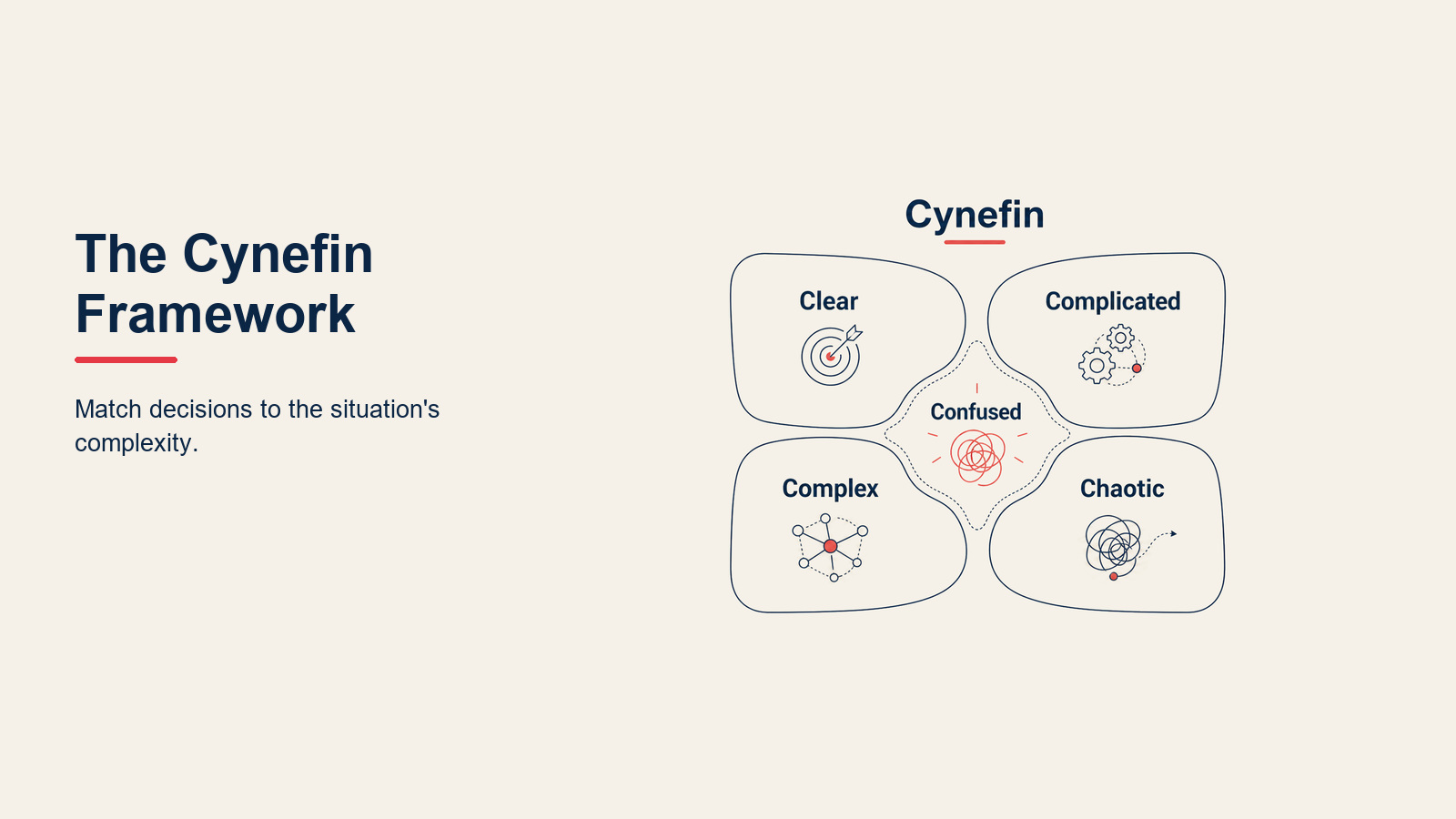
The model organizes problems and situations into five domains: Clear, Complicated, Complex, Chaotic, and Disorder. Each domain describes the relationship between cause and effect and prescribes a matching decision approach. Cynefin is not a categorization tool, it's a sense-making tool. You don't slot a problem neatly in from the outside. You observe, interact, and let the domain reveal itself.
Key Facts
- Snowden created the framework while leading the IBM Institute for Knowledge Management, where he needed a model that acknowledged how managers actually experience uncertainty rather than just how textbooks describe it. (Dave Snowden, IBM, 1999)
- The Harvard Business Review article "A Leader's Framework for Decision Making" (Snowden & Boone, 2007) introduced Cynefin to a global executive audience and remains one of HBR's most-referenced strategy pieces.
- The Welsh word "cynefin" has no single English translation. Snowden chose it deliberately because English lacks a word for the deep sense of place and belonging that shapes how people see the world, a concept central to how context shapes decision-making.
The five Cynefin domains
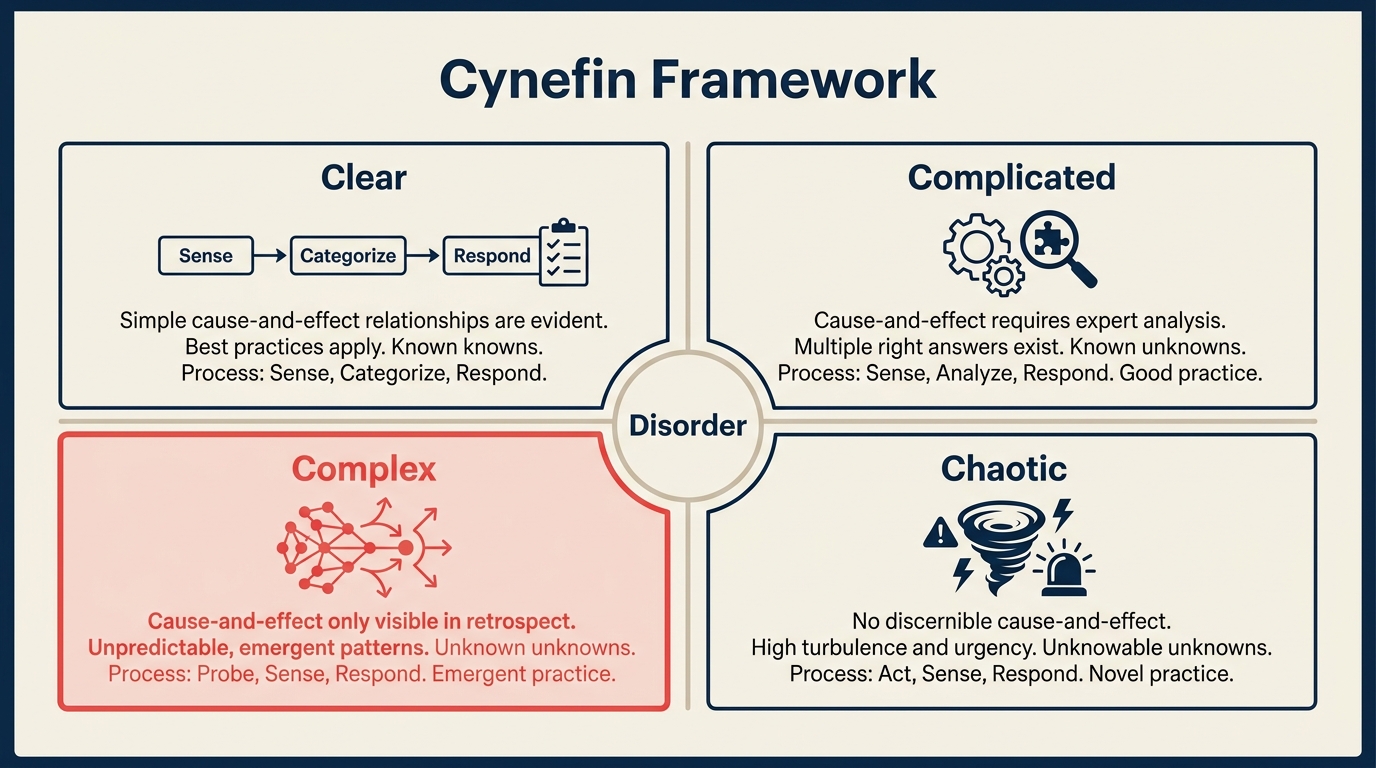
Cynefin maps five domains across two broad categories: ordered (Clear and Complicated, where cause-effect relationships are knowable) and unordered (Complex and Chaotic, where they are not). Disorder sits at the center, representing the state of not yet knowing which domain you're in.
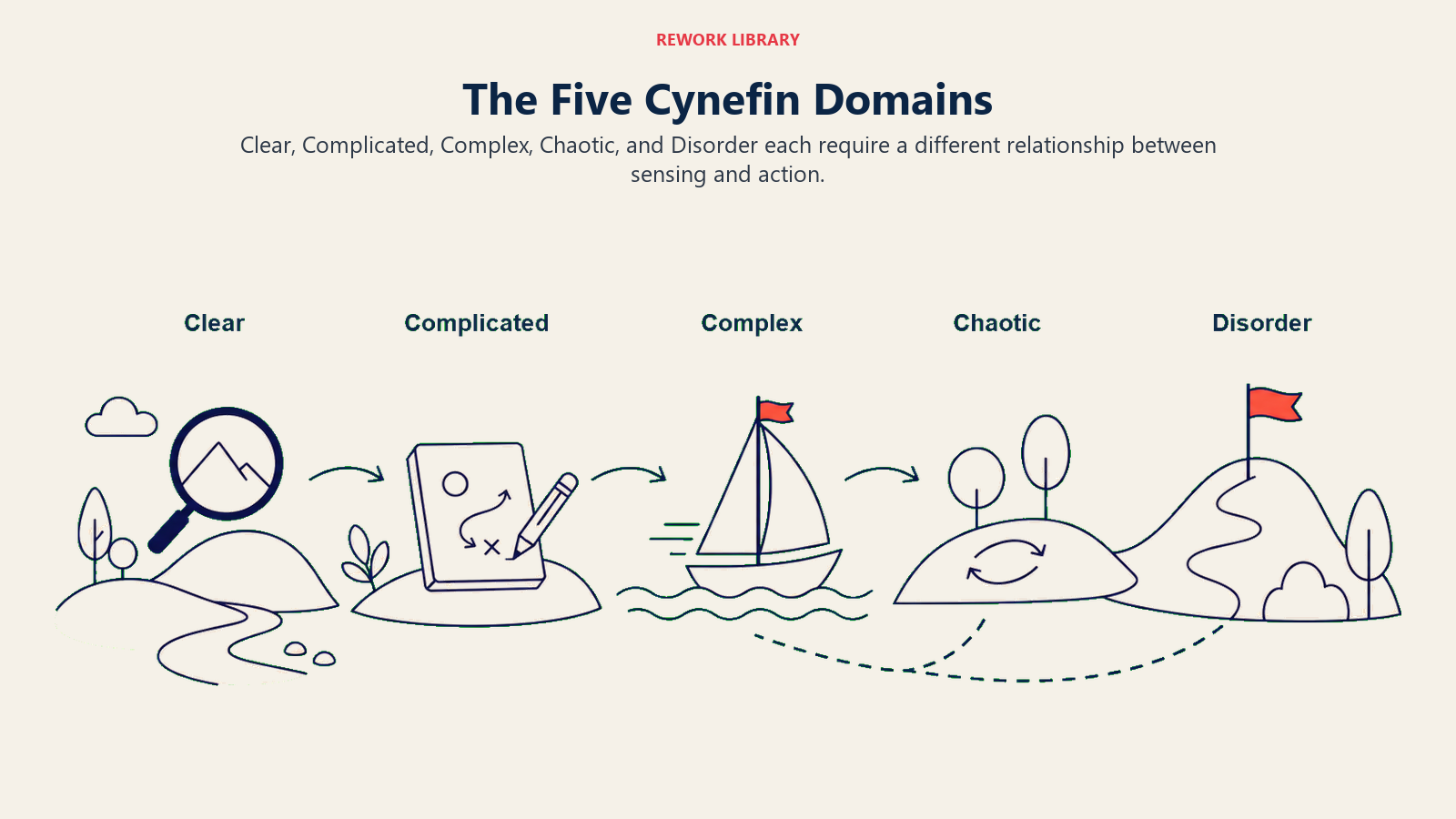
| Domain | Nature | Right response | Example |
|---|---|---|---|
| Clear | Known knowns. Stable cause-effect, best practices exist. | Sense, categorize, respond | Processing a standard invoice, following a compliance checklist |
| Complicated | Known unknowns. Cause-effect knowable with analysis; requires expertise. | Sense, analyze, respond | Diagnosing a technical failure, writing a financial model |
| Complex | Unknown unknowns. Cause-effect only visible in hindsight; patterns emerge. | Probe, sense, respond | Launching into a new market, managing organizational culture change |
| Chaotic | No perceivable cause-effect. Crisis mode; order has broken down. | Act, sense, respond | A product outage at midnight, a PR crisis breaking live |
| Disorder | You don't know which domain you're in yet. | Decompose into sub-problems and route each to the right domain | A situation that "feels wrong" but no one agrees on why |
Clear (formerly Obvious or Simple)
In the Clear domain, the relationship between cause and effect is obvious to everyone. There are established best practices, procedures, or rules. The right response is to sense the situation, categorize it against known patterns, and respond with the appropriate procedure.
The danger here is complacency. When everything runs smoothly for long enough, organizations can mistake Clear for the default state and stop scanning for signals that a situation has shifted. Snowden calls this falling into the "complacency trap." A sudden disruption can push a Clear situation directly into Chaos without passing through Complicated or Complex.
Complicated
In the Complicated domain, cause and effect exist but aren't immediately obvious. You need expert analysis, diagnostic work, or modeling to understand what's going on. Multiple good answers may exist. The right response is to sense the situation, analyze it (often with specialists), and respond.
Complicated problems benefit from structured tools. A SWOT analysis, a VRIO framework audit, or a McKinsey 7S assessment all fit here. They impose structure on something knowable. The risk is "expert overconfidence": assuming every problem is Complicated because your team is skilled at analysis.
Complex
Complex is the domain most leaders mishandle. Cause and effect can only be perceived in hindsight, not predicted in advance. The system is adaptive and non-linear. What worked before may not work again, and what fails may succeed under slightly different conditions.
The right response is to probe (run small, safe-to-fail experiments), sense what emerges, and respond by amplifying what works and dampening what doesn't. You don't plan your way into a Complex domain. You experiment your way through it.
This is where scenario planning and strategic planning processes become most valuable: not as prediction tools, but as frames for recognizing patterns when they surface.
Chaotic
In the Chaotic domain, there is no perceivable relationship between cause and effect. The system has broken down. This is the crisis context: an active data breach, a supply chain collapse, a leadership vacuum during a public controversy.
The right response is to act immediately to stabilize the situation, sense whether the action is working, and respond to shift into Complex or Complicated as order returns. Chaotic does not call for analysis first. It calls for decisive action, then reflection. Leaders who freeze and convene working groups in genuinely Chaotic situations make the crisis worse.
There's also an upside. Chaotic situations create openings for innovation. Snowden describes a move from Chaos to the Complex domain as an opportunity to introduce new practices that would never survive the politics of an ordered environment.
Disorder
Disorder is the center of the Cynefin diagram, not a fifth peer domain in the usual sense. It represents the state of not knowing which domain applies. When teams can't agree on what kind of problem they're dealing with, they often default to the domain that matches their own expertise: engineers see a technical problem, strategists see a planning problem, marketers see a messaging problem.
The right move is to break the situation into smaller components and route each piece to the appropriate domain. This decomposition step is where skilled sense-making adds the most value.
How to use the Cynefin framework
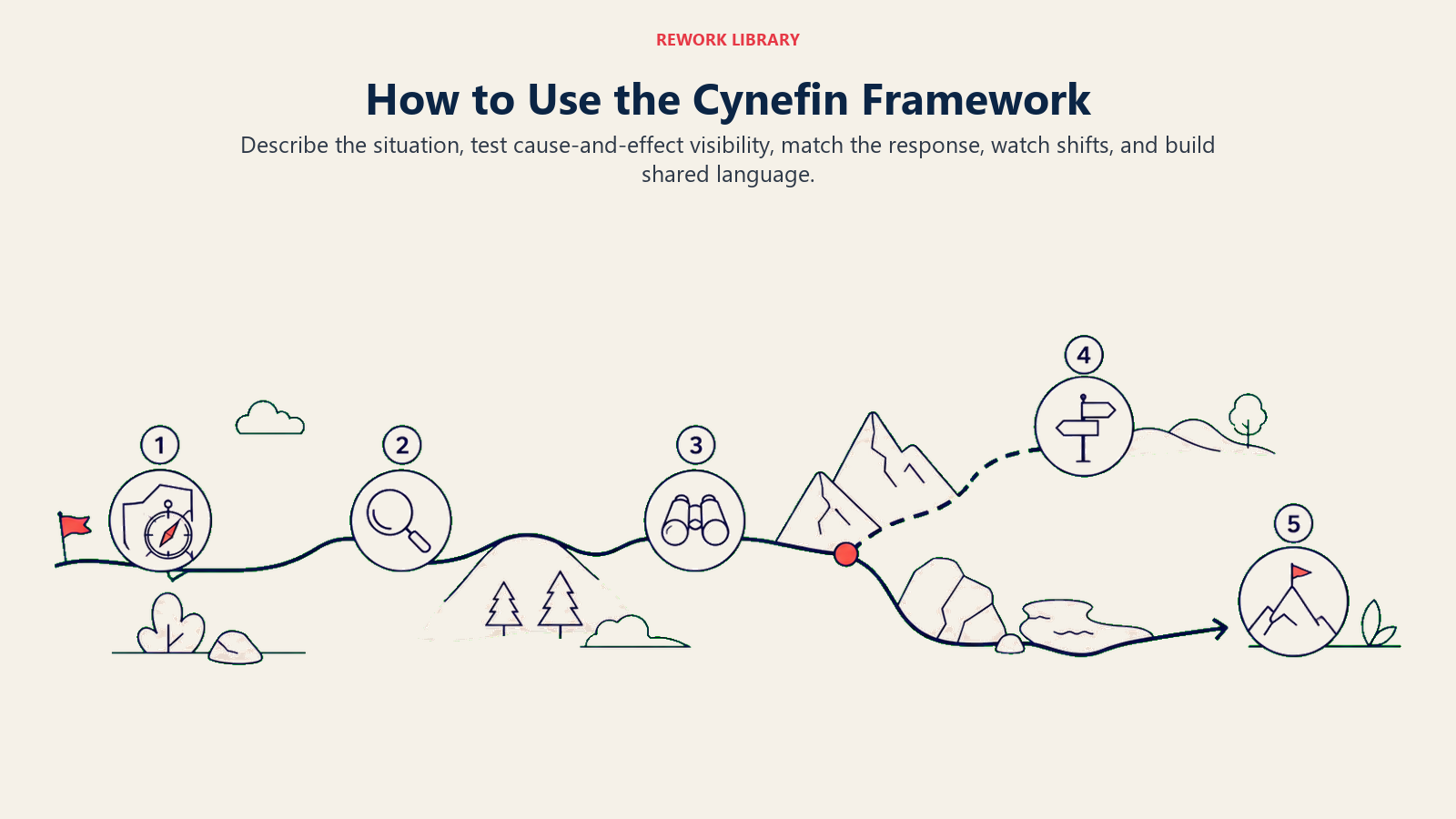
Step 1: Identify the situation
Before applying any framework, describe what's actually happening. Gather observations from multiple perspectives, especially from people closest to the problem. Resist the urge to categorize immediately.
Step 2: Determine cause-effect visibility
Ask: Can you explain why this situation exists and predict what will happen next? If yes with certainty, you're in Clear. If yes with expert analysis, you're in Complicated. If only after the fact, you're in Complex. If there's no coherent pattern at all, you're in Chaotic. If you genuinely don't know yet, you're in Disorder.
Step 3: Match the response to the domain
Apply the domain's prescribed approach rather than your default one. This is the hardest step. Most organizations have a dominant mode: analysis-first cultures naturally try to Complicate everything. Entrepreneurial cultures try to run experiments on everything. Cynefin forces a deliberate choice.
Step 4: Watch for domain shifts
Situations move between domains. A Complicated problem can become Complex if the context changes faster than your analysis. A Chaotic crisis stabilizes into Complex once containment kicks in. Build the habit of re-asking "which domain are we in now?" at regular intervals, especially during fast-moving situations.
Step 5: Use Cynefin as a shared language
The model's biggest organizational value is giving cross-functional teams a shared vocabulary for disagreeing productively. "I think this is Complex, you're treating it as Complicated" is a useful conversation. It names the disagreement precisely and points to what evidence would resolve it.
Cynefin vs other decision frameworks
Cynefin is a sense-making tool, not an analytical or strategic planning model. It sits upstream of most other frameworks, helping you decide which tool to use.
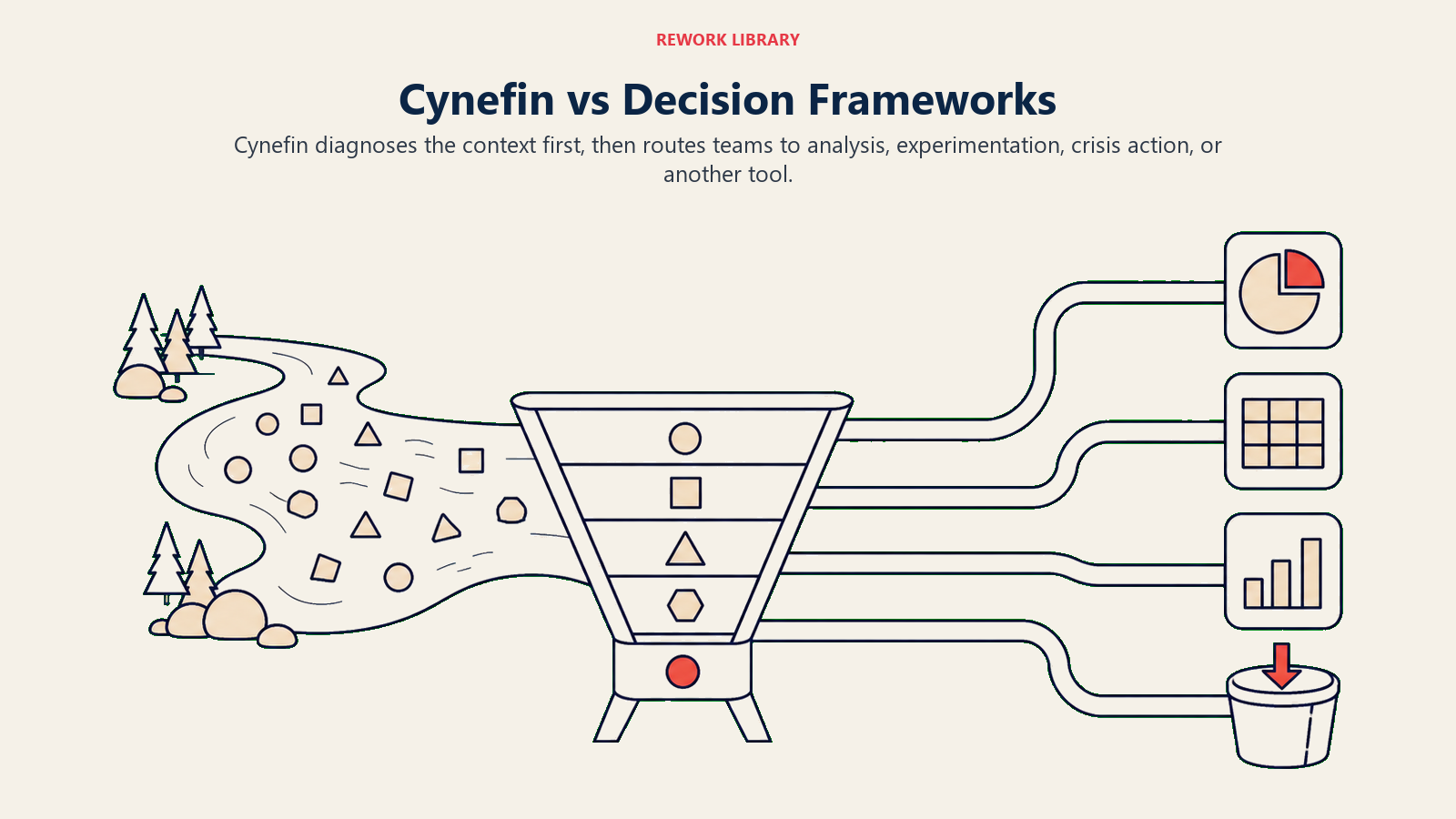
| Framework | Primary use | Where Cynefin fits |
|---|---|---|
| SWOT Analysis | Assess strengths, weaknesses, opportunities, threats | Best applied in Complicated domain |
| VRIO Framework | Evaluate competitive resources | Complicated domain analysis |
| Scenario Planning | Map possible futures under uncertainty | Complex domain navigation |
| McKinsey 7S | Org alignment diagnosis | Complicated domain |
| Strategic Planning Process | Set direction and allocate resources | Works across domains; adapt depth per domain |
| Decision-Making Models | Individual and group decisions | Cynefin determines which decision model to apply |
Cynefin is particularly distinct from frameworks like the Stacey Matrix and the OODA Loop (Observe, Orient, Decide, Act), which address similar uncertainty but with different mechanics. Stacey maps problems on axes of agreement and certainty. OODA is a tactical decision loop designed for speed. Cynefin focuses on the nature of cause-effect relationships themselves.
Cynefin framework examples
Clear domain: expense approval workflows. An employee submits a receipt within the approved policy limit. The process is clear, the rule exists, and the approver categorizes and routes it. No analysis needed, no experimentation. Apply the standard procedure.
Complicated domain: diagnosing a revenue decline. Sales are down 18% quarter-over-quarter. The cause is knowable but not obvious. The finance team analyzes pipeline health, the sales team reviews close rates, and marketing examines lead quality. Experts converge on an answer. The diagnosis required analysis, but a definitive answer was reachable.
Complex domain: rolling out a new go-to-market model. A company decides to shift from product-led to sales-led growth. The outcome is unpredictable. Customer behavior, internal culture, and competitive response will all adapt in ways that can't be modeled in advance. The right move is to run structured pilots in two or three segments, observe what changes, and scale what gains traction. Using critical thinking frameworks during retrospectives helps surface patterns from the probes.
Chaotic domain: a customer data breach discovered on a Friday evening. There's no time for root-cause analysis. The security team takes immediate containment actions, communications goes to work on stakeholder notification, and legal is looped in. Order is restored first. Analysis happens later, once the situation is stable.
Disorder: a new competitor enters the market with a fundamentally different model. Leadership disagrees on whether this is a technology threat (Complicated), a market shift (Complex), or an existential crisis (Chaotic). The right first move is to decompose: the technology comparison is Complicated, the market response question is Complex, and the urgency of the competitive timeline may or may not be Chaotic. Route each to the right team.
Common mistakes
Treating Complex as Complicated. This is the most costly misuse of Cynefin. When leaders apply analytical rigor (best practice, expert diagnosis, planning tools) to a genuinely Complex situation, they produce confident answers to questions that don't have stable answers yet. The result is a detailed plan that becomes obsolete as soon as reality moves. The correct response to Complex is to run experiments, not write plans.
Over-applying the Chaotic response. Not every urgent situation is Chaotic. "Act first, ask questions later" is appropriate when the system has genuinely broken down. Apply it to Complicated situations and you bypass the expert analysis that would have produced a better outcome.
Treating Cynefin as a box to fill in. Cynefin is not a classification system. You don't look at a project brief, pick a domain, and apply the matching approach once. Situations move, and your reading of the domain should move with them.
Conflating Simple/Clear with "easy." A Complicated problem can be straightforward for the right expert. A Clear domain problem can require significant effort. The domain describes the cause-effect relationship, not the difficulty of the work.
Skipping Disorder. When teams jump straight to categorization, they often argue past each other because they've each implicitly assumed a different domain. Naming the Disorder explicitly and decomposing the situation first saves time and reduces conflict.
The Cynefin framework doesn't tell you what decision to make. It tells you what kind of decision you're facing. That's actually the harder problem. Most failed strategies aren't the product of bad decisions in well-understood contexts; they're the product of good decisions applied to the wrong type of problem. Pair Cynefin with the right tools from your strategic planning process and you'll spend less time defending the wrong plan and more time learning from the right experiments.

Co-Founder & COO
On this page
- What is the Cynefin framework?
- The five Cynefin domains
- Clear (formerly Obvious or Simple)
- Complicated
- Complex
- Chaotic
- Disorder
- How to use the Cynefin framework
- Step 1: Identify the situation
- Step 2: Determine cause-effect visibility
- Step 3: Match the response to the domain
- Step 4: Watch for domain shifts
- Step 5: Use Cynefin as a shared language
- Cynefin vs other decision frameworks
- Cynefin framework examples
- Common mistakes