ADKAR Model: Prosci's 5-Step Change Framework
Turn this article into takeaways for your work.


Each assistant summarizes the article only for you and suggests best practices for your work.
The ADKAR model is one of the most widely used change management frameworks in the world, and for good reason: it focuses on the individual, not just the organization. Most change initiatives fail not because the strategy was wrong, but because the people involved weren't brought along properly. ADKAR addresses that gap directly.
What Is the ADKAR Model?
The ADKAR model is a goal-oriented change management framework created by Jeff Hiatt, founder of Prosci, the research-based change management organization. Hiatt introduced the model in the late 1990s and published it formally in his 2006 book ADKAR: A Model for Change in Business, Government and Our Community.
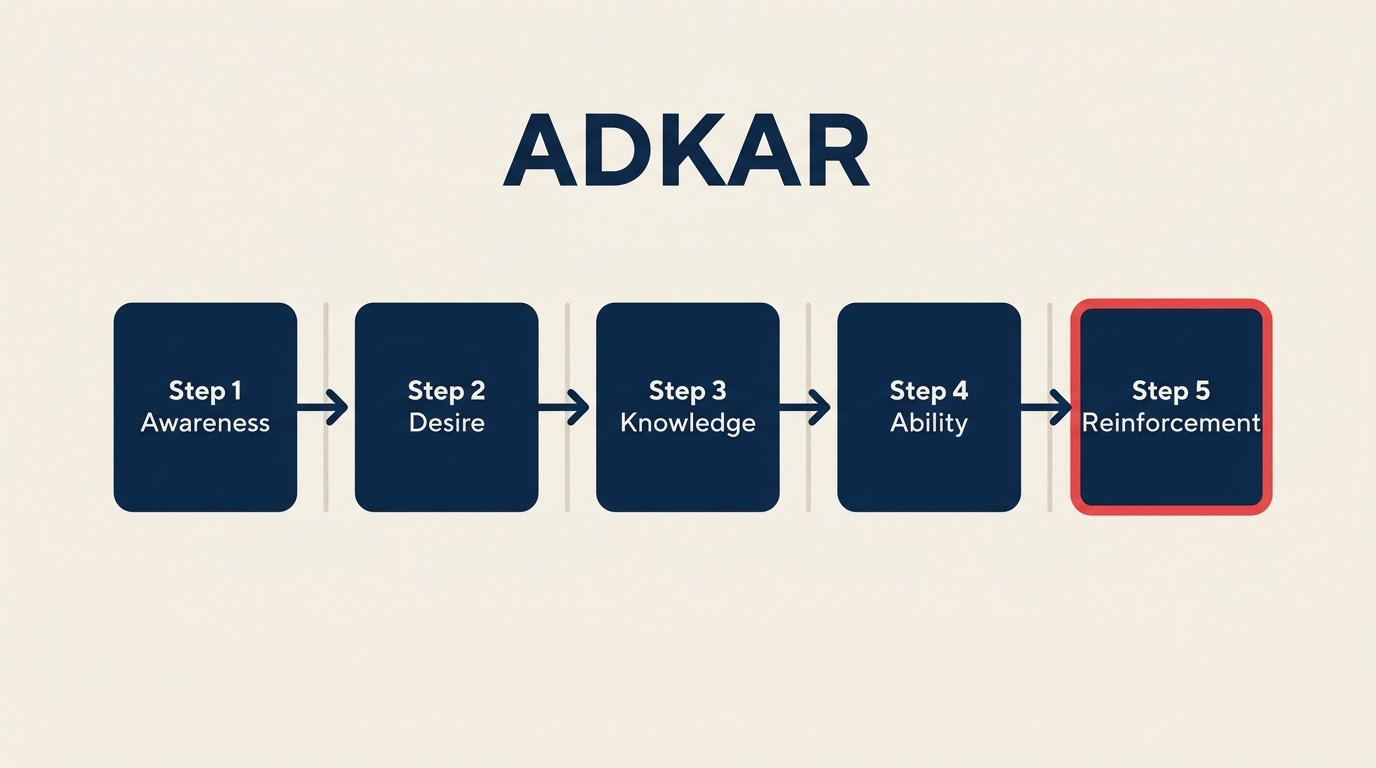
ADKAR is an acronym. Each letter represents a stage an individual must pass through to successfully adopt a change:
- A = Awareness
- D = Desire
- K = Knowledge
- A = Ability
- R = Reinforcement
The framework is sequential: a person can't effectively build Desire without first having Awareness, and can't build Ability without Knowledge. This makes ADKAR both a diagnostic tool and a roadmap. When a change stalls, you can use it to pinpoint exactly where the breakdown is occurring, at the individual level.
Key Facts
- Jeff Hiatt created the ADKAR model while studying over 900 organizations going through change (Prosci, 2006).
- Prosci's research consistently finds that projects with excellent change management are 6 times more likely to meet objectives than those with poor change management (Prosci Best Practices in Change Management, 2018).
- A widely cited McKinsey study found that roughly 70% of large-scale change programs fail to achieve their goals, most often because of employee resistance and lack of management support (McKinsey, "Changing Change Management," 2015).
The 5 Building Blocks of ADKAR
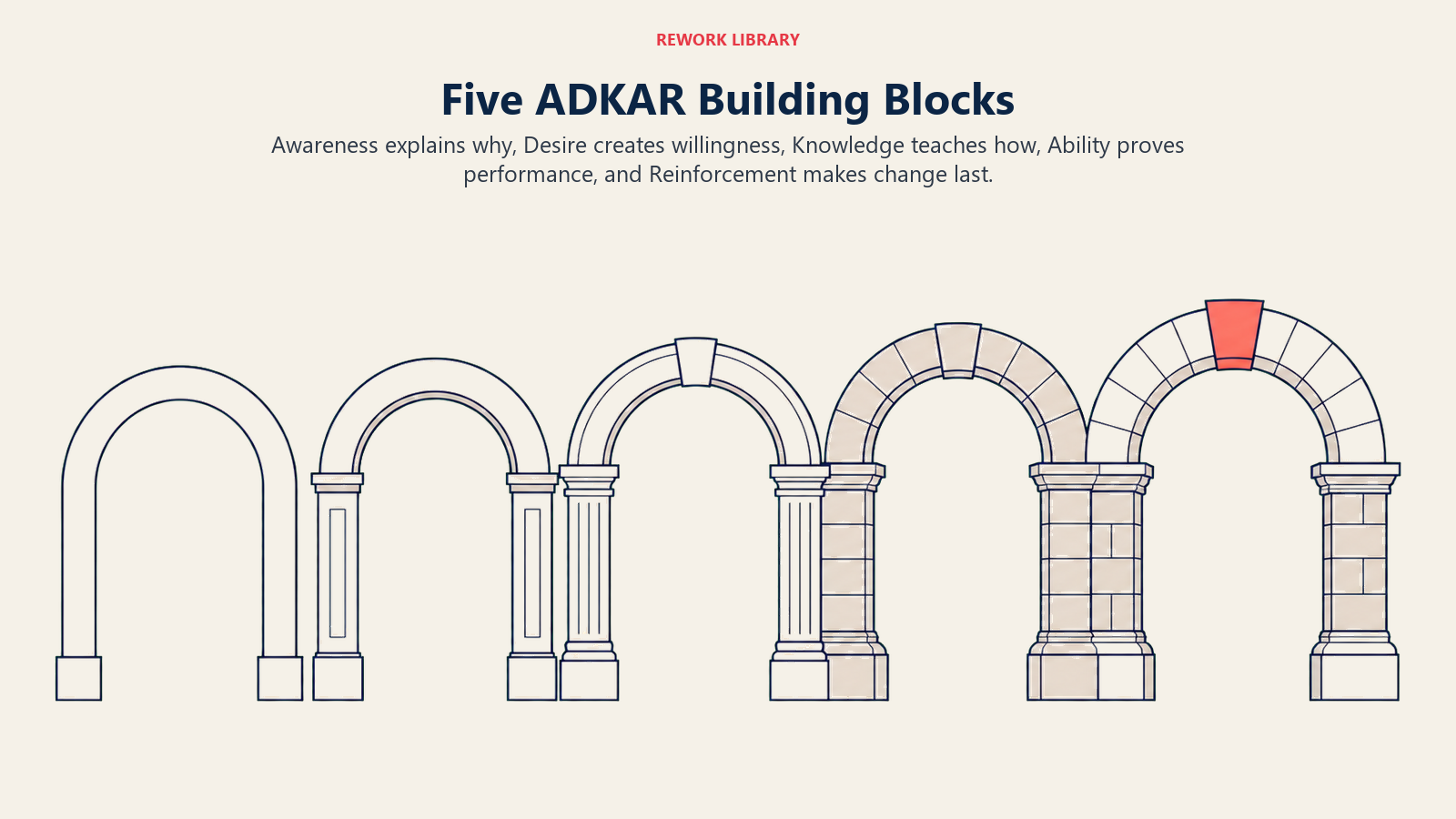
The five elements of ADKAR work in sequence. Think of them as gates: you can't open the next gate until you've passed through the current one.
| Element | What it means | Key question | How to build it |
|---|---|---|---|
| Awareness | Understanding that change is happening and why | "Do people know why this change is necessary?" | Clear, honest communication about the business need; share the "why" before the "what" |
| Desire | Personal motivation to support and participate in the change | "Do people want to make this change?" | Connect the change to personal benefits; involve people early; address fears directly |
| Knowledge | Knowing how to change, what skills and behaviors are needed | "Do people know what to do differently?" | Training programs, job aids, coaching, documentation |
| Ability | The actual capacity to implement required skills and behaviors | "Can people actually do it?" | Practice, feedback loops, mentoring, removing environmental barriers |
| Reinforcement | Sustaining the change so it sticks over time | "What keeps people from reverting?" | Recognition, measurement, accountability systems, ongoing coaching |
Awareness
Awareness is the starting point. People need to understand that a change is coming and, critically, why it's happening. Without this, every other step becomes harder. A common mistake: leaders announce the "what" (a new system, a restructure) without spending enough time on the "why" (competitive pressure, customer feedback, regulatory requirements). When people don't understand the reason behind a change, they fill the gap with rumors.
Good awareness-building means proactive, clear communication from credible sources, typically direct managers and senior sponsors.
Desire
Knowing something is changing doesn't mean someone wants to change. Desire is personal. It depends on the individual's perception of the risks and benefits, their relationship with the organization, and how much they trust the people leading the change.
You can't manufacture desire through mandates. But you can create conditions for it: involving people in problem-solving, being transparent about what the change means for their role, and connecting the change to things they already care about.
Knowledge
Once someone understands why and wants to support the change, they need to know how. Knowledge covers both the skills required and the behaviors expected. This is where training comes in, but training alone isn't enough. People need context, examples, and the chance to ask questions.
A gap here often shows up as: "We trained everyone, but they're still doing it the old way." Usually that's actually an Ability problem, not a Knowledge problem, which is why diagnosing the right stage matters.
Ability
Ability is the practical capacity to act on knowledge. Someone might understand perfectly well what the new process requires, but still struggle to do it under real working conditions. This gap can come from lack of practice, environmental barriers (a tool that doesn't work, a process that contradicts the new one), or anxiety about doing it wrong.
Ability is built through repetition, coaching, and removing obstacles. This is why one-time training events rarely produce lasting behavior change on their own.
Reinforcement
Without reinforcement, people revert. Old habits are comfortable. If there's no visible recognition for doing things the new way, and no consequence for reverting to the old way, most people will drift back over time.
Reinforcement includes formal mechanisms (performance reviews, metrics, incentives) and informal ones (manager recognition, peer modeling). It's the step most often skipped, which is why many change initiatives see initial success followed by slow erosion.
ADKAR vs Other Change Models
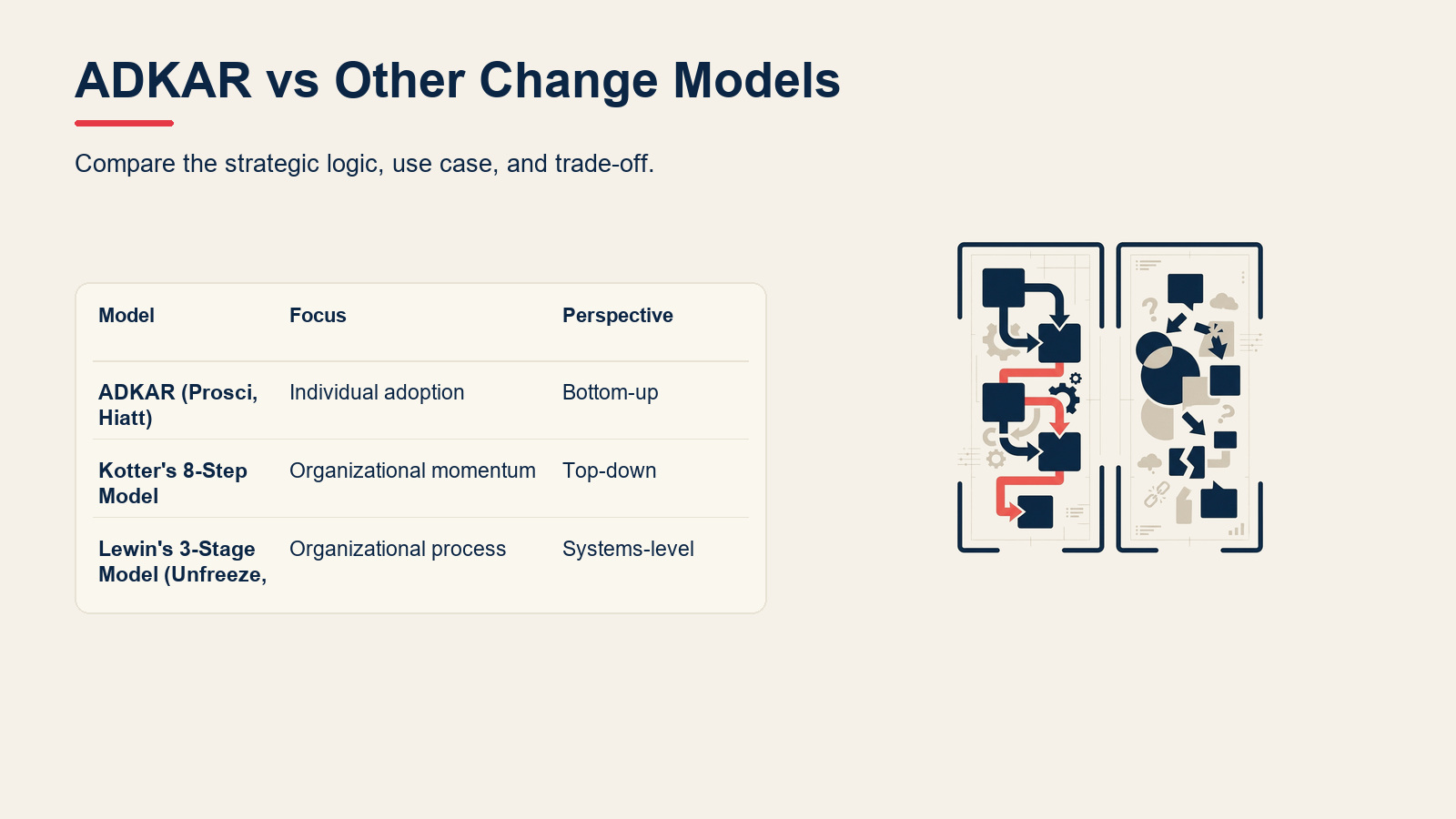
ADKAR's defining characteristic is its individual focus. Most change models operate at the organizational or process level. ADKAR asks: what does each individual person need to successfully make this change?
| Model | Focus | Perspective | Strengths | Limitations |
|---|---|---|---|---|
| ADKAR (Prosci, Hiatt) | Individual adoption | Bottom-up | Diagnostic; pinpoints exactly where a person is stuck | Doesn't address organizational design or structure |
| Kotter's 8-Step Model | Organizational momentum | Top-down | Strong on building urgency, coalition, and culture | Less granular at the individual level |
| Lewin's 3-Stage Model (Unfreeze, Change, Refreeze) | Organizational process | Systems-level | Simple, conceptually clear | Too high-level to guide specific interventions |
ADKAR and Kotter's 8-Step Change Model are often used together. Kotter's model guides the organizational strategy, while ADKAR guides the people strategy. Lewin's model is useful for understanding why change is structurally difficult, but needs to be supplemented with tools like ADKAR to actually execute.
If you're designing a change program from scratch, the McKinsey 7S Framework can help you map the organizational elements that need to align, while ADKAR keeps the human side of that alignment in focus. For the emotional side of the same journey, see the Bridges transition model and the Kubler-Ross change curve.
How to Apply the ADKAR Model
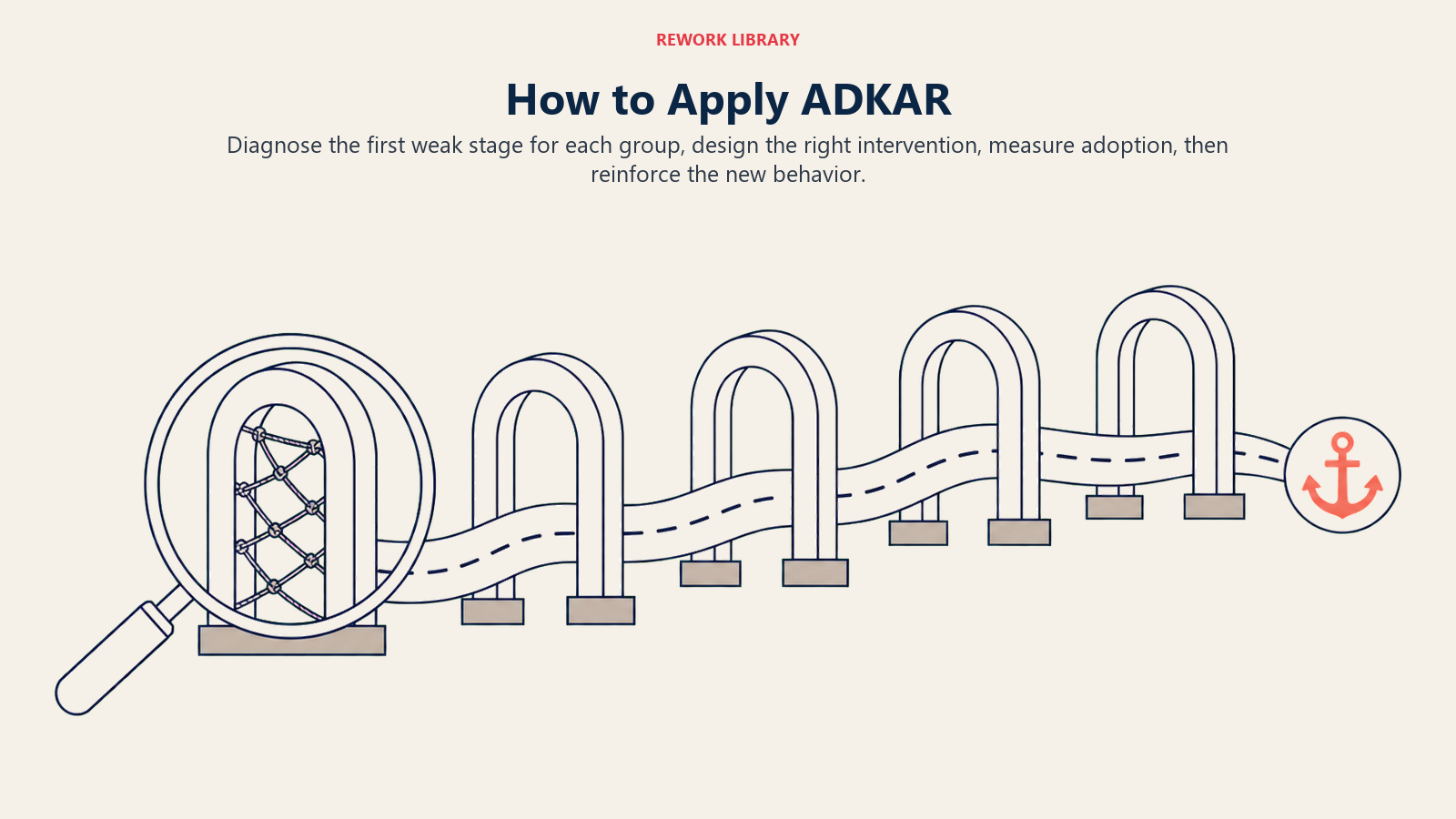
Here's how to put ADKAR into practice for a real change initiative. Each step maps to one building block.
Step 1: Build Awareness
Start communications before the change launches. Explain the business reason honestly: what's driving this change, what happens if nothing changes, and what the organization hopes to achieve. Use multiple channels and let direct managers carry the message, they're more trusted than corporate announcements. Be ready to repeat the "why" many times.
Step 2: Create Desire
Identify the people most affected and understand what the change means for them personally. Address resistance directly rather than dismissing it. Where possible, involve people in shaping how the change is implemented, not just receiving it. Connect the change to outcomes they already care about (efficiency, recognition, job security, professional growth).
Step 3: Build Knowledge
Design training around what people actually need to do differently. Use job aids, process documentation, and worked examples alongside formal training. Make it easy to ask questions and get clarification. Segment by role: different people need different knowledge to support the same change.
Step 4: Develop Ability
Create space for practice in low-stakes conditions before the change goes live. Assign coaches or mentors. Watch for environmental barriers (broken tools, conflicting processes) and remove them. Check in regularly: "What's getting in your way?" is a more useful question than "Is the training done?"
Step 5: Reinforce the Change
Measure adoption and make the data visible. Recognize people who are leading the way. Address reversion quickly and without blame: when someone reverts, it usually signals an unresolved gap in one of the earlier stages. Build ADKAR checkpoints into your project reviews, not just at launch but at 30, 60, and 90 days post-implementation.
ADKAR Model Example
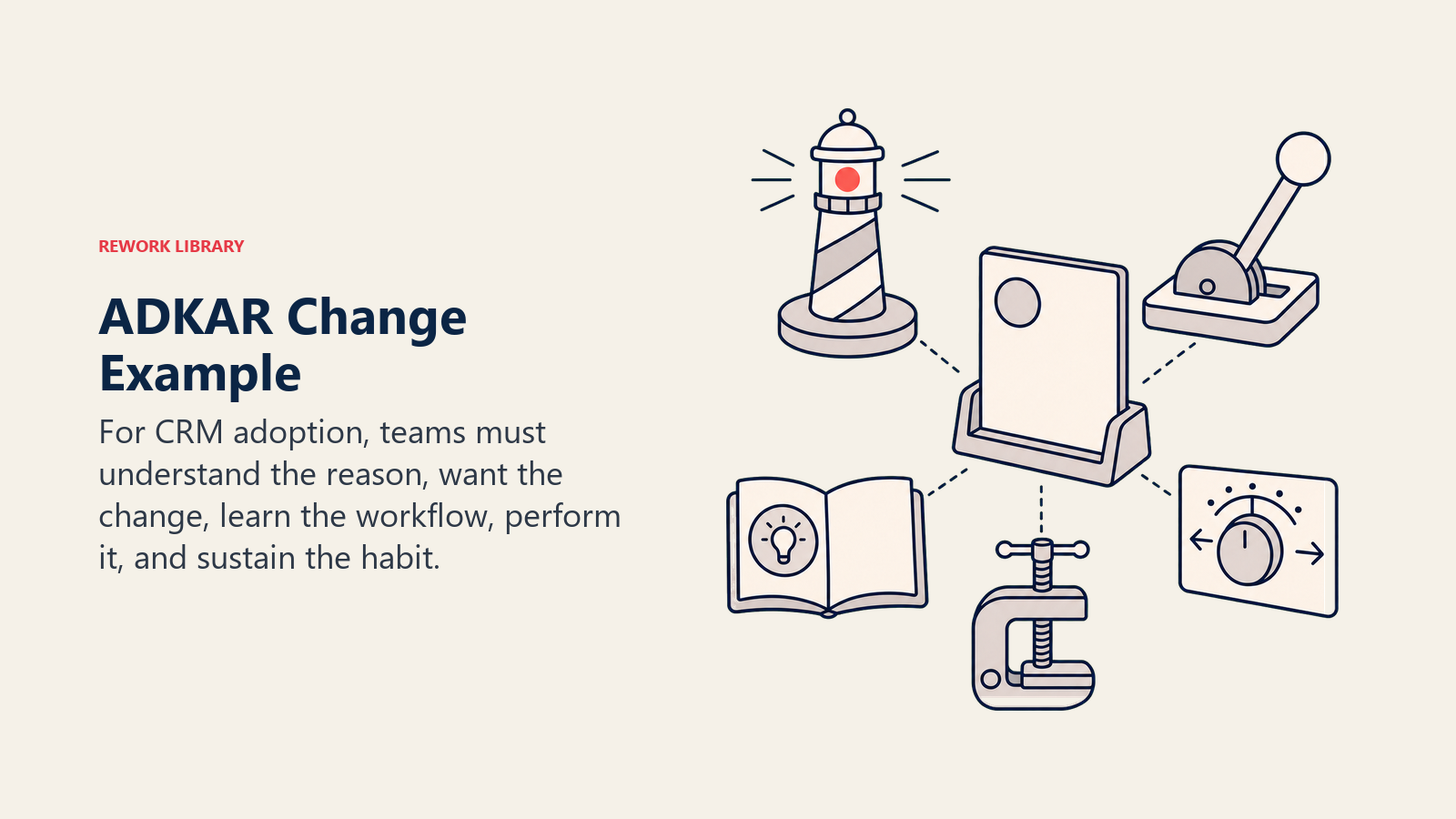
Here's how the ADKAR model plays out in a common scenario: rolling out a new CRM system to a sales team that has been using spreadsheets for years.
| ADKAR Stage | What it looks like in a CRM rollout |
|---|---|
| Awareness | Sales leadership communicates that the company is losing deals due to poor pipeline visibility. They share specific data: three major accounts went cold last quarter because follow-ups fell through the cracks. The new CRM is the solution to a real, named problem. |
| Desire | Managers hold 1:1s with each rep to understand concerns. Top performers are brought in early as "pilot users" and given extra input into the configuration. The message: "We designed this around how you actually work." Reluctant reps hear from peers, not just leadership. |
| Knowledge | Role-specific training is delivered: SDRs learn lead logging, AEs learn opportunity management, managers learn the reporting dashboard. Quick-reference guides are posted in Slack. A live Q&A session runs the week before launch. |
| Ability | The first week after launch, a "CRM buddy" program pairs struggling reps with confident early adopters. Managers spot-check records daily and offer coaching, not criticism, when they find gaps. The IT team fixes two workflow bugs flagged by users within 48 hours. |
| Reinforcement | Weekly pipeline reviews are now run entirely from CRM data (no spreadsheet fallback). Reps who complete records accurately are recognized in the team meeting. Three months post-launch, adoption is tracked and shared with the team; 94% of deals are logged within 24 hours of contact. |
This scenario works because each stage is addressed in sequence. Skipping Desire (common in top-down IT rollouts) is what causes reps to use the system grudgingly and revert to spreadsheets the moment management stops checking.
Common Mistakes and Limitations
Skipping Awareness and jumping to Knowledge. Many organizations launch straight into training. But if people don't understand why the change is happening, training lands in a vacuum.
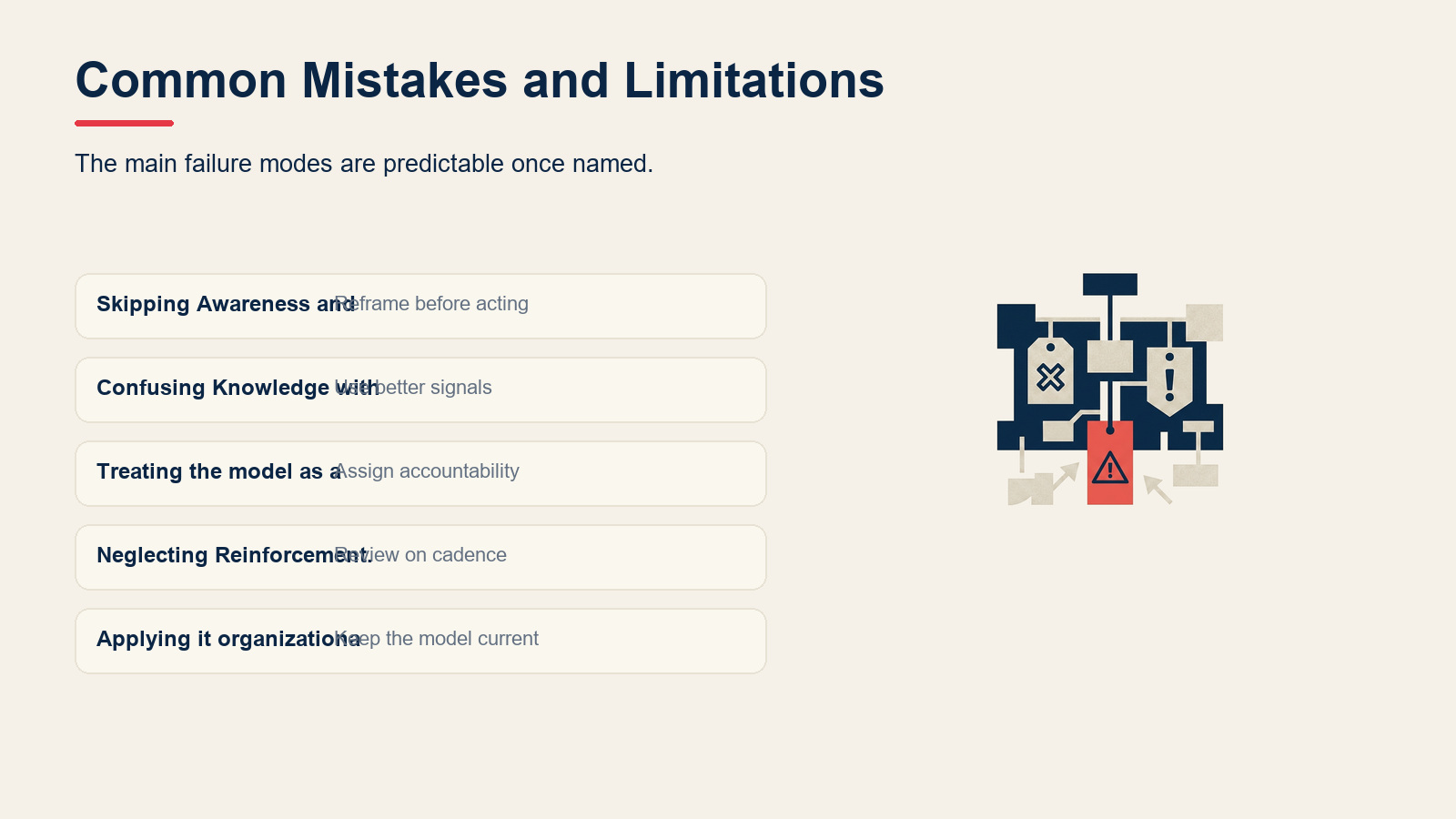
Confusing Knowledge with Ability. Training someone doesn't mean they can do it. These are genuinely different stages and require different interventions.
Treating the model as a one-time checklist. ADKAR is a diagnostic tool you use throughout the change, not just at the start. People move through stages at different speeds, and some may get stuck and need additional support.
Neglecting Reinforcement. This is the most commonly skipped stage. Without it, even well-executed changes erode over time.
Applying it organizationally instead of individually. ADKAR works person by person. "The organization has Awareness" is a category error. Different individuals are at different stages simultaneously.
One genuine limitation: ADKAR doesn't address structural or systemic issues. If the change itself is poorly designed, or if organizational systems actively undermine it, ADKAR won't fix that. It's a people-side tool, and it works best when paired with strong organizational frameworks like the Balanced Scorecard or OKR Framework for strategic alignment.
ADKAR also doesn't prescribe how to build each element, only what needs to be built. For complex changes, you'll need a dedicated change management plan that draws on communication strategy, learning design, and performance management.
Best Practices
Use ADKAR as a diagnostic tool, not just a planning tool. When a change stalls, run an ADKAR assessment: ask people targeted questions to identify which building block is missing. You'll often find the real problem is two stages back from where you thought.
Assess by role, not organization-wide. Different groups move through ADKAR stages at different speeds. The finance team might be at Ability while the operations team is still at Awareness.
Involve managers actively. Prosci research consistently identifies managers as the most trusted source of change messages for their direct reports. They're not just messengers; they're coaches for Ability and enforcers of Reinforcement.
Don't rush Desire. It's tempting to move on once communications are done. But Desire takes time to develop, especially when people have legitimate concerns about how the change affects them.
Pair with process frameworks for full coverage. ADKAR handles the human side. For process improvement and documentation of new ways of working, you'll want complementary tools. Strategic analysis tools like SWOT analysis and value chain analysis help you understand whether the change itself is directionally right before investing in adoption.
Frequently Asked Questions about the ADKAR Model
What does ADKAR stand for?
ADKAR stands for Awareness, Desire, Knowledge, Ability, and Reinforcement. Each letter represents a stage an individual must move through to successfully adopt a change.
Who created the ADKAR model?
Jeff Hiatt, founder of Prosci, created the ADKAR model. He developed it based on research into how individuals experience change across hundreds of organizations. He published it formally in his 2006 book "ADKAR: A Model for Change in Business, Government and Our Community."
How is ADKAR different from Kotter's 8-Step Model?
Kotter's model is organizational and top-down: it guides leaders through building urgency, coalition, and cultural change at the company level. ADKAR is individual and diagnostic: it guides practitioners in understanding where each person is in their change journey and what support they need. The two models are often used together, with Kotter shaping the organizational strategy and ADKAR shaping the people strategy.
When should you use the ADKAR model?
ADKAR is useful for any change that requires people to behave differently: system rollouts, process changes, restructures, culture shifts, or policy updates. It's particularly valuable when a change is stalling and you need to diagnose why, because it helps you identify the specific stage where individuals are stuck.
What is the most common failure point in ADKAR?
Reinforcement is the stage most often skipped or underinvested. Organizations declare victory at launch and move on, but without ongoing reinforcement, people revert to old habits. The second most common failure point is jumping from Awareness directly to Knowledge without adequately building Desire, which is why resistance often surfaces during training rather than being addressed beforehand.
Change succeeds when individuals succeed. That's the core insight behind ADKAR: organizational change is actually the sum of many personal changes, each requiring the same five building blocks. Start with Awareness, build through to Reinforcement, and use the model as a living diagnostic tool rather than a one-time launch checklist. The teams that treat ADKAR as an ongoing practice, not a project phase, are the ones that make change stick.

Co-Founder & COO
On this page
- What Is the ADKAR Model?
- The 5 Building Blocks of ADKAR
- Awareness
- Desire
- Knowledge
- Ability
- Reinforcement
- ADKAR vs Other Change Models
- How to Apply the ADKAR Model
- Step 1: Build Awareness
- Step 2: Create Desire
- Step 3: Build Knowledge
- Step 4: Develop Ability
- Step 5: Reinforce the Change
- ADKAR Model Example
- Common Mistakes and Limitations
- Best Practices