Horizontal Integration: Definition, Strategy, and Examples
Turn this article into takeaways for your work.


Each assistant summarizes the article only for you and suggests best practices for your work.
Horizontal integration happens when a company acquires or merges with another business operating at the same level of the supply chain, typically a direct competitor or a close substitute in the same market. It's one of the most common corporate growth moves, and one of the most scrutinized by regulators.
What Is Horizontal Integration?
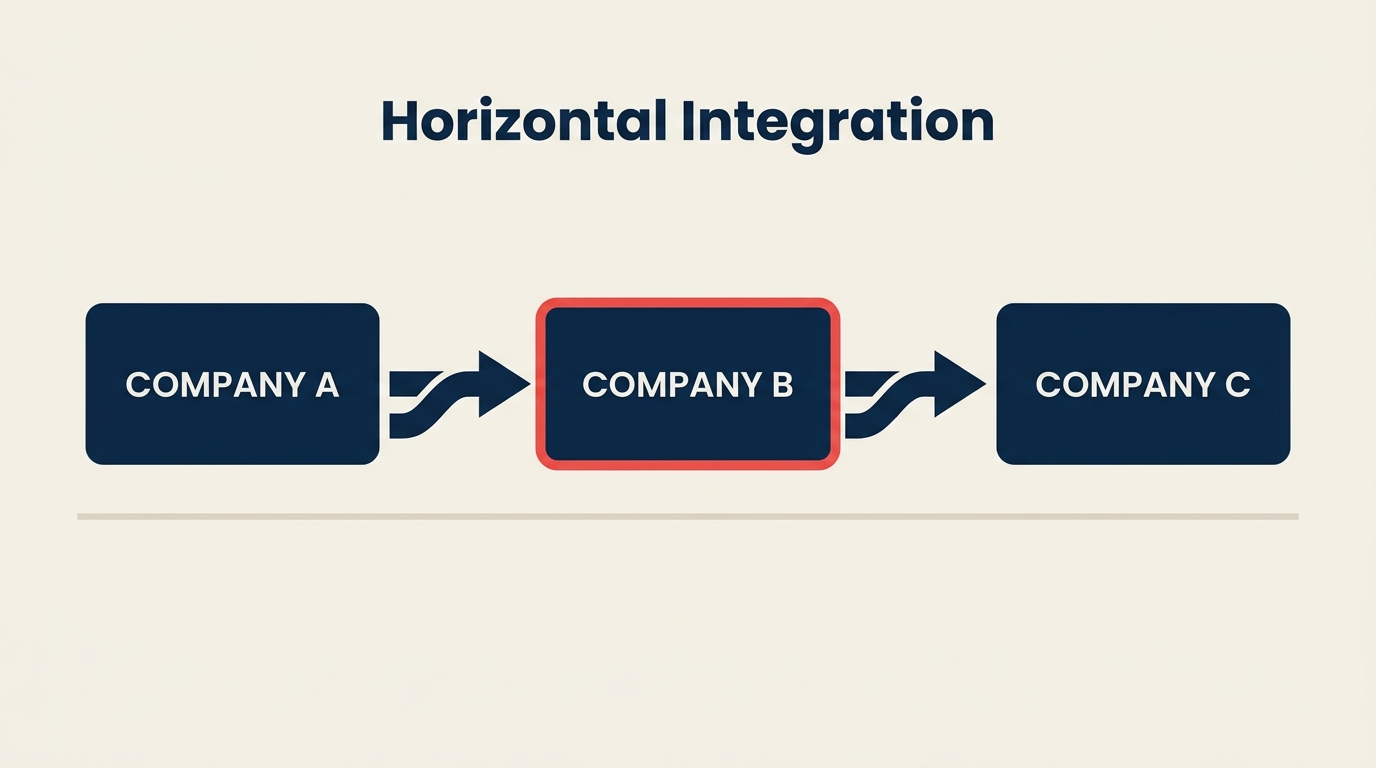
Horizontal integration is a growth strategy in which a company expands by acquiring, merging with, or combining operations with other businesses that produce the same or similar goods and services at the same stage of the production process.

The defining characteristic is "same level." Two hotel chains merging is horizontal integration. A hotel chain acquiring a food supplier is not; that's vertical integration. The horizontal label refers to movement across a market, not up or down a supply chain.
Companies pursue horizontal integration to grow faster than organic expansion allows, eliminate direct competition, or capture cost advantages that only scale can deliver. When it works, the combined entity controls more of the market and operates more efficiently. When it doesn't, the integration costs exceed the synergies and regulators often intervene before the deal closes.
Key Facts
- The global mergers and acquisitions market reached approximately $3.1 trillion in deal value in 2023, with horizontal deals representing the majority of strategic transactions by volume. (KPMG M&A Outlook, 2024)
- Research published in the Strategic Management Journal found that horizontal acquisitions generate an average announcement return of 1.8% for acquirers when the target is in a highly concentrated market, compared to near-zero returns in fragmented markets. (Andrade et al., Strategic Management Journal, 2022)
- A McKinsey study on post-merger integration found that 70% of mergers fail to achieve their expected synergies, with cultural integration and systems consolidation cited as the top failure modes. (McKinsey Quarterly, 2023)
Horizontal vs Vertical Integration
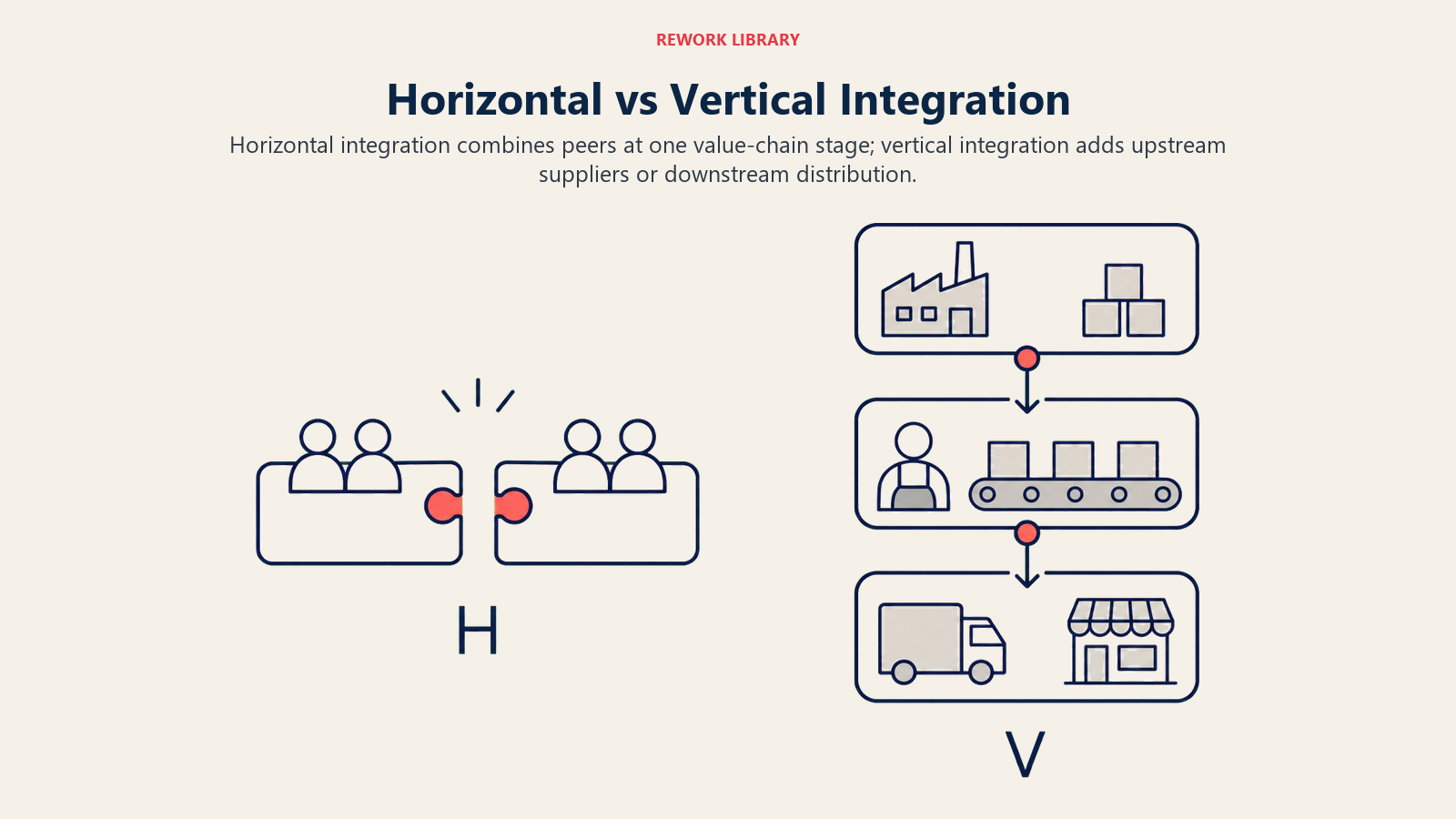
The two terms come up together constantly, so it helps to be precise about what separates them.
| Dimension | Horizontal Integration | Vertical Integration |
|---|---|---|
| Direction of expansion | Across the market (same supply chain stage) | Along the supply chain (upstream or downstream) |
| What you acquire | Competitors or similar businesses | Suppliers, distributors, or customers |
| Primary goal | Market share, scale, reduced competition | Supply chain control, margin capture |
| Regulatory risk | High (antitrust concern) | Moderate |
| Integration complexity | Culture and product overlap | Operational and process alignment |
| Example | Facebook acquiring Instagram | Apple manufacturing its own chips |
Vertical integration gives a company more control over its production process. Horizontal integration gives it more control over its market. Both expand the boundaries of the firm, but in fundamentally different directions.
If you're mapping growth options more broadly, the Ansoff Matrix is useful here: horizontal integration sits in the market penetration and market development quadrants, while diversification represents a separate path entirely.
Why Companies Pursue Horizontal Integration
Increased market share
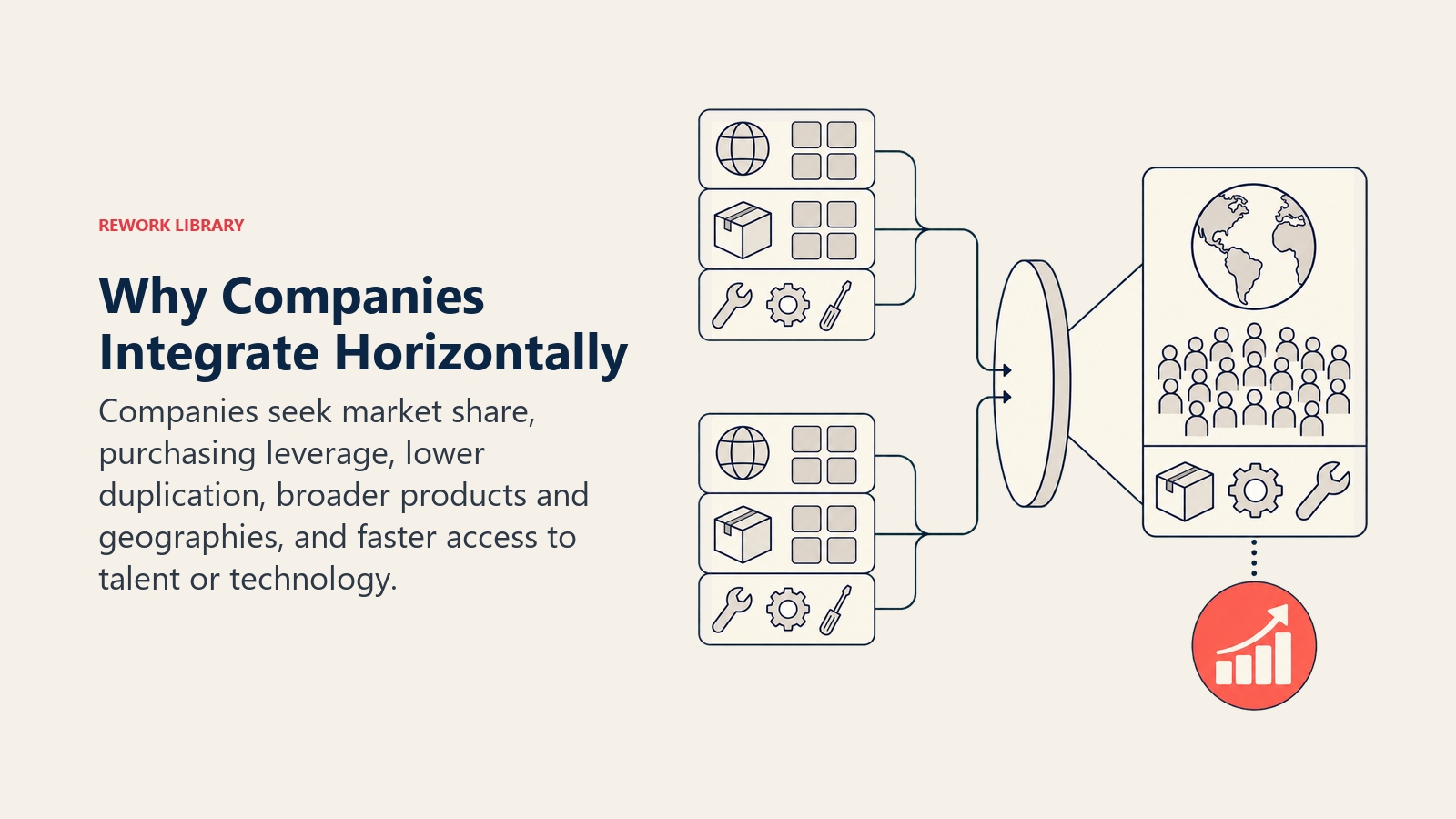
The most direct benefit is simple math. Acquiring a competitor removes it from the market while adding its customers and revenue to yours. For mature industries where organic growth is slow, an acquisition can double a company's market position overnight.
Economies of scale
Two companies that each run their own logistics, legal, IT, and finance functions can merge those into a single, shared operation. The result is lower per-unit cost across the entire combined business. Economies of scale are one of the most commonly cited synergies in horizontal deal rationales, and also one of the hardest to actually realize post-close.
Reduced competition
Acquiring a direct competitor removes one pricing threat from the market. In a duopoly or oligopoly, that can shift pricing power significantly toward the combined entity. This is also why antitrust regulators pay close attention. The same dynamic that creates competitive advantage for the acquirer may reduce competition for buyers.
Faster product and geographic expansion
Acquiring a company that operates in adjacent markets or geographies is faster than building from scratch. If a US software firm wants European market presence, buying a European competitor with existing customers and relationships is typically faster than organic entry, even accounting for integration costs.
Talent and technology acquisition
Sometimes the real target isn't market share but people or proprietary technology. Acqui-hires and technology acquisitions look horizontal on paper when the target builds similar products, but the strategic logic is about capability access rather than market consolidation.
Risks and Limitations
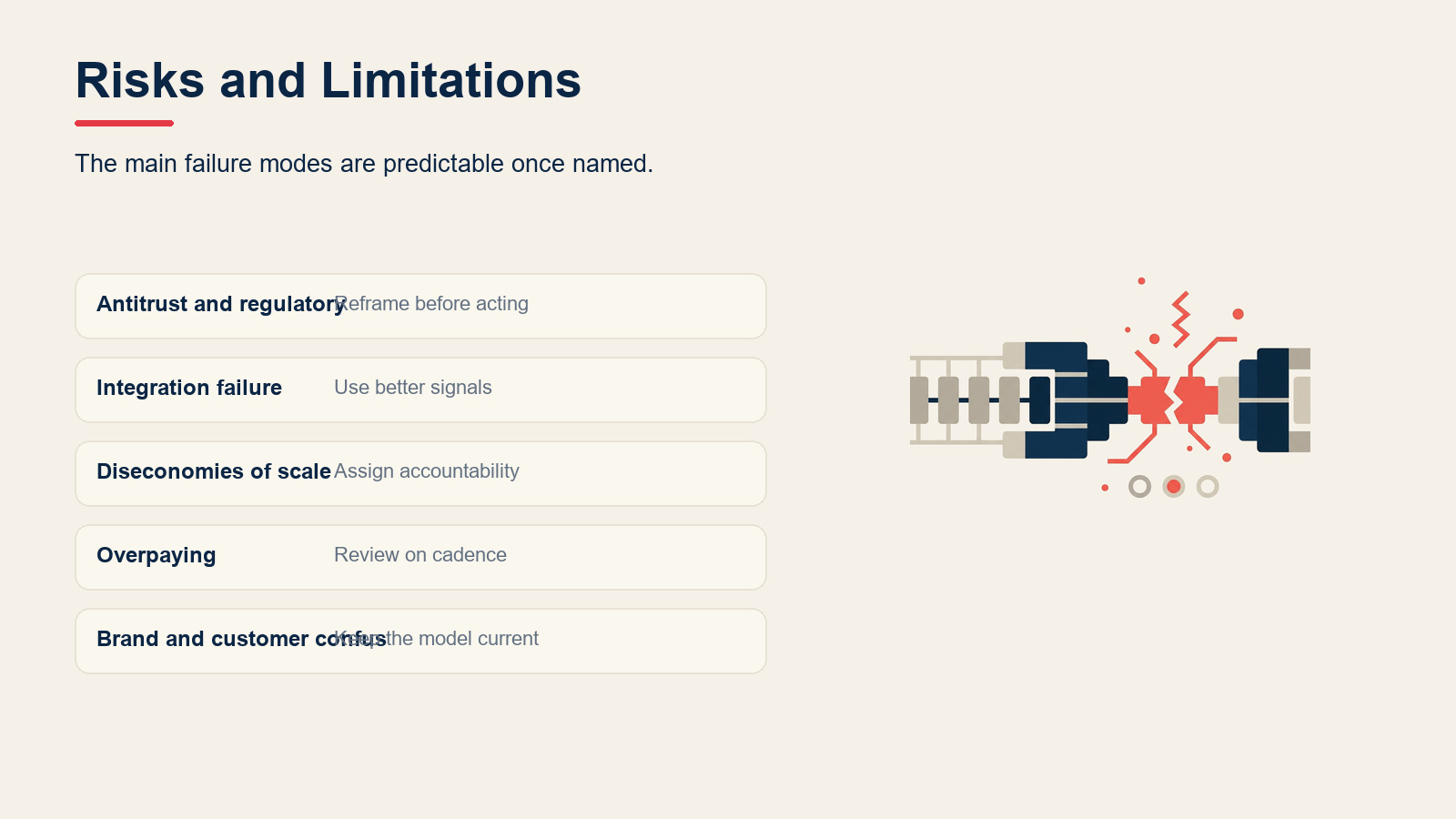
Antitrust and regulatory scrutiny
Regulatory risk is the biggest deal-killer in horizontal M&A. When two large competitors propose a merger, the resulting entity may control enough of the market to harm consumers through higher prices or fewer choices. Regulators in the US (FTC, DOJ) and EU (European Commission) have blocked or unwound several major horizontal deals in recent years, including attempted combinations in airlines, health insurance, and publishing.
Even approved deals often come with divestitures attached: the regulator approves the merger only if the combined company sells off certain business units or brands.
Integration failure
The majority of acquisitions fail to meet their synergy projections. Combining two organizations is harder than the deal model assumes. Different cultures, systems, compensation structures, and customer expectations all create friction. And unlike operational efficiency programs, integration work happens on top of running the business, not instead of it.
Diseconomies of scale
Past a certain size, bigger gets harder to manage, not easier. Communication slows, decision-making gets bogged down, and organizational complexity starts to offset the cost savings that justified the deal. Porter's Five Forces analysis can help identify whether a market truly rewards scale or whether it rewards focus and agility instead.
Overpaying
In competitive deal processes, acquirers frequently pay a premium that takes years to earn back. When the synergy assumptions don't materialize on schedule, the acquisition destroys shareholder value despite looking strategically rational on paper.
Brand and customer confusion
Merging two well-known brands into one can erode loyalty among customers who specifically chose one over the other. Managing brand portfolios post-acquisition is a separate strategic problem that many acquirers underestimate at the time of the deal.
How to Execute a Horizontal Integration
- Define the strategic rationale before the search. Be clear about what the acquisition needs to deliver: market share, technology, geography, talent, or cost structure. Vague rationales produce vague deal screens and overpaying for the wrong target.
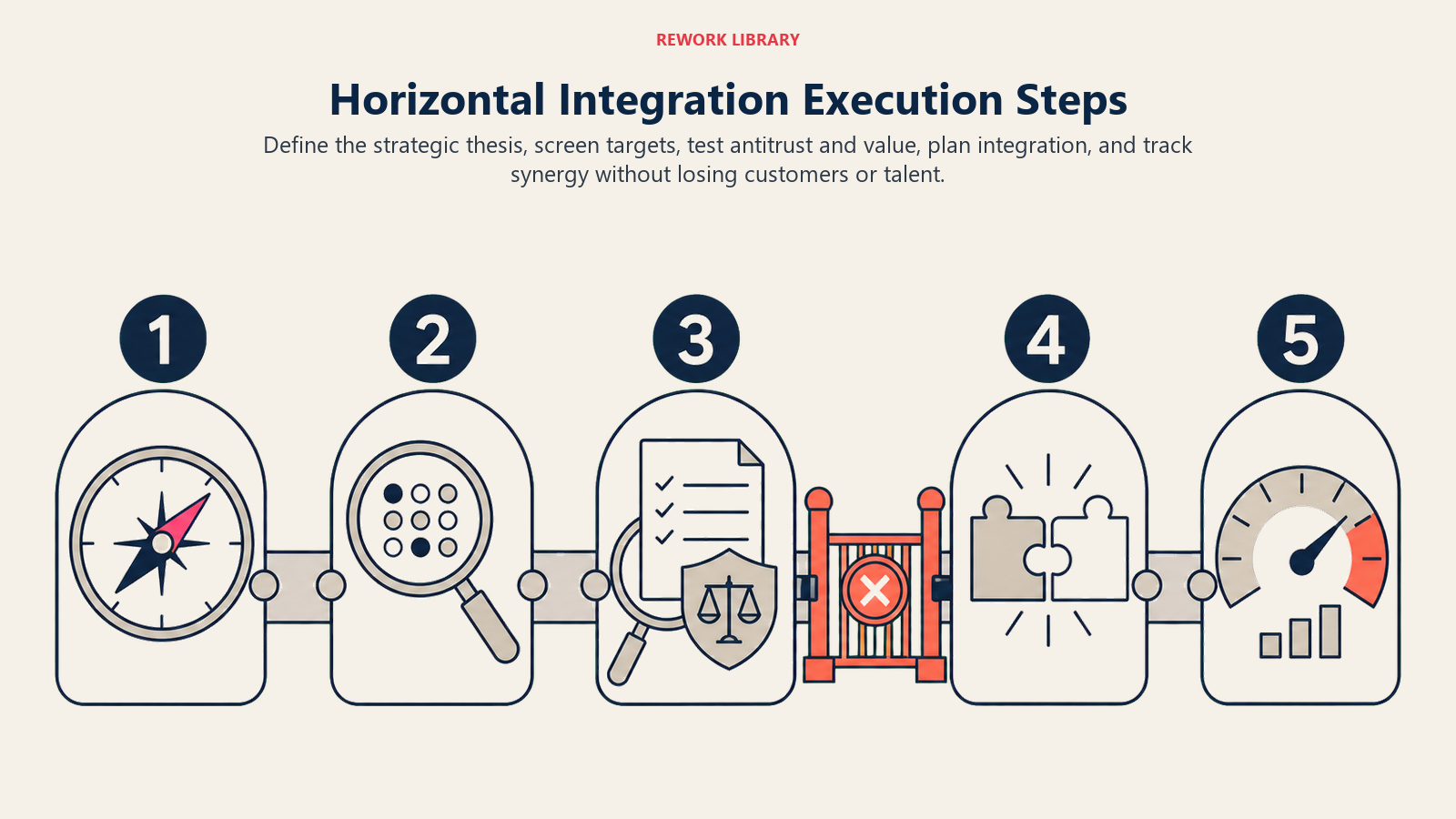
Map the market systematically. Use the BCG Matrix or similar tools to categorize potential targets by growth trajectory and relative market position. The best targets are typically ones that strengthen your position in a growing segment, not ones that add volume in a shrinking one.
Run a rigorous synergy model. Build the financial case from the bottom up: specific cost lines that can be consolidated, specific revenue opportunities that the combined entity enables. Apply a haircut to the synergy estimates, because the integration will take longer and cost more than the model says.
Assess regulatory risk early. Before engaging targets, check combined market share in every relevant product and geography. If the combination would trigger mandatory review, engage antitrust counsel before the deal becomes public. Deals that fall apart under regulatory pressure are expensive and damaging to both parties.
Plan the integration before signing. Integration planning that starts after deal close is integration planning that arrives too late. By the time the deal is announced, you should have a draft Day 1 operating model, an integration management office structure, and a preliminary view on how the two technology stacks will be resolved.
Communicate early and often. Employees at both companies will be anxious. Customers will wonder what the merger means for service levels. Vendors will worry about contract terms. A clear, consistent communication plan prevents the rumor-filling-the-vacuum problem that derails many integrations.
Set 90-day and 12-month integration milestones. Synergies don't land on their own. Assign specific owners to each synergy line and track them with the same rigor you'd apply to any operational target.
Horizontal Integration Examples
| Deal | Acquirer | Target | Year | Strategic rationale |
|---|---|---|---|---|
| Disney + Pixar | The Walt Disney Company | Pixar Animation Studios | 2006 | Acquire animation capability and talent, revitalize Disney's content pipeline |
| Facebook + Instagram | Meta (then Facebook) | 2012 | Eliminate a rising competitor in photo sharing, extend social reach to mobile | |
| Marriott + Starwood | Marriott International | Starwood Hotels and Resorts | 2016 | Become the world's largest hotel company, expand loyalty program and global footprint |
| Exxon + Mobil | ExxonMobil | Mobil Corporation | 1999 | Consolidate after deregulation, capture scale economies across refining and distribution |
| Microsoft + Activision Blizzard | Microsoft | Activision Blizzard | 2023 | Expand gaming content library, strengthen Xbox and Game Pass against Sony PlayStation |
A few patterns stand out across these deals. First, the best-executed horizontal acquisitions tend to have a clear primary rationale rather than a list of generic synergies. Disney knew it wanted Pixar's creative engine and John Lasseter's team. Second, the deals that generated the most regulatory friction (Exxon-Mobil, Microsoft-Activision) were in concentrated markets where combined market share triggered sustained review. Third, in every case the integration work after close determined whether the deal value actually materialized.

Senior Operations & Growth Strategist
On this page
- What Is Horizontal Integration?
- Horizontal vs Vertical Integration
- Why Companies Pursue Horizontal Integration
- Increased market share
- Economies of scale
- Reduced competition
- Faster product and geographic expansion
- Talent and technology acquisition
- Risks and Limitations
- Antitrust and regulatory scrutiny
- Integration failure
- Diseconomies of scale
- Overpaying
- Brand and customer confusion
- How to Execute a Horizontal Integration
- Horizontal Integration Examples