Economies of Scale: Types and Examples
Turn this article into takeaways for your work.


Each assistant summarizes the article only for you and suggests best practices for your work.
Economies of scale are what happen when producing more of something costs less per unit. It's one of the oldest and most powerful forces in business strategy, and it's why Amazon's fulfillment network, Apple's component contracts, and Walmart's logistics operation can consistently undercut rivals who are doing essentially the same thing at smaller volume.
What Are Economies of Scale?
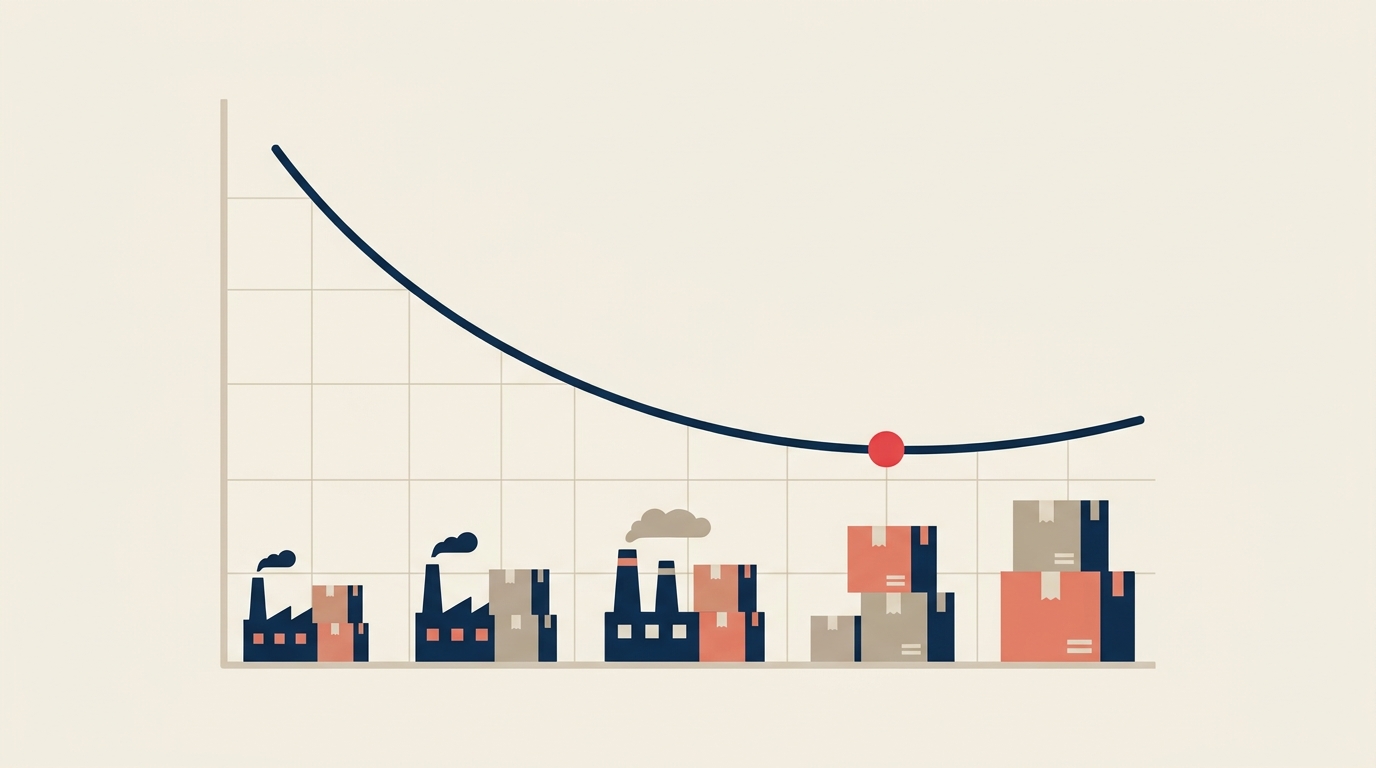
Economies of scale are the cost advantages a business gains by increasing output. As production volume rises, fixed costs get spread across more units, and unit cost falls. The result is a lower average cost per unit at higher levels of output than at lower ones.
The classic representation is the long-run average cost (LRAC) curve: a downward slope that eventually flattens at the point known as minimum efficient scale (MES). Minimum efficient scale (MES) is the smallest output level at which a firm can fully exploit available economies of scale. Below MES, a competitor operating at larger volume has a structural cost advantage. Above MES, further expansion yields diminishing returns and can trigger diseconomies.
Key Facts: Economies of Scale
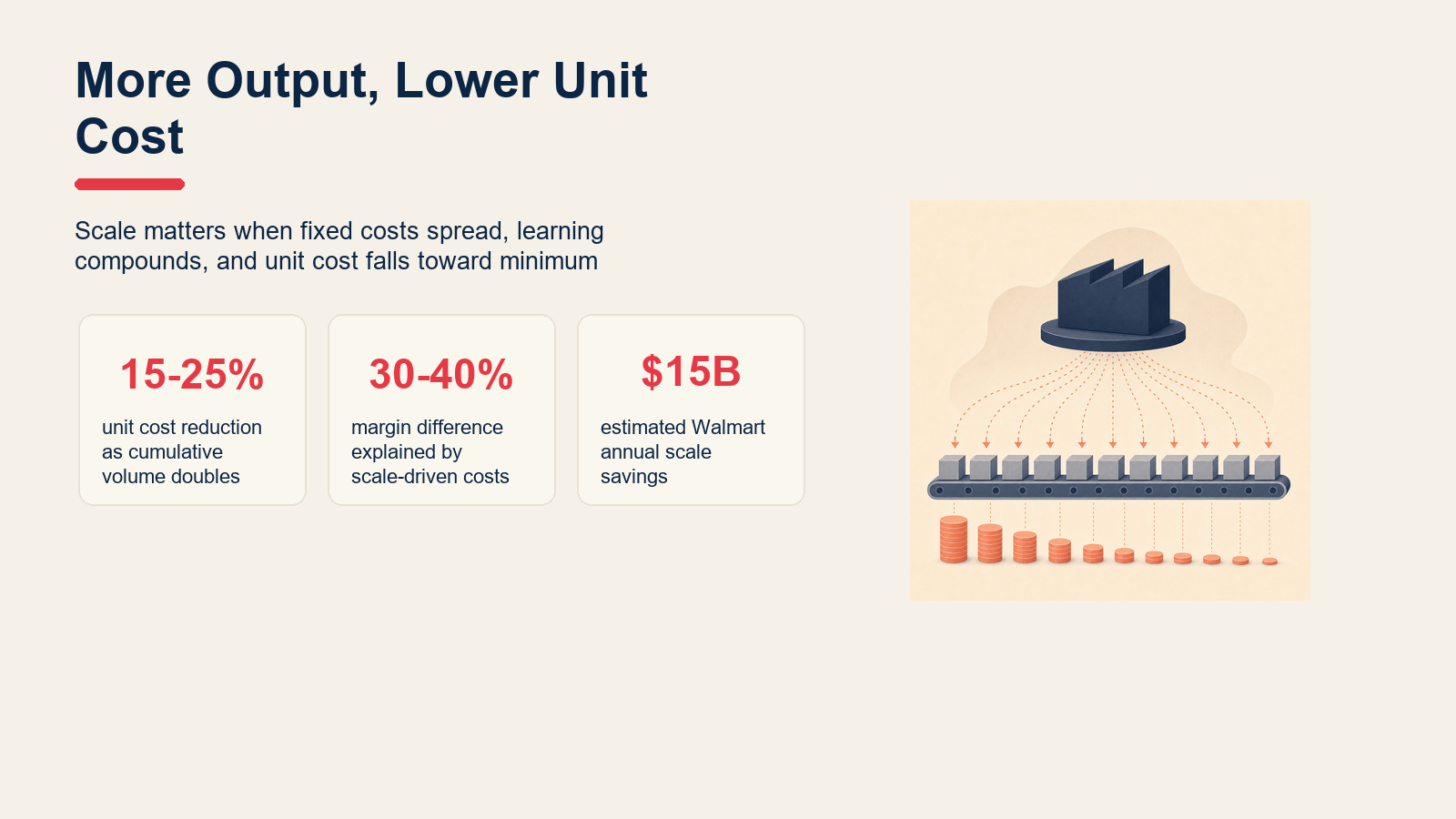
- Boston Consulting Group research found that in many industries, every time cumulative production volume doubles, real unit costs fall by 15-25%. (BCG Experience Curve research, 2022)
- McKinsey analysis of global manufacturing found that scale-driven cost advantages account for roughly 30-40% of operating margin differences between top and bottom quartile competitors in the same sector. (McKinsey Global Institute, 2023)
- Walmart's supply chain efficiencies generate an estimated $15 billion in annual cost savings versus comparable retail rivals, a direct product of scale in procurement, logistics, and distribution. (Walmart Annual Report, 2023)
Understanding economies of scale isn't just an economics exercise. It's the foundation of cost leadership strategy and one of the primary forces shaping industry structure in Porter's Five Forces.
Internal vs External Economies of Scale
Not all scale advantages come from inside the firm. It helps to separate the two categories before going deeper.
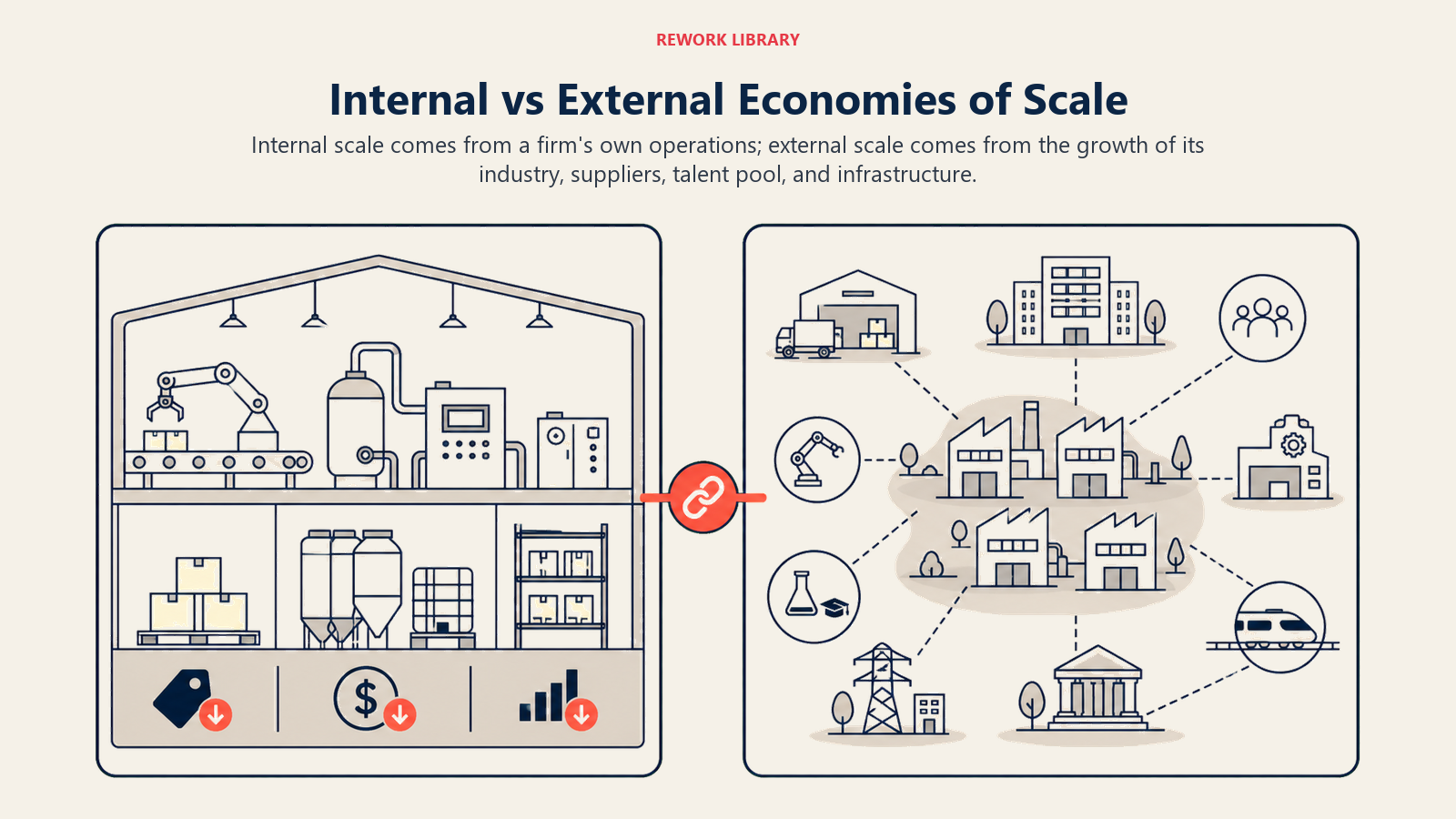
| Dimension | Internal Economies of Scale | External Economies of Scale |
|---|---|---|
| Source | Actions taken within the firm | Industry-wide growth and conditions |
| Control | Firm controls them directly | Shared across all competitors in the industry |
| Examples | Bulk purchasing, specialized labor, automation | Regional talent pools, shared infrastructure, supplier networks |
| Durability | Proprietary and defensible | Accessible to all firms in the sector |
| Strategic value | High (hard for rivals to replicate exactly) | Lower (rivals benefit too) |
Internal economies of scale are what competitive advantage is usually built on. External economies can benefit an entire cluster, such as Silicon Valley's software ecosystem or Germany's automotive supply chain, but they don't differentiate one competitor from another.
Types of Economies of Scale
There are six main types of internal economies of scale. Each operates through a different mechanism, and the strongest cost leaders typically stack several.
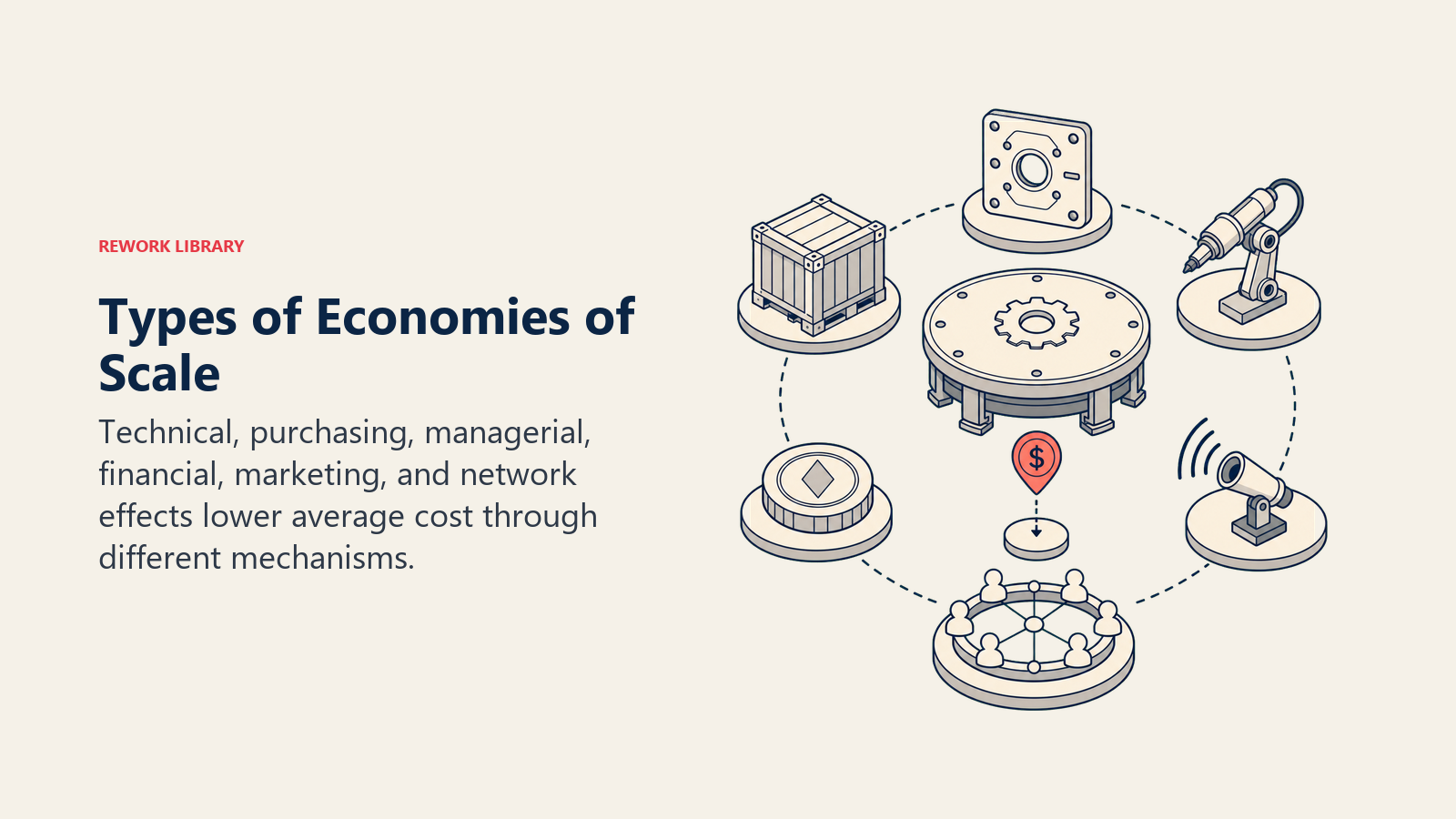
| Type | How it works | Classic example |
|---|---|---|
| Technical | Larger machines and production runs spread capital costs over more units | Steel mills, semiconductor fabs, oil refineries |
| Purchasing | Higher volumes unlock bulk discounts and better supplier terms | Walmart negotiating direct with P&G; Costco buying container loads |
| Managerial | Specialized managers (procurement, logistics, finance) run more efficiently than generalists | Amazon's dedicated category teams vs small retailer owner-managers |
| Financial | Larger firms borrow at lower rates and access capital markets others can't | Apple's 0.9% commercial paper vs small manufacturer's 7% bank loan |
| Marketing | Fixed brand and advertising spend is distributed across a larger revenue base | Coca-Cola's global campaign cost per impression vs regional competitor |
| Network | Each additional user increases value for all others, often at near-zero marginal cost | Visa, Airbnb, LinkedIn, any platform business |
Technical economies: spreading fixed costs
Technical economies are usually the first type a growing manufacturer experiences. A factory that cost $50 million to build has fixed costs that look very different when you produce 100,000 units versus 1,000,000 units. Per-unit capital cost drops from $500 to $50. The machinery hasn't changed. Only the volume through it has.
Purchasing economies: bulk-buying power
As order volumes rise, suppliers compete harder for the business and firms gain leverage to demand lower prices, faster delivery, and better credit terms. Costco's model is built almost entirely around this: narrow SKU count (roughly 3,700 items), bought in enormous quantities directly from manufacturers, sold at margins that would be impossible for a retailer buying at lower volumes.
Network economies: a modern multiplier
Network economies of scale deserve special attention because they don't follow the traditional cost-curve model. The more users a platform has, the more valuable it becomes to each one, and the marginal cost of adding an additional user approaches zero. This is why Visa's transaction costs per payment fall with volume, and why LinkedIn's value to recruiters rises as more candidates join.
Economies of Scale vs Diseconomies of Scale
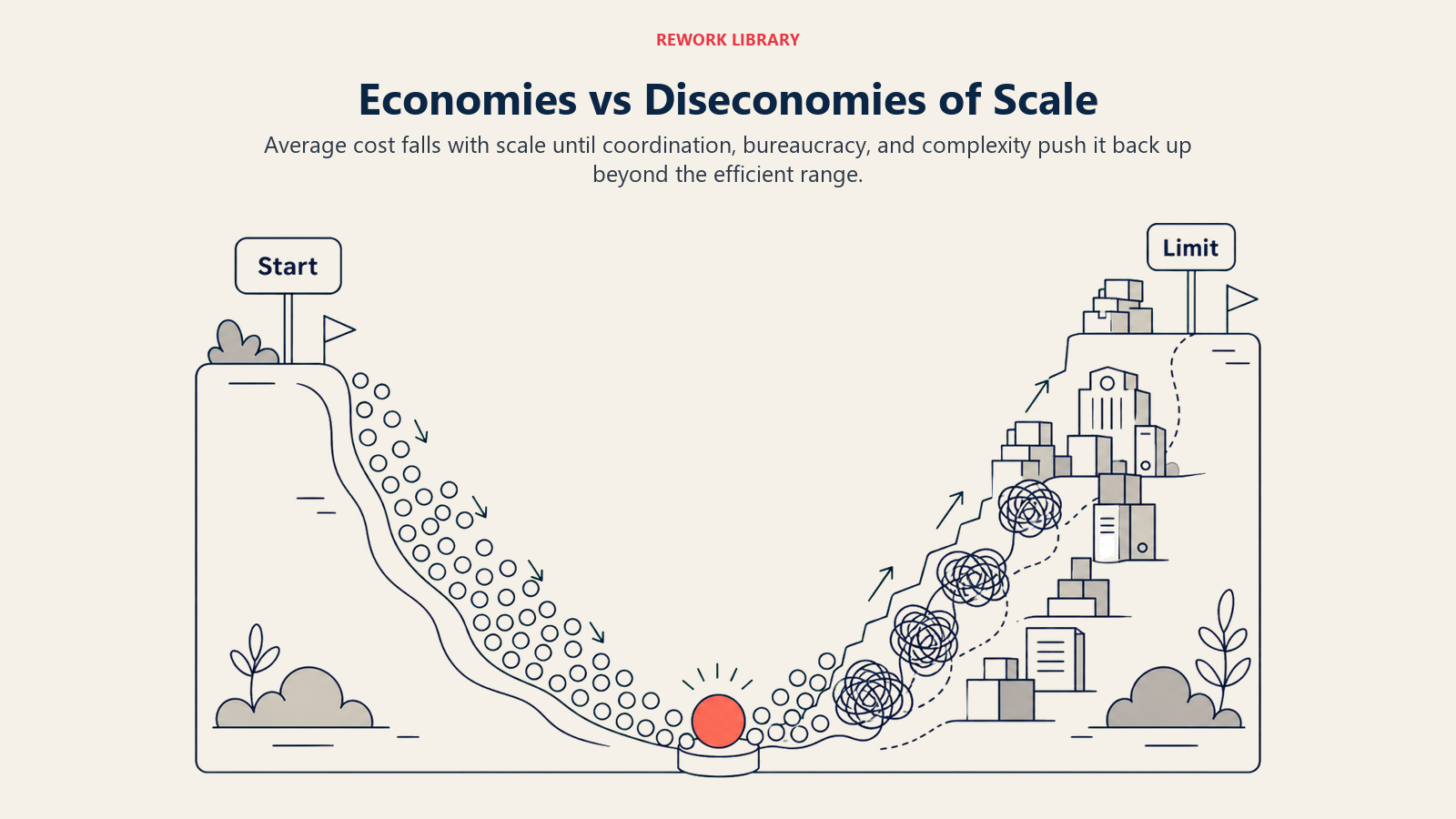
The cost curve doesn't fall forever. Past a certain output level, average costs stop falling and start rising. That's diseconomies of scale (DoS), and it happens for predictable reasons: management complexity grows, communication breaks down across large organizations, bureaucracy slows decisions, and supply constraints push input prices up.
| Feature | Economies of Scale | Diseconomies of Scale |
|---|---|---|
| Cost direction | Average cost falls as output rises | Average cost rises as output rises |
| Curve position | Left side of the U-shaped LRAC curve | Right side of the U-shaped LRAC curve |
| Main causes | Spreading fixed costs, bulk buying, specialization | Management complexity, coordination failure, input price pressure |
| Strategic signal | Expand production to capture cost benefits | Reduce scope, spin off units, or decentralize |
| Example | Toyota scaling production across global plants | General Motors' late-2000s management overhead crisis |
The U-shaped long-run average cost curve captures both forces. The bottom of the U is minimum efficient scale (MES): the sweet spot where average costs are lowest. Operating below MES leaves cost savings on the table. Operating far above MES invites diseconomies. The goal isn't maximum size; it's optimal scale.
IBM's 1980s mainframe business is a good illustration. IBM captured massive economies of scale through its proprietary hardware supply chain. But as it grew, managerial layers multiplied, decision cycles lengthened, and the organization became too slow to respond when personal computing disrupted the industry. Size had flipped from an asset to a liability.
Economies of Scale Examples
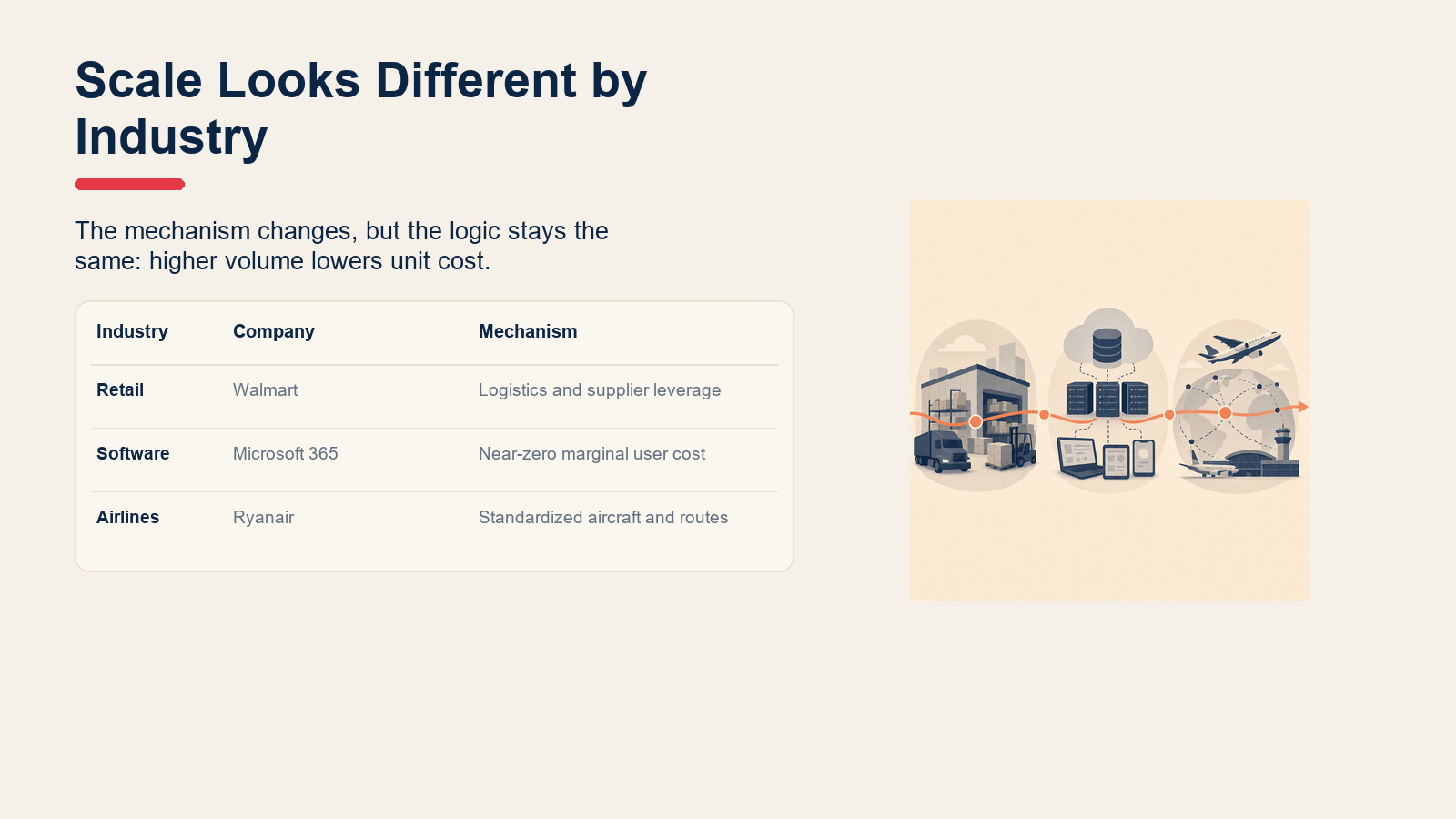
Real-world economies of scale look different depending on the industry. The mechanism changes, but the underlying logic is the same: higher volume lowers the unit cost.
| Industry | Company | Scale mechanism | Cost outcome |
|---|---|---|---|
| Retail | Walmart | Hub-and-spoke logistics, supplier leverage | Estimated $15B annual savings vs peers |
| Software/SaaS | Microsoft 365 | Near-zero marginal cost per additional user | Operating margin expands with subscriber count |
| Airlines | Ryanair | Single aircraft type (Boeing 737), point-to-point routes | Maintenance and training cost per flight far below legacy carriers |
| Consumer goods | Procter & Gamble | Global manufacturing scale, shared marketing platform | Lower cost per unit on Tide, Gillette, Pampers across 180+ markets |
| E-commerce | Amazon | Robotics, network density, third-party seller volume | Fulfillment cost per unit falling even as wages rise |
| Pharma | Pfizer | Global clinical trial infrastructure, shared regulatory teams | Development cost per approved drug lower than smaller rivals |
Software: the purest case
Software is the clearest example of economies of scale in the modern economy. Writing the code costs the same whether one person or ten million people use it. Microsoft's Azure cloud costs roughly the same to operate at the margin regardless of whether it serves the ten-millionth or ten-million-and-first customer. This is why SaaS companies show operating leverage: revenue scales with customers, but infrastructure cost grows much more slowly, compressing unit cost toward near-zero.
Manufacturing: the original model
In manufacturing, technical economies dominate. A semiconductor fab costs billions to build, but once running, each additional chip costs a fraction of the fixed outlay. TSMC's 3nm fab is a recent example: early production runs carry enormous fixed cost per chip, but as volume ramps, that cost per chip falls dramatically, making it impossible for a smaller competitor to build 3nm chips at competitive prices.
How to Achieve Economies of Scale
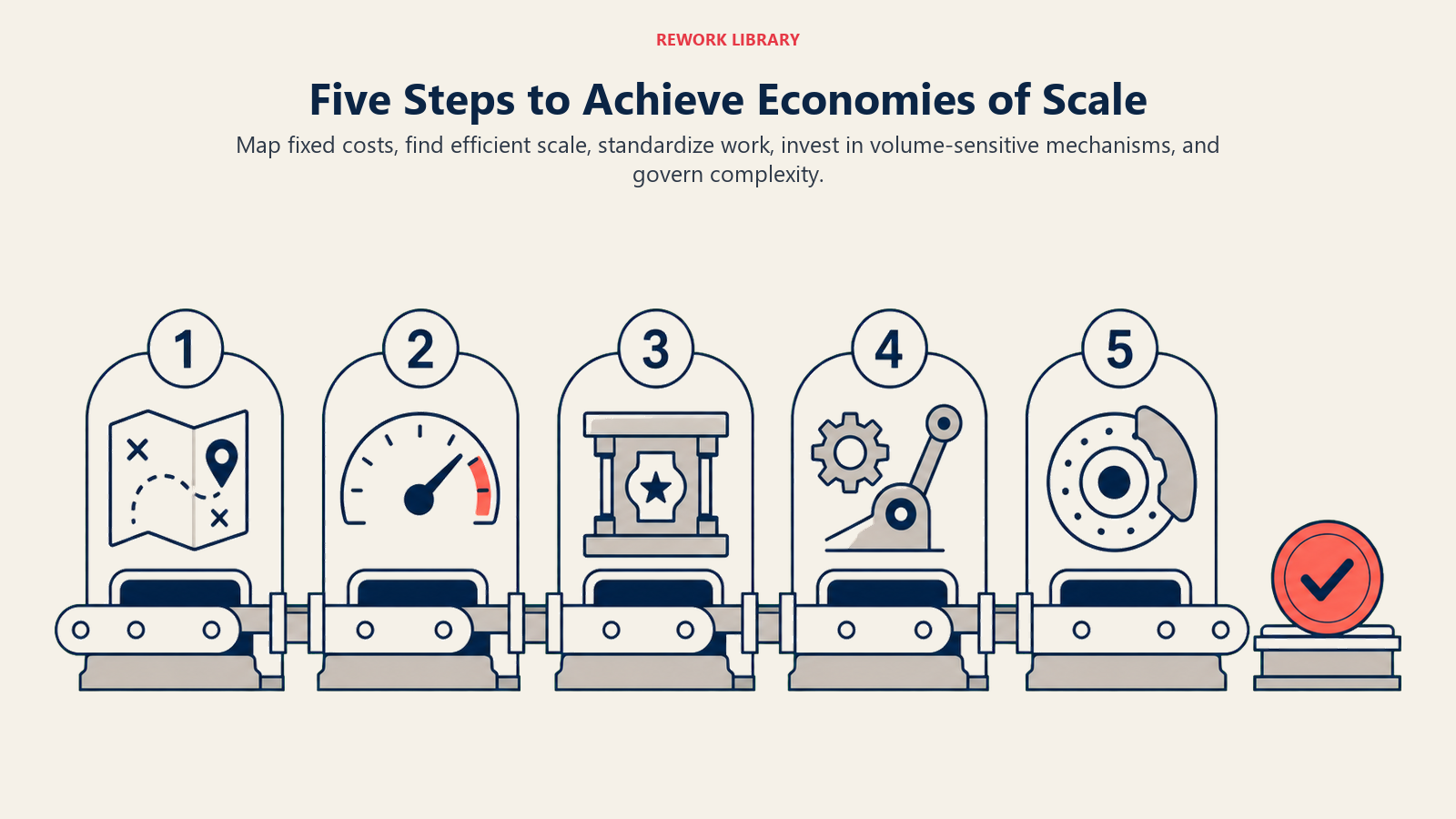
Building genuine scale economies doesn't happen by accident. It requires deliberate choices about where to invest, what to standardize, and how to grow. Here's a practical sequence.
Step 1: Identify your fixed cost structure
Run a value chain analysis and map where your costs actually sit. Separate fixed from variable costs. Fixed costs (factories, software licenses, management overhead, brand spend) are what you'll spread across higher volume. Variable costs (raw materials, per-unit labor, packaging) may benefit from purchasing economies, but the logic is different.
Step 2: Find your current minimum efficient scale
Benchmark your cost per unit against best-in-class competitors. If your unit costs are materially higher than a larger rival's, and the difference can't be explained by quality differences, you're likely below MES. That tells you where to prioritize growth investment.
Step 3: Standardize before you scale
This is the step most companies skip. Scaling a complex, inconsistent operation amplifies the inconsistency. Before expanding, standardize your core process, your supply chain, your SKU count, and your technology stack. Ryanair operates one aircraft type, not because it's the only option, but because standardization is what makes scale efficient. McDonald's franchise model is another example: the entire value of scale depends on every unit running the same process.
Step 4: Invest in the mechanisms that fall with volume
Depending on your business, the biggest scale gains might come from automation (technical), centralized procurement (purchasing), a shared brand platform (marketing), or a platform that grows more valuable with users (network). Don't spread investment evenly. Find the one or two mechanisms where your gap to best-in-class is largest, and allocate disproportionately.
Step 5: Build governance to prevent cost drift
Economies of scale are easy to erode. As companies grow, management layers appear, product lines multiply, and overhead accumulates. Build explicit cost governance into your operating model: cost per unit as a KPI at every level, regular benchmarking, and a culture where spending decisions are treated as strategic choices. ALDI and Ryanair are famously vigilant here, even as they grow rapidly.
Limitations and Common Mistakes
Chasing scale before standardizing
Growing a complex operation creates diseconomies faster than it creates scale benefits. Companies that expand geographically or add product lines before standardizing their core process often end up with higher, not lower, unit costs post-expansion.
Mistaking revenue growth for cost efficiency
Revenue growth and cost efficiency can move in opposite directions. A company that doubles revenue by adding a premium product line with different suppliers, different processes, and different customers may find its cost structure more complex, not simpler, than before. Scale economies require that the growth is in the same or closely adjacent activities.
Ignoring the diseconomy threshold
Bigger isn't always cheaper. At some scale, the coordination costs of managing a large organization outstrip the benefits of spreading fixed costs. The warning signs: slowing decision cycles, rising overhead as a percentage of revenue, and declining employee productivity. When these appear, the answer isn't more scale. It's restructuring, decentralization, or divesting non-core units.
Conflating economies of scale with differentiation strategy
Some companies try to build a distinctive product while simultaneously chasing cost scale. The two strategies require different organizational capabilities and cultures. Pursuing both without exceptional discipline usually produces mediocrity in each. Clarify your strategic priority first, then build the scale that supports it.
Where to go next
Economies of scale are a cost-side force. To see how they combine with product positioning, read competitive advantage, which maps the full range of sources firms draw on. For the cost-specific strategy built on scale, see cost leadership strategy. And for the analytical tool that helps you find where scale benefits actually live in your business, start with value chain analysis.
Related reading
- Competitive Advantage: Types and How to Build One
- Cost Leadership Strategy: How It Works
- Porter's Five Forces: Analyzing Industry Structure
- Value Chain Analysis: Finding Your Cost and Value Drivers
- Differentiation Strategy: How to Stand Out and Charge More
- Flywheel Effect: How Momentum Drives Business Growth

Senior Operations & Growth Strategist
On this page
- What Are Economies of Scale?
- Internal vs External Economies of Scale
- Types of Economies of Scale
- Technical economies: spreading fixed costs
- Purchasing economies: bulk-buying power
- Network economies: a modern multiplier
- Economies of Scale vs Diseconomies of Scale
- Economies of Scale Examples
- Software: the purest case
- Manufacturing: the original model
- How to Achieve Economies of Scale
- Step 1: Identify your fixed cost structure
- Step 2: Find your current minimum efficient scale
- Step 3: Standardize before you scale
- Step 4: Invest in the mechanisms that fall with volume
- Step 5: Build governance to prevent cost drift
- Limitations and Common Mistakes
- Chasing scale before standardizing
- Mistaking revenue growth for cost efficiency
- Ignoring the diseconomy threshold
- Conflating economies of scale with differentiation strategy
- Where to go next
- Related reading