Market Segmentation: Types, Examples, and How to Do It
Turn this article into takeaways for your work.


Each assistant summarizes the article only for you and suggests best practices for your work.
Market segmentation is the practice of dividing a broad customer base into smaller groups whose members share similar characteristics, needs, or behaviors. Done well, it transforms a generic "talk to everyone" message into a focused conversation with the right people, and that shift alone tends to improve conversion rates, reduce wasted ad spend, and clarify product priorities.
Most companies that struggle with growth aren't short on customers to pursue. They're short on clarity about which customers to pursue first.
What is market segmentation?
Market segmentation is the process of dividing a total addressable market into distinct subgroups, called segments, so that each group can be served with a strategy tailored to its specific characteristics. A segment is only useful if the people inside it are meaningfully similar to each other and meaningfully different from people in other segments.
The purpose isn't academic. It shapes which products you build, which channels you invest in, which pricing tiers you set, and which messages you put in front of which audiences. A company that skips segmentation ends up averaging everything, and average positioning rarely wins a customer from a competitor who speaks directly to that customer's situation.
Segmentation sits upstream of most other strategic decisions. It feeds your value proposition canvas, informs how you build buyer personas, and anchors the ideal customer profile that your sales and marketing teams use every day.
Key Facts: Market Segmentation
- Companies that use advanced customer segmentation report 10% higher revenue over 5 years compared to those without a formal segmentation approach (Bain, "Customer Segments That Matter," 2022).
- 72% of consumers say they only engage with marketing messages tailored to their interests (Salesforce State of the Connected Customer, 2023).
- McKinsey research found that personalization driven by effective segmentation can reduce customer acquisition costs by up to 50% and lift revenues by 5 to 15% (McKinsey, "The Value of Getting Personalization Right," 2021).
The 4 types of market segmentation
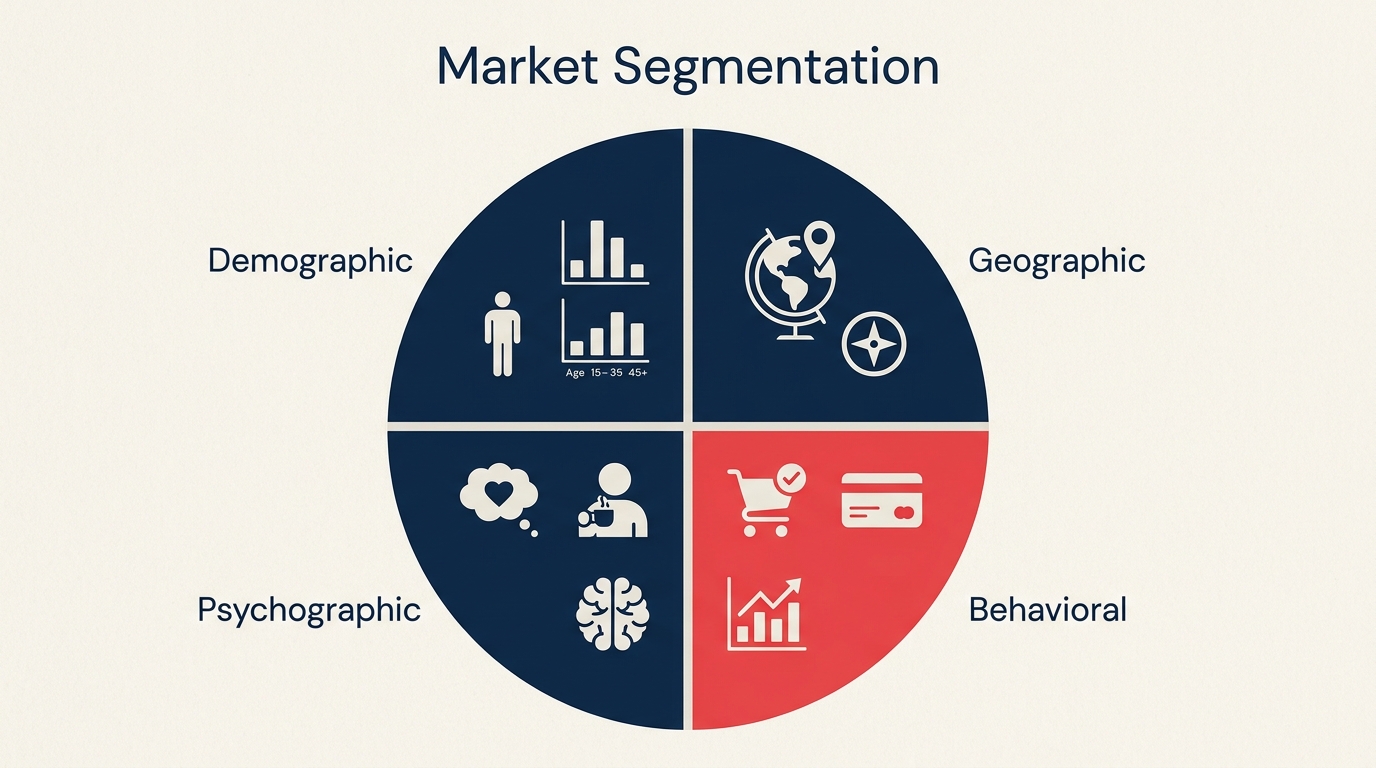
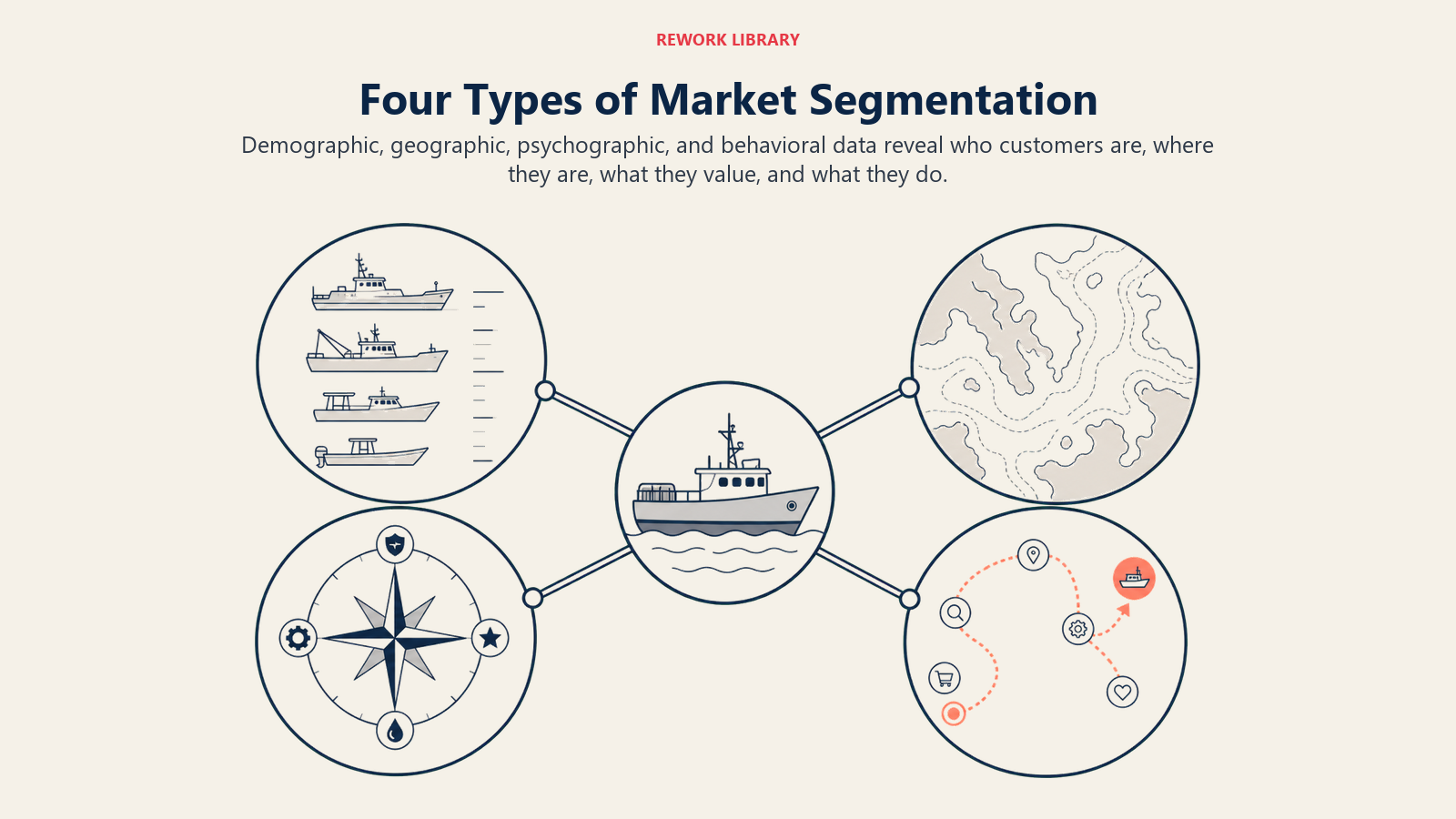
There are four foundational segmentation types. Most real-world strategies combine two or three of them, but each does a distinct job.
Demographic segmentation
Demographic segmentation groups people by measurable personal characteristics: age, gender, income, education level, occupation, family size, or marital status. It's the oldest and most widely used approach because this data is relatively easy to collect and often directly predicts purchasing power and priorities.
A furniture brand targeting newly married couples in their late 20s is using demographic segmentation. So is a financial services firm that builds separate retirement products for 35-year-olds and 55-year-olds.
Geographic segmentation
Geographic segmentation divides the market by location: country, region, city, climate, population density, or even neighborhood. The logic is that where people live shapes what they need. A cold-weather market needs different products than a tropical one. Urban density creates demand patterns that suburbs don't share.
Retailers use geographic segmentation to decide which store formats to open where. Software companies use it to prioritize which language localizations to build first.
Psychographic segmentation
Psychographic segmentation goes deeper than demographics. It groups people by personality traits, values, attitudes, interests, and lifestyle choices. Two people with identical demographic profiles can have completely different buying motivations, and psychographic segmentation captures that.
An outdoor apparel brand might segment by values (sustainability-first buyers vs. performance-first buyers) rather than by age or income. A wellness brand might target people who identify as "proactive about health" rather than those who just happen to be in a certain age bracket.
Psychographic data is harder to collect than demographic data, but the segments it produces tend to be much more predictive of actual purchase behavior.
Behavioral segmentation
Behavioral segmentation organizes customers around what they actually do: their purchase history, usage frequency, loyalty status, benefits sought, or stage in the buying journey. It's the most directly tied to revenue outcomes because it works from observed actions rather than assumed characteristics.
An e-commerce company separating "first-time buyers," "repeat buyers," and "lapsed buyers" into distinct email tracks is using behavioral segmentation. A SaaS platform that prices based on usage tiers is doing the same thing in its product.
Summary of the four types
| Type | What it segments by | Example variables | Example use |
|---|---|---|---|
| Demographic | Measurable personal traits | Age, income, education, occupation | Financial product tiers by life stage |
| Geographic | Location and environment | Country, city, climate, population density | Regional pricing or localized product lines |
| Psychographic | Values, attitudes, and lifestyle | Beliefs, interests, personality, social identity | Brand messaging for sustainability-focused buyers |
| Behavioral | Observed actions and patterns | Purchase frequency, loyalty, benefits sought, usage stage | Retention campaigns for high-value repeat customers |
B2B vs B2C segmentation
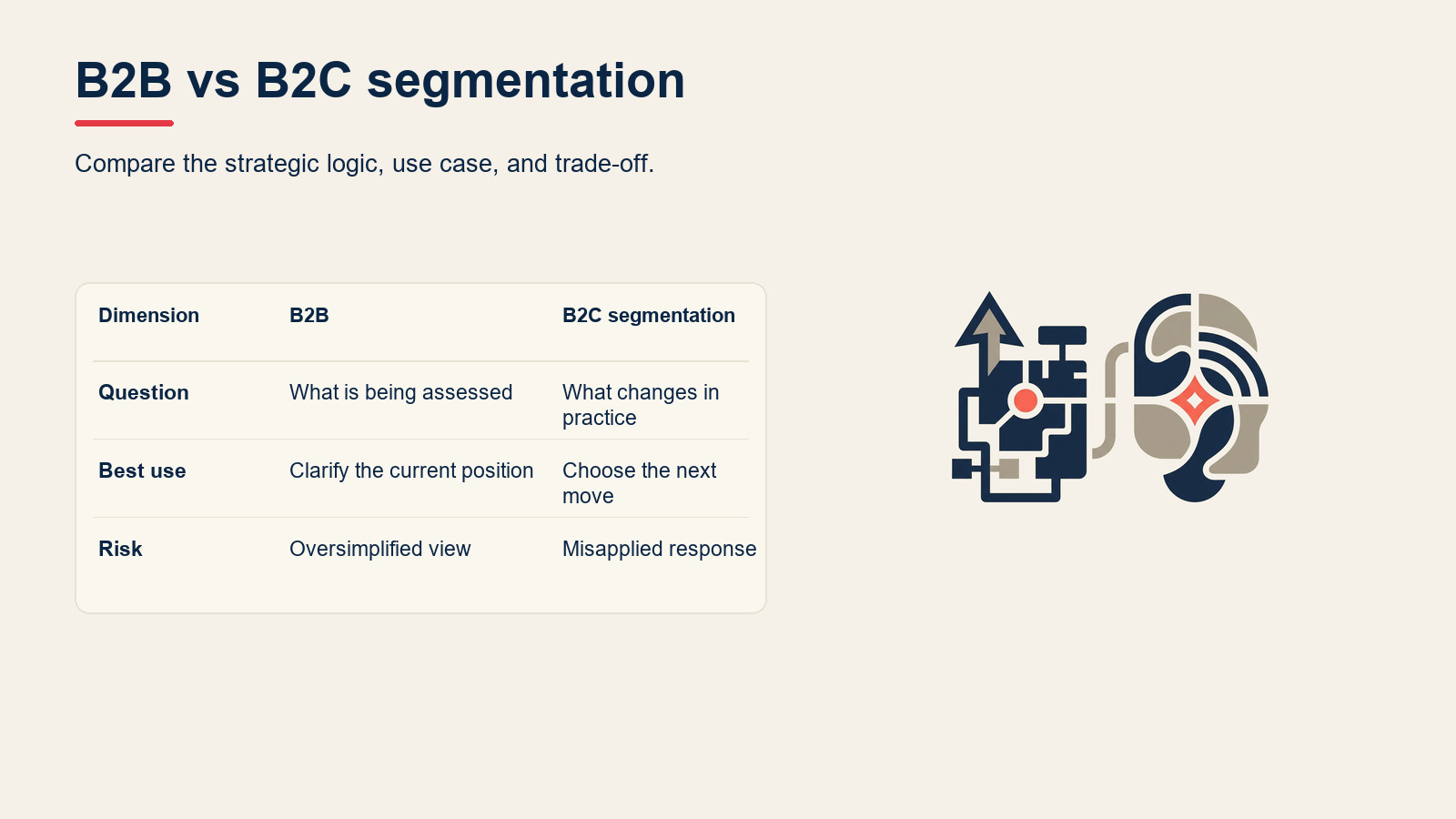
Consumer segmentation and business-to-business segmentation use the same four types above, but B2B adds a fifth layer that B2C rarely needs: firmographic segmentation.
Firmographic variables are the organizational equivalents of demographic variables. They include company size (headcount or revenue), industry vertical, geographic footprint, organizational structure, and technology stack. A software vendor targeting mid-market logistics companies with 200 to 1,000 employees is using firmographic segmentation as its primary filter, then layering behavioral data (trial usage patterns, support ticket frequency) on top.
B2B buying decisions also involve more stakeholders than consumer decisions, which means effective B2B segmentation often needs to account for the different roles inside a buying committee: economic buyers care about ROI, technical buyers care about integration, and operational end users care about day-to-day workflow. Segmenting by role within the account is sometimes as important as segmenting by account type.
B2C segmentation, by contrast, can lean more heavily on psychographic and behavioral signals because the decision-making unit is usually one or two people, and emotional resonance matters more when there's no procurement process to navigate.
A strong starting point for B2B segmentation is building out your ideal customer profile, which captures the firmographic and behavioral characteristics of the accounts most likely to convert and retain.
How to segment your market
Segmentation isn't a one-time workshop exercise. It's a working model that gets sharper as you collect more data. Here's a practical five-step process.
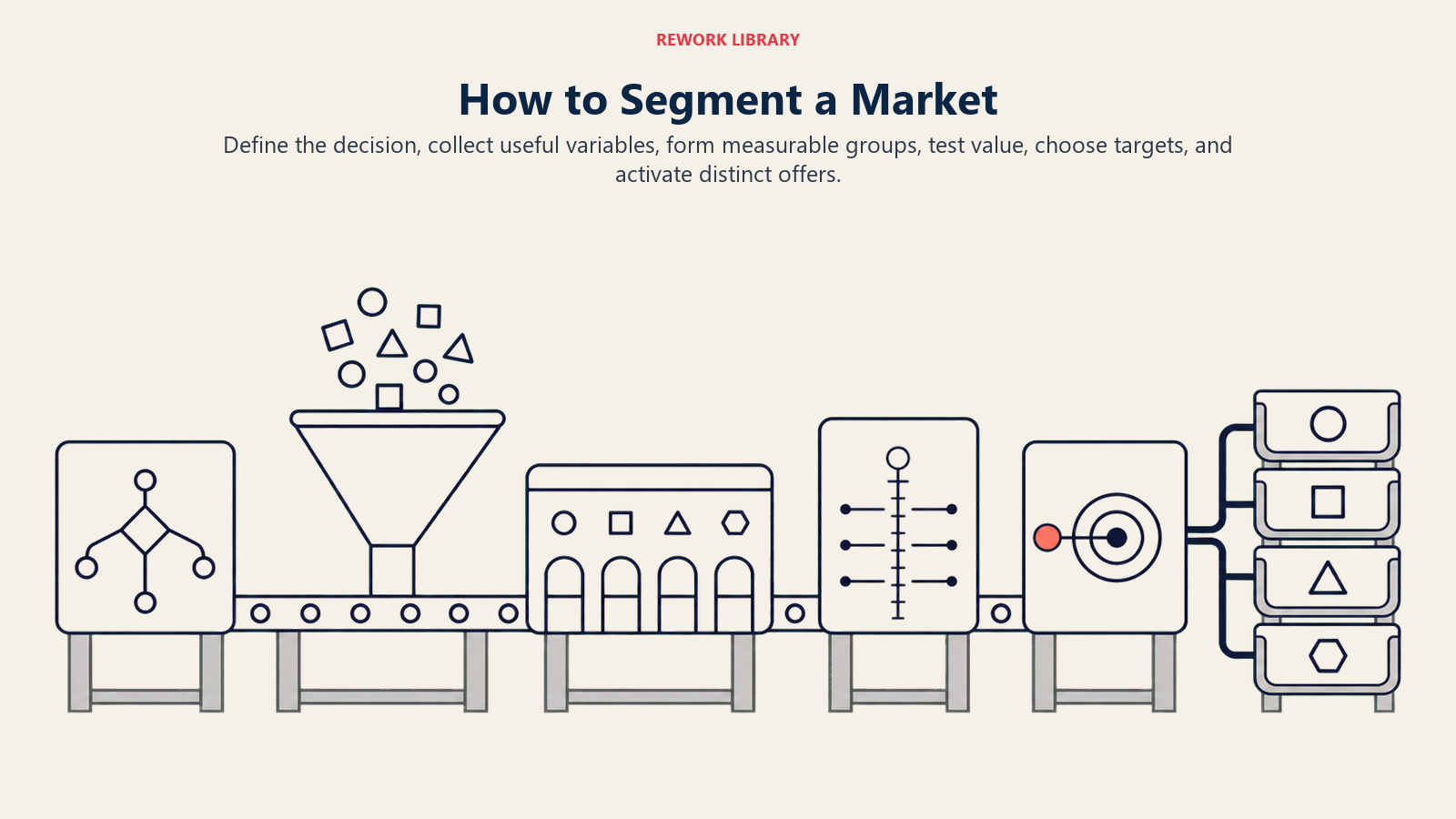
Step 1: Define the total market
Before you can divide anything, you need to be clear about what you're dividing. Define the total market by product category, geography, and timeframe. Who are all the people or organizations that could theoretically buy what you sell? Be specific enough to be useful but broad enough to capture real opportunity. A market defined too narrowly will miss growth pockets; one defined too broadly will make segmentation meaningless.
Step 2: Choose your segmentation variables
Pick the variables most relevant to how your customers actually differ in their needs or buying behavior. For a consumer brand, that might be age plus lifestyle values. For a SaaS product, it might be company size plus usage frequency plus industry. Start with two to three variables. Adding more before you've validated the basics creates complexity without clarity.
Your value proposition canvas can help here: it forces you to map customer jobs, pains, and gains, which surfaces the variables that actually predict purchase fit.
Step 3: Build the segments
Group your market into distinct clusters using your chosen variables. Each segment should meet four tests: it should be measurable (you can quantify the size), accessible (you can reach it with marketing and sales), substantial (it's large enough to be worth targeting), and differentiable (the people inside it respond differently to offers than people in other segments).
Step 4: Evaluate segment attractiveness
Not every segment worth identifying is worth targeting. For each segment, assess: market size, growth rate, competitive intensity, your ability to serve it, and the profit potential. A large segment dominated by an entrenched competitor with pricing power may be less attractive than a smaller, underserved segment where you can win at a healthy margin.
This is where tools like perceptual mapping become useful: they show you which segments have space for a new entrant and which are already crowded.
Step 5: Target and position
Choose the segments to pursue (one for a focused strategy, several if your resources allow) and build a distinct positioning for each. Positioning means deciding what you want each target segment to believe about your product relative to alternatives. The clearest articulation of positioning comes from connecting your segment's specific pains and gains to what your product actually delivers differently.
Keep the product life cycle in mind when choosing segments: segments that are attractive today may evolve quickly as market maturity shifts, so build your segmentation model to be revisited annually or whenever the market signals a structural change.
Market segmentation examples
Consumer packaged goods: Procter and Gamble
P&G doesn't sell one laundry detergent to one market. It sells Tide to performance-focused buyers who prioritize clean results above all, Gain to fragrance-focused buyers who want their clothes to smell a certain way, and Dreft to new parents who need a gentler formula for infant clothing. Same product category, three distinct segments, three separate brand identities. The segmentation is primarily behavioral (benefits sought) layered on top of demographic and psychographic signals.
B2B software: Slack
Slack segments its market by company size and technical sophistication. Its free tier targets individual users and small teams (behavioral: self-serve, low commitment). Its Pro and Business tiers target growing teams that need administrative controls (firmographic: 50-500 employees, demographic of role: IT or ops managers). Its Enterprise Grid targets organizations with complex compliance, security, and integration needs (firmographic: 5,000+ employees, vertical: regulated industries). Each tier has distinct messaging, pricing, and sales motion because each segment's needs, budget authority, and decision criteria are fundamentally different.
Retail banking
A regional bank might use three segments: young professionals (demographic: 25-35, psychographic: value digital convenience and minimal fees), families with children (demographic: 35-50, behavioral: actively saving for education and housing), and retirees (demographic: 65+, psychographic: prioritize security and stability over returns). The same bank offers the same underlying products to all three segments but designs the digital experience, branch model, and marketing messages around each segment's specific context.
| Segment | Primary segmentation type | Key variable | Tailored response |
|---|---|---|---|
| P&G laundry brands | Behavioral + psychographic | Benefits sought (clean vs. scent vs. gentle) | Separate brand identities per segment |
| Slack tiers | Firmographic + behavioral | Company size + self-serve vs. enterprise buying | Separate pricing, features, and sales motions |
| Regional banking | Demographic + psychographic | Life stage + attitudes toward risk and convenience | Tailored UX, messaging, and product bundles |
Common market segmentation mistakes
Segmenting by product instead of customer need. Some companies define segments around their own product categories rather than around what customers are trying to accomplish. This leads to segments that are easy to explain internally but don't map to how customers actually shop or compare alternatives.
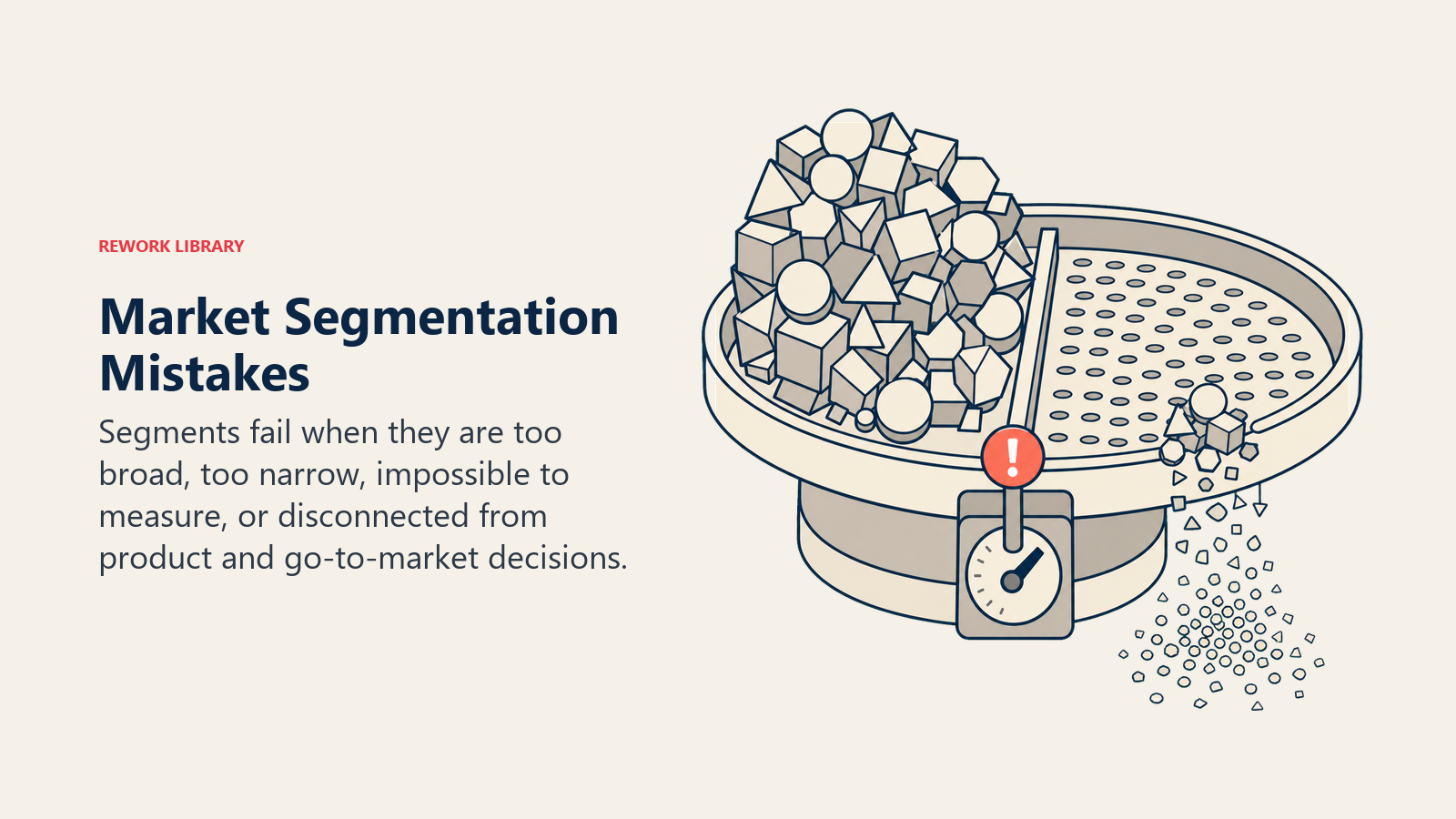
Building too many segments. A segmentation model with 12 segments sounds rigorous but often ends up being ignored because no team can execute a distinct strategy for that many groups simultaneously. Three to five actionable segments is usually more effective than ten theoretical ones.
Treating segments as permanent. Markets shift. A psychographic segment that existed five years ago may have fragmented or merged with another group. Segmentation models need regular validation against fresh data. If you haven't updated your segments in three years, they're probably describing a market that no longer exists.
Skipping the "differentiable" test. A segment is only useful if people inside it respond differently to your offer than people outside it. If your top two segments buy for the same reasons and respond to the same message, you don't actually have two segments. You have one segment with an extra label.
Letting personas substitute for segments. Buyer personas are useful narrative tools, but they're not the same as segments. A persona is a character; a segment is a measurable group. Build your strategy on segments, then use personas to make the communication human.
Frequently Asked Questions about Market Segmentation
What is the difference between market segmentation and targeting?
Segmentation is the process of dividing the market into groups. Targeting is the decision about which of those groups to pursue. You segment first to understand the options, then target to choose where to focus resources.
How many segments should a company have?
Most companies can execute effectively against three to five primary segments. The right number depends on your resources and the actual diversity of your market, not on how detailed your analysis is. Start with fewer and refine over time.
What is firmographic segmentation?
Firmographic segmentation is the B2B equivalent of demographic segmentation. It groups organizations by measurable characteristics: company size, industry, revenue, geographic footprint, and organizational structure. It's typically the first filter a B2B company applies before layering on behavioral or psychographic variables.
Can a company use more than one segmentation type at once?
Yes, and most should. The four types are complementary, not competing. A B2C company might start with demographics to define who the customer is, add psychographics to understand their values, and use behavioral data to prioritize which segment to approach first.
How often should you revisit your market segmentation?
At minimum, once a year. And immediately whenever you see a significant shift: a new competitor enters, customer behavior data changes materially, a major economic shift happens, or you launch a new product line that opens access to a different segment. Segmentation is a working model, not a permanent framework. Good segmentation doesn't end with a slide deck. The real test is whether your teams, sales, product, and marketing, are making different decisions for different segments. When they are, you've turned a strategic exercise into an operational advantage.

Co-Founder & COO
On this page
- What is market segmentation?
- The 4 types of market segmentation
- Demographic segmentation
- Geographic segmentation
- Psychographic segmentation
- Behavioral segmentation
- Summary of the four types
- B2B vs B2C segmentation
- How to segment your market
- Step 1: Define the total market
- Step 2: Choose your segmentation variables
- Step 3: Build the segments
- Step 4: Evaluate segment attractiveness
- Step 5: Target and position
- Market segmentation examples
- Consumer packaged goods: Procter and Gamble
- B2B software: Slack
- Retail banking
- Common market segmentation mistakes