First-Mover Advantage: Pros, Cons, and Examples
Turn this article into takeaways for your work.


Each assistant summarizes the article only for you and suggests best practices for your work.
First-mover advantage is what happens when a company enters a market before its rivals and uses that head start to build a position that is hard to unseat. It sounds like a guaranteed win. But history shows it's far more complicated than that.
Some first movers, like Amazon in e-commerce, turned early entry into an empire. Others, like early social networks before Facebook, got the timing right but still lost. Understanding when being first actually pays off, and when it hands your competitors a free education, is one of the most important calls in strategy.
What is first-mover advantage?
First-mover advantage is the competitive benefit a company gains by being the first to enter a new market or product category. The advantage comes from securing resources, customers, and brand recognition before rivals can react.
The concept is rooted in industrial organization economics and was formalized in strategy research during the 1980s. The idea is simple: if you get there first, you can shape the rules of competition. You pick the best distribution channels. You set customer expectations. You accumulate data no one else has yet.
Key facts
- A landmark 1988 study by Lieberman and Montgomery found first movers hold market share advantages in about 70% of studied industries, but also bear disproportionately high failure rates from what the authors called "pioneer costs." (Lieberman & Montgomery, 1988)
- Research published in the Journal of Marketing found that market pioneers held an average market share roughly 29 percentage points higher than later entrants, though this premium erodes significantly over time. (Urban et al., 1986)
- A 2013 study of 66 product categories found that in over half the categories, an early follower displaced the pioneer as market leader within a decade. (Golder & Tellis, 2013)
The advantage is real. But so is the risk.
First-mover vs second-mover (fast follower)
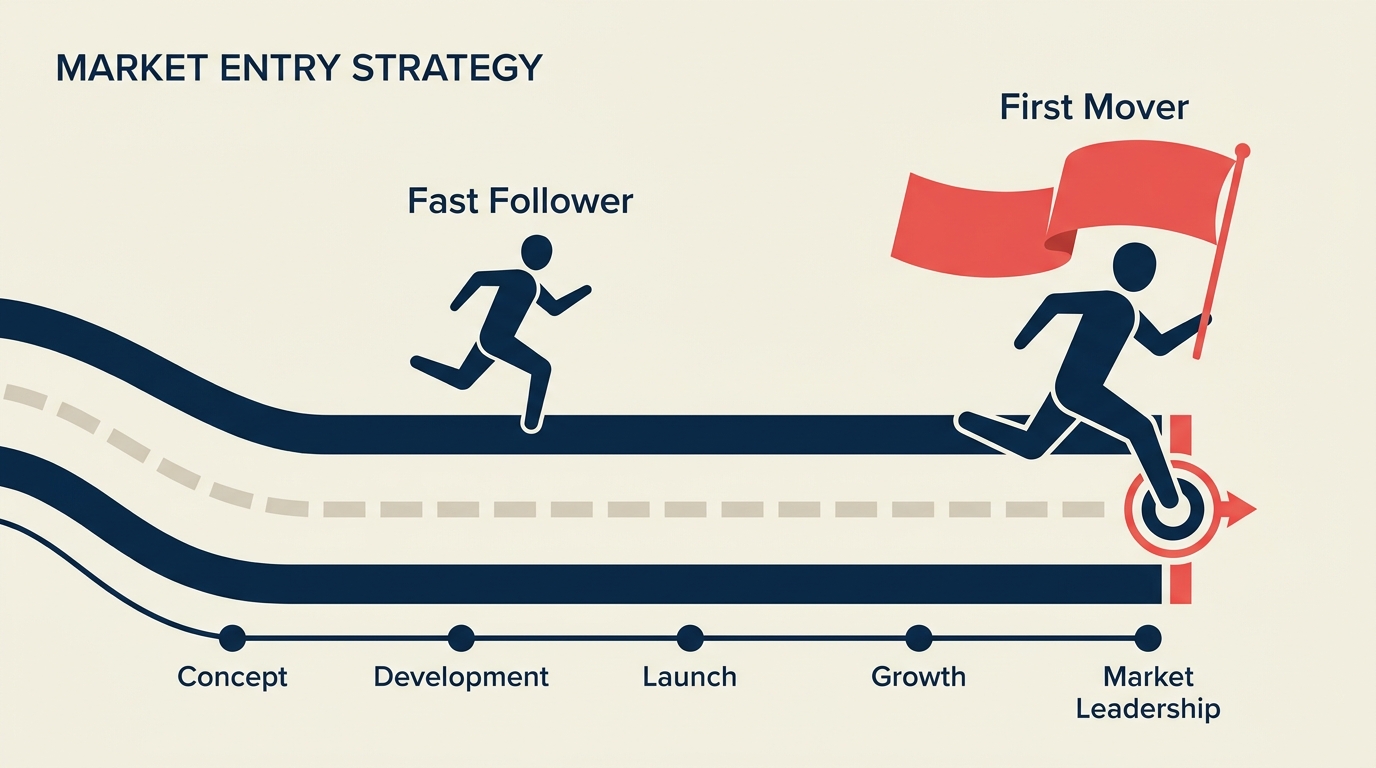
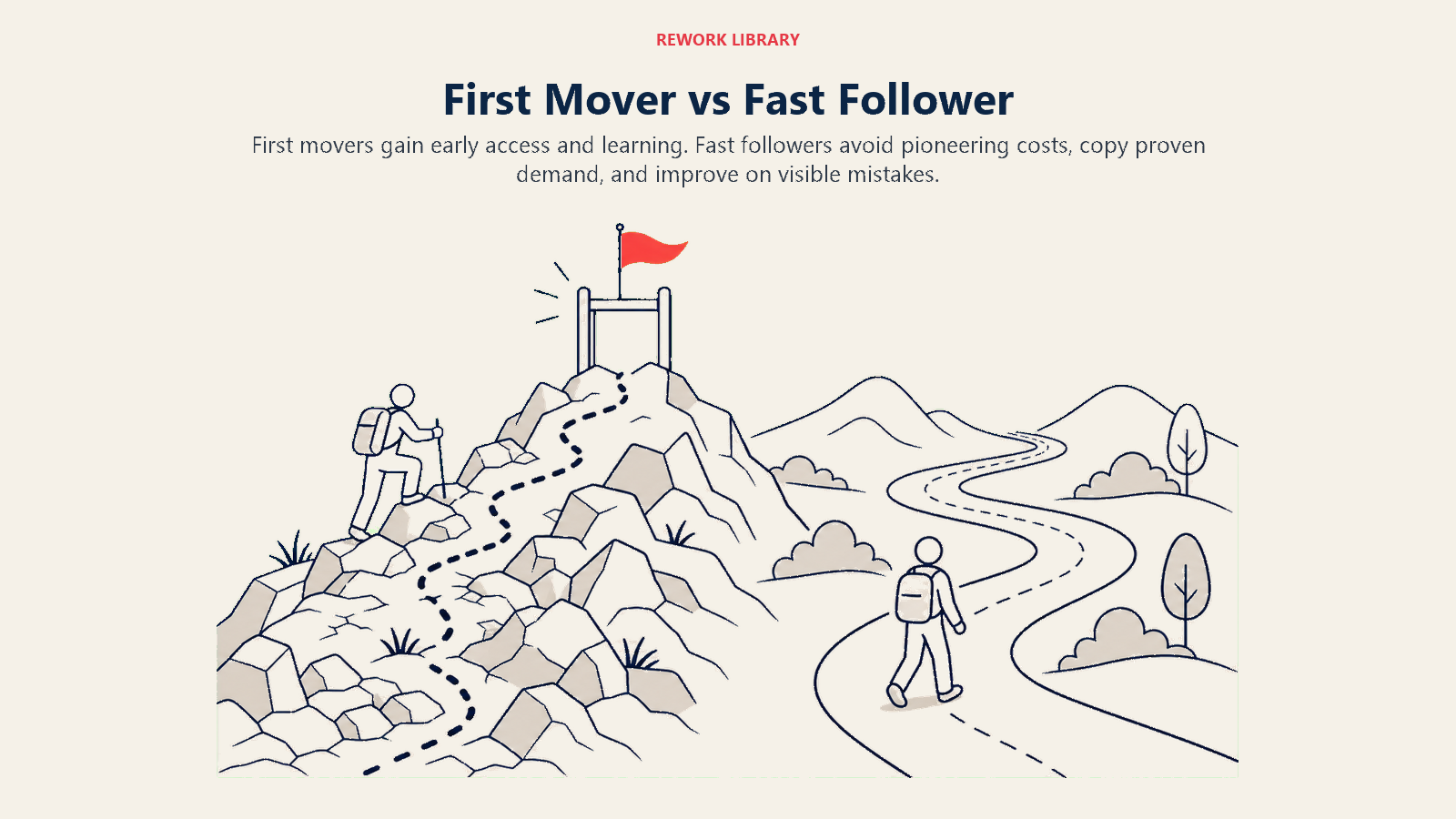
Not every company wants to be first. Fast followers, sometimes called second movers, enter after the pioneer has done the expensive work of validating demand. They free-ride on what the pioneer learned, then execute better.
| Dimension | First Mover | Fast Follower |
|---|---|---|
| Market validation cost | Bears full cost | Near zero |
| Technology risk | High (unproven) | Lower (learns from pioneer) |
| Brand positioning | Defines the category | Must differentiate from established player |
| Customer acquisition | Educating from scratch | Market already aware |
| Switching costs | Can build early lock-in | Faces higher switching costs to dislodge |
| Classic example | Amazon (online retail) | Google (followed Yahoo, Altavista into search) |
| Classic example (lost) | Friendster (social networking) | Facebook (fast follower that won) |
The right entry timing depends on your resources and your ability to build durable advantages quickly. That question connects directly to competitive advantage more broadly.
Sources of first-mover advantage
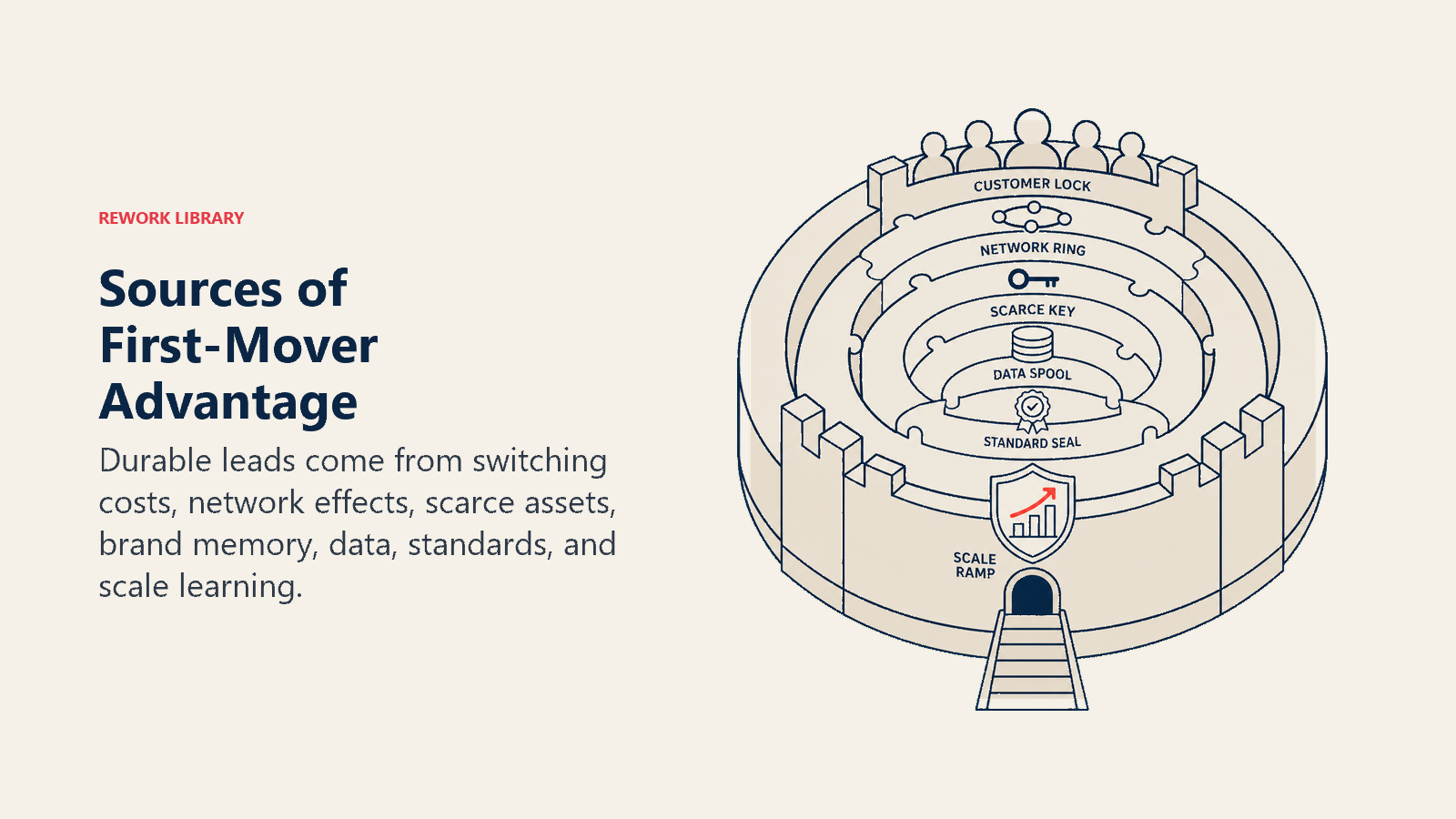
Not all first-mover gains are equal. The strongest come from mechanisms that compound over time and are expensive for rivals to replicate.
Technology leadership
A company that invests heavily in R&D before a market opens can build patents, proprietary processes, or technical depth that takes rivals years to match. Intel's early dominance in microprocessors came from this. The risk: technology changes. A rival with a genuinely better architecture can leapfrog an entrenched incumbent.
Switching costs
When customers invest time, money, or data into your product, leaving becomes painful. That's one of the most durable forms of first-mover advantage. Enterprise software companies use this explicitly: the more deeply a customer integrates your platform into their workflows, the higher the switching cost becomes. For a deeper look at how this mechanism works, see switching costs.
Network effects
Some products become more valuable as more people use them. Telephone networks, marketplaces, and professional platforms all benefit from this dynamic. A first mover who reaches critical mass early can create a moat that's nearly impossible for a late entrant to overcome without a radically different approach. This dynamic is explored in detail in network effects.
Resource pre-emption
Being first means you get to choose the best locations, lock up key suppliers, hire the best talent before the market heats up, and secure preferred distribution agreements. Coca-Cola built decades of retail shelf space and distribution infrastructure that newer entrants simply couldn't replicate at comparable cost.
Brand recognition
The first brand in a category often becomes the category name itself. People say they need a Kleenex, not a facial tissue. They Google something, not "search for it online." That kind of brand ownership is built through early market presence and is very hard to displace even when competitors offer objectively better products.
The disadvantages and risks
First-mover advantage is not a free lunch. There are real costs that come with being early, and teams that ignore them often hand the market to a better-resourced follower.

Free-rider effect. Competitors learn from your mistakes at no cost. You spend millions educating customers about why your product category exists. A rival enters two years later, skips that investment, and competes directly for the customers you warmed up. This is sometimes called "pioneer's curse."
Market uncertainty. Early markets are fuzzy. Customer needs are unclear, willingness to pay is unknown, and distribution channels may not exist yet. A first mover has to make large bets on questions that later entrants get to answer with actual data.
High up-front costs. Building the infrastructure, hiring talent for an unproven market, and educating customers all cost money before any revenue arrives. Followers benefit from a more developed ecosystem without bearing those startup costs.
Incumbent inertia. Ironically, being first can make you slow. Once you've built a successful operation around one approach, changing direction is costly. Disruptive technology often defeats first movers not because the follower was smarter but because the incumbent couldn't pivot. This is a recognized pattern in product life cycle analysis: market leaders get disrupted at transition points.
First-mover advantage examples
Some of the most instructive examples come from cases where the first mover won decisively, and from cases where it did not.
| Company | Category | Outcome | Why |
|---|---|---|---|
| Amazon | Online retail (1995) | Won | Built logistics infrastructure and customer data that became impossible to replicate at scale |
| Coca-Cola | Soft drinks (1886) | Won | Distribution pre-emption + brand identity became the category definition |
| Web search | Won as follower | Entered after Yahoo, AltaVista; PageRank was technically superior and execution was faster | |
| Social networking | Won as follower | Entered after Friendster, MySpace; better UX and focus on real-identity network | |
| TiVo | DVR category (1999) | Lost | Pioneered the market, but cable companies bundled competing DVRs for free, eliminating the price advantage |
| Netscape | Web browser (1994) | Lost | Microsoft bundled Internet Explorer with Windows and eroded Netscape's distribution advantage |
| Myspace | Social networking | Lost | First major social network in the US; failed to improve UX fast enough as Facebook executed better |
The pattern across these examples is consistent. First movers who won did so by building durable structural advantages, not just by showing up early. First movers who lost typically relied on a head start alone without building the switching costs or network effects that could defend their position.
How to build and defend a first-mover advantage
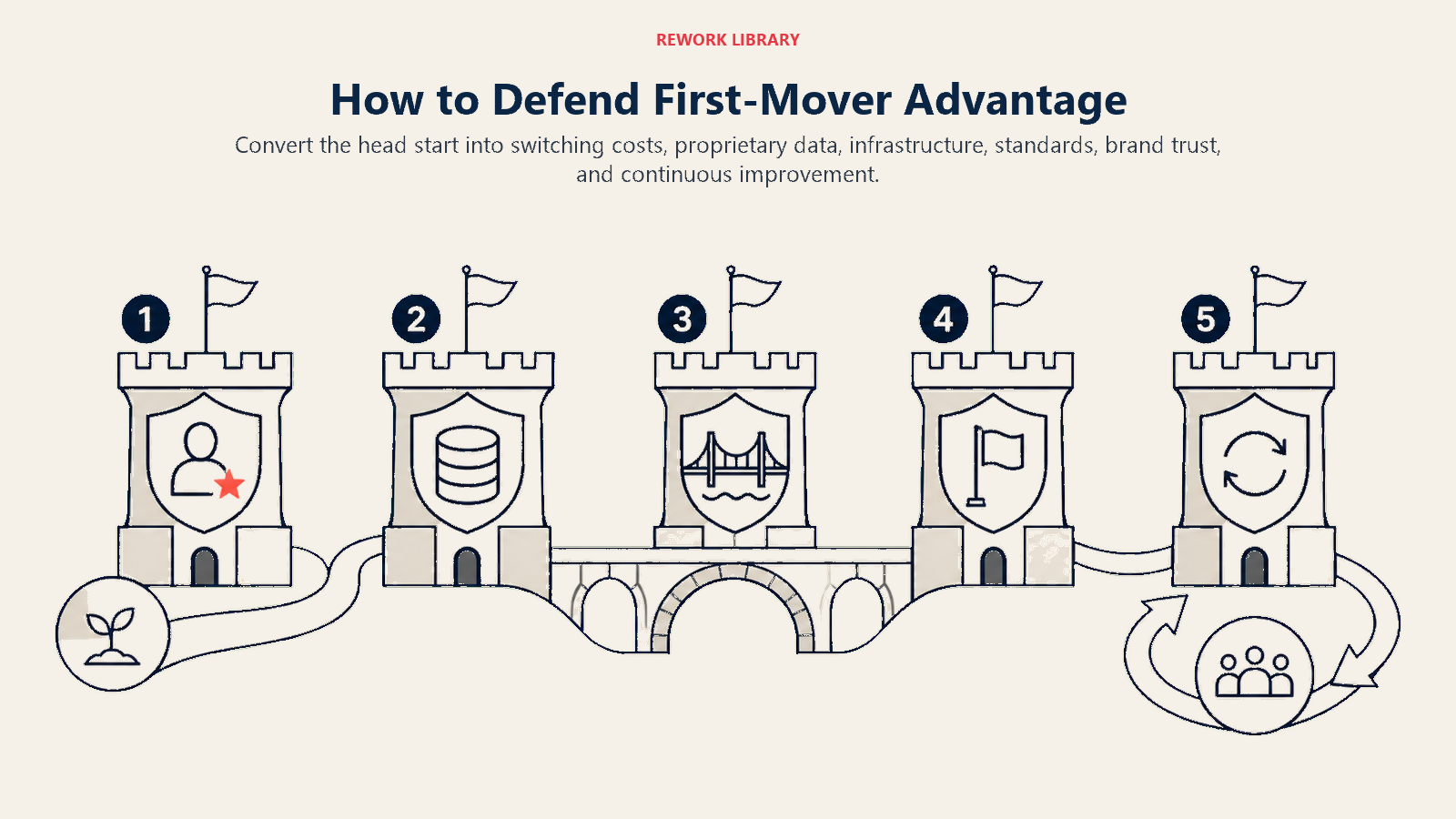
Being first only matters if you convert the head start into a durable position. These five steps reflect how successful first movers have actually done it.
Step 1: Move fast on switching costs
From day one, design your product so that customers become more embedded over time. This means investing in integrations, data portability that works in your favor, onboarding depth, and relationships. Don't wait until competition arrives to think about lock-in.
Step 2: Build the infrastructure competitors can't easily replicate
Amazon spent years building warehouses, logistics networks, and fulfillment capabilities that no pure software company could replicate quickly. Pick the dimension of your market that requires physical, organizational, or technical investment and go deep on it early.
Step 3: Use your data advantage before rivals accumulate their own
A first mover collects customer behavior data before anyone else. That data can improve your product, personalize your service, and train models that late entrants won't be able to match. Treat data as a compounding asset from the first transaction.
Step 4: Set industry standards
If you can define the file formats, APIs, or protocols that your market uses, you make your platform the center of gravity. This works in software, manufacturing, and payments. Rivals either build on your standards (cementing your position) or face the much harder task of convincing customers to change.
Step 5: Anticipate the fast follower's playbook
Study what a well-resourced competitor would do if they entered your market in year two. Then do it yourself first. This might mean expanding to adjacent segments before a rival uses them as a beachhead, lowering prices to reduce the margin that makes your market attractive, or acquiring potential fast followers before they scale.
Best practices
These principles apply across industries and market types.
Choose your battles carefully. First-mover advantage matters most in markets with strong network effects, high switching costs, or resource pre-emption opportunities. In markets where technology changes rapidly and customer loyalty is low, being second with a better product often wins. The Ansoff matrix is a useful framework for mapping which markets warrant aggressive early entry.
Know the difference between a real advantage and a head start. A head start in time is not an advantage unless it translates into something structural: a cost position, a locked-in customer base, a brand that defines the category. Many companies mistake early revenue for durable position.
Pair first-mover moves with a clear value discipline. First movers who win typically focus relentlessly on one dimension: cost leadership, product excellence, or customer intimacy. Spreading investment across all three dilutes the advantage. The value disciplines model offers a framework for making that choice explicitly.
Don't ignore the market penetration strategy. Getting into a market first matters less if you don't have a plan to penetrate it deeply enough to prevent a well-funded follower from taking the best segments.
Watch for disruptive signals. Most first movers who lost were not caught off guard in one dramatic moment. They saw the signals and either didn't believe them or couldn't reorganize fast enough. Build a systematic process for evaluating threats from the fringes of your market. Blue ocean strategy is one lens for spotting those shifts before they arrive.
Related reading
- Competitive Advantage
- Network Effects
- Switching Costs
- Ansoff Matrix
- Blue Ocean Strategy
- Porter's Generic Strategies
- Market Penetration Strategy
- Value Disciplines Model
First-mover advantage is most powerful when it is treated as a launching pad rather than a destination. Companies that enter markets early and then build compounding structural advantages, through switching costs, network effects, and infrastructure depth, convert a temporary head start into something that rivals spend decades trying to overcome. The ones who lose treat being first as a strategy in itself. It never is.

Co-Founder & COO
On this page
- What is first-mover advantage?
- First-mover vs second-mover (fast follower)
- Sources of first-mover advantage
- Technology leadership
- Switching costs
- Network effects
- Resource pre-emption
- Brand recognition
- The disadvantages and risks
- First-mover advantage examples
- How to build and defend a first-mover advantage
- Step 1: Move fast on switching costs
- Step 2: Build the infrastructure competitors can't easily replicate
- Step 3: Use your data advantage before rivals accumulate their own
- Step 4: Set industry standards
- Step 5: Anticipate the fast follower's playbook
- Best practices
- Related reading