Disruptive Innovation: Christensen's Theory Explained (With Examples)
Turn this article into takeaways for your work.


Each assistant summarizes the article only for you and suggests best practices for your work.
Disruption gets thrown around so loosely that it's almost stopped meaning anything. Every startup calls itself disruptive. Every new app claims to disrupt an industry. But Clayton Christensen's actual theory is much more specific than the buzzword suggests, and understanding the real definition is what separates executives who spot threats early from those who recognize them only in the post-mortem.
What is disruptive innovation?
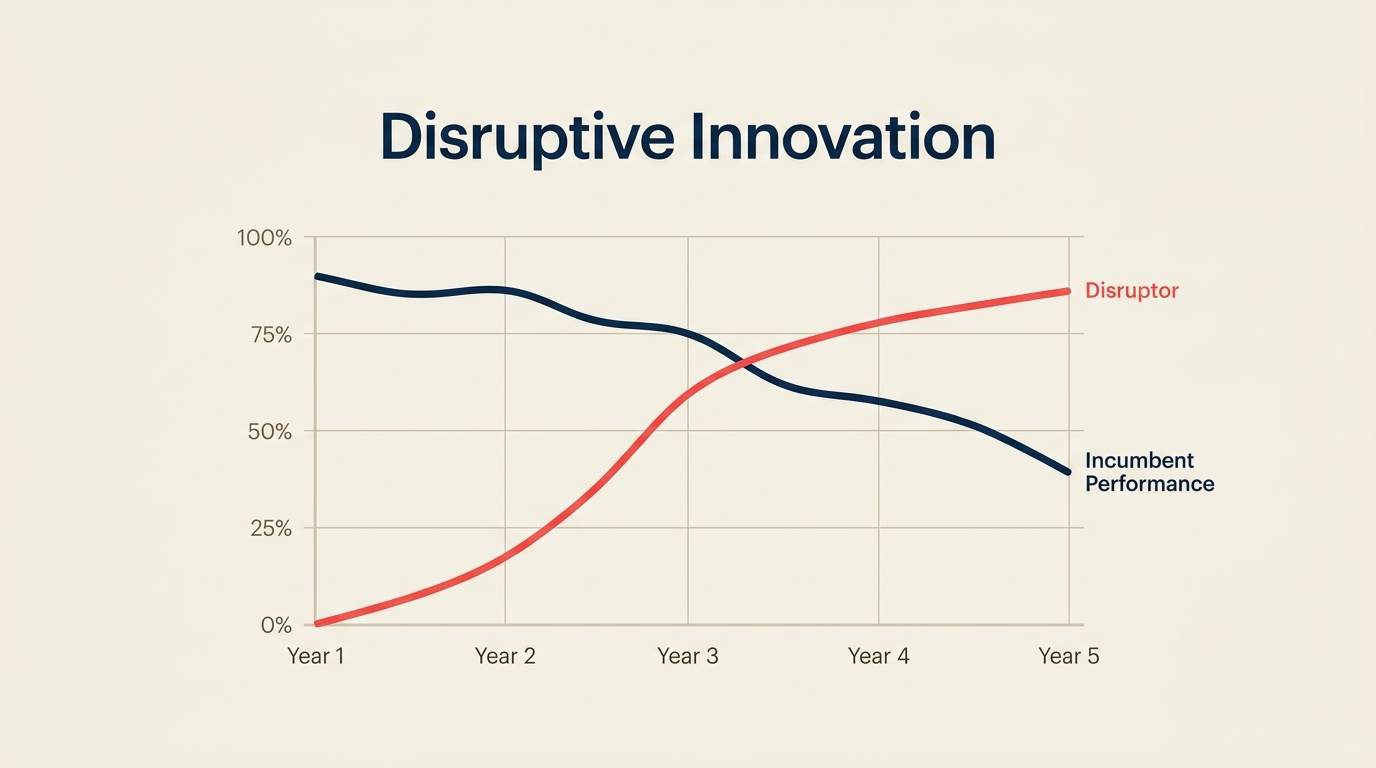
Disruptive innovation is a process by which a product or service initially takes root in simple, overlooked market segments and then relentlessly moves upmarket, eventually displacing established competitors. The term was coined by Harvard Business School professor Clayton Christensen in his 1997 book, The Innovator's Dilemma.
The key insight is not that new technology beats old technology. It's that incumbents are structurally motivated to ignore the threat. Their best customers don't want the cheaper, simpler version. Their profit margins are higher on the premium end. So they keep improving what they already sell, while the disruptor quietly gets good enough for more and more of the market.
Key Facts
- Christensen's research found that 93% of successful companies started with a strategy significantly different from the one that eventually made them successful, suggesting that disruptors often find their footing through iteration, not a fixed grand plan. (Clayton Christensen Institute, 2016)
- A McKinsey Global Institute analysis (2021) found that industries with the highest disruption scores saw incumbent revenue decline by an average of 34% over a decade, while new entrants captured the lost share.
- A Harvard Business Review study (2015) found that incumbents correctly identified disruptive threats in their market only 30% of the time before those threats reached 10% market share, illustrating the structural blind spot Christensen described.
Disruptive vs sustaining innovation
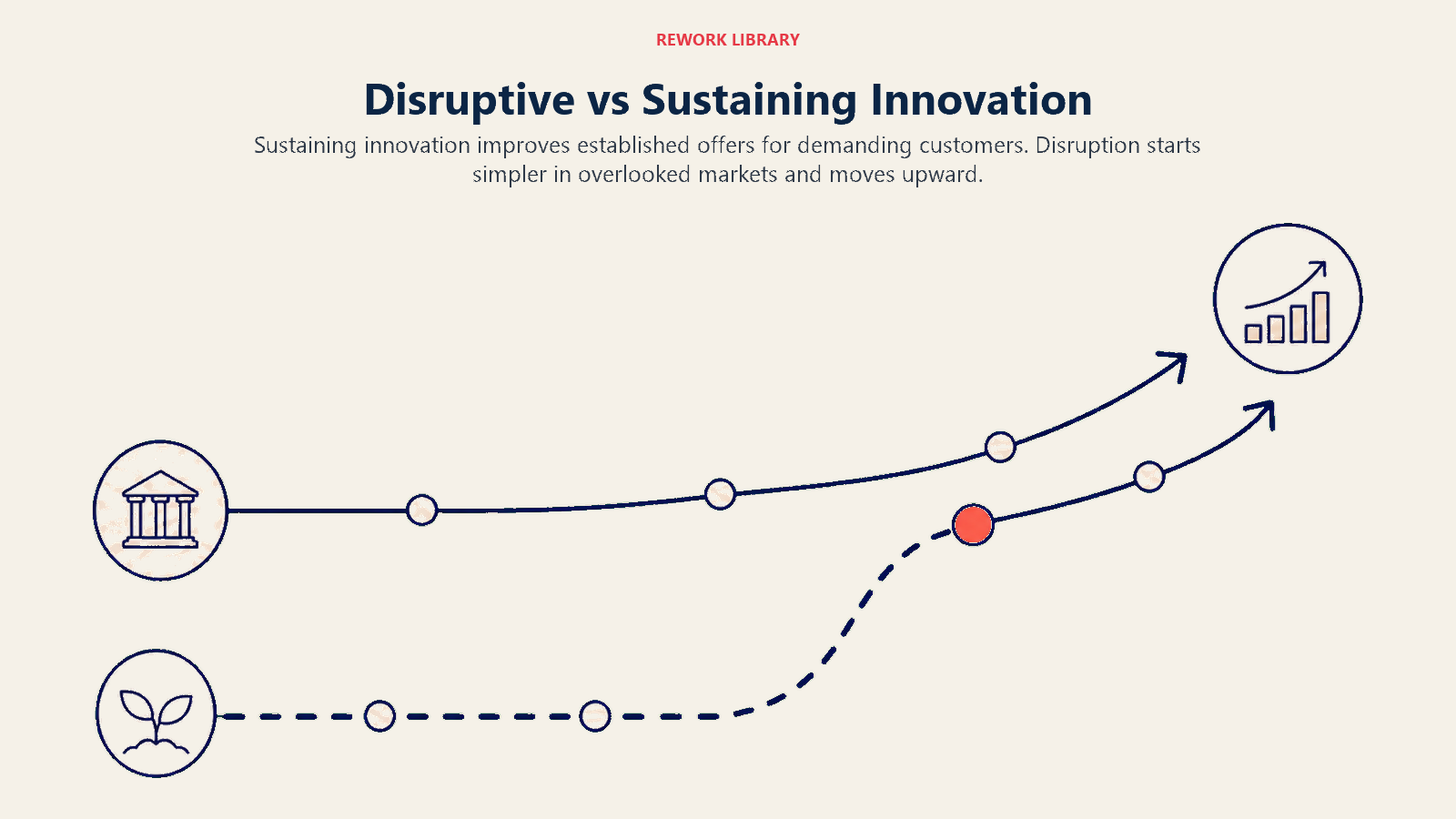
Not all innovation is disruptive in Christensen's sense. Most innovation is actually sustaining, meaning it makes good products better for existing customers. That's valuable work, but it doesn't change the competitive landscape in the same way.
| Dimension | Sustaining Innovation | Disruptive Innovation |
|---|---|---|
| Target customer | Current, profitable customers | Overlooked or non-consumers |
| Starting point | High end of the market | Low end or a new segment |
| Initial performance | Better than the current offering | Worse on mainstream metrics |
| Price | Often higher | Lower |
| Who drives it | Established firms | New entrants or fringe players |
| Incumbent response | Invest to improve it | Ignore or dismiss it |
| Long-term outcome | Incremental market share | Potential market displacement |
| Classic example | Tesla Model S (premium EV) | Early Netflix (mail-order DVD) |
Sustaining innovation is how incumbents compete. Disruptive innovation is how challengers win. The confusion arises because both involve new products or features. What distinguishes them is where they start and who they serve first.
Note that disruption is a trajectory, not a single moment. A company starts below the mainstream performance bar, then improves. At some point, the disruptive product is good enough for the middle of the market, then for the top. By then, the incumbent has usually been defending the wrong hill.
Two types of disruption: low-end and new-market
Christensen identified two distinct entry points for disruptive innovation. Both follow the same eventual trajectory, but they start in different places.
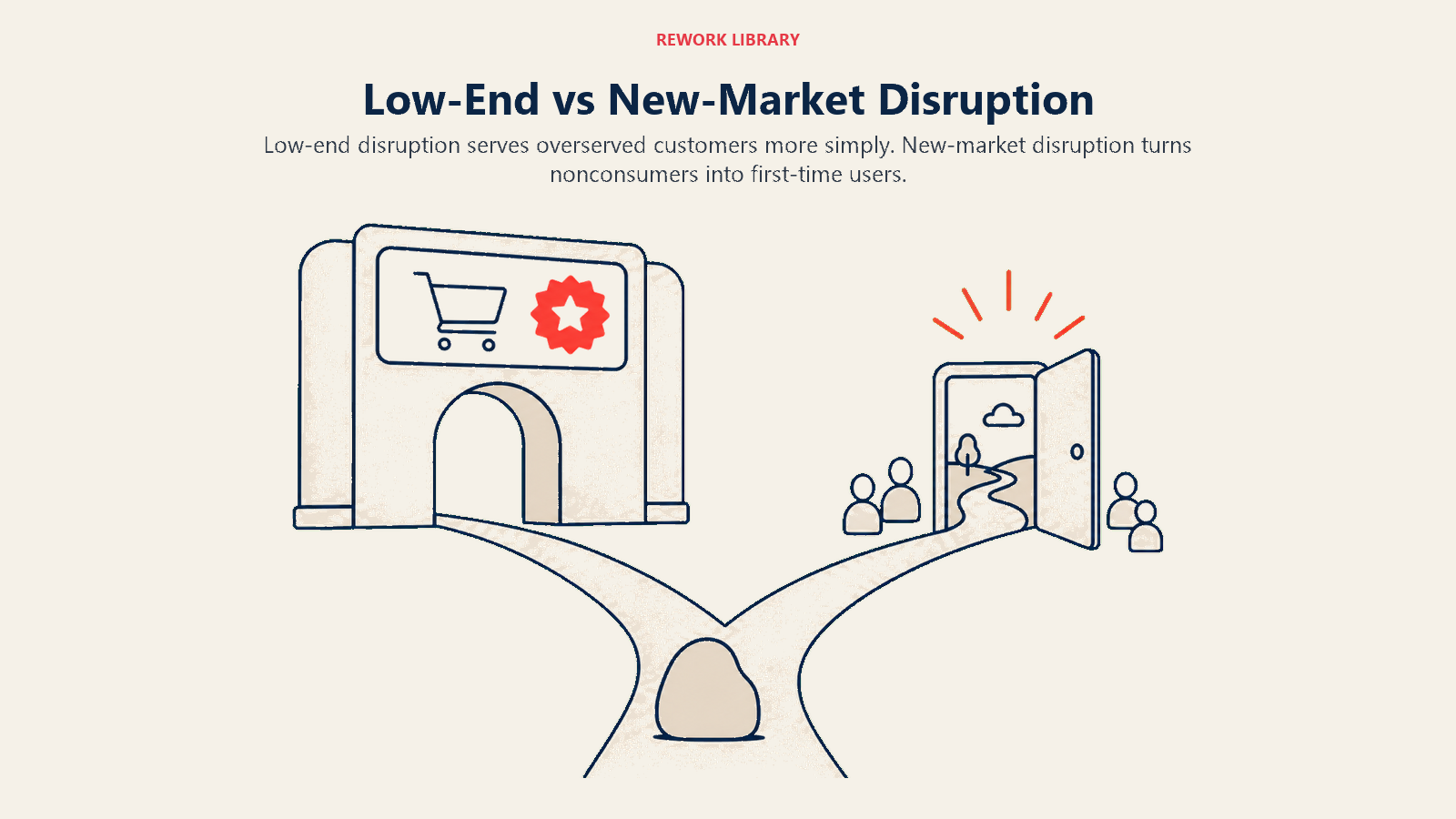
Low-end disruption targets customers at the bottom of an existing market, people who are over-served by the current offerings and happy to accept a simpler, cheaper alternative. Steel mini-mills are the textbook case. They entered the market making low-quality rebar, the product that integrated steel mills didn't want because the margins were terrible. Over time, mini-mills improved and moved upmarket, eventually producing structural steel and sheet steel. By then, they had gutted the industry.
New-market disruption doesn't compete with incumbents at all, at first. It creates a new category of customers who previously couldn't afford or access the existing product. Personal computers in the 1970s didn't compete with mainframes for IBM's clients. They opened up computing to individuals and small businesses that had never been customers. Only later did PCs become powerful enough to threaten the enterprise market.
Both types share the same structural dynamic: incumbents rationally ignore the early-stage threat because it doesn't look like a real competitor. That rational response is exactly what makes disruption so effective.
Disruptive innovation examples
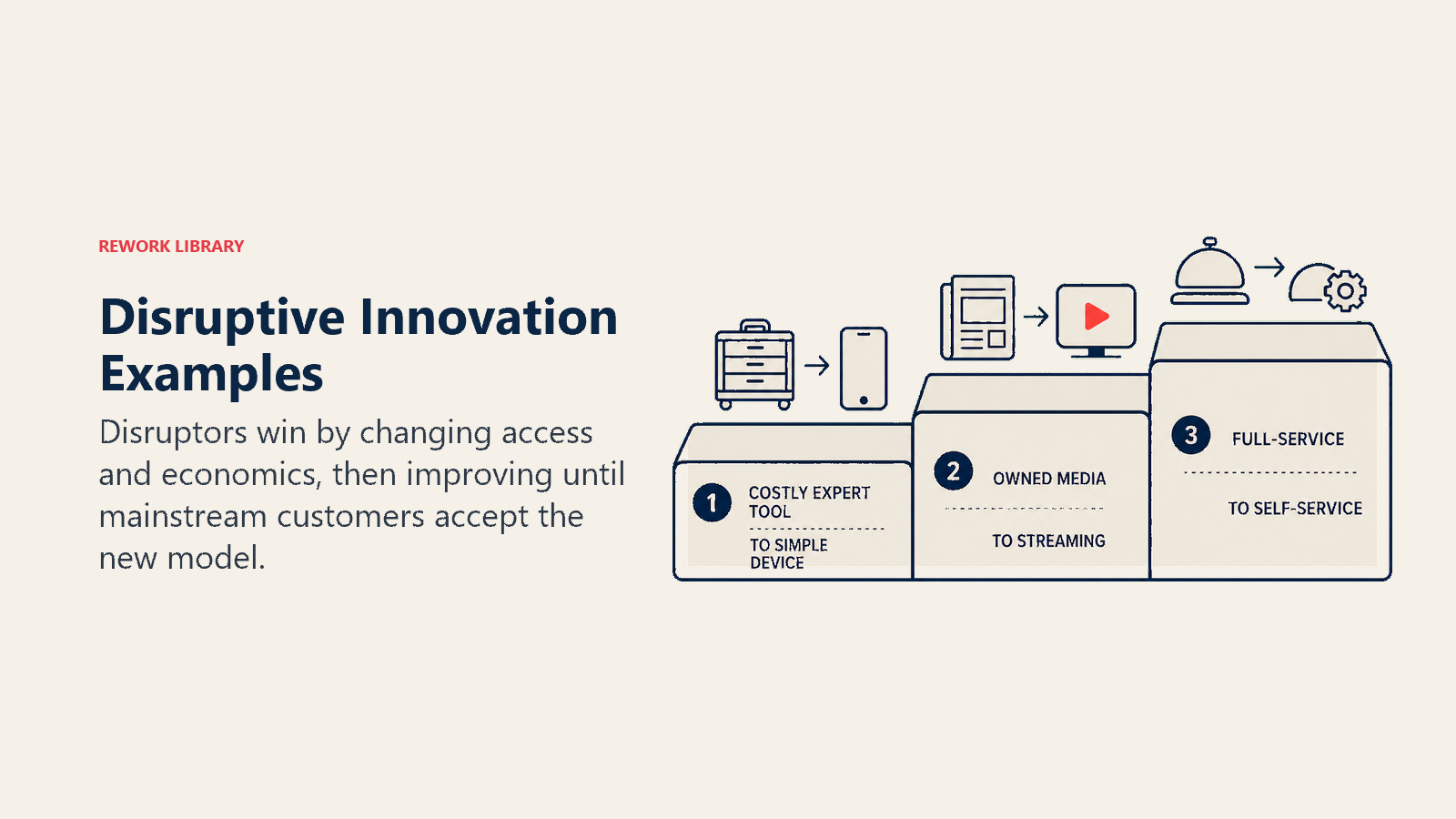
Real examples help sharpen the pattern. In each case, notice where the disruptor started and how it moved.
| Industry | Disruptor | Incumbent(s) Threatened | Entry Point | How It Moved Up |
|---|---|---|---|---|
| Home entertainment | Netflix (DVD-by-mail, then streaming) | Blockbuster, cable TV | Niche viewers who wanted convenience at low cost | Built content library, then original programming; cable customers switched gradually |
| Mobile phones | iPhone / App Store ecosystem | Nokia, Motorola | Early smartphones had worse call quality; targeted tech early-adopters | App ecosystem made phones indispensable; feature phone makers had no answer |
| Retail banking | Fintech apps (Chime, Revolut, etc.) | Large retail banks | Unbanked and underbanked populations ignored by big banks | Added credit products, savings tools, and payroll features; now competing for mainstream accounts |
| Education | Coursera, edX, Khan Academy | Traditional universities and training firms | Learners who couldn't afford or access campus programs | Employer-recognized certificates now compete with degrees for some roles |
| Automotive | Toyota in the 1970s (then later BYD in EVs) | US Big Three automakers | Economy segment that US makers abandoned as low-margin | Quality improvements brought Toyota into every segment; BYD follows the same trajectory in electric |
| Publishing | Substack / self-publishing platforms | Traditional publishing houses | Writers with small audiences who couldn't get deals | Some Substack writers now earn more than traditionally published authors |
Netflix is worth examining closely because it went through two disruptions. The first was DVD-by-mail, which undercut Blockbuster's late-fee model. The second was streaming, which undercut cable. Each time, the incumbent had a structural reason to dismiss the threat. Blockbuster didn't want to cannibalize its own late-fee revenue. Cable companies didn't want to cannibalize their bundle.
How to apply disruptive innovation theory
Whether you're defending against disruption or trying to be the disruptor, the theory gives you a practical lens.
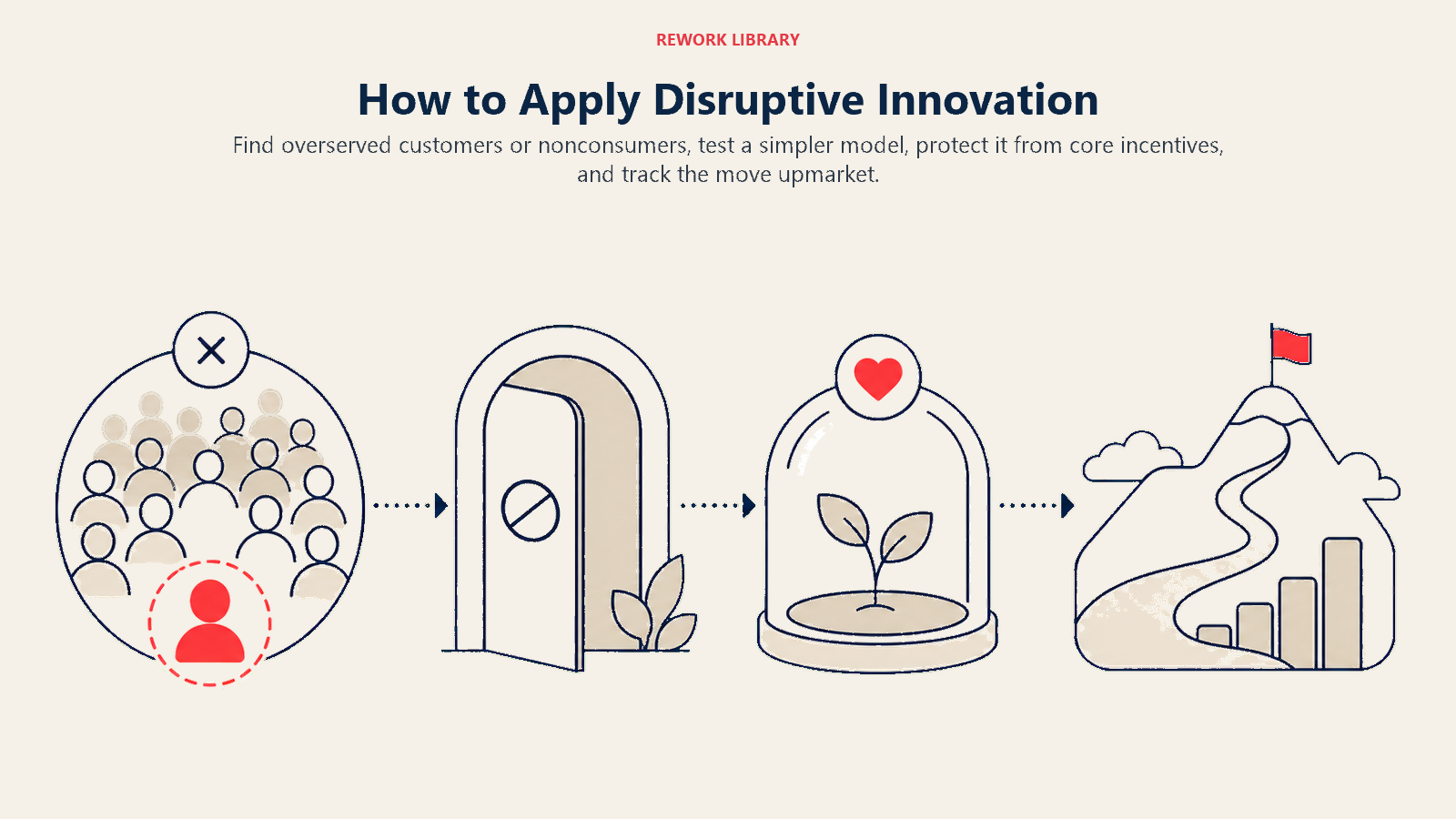
Step 1: Map who is over-served in your market
Look at the low end of your current customer base. Who is paying for capabilities they don't actually use? Those customers are disruption candidates. They'll leave for a simpler, cheaper alternative if one appears. If you're the challenger, that segment is your entry point. If you're the incumbent, that segment is your early-warning system.
Step 2: Identify non-consumers in your category
Ask who could benefit from what you offer but currently can't afford it, access it, or understand it. Non-consumption is often the richest vein for new-market disruption. The jobs to be done framework pairs well here: it helps you articulate what job these non-consumers are trying to accomplish and why current solutions fail them.
Step 3: Run a disruption stress test on your own portfolio
For each of your core products or services, ask: what would a startup need to do to offer 80% of the value at 40% of the price? Where would it start? Which customer segment would it target first? This exercise surfaces the most likely attack vectors before a competitor exploits them. The three horizons of growth model is useful here: Horizon 3 investments are often where you'd fund your own disruptive response.
Step 4: Build or acquire a separate unit to pursue the disruption
Christensen's research was clear: incumbents almost never successfully disrupt themselves from within an existing business unit. The incentive structures, reporting lines, and cultural norms all push toward serving current profitable customers. You need a separate team with separate economics. Blue ocean strategy offers a related framing for how to carve out uncontested space rather than fight the existing market.
Step 5: Track trajectory, not snapshot
A disruptive competitor may look irrelevant today. Track how fast it's improving relative to what the market actually needs, not how it compares to your best product. The question isn't "is it as good as us?" The question is "is it getting better faster than we're getting better?" That's the leading indicator that matters.
Step 6: Decide: respond, acquire, or ignore deliberately
Not every new entrant is disruptive. Some are just sustaining competitors in a different package. Apply the framework to decide: is this threat targeting over-served or non-consuming segments? Is it on a trajectory to move upmarket? If yes, you need a response. If no, you can compete as you normally would. The product life cycle curve can help calibrate where your core offering sits and how much runway you have.
Common misconceptions
The word "disruptive" is so widely misused that it's worth naming the most common errors explicitly.
Misconception 1: Any breakthrough is disruptive. The iPhone is often called disruptive, but Christensen himself argued it was sustaining innovation for Apple (it improved on existing smartphones for existing premium customers) and disruptive only in the sense that it displaced the entire mobile ecosystem over time. Breakthrough and disruptive are not synonyms.
Misconception 2: Disruption is always fast. Netflix took about a decade to seriously wound Blockbuster, and another decade to reshape television. Most disruptions are slow at first and only look obvious in retrospect. This is part of why incumbents miss them.
Misconception 3: Being disrupted means you made bad decisions. Christensen was explicit that incumbents often make very good decisions, given what their data tells them. Their best customers want better performance, not a worse product at a lower price. Rational resource allocation leads directly to disruption vulnerability. The problem is systemic, not managerial incompetence.
Misconception 4: Disruption is always good. From a market-efficiency standpoint, disruption often drives innovation and lower prices. But it also destroys jobs, forces painful pivots, and can harm communities built around incumbent industries. Christensen didn't celebrate disruption; he described it.
Misconception 5: You can disrupt yourself voluntarily. Amazon's creation of AWS is often cited as self-disruption. But AWS started as an internal tool and then became a product. It didn't cannibalize Amazon's retail business. True self-disruption, where you voluntarily undercut your most profitable product line, is extraordinarily rare and almost always requires strong external pressure to actually execute.
Best practices
- Use Christensen's definition precisely. If a new entrant is targeting your best customers with a better product, that's a sustaining threat. Respond with better R&D. If it's targeting the bottom of your market or non-consumers, treat it differently and more seriously.
- Separate the disruption-watching function. Give someone explicit responsibility for monitoring low-end and non-consumer segments. These signals won't come from your sales team, whose compensation depends on the current customer base.
- Pair disruption theory with the ansoff matrix and value proposition canvas. Ansoff frames your growth options; the value proposition canvas helps you articulate what an underserved segment actually needs. Together, they give you a roadmap for where to plant a disruption hedge.
- Revisit your "good enough" thresholds regularly. What the market considers acceptable performance shifts. A product that was only good enough for budget buyers three years ago may now be good enough for your core segment. Track this deliberately.
- Don't confuse the theory with a license to ignore all competition. Disruptive innovation theory is one lens. Use it alongside competitive advantage analysis and scenario planning to build a complete picture. Wardley mapping is especially useful here, since it shows how components evolve from novel to commoditized, which is exactly where disruption tends to enter.
Frequently Asked Questions about Disruptive Innovation
What exactly did Clayton Christensen mean by disruptive innovation?
Christensen defined disruptive innovation as a process where a product starts in overlooked or low-end market segments, offers simpler and cheaper performance than the mainstream, and then improves over time until it displaces established players. The core insight is that incumbents are structurally incentivized to ignore early disruptors because those disruptors initially serve customers the incumbents don't want.
Is Uber a disruptive innovation?
Christensen's own answer was no. Uber didn't start by serving non-consumers or over-served customers at the low end. It targeted the same customers who were already using taxis, with a better and more convenient product. By Christensen's definition, that's sustaining innovation (or a new-market entrant with better technology), not disruption in the technical sense. That said, it disrupted the taxi industry in the colloquial sense. The two definitions create constant confusion.
Can established companies create disruptive innovations?
Rarely from within an existing business unit, because the incentives work against it. Incumbents who successfully pursue disruption typically do it through a separate subsidiary, a spinoff, or an acquisition of a smaller company already on the disruptive trajectory. Amazon Web Services, Google's acquisition of Android, and Johnson and Johnson's venture arm are all examples of incumbents creating or capturing disruption at arm's length.
How is disruptive innovation different from incremental innovation?
Incremental innovation improves an existing product for existing customers on dimensions they already value. Disruptive innovation initially performs worse on those dimensions but introduces new benefits (lower cost, simpler use, broader access) for a different customer segment. Over time, the disruptive product improves and the two paths intersect, at which point the incumbent faces a serious threat.
How do you know if a competitor is truly disruptive or just a new entrant?
Ask two questions. First, who is the target customer? If it's your core customers, the threat is sustaining. If it's the bottom of your market or people who currently don't buy at all, it may be disruptive. Second, what is the improvement trajectory? A disruptor's product should be getting better faster than the market's performance bar is rising. If that's the case, it will eventually cross into your core market, even if it looks irrelevant today. Disruption is not a synonym for change, and it's not a compliment to hand out to every startup with a flashy pitch deck. But when you use Christensen's framework precisely, it becomes one of the most useful tools in strategic management: a way to spot the threats your competitors are too comfortable to see and your own organization is structurally motivated to ignore.

Senior Operations & Growth Strategist
On this page
- What is disruptive innovation?
- Disruptive vs sustaining innovation
- Two types of disruption: low-end and new-market
- Disruptive innovation examples
- How to apply disruptive innovation theory
- Step 1: Map who is over-served in your market
- Step 2: Identify non-consumers in your category
- Step 3: Run a disruption stress test on your own portfolio
- Step 4: Build or acquire a separate unit to pursue the disruption
- Step 5: Track trajectory, not snapshot
- Step 6: Decide: respond, acquire, or ignore deliberately
- Common misconceptions
- Best practices