Bahasa Indonesia
DMAIC: 5 Fase Perbaikan Six Sigma (Dengan Alat dan Contoh)
Turn this article into takeaways for your work.


Each assistant summarizes the article only for you and suggests best practices for your work.
Sebagian besar masalah proses diselesaikan dengan cara yang sama: seseorang menyadari cacat, pertemuan diadakan, dan perbaikan diimplementasikan. Beberapa minggu kemudian cacat itu kembali. Itu bukan nasib buruk. Itulah yang terjadi ketika Anda langsung ke solusi sebelum mengukur apa yang sebenarnya rusak atau membuktikan apa yang menyebabkannya. DMAIC memutus siklus itu dengan memaksakan ketelitian di setiap langkah sebelum Anda diperbolehkan menyentuh prosesnya.
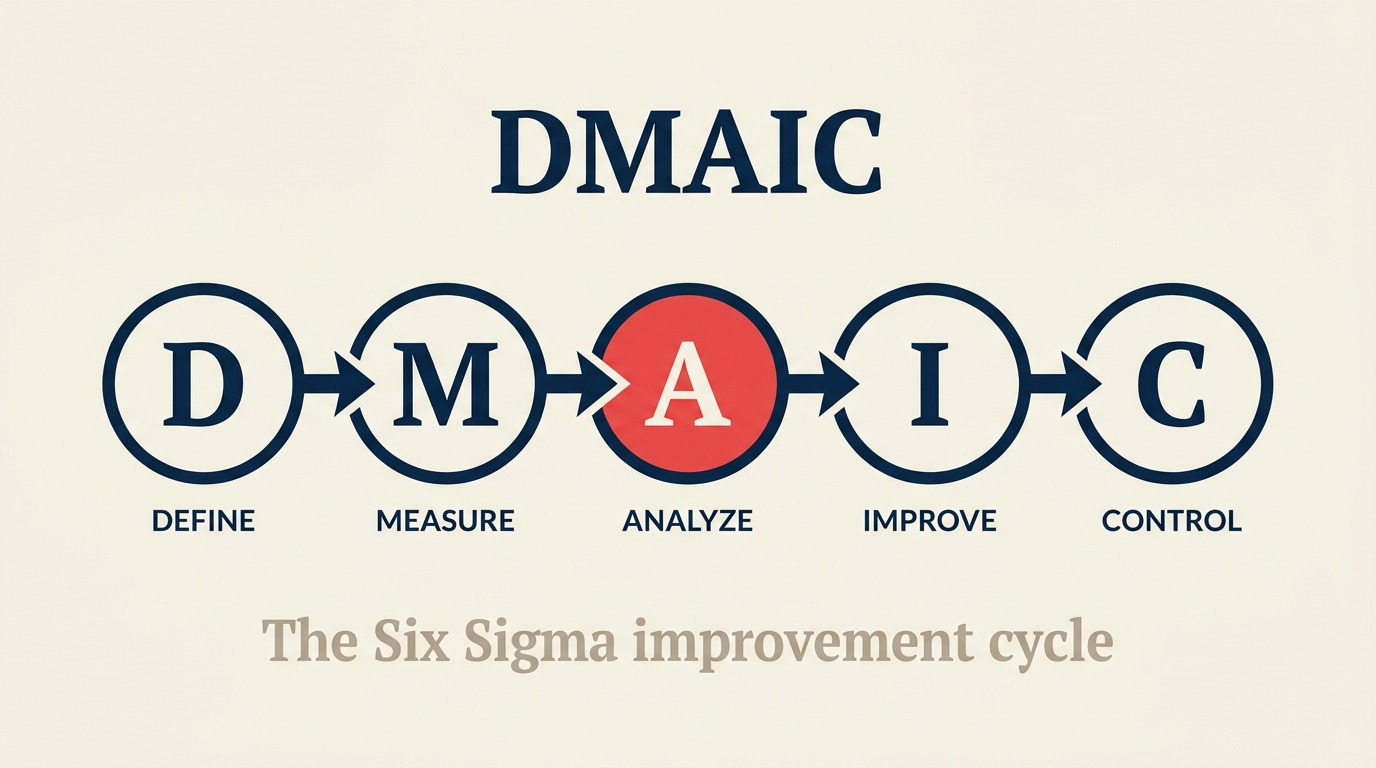
DMAIC (diucapkan "duh-may-ick") adalah metodologi perbaikan terstruktur di jantung Six Sigma. Setiap huruf adalah gerbang yang harus Anda lewati: Define masalahnya, Measure kondisi saat ini, Analyze akar masalah, Improve dengan solusi yang telah diuji, dan Control keuntungan agar tidak terkikis. Lewati satu fase dan seluruh proyek berisiko.
Apa Itu DMAIC?
DMAIC adalah siklus perbaikan 5 fase yang membentuk tulang punggung operasional Six Sigma. Akronim ini singkatan dari Define, Measure, Analyze, Improve, dan Control. Ini memberi tim peta jalan berulang berbasis data untuk mengurangi cacat, memangkas waktu siklus, dan mengunci keuntungan mutu.
Metode ini dikodifikasikan pada pertengahan 1980-an di Motorola oleh insinyur keandalan Bill Smith dan ahli statistik Mikel Harry sebagai bagian dari kerangka Six Sigma asli mereka. Motorola memerlukan cara terstruktur untuk mendorong mutu menuju 3,4 cacat per sejuta kesempatan (DPMO) di seluruh lini manufakturnya. DMAIC adalah kendaraannya. Ketika Jack Welch mengadopsi Six Sigma di seluruh GE pada tahun 1995, DMAIC menjadi playbook perbaikan standar untuk perusahaan besar di seluruh dunia, menyebar dari manufaktur ke layanan kesehatan, keuangan, logistik, dan perangkat lunak.
Yang membedakan DMAIC dari kerangka yang lebih sederhana adalah ketegangannya pada pengukuran sebelum tindakan. Anda tidak mendefinisikan akar masalah sampai Anda memiliki data. Anda tidak melakukan uji coba solusi sampai Anda mengkonfirmasi akar masalah secara statistik. Anda tidak menyatakan kemenangan sampai sistem kontrol sudah ada. Urutan itu adalah kekuatannya sekaligus alasan proyek macet ketika tim mencoba mempersingkatnya.
Fakta Kunci
- Motorola, yang menghasilkan Six Sigma dan DMAIC pada tahun 1986, mengkredit metodologi ini dengan penghematan kumulatif lebih dari $17 miliar pada tahun 2006, menurut angka yang dikutip oleh American Society for Quality (ASQ).
- GE melaporkan $10 miliar dalam manfaat Six Sigma kumulatif antara tahun 1996 dan 2001 dalam laporan tahunannya, menjadikannya studi kasus perusahaan yang paling sering dikutip untuk DMAIC dalam skala besar.
- Six Sigma dan Lean Six Sigma secara konsisten masuk dalam daftar kredensial proses yang paling dicari dalam manufaktur dan operasional, dengan ratusan ribu sertifikasi Belt aktif yang dilacak oleh International Association for Six Sigma Certification (IASSC).
5 Fase DMAIC Dijelaskan
DMAIC bersifat berurutan berdasarkan desain. Setiap fase menghasilkan deliverable yang mengatur masuk ke fase berikutnya. Tim yang menjalankan fase secara paralel atau melewati fase pengukuran hampir selalu berakhir dengan memecahkan masalah yang salah. Inilah yang terjadi di masing-masing fase.
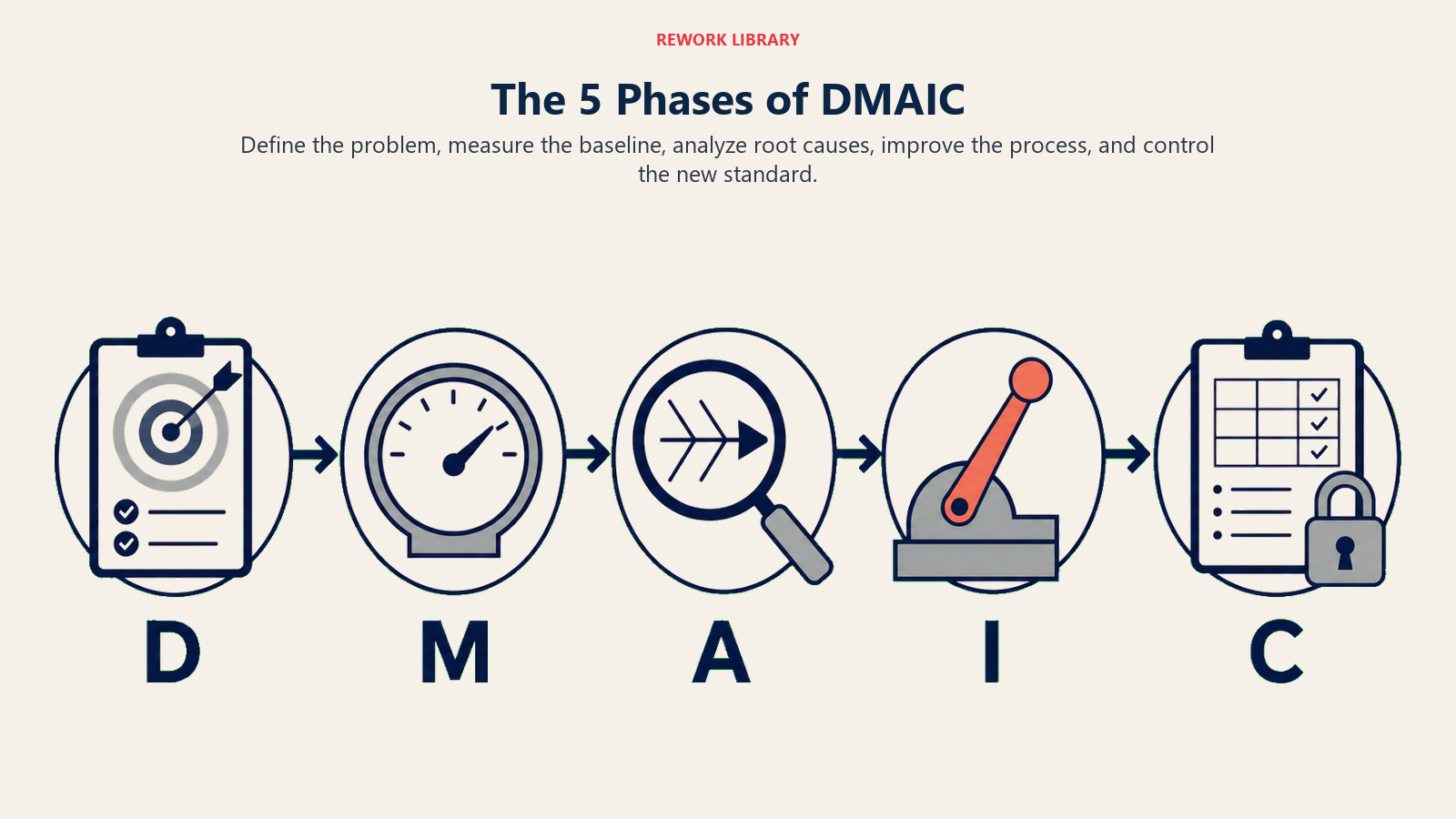
D - Define (Menentukan)
Fase Define menjawab satu pertanyaan: masalah apa yang sebenarnya sedang kita selesaikan, dan apakah layak diselesaikan? Tim menghasilkan piagam proyek yaitu dokumen satu halaman yang menyatakan masalah, tujuan, ruang lingkup, kasus bisnis, dan anggota tim. Tanpanya, ruang lingkup proyek meluber dan sponsor tidak terlibat.
Dua alat utama lainnya dalam Define adalah diagram SIPOC (Suppliers, Inputs, Process, Outputs, Customers) dan penelitian Voice of the Customer (VOC). SIPOC memberi semua orang pandangan dari ketinggian tinggi tentang proses sebelum siapa pun menggali lebih dalam. VOC menerjemahkan keluhan pelanggan, survei, dan tiket dukungan menjadi persyaratan mutu yang terukur. Anda tidak dapat mendefinisikan "cacat" sampai Anda tahu apa yang benar-benar dipedulikan pelanggan. Define berakhir ketika tim setuju tentang pernyataan masalah dan metrik keberhasilan, serta sponsor menandatangani piagam.
M - Measure (Mengukur)
Measure menetapkan garis dasar. Sebelum Anda dapat meningkatkan apa pun, Anda perlu mengetahui seberapa buruk kondisi saat ini, dan apakah sistem pengukuran Anda cukup dapat dipercaya untuk melacak perbaikan. Output utamanya adalah indeks kapabilitas proses (Cp dan Cpk), yang memberi tahu Anda seberapa baik proses saat ini cocok dalam batas spesifikasi pelanggan.
Rencana pengumpulan data mendokumentasikan dengan tepat data apa yang akan Anda kumpulkan, bagaimana caranya, dan dari mana. Tanpanya, tim berakhir dengan kumpulan data yang tidak konsisten yang membuat analisis tidak mungkin dilakukan. Banyak tim juga menjalankan Measurement System Analysis (MSA), yang memeriksa apakah alat ukur, perangkat lunak, atau penilaian manusia yang digunakan untuk mengumpulkan data sudah dapat diandalkan. Sistem pengukuran dengan variasi tinggi dapat membuat proses yang mampu terlihat cacat. Measure berakhir ketika Anda memiliki garis dasar yang dikonfirmasi: tingkat cacat, waktu siklus, tingkat kesalahan, apa pun yang dikomitmenkan piagam untuk diperbaiki.
A - Analyze (Menganalisis)
Analyze adalah tempat tim bergerak dari "inilah datanya" ke "inilah alasannya." Tujuannya adalah mengkonfirmasi akar masalah dengan bukti, bukan sekadar brainstorming teori yang masuk akal. Dua alat awal yang paling umum adalah Fishbone diagram (juga disebut diagram Ishikawa atau cause-and-effect) dan teknik 5 Whys, yang menggali dari gejala ke penyebab sistemik dengan berulang kali bertanya "mengapa".
Tetapi Analyze tidak berhenti pada alat kualitatif. Tim menggunakan uji hipotesis, t-test, uji chi-square, analisis regresi, untuk mengkonfirmasi penyebab mana yang signifikan secara statistik. Inilah yang membedakan DMAIC dari pemecahan masalah berdasarkan intuisi: Anda tidak bisa melanjutkan ke Improve sampai Anda telah menunjukkan, dengan data, bahwa menghilangkan akar masalah yang diidentifikasi akan menutup kesenjangan antara garis dasar saat ini dan target Anda. Analyze berakhir dengan akar masalah yang tervalidasi dan pernyataan jelas tentang seberapa banyak masalah yang dijelaskannya.
I - Improve (Memperbaiki)
Improve merancang, menguji, dan memilih solusi. Tim menghasilkan beberapa pilihan solusi terhadap akar masalah yang dikonfirmasi, kemudian menggunakan matriks prioritas atau Failure Mode and Effects Analysis (FMEA) untuk mengevaluasi risiko, biaya, dan dampak sebelum berkomitmen pada uji coba. Design of Experiments (DOE) adalah alat statistik pilihan ketika beberapa faktor berinteraksi dan Anda perlu menemukan kombinasi pengaturan optimal tanpa menguji setiap permutasi.
Uji coba tidak bisa dinegosiasikan. Uji terkontrol skala kecil memvalidasi bahwa solusi yang diusulkan benar-benar menggerakkan metrik sebelum tim berinvestasi dalam penerapan penuh. Hasil uji coba dibandingkan dengan garis dasar fase Measure: apakah tingkat kesalahan turun? Apakah waktu siklus menyusut? Jika perbaikan dikonfirmasi, tim mendokumentasikan proses baru dan mempersiapkan serah terima. Improve berakhir ketika data uji coba membuktikan solusi berhasil.
C - Control (Mengendalikan)
Control mengubah keberhasilan uji coba menjadi perubahan proses permanen. Output utamanya adalah rencana kontrol, dokumen yang mendefinisikan apa yang dipantau, seberapa sering, siapa yang memilikinya, dan tindakan apa yang harus diambil jika metrik menyimpang di luar batas yang dapat diterima. Tanpa rencana kontrol, proyek perbaikan mengalami kemunduran: staf berganti, solusi sementara merayap kembali, dan tingkat cacat naik.
Grafik Statistical Process Control (SPC) adalah alat pemantauan standar. Mereka memplot metrik dari waktu ke waktu dengan batas kontrol, sehingga secara visual jelas kapan proses menyimpang dibandingkan menunjukkan variasi normal. Materi pelatihan dan standard operating procedures (SOP) yang diperbarui, lihat standard operating procedures, memformalkan cara kerja baru. Proyek secara resmi ditutup ketika pemilik proses menerima tanggung jawab untuk mempertahankan keuntungan dan sponsor menandatangani hasil akhir. Control adalah fase yang paling kurang diinvestasikan tim, dan itulah alasan sebagian besar keuntungan masih ada dua tahun kemudian, atau tidak.
Alat yang Digunakan di Setiap Fase DMAIC
Setiap fase memiliki daftar pendek alat yang paling sering digunakan. Anda tidak akan menggunakan semuanya di setiap proyek, tetapi mengetahui daftarnya memungkinkan Anda memilih alat yang tepat untuk bukti yang Anda butuhkan.
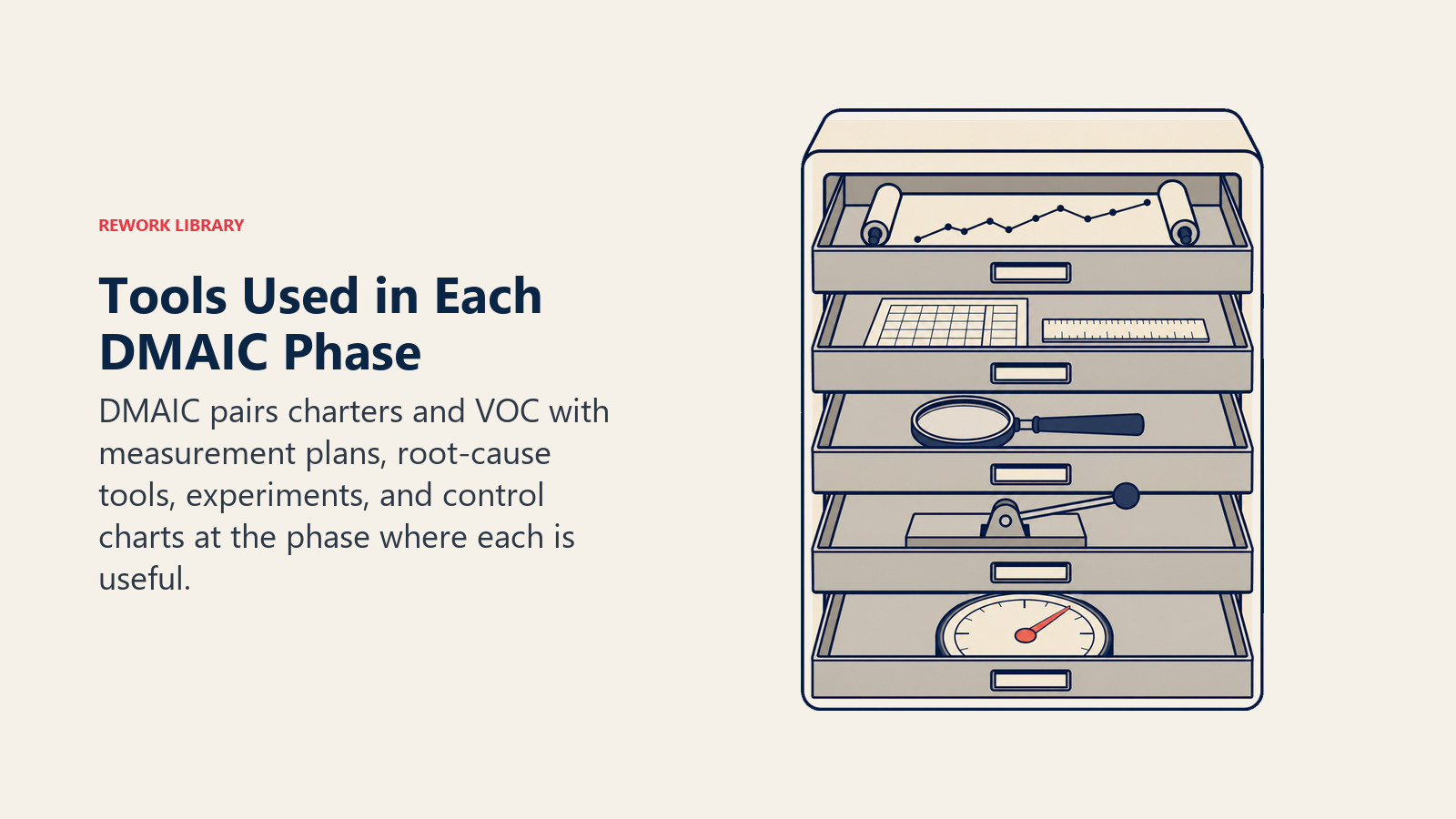
| Fase | Alat umum | Output / artifact |
|---|---|---|
| Define | Piagam proyek, diagram SIPOC, analisis VOC, peta pemangku kepentingan, pohon CTQ | Piagam proyek yang ditandatangani, batas ruang lingkup, metrik keberhasilan |
| Measure | Rencana pengumpulan data, peta proses, MSA (Gauge R&R), diagram kendali, kapabilitas proses (Cp/Cpk) | Tingkat cacat atau waktu siklus garis dasar, sistem pengukuran yang tervalidasi |
| Analyze | Fishbone diagram, 5 Whys, Pareto chart, uji hipotesis, regresi, scatter plot | Akar masalah yang dikonfirmasi secara statistik |
| Improve | Matriks solusi, FMEA, DOE (Design of Experiments), rencana uji coba, analisis biaya-manfaat | Hasil uji coba, desain proses yang dioptimalkan |
| Control | Grafik SPC, rencana kontrol, RACI, SOP yang diperbarui, materi pelatihan | Serah terima ke pemilik proses, metrik yang dipertahankan |
CTQ singkatan dari Critical to Quality, yaitu terjemahan persyaratan pelanggan ke dalam spesifikasi proses internal yang terukur. MSA singkatan dari Measurement System Analysis. FMEA singkatan dari Failure Mode and Effects Analysis. DOE singkatan dari Design of Experiments. SPC singkatan dari Statistical Process Control. RACI singkatan dari Responsible, Accountable, Consulted, Informed.
Contoh Nyata: Memangkas Kesalahan Pemrosesan Faktur di Perusahaan B2B
Sebuah perusahaan logistik menengah, sebut saja FreightCo, mengalami tingkat kesalahan 8% pada faktur keluar. Keuangan menghabiskan sekitar 40 jam sebulan untuk koreksi, dan dua klien telah mengajukan sengketa formal. CFO mensponsori proyek DMAIC dengan target mendapatkan di bawah tingkat kesalahan 1% dalam satu kuartal.
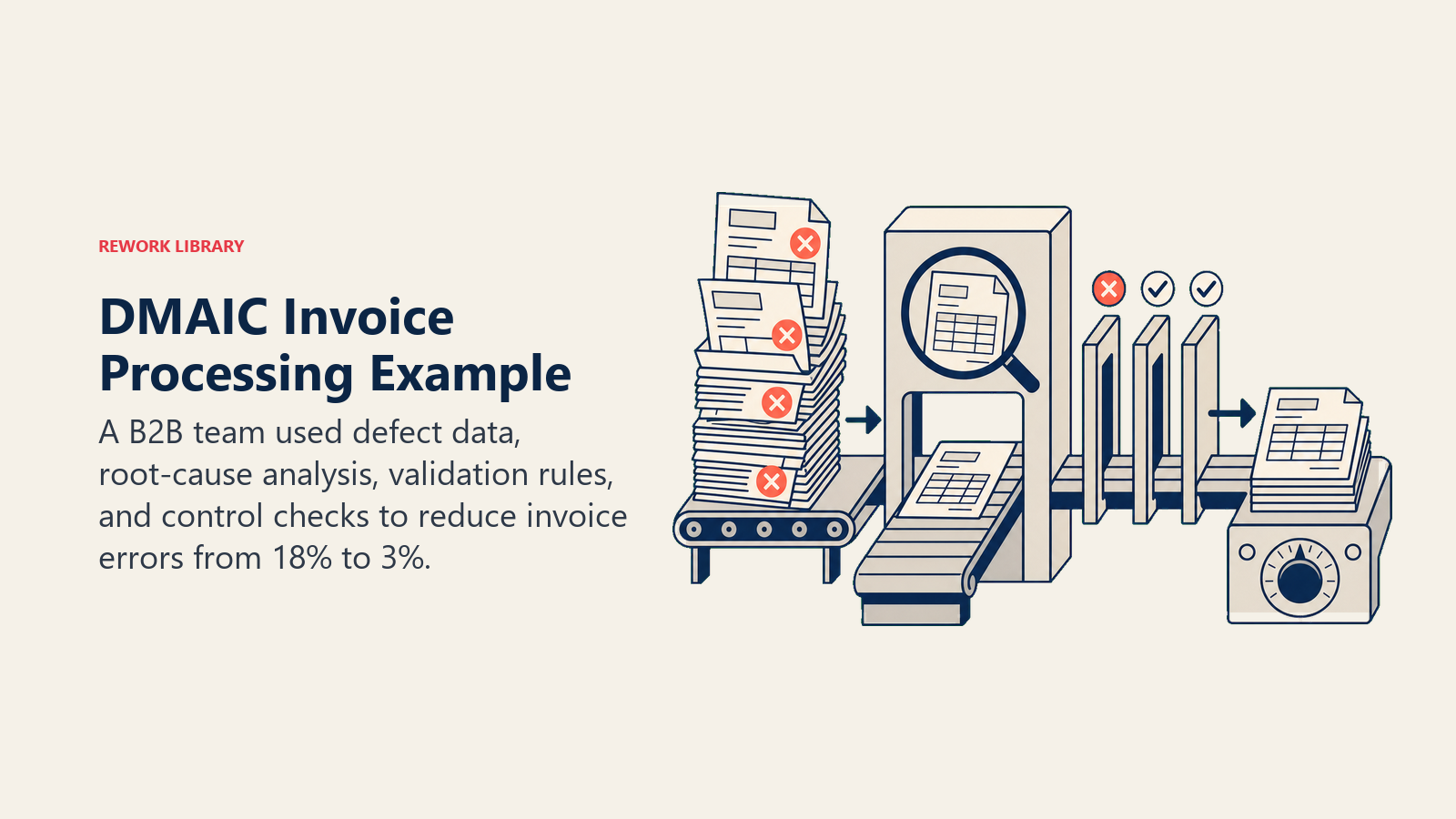
Define. Piagam proyek membatasi masalah pada faktur B2B (business-to-business) yang diproses melalui sistem ERP (Enterprise Resource Planning). SIPOC memetakan aliran dari penerimaan purchase order hingga persetujuan dan pengiriman faktur. Wawancara VOC dengan dua klien yang bersengketa menunjuk jenis kesalahan: harga satuan yang salah diterapkan pada item baris.
Measure. Tim menarik tiga bulan data faktur dan mengkonfirmasi tingkat kesalahan 8,1% (412 kesalahan dari 5.087 faktur). MSA yang dijalankan pada proses tinjauan manual menunjukkan peninjau tidak setuju apakah perbedaan harga adalah "kesalahan" atau "pembulatan" 18% dari waktu, masalah sistem pengukuran itu sendiri, yang diselesaikan tim dengan memperketat definisi kesalahan sebelum melanjutkan. Kapabilitas proses menunjukkan proses faktur berjalan pada sekitar sigma 2,8.
Analyze. Fishbone diagram menghasilkan 11 kandidat akar masalah di seluruh kategori People, Process, Systems, dan Data. Penggalian Five Whys pada tiga kandidat teratas terus berakhir di satu tempat: tabel data master vendor dalam ERP tidak memiliki validasi otomatis. Perubahan harga dari pemasok diterapkan secara manual, dan tingkat pembaruan berjalan dua hingga lima hari di belakang tanggal perubahan sebenarnya. Uji hipotesis mengkonfirmasi bahwa 73% faktur dengan kesalahan harga telah dibuat selama jendela lag setelah perubahan harga pemasok.
Improve. Tim menetapkan dua solusi: (1) aturan validasi otomatis yang memblokir pembuatan faktur ketika harga item baris jatuh di luar rentang toleransi spesifik vendor, dan (2) SLA (Service Level Agreement) yang mengharuskan perubahan harga pemasok dimasukkan dalam 24 jam. Mereka menjalankan uji coba empat minggu dengan aturan validasi aktif pada segmen klien satu. Tingkat kesalahan untuk segmen tersebut turun menjadi 0,9%, di dalam target 1%. FMEA mengkonfirmasi aturan tersebut tidak akan menciptakan positif palsu di atas tingkat yang dapat diterima.
Control. Aturan validasi diterapkan di semua akun. Grafik SPC bulanan yang melacak tingkat kesalahan faktur ditugaskan ke manajer tim Accounts Payable (AP). Rencana kontrol mendefinisikan pemicu tindakan pada 2%, jika tingkatnya melampaui garis itu, protokol audit master vendor aktif secara otomatis. Enam bulan setelah penutupan, tingkat kesalahan bertahan pada 0,8%.
Proyek ini memangkas beban kerja koreksi dari 40 jam sebulan menjadi kurang dari 5 jam, dan dua sengketa klien diselesaikan. Total waktu proyek: 11 minggu.
DMAIC, PDCA, dan DMADV Dibandingkan
DMAIC adalah salah satu dari beberapa kerangka perbaikan iteratif. Dua yang paling sering Anda lihat bersamanya adalah PDCA dan DMADV. Lihat juga panduan kami tentang process optimization untuk perbandingan yang lebih luas.
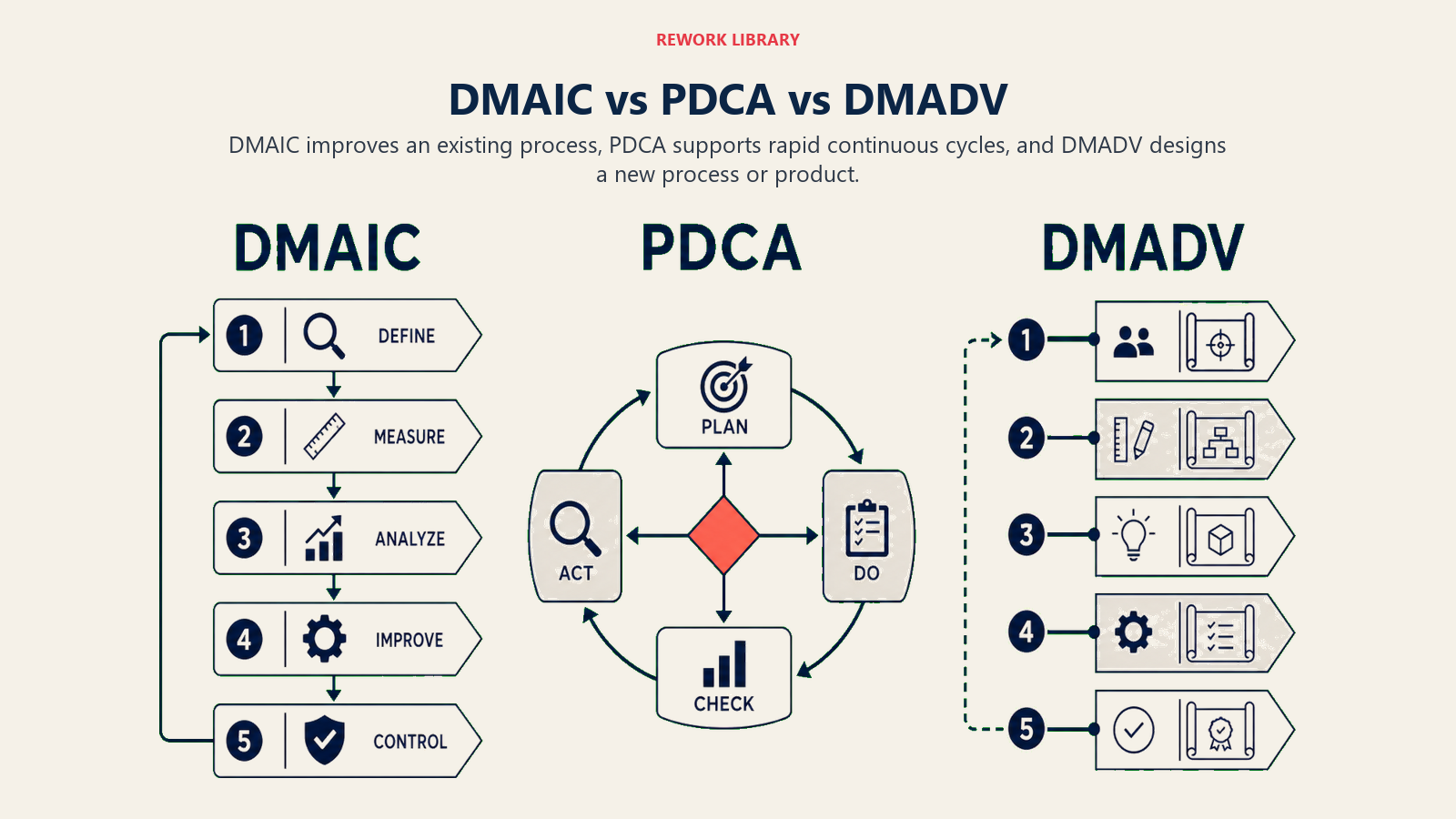
| Siklus | Digunakan dalam | Terbaik untuk | Fase |
|---|---|---|---|
| DMAIC | Six Sigma, Lean Six Sigma | Memperbaiki proses yang ada dan rusak menggunakan analisis statistik | Define, Measure, Analyze, Improve, Control |
| PDCA | Lean, perbaikan berkelanjutan umum | Perbaikan iteratif cepat, sering untuk masalah lebih sederhana atau data terbatas | Plan, Do, Check, Act |
| DMADV | Six Sigma (DFSS) | Merancang proses atau produk baru dari awal | Define, Measure, Analyze, Design, Verify |
Perbedaan intinya: DMAIC memperbaiki yang sudah ada. DMADV, kadang disebut DFSS (Design for Six Sigma), merancang sesuatu yang baru. PDCA lebih ringan dan lebih cepat bersiklus; tidak memerlukan uji hipotesis statistik, yang membuatnya dapat diakses oleh tim tanpa Black Belt. Tetapi kecepatan PDCA bisa menjadi kelemahan pada masalah kompleks di mana akar masalah tidak jelas. Lihat artikel kami tentang PDCA untuk pembahasan lengkap.
DMAIC dan Lean methodology sering dikombinasikan menjadi Lean Six Sigma, yang menggunakan alat Lean (value stream mapping, 5S, Kanban) dalam fase Analyze dan Improve bersamaan dengan toolkit statistik DMAIC. Hasilnya adalah kerangka yang menyerang pemborosan (domain Lean) dan variasi (domain Six Sigma) pada saat yang bersamaan.
Kapan Menggunakan DMAIC (dan Kapan Tidak)
DMAIC adalah alat presisi, bukan alat universal. Menggunakannya pada masalah yang salah menghabiskan berbulan-bulan.
| Gunakan DMAIC ketika... | Hindari DMAIC ketika... |
|---|---|
| Cacat atau tingkat kesalahan berulang memiliki dampak bisnis yang diketahui | Masalah ini baru, gunakan DMADV atau design sprint |
| Akar masalah benar-benar tidak jelas dan data tersedia | Anda membutuhkan perbaikan dalam hitungan hari, bukan minggu, PDCA atau event Kaizen cepat lebih tepat |
| Perbaikan perlu dibuktikan secara statistik, bukan hanya diamati | Proses itu sendiri perlu dirancang ulang dari awal |
| Kepemimpinan menginginkan catatan proyek yang ketat dan dapat diaudit | Tim tidak memiliki data dan tidak ada cara untuk mengumpulkannya dengan cepat |
| Proses melintas banyak tim atau fungsi | Ruang lingkup sangat sempit dan perbaikannya sudah jelas |
Event Kaizen, workshop terfokus 3-5 hari, sering lebih cepat untuk masalah di mana tim sudah mencurigai akar masalah dan hanya perlu bertindak. DMAIC menghasilkan biayanya sendiri ketika masalah bersifat kronis, akar masalah benar-benar ambigu, dan taruhannya cukup tinggi untuk membenarkan enam hingga dua belas minggu pekerjaan terstruktur.
Kesalahan Umum yang Menggagalkan Proyek DMAIC
- Melewati Measure untuk menghemat waktu. Tim yang melompat dari Define ke Analyze berdasarkan intuisi berakhir di Analyze tanpa garis dasar, tanpa definisi cacat yang dikonfirmasi, dan tidak ada cara untuk membuktikan solusi mereka berhasil. Measure adalah fase yang paling sering dilewati dan yang paling berdampak jika dilewati.
- Mendefinisikan masalah sebagai solusi. Piagam proyek yang mengatakan "kami perlu mengimplementasikan sistem X" tidak mendefinisikan masalah, melainkan memilih solusi terlebih dahulu. Define harus menggambarkan kesenjangan antara kinerja saat ini dan yang diinginkan, bukan meresepkan jawabannya.
- Mengacaukan korelasi dengan akar masalah. Fishbone dan 5 Whys mengidentifikasi kandidat. Uji hipotesis mengkonfirmasinya. Tim yang melanjutkan ke Improve berdasarkan brainstorming Fishbone saja sering menemukan perbaikannya tidak menggerakkan metrik.
- Kurang mendanai fase Control. Control mendapat perhatian paling sedikit dan paling banyak disalahkan pasca-proyek. Tidak ada rencana kontrol berarti tidak ada pemilik proses. Tidak ada pemilik proses berarti keuntungan terkikis dalam enam bulan.
- Perluasan ruang lingkup setelah piagam ditandatangani. Proyek DMAIC berkembang karena memecahkan satu masalah mengungkap tiga masalah lainnya. Tetap pada ruang lingkup yang dipiagamkan; buka proyek terpisah untuk masalah yang berdekatan.
- Menjalankan DMAIC tanpa Black Belt atau fasilitator berpengalaman. Alat statistik dalam Analyze dan Improve, uji hipotesis, DOE, SPC, memerlukan pelatihan. Tim tanpa seseorang yang dapat menjalankan analisis dengan benar cenderung menghasilkan grafik yang mengkonfirmasi apa pun yang sudah dipercaya tim.
Untuk tinjauan lebih luas tentang business process management dan di mana DMAIC cocok dalam toolkit perbaikan keseluruhan, lihat artikel tersebut. Dan untuk pemahaman dalam konsep process management yang mendasar sebelum menjalankan proyek DMAIC, gambaran umum tersebut layak dibaca terlebih dahulu.
Pertanyaan yang Sering Diajukan tentang DMAIC
Apakah DMAIC sama dengan Six Sigma?
Tidak, tetapi keduanya tidak terpisahkan. Six Sigma adalah filosofi dan metodologi mutu keseluruhan, yang menargetkan 3,4 cacat per sejuta kesempatan. DMAIC adalah peta jalan proyek spesifik yang digunakan untuk mencapai perbaikan Six Sigma dalam proses yang ada. Anda dapat menganggap Six Sigma sebagai tujuan dan DMAIC sebagai rutenya. Six Sigma juga mencakup DMADV untuk merancang proses baru dan sistem sertifikasi Belt (White, Yellow, Green, Black, Master Black Belt) yang mendefinisikan siapa yang dapat memimpin proyek DMAIC pada tingkat kompleksitas yang berbeda.
Berapa lama proyek DMAIC berlangsung?
Sebagian besar proyek DMAIC berlangsung antara 3 dan 6 bulan dari penandatanganan piagam hingga serah terima Control. Proyek yang sederhana dan lingkupnya jelas dalam satu tim dapat selesai dalam 8 hingga 10 minggu. Proyek lintas fungsi yang kompleks, terutama yang memerlukan DOE atau pengumpulan data ekstensif, dapat berlangsung 9 hingga 12 bulan. Fase Measure dan Analyze biasanya memakan waktu paling lama karena pengumpulan data membutuhkan waktu dan uji hipotesis memerlukan ukuran sampel yang cukup besar untuk bermakna secara statistik. Tergesa-gesa di salah satu fase adalah alasan paling umum mengapa proyek DMAIC gagal mempertahankan keuntungannya.
Bisakah DMAIC digunakan tanpa sertifikasi Six Sigma?
Ya, dengan catatan. Fase Define dan Control dapat diakses oleh siapa pun yang familiar dengan manajemen proyek. Fase Measure memerlukan kenyamanan dengan statistik dasar dan analisis sistem pengukuran. Analyze, terutama uji hipotesis dan regresi, benar-benar membutuhkan seseorang dengan pelatihan Green Belt atau Black Belt untuk dijalankan dengan benar. Banyak tim menjalankan DMAIC dengan fasilitator bersertifikat dalam peran utama dan anggota tanpa sertifikasi berkontribusi dalam Define dan Improve. Menggunakan struktur DMAIC tanpa rigor statistik dalam Analyze lebih baik daripada tidak ada struktur, tetapi risikonya adalah mengkonfirmasi akar masalah yang sebenarnya tidak mendorong cacat.
Apa perbedaan antara DMAIC dan DMADV?
Keduanya termasuk dalam keluarga Six Sigma dan berbagi tiga fase pertama (Define, Measure, Analyze). Keduanya menyimpang pada fase keempat. Fase keempat DMAIC adalah Improve, Anda memperbaiki proses yang sudah ada. Fase keempat DMADV adalah Design, Anda membangun sesuatu yang baru. DMADV berakhir dengan Verify, bukan Control, karena Anda memvalidasi desain baru terhadap persyaratan, bukan mempertahankan keuntungan dalam proses yang sudah ada. Gunakan DMAIC ketika proses rusak tetapi dapat diperbaiki. Gunakan DMADV ketika proses perlu dibuat dari awal, atau ketika DMAIC telah diterapkan dan proses masih tidak dapat memenuhi persyaratan.
DMAIC bukan jalur tercepat untuk memperbaiki masalah proses. Tetapi untuk cacat kronis berisiko tinggi di mana akar masalah tidak jelas, ini adalah yang paling andal. Definisikan apa yang rusak sebelum mengukurnya. Ukur sebelum menganalisis. Analisis sebelum meningkatkan. Kontrol agar tetap meningkat. Urutan itu membosankan, disiplin, dan berhasil.
Bagi tim yang memulai perjalanan mutu mereka, metodologi 5S sering kali merupakan titik awal yang berguna sebelum proyek DMAIC formal, karena menstabilkan lingkungan kerja dan membuat pengukuran lebih andal.

Customer Success Operations Manager
On this page
- Apa Itu DMAIC?
- 5 Fase DMAIC Dijelaskan
- D - Define (Menentukan)
- M - Measure (Mengukur)
- A - Analyze (Menganalisis)
- I - Improve (Memperbaiki)
- C - Control (Mengendalikan)
- Alat yang Digunakan di Setiap Fase DMAIC
- Contoh Nyata: Memangkas Kesalahan Pemrosesan Faktur di Perusahaan B2B
- DMAIC, PDCA, dan DMADV Dibandingkan
- Kapan Menggunakan DMAIC (dan Kapan Tidak)
- Kesalahan Umum yang Menggagalkan Proyek DMAIC