Sales Playbook: What to Include (With Template)
Turn this article into takeaways for your work.


Each assistant summarizes the article only for you and suggests best practices for your work.
A sales playbook is a living document that captures everything a sales rep needs to do their job well: who to target, what to say, how to handle objections, and how to move a deal through each stage. Done right, it's the single source of truth for a repeatable, coachable sales motion.
What is a sales playbook?
A sales playbook is a centralized reference that codifies a team's repeatable sales process. It defines the ideal customer profile (ICP), maps out buyer personas, documents sales stages with exit criteria, lays out qualification frameworks, messaging, objection responses, competitive battlecards, demo flows, and outreach cadences.
Think of it as the operating manual for revenue generation. New reps open it on day one. Experienced reps return to it when a deal stalls. Managers use it to coach from a shared standard instead of personal intuition.
Key Facts
- Companies with a formal sales playbook see new rep ramp time cut by up to 40% compared to teams without one. (Sales Enablement Society, 2023)
- Organizations that consistently use a playbook report win rates roughly 27% higher than those that don't. (CSO Insights, 2022)
- 65% of sales teams say their biggest productivity challenge is finding and using the right content at the right time. (Seismic State of Sales Enablement, 2023)
What to include in a sales playbook
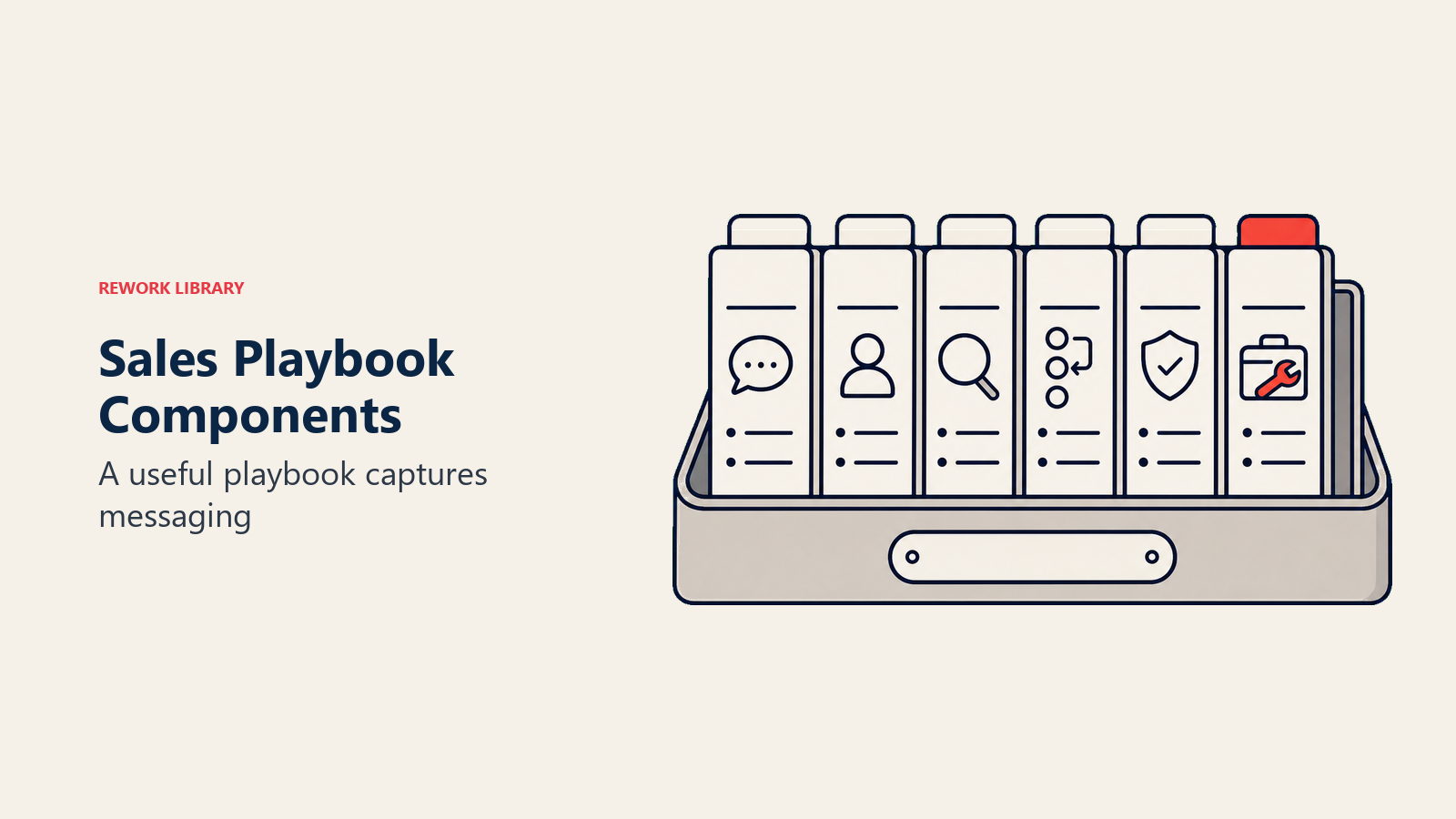
Not every playbook needs every section. But the components below are the ones that move the needle most on ramp time and win rate consistency. A mature playbook covers all of them.
| Component | What it covers | Why it matters |
|---|---|---|
| Ideal Customer Profile (ICP) | Firmographic + behavioral traits of your best-fit accounts | Focuses prospecting effort; reduces churn by attracting buyers who succeed with your product |
| Buyer personas | Decision-maker roles, goals, pain points, objections by title | Lets reps tailor messaging instead of pitching a generic feature list |
| Sales stages + exit criteria | Stage names, definition, required proof before advancing | Prevents sandbagging and false pipeline; keeps forecasts reliable |
| Qualification framework | BANT, MEDDIC, CHAMP, or a custom model | Gives reps a consistent lens for judging deal quality and spend allocation |
| Talk tracks and value messaging | Core pitch, discovery questions, value hypothesis by persona | Shortens ramp; lifts average quality of calls across the team |
| Objection handling | Common objections, root cause, and scripted counter-responses | Reduces lost deals caused by avoidable friction |
| Competitive battlecards | How you win vs. each named competitor | Prevents reps from winging competitive deals |
| Demo and presentation flows | Standard demo structure, key moments, customization rules | Ensures consistent quality; prevents show-up-and-throw-up demos |
| Outreach cadences | Prospecting sequences by channel, timing, and message type | Systematizes follow-up so deals don't die from neglect |
| Mutual action plan guidance | How to co-author a timeline with the buyer | Aligns both sides on next steps and narrows stalls |
For a deeper look at how qualification frameworks like BANT and MEDDIC fit into the broader pipeline, see Sales Methodologies Compared.
Sales playbook vs. sales process
These two terms get mixed up constantly. They're related but not the same thing.
| Sales process | Sales playbook | |
|---|---|---|
| What it is | The sequence of stages a deal moves through | The reference material that supports execution at each stage |
| Format | Usually a CRM stage map or flowchart | A document, wiki, or enablement platform |
| Who uses it | Managers (to review pipeline) + reps (to advance deals) | Reps (daily) + managers (to coach) + onboarding (to train) |
| When it changes | When the go-to-market motion changes | Continuously, as messaging and competitive landscape evolve |
| Scope | What happens | How it happens |
Put simply: the sales process tells reps where they are; the playbook tells them what to do next. Both are necessary. Neither replaces the other.
Benefits of a sales playbook
A well-built playbook pays for the time it takes to create it, usually within the first quarter a new rep uses it.
Faster onboarding. New hires don't need to shadow three different reps and synthesize three different approaches. The playbook is the approach. Ramp time drops because the learning curve is structured.
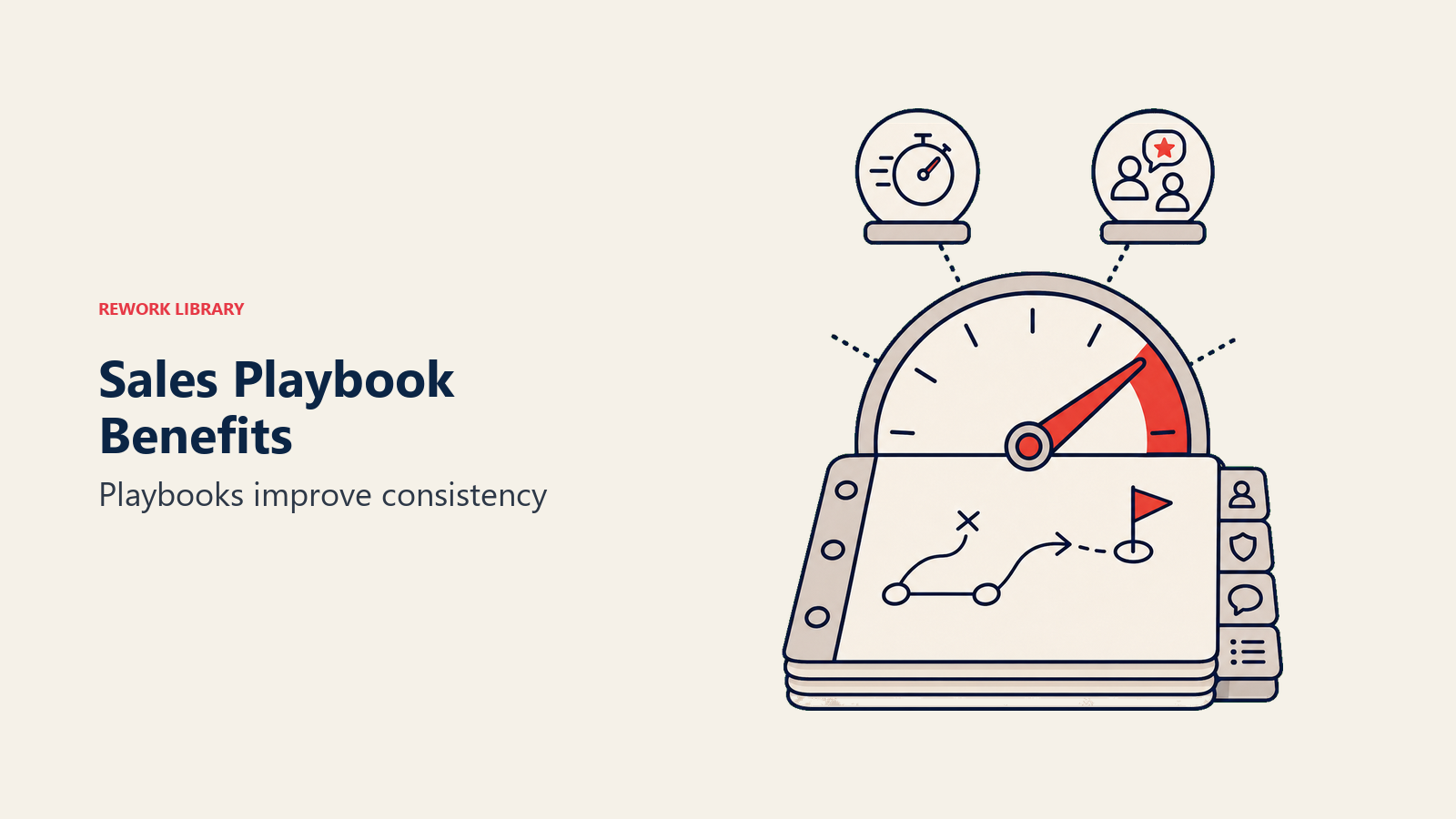
Consistent execution. Without a playbook, every rep invents their own discovery process, their own pitch, their own objection responses. Results vary wildly. A playbook narrows that variance so your median rep performs closer to your top rep.
Easier coaching. Managers can only coach to a standard that exists. When a rep loses a deal, the playbook makes it clear whether they followed the process or deviated. That specificity makes feedback actionable instead of vague.
Better win rates. This is the downstream result of the above. When more reps qualify better, pitch more consistently, and handle objections with tested responses, more deals close. The qualification framework alone, applied consistently, tends to lift win rates by filtering out deals that were never real.
Institutional knowledge that doesn't walk out the door. When your best rep leaves, most teams lose whatever made them good. A playbook captures that knowledge while they're still around.
How to build a sales playbook
Building a playbook from scratch takes four to eight weeks if you're thorough. Here's the sequence that works.
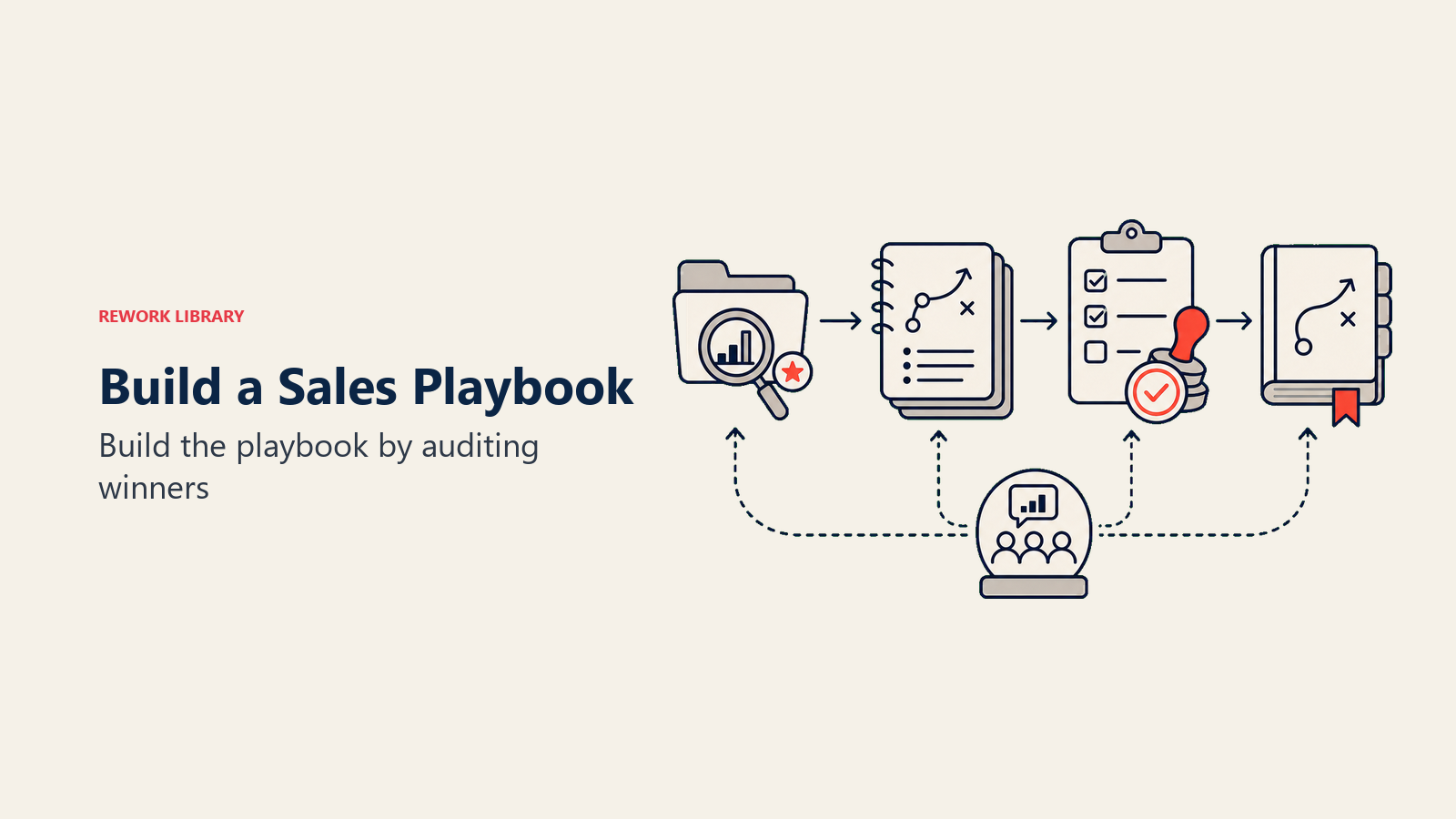
Step 1: Audit what already works
Start by talking to your top performers. What's their discovery process? What questions do they always ask? How do they handle the three most common objections? Pull win/loss data from your CRM to identify patterns. You're looking for the behaviors and messages that correlate with closed deals.
Step 2: Define your ICP and buyer personas
Your ICP is who you should be selling to, not who has bought in the past. Pull your best customers (low churn, high expansion, fast onboarding), find the common traits (industry, company size, tech stack, trigger events), and document them. Then build personas for each buying role: champion, economic buyer, technical evaluator. Include their goals, daily frustrations, typical objections, and the metrics they care about.
Step 3: Map your sales stages with exit criteria
Work with sales leadership and ops to define each stage and what must be true before a deal moves forward. Exit criteria are the key. "Demo completed" is not an exit criterion. "Champion confirmed, budget range validated, next steps agreed with economic buyer" is. The sales funnel stages article covers how buyer-side stages align with these internal milestones.
Step 4: Choose and document your qualification framework
Pick one framework and train to it consistently. SPIN Selling works well for complex solution sales with multiple pain layers. Challenger Sale fits enterprise deals where you need to reframe the buyer's thinking. Consultative Selling suits high-relationship, advisory sales. Whatever you choose, document the specific questions reps should ask and the signals they're listening for.
Step 5: Build talk tracks and objection responses
A talk track is not a script. It's a structured outline: the opening, the discovery sequence, the value pivot, and the ask. Write versions for each persona and each stage. Then list your 10 most common objections and write a response for each. Test the responses in role-plays before publishing them.
Step 6: Create competitive battlecards
For each major competitor, document: how you win head-to-head, how they win against you, the three questions that expose their weaknesses, and the positioning statement that differentiates you. Keep these short (one page per competitor). Long battlecards don't get read. Solution Selling and Consultative Selling both have frameworks for leading with differentiated value in competitive deals.
Step 7: Document cadences and demo flows
Map out your standard outreach cadences: how many touches, by which channel, over how many days, for each persona type. Then build a standard demo flow with a clear structure: context-setting, discovery questions inside the demo, key moments to highlight, and a close. For late-stage deals, document how to build a mutual action plan that keeps both sides accountable.
Step 8: Publish, train, and iterate
A playbook that lives in a shared drive and never gets opened is not a playbook. Build it where reps actually work (CRM, Notion, your enablement platform). Run a live training session. Then set a review cadence (quarterly is typical) to update messaging, swap out old battlecards, and add new objection responses.
Sales playbook template
Use this structure as your starting outline. Each section becomes a chapter.
1. About This Playbook
   - Purpose, owner, last updated

2. Our Ideal Customer Profile
   - Firmographics, technographics, behavioral triggers, negative ICP

3. Buyer Personas
   - Champion | Economic Buyer | Technical Evaluator | End User
   - Goals, pains, objections, metrics they care about

4. Sales Stages and Exit Criteria
   - Stage 1: Prospect (exit criteria...)
   - Stage 2: Qualified (exit criteria...)
   - Stage 3: Demo/Eval (exit criteria...)
   - Stage 4: Proposal (exit criteria...)
   - Stage 5: Negotiation (exit criteria...)
   - Stage 6: Closed Won / Closed Lost

5. Qualification Framework
   - Framework name + question set
   - Green flags | Red flags | Disqualifying signals

6. Talk Tracks
   - Cold outreach opener (by persona)
   - Discovery call structure
   - Value pitch by persona
   - Executive presentation outline

7. Objection Handling
   - Objection | Root cause | Response | Follow-up question

8. Competitive Battlecards
   - One page per competitor

9. Demo Flow
   - Standard structure
   - Key moments | Customization rules | Close ask

10. Outreach Cadences
    - Prospecting sequence (by channel + persona)
    - Re-engagement sequence
    - Post-meeting follow-up

11. Mutual Action Plan Template
    - Buyer milestones | Seller milestones | Success criteria

12. Resources and Tools
    - CRM guidance, approved decks, case studies, ROI calculator
Common mistakes
Making it too long. A 200-page playbook is not a playbook, it's an archive. Reps won't use it. Aim for the shortest document that covers the essentials. Battlecards should be one page. Talk tracks should be one page. If a section takes more than five minutes to read, cut it.
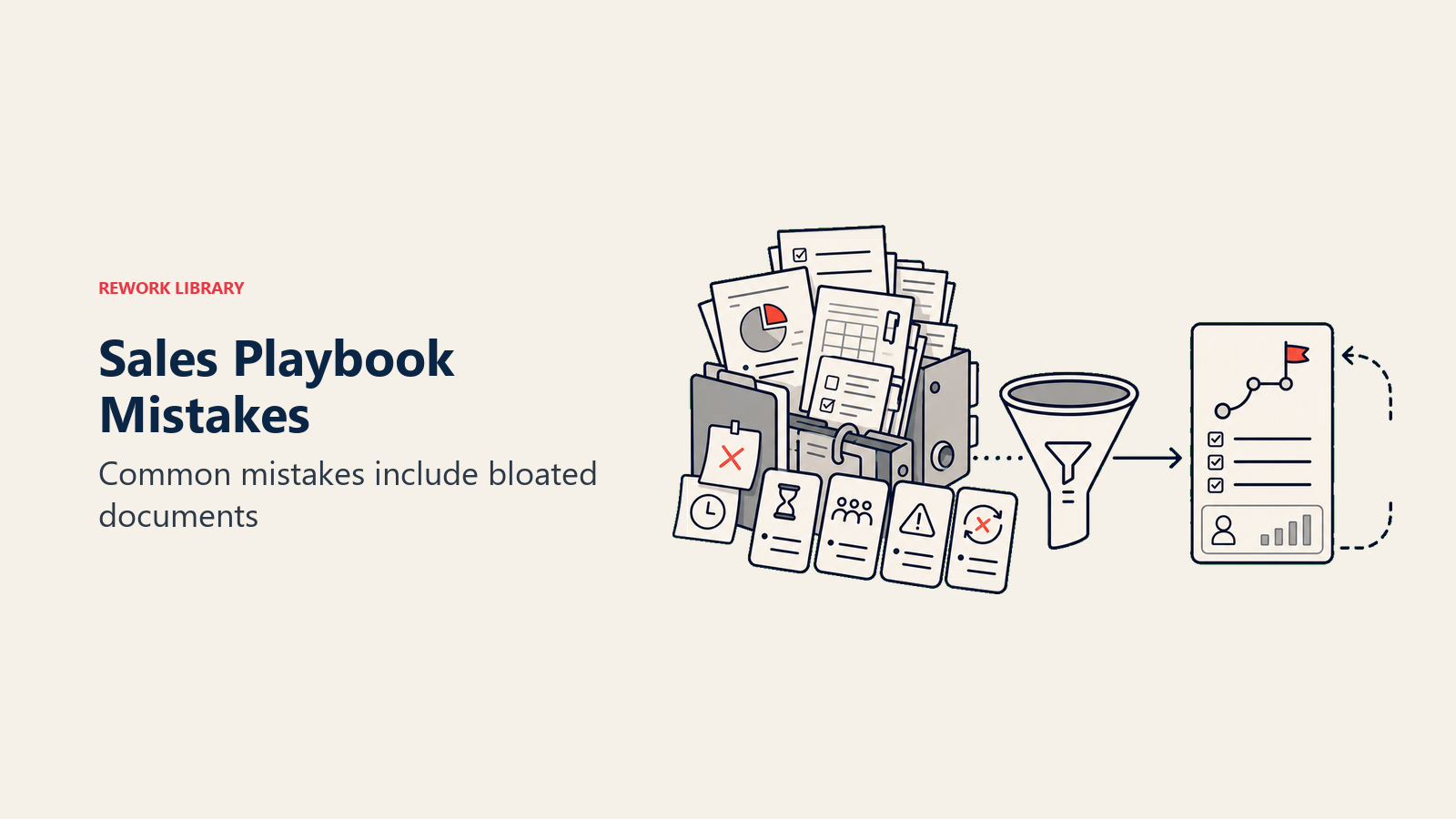
Building it without rep input. Playbooks written entirely by leadership tend to miss the nuances that actually come up in calls. Pull in two or three top performers during the drafting process. They'll surface objections you forgot, customer language you haven't used in years, and gaps in your competitive coverage.
Never updating it. A playbook that's 18 months stale is worse than no playbook, because it builds false confidence. Set a quarterly review on the calendar and assign an owner.
Skipping exit criteria. Stage names without criteria are decoration. The discipline of defining what must be true before a deal advances is what makes the whole system work, including forecast accuracy, coaching, and quota attainment.
Treating it as a training artifact. The playbook should be referenced daily, not just during onboarding. If reps stop opening it after week two, the problem is usually that it's not in the right place or not kept current.
Frequently Asked Questions about Sales Playbook
How long should a sales playbook be?
There's no right length, but shorter is usually better. A playbook that covers ICP, personas, stages, qualification, talk tracks, 10 objections, and 3-5 battlecards can fit in 20-40 pages and still be genuinely useful. Anything longer tends to collect dust.
Who owns the sales playbook?
Ownership typically sits with sales enablement if you have that function, or the VP of Sales / Head of Revenue Operations otherwise. Someone needs to be accountable for keeping it current. Shared ownership usually means no ownership.
How often should a sales playbook be updated?
Quarterly for messaging, competitive content, and objection responses. Annually for a deeper structural review. Any time there's a major product launch, pricing change, or shift in ICP, update the relevant sections immediately rather than waiting for the scheduled review.
What's the difference between a sales playbook and a sales script?
A script is word-for-word dialogue that reps read verbatim. A playbook includes talk tracks, which are structured outlines with suggested language, not rigid scripts. Talk tracks give reps a framework to improvise from, which produces more natural conversations and better outcomes than scripted delivery.
Can a small sales team use a playbook?
Yes, and it often helps most at small teams because there's less institutional knowledge and onboarding resources to draw on. A lean playbook covering ICP, three to five buyer personas, stage criteria, and a handful of objection responses takes a week to build and pays off immediately when the first new hire joins.
A sales playbook is not a one-time project. It's a system for capturing what works, spreading it across the team, and improving it as the market changes. The teams that treat it as a living document, update it regularly, and actually build coaching around it are the ones that see consistent improvement in ramp time and win rate. Start with the sections that matter most for your stage, get something published, and iterate from there.

Head of Enterprise Solutions
On this page
- What is a sales playbook?
- What to include in a sales playbook
- Sales playbook vs. sales process
- Benefits of a sales playbook
- How to build a sales playbook
- Step 1: Audit what already works
- Step 2: Define your ICP and buyer personas
- Step 3: Map your sales stages with exit criteria
- Step 4: Choose and document your qualification framework
- Step 5: Build talk tracks and objection responses
- Step 6: Create competitive battlecards
- Step 7: Document cadences and demo flows
- Step 8: Publish, train, and iterate
- Sales playbook template
- Common mistakes