Consultative Selling: A Step-by-Step Approach
Turn this article into takeaways for your work.


Each assistant summarizes the article only for you and suggests best practices for your work.
Consultative selling is the approach that separates reps who close on rapport and relationships from those who win because they actually understood the buyer's problem. It puts diagnosis before prescription, questions before pitches, and the buyer's goals ahead of the seller's quota.
It's the foundation underneath frameworks like SPIN Selling, Solution Selling, and the Challenger Sale. All three borrow from its core logic. But consultative selling itself is worth understanding as a discipline, not just as a label people apply to anything that isn't cold-calling scripts.
What Is Consultative Selling?
Key Facts
- Research by the Rain Group found that 58% of B2B buyers report that sales reps cannot answer basic questions about their business problems effectively, the core failure consultative selling is designed to fix. (Rain Group, 2022)
- Buyers who rate their rep as "extremely helpful" are 3x more likely to expand into additional purchases than buyers who rate the rep as merely "helpful." (Gartner, 2020)
- Companies with formal consultative sales training programs see average deal size increases of 15-20% versus teams relying on product-led selling alone. (Richardson Sales Performance, 2021)
Consultative selling is a sales methodology in which the rep acts as an advisor rather than a vendor. The goal is to deeply understand a buyer's situation, challenges, and priorities before recommending anything. The product enters the conversation only after the seller has a clear picture of what the buyer needs and why.
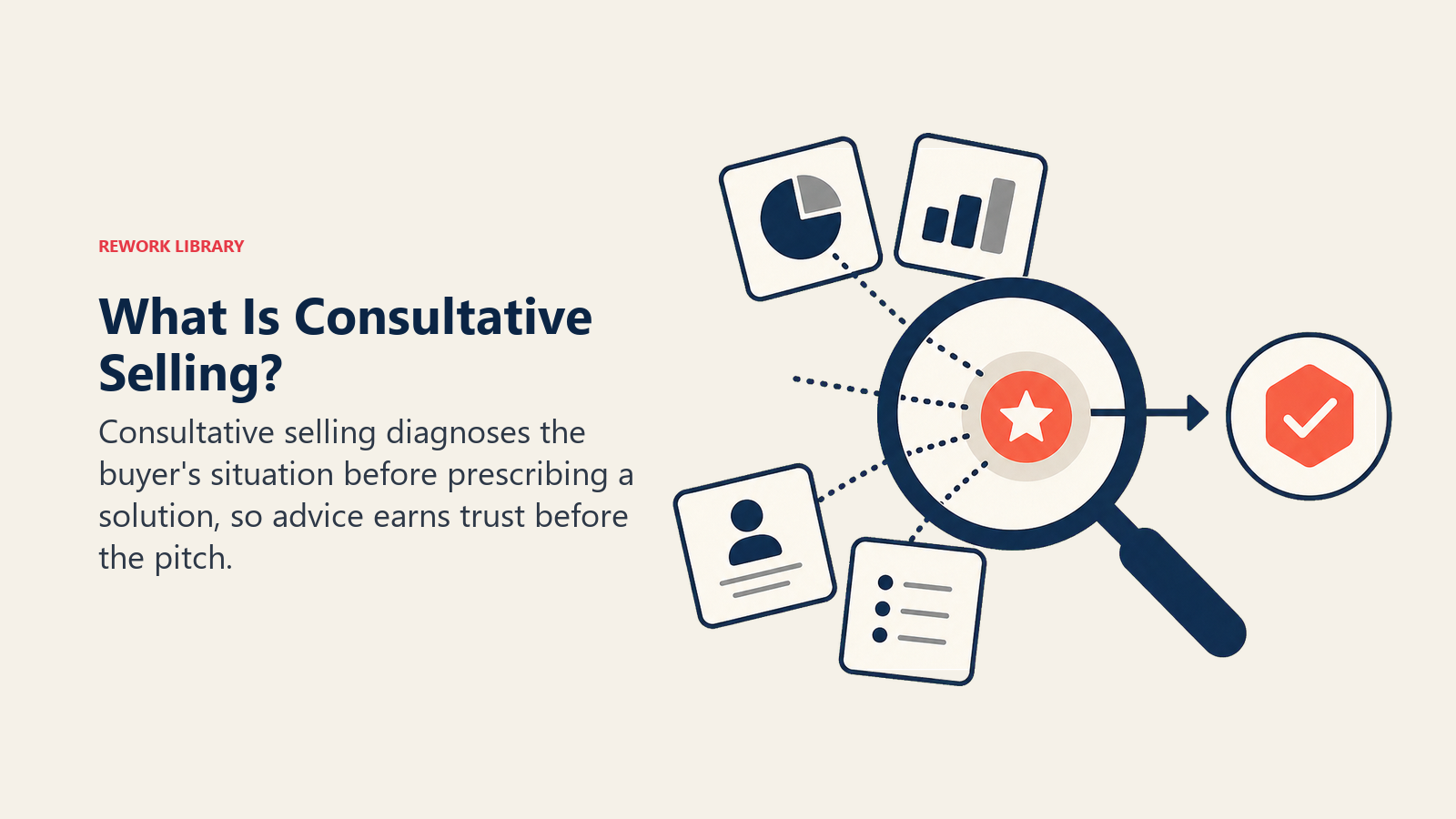
That's the whole idea. But what makes it different from just "good selling" is the structure: deliberate questioning, active listening, diagnosis of root causes, and recommendations that connect directly to the buyer's stated goals. It's not instinctive for most reps. It has to be learned and practiced.
Consultative selling works best in complex B2B deals with longer sales cycles, multiple stakeholders, and high-consideration purchases. In those contexts, buyers don't just want a product. They want someone who understands their problem well enough to help them think through it.
Consultative Selling vs Transactional Selling
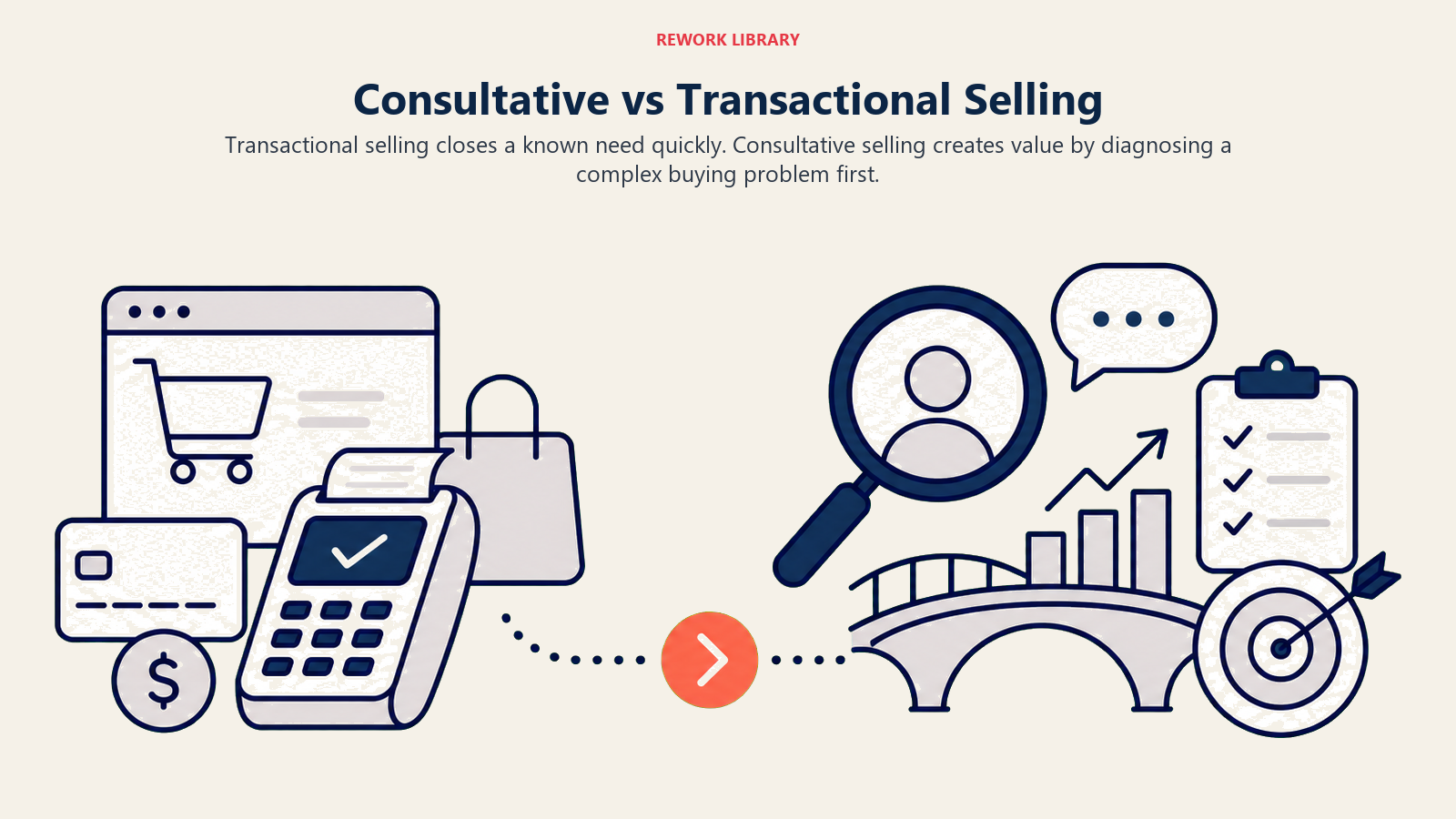
Most sales interactions fall somewhere on a spectrum between transactional and consultative. Neither is universally better. The question is which fits the deal.
| Factor | Transactional Selling | Consultative Selling |
|---|---|---|
| Primary goal | Close quickly, move volume | Build trust, solve the right problem |
| Rep's role | Product presenter | Trusted advisor |
| Conversation focus | Features, price, availability | Buyer's situation, challenges, goals |
| Typical deal size | Low to mid | Mid to high |
| Sales cycle length | Short (days to weeks) | Medium to long (weeks to months) |
| Number of stakeholders | Usually one | Often three or more |
| Repeat purchase driver | Price, convenience | Confidence in the rep's judgment |
| Example | Buying office supplies | Selecting a CRM, ERP, or consulting partner |
Transactional selling isn't broken. For commodity products where the buyer knows what they want, a short, efficient interaction is the right experience. But when the problem is complex, the stakes are high, or the buyer is still figuring out what they actually need, transactional selling fails. The rep who leads with price or features on a deal that requires diagnosis will lose to the rep who leads with questions.
The Consultative Selling Process
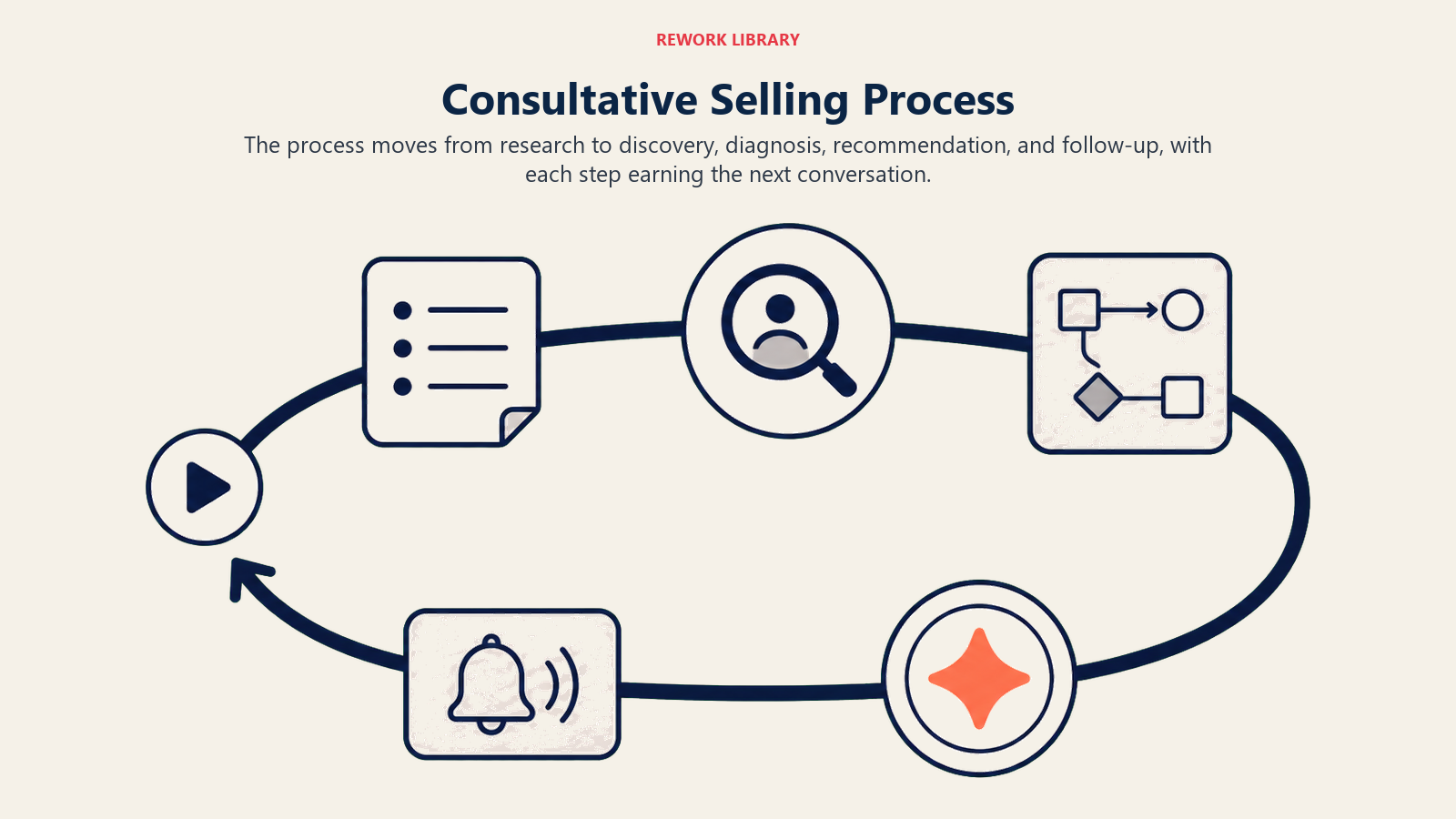
Consultative selling isn't a single conversation. It's a sequence of deliberate steps, each building on the last. Here's how it works in practice.
1. Research Before the Call
Before you speak with anyone, you should understand the buyer's business, industry, and likely challenges. This means reviewing the company's website, recent news, LinkedIn profiles for key stakeholders, and any data you can pull from your CRM about past interactions.
The goal isn't to pretend you know everything. It's to show up with relevant questions and avoid wasting the buyer's time on basics you could have learned beforehand. Buyers notice when a rep did their homework. And they notice when they didn't.
Good pre-call research also helps with opportunity qualification. You'll have a much clearer sense of whether this prospect fits your ideal customer profile before the first call.
2. Build Rapport and Set the Agenda
The opening minutes of a consultative sales call are not for pitching. They're for establishing that this is a two-way conversation and that your job is to understand before you advise.
Set a clear agenda early: explain why you're there, roughly how the conversation will go, and what you hope the buyer gets out of it. Then shift into discovery. Buyers who understand the structure upfront are more forthcoming. They know they're not about to sit through a demo.
Rapport here isn't small talk for its own sake. It's about demonstrating genuine interest in the buyer's situation. Ask about recent changes in their business, what's driving current priorities, and what they've tried before. These questions do double duty: they build rapport and gather intelligence.
3. Ask and Listen
This is the core of consultative selling. The quality of your questions determines everything downstream.
Effective consultative questions move from broad to specific:
- Situation questions: Understand the current state. "How does your team currently manage the pipeline between marketing and sales?" "What tools are in the stack today?"
- Problem questions: Surface pain. "Where does that process break down?" "What do your reps spend the most time on that isn't actual selling?"
- Impact questions: Quantify the cost. "What does that bottleneck cost you per quarter?" "How does that affect ramp time for new hires?"
- Vision questions: Invite the buyer to describe the ideal state. "If you could fix one thing about the current setup, what would it be?"
Asking good questions matters, but so does what you do after. Active listening means you're tracking the buyer's exact words, noticing what they emphasize, and following threads they open without letting them drop. Don't move to your next question until you've genuinely absorbed the answer to the previous one.
The SPIN Selling framework provides a rigorous structure for this phase, specifically the Situation-Problem-Implication-Need-payoff sequence.
4. Diagnose Needs
After discovery, you should be able to articulate the buyer's situation back to them more clearly than they said it themselves. That's the diagnostic step.
This means synthesizing what you heard, identifying the root cause (not just the symptom), and confirming your diagnosis with the buyer before jumping to recommendations. A line like "Based on what you've described, it sounds like the core issue is X, which is causing Y. Does that capture it?" does two things: it shows you listened, and it gives the buyer a chance to correct or refine.
Skipping diagnosis and rushing to recommendations is the most common consultative selling failure. The rep thinks they've understood enough, but they've actually only captured the surface. The resulting recommendation doesn't hit the real pain, and the deal stalls.
Connecting diagnosis to a structured qualification approach, like the MEDDIC framework, helps you confirm that the need is real, urgent, and tied to economic impact before investing deeper in the deal.
5. Recommend
Only after thorough diagnosis do you bring the product into the conversation. And when you do, you frame it directly against the buyer's stated needs.
This isn't a standard demo. It's a targeted recommendation that connects specific capabilities to specific problems the buyer has confirmed. "You mentioned that your team loses about three hours per week on manual data entry between systems. Here's exactly how our integration layer addresses that."
The recommendation phase is shorter than most reps expect, because the hard work happened in discovery. The buyer has already talked themselves into believing the problem is real and the cost of inaction is high. Your job is to show them the path from current state to desired state, using their language.
6. Handle Objections
Objections in consultative selling are different from objections in transactional selling. In a product-led sale, objections are mostly about price and features. In a consultative sale, they're often about risk, timing, internal politics, or uncertainty.
Handle them by returning to what the buyer said earlier. "You mentioned earlier that this is costing your team X hours per week. What would need to be true for the timing to work?" Or: "You said the current setup isn't sustainable for the next growth phase. What concerns do you have about making the change?"
The lead qualification frameworks your team uses upstream often predict which objections will surface. Buyers who weren't fully qualified tend to raise process and budget objections late. Buyers who were well-qualified raise risk and change-management objections, which are more workable.
7. Close and Follow Up
Closing in consultative selling is a natural conclusion to a well-run process, not a technique applied under pressure. If you've diagnosed correctly and recommended well, the buyer knows what they need and why. The close is confirming next steps, not wrestling them out.
Follow-up is part of the deal, not an afterthought. After the close, check in on implementation, connect with stakeholders who weren't in the buying conversation, and make sure the promised outcomes are materializing. Consultative sellers build the kind of trust that generates expansions, referrals, and long-term retention.
For a view into how deals progress through stages after the close, see deal progression management.
Consultative Selling vs Solution Selling vs Challenger Sale
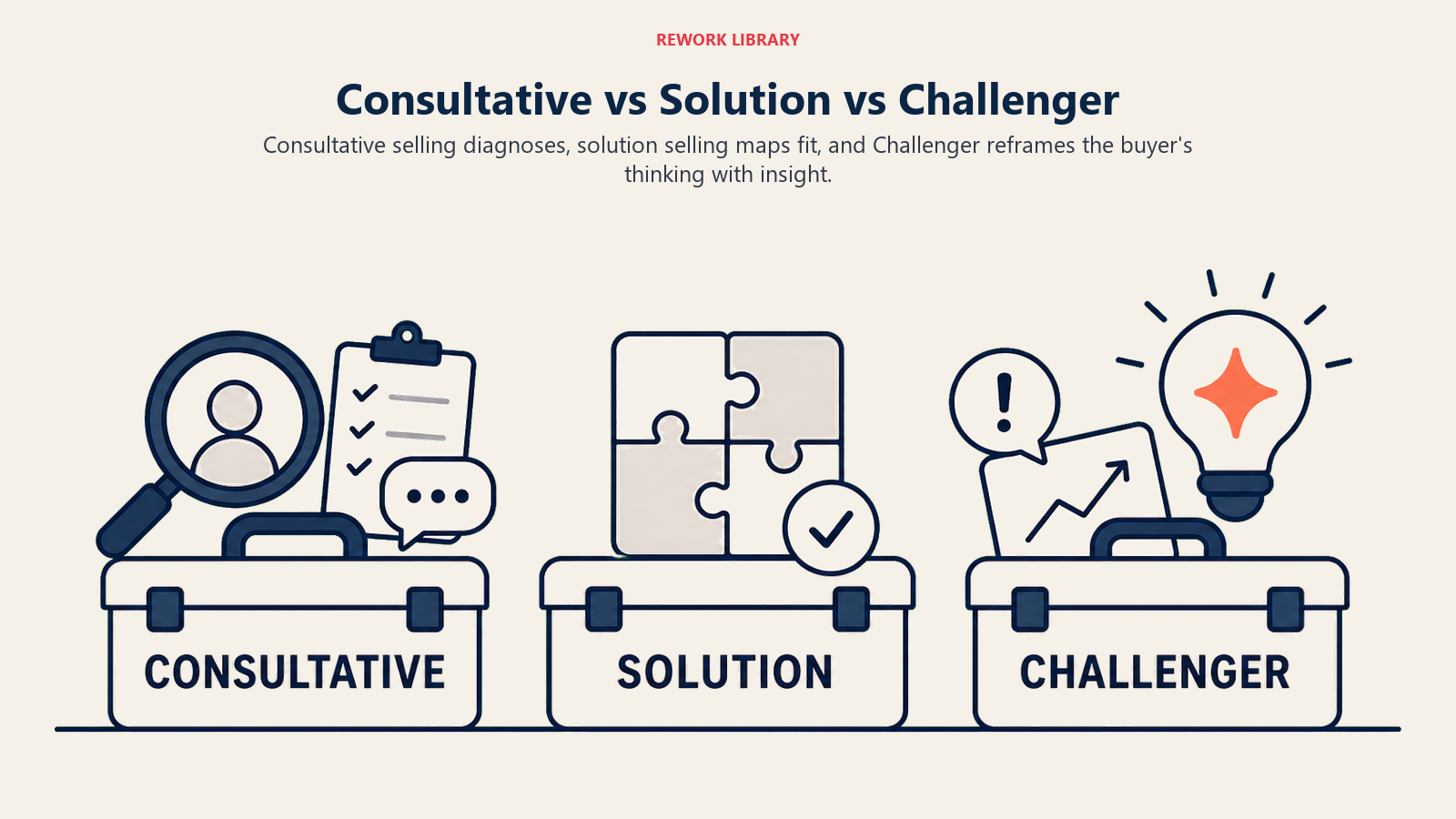
These three are often conflated, and understandably so. They share a foundation. But they're distinct approaches with different emphases.
| Dimension | Consultative Selling | Solution Selling | Challenger Sale |
|---|---|---|---|
| Core premise | Understand before advising; rep as trusted advisor | Diagnose pain, then position product as the solution | Teach the buyer something new; challenge their assumptions |
| Rep's role | Advisor / diagnostician | Pain-finder / solution architect | Commercial teacher / constructive disruptor |
| Discovery approach | Deep questioning, active listening, diagnosis | Pain-focused discovery, mapping to solution capabilities | Insight-led opening, then tailored teaching |
| Product entry point | After thorough diagnosis | After confirming pain and urgency | After reframing the problem with a unique insight |
| Works best when | Buyer knows they have a problem but not the solution | Buyer has acknowledged pain and needs help scoping | Buyer doesn't know they have a problem, or is anchored to the wrong solution |
| Risk | Too passive if the buyer is anchored to a wrong view | Can become too formulaic, too demo-heavy | Can feel adversarial or arrogant if delivered poorly |
| Typical deal type | Complex B2B, any industry | Enterprise software, consulting, services | Large enterprise, multi-stakeholder, high disruption |
Consultative selling is the broadest of the three. Solution selling is a specific application of it, focused tightly on pain discovery and solution positioning. The Challenger Sale shares the consultative mindset but adds a proactive insight component: the rep isn't just responding to the buyer's reality, they're redefining it.
In practice, most skilled B2B sellers blend all three depending on the deal and buyer.
Key Consultative Selling Skills
The methodology is only as good as the skills behind it. Three matter most.
Questioning
Great consultative sellers are deliberate about question design. They open with broad situational questions, narrow into specific problems, dig into impact, and invite the buyer to articulate the ideal outcome. They avoid leading questions that telegraph the answer they want. And they know when to stop asking and start listening.
Active Listening
This is harder than it sounds. Active listening means processing what the buyer says, noting what they emphasize or avoid, and responding in ways that make them feel genuinely heard. It also means resisting the urge to immediately connect what the buyer says to your product. Let the discovery breathe before moving to recommendation.
Business Acumen
Consultative selling requires understanding how businesses work: how revenue is generated, where costs are incurred, what a bad quarter looks like from a CFO's chair, and how change gets approved in large organizations. Without this, your questions will stay shallow and your recommendations won't hit the real levers.
Business acumen is especially important when the buyer is a senior executive. A VP of Sales asking about pipeline accuracy isn't just asking about software. They're thinking about forecast credibility, board expectations, and rep performance. A rep who understands that context earns trust faster. For context on what pipeline accuracy means at that level, see what is sales pipeline.
Consultative Selling Examples
Here's how a consultative selling sequence plays out in a real B2B context. The seller is a CRM vendor talking to a VP of Sales at a 75-person software company.
| Stage | What the Seller Does | Example Exchange |
|---|---|---|
| Research | Reviews company LinkedIn, recent news, CRM notes from prior calls | Learns the company doubled headcount last year, struggles with pipeline visibility |
| Rapport / agenda | Opens call by setting context, not pitching | "I want to understand what's working and what isn't before we talk about anything on our end." |
| Situation questions | Gathers facts about the current setup | "How many reps do you have on the team right now, and what tools are they using for pipeline management?" |
| Problem questions | Surfaces friction | "Where does visibility break down when you're trying to call the forecast for the quarter?" |
| Impact questions | Quantifies cost | "When the forecast misses, what does that mean for planning, hiring decisions, resource allocation?" |
| Vision questions | Buyer describes the ideal | "If the pipeline data were reliable, what decisions would you make differently?" |
| Diagnosis | Synthesizes and confirms | "So the core issue sounds like: reps are updating the CRM inconsistently, which makes your forecast unreliable, which affects board reporting. Is that right?" |
| Recommendation | Targeted to confirmed pain | "The piece that solves that specific problem is our automated activity capture, no manual entry. Here's exactly how it works in a team your size." |
| Objection handling | Connects to earlier stated pain | "You mentioned the forecast misses are affecting board trust. How does that weigh against the risk of changing tools mid-year?" |
| Close | Natural next step | "Based on what we've covered, a 30-day pilot with your top 10 reps makes sense. What would you need from us to get that approved internally?" |
Common Mistakes
Leading with the product. The most common failure. The rep gets excited about features and starts pitching before they understand the problem. Buyers disengage fast.
Shallow discovery. Asking only one or two problem questions and moving on. Real diagnosis requires following threads, not just checking boxes.
Forgetting to diagnose. Collecting a lot of information in discovery but never synthesizing it. The buyer hears a recommendation that doesn't match what they said, and trust evaporates.
Confusing rapport with consultation. Being likable isn't the same as being useful. Buyers want reps who understand their business, not just reps they enjoy talking to.
Not qualifying while consulting. Consultative selling takes time. If the deal isn't qualified, that time is wasted. Run discovery and qualification in parallel. Use a framework like MEDDIC or opportunity qualification to confirm the deal is worth pursuing.
Best Practices
Prepare better questions, not better pitches. The time you'd spend polishing slides is better spent designing the questions that will reveal the buyer's real situation.
Confirm your diagnosis before recommending. A short summary check ("so the core issue is X, which causes Y, does that capture it?") prevents misaligned recommendations and shows the buyer you were listening.
Use their language. When you recommend, use the exact words the buyer used to describe their problem. It signals that your recommendation is a response to their reality, not a canned pitch.
Know when to push. Consultative selling isn't passive. If the buyer is anchored to a wrong diagnosis or minimizing a real problem, surface it. Being the rep who helps them think more clearly about their own situation is more valuable than being the one who just agrees.
Track pipeline health alongside your method. A great consultative process doesn't guarantee every deal closes. Check in regularly on deal progression to spot stalls early.
Consultative selling doesn't close deals by being clever. It closes them by being genuinely useful. When buyers trust that a rep understands their problem, the path from discovery to decision gets shorter, not longer. The reps who internalize that tend to carry bigger pipelines, win more of them, and keep customers longer.

Head of Enterprise Solutions
On this page
- What Is Consultative Selling?
- Consultative Selling vs Transactional Selling
- The Consultative Selling Process
- 1. Research Before the Call
- 2. Build Rapport and Set the Agenda
- 3. Ask and Listen
- 4. Diagnose Needs
- 5. Recommend
- 6. Handle Objections
- 7. Close and Follow Up
- Consultative Selling vs Solution Selling vs Challenger Sale
- Key Consultative Selling Skills
- Questioning
- Active Listening
- Business Acumen
- Consultative Selling Examples
- Common Mistakes
- Best Practices