Patient Referral Programs for Dental Practices: Building Word-of-Mouth That Scales
Turn this article into takeaways for your work.


Each assistant summarizes the article only for you and suggests best practices for your work.
The best new patient you'll ever see walked through your door because an existing patient told them to come. They arrived already trusting you, they accepted more treatment, they asked fewer price-comparison questions, and they stayed longer. And they probably sent someone else within the first year.
Referred patients aren't just cheaper to acquire. They're structurally better patients. They've passed through a pre-qualification filter: someone who knows them vouched for your practice. That word-of-mouth endorsement does the trust-building work that a Google Ad can't do no matter how good the landing page is.
Most dental practices generate some referrals passively. Patients who love the experience tell people. But passive referral generation is unpredictable and leaves most of the available volume on the table. A practice with 1,200 active patients who feel positively about their care should be generating 40-80 referrals per year from systematic effort. Most practices with the same base generate 15-20 referrals per year because they never built the system to capture more. Referral programs work best alongside new patient specials and promotions that give referring patients something compelling to share with friends.
This article is about building that system and keeping it compliant with the regulations that govern dental patient incentives.
Key Facts: Patient Referral Programs
- Referred patients have a 37% higher retention rate and 25% higher lifetime value than patients acquired through advertising (source: Wharton School of Business, Customer Referral Study)
- The cost to acquire a referred patient averages $20-$50, compared to $150-$400 for a Google Ads-generated patient in competitive markets (source: Dental Practice Management Association)
- The CDC reports that roughly one-third of adults did not visit a dentist last year, meaning a large share of your patients' social networks are not under active dental care and are reachable through a well-run referral program
Why Referrals Are Your Best Acquisition Channel
The economics of referral-generated patients are fundamentally different from paid acquisition.
Acquisition cost: A referral from an existing patient costs you approximately the price of your referral acknowledgment: a thank-you card, a small gift, or a charitable donation in their name. That's $10-$40. A patient from Google Ads in a competitive market costs $150-$400. A referred patient costs 5-10x less to acquire.
Case acceptance rate: Referred patients accept comprehensive treatment at a noticeably higher rate than cold-channel patients. Where a new patient from a paid ad might accept 30-35% of presented treatment, a referred patient who came on the recommendation of a trusted friend or family member often accepts at 45-55%. They came predisposed to trust you. This trust advantage compounds when your case acceptance training is solid, referred patients need less persuasion, so strong presentation skills close them at very high rates.
Lifetime value: The same trust premium that drives higher case acceptance also drives longer retention. Referred patients stay with the practice longer, refer more people themselves, and are less likely to leave over an insurance change or a slightly lower-priced competitor.
The referral multiplier: Referred patients also refer at higher rates than non-referred patients. A practice where 30% of patients came through referral has a self-reinforcing growth dynamic. The channel builds itself if you maintain the patient experience that generated the original referrals. McKinsey's healthcare consumer research confirms that word of mouth and trusted personal recommendations remain among the top drivers for healthcare provider selection, making referral programs particularly powerful in dental compared to other healthcare categories.
Incentive Structures Within Regulatory Limits
Before implementing any incentive program, understand the regulatory landscape. Dental board rules on patient referral incentives vary significantly by state, and some states that appear permissive at first reading have nuanced restrictions that apply to licensed practitioners.
The general rule:
Most state dental boards permit practices to "appreciate" referring patients with nominal gifts, as long as the gift is not explicitly framed as compensation for the referral and the value is modest. The line the boards are drawing is between expressing gratitude and paying for patient generation. Cross that line and you're in kickback territory, which carries license risk.
What's typically permitted:
- Thank-you cards or notes (always appropriate)
- Small gifts valued at $10-$25 (gift cards to local restaurants, floral arrangements, branded merchandise)
- Charitable donations in the patient's name (typically $25-$50 donated to a charity of their choice)
- In-practice recognition (a "Patient of the Month" board, a thank-you acknowledgment in a newsletter)
What's typically problematic:
- Cash payments for referrals
- Treatment credits that directly reduce the referring patient's bill
- High-value gifts (anything above $50 often draws scrutiny)
- Any arrangement that looks like a structured fee for service
Gift cards specifically:
Gift cards are widely used and generally considered appropriate when the value is modest and they're given as a gesture of appreciation rather than as an explicit "payment for referral." A $25 Starbucks card given with a handwritten note thanking a patient for referring their neighbor is very different from advertising "Refer a friend, get a $100 gift card." The framing matters.
State-by-state reality:
California, Texas, and Florida have explicit dental board guidance on referral incentives; other states rely on general anti-kickback principles from their licensing statutes. Before launching any incentive program, have your attorney or compliance advisor confirm the rules in your specific state. The compliance note here isn't theoretical. Board complaints over referral incentive programs do happen, and the cost of defending one far exceeds the cost of getting a legal review upfront. The ADA's dental insurance and practice resources include guidance on patient communication practices that intersect with referral and retention programs.
Tracking and Attribution
The most common failure mode of referral programs isn't compliance. It's tracking. Practices implement a referral thank-you system and then have no idea which patients referred whom, how many referrals came in this month, or whether the program is growing or shrinking.
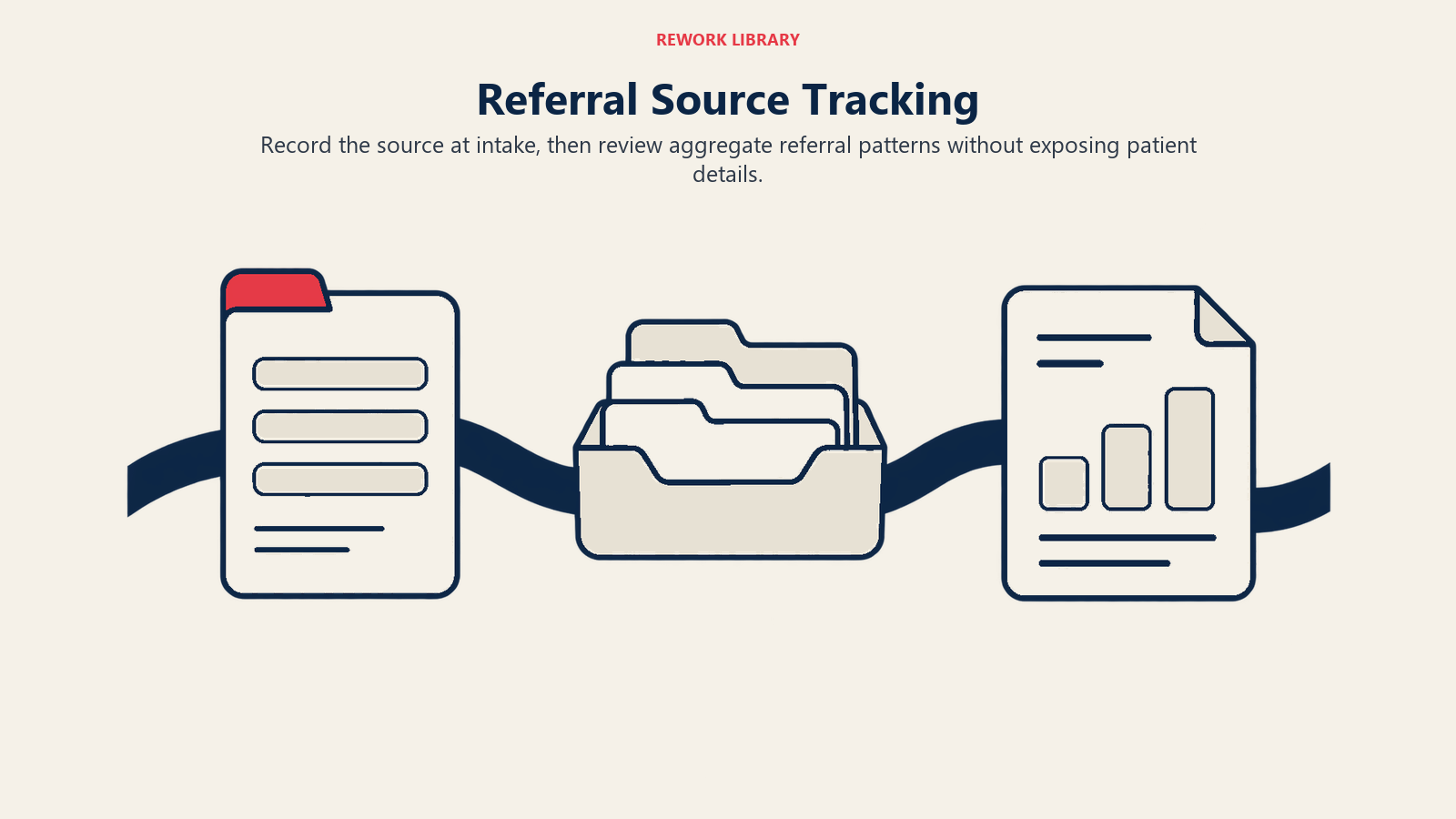
How to capture referral source accurately:
The standard "How did you hear about us?" question on a new patient form is useful but incomplete. Patients answer it hastily, and the form often lumps "referral from patient" and "referral from friend" together without capturing the referring person's name.
Better approach: train your front desk coordinator to ask specifically during the new patient phone call or the intake process: "Did someone in our practice recommend us to you? We'd love to know who to thank." This captures the referring person's name and creates a warm touchpoint.
In your practice management software (Dentrix, Eaglesoft, Carestream, or similar), every new patient should have a referral source category selected. Create a category specifically for "Patient Referral" and a field for the referring patient's name. Run a referral source report monthly to see volume trends and identify your most active referrers.
Referral tracking template (monthly):
| Month | New patients from referral | % of total new patients | Top referring patients | Referral incentives sent |
|---|---|---|---|---|
| Target | 12-20 | 30-40% | Track names | Track value |
Closing the loop:
When a new patient comes in by referral and you have their referring patient's name, do three things within 48 hours:
- Send a handwritten thank-you note to the referring patient (not email, handwritten)
- If using a gift incentive, process it promptly (delayed thank-yous send the wrong signal)
- Have the treating provider mention the referral at the referring patient's next appointment. Something like: "By the way, thank you so much for sending the Petersons. That meant a lot to us."
That three-step close builds a referral culture instead of just a referral transaction.
Staff Involvement and Culture
The front desk team is your referral program's front line. They have the most patient-facing time, they answer the phone, and they set the patient's experience at arrival and departure, two high-sentiment moments that are ideal for planting referral seeds.
Training front desk to ask for referrals:
The ask should feel natural, not transactional. It works best when it follows a genuinely positive moment. After a patient says "That went so well, I barely felt anything," the front desk coordinator has an ideal opening.
Sample scripting:
Coordinator: "I'm so glad! Dr. [Name] really appreciates hearing that. If you have friends or family who've been putting off coming to the dentist, we'd love to be there for them the same way. We're always accepting new patients. If you'd like, I can give you a couple of our cards to pass along."
Or more direct: "Thank you so much. We really value patients like you. And honestly, the best compliment you can give us is introducing someone you care about to our practice. We'll make sure they have the same experience you did."
Neither script feels like a sales pitch. Both feel like a genuine expression of connection. Building this kind of interaction into your standard patient experience requires thoughtful dental patient communication strategies across every touchpoint.
Incentivizing staff participation:
Some practices create staff referral contests, tracking which front desk team member successfully attributes the most new patient referrals in a month and offering a bonus or prize. This works well when the team is already engaged, but it can feel forced if the culture isn't already patient-centered. The better approach is to track referral metrics in your monthly team meeting and celebrate progress as a team achievement rather than a competition.
Making referral generation part of the patient experience:
The best referral programs don't feel like programs. They feel like part of how the practice operates. Practices with strong referral cultures do a few things consistently:
- Providers thank patients by name for specific referrals during appointments
- The front desk acknowledges family connections ("Oh, you're Michael's mom. He's such a great patient")
- New patients who came by referral are specifically told how their referral source made a difference ("Mrs. Johnson has been coming to us for nine years. We're so glad she sent you our way")
These moments reinforce that your practice is a community, not just a healthcare transaction.
See Patient Communication Strategies for the broader communication framework, and Dental Recall & Recare Systems for how recall touchpoints create natural referral opportunities.
Building a Referral Program That Runs Without You
A referral program that requires constant owner attention will stop running when the owner is busy, which is always. The goal is a system that operates with minimal friction once it's designed.
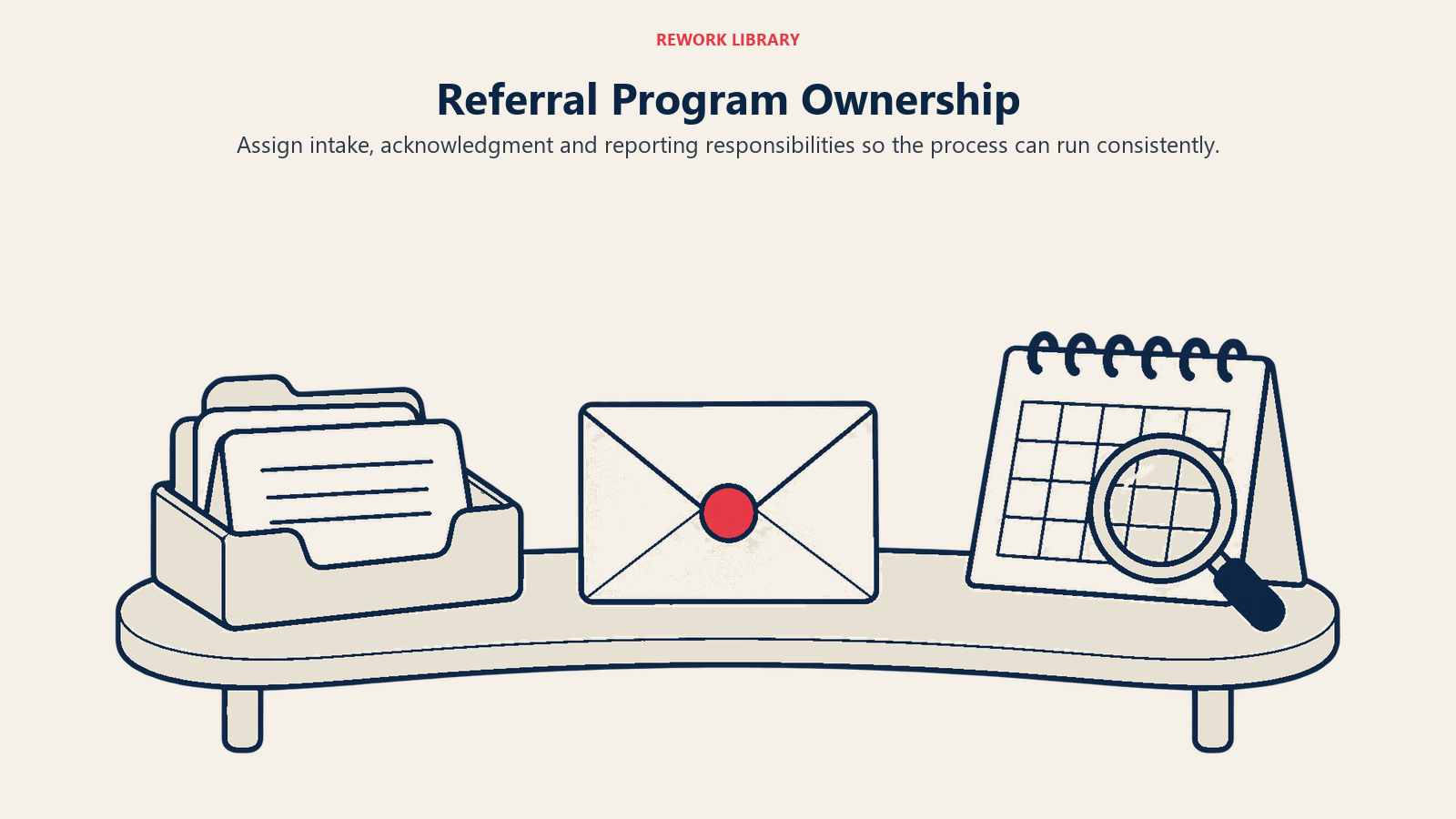
System components:
- Referral source tracking built into your new patient intake (form field + front desk verbal confirmation)
- Thank-you protocol with assigned responsibility (who sends the note, within what timeframe)
- Incentive fulfillment process with budget pre-approved and materials on hand
- Monthly referral report pulled from practice management software
- Quarterly referral program review in the team meeting (what's working, who referred recently, is the volume growing)
That's the whole system. It takes about 20 minutes per week to maintain once it's built.
When referral volume is low:
If you're generating fewer than 10 referrals per month from a practice with 1,000+ active patients, the most common cause isn't the incentive program. It's the patient experience. Referrals are downstream of trust. If patients aren't referring at volume, the question to ask is whether the experience is genuinely memorable enough to create advocates. Investing in patient comfort amenities and a consistently excellent clinical experience creates the emotional foundation that referral programs depend on.
See Dental Review Management and Key Financial Metrics for Dental Practices for the operational and financial context that supports a strong patient experience foundation.
Conclusion
Referral programs don't require big budgets. They require consistency, a system, and a patient experience worth talking about. The infrastructure is simple: ask for referrals at the right moments, track who refers, say thank you quickly and personally, and review your referral metrics monthly. The BLS Occupational Outlook for Dentists projects around 4,500 new dentist openings annually through 2034, as more providers enter the market, the patients who feel a genuine connection to your practice and refer their friends become your most defensible competitive asset.
The practices that generate 30-40% of new patients through referrals didn't get there by accident. They built a culture where referring was natural, they made the ask easy for patients, and they created a feedback loop that reinforced referral behavior over time.
That's achievable for any practice. Start with the tracking system, build the scripting for your front desk, and send a handwritten thank-you card to the next patient who refers someone to your practice. Then do it again. And again. The compounding comes from the consistency.
Learn More