Key Financial Metrics for Dental Practices: The Numbers Every Owner Must Track

Turn this article into takeaways for your work.


Each assistant summarizes the article only for you and suggests best practices for your work.
The key financial metrics every dental practice owner should track are collection rate, overhead ratio by category, hygiene production percentage, new patient lifetime value and acquisition cost, and production per visit. Together these business numbers reveal whether a practice is healthy or quietly losing money. This guide gives the formula, benchmark range, and warning threshold for each one.
The average dental practice owner has a vague sense of whether last month was "good" or "bad" based on how the schedule felt. A genuinely excellent dental business owner knows their collection rate to one decimal point, can tell you whether their lab costs are inside or outside benchmark, and reviews a monthly financial dashboard the way a pilot checks instruments.
Most owners sit closer to the first description than the second. And the gap between those two profiles isn't a matter of financial sophistication. It's a matter of knowing which numbers to track and what they mean. This article gives you both.
The goal isn't to turn you into an accountant. It's to give you the specific metrics, the benchmark ranges, and the warning thresholds that allow you to run your practice from financial clarity rather than financial instinct. These numbers also connect directly to your dental practice growth model, where each lever has a measurable financial expression.
Key Facts: Dental Practice Financial Performance
- The average overhead ratio for a general dental practice is 60-64%; practices below 55% are considered top performers (source: American Dental Association Survey of Dental Practice)
- Practices that conduct monthly financial reviews grow 22% faster over five years than those that review quarterly (source: Dental Economics Practice Management Study, 2023)
Production and Collections
Production is what you diagnose and complete. Collections is what you actually get paid. The gap between the two is the most important number most practices never analyze properly.
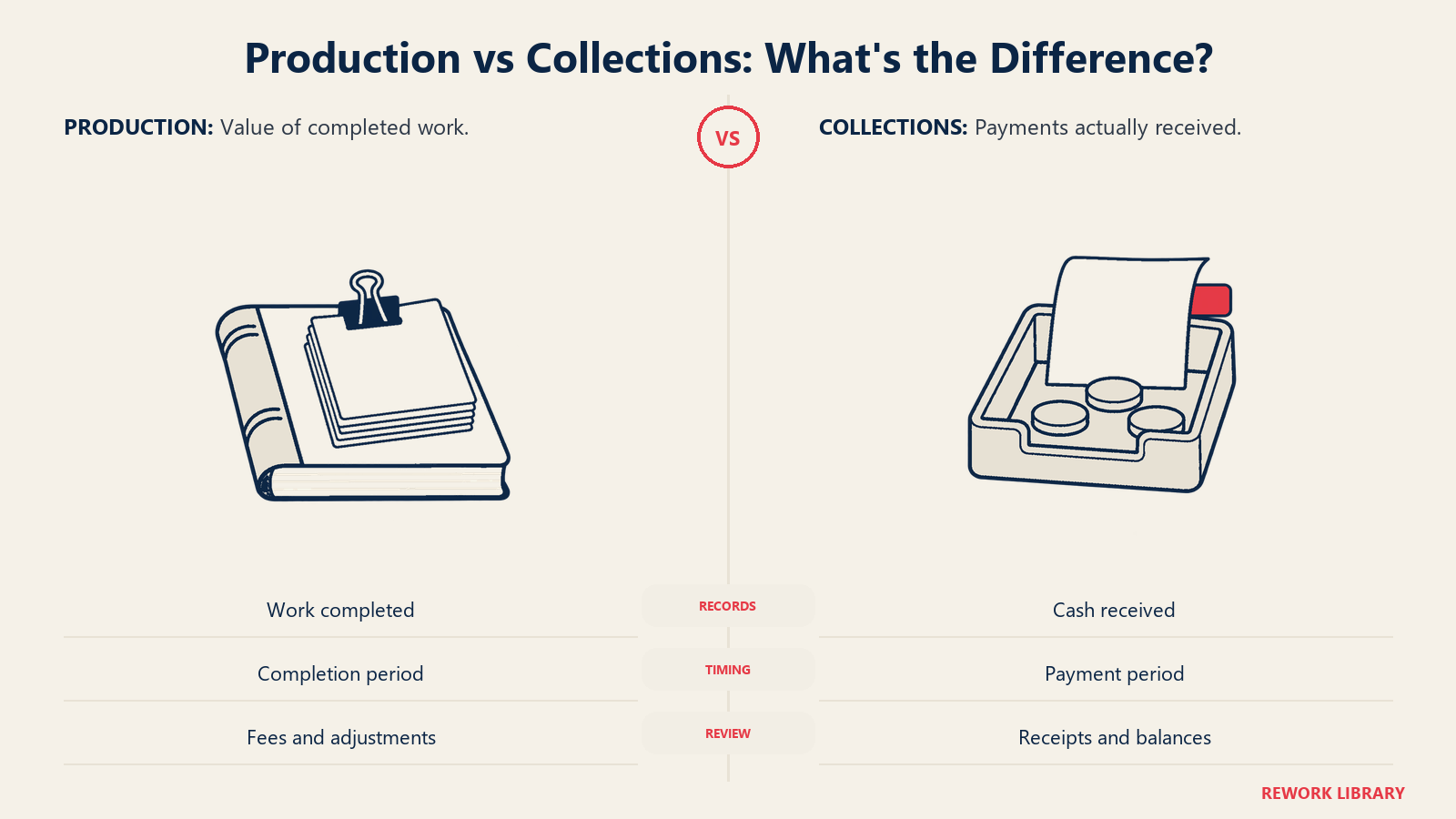
Gross Production is the total value of all treatment completed at your full posted fee, before any insurance adjustments, discounts, or write-offs. This is the top-line number most practice management software highlights on the daily huddle report.
Net Collections is the actual cash that hits your bank account after all adjustments. This is what funds your payroll, your rent, your loan payments, and your income.
Collection Rate = Net Collections / Gross Production × 100
For a healthy practice, collection rate should be 95-99% of adjusted (post-write-off) production. If you're running below 92%, you have either a billing problem (claims not being submitted or followed up), an aging accounts receivable issue (patients with open balances that aren't being collected), or an insurance write-off category problem that's being miscoded.
Write-offs and adjustments are where the real financial leakage hides. Every insurance contract you sign creates a contractual adjustment: the difference between your fee and the plan's fee. That adjustment isn't income you're collecting; it's income you agreed not to collect. Tracking your adjustments as a percentage of gross production tells you what your insurance participation is actually costing you in revenue terms.
Monthly Metric Reference:
| Metric | Formula | Healthy Range | Warning Threshold |
|---|---|---|---|
| Gross Production | Total billed at full fee | Track monthly | Flat 3+ months |
| Collection Rate | Net collections / Adjusted production | 95-99% | Below 92% |
| Adjustment Rate | Total adjustments / Gross production | 10-25% | Above 30% |
Overhead Ratio and Category Breakdown
Overhead is the total of all operating expenses as a percentage of net collections. It's the most comprehensive measure of practice efficiency, and it's the number that most directly determines owner income.

Total Overhead Rate = Total Operating Expenses / Net Collections × 100
The industry benchmark for a healthy general practice is 55-65% overhead. Below 55% is exceptional. Above 68% typically means either the practice is in a growth phase absorbing new costs, or there are cost structure problems that need attention.
But total overhead is only useful as a starting point. The real insight is in the breakdown:
Staff Costs (salaries, benefits, payroll taxes) should run 22-28% of collections. This is typically the largest overhead category, and it's where practices either build efficiency or bleed profitability. A team running at 32% of collections is either overstaffed or underpaid in a high-cost market. Both situations require intervention. The BLS Dental Hygienists Occupational Outlook and Dental Assistants data provide national wage benchmarks that can help you gauge whether your staffing costs are market-appropriate. Dental team compensation models directly affect where your staff cost ratio lands.
Lab Costs should be 8-12% of collections for a general practice. Below 8% may indicate under-use of lab-supported procedures (which is a production mix problem). Above 14% usually means either lab fees haven't been renegotiated in years, or the fee schedule hasn't kept pace with case complexity.
Dental Supplies should run 5-7% of collections. Above 8% signals either purchasing inefficiency (buying without a purchasing protocol), inventory mismanagement, or waste.
Facility Costs (rent, utilities, maintenance) should be 5-8% of collections. For practices in high-cost real estate markets, this may legitimately run to 10%, but anything above that is a structural overhead problem.
Overhead Category Reference:
| Category | Healthy Range | Warning Threshold |
|---|---|---|
| Staff costs | 22-28% of collections | Above 32% |
| Lab costs | 8-12% of collections | Above 14% |
| Dental supplies | 5-7% of collections | Above 9% |
| Facility costs | 5-8% of collections | Above 10% |
| Marketing | 3-6% of collections | Below 2% (underinvesting) |
| Total overhead | 55-65% | Above 68% |
See Dental Lab Cost Management for specific strategies on managing your lab cost category.
Hygiene Production Ratio
Hygiene production is one of the most reliable leading indicators of overall practice health. A strong hygiene department means a strong recall system, which means predictable revenue and a consistent pipeline of patients who need restorative work identified and presented.
Hygiene Production Ratio = Hygiene Department Production / Total Practice Production × 100
The benchmark: hygiene should contribute 30-35% of total practice production. Below 30% often signals one or more problems: under-scheduled hygiene appointments, a hygienist who isn't identifying and presenting periodontal treatment, or a hygiene fee schedule that hasn't been updated in several years.
Above 40% isn't inherently a problem, but in combination with low restorative production it may suggest that hygiene is identifying needs that aren't being converted to accepted treatment.
The hygiene production ratio is also a capacity planning tool. A practice adding an associate doctor needs hygiene production at or above benchmark to give that associate a filled schedule with treatment to provide. Associates who join a practice with weak hygiene recall end up with empty chairs, and they leave. Building a strong hygiene department production baseline before hiring is one of the most overlooked associate readiness indicators.
Per-Hygienist Production is a related metric worth tracking separately. A hygienist working a full schedule of eight to ten patients per day should produce $1,200-$2,000 per day in collections, depending on the practice's fee schedule and market. Consistently below $1,100 per day suggests either scheduling efficiency issues or a fee schedule problem.
New Patient Value and Acquisition Cost
This is the metric set most dental owners never calculate, and it's one of the most important for making intelligent marketing decisions.
New Patient Lifetime Value (LTV) = Average annual spend per patient × Expected years of relationship
For a general family practice, a healthy estimate of average annual patient spend is $500-$700 per year. Patient relationships typically last 8-12 years before life changes (relocation, insurance change, etc.) end the relationship. That puts new patient LTV in the $5,000-$8,400 range for an average patient in a general practice. Context for why unmet demand is real: the CDC reports that roughly one in three adults does not visit a dentist in a given year, representing a substantial pool of potential new patients for practices with effective acquisition systems.
For a cosmetically-focused practice with higher elective spend, LTV can be $15,000-$25,000 over the same period.
Cost Per New Patient (CPnP) = Total marketing spend / Number of new patients attributed to marketing
Industry benchmarks vary by channel: referral-sourced patients cost $15-$50 to acquire (mostly the cost of the referral program). SEO-sourced patients typically run $80-$150 per acquisition over time. Google Ads patients in competitive markets cost $150-$400+ per new patient, depending on the procedures being advertised.
Return on Marketing Spend = New Patient LTV / CPnP
If a new patient from Google Ads costs you $280 to acquire and has a lifetime value of $6,000, your ROI is 21x. That's an excellent investment. If your CPnP is $280 and your LTV is $1,200 (because case acceptance is poor and patients don't return), you're losing money on new patient acquisition without knowing it. For the full analysis on what dental paid search actually costs, see Google Ads for Dentists.
New Patient Value Reference:
| Metric | General Practice | Cosmetic-Focused | Warning Threshold |
|---|---|---|---|
| Annual spend per patient | $500-$700 | $1,500-$4,000 | Below $350 |
| LTV (10-year horizon) | $5,000-$7,000 | $15,000-$40,000 | N/A |
| CPnP (Google Ads) | $150-$400 | $200-$600 | Above $500 (general) |
| CPnP (SEO) | $80-$150 | $100-$200 | N/A |
Production Per Visit
Production per visit measures how efficiently each appointment slot generates revenue. It's a direct reflection of your procedure mix, fee schedule, and scheduling structure.
Production Per Visit = Total monthly production / Total patient visits
For a healthy general practice, $250-$350 per visit is the typical benchmark. High-performing practices with strong cosmetic and restorative procedure mixes average $400+.
Low production per visit typically points to: an insurance-heavy fee schedule where effective fees are heavily discounted, a scheduling structure that packs in too many short hygiene appointments relative to restorative time, or a procedure mix that hasn't evolved with the practice's capabilities.
The fix is scheduling template design: building provider schedules that allocate specific blocks for high-value procedures and protect them from being filled with lower-production appointments. See Dental Scheduling Optimization for how to structure your templates around production targets.
Building Your Monthly Dashboard
Financial clarity is a leadership function, not just an accounting function. The practice owner who reviews these numbers monthly, compares them to benchmarks, and makes adjustments based on what the data shows is running a fundamentally better business than the one who waits for the annual tax return to understand what happened.

A monthly financial review should take 30-45 minutes and cover:
- Gross production and net collections (vs. prior month and same month prior year)
- Collection rate
- Overhead ratio by category (staff, lab, supplies, facility, marketing)
- New patients by source and count
- Hygiene production as % of total
- Production per visit
That's seven numbers. Review them in a consistent format each month. Flag anything outside benchmark. Take action before it compounds.
For how these metrics shift at each growth stage, see Dental Practice Growth Stages. And for the fee schedule decisions that affect your effective production numbers, see Dental Fee Schedule Optimization.
Conclusion
Financial clarity isn't a luxury for large practices with CFOs. It's a discipline that any practice owner can build with seven metrics, a monthly calendar block, and the benchmarks outlined in this article. The practices that grow consistently aren't necessarily better clinically than their competitors. They're usually better at knowing their numbers and acting on them. The ADA Health Policy Institute's trends in dentist income and revenue publishes annual data that provides a national baseline for benchmarking your own production and income figures against peers.
Start with your collection rate and overhead ratio. Those two numbers alone, benchmarked honestly against the ranges above, will tell you more about the health of your business than a year's worth of P&L statements reviewed in isolation.
Measure. Benchmark. Decide. That's the discipline that separates practice owners from practice managers of their own business.
Frequently Asked Questions
What is the single most important financial metric for a dental practice? Collection rate. It tells you how much of the dentistry you produce actually turns into cash in the bank. A healthy practice collects 95-99% of adjusted production. Anything below 92% points to a billing, accounts receivable, or insurance write-off problem that is quietly draining revenue you already earned.
What is a healthy overhead ratio for a general dental practice? The benchmark is 55-65% of net collections, with anything below 55% considered exceptional. Above 68% usually signals either a growth phase absorbing new costs or a structural cost problem. The real insight comes from breaking overhead into staff (22-28%), lab (8-12%), supplies (5-7%), and facility (5-8%) categories.
How do I calculate new patient lifetime value? Multiply average annual spend per patient by the expected years of the relationship. For a general family practice that is roughly $500-$700 per year over 8-12 years, putting lifetime value in the $5,000-$8,400 range. Cosmetic-focused practices can reach $15,000-$25,000 per patient.
How often should I review my practice numbers? Monthly. A 30-45 minute review of seven core numbers (production, collections, collection rate, overhead by category, new patients by source, hygiene percentage, and production per visit) lets you flag anything outside benchmark and act before it compounds. Practices that review monthly grow faster than those that wait for the annual tax return.
What percentage of production should come from hygiene? Hygiene should contribute 30-35% of total practice production. Below 30% often means under-scheduled hygiene appointments or a hygienist not identifying periodontal treatment. A strong hygiene department is also the leading indicator that a practice is ready to add an associate doctor.
Learn More