Dental Review Management: Getting More Reviews, Handling Negatives, and Protecting Your Reputation
Turn this article into takeaways for your work.


Each assistant summarizes the article only for you and suggests best practices for your work.
84% of patients read online reviews before choosing a new dentist. That number has been climbing for a decade, and it's not going back down. Before a prospective patient ever calls your front desk, they've already seen your Google rating, scanned your most recent reviews, and formed an opinion about whether they want to sit in your chair.
Most practices know this and still manage their reputation reactively, responding to a negative review only after it stings, or scrambling to generate reviews when they notice their competitor has 300 more. That's the wrong approach. Review management is a system, not a crisis response. And practices that build the system correctly generate reviews consistently, protect their rating when something goes wrong, and use their online reputation as an actual new patient acquisition asset, one that feeds directly into local SEO for dental practices and determines how prominently you appear when patients search.
This article covers each component of that system: how to ask for reviews in a way that generates responses, how to automate generation without violating platform policies, how to respond to negative reviews without running afoul of HIPAA, and which platforms actually matter for dental practices.
Key Facts: Online Reviews and Dental Patient Behavior
- 84% of patients research a dental practice online before booking (BrightLocal Consumer Review Survey, 2024)
- Practices with 4.5+ star ratings on Google convert 23% more new patient inquiries than those below 4.0 (Dental Intelligence, 2023)
- Google's local map pack algorithm weights both review count and recency: 10 new reviews this month matters more than 50 reviews from 3 years ago
Research published in PMC (NIH) confirms a direct link between online review content and patient visit volume: positive reviews and higher star ratings correspond with measurable increases in provider outpatient visits.
Asking for Reviews: Timing and Method
The biggest reason dental practices don't have enough reviews isn't patient dissatisfaction. It's that they don't ask. Or they ask at the wrong moment in a way that feels awkward and gets ignored.
Timing is everything. The optimal moment to request a review is immediately after a positive interaction, before the patient has mentally moved on to their next task. That moment is typically one of these: after a patient expresses relief that the procedure was better than expected, after a hygienist receives a genuine compliment, or after a new patient tells the front desk it was the best dental experience they've had.
Train clinical and front desk staff to recognize these moments and respond to them with a direct, non-pushy ask. Something like: "We're so glad to hear that! If you have a couple minutes, an honest Google review would really help other patients find us. I'll send you a direct link right now." Then send the link via text before they walk out the door. These positive moments don't happen by accident, they're downstream of deliberate patient comfort amenity investments and consistent patient communication strategies that shape how patients feel when they leave.
The frictionless link. The review request text should contain a direct link to your Google review form, specifically the URL that opens the review compose window, not just your Google Business profile homepage. You can generate this link from your Google Business Manager. Reducing the number of taps between "I want to leave a review" and "the review window is open" directly increases completion rates.
In-person ask vs. text follow-up. The in-person ask converts better when done correctly but requires consistent team execution. The automated text follow-up is the reliable fallback. It goes out every time without depending on a staff member remembering to ask. Best-performing practices use both: the in-person ask for patients who express satisfaction verbally, and the automated follow-up text for everyone who completes an appointment.
Review request script (in-person):
"It was great seeing you today. If you have a minute after you get home, we'd really appreciate an honest Google review. It helps other patients find us and know what to expect. I'll text you a link right now so it's easy to find."
Review request text (automated, 2-4 hours post-visit):
"Hi [First Name], thanks for visiting [Practice Name] today. If you have 2 minutes, we'd love an honest Google review. It means a lot to our team. [Direct Review Link]"
Keep the text under 160 characters so it displays as a single SMS. Long messages get truncated or ignored.
Review Generation Systems
Manual asking gets you some reviews. Automated systems get you consistent reviews. The combination is what builds and maintains the review velocity needed to rank in the Google local map pack.
Automated review request sequences. Most modern practice management platforms (Dentrix, Eaglesoft, Open Dental, Curve) integrate with reputation management tools like Birdeye, Podium, or NexHealth. These integrations trigger a review request text 2-4 hours after appointment completion, without any manual action required. Set it up once and it runs on every closed appointment.
Review velocity benchmarks. Google's local algorithm rewards recent reviews. A practice with 40 reviews from the past 12 months will typically outrank a practice with 200 reviews from 3-5 years ago, all else being equal. The target in most competitive markets is 5-10 new Google reviews per month. In smaller markets, 2-4 per month can maintain strong local ranking. Review velocity is one of several signals that work alongside dental website optimization to drive new patient conversion from search.
Platform policy compliance. Google prohibits incentivizing reviews (offering discounts, gift cards, or services in exchange for a review). Yelp prohibits asking for reviews directly. Don't offer anything in exchange for a review on any platform. Don't generate fake reviews. And don't filter patients before sending review requests. Sending only to patients you think will leave 5 stars is called "review gating" and violates Google's terms of service. Ask everyone. Your ratings average will reflect your actual performance. A Dental Economics overview of reputation management notes that review velocity matters as much as total count for local search visibility.
Avoiding the most common mistake. Never bulk-import reviews or use services that generate artificial review volume. Google's algorithm detects unusual review spikes and will suppress or remove suspicious review clusters, sometimes penalizing the entire business listing.
Responding to Negative Reviews
Negative reviews feel personal. They're not, or at least they shouldn't be treated that way. A well-handled negative review response actually builds trust with prospective patients who are reading your responses as an indicator of how you treat people when things go wrong.
But dental practices face a unique constraint: HIPAA. You cannot confirm whether the reviewer is a patient. You cannot reference their treatment. You cannot disclose any details about their visit. And you can't even imply that you know who they are. For the broader picture of how to manage these dynamics across all review channels, the complete approach is covered in online reputation management for dentists.
The HIPAA-compliant negative review response framework:
- Thank the reviewer for their feedback
- Acknowledge their experience without confirming patient status
- Express that you take concerns seriously
- Invite them to contact you directly to resolve the situation
- Provide a direct phone number or email for follow-up
Template for negative review response:
"Thank you for sharing your feedback. We take every concern seriously and are committed to providing an excellent experience for everyone who visits our practice. We'd appreciate the opportunity to understand more about your experience and make it right. Please contact us directly at [phone] or [email] so we can speak with you personally."
This response is 71 words. It doesn't confirm the reviewer is a patient. It doesn't reference any clinical details. It demonstrates professionalism to every prospective patient reading it, even if the original reviewer never responds.
When to respond publicly vs. take it offline. Always respond publicly. Silence is worse than an imperfect response. But keep the public response brief and use it to route the conversation offline. Lengthy public back-and-forth almost never ends well for the practice, regardless of who's right.
When not to respond defensively. Even if a review is factually incorrect, arguing the facts publicly is a losing strategy. "Our records show you arrived 20 minutes late" sounds petty to outside readers. Address the emotional content ("We're sorry your experience didn't meet your expectations") and redirect to a private conversation.
De-escalation language to avoid:
- "As I already explained..." (defensive)
- "If you had read the paperwork..." (condescending)
- "We cannot discuss patient information..." (sounds evasive, even though it's accurate)
- Asking Google to remove the review immediately (only do this if the review violates policy: spam, irrelevant content, fake review)
Monitoring Platforms
Google is the most important platform for dental practices, but it's not the only one. Here's where to focus and why.
Platform priority matrix for dental practices:
| Platform | Importance | Why |
|---|---|---|
| Google Business | Critical | Map pack ranking, search visibility, primary new patient discovery |
| Healthgrades | High | Specific dental/medical credibility, high domain authority |
| Zocdoc | High | Appointment booking integration, significant volume for participating practices |
| Medium | Social proof for existing network, lower impact on search visibility | |
| Yelp | Medium | Relevant in coastal urban markets; less important in suburban/rural areas |
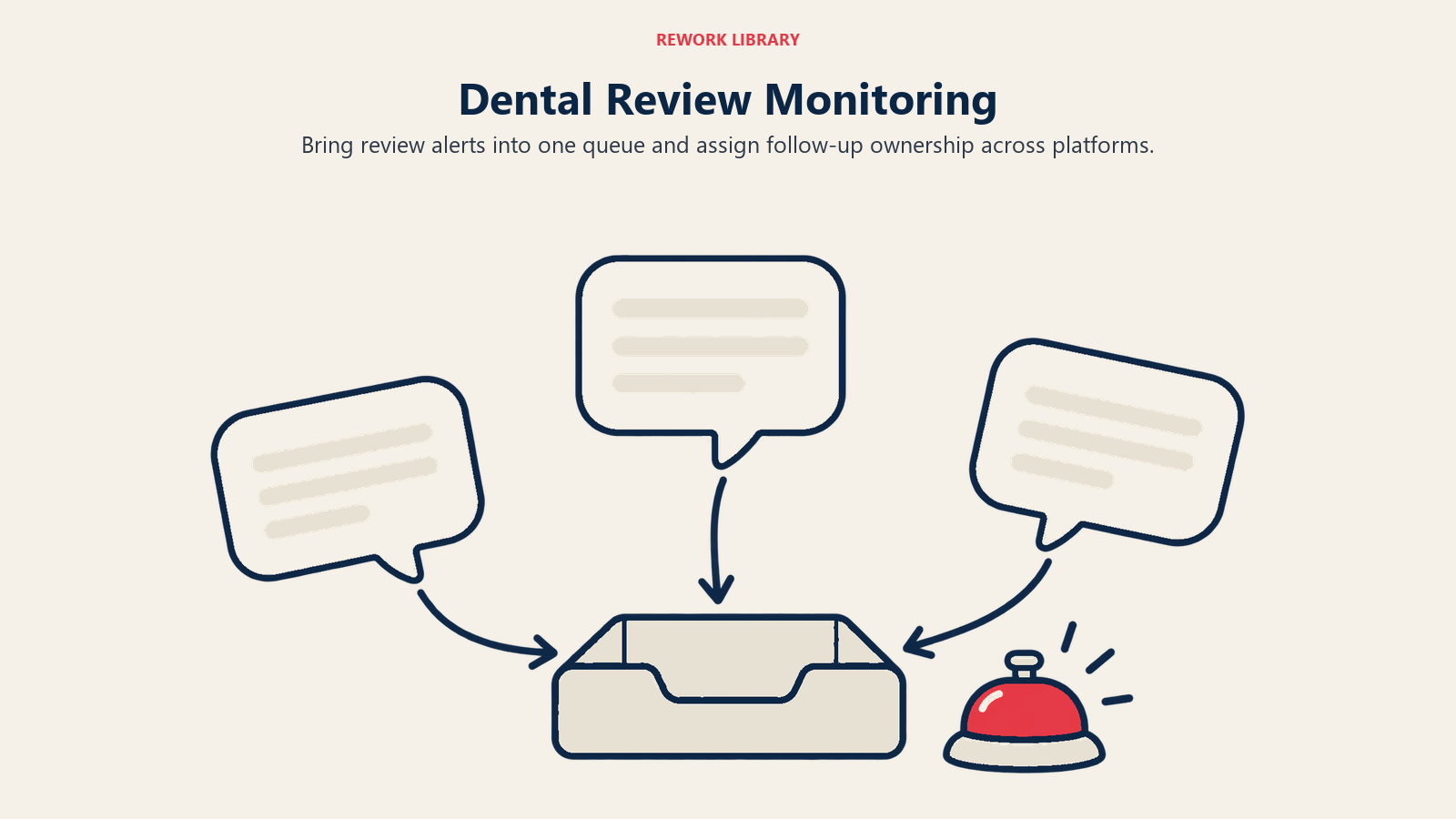
Setting up monitoring alerts. Configure Google Business email alerts for new reviews. For Healthgrades and other platforms, either set up manual review checks weekly (15 minutes) or use a reputation management tool that aggregates reviews from all platforms into a single dashboard. Practices with 10+ providers or multiple locations should use an aggregation tool. The manual approach doesn't scale. Managing reviews at scale is also a consideration when planning multi-location dental practice management, where reputation consistency across sites becomes a significant operational priority.
Reviews on platforms you don't manage. If you receive a negative review on a platform you haven't claimed (RateMDs, CareDash, Vitals), claim the profile first, then respond. An unclaimed profile with an unanswered negative review looks worse than either version in isolation.
Review removal requests. Google will remove reviews that violate its policies: fake reviews, spam, reviews about a different business, reviews that contain hate speech or personal information. To request removal, flag the review through Google Business Manager and document the policy violation. Approval isn't guaranteed and takes 1-7 business days. Don't wait for removal before responding. Respond publicly while the removal request is pending.
Building the System
Review management is not a marketing task you do occasionally. It's a patient experience measurement system running in the background continuously.
The practices consistently earning 4.8+ stars aren't doing anything exotic. They're delivering solid clinical care, training their teams to recognize and act on positive moments, sending automated follow-up texts after every appointment, and responding to every review (positive and negative) within 48 hours. According to research published via NIH, physician and provider visit volume correlates directly with online review volume and sentiment, making review generation a patient acquisition strategy as much as a reputation management one.
That's it. The asking is what most practices skip. And it's the only reason their competitors with equivalent clinical quality have 400 reviews to their 60. Review volume also amplifies the returns from patient referral programs: when a referred patient looks you up and sees 200+ positive reviews, the conversion from referral to first appointment improves significantly.
Implementation checklist:
- Set up Google Business profile with direct review link
- Configure automated review request text through practice management software
- Train clinical team on in-person review ask timing and language
- Create HIPAA-compliant response templates for 1-star, 3-star, and 5-star reviews
- Set up review monitoring alerts on Google and Healthgrades
- Claim all major platform profiles (Healthgrades, Zocdoc, Yelp, Facebook)
- Establish weekly 15-minute review monitoring routine
- Track monthly review count and average rating as a KPI
Learn More