Dental Scheduling Optimization: Block Scheduling, Production Goals, and Filling the Schedule
Turn this article into takeaways for your work.


Each assistant summarizes the article only for you and suggests best practices for your work.
A dental practice's schedule is its production plan. Every open slot is lost revenue that can't be recovered. Every low-value appointment in a prime time slot is an opportunity cost. And every cancellation without a same-day fill is a chair sitting empty while overhead keeps running.
Most dental schedules aren't designed. They're accumulated. Over time, default appointment lengths get set, hygiene gets pre-appointed in whatever slots are available, and the front desk fills in the gaps based on what the patient requests, not what the production goal requires. The result is a schedule that looks full but underperforms. A full calendar isn't the same as a productive one.
The practices that consistently hit their production goals don't have more patients than the practices that don't. They have better scheduling systems: production targets that reverse-engineer the appointment template, block scheduling that protects high-value time, and protocols for filling last-minute cancellations before they become empty chairs. Scheduling is also the operational layer where wait time optimization either succeeds or fails, schedules designed without buffer capacity guarantee delays regardless of how well the clinical team performs.
Key Facts: Scheduling and Practice Production
- The average dental practice operates at 65-75% of its theoretical production capacity due to scheduling inefficiencies (Dental Economics, 2023)
- Practices using block scheduling report 15-22% higher daily production compared to open scheduling (Journal of Dental Practice Management, 2022)
- Each 60-minute slot sitting empty costs the average general dental practice $350-600 in lost production, depending on fee schedule
Dental Economics on scheduling for maximum profitability makes the case that most practices can grow 18–30% without adding patients or overhead, solely by correcting their scheduling design, the gap between a full calendar and a productive one is almost entirely a systems problem.
Production-Based Scheduling
Most scheduling conversations start with "when is the patient available?" The better question is "what does this slot need to produce?" Those are different conversations with different outcomes.
Setting daily production goals per provider. The starting point is your practice's annual production target, broken down to daily. If your practice targets $1.2M in annual collections and runs 240 production days per year, that's $5,000 per day. Across two providers, that's $2,500 per provider per day. Every scheduling decision should be made with that number in mind.
Daily production goal calculation formula:
Annual Production Target ÷ Production Days Per Year = Daily Practice Goal Daily Practice Goal ÷ Number of Providers = Daily Goal Per Provider
For a solo general dentist targeting $700,000 in annual production with 220 production days, the daily goal is $3,182.
Reverse-engineering the schedule from revenue targets. Once you have a daily production target, work backward: how many high-value appointments (crowns, implants, multi-surface restorations) do you need each day to hit the target, and how many hygiene and lower-value appointments fill the rest? Most providers need 2-3 high-production appointments per day plus a foundation of routine work to consistently hit goals.
Appointment value weighting. Not every 60-minute slot is worth the same. A crown prep produces $1,200-1,800. A composite restoration produces $200-400. A new patient exam produces $180-300. Knowing the production value of each appointment type and scheduling your highest-value procedures in your highest-energy time blocks is the difference between a productive schedule and a merely busy one. A broader view of which procedure types drive the highest revenue return is covered in high-value dental procedure mix.
Block Scheduling
Block scheduling assigns specific appointment types to specific time windows in the day. It's not a rigid constraint. It's a framework that protects your highest-value production from being displaced by routine care.
Defining blocks by procedure type. A standard block schedule design for a general dentist:
| Time Block | Procedure Type | Rationale |
|---|---|---|
| 8:00-11:00 AM | High-value restorative (crowns, implants, complex composites) | Peak provider energy, lower interruption risk |
| 11:00 AM-12:00 PM | Intermediate restorative or new patient exams | Transition period |
| 1:00-3:00 PM | Hygiene exams, consultations, moderate restorative | Post-lunch, lower-intensity window |
| 3:00-5:00 PM | Emergency slots, simple restorations, patient-convenient scheduling | Flex time, emergency absorption |
Protecting high-value blocks. The morning block is the most critical. Train scheduling staff not to fill 9:00 AM with a recall appointment or a simple composite when that slot should be reserved for a crown prep. Define the rules clearly: morning blocks hold until X days before the appointment date, then release to other appointment types if unfilled.
Balancing emergency slots. Every day needs protected emergency time. A general rule: reserve one slot in the mid-morning and one in the mid-afternoon for same-day emergencies. These slots hold until 90 minutes before the time; if no emergency has come in, release them for routine scheduling. Without reserved emergency slots, every emergency becomes a 30-minute add-on that delays the rest of the day.
Provider-specific block design. Different providers have different production profiles. A provider who sees primarily pediatric patients needs different blocks than a general dentist focused on restorative. Design block templates per provider based on their actual procedure mix, not a generic template.
Hygiene Scheduling Strategies
Hygiene production typically represents 30-35% of total practice revenue when the department is running well. It's also the most common area where scheduling discipline breaks down.
Hygiene production as a percentage of practice revenue. If your hygiene department is producing below 28% of total practice revenue, one of three things is happening: hygiene appointments are being under-scheduled, hygiene fees are below market, or the hygienists aren't diagnosing and co-presenting restorative needs effectively. All three are fixable.
Pre-appointing at checkout. Pre-appointing (scheduling the patient's next recall appointment before they leave today's appointment) is the single most effective tool for maintaining a full hygiene schedule. Practices with high pre-appointment rates (75%+) run full hygiene schedules. Practices that rely on recall calls after patients leave fill maybe 50% of their hygiene capacity consistently.
The pre-appoint conversation isn't complicated: "Before you go, let's get your next cleaning on the schedule so you don't have to worry about it. Do you prefer mornings or afternoons?" The patient who walks out without a scheduled appointment is a recall follow-up call that may or may not result in a booking. The system for following up with patients who weren't pre-appointed is covered in dental recall and recare systems, which pairs directly with the pre-appointment discipline to maintain a full hygiene column.
Recall integration. For patients who weren't pre-appointed or who cancel without rescheduling, a systematic recall outreach process fills the gap. The sequence: text/email 4 months after the last appointment, automated reminder at 5 months, personal call at 6 months. Each touch should include a direct scheduling link or an easy call-to-action.
Same-day treatment acceptance in hygiene. Hygienists who identify restorative needs during a cleaning and communicate them clearly to the patient create opportunities for same-day or next-day treatment scheduling. This requires training in verbal case presentation (not just clinical notation) and a workflow that gets the dentist to the hygiene room for a warm handoff within the appointment. Practices with structured same-day treatment protocols generate 12-18% more restorative revenue per hygiene visit. The verbal skills behind that presentation are specifically what case acceptance training develops, it's the human complement to the scheduling system that creates the opportunity.
Emergency Slot Management
How you handle emergencies determines whether your day stays on track or becomes a cascade of delays.
How many emergency slots to reserve. The right number is based on your actual emergency volume. Pull your practice management data for the past 90 days and count how many same-day appointments you completed per day. If the average is 2-3 per day, reserve 2 slots. If it's 4-5, reserve 3.
When to release slots. Emergency slots should release to routine scheduling based on proximity to the appointment time. A common protocol: slots release at 90 minutes before the appointment time if unused. By that point, the morning emergency window has either been used or you know it won't be needed today.
Triage protocols for same-day callers. Not all "emergencies" require same-day appointments. Train your front desk on basic triage: a cracked tooth with cold sensitivity and mild pain can often wait 24-48 hours. A post-extraction that's bleeding or an acute abscess needs to be seen today. Clear triage criteria prevent emergency slots from being used for non-urgent issues while genuinely urgent patients can't get in.
Reducing Cancellations and No-Shows
Cancellations are expensive. A last-minute cancellation in a prime morning slot leaves the chair empty for a procedure that cost you marketing and scheduling overhead to fill. The goal is to prevent cancellations, not just respond to them.
Confirmation workflows. Automated appointment confirmation (72-hour email + 24-hour text with confirm/cancel option) reduces no-shows by approximately 25-30% compared to no confirmation system. The cancel option matters: easy cancellation surfaces cancellations early enough to fill the slot.
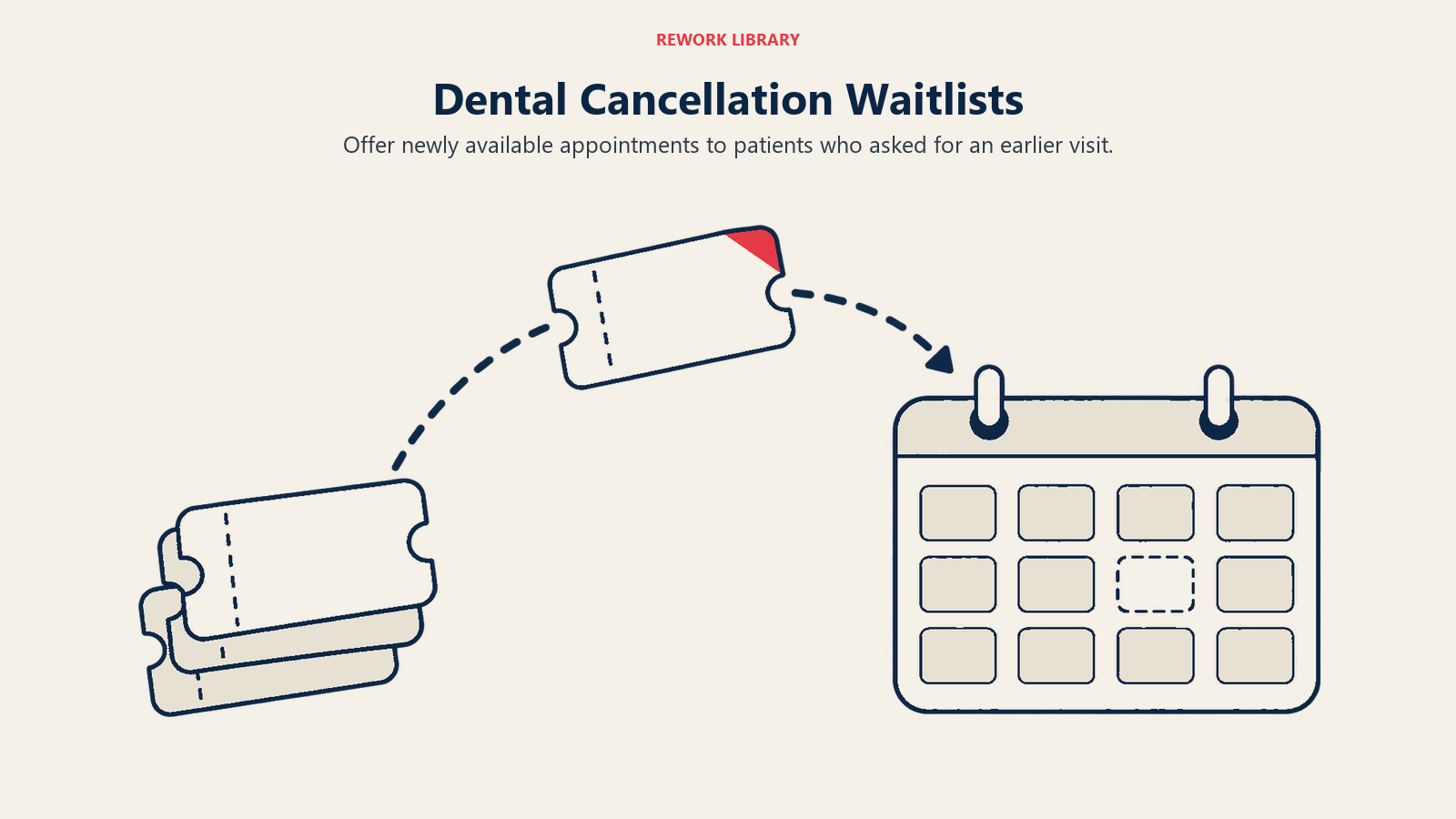
Waitlists. Maintain an active waitlist of patients who want to be seen sooner than their scheduled appointment. When a cancellation creates an open slot, the front desk works through the waitlist first before opening it to new patients. Practices with active waitlists fill 60-70% of same-day cancellations.
Deposit policies for high-value appointments. For crown preps, implant placements, and other high-production appointments scheduled weeks in advance, a deposit at booking ($50-200, credited toward treatment) dramatically reduces no-shows. Patients who've paid a deposit cancel at much lower rates than those who haven't. The ADA's analysis of no-show economics confirms that a single missed appointment per day, compounded over a year, represents tens of thousands of dollars in unrecoverable production, making deposit policies one of the highest-return administrative changes a practice can implement. Present it as "securing your appointment" rather than "a fee for canceling." The appointment confirmation and reminder workflow that also reduces no-shows is detailed in patient communication strategies, deposits and communications are complementary tools, not alternatives.
Cancellation benchmarks by practice type:
| Practice Type | Acceptable Cancellation Rate | Alert Threshold |
|---|---|---|
| General dental | Under 8% | Above 12% |
| Pediatric | Under 10% | Above 15% |
| Specialty (ortho, oral surgery) | Under 6% | Above 10% |
If your cancellation rate regularly exceeds the alert threshold, something systematic is wrong, either with the confirmation workflow, the patient demographic mix, or the appointment types being booked.
Scheduling as a Leadership Function
The scheduling coordinator manages the most important revenue document in your practice. That role deserves training, clear KPIs, and regular review, not just access to the scheduling software.
Weekly metrics to track:
- Daily production per provider vs. goal
- Unfilled appointment slots (by day and time block)
- Cancellation and no-show rate
- Pre-appointment rate from hygiene
- Same-day fill rate for cancellations
Morning huddle integration. The daily morning huddle should review the schedule for the day: production goal vs. current schedule production, open slots in emergency blocks, any patients flagged for pending treatment, and the pre-appointment goal for hygiene. 15 minutes every morning creates accountability and gives the team the information they need to fill gaps before the day is already gone.
The difference between a busy schedule and a productive one. Full chairs are the floor, not the ceiling. The practices that build 15-25% more production from the same number of clinical hours aren't seeing more patients. They're seeing the right patients, in the right order, at the right appointment lengths, with the right value mix. That's a scheduling system, not a hustle ethic. Dental Economics' research on KPI tracking identifies scheduling-related metrics, unfilled slots, on-time start rate, same-day fill rate, as among the six most critical indicators of practice health, precisely because they translate directly to revenue without requiring more patients. What those numbers look like in practice, the revenue benchmarks, overhead ratios, and production-per-hour targets that define a high-performing schedule, is tracked through key financial metrics for dental practices.
Learn More