Patient Communication Strategies for Dental Practices: Pre-Visit, Post-Treatment, and Between Appointments
Turn this article into takeaways for your work.


Each assistant summarizes the article only for you and suggests best practices for your work.
Most dental practices communicate with patients at two moments: when they need to schedule and when they need to send a reminder. That's it. And for practices running at 60-70% recall rates, that two-touch approach is a big part of the problem.
The practices with the highest retention (the ones running 85%+ recall rates and generating 40% of new patients from referrals) communicate consistently across the entire patient relationship. They reach patients before their first appointment, during the visit itself, immediately after complex procedures, and multiple times between cleanings. But here's the thing: they're not doing this manually. Automation handles the volume. The team only steps in when it matters most.
Building that communication system isn't complicated. It requires deciding what to say, when to say it, through which channel, and then setting it up once so it runs without daily management. A strong communication foundation also connects directly to dental scheduling optimization, the two systems reinforce each other when aligned. This article covers each stage of the communication journey and what high-performing practices actually send.
Key Facts: Patient Communication and Retention
- Practices using automated recall reminders see 25-30% fewer no-shows compared to phone-only reminder systems (Dental Products Report, 2024)
- 68% of patients who don't return to a dental practice say they simply weren't contacted, not that they were dissatisfied (ADA Health Policy Institute)
- Text message open rates for appointment reminders exceed 95%, compared to 20-25% for email (MGMA Communications Benchmarks)
The ADA's resource on reducing missed appointments documents the compounding cost of no-shows: a single missed appointment per day over a year can represent $20,000–$70,000 in lost production depending on the practice's fee schedule.
Pre-Visit Communication
The communication window before a first appointment is where most practices leave the most value on the table. A new patient who schedules but never comes is a lost acquisition cost. Pre-visit communication reduces that risk significantly.
New patient welcome sequence. Within 24 hours of booking, send a welcome message that includes the practice's address (with a map link), parking instructions, what to bring (insurance cards, photo ID, prior records if applicable), and a brief introduction to what to expect. This isn't fluff. It's anxiety reduction. New patients who feel prepared are less likely to cancel.
Digital intake forms. Send the intake forms 48-72 hours before the appointment with a clear deadline. Forms completed in advance cut new patient processing time by 10-15 minutes, which reduces the ripple effect on the rest of the schedule. This is also one of the most practical wait time optimization strategies for dental clinics, recovering that time per new patient has a compounding effect across the day. Forms submitted late (or not at all) are a scheduling problem waiting to happen.
Appointment confirmation flow. The standard is a 72-hour email confirmation followed by a 24-hour text reminder with a one-click confirm or cancel option. The cancel option matters: easy cancellation gives you enough lead time to fill the slot rather than discovering the no-show 10 minutes before the appointment. It sounds counterintuitive, but it works.
Pre-procedure communication. For complex procedures (extractions, implant placements, sedation appointments), send specific pre-op instructions 48-72 hours in advance. Include dietary restrictions, medication instructions, and transportation requirements (no driving after sedation). Send a reminder call or text the morning of. These messages reduce day-of complications and cancellations.
Financial confirmation. For large treatment cases, confirm the estimated patient portion and payment method 48 hours before the appointment. This prevents the scenario where a patient arrives, sees the number for the first time, and decides they need to "think about it." That usually means they leave without the procedure and often don't reschedule.
In-Office Communication
Communication during the visit is less about technology and more about team training, but it directly feeds downstream outcomes: review requests, referrals, and post-treatment compliance.
Treatment explanation standards. Every clinical finding should be explained to the patient in plain language before beginning treatment. "You have a cavity on the upper left molar" is not sufficient. "You have a small cavity between your upper left molar and the next tooth. We caught it early, which means we can fix it with a simple filling today rather than waiting until it reaches the nerve" gives the patient context, urgency, and a clear outcome. That explanation style increases same-day acceptance. The verbal frameworks behind it are a core component of case acceptance training that the entire clinical team can practice.
Post-treatment verbal instructions. Before a patient leaves the chair, give them verbal aftercare instructions and hand them a printed or digital summary. For extraction patients, explain what to expect in the first 24-48 hours specifically, not generically. Patients who know what's normal don't call the office panicking, and they also feel cared for, which drives reviews.
The review ask moment. The right moment to ask for a review is immediately after a positive interaction, typically when a patient expresses relief that it wasn't as bad as they expected, or thanks the hygienist for their gentleness. Train clinical staff to respond to those moments with something like: "We're so glad to hear that. If you have a few minutes after your appointment, we'd really appreciate it if you shared that on Google. It helps other patients find us." Direct, not pushy. And the text follow-up handles the rest.
Post-Treatment Follow-Up
The 24 hours after a procedure are the highest-impact communication window in dentistry, and most practices ignore it entirely.
Same-day check-in calls. For extractions, implant placements, root canals, and any sedation case, a same-day check-in call from a clinical team member makes a significant impression. Not a text: an actual call. "Hi, this is Sarah from [Practice]. Dr. Chen asked me to check in and make sure you're doing okay after your extraction today. Do you have any questions or concerns?" This call takes 90 seconds. It generates the kind of loyalty that dental patient loyalty programs work to build, but this costs nothing beyond a minute of staff time.
Post-treatment instruction reminders. For multi-day recovery procedures, send a text or email reminder of the aftercare instructions 24-48 hours post-procedure. Patients don't read the discharge instructions carefully in the chair. They're still numb and slightly disoriented. A digital follow-up that they can reference later is genuinely useful.
The referral window. Patients who've just had a positive experience are your best referral source. A post-visit email that says "We hope your recovery is going well. If you have friends or family who've been putting off dental care, we'd love to take care of them. Here's a link to schedule" converts significantly better than a generic referral ask at checkout. The timing is everything. Practices that build out patient referral programs alongside this type of post-visit messaging tend to see compounding returns from both channels.
Between-Visit Communication
This is where most practices go completely dark, and where retention quietly erodes. A patient who doesn't hear from your practice for 12 months between cleanings is easy to lose to the DSO that just opened two miles away.
Monthly or quarterly newsletters. These don't need to be elaborate. A brief email newsletter covering one oral health tip, one practice update (new technology, new team member), and a seasonal reminder drives recall scheduling. Keep it under 300 words. If you're writing 1,200-word newsletters, nobody is reading them. A well-developed patient education content strategy can supply the oral health topic material for these newsletters without requiring original writing every month.
Seasonal oral health tips. Tie communication to the calendar. Back-to-school mouth guard checks in August. Holiday eating tips in November. End-of-year insurance benefit reminders in October. These messages feel timely rather than promotional, and they prompt scheduling without asking for it directly.
Birthday messages. A simple birthday text or email (no discount attached, just a genuine greeting) has a surprisingly high open and positive response rate. It keeps the practice top of mind without being promotional.
Milestone check-ins. For patients who haven't scheduled in 8+ months, a personal-sounding outreach message (even if automated) performs better than generic recall scripts. "We noticed it's been a while since your last visit and wanted to check in" outperforms "You're due for your 6-month cleaning."
Channel Selection by Patient Demographics
Not every patient wants to hear from you the same way. But most practices use one channel for everyone, which means they're either over-communicating with some patients or missing others entirely.
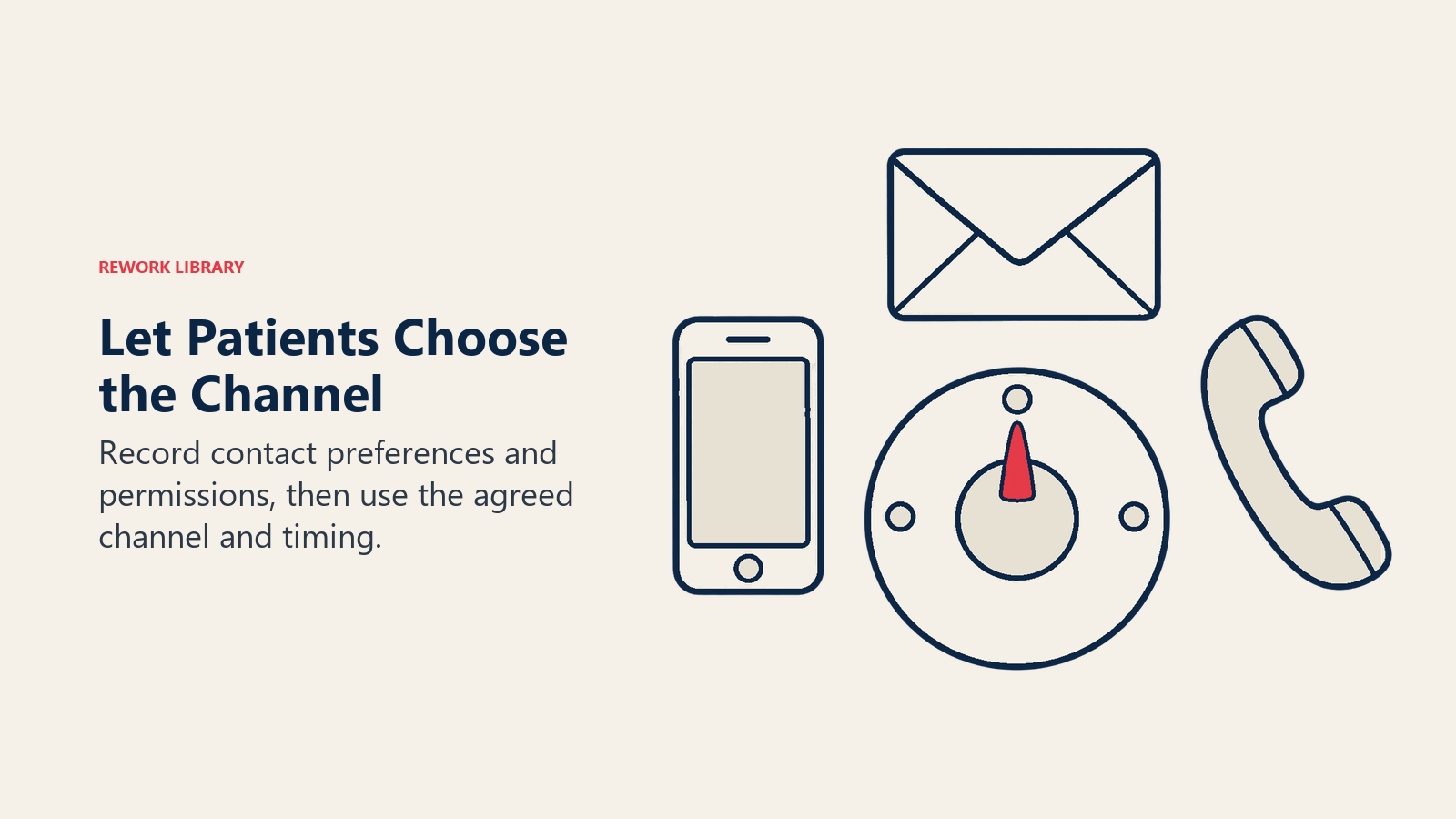
Text messaging is the highest-engagement channel for patients under 55 and increasingly preferred even in older demographics. It's the right channel for appointment reminders, post-visit follow-ups, and one-click confirm/cancel actions. Keep messages under 160 characters when possible.
Email works best for content that requires more detail: welcome sequences, pre-op instructions, newsletters, financial summaries, and post-treatment care instructions. Patients can reference email later; they can't easily reference a text they've already swiped past.
Phone calls should be reserved for high-stakes situations: same-day check-ins after complex procedures, patients who haven't responded to text or email reminders for overdue recall, and any situation where the message requires nuance that a text can't convey.
Patient preference capture. The intake form is where you capture communication preferences. Ask patients their preferred channel and preferred time of day for contact. Document it. If your practice management software allows it, store it as a field you can filter on. This isn't just courtesy. It's opt-in compliance, which matters under TCPA regulations for text messaging. The HHS HIPAA guidance on patient communications also clarifies what safeguards are required when using email and text messaging to communicate with patients about appointments and care. Strong front office excellence means the intake process is standardized enough that this preference data is actually captured and used consistently, not just collected on paper and filed.
Demographic guidelines to follow:
| Age Group | Preferred Primary Channel | Backup Channel |
|---|---|---|
| 18-34 | Text | |
| 35-54 | Text or Email | Phone |
| 55-69 | Email or Phone | Text |
| 70+ | Phone | Mailed postcard |
These are guidelines, not rules. Always let stated preference override assumptions.
HIPAA-compliant communication checklist:
- Text messages should not include specific treatment information or diagnosis details
- Email communications should not confirm what procedures were performed unless the patient initiates
- All automated communications should include an opt-out mechanism
- Obtain written consent for text marketing at intake
- Store consent documentation in the patient record
Building Your Communication Calendar
The most effective way to implement this framework is to map every communication touchpoint to a patient stage and assign responsibility and automation status.
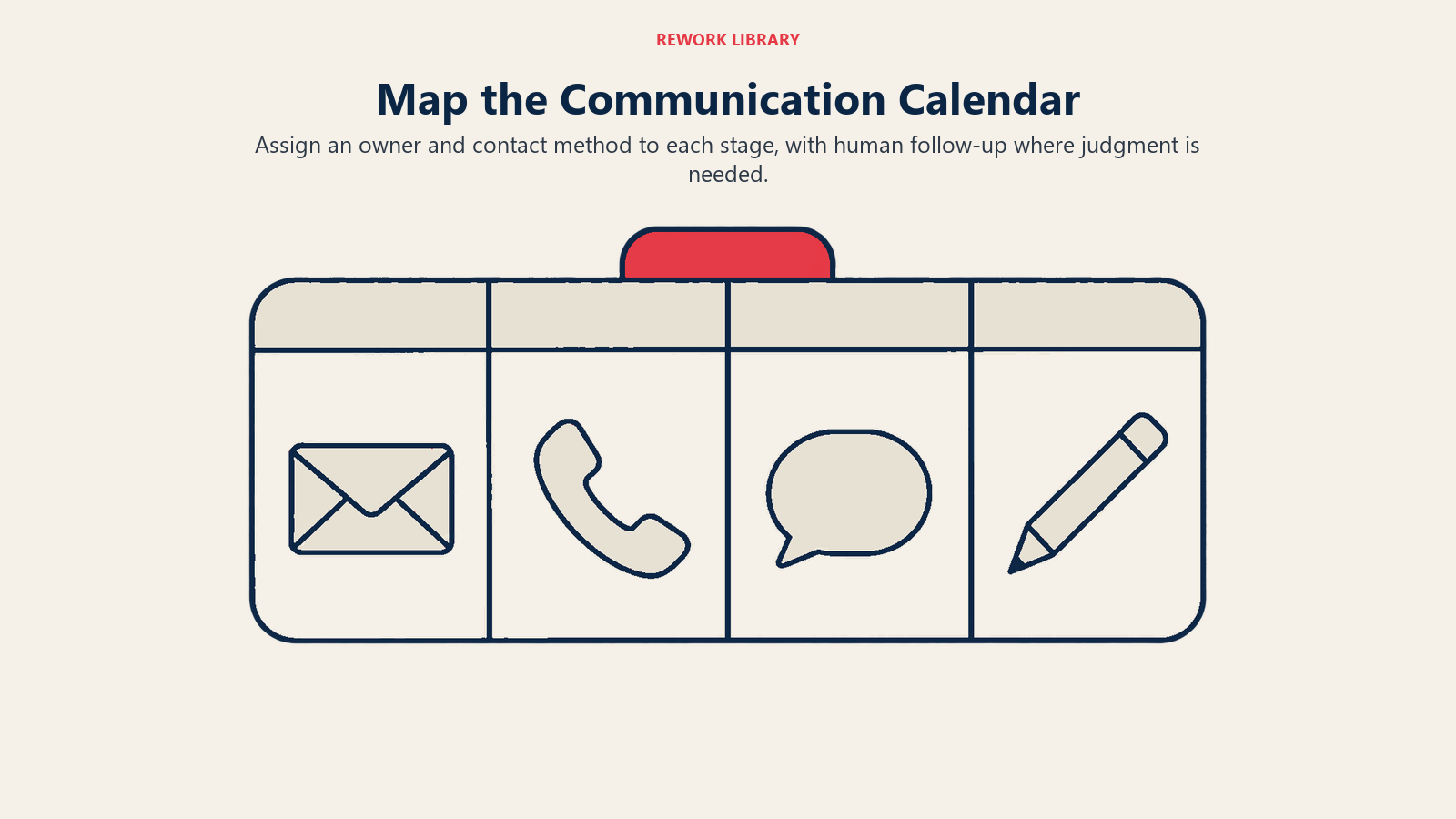
| Stage | Touchpoint | Channel | Timing | Automated? |
|---|---|---|---|---|
| New patient | Welcome sequence | Within 24h of booking | Yes | |
| New patient | Intake forms | Email/Text | 72h before visit | Yes |
| All patients | Appointment confirmation | 72h before | Yes | |
| All patients | Appointment reminder | Text | 24h before | Yes |
| Complex procedures | Pre-op instructions | Email + Call | 48h before | Partial |
| Post-visit | Check-in call | Phone | Day of (complex) | No |
| Post-visit | Review request | Text | 2-4h post-visit | Yes |
| Between visits | Newsletter | Monthly/Quarterly | Yes | |
| Overdue recall | Re-engagement | Text/Email | 8+ months | Yes |
The automation handles most of it. The human element (the same-day check-in call, the in-office ask for a review, the front desk call for patients who haven't responded after two automated attempts) is where your team focuses. Dental Economics covers the economic impact of no-shows in detail, the combination of automated confirmations and easy-cancel options is specifically what prevents the front desk from discovering gaps with no time to fill them. When a patient does leave a review as a result of this system, handling it well is a separate discipline covered in dental review management.
Learn More