Dental Recall & Recare Systems: Keeping Patients Active and Hygiene Schedules Full
Turn this article into takeaways for your work.


Each assistant summarizes the article only for you and suggests best practices for your work.
A dental recall and recare system is the set of processes that keep patients on a regular hygiene schedule: risk-based recall intervals, pre-scheduling at checkout, automated reminder sequences, and reactivation outreach for lapsed patients. Run systematically, it holds the hygiene schedule at 90-95% capacity and lifts recall rates 15-20 points above practices that rely on call-to-schedule. Recall is recurring revenue, so every point of improvement compounds.
A dental practice with a full hygiene schedule and high recall rate is structurally more profitable than one constantly chasing new patients to fill holes. Recall is the foundation of practice stability, and most practices manage it reactively instead of systematically. The ADA's clinical guidelines on recall and maintenance establish the evidence base for risk-stratified recall intervals, moving beyond the one-size-fits-all 6-month standard and toward protocols that match visit frequency to actual patient risk.
The reactive model looks like this: hygiene has openings next week, the front desk pulls a list of patients due for recall, staff makes calls, some patients respond, the schedule gets partially filled. This works well enough to survive. It doesn't work well enough to build a practice that grows.
The systematic model looks different. Patients leave every hygiene appointment with their next visit already scheduled. Automated reminders go out at predictable intervals. Lapsed patients receive a reactivation sequence that brings a percentage of them back. The hygiene schedule runs at 90-95% capacity not because the front desk works harder, but because the system is designed to keep it there.
The difference in practice economics is significant: a practice with an 85% recall rate needs far fewer new patients to maintain growth than one at 60%. Every percentage point of recall improvement is compounding. It doesn't just fill next week's schedule, it builds the recurring revenue base that makes the practice less vulnerable to new patient acquisition cycles. Tracking recall performance alongside other key financial metrics for dental practices makes the production impact of retention clearly visible in your monthly numbers.
Key Facts: Recall Rate Impact on Practice Health
- Industry average recall rate is 60-70%; top-performing practices achieve 80-88% (American Dental Association, 2024)
- Practices with recall rates above 80% generate 25-35% more revenue per patient over a 5-year period than those below 65%
- Pre-scheduled recall appointments show a no-show/cancellation rate of 8-12%, compared to 22-30% for call-to-schedule patients
Recall Intervals: Evidence-Based Scheduling
The standard semi-annual recall (every 6 months) isn't clinically appropriate for all patients. Using it as a one-size-fits-all protocol means you're underserving high-risk patients and potentially scheduling low-risk patients more often than necessary.
A risk-stratified approach to recall intervals:
Low-risk patients (6-month or annual recall): Patients with a history of minimal decay, no active periodontal disease, good oral hygiene compliance, and no systemic conditions that raise oral health risk. Adults with stable dentitions who've shown consistent preventive behavior over multiple visits fall here.
Moderate-risk patients (4-month recall): Patients with one or two new caries per year, early-stage periodontal findings, or systemic conditions with oral implications (diabetes, dry mouth from medications, acid reflux). This group benefits from more frequent monitoring and early intervention before small problems become large ones.
High-risk patients (3-month recall): Active periodontal disease patients in the maintenance phase, patients undergoing radiation therapy, heavy-caries-prone patients, and immunocompromised individuals. Three-month periodontal maintenance (D4910) is well-supported in the literature and typically covered by insurance for qualifying patients. CDC data on oral health disparities shows that periodontal disease disproportionately affects adults with certain systemic conditions and lower socioeconomic status, groups that may benefit most from more frequent hygiene contact and proactive scheduling systems.
The scheduling-at-checkout rule: Pre-schedule the next recall appointment before the patient leaves. This is the single highest-impact practice change for recall rates. Practices that consistently pre-schedule at checkout run recall rates 15-20 percentage points higher than those that rely on call-to-schedule systems. A well-optimized dental scheduling system makes this checkout scheduling step frictionless by protecting recall appointment slots in your daily template.
The conversation is simple: "Let's get you on the calendar for your next visit. Based on [your periodontal status / your caries risk], we'd like to see you in [3/4/6] months. Does [month] work for you?" The patient leaves with a scheduled appointment, a confirmation card, and an expectation. No "call us sometime" reminder needed.
Reminder Systems and Channels
Pre-scheduling sets the appointment. Reminders protect it. The standard reminder sequence that most practices find optimal:
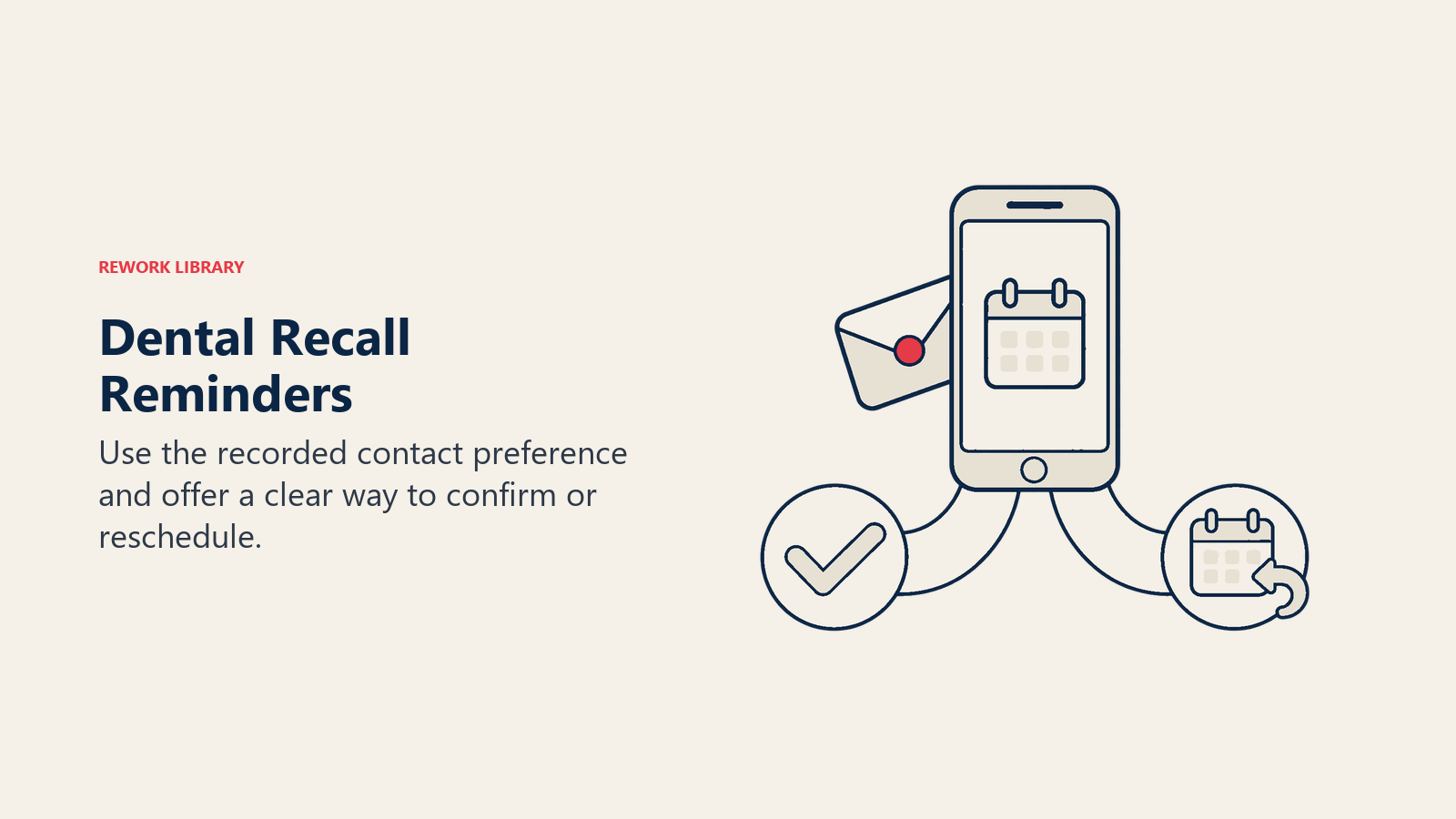
3 weeks before the appointment: Text or email reminder. "Hi [Name], just a reminder that you have a dental hygiene appointment with [Practice Name] on [Date] at [Time]. Reply CONFIRM to confirm or call us at [Number] to reschedule." Sends at 3 weeks because it gives enough advance notice for schedule adjustments without being so early that patients ignore it.
1 week before: Follow-up reminder for patients who haven't confirmed. Same channel as the first reminder, slightly more specific message: "We're looking forward to seeing you next [Day] at [Time]. Please confirm or let us know if you need to reschedule."
48 hours before: Confirmation reminder. This is the last-chance signal for patients who are on the fence. "Reminder: your appointment with Dr. [Name] is [Day] at [Time]. We've reserved this time for you. Please call [Number] if you need to make changes."
Day-of: Optional for high no-show practices or specific patient segments. A same-day morning text for afternoon appointments reduces no-shows in practices with historically high attrition.
Channel preferences by demographic: Patients under 45 prefer text; patients 45-60 are split between text and phone; patients 65+ often prefer phone calls. Most practice management software allows channel preference settings by patient. Use them. This connects directly to broader patient communication strategies that guide how your team engages patients across every touchpoint, not just recall reminders.
What to say: Reminder messages that include a clear call-to-action (confirm or reschedule) perform better than generic reminders. Patients who confirm feel committed. Patients who need to reschedule do so in advance rather than no-showing, which is operationally better because you can fill the slot.
Reactivation Campaigns: Bringing Back Lapsed Patients
Every practice has a segment of lapsed patients (people who were once active and stopped coming). Reactivating a lapsed patient costs approximately 20% of what it costs to acquire a new patient through marketing. Dental Economics' analysis of patient retention shows that the economics of recall are compounding. Practices that improve retention even modestly generate significantly more revenue per patient over a 3-5 year horizon than those focused primarily on new patient acquisition. This makes reactivation one of the highest-ROI activities in practice management. For practices that do need to supplement reactivation with new patient acquisition, a well-structured patient referral program can generate warm, high-quality leads from your existing active patient base.
Define "lapsed" with specificity: Most practices define lapsed by how long it's been since the last visit:
- 12-18 months: Recently lapsed; highest reactivation probability
- 18-24 months: Moderately lapsed; still reachable with direct personal outreach
- 24+ months: Long-lapsed; harder to reactivate but worth a focused annual campaign
Segmenting reactivation outreach by lapse duration: Recently lapsed patients respond well to a brief, personal call. "Hi [Name], this is [Team Member] from [Practice Name]. You're due for your cleaning and we haven't seen you in a while, and Dr. [Name] wanted us to reach out personally. We have openings this week and next. Would either work for you?" The warmth and specificity matter.
Long-lapsed patients often respond better to written outreach first (an email or a letter) that doesn't put them on the spot. "We miss you at [Practice Name] and wanted to reach out. It's been [X] months since your last visit. We'd love to welcome you back with a complimentary fluoride treatment with your next hygiene appointment."
Reactivation scripting that works: The most common failure in reactivation calls is a tone that feels like a collection call. Compare:
"Hi, we're calling because you haven't been in since 2023 and you're overdue for your appointment." This sounds like a billing reminder. Patients don't respond well.
vs.
"Hi [Name], this is [Team Member] at [Practice Name]. Dr. [Name] asked us to reach out personally. We haven't seen you in a while and wanted to check in. Is everything okay? We'd love to get you back in for a cleaning." This is human and care-oriented. Patients respond to being noticed.
Email reactivation sequences for unreachable patients: For patients you can't reach by phone after 2 attempts, a 3-email sequence often performs better than continued calls:
- Email 1: Personal note from the practice ("We miss you")
- Email 2: Clinical value ("Here's why regular hygiene visits matter for your health")
- Email 3: Offer ("Come back. Your first visit back includes X")
Who to stop pursuing: After 2 phone attempts and 3 emails over 6-8 weeks, some patients are genuinely gone: moved, switched practices, or actively disengaged. Don't burn staff time on them. Move to a low-frequency annual reactivation card or email, and accept that not every patient is recoverable.
Hygiene Continuity Metrics: Measuring What Matters
You can't manage what you don't measure. Recall effectiveness requires specific metrics tracked consistently:
Continuing care percentage: The percentage of active patients who are pre-scheduled or overdue for recall. Target: 85%+. This is the single most important hygiene recall metric. Most practice management systems can generate this report with minimal setup.
Active patient count: How many patients have had at least one visit in the past 18 months. Track this quarterly and watch for decline. A declining active patient count means you're losing more patients than you're gaining, and marketing alone won't fix a recall retention problem. Building a dental patient loyalty program alongside your recare system gives long-term patients a reason to stay engaged beyond routine visits.
Hygiene schedule utilization: The percentage of hygiene appointment slots filled vs scheduled capacity. Target: 90-95%. Less than 85% utilization consistently suggests a recall system problem.
No-show and cancellation rate: Track separately by appointment type (new patient vs recall) and by reminder channel. High no-show rates on confirmed appointments may signal a specific demographic issue. High cancellation rates may indicate scheduling too far in advance.
Reactivation conversion rate: What percentage of your reactivation outreach results in a scheduled appointment? 20-30% is a reasonable benchmark for phone-based reactivation of recently lapsed patients; 10-15% for long-lapsed patients.
Recall Rate Benchmarks by Practice Type
| Practice Type | Average Recall Rate | Top Quartile Target |
|---|---|---|
| General family practice | 65-72% | 82-88% |
| Pediatric practice | 70-78% | 85-90% |
| Fee-for-service/cash practice | 72-80% | 88-92% |
| Insurance-heavy practice | 60-68% | 76-82% |
If your practice falls below these averages, the gap is almost always in the checkout scheduling process and the reminder system, not in patient loyalty or community demographics. The hygiene department's production contribution (including recall-driven diagnostic findings and treatment recommendations) is explored in detail in the hygiene department production guide.
Recall Interval Decision Framework
Use this framework at the checkout appointment scheduling conversation:
Ask these questions (your hygienist should have the answers from the visit):
- Current caries risk: low, moderate, or high?
- Periodontal status: healthy, gingivitis, or periodontal maintenance?
- Compliance history: consistent attender or frequent gaps?
- Systemic conditions: diabetes, dry mouth, radiation, immunosuppression?
Apply this logic:
- All low: 6-month recall
- One moderate: 4-month recall
- Any high or active perio maintenance: 3-month recall
- Active treatment underway: schedule follow-up at the current appointment
This framework takes 60 seconds at checkout and produces a recall schedule that's clinically appropriate, better documented, and more defensible to insurance payers.
The Reactivation Campaign Script (Phone)
For recently lapsed patients (12-18 months):
"Hi, may I speak with [Patient Name]? [Pause] Hi [Name], this is [Your Name] from [Practice Name]. How are you doing? [Brief exchange] The reason I'm calling is that Dr. [Name] asked us to reach out personally. We haven't seen you since [approximate timeframe] and wanted to make sure everything's okay and that you're taking care of your oral health. We'd love to get you back in for a cleaning and checkup. We have some openings coming up. Would something in the next 3-4 weeks work for you?"
If they say they've been busy or meaning to call: "I completely understand. Let's just get it on the calendar right now so it's done. Would [specific date] work, or is there a better time of day for you?"
If they mention a cost concern: "We actually have some options that can help with that. Would it be helpful to go over what's covered and what payment options we have?"
This script is direct, personal, and designed to solve the actual barriers (timing, cost) rather than just repeat the appointment reminder.
Frequently Asked Questions about Dental Recall & Recare Systems
What is a dental recall and recare system?
It is the structured program that keeps active patients returning for hygiene visits. The core components are risk-based recall intervals, pre-scheduling the next visit before the patient leaves, a multi-touch reminder sequence, and a reactivation campaign for lapsed patients. Together they make the hygiene schedule self-filling instead of front-desk dependent.
What is a good dental recall rate?
The industry average is 60-70%, while top-performing practices reach 80-88%. Practices above 80% generate 25-35% more revenue per patient over five years than those below 65%. If you fall below average, the gap is almost always in checkout scheduling and the reminder system, not patient loyalty.
How often should dental patients come in for recall?
Use a risk-stratified schedule rather than a flat six months. Low-risk patients fit a 6-month or annual interval, moderate-risk patients a 4-month interval, and high-risk or active periodontal-maintenance patients a 3-month interval. A 60-second checklist at checkout sets the right interval and documents it for insurance.
How do you reactivate lapsed dental patients?
Segment by how long they have been gone, then lead with a warm, personal phone call for recently lapsed patients (12-18 months) and written outreach for long-lapsed ones. Reactivating a lapsed patient costs about 20% of acquiring a new one, so a short scripted sequence is one of the highest-ROI activities in the practice.
Learn More

Business Consultant