Hiring Dental Professionals: Recruiting Hygienists, Assistants, and Associates in a Competitive Market
Turn this article into takeaways for your work.


Each assistant summarizes the article only for you and suggests best practices for your work.
The dental staffing crisis is real, and it's getting worse. The Bureau of Labor Statistics projects dental hygienist employment to grow 7% through 2034, faster than most occupations, while dental schools graduate roughly 7,000 new hygienists annually against a market that needs twice that. Dental assistants face similar dynamics, with experienced chairs leaving the profession entirely after the pandemic reshaped their expectations about work conditions and compensation.
For a practice owner, this isn't an abstract workforce trend. It's the empty chair on Tuesday, the hygienist you lost to a competitor offering $8 more per hour, and the three months you spent shorthanded because you treated hiring as something you do when someone quits. Understaffed practices lose patients. They cancel appointments, stretch remaining staff past their limits, and watch production numbers crater while overhead stays fixed. Understanding dental staff turnover dynamics before building your hiring system prevents the cycle of recruiting and re-recruiting the same roles.
The practices that win in this environment don't get lucky with candidates. They build hiring systems that work continuously, not reactively. Here's how to build one.
Key Facts: Dental Staffing Market
- Dental hygienist job openings are projected to increase 7% by 2034, significantly outpacing graduation rates (Bureau of Labor Statistics, 2024)
- Average cost to replace a dental hygienist ranges from $15,000 to $30,000 when accounting for recruiting, lost production, and training time
Define the Role Before You Post Anything
The most common hiring mistake in dental practices is posting a job description within 24 hours of someone giving notice. You're not hiring a "dental hygienist." You're hiring a specific person for a specific clinical environment, and your job description should reflect that.
Start with three questions. What does this person do every day, and what does success look like at 90 days? What do your current top performers have in common that you didn't explicitly hire for? What would make a candidate choose you over the practice two miles away offering $5 more per hour?
For hygienist roles, separate your must-haves from your nice-to-haves in writing before you start reviewing resumes. Must-haves typically include active state licensure, at least one year of clinical experience (unless you're specifically recruiting new graduates), and proficiency with your practice management software or a comparable system. Nice-to-haves might include experience with Waterlase, Invisalign coordination, or specific sedation protocols.
Compensation range disclosure matters more now than it did five years ago. Candidates, particularly hygienists who've learned their market value, will pass on job posts without salary information. You're filtering yourself out before the conversation starts. Know your range before you post, and post it. Defining your range requires current market data, use the benchmarks in dental team compensation models as your starting reference before setting a public range.
Sourcing Strategies That Actually Deliver Candidates
Job boards work. They're not the only tool, but Indeed and LinkedIn remain the highest-volume channels for dental clinical roles, and neglecting them because "nobody uses job boards" is wrong. The issue is that most dental practice job posts on these platforms are identical: generic descriptions, no salary range, photos of a stock image office. Differentiation at the listing level pays off.
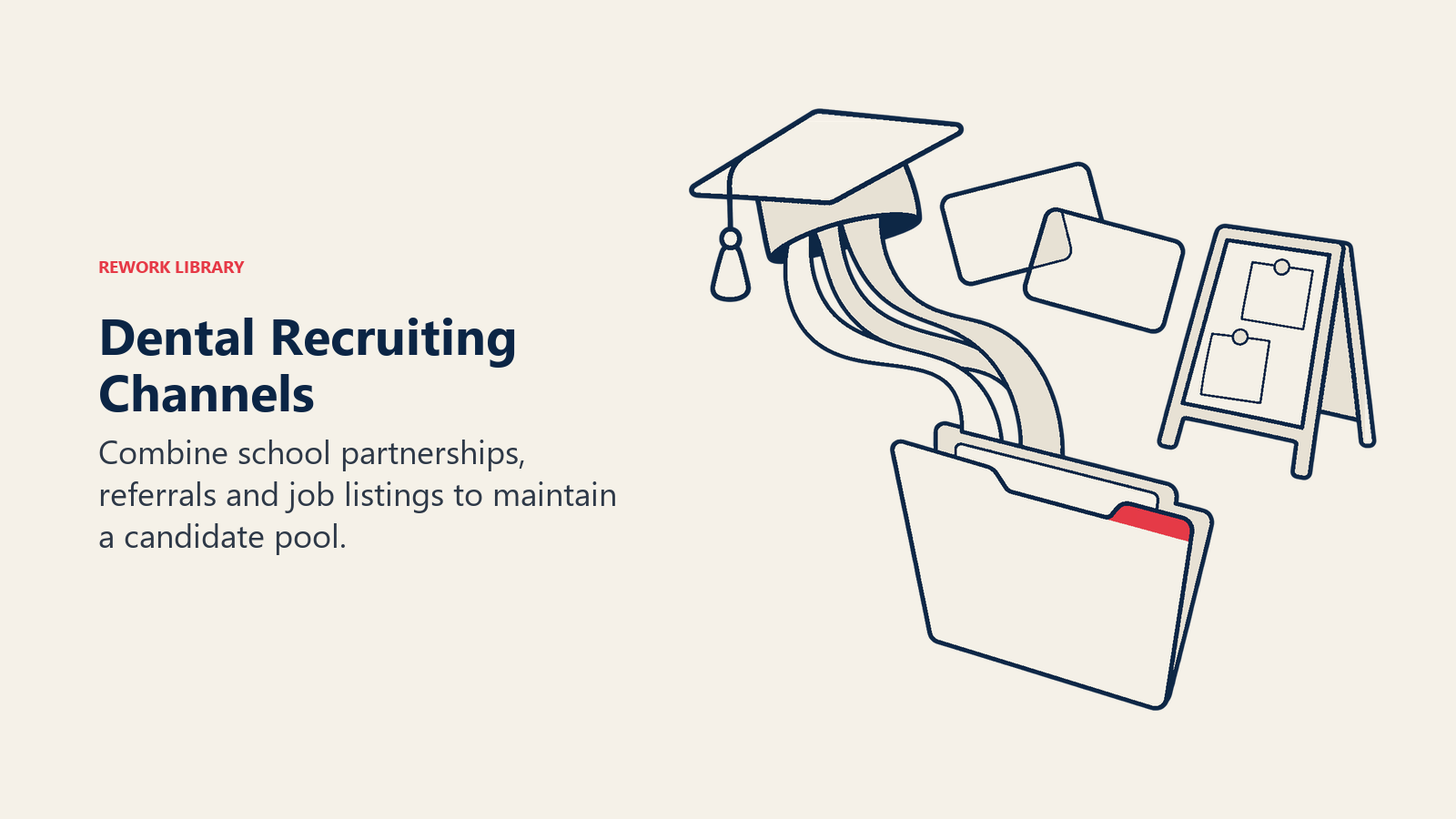
Dental school partnerships are underutilized. Contact your regional dental hygiene programs directly. Offer to host clinical rotations, speak to final-year students, and build relationships with program directors. Students who rotate through your practice are warm candidates who already know your environment, your equipment, and your team culture. The conversion rate from rotation-to-hire is significantly higher than cold recruits.
State dental association job boards (ADA, ADHA, and state-level equivalents) attract candidates who are actively engaged with their profession, typically better clinical performers than passive candidates. The volume is lower, but signal quality is higher.
Referral bonuses for your current staff are worth calculating explicitly. If replacing a hygienist costs you $20,000 in lost production and recruiting time, a $2,500 referral bonus paid out at the 90-day mark for a referred hire is one of the best investments you'll make. Your current team knows people in the field. Make it worth their while to make the introduction. Practices with structured patient referral programs can apply a similar referral bonus logic, the principles of rewarding introductions translate from patient acquisition to staff recruitment.
Temp-to-perm arrangements through dental staffing agencies give you a working interview that spans weeks rather than hours. The agency markup is real (typically 25-35% above base pay), but you're buying risk reduction. If it doesn't work, you haven't committed.
The Structured Interview Process
Structured interviews outperform unstructured ones in predictive validity by a wide margin across every profession, including dentistry. That means everyone interviewing for a given role answers the same questions, and answers are evaluated against pre-defined criteria rather than gut feel.
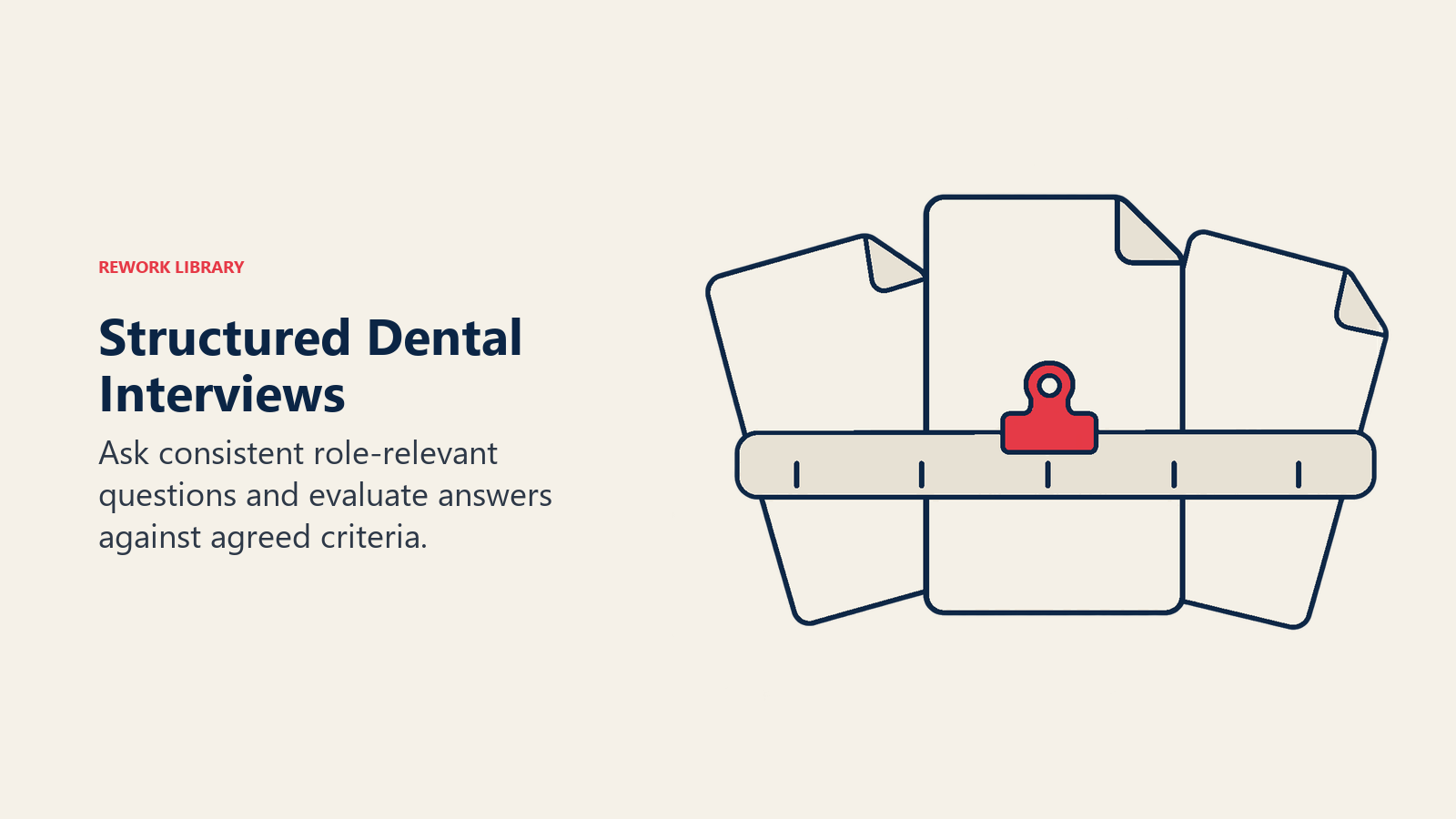
For a dental hygienist position, a useful competency-based question bank includes:
Clinical competency: "Walk me through how you handle a patient who presents with significant calculus buildup but who's anxious about pain during scaling. What's your approach?" This surfaces clinical skill and patient management style simultaneously.
Time management: "Describe a day when your schedule fell apart: appointments running long, an emergency worked in, a patient who needed more time than charted. How did you manage it?" This tells you how they operate under pressure.
Team integration: "Tell me about a time you disagreed with a clinical protocol a colleague or dentist preferred. How did you handle it?" This surfaces how they navigate hierarchy and professional disagreement.
Patient education: "How do you handle a patient who consistently refuses to follow home care recommendations despite repeated periodontal treatment?" This reveals their patient communication philosophy.
For dental assistant roles, add practical skills assessment to the process. A working interview, where a candidate works a half-day or full day in the practice before a hiring decision, is both more informative and more efficient than a second interview. Check your state regulations, as some states have specific requirements around working interviews and worker classification.
When hiring associates, add a production review component. Ask to see case mix data from their previous position, their case acceptance rate on treatment plans they've presented, and their average production per day. These numbers tell you what you can't observe in an interview.
Competitive Compensation Packages
Compensation benchmarks vary significantly by region, urban density, and practice type. A hygienist in suburban Minnesota earns differently than one in San Francisco or Miami. That said, general ranges provide a starting framework.
Dental hygienist compensation benchmarks (2025):
- Rural markets: $35-$45/hour
- Suburban markets: $42-$55/hour
- Urban/coastal markets: $55-$75/hour
- Daily rate (common in some markets): $400-$700/day
These figures shift constantly. The Dental Assisting National Board, state dental associations, and regional surveys from dental CPAs are better sources than national averages for your specific market.
For associates, the industry norm for production-based compensation sits at 28-35% of net production, with 30% as a common starting point for new graduates and 32-35% for experienced clinicians with established patient relationships. Guarantee structures (a daily minimum regardless of production) are increasingly common as recruitment pressure rises. Associates who see a defined associate-to-partner pathway in the offer are more likely to commit long-term than those who join without visibility into their equity trajectory.
Benefits differentiation often matters more than the base pay number. Dental practices competing on base pay alone with DSOs and larger groups typically lose. But paid CE allowances ($1,500-$2,500 annually), retirement matching (even at 3%), and genuine schedule flexibility are harder for larger organizations to deliver and represent real value to candidates.
Onboarding for Retention
Turnover in the first 90 days is disproportionately high in dental practices, and most of it is preventable. The first week sets the tone for whether someone stays 18 months or 5 years.
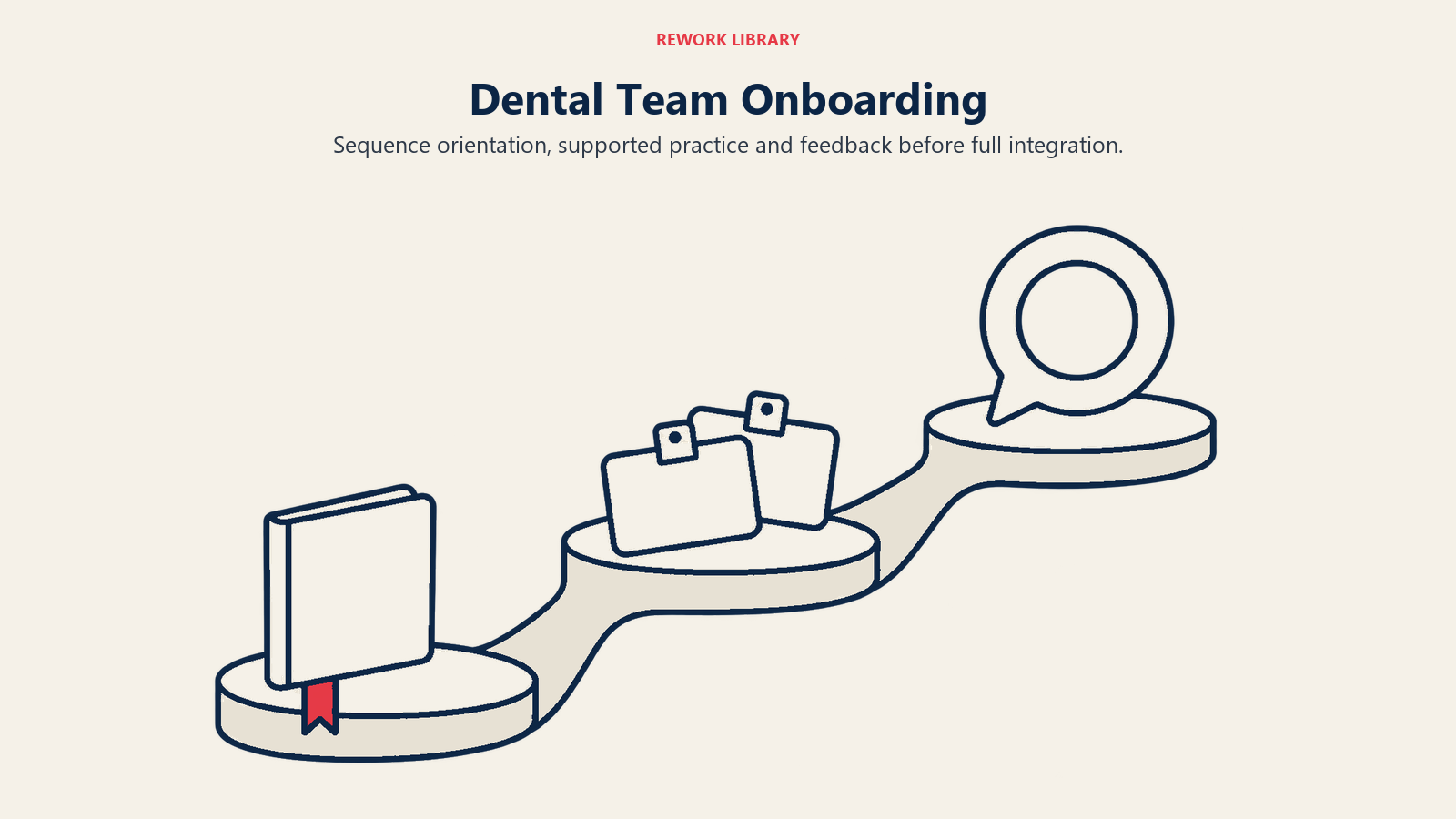
A structured 90-day onboarding plan for clinical staff should include:
Days 1-14: Practice management software proficiency, clinical protocol review, introduction to the patient base, shadowing established clinical staff for procedures outside their initial comfort zone.
Days 15-45: Independent patient care with check-ins, introduction to the recall and hygiene systems, participation in morning huddles, first formal feedback conversation at day 30.
Days 46-90: Full integration with scheduling, performance data review, discussion of CE goals and practice-supported training, and a retention-focused conversation about what's working and what isn't. Continuing education for dental teams is most effective when introduced early in onboarding, giving new hires a clear signal that the practice invests in development.
That day-90 conversation is the most important thing you can do to retain someone in their first year. Ask directly: What's working well for you here? What's not working yet? What would make this feel like the right long-term fit? The answers tell you whether you're keeping this person or funding their job search.
Hiring as a Practice Growth System
The practices that consistently outperform their peers on production and patient satisfaction share one operational characteristic: they treat hiring as a continuous, proactive function rather than an emergency response to vacancy.
That means keeping a warm candidate pipeline even when fully staffed. It means having a referral program running year-round. It means updating your compensation benchmarks annually rather than when someone threatens to leave. And it means tracking time-to-fill by role so you know how long your practice is actually vulnerable when someone departs.
The staffing market won't get easier. But practices with hiring systems built for the current environment will grow faster, lose fewer patients to scheduling failures, and operate with clinical teams that stay long enough to actually know their patients. A fully staffed practice also supports stronger dental recall and recare systems, since continuity of care from familiar hygienists is one of the most reliable drivers of patient retention.
Learn More