Treatment Plan Acceptance Rate: Presentation Skills, Financing, and Follow-Up Systems
Turn this article into takeaways for your work.


Each assistant summarizes the article only for you and suggests best practices for your work.
To raise your treatment plan acceptance rate, improve three systems: case presentation that translates clinical findings into plain-language patient impact, financing that leads with the monthly payment, and same-day scheduling backed by a structured follow-up sequence for unscheduled treatment. Practices that train on this lift production 20-40% on the same patient volume.
The average dental practice presents treatment that never gets scheduled at a rate of 40-60%. That number sits in most practices as an accepted reality. Patients choose whether to proceed, and it's not the practice's job to push. But CDC data on dental care utilization shows that cost is the most commonly cited barrier to getting needed dental care, which means many patients who decline treatment aren't rejecting it. They're struggling with how to pay for it. But this framing misses what's actually happening: treatment that was diagnosed as clinically necessary, presented to a patient, and left on the table. That's not patient choice. That's a system failure.
Unscheduled treatment represents the single largest untapped revenue opportunity in most practices. Capturing even half of it requires no new patients, no marketing budget expansion, and no new services. It requires better presentation, smarter financial arrangements, and a systematic follow-up process. Before investing in new patient specials and promotions or other acquisition channels, most practices would generate more production by closing the treatment acceptance gap they already have.
Practices that train on case presentation and measure acceptance rate consistently outperform those that don't. Not by a little, but by 20-40% in production on the same patient volume. That's the difference between a practice that grows and one that stagnates at the same production level year after year.
Key Facts: Treatment Acceptance Benchmarks
- Industry average treatment acceptance rate is 55-65% for comprehensive treatment plans (Dental Economics, 2024)
- Top-performing practices achieve 75-85% acceptance rates through systematic presentation training
- Practices that offer financing at time of case presentation report 15-25% higher acceptance on cases over $1,000
- Same-day treatment scheduling increases acceptance by 20-30% compared to scheduling at a future appointment
Case Presentation Skills: From Diagnosis to Decision
The conversation structure that consistently drives higher acceptance shifts the framing from "here's what's wrong" to "here's what's possible." Patients don't make treatment decisions based on clinical data. They make them based on how the information connects to what they care about.
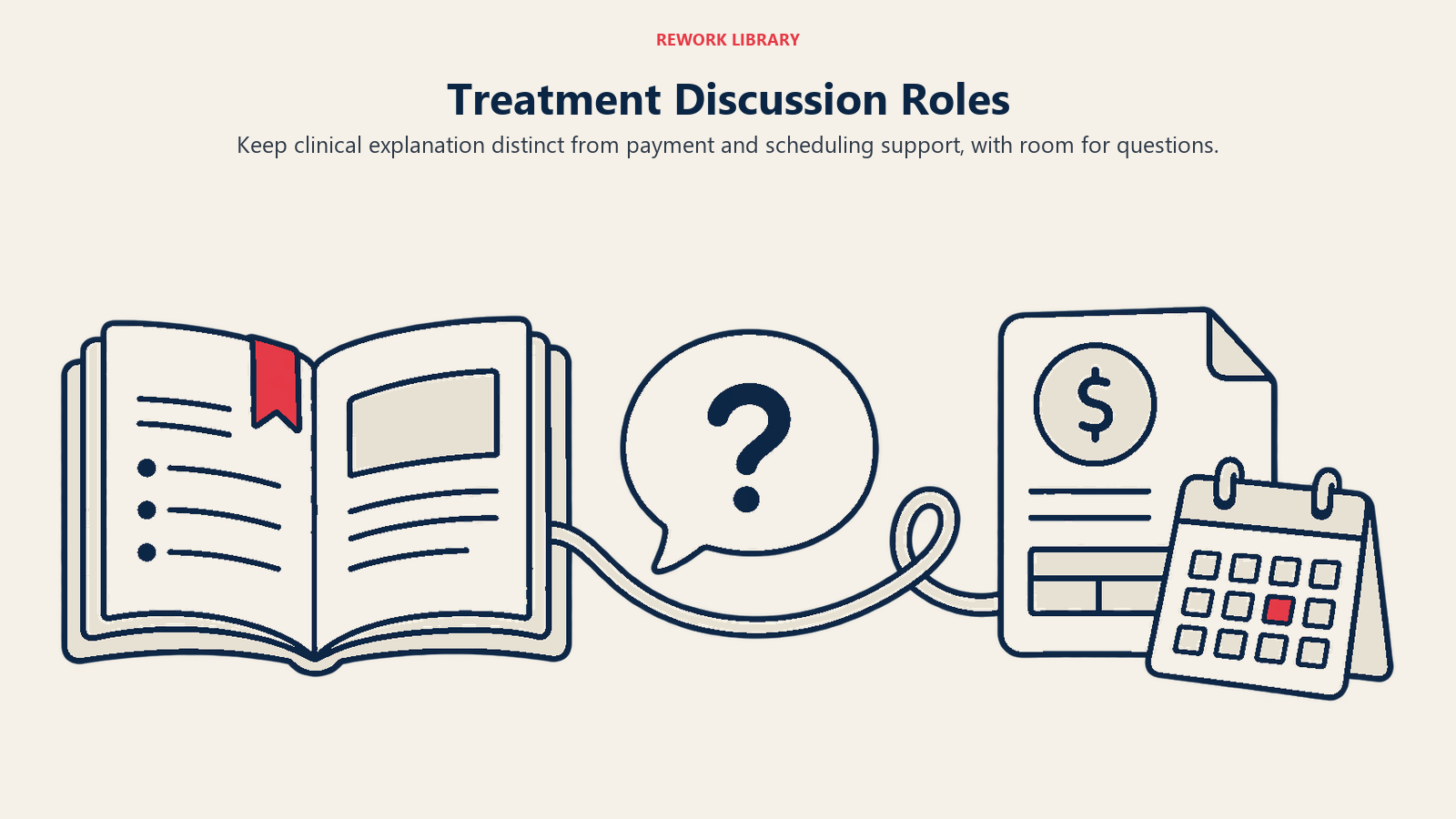
The role split between doctor and treatment coordinator: The doctor's job in case presentation is clinical authority and relationship. The treatment coordinator's job is logistics and financial arrangement. Mixing these in the same conversation weakens both. The doctor presents findings with clinical clarity and emotional connection. The treatment coordinator handles the fee discussion, financing options, and scheduling. When these roles are distinct and trained separately, the patient experiences a professional handoff that builds confidence rather than confusion. Building this team capacity is part of what strong front office excellence in dental practices looks like in practice.
Visual aids that improve comprehension: Patients presented with visual clinical evidence accept treatment at significantly higher rates than those presented verbally. Intraoral photos of decay, cracked cusps, or periodontal conditions make abstract diagnoses concrete and personal. The NIDCR's data on dental caries in adults shows that nearly 90% of adults aged 20–64 have had decay in their permanent teeth, meaning virtually every patient in your chair has a clinical history that a well-presented visual narrative can connect to. Put the photos on a screen the patient can see during the presentation. Walk through what you're seeing and why it matters. Patients who see their own X-ray with decay clearly visible are far more motivated to act than those who hear "you have a cavity on tooth 14."
Presenting phased treatment: Large treatment plans presented all at once overwhelm patients. A patient facing a $8,000 treatment plan has a different decision than one facing "Phase 1: two crowns at $2,400, which we'd like to start this month because the structural integrity of those teeth is at risk." Phasing the presentation reduces the decision size and allows patients to say yes to something manageable while understanding the full picture.
The language shift: Avoid clinical jargon in case presentation. "You have 4mm probing depths with bleeding on probing suggesting Stage II periodontitis" communicates nothing useful to a patient. "Your gum tissue is showing signs of infection that, if we don't address it, can cause bone loss around your teeth and eventually threaten the teeth themselves" communicates urgency and consequence. Practice translating every diagnosis into plain-language patient impact.
Financial Arrangements and Flexibility
The single most reliable lever for increasing treatment acceptance is expanding payment options. Patients who want care but can't figure out how to pay for it don't schedule. They leave. A well-structured financing menu removes cost as the primary barrier to care.
Present the monthly payment first: For cases over $1,000, present the monthly financing option before the total case cost. "This treatment, which we'd like to start this month, runs about $120 per month through our financing partner" lands very differently than "$2,900." The total must be disclosed, but which number the patient hears first shapes the entire financial conversation.
What financing terms to offer by case size:
| Case Size | Recommended Terms |
|---|---|
| Under $500 | In-office payment plan (2-3 installments) |
| $500-$2,000 | CareCredit 12-month deferred interest or Sunbit 6-12 month |
| $2,000-$5,000 | CareCredit 24-month, Sunbit 24-36 month |
| $5,000+ | Multiple financing options; Proceed Finance or LendingClub for longer terms |
Training staff to discuss finances without discomfort: Financial conversations are uncomfortable for many team members because they feel like they're asking patients for money. Reframe it: you're presenting options that make care possible. A treatment coordinator who genuinely believes that's true will have very different energy in the financial conversation than one who feels like she's pressing patients. A full menu of patient financing options for dental practices gives your team real tools to back that confidence: CareCredit, Sunbit, and in-house alternatives for every patient profile.
Script practice matters here. Role-play the financing conversation weekly until it feels natural. The staff member who can say "Most patients in a similar situation finance through CareCredit. It's zero interest for 18 months, and we can run the application right now" without hesitation will convert far more cases than one fumbling through a brochure.
Same-Day Treatment Scheduling
One of the highest-impact, most overlooked tools in case acceptance is same-day treatment. Offering to begin treatment the day of diagnosis, when the patient is already in the chair, has already heard the clinical case, and hasn't had time to talk themselves out of it, dramatically increases scheduling rates.
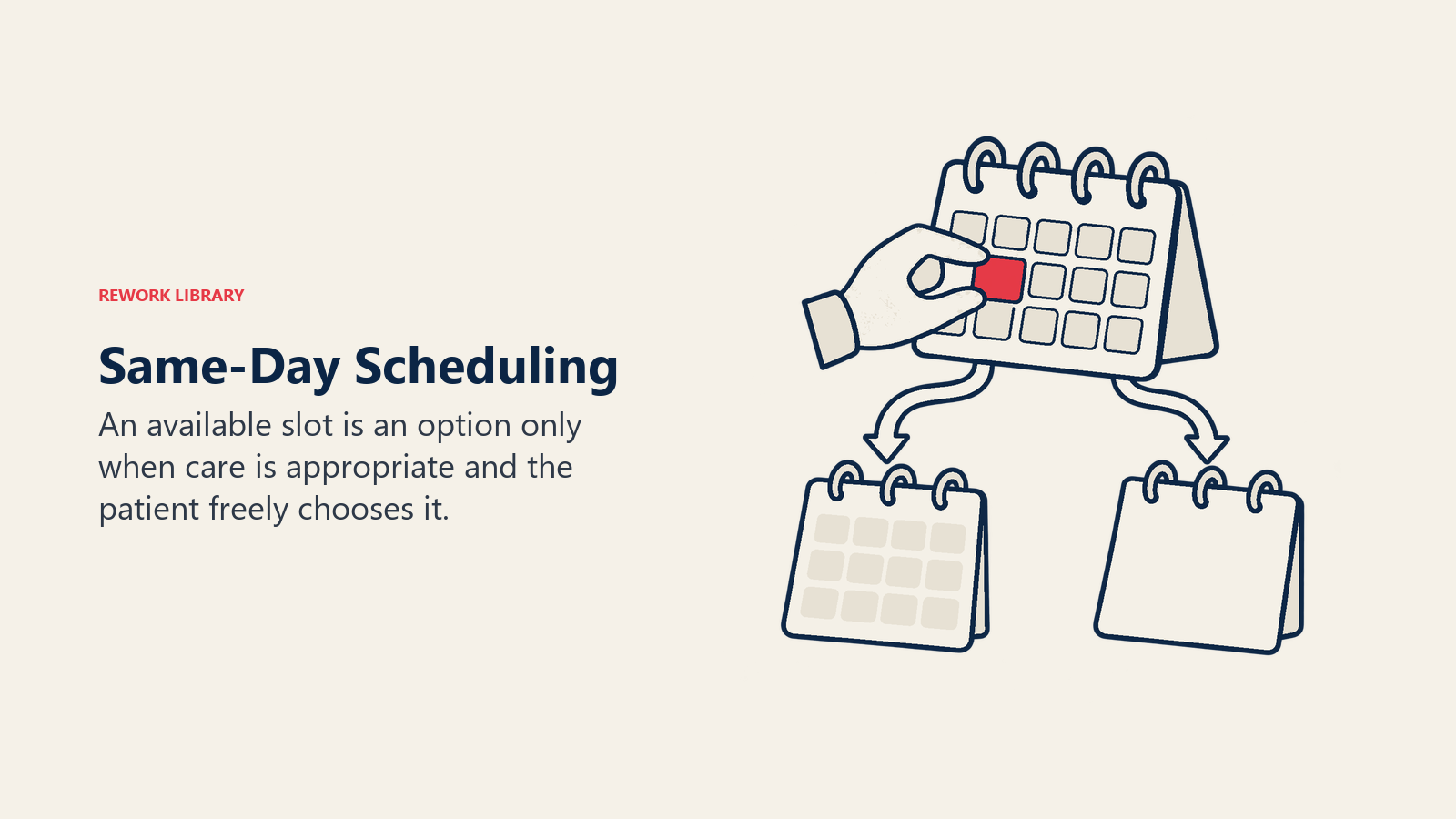
The psychology is simple: every day between diagnosis and treatment is an opportunity for hesitation, second-guessing, and competitive browsing. Same-day scheduling captures patients at peak motivation.
Structuring your schedule for same-day conversion: This requires intentional schedule design. Block 30-60 minutes of clinical flexibility in your afternoon schedule daily: this time absorbs same-day treatment starts. Many practices find that this time fills with same-day cases far more often than it goes empty, making it net-positive for production.
What procedures work for same-day: Simple restorative, tooth extractions, treatment plan initiation (first phase of a larger case). Complex cases requiring lab work or multi-session treatment can still be initiated same-day: take impressions, place a provisional, begin the first appointment. Starting creates momentum.
The offer language: "We actually have time this afternoon if you'd like to get started. It would be a good opportunity to begin while we're already here." This framing positions same-day treatment as a convenience benefit, not a sales push. Most patients either say yes or appreciate the offer even if they decline. Capturing same-day cases also requires scheduling infrastructure. See dental scheduling optimization for how to build daily flexibility into your template without disrupting planned production.
Following Up on Unscheduled Treatment
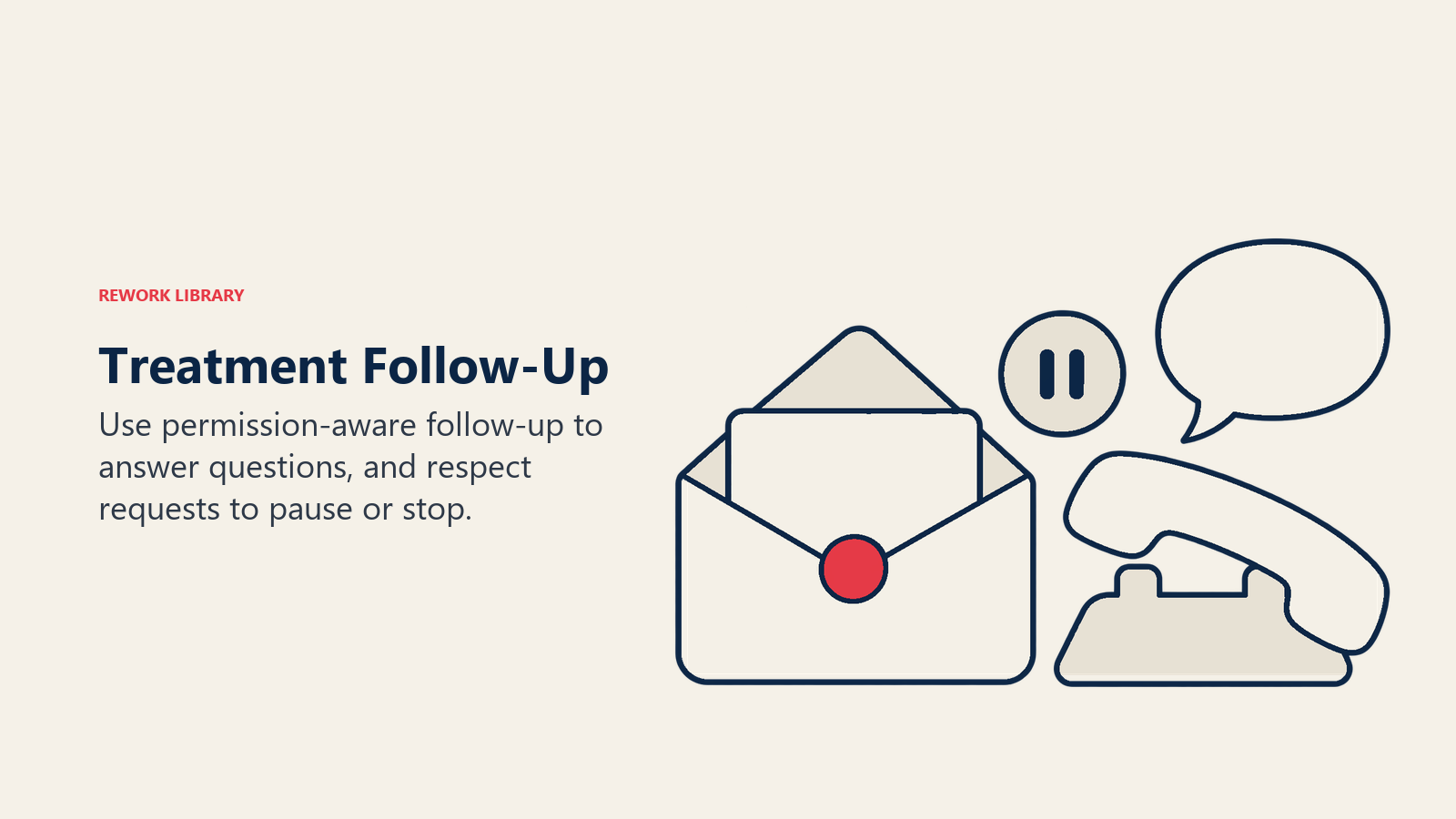
Unscheduled treatment is your highest-ROI follow-up activity. These patients have already received a clinical recommendation. They know they need care. The barrier isn't awareness. It's usually financial, logistical, or procrastination. A thoughtful follow-up system addresses all three.
Define your follow-up sequence:
Day 5-7 post-appointment: Text or email reminder. "Hi [Patient Name], this is [Team Member] from [Practice Name]. Dr. [Name] wanted us to reach out about the treatment we discussed at your last visit. Do you have any questions we can answer, or would you like to get that scheduled?" Short, non-pressure, genuinely helpful.
Day 21 post-appointment: Phone call from treatment coordinator. "I'm calling about the crown Dr. [Name] recommended for tooth 14. We wanted to check in. Sometimes timing is the issue and we can often find a same-week opening. Is that something you'd like to move forward with?"
Day 45-60 post-appointment: Final follow-up call or email. After 60 days, move to the quarterly reactivation list rather than active follow-up. Don't abandon the case. Just reduce the frequency.
Scripting for follow-up calls that re-engage without pressure: The biggest mistake in unscheduled treatment follow-up is a tone that feels like collections. The tone should be clinical concern, not sales urgency. "We want to make sure this doesn't become a more significant issue" is clinical. "Are you ready to get this scheduled?" is sales. Both can lead to a scheduled appointment, but only one builds the relationship.
How long to pursue unscheduled cases: Most practices find meaningful conversion up to 90 days post-diagnosis. After 90 days, conversion rates drop significantly. At the 12-month mark (the next hygiene visit), the case gets re-evaluated clinically and re-presented if still indicated.
Tracking unscheduled treatment: Use your practice management software to generate an unscheduled treatment report monthly. This list is your highest-value follow-up activity, more valuable than marketing spend for new patients. Dental Economics' key performance indicators framework provides a structured approach to tracking unscheduled treatment as a measurable production metric alongside other practice KPIs. Folding this into your key financial metrics for dental practices tracking lets you quantify the production value of unscheduled treatment as a line item, not just an abstract opportunity.
Treatment Acceptance Rate Benchmarks
| Practice Type | Average Acceptance Rate | Top Quartile |
|---|---|---|
| General practice, insurance-heavy | 55-65% | 72-78% |
| General practice, fee-for-service | 60-70% | 78-85% |
| Cosmetic/fee-for-service focus | 65-75% | 82-88% |
| Pediatric practice | 70-80% | 85-90% |
If your acceptance rate is below your practice type's average, the gap is almost certainly in presentation skills and financial arrangements, not in the quality of your clinical diagnoses. Start there. For high-value procedures like implants and full smile cases, structured case acceptance training delivers the biggest return on team development investment.
Case Presentation Framework: Step-by-Step
Acknowledge the patient's starting point: "How have you been since your last visit? Any issues or concerns I should know about before we dive in?"
Clinical examination with running narrative: Describe what you're seeing as you examine. "This filling has been in for about 15 years, and I'm seeing some marginal breakdown that I want to show you."
Visual documentation: Pull up X-rays and photos. "Here's what I'm talking about on tooth 14. This darker area is decay under the existing filling."
Clinical impact in plain language: "If we leave this, the decay will spread to the nerve, and what's currently a $1,400 crown becomes a root canal and crown for $2,800. I want to address it before that happens."
Recommendation with confidence: "My recommendation is to take care of this in the next 60 days. I don't want to push this out further than that."
Hand off to treatment coordinator: "I'm going to have [Coordinator Name] come in and go over what this looks like from a timing and investment standpoint. She can answer any questions you have."
Financing presented by coordinator: Monthly option first, then total cost, then multiple payment methods.
Scheduling before they leave: "We can get you on the calendar right now. We have openings Thursday afternoon or next Monday morning."
Frequently Asked Questions
What is a good dental treatment plan acceptance rate? The industry average is 55-65% for comprehensive treatment plans, while top-performing practices reach 75-85% through systematic presentation training. If your rate is below your practice type's average, the gap is almost always in presentation skills and financial arrangements, not in the quality of your clinical diagnoses.
How do you increase treatment acceptance? Focus on three levers: present clinical findings with visual evidence and plain-language impact, expand payment options and lead with the monthly figure on cases over $1,000, and offer same-day scheduling so patients act at peak motivation. Add a structured follow-up sequence for treatment that goes unscheduled.
Why do patients decline recommended dental treatment? Cost is the most commonly cited barrier, but most patients who decline are not rejecting care, they are struggling with how to pay for it. A clear financing menu, phased treatment plans that reduce the decision size, and a non-pressure follow-up process recover much of that unscheduled treatment.
How long should you follow up on unscheduled treatment? Most practices see meaningful conversion up to 90 days post-diagnosis, with follow-ups at days 5-7, day 21, and days 45-60. After 90 days, move the case to a quarterly reactivation list and re-present it at the next hygiene visit if still clinically indicated.
Learn More

Business Consultant