Multi-Location Dental Practice Management: Centralization, Associate Oversight, and Brand Consistency
Turn this article into takeaways for your work.


Each assistant summarizes the article only for you and suggests best practices for your work.
Opening a second location feels like a logical next step after a successful solo practice. The owner is busy, the schedule is full, revenue is strong. The assumption is that you replicate what works and double the output. Most practices discover that assumption is wrong within 18 months.
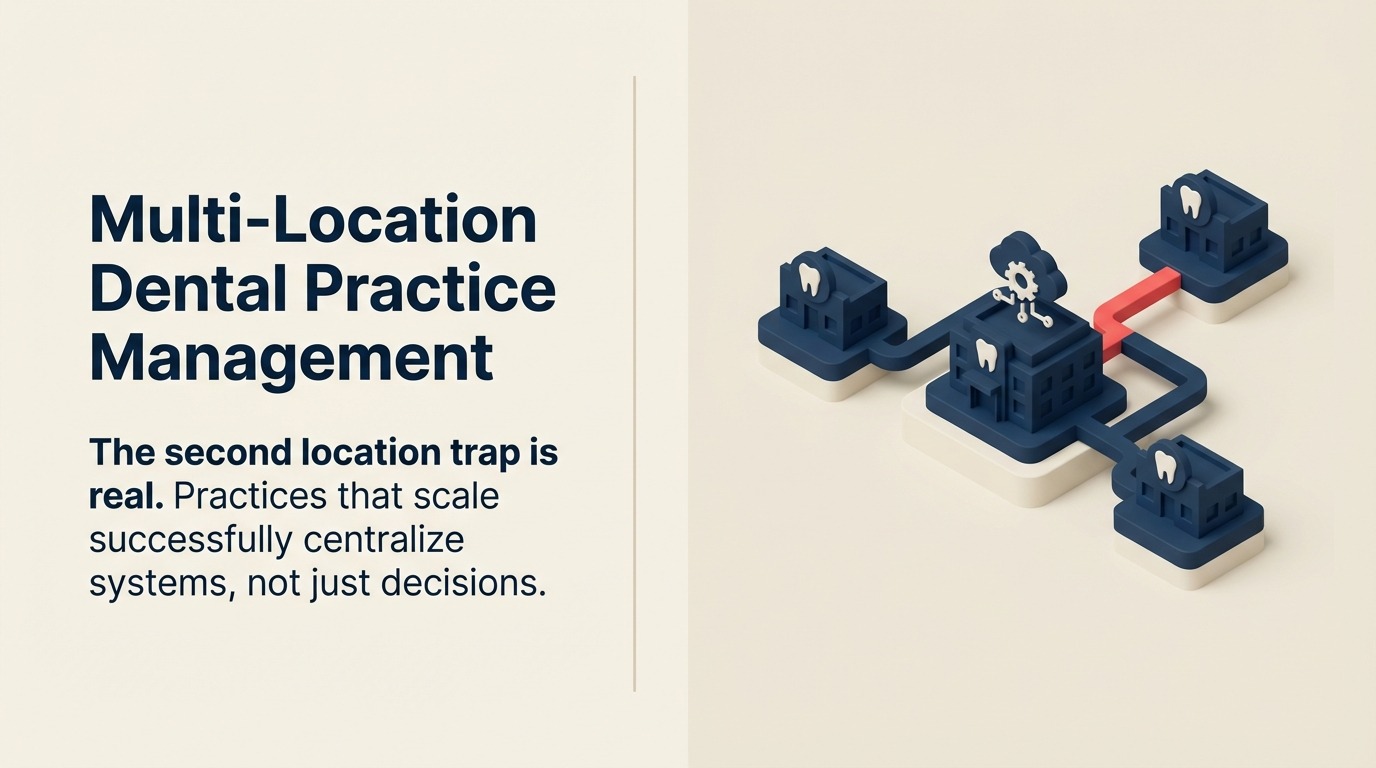
The second location trap is a recognizable pattern. The owner spreads their time across two sites, quality control slips at both, associate dentists underperform without oversight, billing errors accumulate at the new location, and the practice that thrived as a single unit struggles to stay even at two. The ADA's practice management resources address this transition specifically, noting that opening a second location carries significant time and financial risks that differ meaningfully from operating a single site. The problem isn't the expansion decision. It's the absence of systems designed specifically for multi-site operations.
Practices that scale successfully share a common characteristic: they build infrastructure before they need it, not after the problems surface. That infrastructure involves deliberate choices about what to centralize, how to manage providers at a distance, which technology to standardize on, and how to maintain patient experience quality across locations you can no longer visit daily. Before expanding, it's worth understanding where a multi-location group fits within the broader ownership landscape, solo vs. group vs. DSO practice models lays out the structural differences and trade-offs clearly.
Key Facts: Multi-Location Dental Practice Operations
- 64% of dental group owners cite associate performance management as their top operational challenge after the second location opens (ADSO, 2024)
- Practices with centralized billing report 18% lower accounts receivable days compared to those managing billing site-by-site (Dental Group Management Association, 2023)
- Dental groups with standardized technology stacks achieve 22% faster onboarding for new associates and staff (ADA Health Policy Institute, 2023)
Centralized vs. Decentralized Management Models
The first strategic decision for any growing dental group is what to centralize. Get this wrong, and you either create operational rigidity that stifles local flexibility, or you maintain decentralization that makes meaningful oversight impossible.
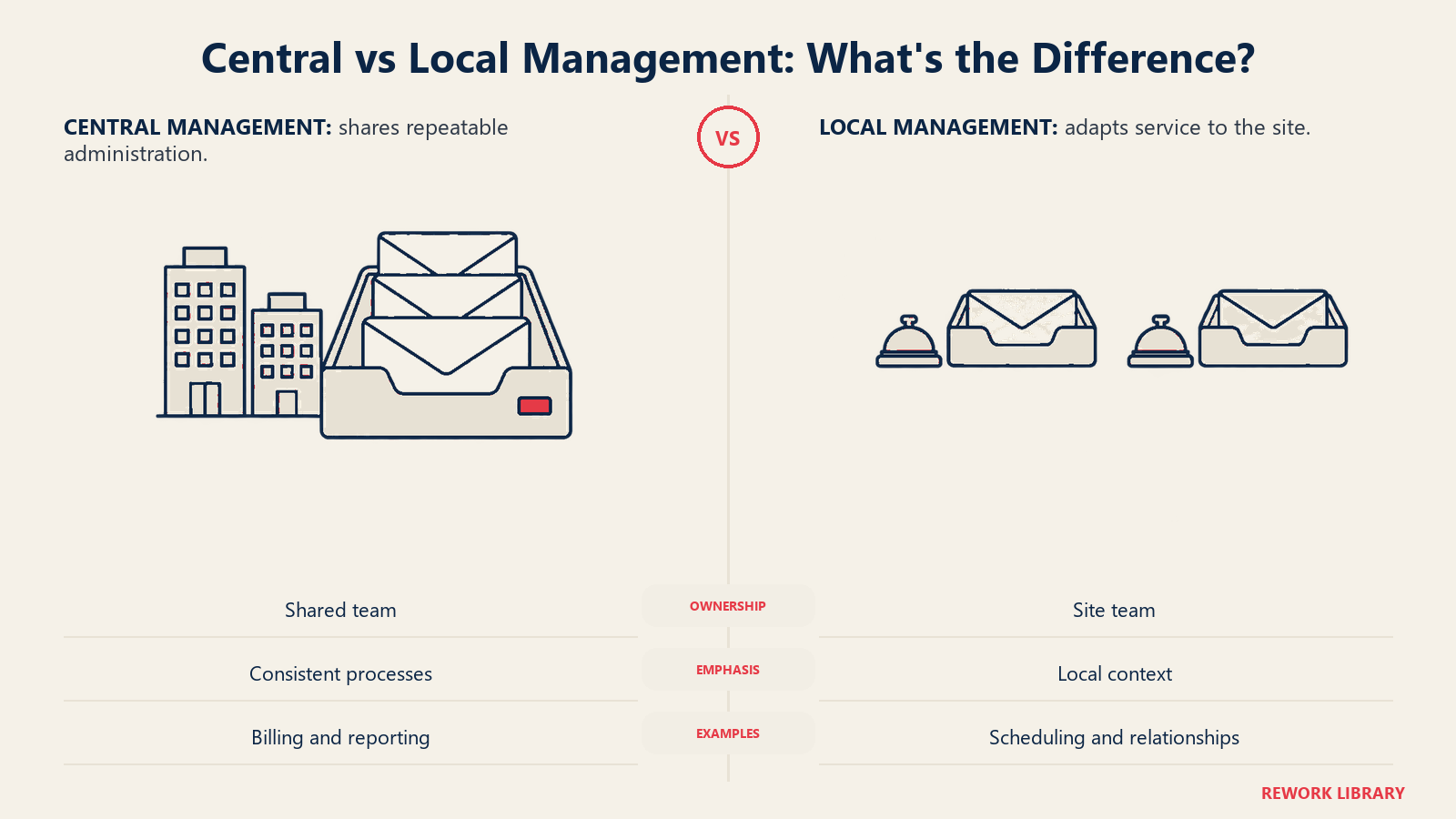
What to centralize:
- Billing and insurance credentialing: Billing errors compound at scale. A centralized billing team applying consistent coding protocols, claim submission standards, and collections follow-up dramatically reduces AR days and write-offs. One billing specialist can typically manage 2 to 3 locations effectively with the right software.
- HR and recruiting: Job posting, screening, benefits administration, and compliance tracking are highly repetitive. A centralized HR function eliminates duplicate effort and ensures consistent employment practices across sites.
- Marketing: Brand standards, website management, review generation campaigns, and advertising should be managed centrally to ensure consistency and avoid competing against yourself for the same local search terms. A consistent review generation system across all locations, as described in online reputation management for dentists, is one of the highest-return centralized marketing functions for a growing group.
- Purchasing and supply management: Group purchasing reduces supply costs by 8 to 15% through volume buying power. Centralized ordering also prevents individual locations from over-ordering or building excess inventory. According to IBISWorld's U.S. dentistry market analysis, the industry's scale and steady growth make purchasing leverage one of the clearest financial advantages available to multi-location groups.
- Financial reporting: Each location should produce standardized P&L statements using consistent accounting categories so the owner or CFO can compare performance across sites.
What to keep local:
- Clinical decisions: Treatment planning and clinical protocol are the clinical director or lead dentist's domain at each location. Centralizing clinical decisions creates liability risk and undermines associate autonomy.
- Scheduling nuances: Local market patterns, provider preferences, and appointment type mix vary by location. Centralized scheduling coordination is fine; rigid centralized control is not.
- Patient relationships and communication: Front desk staff build relationships with recurring patients. Those relationships are a retention asset and shouldn't be depersonalized through remote call centers unless volume genuinely requires it.
The right model evolves with practice size. A two-location group often centralizes billing and keeps most other functions local. A five-location group typically needs a dedicated operations manager and centralized HR. A ten-plus location group needs a full management team with regional structure.
Associate Dentist Management at Scale
Associate dentist performance management is where multi-location practices most frequently fail. An owner who relied on direct daily observation to maintain quality at a single location can't replicate that at three sites. The solution is replacing observation with data.
Production reporting by provider: Every associate should receive a monthly report showing their production, collection rate, procedure mix, patient retention rate, and new patient conversion rate. These metrics make performance patterns visible without requiring the owner's physical presence. An associate whose crown-to-exam ratio is significantly below the practice average either needs coaching or has a patient population that genuinely warrants a different approach. The data opens the conversation.
Accountability structures: Weekly brief calls (15 to 20 minutes) between the owner or operations manager and each location's lead dentist provide a regular cadence for addressing issues before they become entrenched. Monthly in-person visits to each location, even for an hour, signal that leadership is engaged and provides an opportunity to observe the patient experience directly.
Production benchmarks: Establish clear expectations before associates start. A full-time associate in a general practice should typically produce $650,000 to $900,000 annually in collections at a 30 to 35% compensation rate. Expectations below or above that range should be intentional and tied to specific practice circumstances. The full structure for associate performance agreements and compensation design is covered in dental team compensation models, which is essential reading before bringing on your second or third associate dentist.
Performance improvement protocols: When an associate consistently underperforms against benchmarks, address it with a documented improvement plan. Define the gap, agree on the specific behaviors or skills to develop, set a timeline, and schedule checkpoints. This protects the practice legally and gives the associate a fair path to improvement.
Unified Systems and Technology
Running multiple locations on different practice management systems is a common mistake made by groups that acquired existing practices with legacy software. The operational cost compounds quickly: different reporting formats, different insurance credentialing workflows, staff who can't work across locations, and no consolidated view of group performance.
Practice management software for multi-site groups:
- Dentrix Enterprise: Designed specifically for multi-location and DSO environments. Provides centralized patient records, consolidated reporting, and enterprise-level scheduling. Higher implementation cost but purpose-built for scale.
- Eaglesoft: Strong option for smaller groups, particularly those already using it at a single site. Less capable than Dentrix Enterprise for complex multi-site reporting but familiar to many associate dentists and staff.
- Open Dental: Open-source platform with lower licensing costs. Highly customizable. Requires more technical setup but can be configured for multi-site reporting with the right implementation partner.
Beyond practice management software, standardize on:
- Patient communication platforms: One texting and appointment reminder system across all locations (Weave, NexHealth, Solutionreach)
- Digital imaging: Consistent radiograph and intraoral camera systems so providers can read each other's images and patients can be seen at multiple locations
- Reporting dashboards: Consolidated dashboards that surface location-level KPIs daily without requiring manual report pulls
Tracking the right indicators at each location is a discipline of its own, key financial metrics for dental practices identifies the specific numbers that distinguish a genuinely underperforming location from one that's in a normal growth curve.
A multi-site KPI dashboard should show, at minimum: daily production per location, monthly collections, new patient volume, hygiene reappointment rate, and associate utilization (scheduled hours vs. available hours).
Brand Consistency Across Locations
Patients who visit multiple locations of the same practice expect the same experience. If location A has a spotless waiting area with current magazines and a friendly check-in process, while location B has outdated decor and a distracted front desk, the brand suffers at both sites. That inconsistency communicates operational looseness to the patients who notice it.
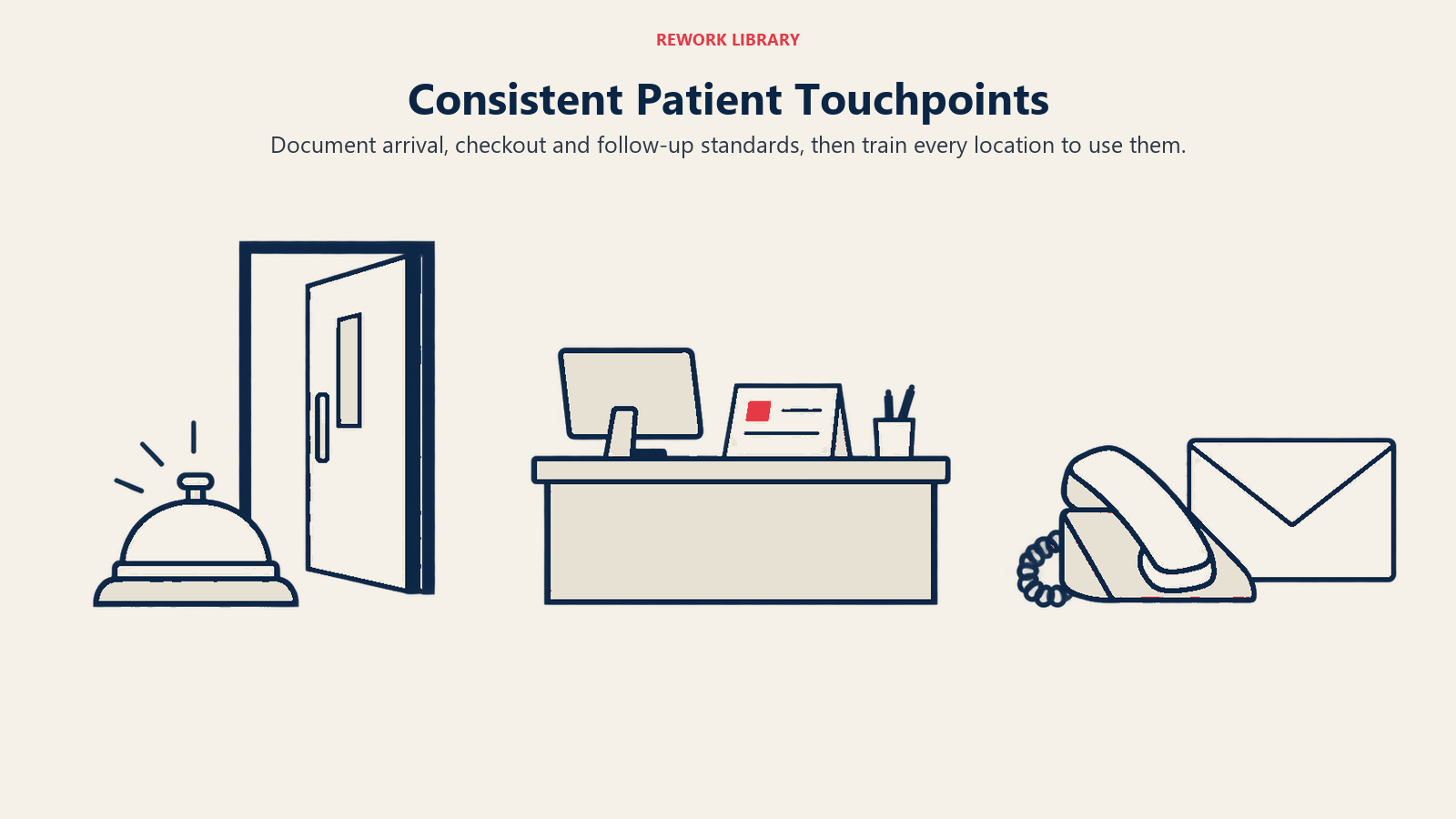
Patient experience standards: Document the patient journey at your best-performing location. What happens when a patient calls? When they arrive? When they're brought back? When they check out? When they receive a follow-up? Create a written protocol for each touchpoint and train all locations to it.
Uniform clinical protocols: Standardize your new patient exam protocol, treatment planning presentation, and case acceptance process across all locations. This improves case acceptance rates and ensures patients receive comparable recommendations regardless of which provider they see.
Staff training consistency: Onboarding new staff at a multi-location group is an operational risk if training is entirely site-dependent. Build a centralized onboarding program covering practice values, patient experience standards, clinical support protocols, and software basics. Supplement with site-specific training. Staff retention becomes an increasingly important operational metric as you scale, reducing dental staff turnover covers the specific drivers and practical solutions for practices managing teams across multiple sites.
Quality audits: Quarterly "mystery patient" calls and periodic site visits by the owner or operations manager with a structured observation checklist catch consistency gaps before they compound.
Financial Management for Multi-Site Groups
Location-level financial reporting is non-negotiable for a group practice. Without it, the owner has no way to distinguish a genuinely underperforming location from one in a normal ramp-up phase.
Location-level P&L structure: Each location should report monthly on collections, cost of goods (supplies), staffing costs, rent, and allocated overhead. Net operating income by location tells you which sites are carrying the group and which need intervention.
Overhead benchmarks per site: Target total overhead below 65% of collections for a mature location. New locations typically run 70 to 80% overhead in the first 18 to 24 months while building patient volume. Dental Economics benchmarks overhead ratios across practice types and confirms that supply costs and staffing ratios are the two line items where multi-location groups have the most room to improve margins through centralization. If an established location's overhead exceeds 70% consistently, investigate staffing ratios and supply costs first.
Underperforming vs. ramp-up distinction: A location that opened 12 months ago and hasn't hit production targets may be on a normal growth curve or may have a structural problem (wrong market, wrong associate, wrong hours). Distinguish the two with a structured 12-month performance review against the original location plan. If the gap is significant, address it operationally before it becomes a financial drain on the group.
Inter-location resource allocation: When one location is short-staffed or overbooked, can providers and staff move between sites flexibly? Building cross-location flexibility into employment agreements and scheduling practices protects the group from individual site disruptions. Dental scheduling optimization covers the specific scheduling frameworks that work across multi-site environments, including how to balance provider utilization across locations with different patient volumes.
The Infrastructure for Scale
The mindset shift required to run a group practice is the hardest part of the transition. An owner-operator who thrives on being the best clinical provider in the room has to reorient toward being the best builder of systems and developers of people. Some dental owners make that transition naturally. Many need outside support.
Management layers become necessary at four or more locations: a practice administrator or COO to own daily operations, a clinical director (often the founding dentist) to maintain quality standards, and potentially a CFO or controller for financial oversight. Trying to fulfill all these roles personally while still seeing patients is a common scaling failure. When the scale and complexity of a multi-location group reaches the point where professional management infrastructure no longer provides adequate capital or growth support, dental group and DSO transition becomes a natural strategic consideration.
The practices that build successfully to ten or twenty locations don't succeed because they have better dentists. They succeed because they build the administrative infrastructure, technology stack, and performance management systems that make consistent quality possible without requiring the founder's daily presence in every room. The ADA's overview of DSO structures is a useful reference for understanding how the largest multi-location operators have organized their management layers, a model that independent groups can adapt without a full DSO affiliation.
Learn More