New Patient Specials & Promotions for Dental Practices: What Works and What to Avoid
Turn this article into takeaways for your work.


Each assistant summarizes the article only for you and suggests best practices for your work.
A $49 new patient exam special will fill your schedule. Whether it fills it with patients who accept treatment and stay long-term is a different question, and it's the one most practices forget to ask before running the promotion.
New patient promotions are one of the most commonly mismanaged growth tools in dentistry. Practices discount their services to attract volume, then wonder why their hygiene schedule is full of patients who decline treatment recommendations, don't show for follow-up appointments, and leave for the next clinic offering a cheaper exam. The promotion worked as an attraction mechanism. It failed as a patient acquisition strategy. Understanding your dental market positioning before designing a promotion prevents this mismatch between offer and intended patient profile.
The distinction matters because these aren't the same thing. Filling your schedule is easy. Building a patient base that generates consistent production, accepts comprehensive treatment, and refers their family members takes more thought. The Dental Economics patient acquisition overview puts the cost of acquiring a new patient through paid digital advertising at $150–$500 in most markets, a benchmark that clarifies exactly what each promotional new patient is worth from a return-on-investment standpoint. You need to design promotions with the right patient in mind, not just the widest net.
Key Facts: New Patient Promotion Economics
- Practices report an average new patient acquisition cost of $150-$300 through digital advertising (Dental Economics, 2024)
- Promotional patients who accept treatment within 90 days of their first visit have a 3x higher long-term retention rate than those who don't
- State dental boards in 37 states have specific advertising rules governing how promotional fees can be disclosed
Exam and Cleaning Specials: Structuring the Offer
The exam and cleaning special is the most common new patient promotion in dentistry. Done well, it's an entry point to a comprehensive patient relationship. Done poorly, it's a discount that attracts price-sensitive patients who cost more to serve than they generate in revenue.
Structure matters more than price point. The questions to answer before running the promotion:
What's included? An exam, digital X-rays, and a cleaning covers the basics. But if your market includes heavy HMO competition, patients may compare your promotional offer to their $0 copay plan. Be specific about what's included so you're not competing purely on price.
What's the right price point? This depends on your market positioning. In a suburban family practice market, $59-$99 for a new patient exam and cleaning special is defensible. In an urban, higher-income market, $149-$199 may actually attract a better patient profile than a deep discount, since patients in these markets sometimes associate very low prices with lower quality.
Who's excluded? Promotional pricing that conflicts with insurance write-off limits can create compliance issues. Clearly state in the offer: "For patients without dental insurance" or "May not be combined with dental insurance benefits." Work with your office manager to confirm the offer language doesn't violate your insurance contract terms.
The conversion step that most practices underexecute: the promotional visit is a diagnostic and relationship-building opportunity. A well-run new patient exam should identify unmet treatment needs, begin building trust, and result in a scheduled second appointment, either for hygiene continuation or treatment planning. If your new patient promotions convert to comprehensive care at less than 40%, the problem isn't the promotion. It's the intake experience. Review your treatment plan acceptance rate to identify where that conversion gap is actually occurring.
Procedure-Specific Promotions
Beyond the standard exam special, procedure-specific promotions can drive both acquisition and revenue simultaneously.
Invisalign consultation days work well as an acquisition event because clear aligner patients tend to be treatment-motivated and willing to invest in their smile. A "complimentary Invisalign consultation with digital scan" positions the consult as high-value (digital technology, personalized simulation) rather than a discount. The consult itself should include a before/after simulation that creates an emotional connection to the outcome, and that's what converts consultations to case acceptance, not the promotional framing.
Whitening promotions attract cosmetically motivated patients, which is exactly the patient profile you want if you offer veneers, smile design, or implants. In-office whitening at a promotional rate ($199 instead of $350, for example) is low clinical complexity and high perceived value. The follow-up: every whitening patient should receive a cosmetic consultation offer. The whitening entry point opens the door to the cosmetic conversation.
Implant free consultation events (a Saturday morning block of 30-minute consultations for patients considering implants) work well when marketed on Google with implant-specific keywords. The consultation is the acquisition event; the case presentation within it is the revenue event. Practices that run these quarterly report consistent implant case starts from each event. Building a full dental implant practice growth system around these events turns occasional consultations into a reliable production stream.
The shared structure across procedure-specific promotions: the promotion gets the patient in the door. The in-office experience is where conversion happens. Invest as much thought in the consultation workflow as you do in the promotional offer itself.
Compliance Considerations
Dental advertising is regulated by state dental boards, and promotional offers sit squarely in this regulatory territory. Violating these rules can result in board complaints, fines, or worse. Getting this right isn't optional.
Key compliance areas to review:
State advertising rules: Most state dental boards prohibit "misleading or deceptive" advertising. "Free exam" is problematic if there are conditions that make it not free. "Free consultation" is safer when the consult is genuinely free of charge. Review your state board's advertising guidelines. Most are available on the board's website, or ask your state dental association for guidance. The ADA's Dental Care Market research provides useful context on how consumer dental spending and insurance coverage interact with how patients respond to promotional offers.
Medicare and Medicaid: If your practice accepts Medicaid or treats Medicare patients, waiving copayments or offering discounts below your standard fee to Medicare/Medicaid patients may violate federal anti-kickback laws. Given that cost is the most commonly cited barrier to dental care, particularly for low-income and uninsured patients, promotions need to be designed with genuine access intent, not just volume generation, to hold up under regulatory scrutiny. Promotional offers should explicitly exclude Medicare and Medicaid beneficiaries, or you should confirm with a healthcare attorney that your offer structure is compliant.
"Free" offer requirements: The FTC has guidance on use of the word "free" in advertising. Conditions attached to a free offer must be clearly disclosed. "Free whitening with Invisalign start" is fine with disclosure. "Free implant consultation" is fine when the consult is genuinely free. Where practices get into trouble is burying conditions in fine print.
Build a pre-launch compliance checklist for any new promotion: state board advertising rules reviewed, insurance contract terms checked, Medicare/Medicaid exclusion language included, all conditions disclosed clearly in the ad itself.
Patient Quality vs Volume: Designing Promotions for Your Target Patient
The highest-value new patient promotions attract people who match your clinical focus, geographic market, and long-term retention profile, not just whoever responds to a discount.
Demographic targeting: If you're growing a cosmetic practice, a whitening promotion reaching adults 25-45 with household income above $80K on Instagram is better than a $49 exam special promoted via a generic direct mail drop. The channel choice and offer type signal the patient type.
Insurance mix targeting: If you're trying to reduce your dependence on in-network patients, a promotion explicitly stating "for patients without insurance" or "for patients with out-of-network benefits" self-selects toward the patients you actually want.
Geographic targeting: For paid digital promotions, limiting geography to a 5-7 mile radius of your office and targeting by zip code income level is more effective than broad geographic targeting for most practices. Google Ads and Meta both support this level of targeting. Your local SEO for dental practices strategy should reinforce these same geographic targets to create a consistent presence across paid and organic channels.
The intake process seals the outcome. A new patient from a promotional visit who receives a thorough exam, a treatment plan with financial options, and a personalized follow-up from a care coordinator. That patient converts. A new patient who waits 20 minutes past their appointment, sees the hygienist but barely sees the doctor, and gets handed a paper treatment plan on the way out. That patient doesn't come back.
Measuring promotion ROI beyond new patient count. The 2024 DE/Levin Group Annual Practice Survey found average total production per doctor exceeded $1 million in 2024, context that helps benchmark whether your promotional patient cohort is contributing proportionally to that production target or dragging the average down:
- New patient conversion rate to second appointment (target: 70%+)
- Promotional new patient 6-month production value (compare to non-promotional new patients)
- Unscheduled treatment from promotional new patients (how much are they declining?)
- 12-month retention rate for promotional new patient cohort
New Patient Conversion Sequence: From Promotional Visit to Long-Term Relationship
The day-of visit is only one step. The sequence that converts a promotional patient to a long-term relationship:
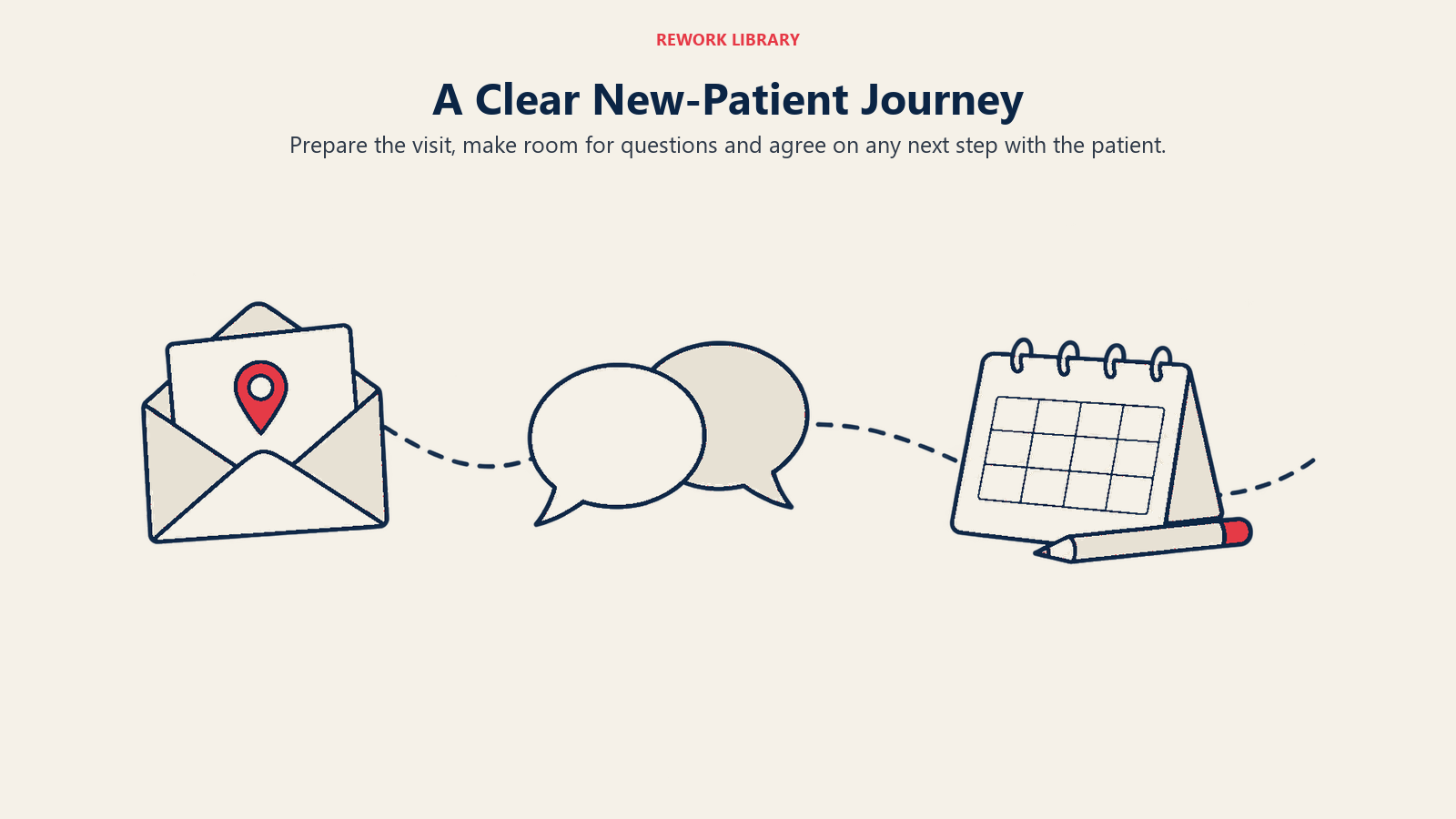
Pre-visit: Send a new patient welcome sequence (2-3 messages via text and email) before the appointment. Include directions, what to expect, and a short video from the doctor introducing the practice. This reduces no-show rates and starts building the relationship before the first appointment.
The visit: The doctor should spend meaningful time with every new patient: 15-20 minutes minimum. This isn't just clinical. It's relationship-building. Ask about what they want for their oral health, what they've found frustrating about dental care in the past, and what their smile goals are. This information feeds the treatment discussion.
Treatment presentation: Present findings with visual aids: intraoral photos, X-rays on a screen, a walkthrough of what you see and why it matters. Offer financial options (financing, payment plans) as part of the presentation, not as an afterthought. Well-structured patient financing options for dental practices give promotional patients who need larger treatment a clear path to saying yes.
Scheduling before they leave: The treatment coordinator should schedule the next appointment (whether it's a second hygiene visit, a treatment planning appointment, or the start of recommended care) before the patient walks out.
Post-visit follow-up: A call or personal text from the care coordinator within 24-48 hours. "Dr. [Name] asked me to check in, any questions about what we discussed yesterday?" This alone significantly improves conversion rates on unscheduled treatment. Consistent post-visit follow-up is also the first step in a broader dental recall and recare system that keeps promotional patients coming back long after the initial special.
Promotion Pricing Framework by Market Type
| Market Type | Recommended Exam Special | Positioning Notes |
|---|---|---|
| Urban, high-income | $149-$199 | Lower prices may signal lower quality |
| Suburban family market | $59-$99 | Competitive with insurance alternatives |
| Rural/underserved market | $49-$79 | Price sensitivity is higher |
| Cosmetic-focused practice | Free consultation | Position on outcome, not on price |
| Implant-focused promotion | Free consultation + scan | Technology differentiates |
These are starting points, not formulas. Test your market. Run a promotion for 90 days, measure quality metrics (not just volume), and adjust. Tracking promotion ROI alongside your broader key financial metrics for dental practices gives you the full picture of whether a promotion is generating sustainable production or just filling seats.
Learn More

Business Consultant
On this page
- Exam and Cleaning Specials: Structuring the Offer
- Procedure-Specific Promotions
- Compliance Considerations
- Patient Quality vs Volume: Designing Promotions for Your Target Patient
- New Patient Conversion Sequence: From Promotional Visit to Long-Term Relationship
- Promotion Pricing Framework by Market Type
- Learn More