Dental Practice Business Models: Solo vs Group vs DSO Compared
Turn this article into takeaways for your work.


Each assistant summarizes the article only for you and suggests best practices for your work.
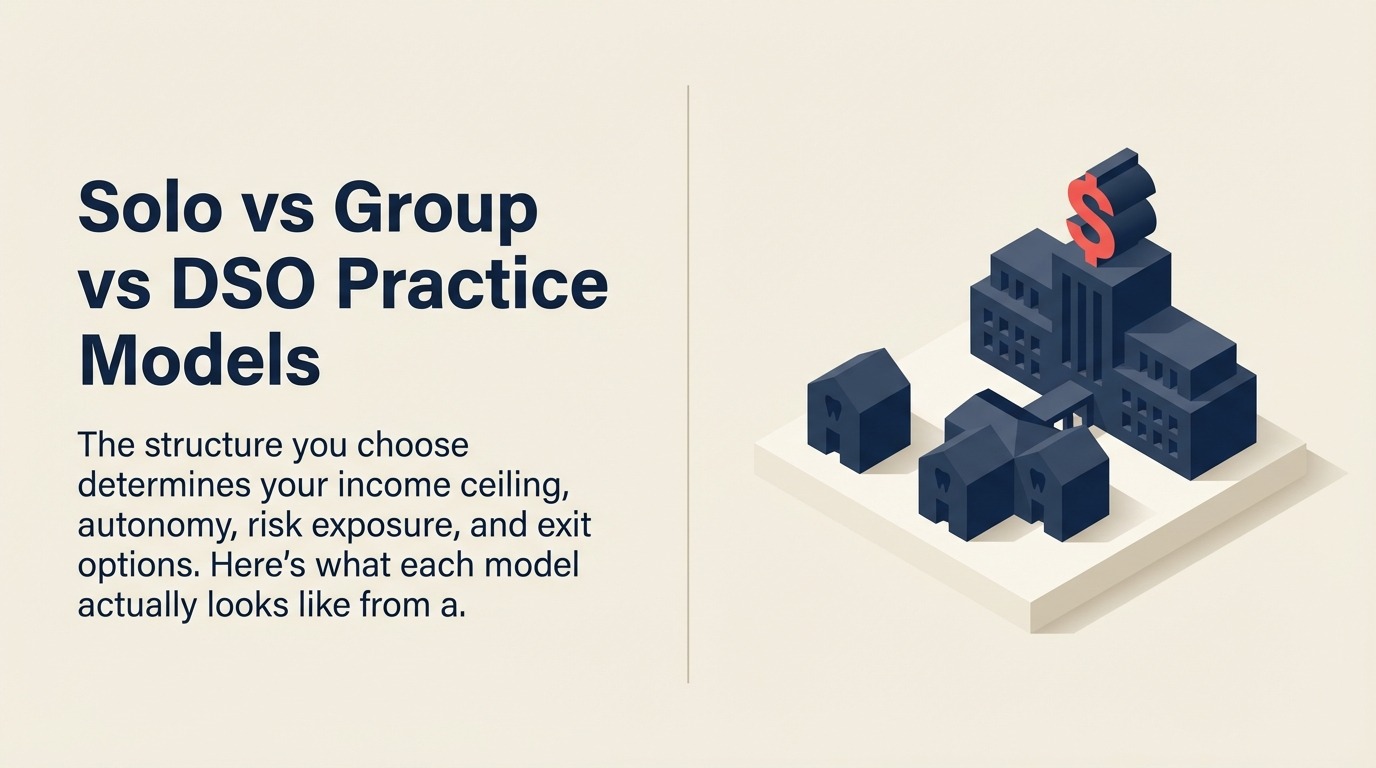
The three dental practice business models are solo (one owner, full control and full risk), group (two to ten dentists sharing costs and equity), and DSO affiliation (a service organization provides capital and back-office support in exchange for equity or ownership). Each sets a different ceiling on income, autonomy, risk, and exit value.
The structure you choose for your dental practice determines more than your income. It sets your ceiling, shapes your daily autonomy, defines your risk exposure, and determines what your exit looks like when you eventually decide to leave. Many dentists choose their model by default. They buy a solo practice because that's what they know, or they take a DSO offer because someone called. The ones who build consistently strong businesses make this decision deliberately, with financial data in hand.
This isn't a values debate about private vs. corporate dentistry. It's a capital allocation and lifestyle decision that deserves the same rigor you'd apply to any major business choice. Here's an honest comparison of all three models across the dimensions that actually matter.
Key Facts: Dental Practice Ownership
- DSOs now account for approximately 18% of all dental offices in the U.S. up from roughly 7% in 2015 (source: American Dental Association Health Policy Institute)
- Multi-doctor group practices produce 2.3x the revenue per location of solo practices on average (source: Dental Group Practice, 2024)
Solo Practice: Full Ownership, Full Responsibility
The solo private practice is still the most common ownership model in dentistry. One doctor, one location, full ownership of the upside and full exposure to the downside.
What works well in the solo model:
You make every clinical and business decision. You choose your staff, your hours, your fee schedule, your insurance participation, your equipment vendors, and the color of the walls. For dentists who are motivated by autonomy and who have strong operational instincts, this control translates directly into profitability. When you improve case acceptance or reduce supply costs, the entire benefit flows to you.
Revenue range varies widely, but a solo general practice that's well-run typically produces $800,000-$1.5M annually. Owner compensation for a practice at that level (after facility, staff, lab, and supply costs) typically lands between $200,000-$450,000. Practices that optimize production per visit and recall systems can push higher.
Where solo practices struggle:
Capital. You're funding everything (equipment upgrades, technology, marketing, emergency reserves) from a single practice cash flow and your personal credit. When a CBCT scanner or a practice management system upgrade needs to happen, you're the one writing the check.
Operational burden is also real. You're the CEO, the lead clinician, and often the HR director. For some dentists, this is energizing. For others, it's exhausting, and that exhaustion tends to cap growth. When the owner is the only producer, the practice has a biological ceiling defined by how many hours one person can work.
The profile of someone who thrives here:
Solo works best for dentists who value clinical autonomy above all else, who are strong business operators or willing to develop those skills, and who are content with a practice ceiling that's high enough for excellent personal income but not the scale of a multi-location group.
Group Practice: Shared Resources, Shared Complexity
A group practice means multiple dentists (typically two to ten) operating under a shared ownership structure at one or more locations. The ownership arrangement can take many forms: equal partnerships, equity stakes proportional to investment or seniority, or associate-to-partner pathways where associates earn in over time.
What works well in the group model:
Cost sharing is the immediate advantage. Fixed costs (rent, management staff, billing, equipment, marketing) are spread across more production, which improves the overhead ratio for all partners. A solo practice might run overhead at 60-65%. A well-run group with three doctors can often hold overhead at 52-58%, which means more of each dollar produced goes to owner compensation.
Groups also allow clinical specialization without losing patients. One partner focuses on implants, another on pediatric cases, and referrals stay in-house rather than flowing to outside specialists. That internal referral capture can add $15,000-$30,000 in monthly production without a single new external patient. Adding high-value specialty services requires investment, but the revenue impact is significant. See Adding Specialty Services to Your Practice for the analysis.
Scale creates opportunities that solo practices can't access: more favorable lab contracts, better equipment financing terms, insurance fee negotiation leverage, and the ability to hire specialized administrative staff that no single solo practice could afford.
Where group practices get complicated:
Partnership agreements. The failure mode of most group practices isn't clinical. It's relational. Partners disagree on hiring decisions, compensation structures, capital investment priorities, or what to do when one partner wants to scale and another wants to slow down. Getting your partnership agreement right (with a buy-sell provision, a clear compensation formula, and a dispute resolution mechanism) is non-negotiable before you sign anything.
Compensation in group practices typically follows one of three models: equal splits (simple, can create resentment if production is unequal), production-based splits (fair, but can discourage collaboration), or blended base-plus-production models (complex, but often the best balance). Each model has legitimate arguments for and against it. See Dental Team Compensation Models for a full breakdown of how these structures work in practice.
What valuation looks like in groups:
When a group practice sells, the valuation multiple is typically higher than a solo practice, reflecting the reduced owner dependency and more diversified revenue base. Solo practices typically sell at 0.65-0.85x annual collections. Group practices with strong systems and multiple producers sell at 0.85-1.0x collections, sometimes higher for practices with clean financials and documented management systems.
DSO Affiliation: Capital and Infrastructure, With Trade-offs
A DSO (dental service organization) is a business that provides non-clinical support services to dental practices. The dentist typically retains clinical autonomy on paper (treatment decisions remain with the doctor), while the DSO manages HR, marketing, billing, purchasing, and often real estate.
DSOs exist on a spectrum, not a binary:
Full acquisition: The DSO purchases your practice outright. You receive a lump sum (typically at a higher multiple than private sale, because DSOs value practices at 1.0-1.5x collections or higher for attractive targets) and may sign a five-to-seven year employment contract. You become an employee. Income security goes up; equity upside goes away.
Partial affiliation: Some DSOs take a minority stake (20-40%) in your practice, providing capital and services in exchange for equity and management fees. You retain majority ownership and operational involvement but gain access to DSO resources. Exit is typically structured as a future buyout option at a pre-agreed formula.
What DSOs actually provide:
The pitch is usually some combination of: recruitment support, centralized billing, group purchasing power, marketing infrastructure, and access to capital for expansion. For practices that are operationally constrained (where the owner is drowning in management tasks and can't focus on production), DSO affiliation can genuinely free up clinical time and production. The ADA News covers the trend in detail, more dentists affiliating with DSOs each year, particularly among dentists in the first decade after graduation.
What you give up:
Fee control is the most common complaint. Many DSOs push high-volume, insurance-heavy models that maximize patient throughput at the expense of production per visit. You may find your fee schedule decisions, insurance participation, and treatment protocols reviewed or influenced by the management layer. Understanding the trade-offs in dental insurance network strategies before entering a DSO relationship is essential. If your identity as a clinician is tied to quality-over-volume practice, this friction is real.
When DSO makes the most sense:
DSO affiliation or sale tends to make sense at two specific moments: when you want to monetize equity you've built and convert it into personal wealth (a sale event), or when you're trying to expand to multiple locations and need capital and infrastructure that you can't self-fund. For an owner who has built a $1.5M practice over fifteen years and wants a partial exit while still practicing, a DSO minority stake can be a very rational financial decision.
Comparison Table: Solo, Group, and DSO Across Key Dimensions
| Dimension | Solo | Group | DSO |
|---|---|---|---|
| Clinical Autonomy | Full | High (shared governance) | Moderate (policy-constrained) |
| Income Potential | High (capped by one doctor) | Very High (multiple producers) | Stable (employment model) |
| Capital Access | Limited (personal credit) | Better (shared) | Strong (institutional) |
| Overhead Ratio | 58-65% | 52-60% | Varies by agreement |
| Operational Burden | High (all on you) | Shared | Low (DSO manages ops) |
| Exit Valuation Multiple | 0.65-0.85x collections | 0.85-1.0x collections | 1.0-1.5x collections |
| Equity Upside | Full | Proportional to stake | Limited/None (post-sale) |
| Partnership Risk | None | Real | Minimal (contractual) |
| Expansion Speed | Slow | Moderate | Fast |
Transition Considerations: Moving Between Models
Going from solo to group means finding the right partner. That's harder than it sounds. Technical skill compatibility matters less than operational alignment: same philosophy on treatment, same expectations about investment in the practice, and same horizon for the future.
The mechanics of a buy-in depend on practice valuation and negotiated terms, but typically involve the incoming partner paying 20-50% of their proportional share of practice value in cash or financed amounts over two to five years. The outgoing (or existing) solo owner should have a current appraisal, clean financials going back at least three years, and a clearly structured partnership agreement drafted by a dental-specific attorney. See Associate-to-Partner Pathway for how these transitions work from the associate's perspective.
Going from private to DSO requires understanding the earnout structure if one is offered. Many DSO deals include a portion of purchase price paid over three to five years contingent on continued performance. Know exactly what metrics trigger those payments, and have a dental-specific M&A attorney review every document before signing. The BLS Occupational Outlook Handbook for Dentists provides useful context on market-wide income benchmarks that can inform whether a DSO employment offer is competitive relative to independent practice earnings.
For more on what multi-location expansion looks like operationally, see Multi-Location Dental Practice Management. And for the financial metrics that matter when evaluating any structural decision, see Key Financial Metrics for Dental Practices.
The Decision Framework
Before you decide, answer these five questions honestly:
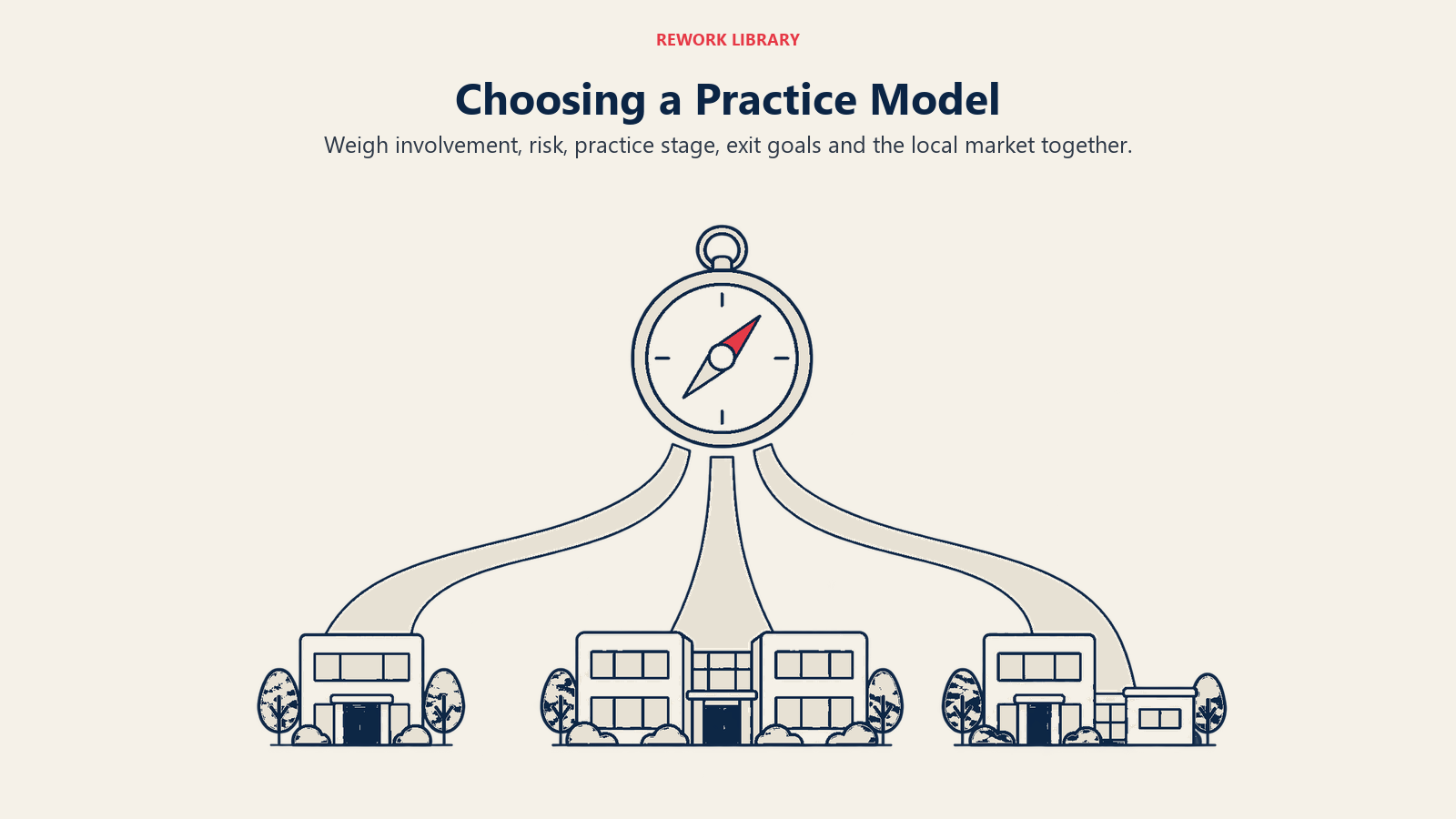
How much operational involvement do you want in 5 years? If you want to practice dentistry without managing a business, DSO or group with strong management makes sense. If you want to run and own the business, solo or founding partner of a group is the right path.
What's your risk tolerance? Solo ownership carries full upside and full downside. DSO employment offers income security in exchange for equity sacrifice.
What stage is your practice in? Dental Practice Growth Stages walks through what each stage demands. The right structural choice depends partly on whether you're in startup, mature, or expansion phase.
What's your target exit? If you want a $3M+ exit event, you need to build enterprise value through growth, documentation, and reduced owner-dependency, which usually means expanding beyond solo. If you want predictable retirement income, a practice sale or DSO affiliation may be cleaner.
What does your market support? A solo fee-for-service practice in a high-income suburban market has a different ceiling than a solo insurance-heavy practice in a rural market. The DSO value proposition also varies: some markets have intense DSO competition that creates real pressure on private practices, while others remain primarily independent. The ADA's practice modalities data shows significant geographic variation in DSO penetration that is worth reviewing when evaluating your specific market dynamics.
Conclusion
No practice model is universally superior. The right structure depends on your growth ambition, risk appetite, clinical values, and the stage your practice is currently in. What's not acceptable is choosing by default: buying a solo practice without considering whether a group entry might be smarter, or accepting a DSO offer without fully modeling what you're giving up.
The best dental business decisions look like investment decisions: you run the numbers on multiple scenarios, identify the trade-offs clearly, and choose the path that best fits your goals with your eyes open.
Start with the growth model that fits your current situation, but design it with your target exit in mind. The resources in the Learn More section below cover the operational framework and transition process in detail.
Frequently Asked Questions about Dental Practice Business Models
What are the main dental practice business models?
There are three: solo practice (one owner with full ownership and full operational burden), group practice (two to ten dentists sharing costs and equity across one or more locations), and DSO affiliation (a dental service organization supplies capital, marketing, billing, and HR in return for equity or a full buyout).
Which dental practice model makes the most money?
Group practices usually offer the highest income ceiling because multiple producers spread fixed costs and lower overhead to 52% to 60%. A well-run solo practice produces $800,000 to $1.5M with strong owner compensation, while DSO employment trades equity upside for stable, predictable income.
Is a DSO better than owning a private practice?
It depends on your goals. DSO affiliation makes sense when you want to monetize built-up equity or need outside capital to expand. You gain capital and infrastructure but give up fee control and equity upside, and you usually sign a multi-year employment contract. Owners who prize clinical and pricing autonomy often prefer solo or group ownership.
How does the exit valuation differ between models?
Solo practices typically sell at 0.65 to 0.85 times annual collections, group practices at 0.85 to 1.0 times because of reduced owner dependency, and DSO acquisitions at 1.0 to 1.5 times or higher for attractive targets. Building enterprise value and documented systems pushes you toward the higher multiples.
Learn More

Business Consultant
On this page
- Solo Practice: Full Ownership, Full Responsibility
- Group Practice: Shared Resources, Shared Complexity
- DSO Affiliation: Capital and Infrastructure, With Trade-offs
- Comparison Table: Solo, Group, and DSO Across Key Dimensions
- Transition Considerations: Moving Between Models
- The Decision Framework
- Conclusion
- Learn More