Reducing Dental Staff Turnover: Culture, Career Paths, and Retention Strategies That Work
Turn this article into takeaways for your work.


Each assistant summarizes the article only for you and suggests best practices for your work.
Replacing a dental hygienist costs between $20,000 and $50,000 when you account for recruiting time, lost production during vacancy, agency fees, and the months it takes a new hire to reach full productivity. Most practice owners know turnover is expensive. Almost none of them have calculated the actual number for their practice.
The practices that manage this best aren't the ones with the highest wages, though compensation matters. They're the ones who treat retention as a system with measurable outcomes rather than a feeling about workplace culture. They track turnover by role. They run stay interviews before people decide to leave. They build career paths that give staff reasons to stay longer than 18 months. The structural foundation for retention starts with hiring dental professionals correctly, a bad hire who leaves in three months is a turnover event that no retention system can fix retroactively.
Turnover in dental practices is structurally high. The hygienist shortage means experienced clinicians have options, the ADA Health Policy Institute found that 91.7% of dentists actively recruiting a hygienist in 2024 rated the process as very or extremely challenging. Dental assistants average under two years tenure in many markets. Front office staff are often treated as interchangeable, which becomes a self-fulfilling prophecy. But the practices with consistently low turnover (and there are many of them) do specific things differently. Here's what those things are.
Key Facts: Dental Staff Turnover
- Average dental hygienist tenure in independent practices is 3.2 years; in practices with structured development programs, it exceeds 5.5 years (ADA Health Policy Institute, 2023)
- Dental staff turnover costs practices an estimated $20,000-$50,000 per departure in lost production, recruiting fees, and training time
Diagnosing Turnover Root Causes
You can't fix a retention problem you haven't diagnosed. And most practice owners diagnose it wrong. They assume turnover is about pay when it's usually about something else.

Exit interviews are your first data source, but they're unreliable. People leaving a job are reluctant to share honest feedback because they don't want to burn bridges. A hygienist who's leaving because the dentist's communication style makes her feel dismissed will say "I'm leaving for a better opportunity." She's not lying, but she's not telling you the actual root cause either.
Stay interviews are more useful. A stay interview is a structured conversation with a current employee asking directly: What makes you want to stay here? What would make you consider leaving? Is there anything about this role or this practice that frustrates you consistently? Done well, by someone the employee trusts in a genuinely confidential setting, these conversations surface retention risks before they become resignations.
Schedule stay interviews annually with every clinical staff member who's been with you more than 12 months. Keep notes. Act on what you hear.
Common departure reasons vary by role:
Hygienists: Feeling rushed or overbooked beyond clinical comfort, limited professional development, pay that hasn't kept pace with market rates, communication issues with the dentist (being overridden on clinical recommendations, lack of respect for professional judgment).
Dental assistants: Physical demands and fatigue, limited advancement opportunities, inconsistent scheduling, feeling undervalued relative to clinical staff, pay that's close to other service industry wages with more physical demands.
Front office: Lack of clear job expectations, insufficient training for insurance complexity, no advancement path, feeling caught between patient demands and clinical team expectations.
Culture and Leadership Factors
The dentist is the most significant retention variable in most practices. This is uncomfortable to acknowledge but important to act on. A talented clinical team will leave a practice where the dentist is dismissive, unpredictable under stress, or communicates poorly, regardless of pay.
The communication patterns that drive turnover most reliably include: criticizing staff in front of patients, making clinical decisions without explaining the reasoning, inconsistent expectations (different standards on different days depending on mood), and dismissing staff input without acknowledgment. None of these require a toxic personality to cause retention damage. They often occur in practices where the dentist is clinically excellent and genuinely well-intentioned but hasn't received feedback about their leadership impact.
360-degree feedback (structured anonymous feedback from staff about leadership effectiveness) is underused in dental practices. Done annually through a structured format, it gives dentist-owners information they can't get any other way.
Recognition systems matter more than most dentist-owners realize. Clinical staff who feel their work is seen and valued stay longer and perform better. This doesn't require elaborate programs: consistent verbal acknowledgment of good work, a monthly "spotlight" mention in the team meeting, and small gestures for tenure milestones (1 year, 3 years, 5 years) create a recognition culture that costs almost nothing and pays back in retention.
Daily huddle culture is a retention mechanism. Practices with well-run morning huddles (specific, brief, operationally focused) communicate that the team's time and input matter. Practices without them, or with chaotic ones, create an every-person-for-themselves dynamic that erodes cohesion. A well-run huddle also supports front office excellence, since the morning briefing is where scheduling gaps, patient notes, and production targets are communicated to the administrative team.
Career Path Development
The question a dental assistant asks at 18 months isn't always about pay. Often it's: where does this go? If the answer is nowhere visible, she'll find a path somewhere else.
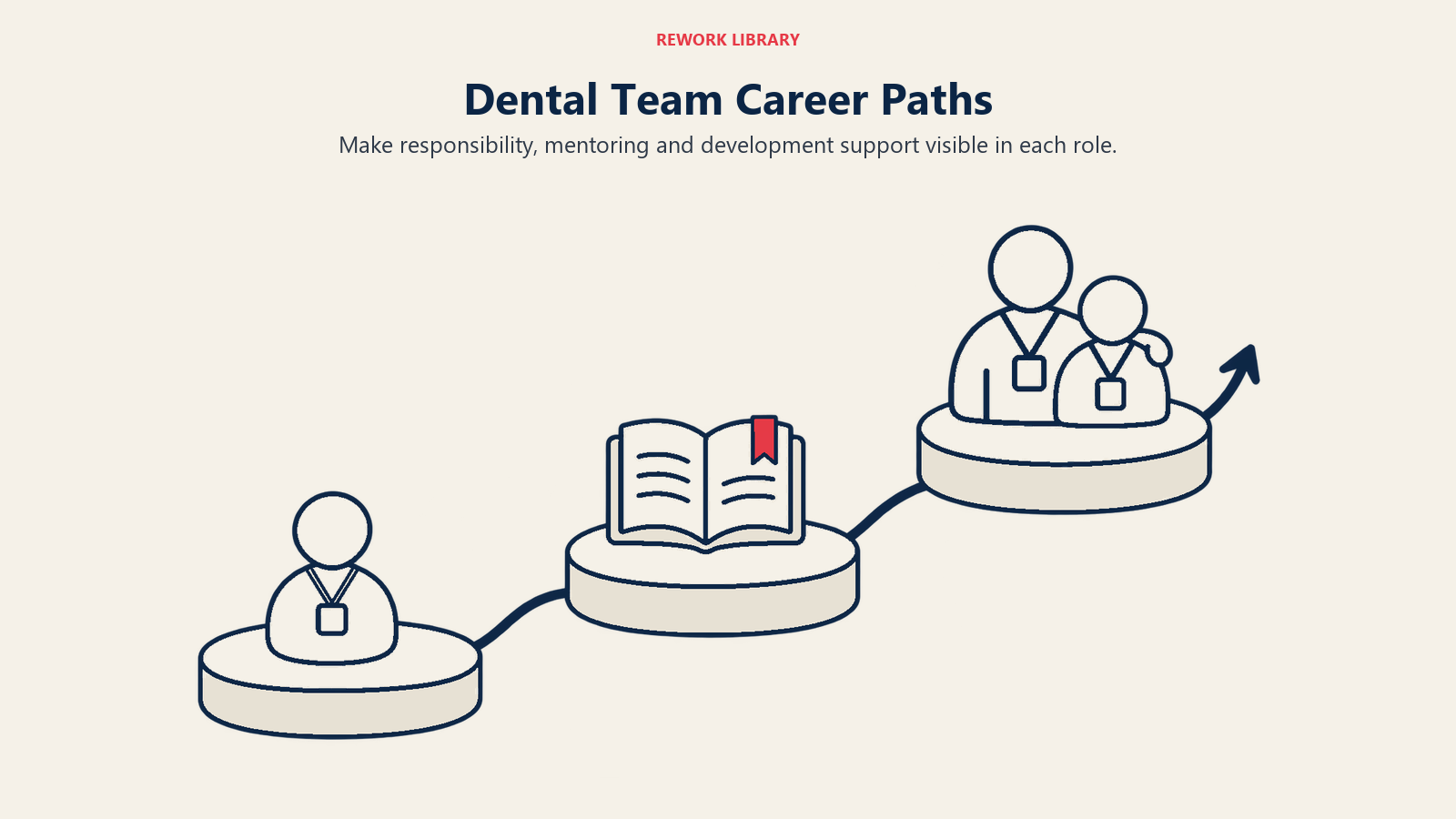
Structured career tracks for dental assistants should include at minimum: a path from general assistant to lead assistant with defined responsibilities and a pay differential; the option to pursue expanded functions certification (state-dependent) with practice support; and a potential path to clinical coordinator or even office manager for those with the aptitude.
For hygienists, career development looks different. They're already licensed professionals. But development opportunities still matter: becoming a lead hygienist with scheduling authority, training newer hygienists, taking on a mentorship role for the practice, or pursuing advanced certifications (local anesthesia, laser certification, periodontal therapy specialization) on the practice's dime. A structured continuing education program for dental teams gives hygienists a visible, funded development path without requiring a title change to feel like growth.
Cross-training creates both resilience for the practice and engagement for the employee. A dental assistant who understands front office workflows, or a front office coordinator who's been trained in basic chairside support, has broader value and broader interest in the practice's success.
Put development conversations into your annual review process explicitly. Ask each team member: What skills do you want to develop this year? What role do you see yourself in three years from now? How can we support that? Then actually fund and schedule the support you commit to.
Compensation Benchmarking and Adjustment
Compensation-related departures are usually invisible until someone gives notice. By then, they've already been contacted by a recruiter, completed a working interview at another practice, and decided. The conversation you should have had 12 months ago is now an exit interview.
Annual market rate benchmarks (not biennial, not when you get around to it, but annually) are the baseline. Use state dental association salary surveys, the ADA's Dental Practice Health Report, and local intelligence from your dental CPA network. Know where your current pay sits relative to your market. Dental team compensation models provides the structure for running this benchmarking review, including how to calculate total compensation value rather than just base pay comparisons.
Total compensation audits are more useful than salary comparisons alone. A hygienist earning $48/hour with 2 weeks PTO, a $2,000 CE allowance, and retirement matching is being compensated differently than a hygienist earning $48/hour with none of those benefits, even though the base rate is identical. Calculate and communicate total compensation value, not just the hourly number.
Pay transparency within teams is evolving. In most dental practices, some level of pay range transparency is better than strict secrecy. Staff who discover large unexplained pay differentials lose trust faster than those who understand the general range structure.
Work-Life Balance and Scheduling Flexibility
Four-day workweeks have moved from a perk to an expectation in many dental markets. Practices running Monday-Thursday schedules (or Tuesday-Friday) consistently report lower turnover among clinical staff than those running traditional five-day weeks. The math works for the practice if you're running 10-hour clinic days and maintaining production.

Schedule predictability matters as much as schedule length. A hygienist who knows her schedule three weeks in advance can manage her life around it. One whose schedule changes week to week loses the ability to plan anything, and that friction adds up.
Overtime management is a retention factor that's easy to overlook. Consistent overtime creates physical and mental fatigue that accelerates burnout. If your team regularly works past closing, the problem is scheduling density, not hard work, and the long-term cost in turnover is higher than whatever you're gaining in short-term production.
Part-time arrangements for hygienists who have reduced availability (young children, caregiving responsibilities, pursuing advanced education) are worth accommodating when clinically feasible. A 3-day-per-week hygienist you retain is worth far more than a 5-day-per-week hire you make and lose in 14 months. Part-time hygiene scheduling also fits naturally within dental scheduling optimization strategies that build flexibility into the appointment block structure.
Building a Retention Scorecard
Retention without measurement is guesswork. Build a simple retention scorecard that your office manager reviews monthly.
Key retention metrics:
- Turnover rate by role: Number of departures in the past 12 months divided by average headcount for that role. Benchmark target: below 15% for clinical staff, below 20% for front office.
- Time-to-fill by role: Average days from departure notice to new hire fully onboarded. This is your vulnerability window.
- 90-day retention rate: Percentage of new hires still employed at day 90. High early turnover indicates an onboarding problem.
- Tenure distribution: What percentage of your clinical staff has been with you more than 3 years? More than 5 years? A practice where nobody stays long is a different kind of problem than one with concentrated long tenure.
- Stay interview completion rate: Are you actually running them? Track this.
A stable team, where people know the patients, know each other's workflows, and trust the leadership, produces more, delivers better patient experiences, and creates word-of-mouth referral patterns that marketing can't buy. Turnover disrupts all of that, and the cost compounds every time it happens. Long-tenured teams are also foundational to patient loyalty programs, patients bond to the people who care for them, not just the brand, so staff continuity directly drives the retention metrics those programs measure.
Learn More