High-Value Dental Procedure Mix: Building Revenue Beyond Basic Restorative
Turn this article into takeaways for your work.


Each assistant summarizes the article only for you and suggests best practices for your work.
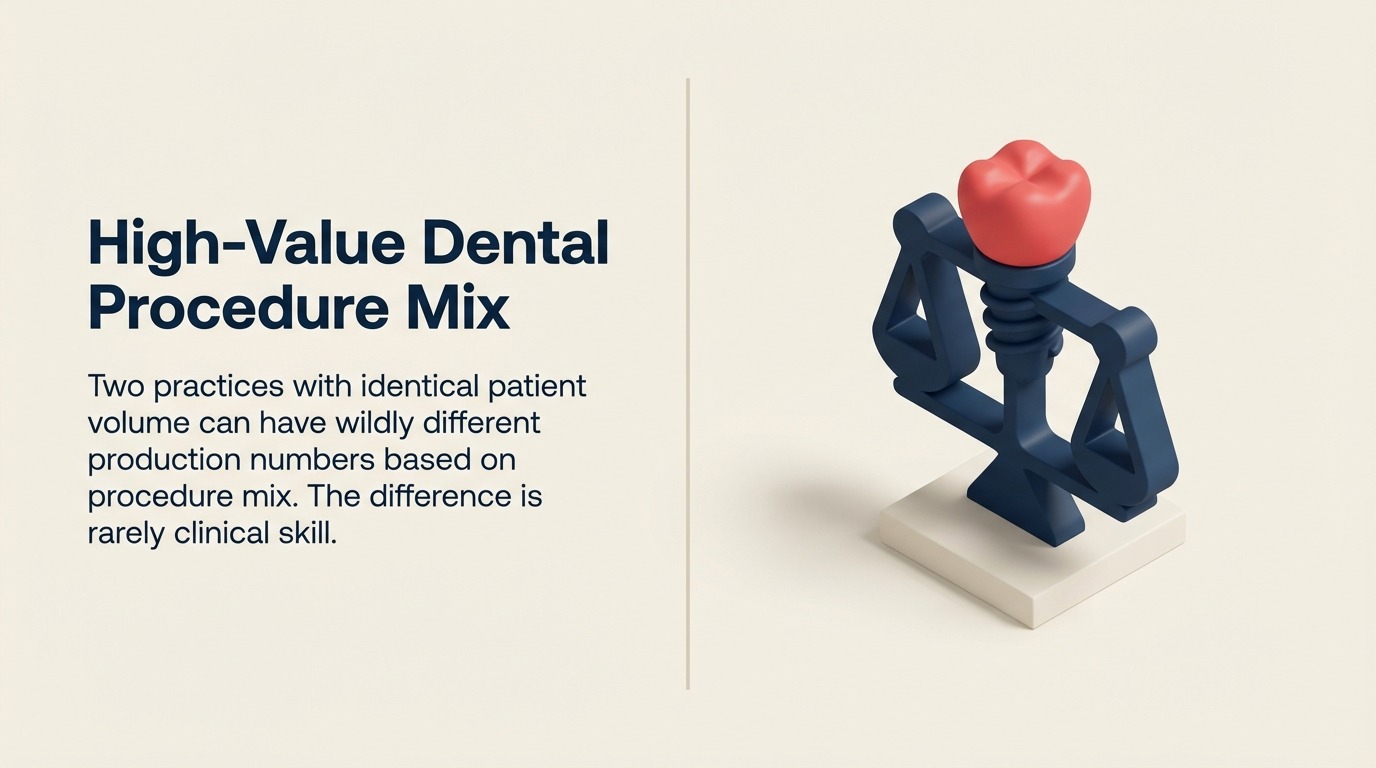
Two practices with identical patient volume can have wildly different production numbers based on procedure mix alone. One practice doing 1,200 patient visits per year might produce $900,000. Another with the same visit count produces $1.4 million. The difference is rarely clinical skill, it's case identification, presentation, and the infrastructure to deliver high-value care. The 2024 DE/Levin Group Annual Practice Survey found that average total production per doctor exceeded $1 million in 2024, with practices that expanded high-value service lines driving the largest year-over-year gains.
Most practices default to the procedure mix they've always had. The doctor trained to do basic restorative, the team learned to schedule around it, and the practice grew along that line. Changing the mix feels disruptive because it is. It requires training investment, marketing repositioning, and a willingness to see your patient base differently. But the production impact is compounding: a practice that adds $300K in implant production doesn't lose the restorative base. It layers higher-margin revenue on top. A structured dental practice growth model helps you sequence these investments without destabilizing the revenue you already have.
This article covers the four high-value service lines that most general practices can add or expand: implants, cosmetic dentistry, clear aligners, and sleep dentistry. Each has a different training curve, investment requirement, and revenue profile. The question isn't which one to choose. It's which one your patient population needs most and where the infrastructure gap is smallest.
Key Facts: High-Value Procedure Economics
- Single implant fees range from $3,500-$6,000 nationally, compared to $1,200-$1,800 for a crown (American Dental Association, 2024)
- Practices with active cosmetic programs report 20-35% higher production per patient than restorative-only practices
- Clear aligner cases average $4,500-$6,000 in GP practices, compared to $5,500-$7,000 in orthodontic specialty offices
Implants: Revenue Contribution and Business Case
Implants are the highest-revenue single procedure in general dentistry. A single implant case (implant placement, abutment, and crown) generates $3,500-$6,000 in a typical market. An All-on-4 full arch case runs $20,000-$35,000. A practice placing 3-5 implants per month adds $150,000-$300,000 annually in production from a single service line expansion.
But the revenue potential is only half the analysis. The investment is real:
Training: A clinician comfortable with simple implant cases needs 2-4 CE courses (60-80 CE hours) at minimum. Comprehensive implant training programs run $8,000-$25,000 depending on depth and hands-on component. Budget 12-18 months before the provider feels confident with a full range of single-tooth cases.
Equipment: CBCT imaging is essentially non-negotiable for modern implant dentistry. New CBCT units run $60,000-$120,000. Surgical kits (handpieces, bone reduction instruments, implant motor) add another $15,000-$30,000. Guided surgery software and stent fabrication adds $5,000-$15,000. Total equipment investment for a capable implant setup: $80,000-$165,000.
Break-even math: At an average fee of $4,500 per implant and a lab cost of $400-$600 (abutment and crown), your margin per case is roughly $3,900-$4,100 before overhead allocation. An $80,000 equipment investment breaks even at roughly 20-21 implant cases, less than 6 months of production at modest volume.
The referral relationship that feeds implant volume: if you're currently referring edentulous patients and failed bridge cases to an oral surgeon, you're giving away your best implant candidates. The CDC's 2024 Oral Health Surveillance Report reports that nearly 21% of adults aged 20–64 have untreated decay and significant rates of tooth loss, confirming that implant candidates are distributed across the general adult population, not concentrated in specialty referral streams. Map your own patient base first. A chart audit of patients with edentulous spaces, failing bridges, or documented interest in implants will reveal far more opportunity than most practices expect. The complete business case for building this out is covered in the dental implant practice growth guide, including training pathways and marketing systems.
Cosmetic Dentistry: Veneers, Smile Design, and Whitening
Cosmetic dentistry doesn't require a cosmetic-only practice or a Hollywood location. It requires a consultation process that helps patients see what's possible and a presentation approach that connects clinical recommendations to patient-stated goals.
Veneers are the revenue anchor of a cosmetic program. Full veneer cases (8-10 anterior veneers) run $8,000-$18,000 depending on material and market. Even a modest 2-case-per-month volume adds $200,000+ in annual production. The clinical investment is relatively low. Most GP dentists are technically capable of veneers with modest CE investment. The bigger gap is usually consultation process and digital smile design tools.
Digital smile design software (DSD, Smile Designer Pro, or similar) allows the patient to see a simulation of their result before committing to treatment. Practices that use digital design tools report 30-50% higher cosmetic case acceptance than those presenting without them. The tool pays for itself quickly.
Whitening as an entry point: In-office whitening is a low-complexity, high-perceived-value service that attracts cosmetically motivated patients. Every whitening patient should receive a cosmetic conversation, not a sales pitch, but a genuine "now that we've brightened your smile, is there anything else about it you'd like to address?" That conversation opens the door to veneers, bonding, and more comprehensive smile design work.
Case identification in your existing patient base: hygiene appointments are the best opportunity to surface cosmetic interest. Train your hygienists to ask one question: "Is there anything about your smile you'd change if you could?" Patients who say yes get flagged for a cosmetic consultation. Most practices have dozens of cosmetically interested patients they've never asked. The full consultation and conversion workflow for these cases is covered in the cosmetic dentistry revenue strategy guide.
Clear Aligners and In-House Orthodontics
The clear aligner market is one of the clearest examples of specialty revenue moving into general practice. GP dentists using Invisalign, ClearCorrect, or private-label aligner systems now capture a significant share of cases that would previously have gone to orthodontists, particularly mild to moderate malocclusion in adult patients. According to NIDCR oral health statistics for adults, a significant portion of U.S. adults have untreated malocclusion or cosmetic concerns, representing a large untapped aligner candidate pool in most general practices.
The economics favor GP participation. A comprehensive aligner case billed at $4,500-$5,500 in a GP practice represents high revenue density relative to chair time. Most of the work is digital: case planning, attachment placement, and periodic monitoring, rather than complex clinical intervention.
Training investment: Invisalign provider certification is accessible to any licensed dentist. Basic training runs 1-2 days. Clinical competence on moderate cases develops over 10-15 cases. Budget $3,000-$5,000 for training, software access, and initial case submissions.
Case complexity boundaries: GPs should be selective about case complexity, at least initially. Simple crowding correction, spacing closure, and mild bite correction are appropriate for most GP providers. Complex skeletal discrepancies, significant vertical problems, or severe crowding should still be referred. Define your complexity boundary clearly. Taking on cases beyond your experience level harms outcomes and your reputation.
Positioning vs specialty: Orthodontists typically charge $5,500-$7,500 for aligner cases. Pricing your GP aligner services 10-20% below that, with the added convenience of receiving all dental care in one location, is a strong patient value proposition. Many adult patients prefer the integrated care model. Reviewing your dental fee schedule optimization strategy ensures your aligner pricing reflects both competitive positioning and sustainable margins.
Sleep Dentistry: Oral Appliance Therapy
Sleep dentistry, specifically oral appliance therapy (OAT) for obstructive sleep apnea, is one of the most underdeveloped revenue opportunities in general practice. Oral appliances are indicated as first-line therapy for mild-to-moderate OSA and for CPAP-intolerant patients with severe OSA. The ADA's clinical resource on obstructive sleep apnea outlines evidence-based protocols for dentist involvement and the referral pathways from sleep physicians. Reimbursement runs $1,200-$2,500 per appliance through medical insurance, often at higher net revenue than dental insurance procedures.
The physician referral pipeline is what makes this work. Sleep physicians, pulmonologists, ENTs, and primary care doctors who diagnose OSA need oral appliance providers they trust. A dentist credentialed in dental sleep medicine (AADSM or similar) can build a referral pipeline from these providers that generates 3-5 new OAT cases per month, with no patient acquisition cost beyond the relationship-building. This kind of specialty service expansion is one of the most effective ways to add specialty services to a dental practice without dramatically increasing overhead.
Training and equipment: AADSM offers a comprehensive dental sleep medicine curriculum. Board certification is available for those pursuing deep expertise. At minimum, a 2-day CE course in oral appliance therapy and familiarity with the billing codes (typically medical billing, not dental) is necessary to get started. Equipment cost is low: appliances are lab-fabricated, and the main practice investment is relationship development and billing system setup.
Medical vs dental billing: OAT bills to medical insurance (CPT codes), not dental. Your billing team needs to know how to submit to medical carriers, obtain prior authorization, and manage the documentation requirements (sleep study, physician diagnosis, medical necessity letter). This learning curve is real but manageable with a focused training investment.
Procedure Mix Strategy: The 12-24 Month Model
Shifting your procedure mix doesn't happen in a quarter. It's a 12-24 month project that requires parallel investment in clinical training, marketing, case presentation systems, and patient education. Here's what a realistic timeline looks like:
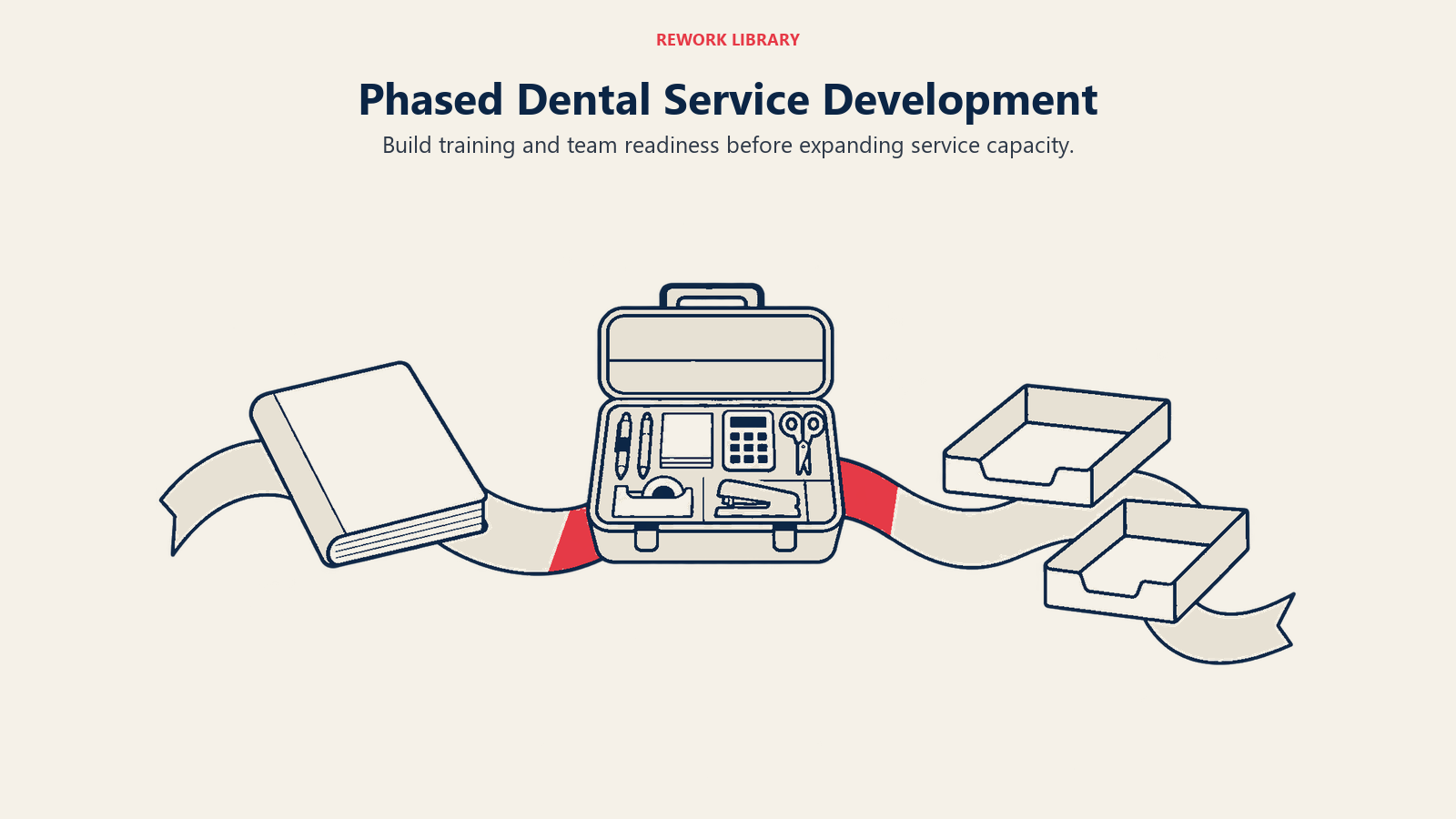
Months 1-3: Choose one service line to develop. Audit your existing patient base for candidates. Begin CE training.
Months 4-6: Complete foundational training. Start with straightforward cases in your existing patient base. Don't market externally until you have 5-10 successful cases.
Months 7-12: Begin external marketing (Google Ads, before/after content, referral outreach). Develop case presentation materials. Track production separately from restorative revenue.
Months 13-24: Expand volume with proven systems. Add team training (treatment coordinator case presentation, financing discussions). Consider adding a second service line.
The revenue impact compounds: the implant program you start this year generates cases for years. The cosmetic reputation you build in year one brings referrals in year three. The sleep appliance relationships you establish with physicians become a referral pipeline that requires no advertising spend to maintain. Tracking production by service line using key financial metrics for dental practices keeps you accountable to the 12-24 month targets you set.
Revenue Contribution by Procedure Category
| Procedure Category | Typical Fee | Annual Volume (modest) | Annual Revenue Contribution |
|---|---|---|---|
| Single implant (placement + crown) | $4,500 | 36 cases | $162,000 |
| All-on-4 full arch | $27,000 | 6 cases | $162,000 |
| Full veneer case (8 veneers) | $12,000 | 12 cases | $144,000 |
| Clear aligner comprehensive | $5,000 | 24 cases | $120,000 |
| OAT (oral appliance therapy) | $1,800 net | 24 cases | $43,200 |
These numbers represent modest volume: 3 implants per month, one cosmetic case per month, two aligner cases per month. Most practices can reach these targets within 18 months of focused development.
Case Identification Checklist for High-Value Procedures
Before investing in training and equipment, confirm the demand exists in your current patient base:
- How many patients have edentulous spaces? (Implant candidates)
- How many patients have failing or existing bridges? (Implant candidates)
- How many patients have expressed cosmetic interest in chart notes? (Cosmetic candidates)
- How many patients have crowding, spacing, or mild malocclusion? (Aligner candidates)
- How many patients report snoring, daytime fatigue, or diagnosed sleep apnea? (OAT candidates)
Run this audit before committing to any training program. If you find 50 implant candidates in your existing patient base, the business case for training is immediate. If you find 5, the timeline is longer.
Learn More

Business Consultant
On this page
- Implants: Revenue Contribution and Business Case
- Cosmetic Dentistry: Veneers, Smile Design, and Whitening
- Clear Aligners and In-House Orthodontics
- Sleep Dentistry: Oral Appliance Therapy
- Procedure Mix Strategy: The 12-24 Month Model
- Revenue Contribution by Procedure Category
- Case Identification Checklist for High-Value Procedures
- Learn More