Wait Time Optimization in Dental Clinics: Scheduling, Patient Flow, and Managing Delays
Turn this article into takeaways for your work.


Each assistant summarizes the article only for you and suggests best practices for your work.
Running 30 minutes behind is considered normal in most dental offices. Walk into any dental waiting room at 10:15 AM and you'll find at least two patients who were scheduled for 10:00. The providers know it. The front desk knows it. And increasingly, patients know it too, and they're losing patience with it faster than previous generations.
Negative reviews citing wait time are among the most common single-star triggers for dental practices with otherwise strong clinical reputations. A patient who thought the dentist was skilled and the staff was friendly will still leave three stars if they waited 45 minutes past their appointment time. And they'll tell three friends.
But wait time problems aren't a discipline problem. They're usually a design problem. Schedules built without realistic procedure time estimates, no buffer slots to absorb emergencies, and no communication protocol when delays happen are schedules that will run late every single day. The goal isn't zero wait time. It's predictable, communicated wait time. Patients tolerate delays they're prepared for. They resent delays that feel invisible and unacknowledged. The structural fix starts with dental scheduling optimization, building a template that reflects reality rather than optimism.
Key Facts: Wait Time and Patient Retention
- 30% of dental patients have considered switching practices due to consistently long wait times (Dental Patient Satisfaction Survey, Patterson Dental, 2023)
- On-time appointment starts correlate with a 40% reduction in negative reviews citing scheduling or wait time as a complaint
- Practices that implement proactive delay communication see 60% fewer patient complaints about waiting, even when the actual wait time doesn't change (Journal of the American Dental Association, 2022)
A peer-reviewed study in PMC found that subjective wait time, the patient's perception of how long they waited, affects satisfaction more directly than the objective clock time. Practices that communicate proactively about delays shift perception even when the actual wait doesn't change.
Scheduling Buffer Design
Most chronic lateness in dental practices traces directly to appointment templates that don't reflect reality. A procedure that takes 60 minutes on an easy case gets scheduled in 50 minutes. Multiply that over 8 appointments and you've built in 80 minutes of lateness before the day starts.
Building realistic appointment templates. Pull data from your practice management software on actual procedure completion times across the last 90 days, broken down by procedure code and provider. Most practices find their scheduled times are 10-20% shorter than their actual completion times. Adjust the templates to match reality, not optimism. Dental Economics reports that most practices can improve production by 18% or more simply by correcting their scheduling systems, and the first failure point is almost always the appointment template.
Buffer slot placement. The most effective buffer placement depends on your practice's emergency volume. A practice that averages 3-4 same-day emergencies per day should protect 2-3 open slots: one mid-morning, one mid-afternoon, and optionally one end-of-day. These slots hold until 90 minutes before the target time, then release to the wait list or for scheduling routine care.
Without buffer slots, every emergency becomes a cascade. A 30-minute emergency at 9:30 AM delays every subsequent appointment by 30 minutes. With a mid-morning buffer slot, the emergency fills the slot and the rest of the day runs on time.
Back-to-back scheduling without buffers. This is the most common scheduling mistake in dental practices. When every time slot is booked consecutively with no flexibility built in, a single late patient, a difficult extraction, or an equipment issue creates compounding delays for the rest of the day. There's no slack in the system to absorb anything.
Appointment type separation. High-variance appointments (new patients, comprehensive exams, complex restorative) should not be scheduled adjacent to other high-variance appointments. Bracket them with lower-variance procedures (prophylaxis, simple restorations) so a difficult case doesn't drag the next four appointments with it. This kind of intentional separation is central to block scheduling design, which is explored in detail in the context of hygiene department production and how it interacts with overall daily flow.
Patient Flow and Operatory Management
The waiting room is only one place patients wait. The other is the operatory, seated in the chair, prepped, waiting for the provider. The latter is often more frustrating because patients feel the clock ticking on treatment that hasn't started.
Seating patients before providers are ready. The standard practice of seating patients, taking X-rays, and having the hygienist begin before the dentist arrives is the right operational model, but it only works if the handoff protocol is clear and fast. Define the maximum time a patient should sit in a prepped operatory before a provider arrives (most practices target under 10 minutes) and track it.
Hygiene-to-doctor handoff timing. The single biggest source of hygiene schedule delays in most practices is waiting for the dentist to complete the hygiene exam. Hygienists who can't close out their appointments on time because the doctor is tied up in restorative become the bottleneck that backs up the entire afternoon.
The fix is a defined handoff signal protocol. Hygienists should signal for the doctor 5 minutes before the exam is needed, not when the patient is fully ready and the hygienist is standing idle. This gives the doctor a transition window without leaving the hygiene patient waiting.
Identifying bottlenecks in clinical flow. Common locations where patient flow breaks down:
- Front desk check-in for new patients who didn't complete forms in advance
- X-ray room when only one sensor is available for multiple operatories
- Sterilization turnover when room setup takes longer than expected
- Doctor exam queuing when the provider is behind in restorative
Map your patient journey from arrival to departure on a busy day. You'll find 2-3 specific moments that account for 80% of your total delay time. Fix those first. The front desk contribution to flow is significant, front office excellence in dental practices covers the check-in and handoff protocols that prevent bottlenecks from forming at the administrative level.
Communication About Delays
This is the highest-impact intervention in wait time management, and it costs nothing. Practices that communicate proactively about delays retain patients who would otherwise leave frustrated. The key is honesty over false reassurance.
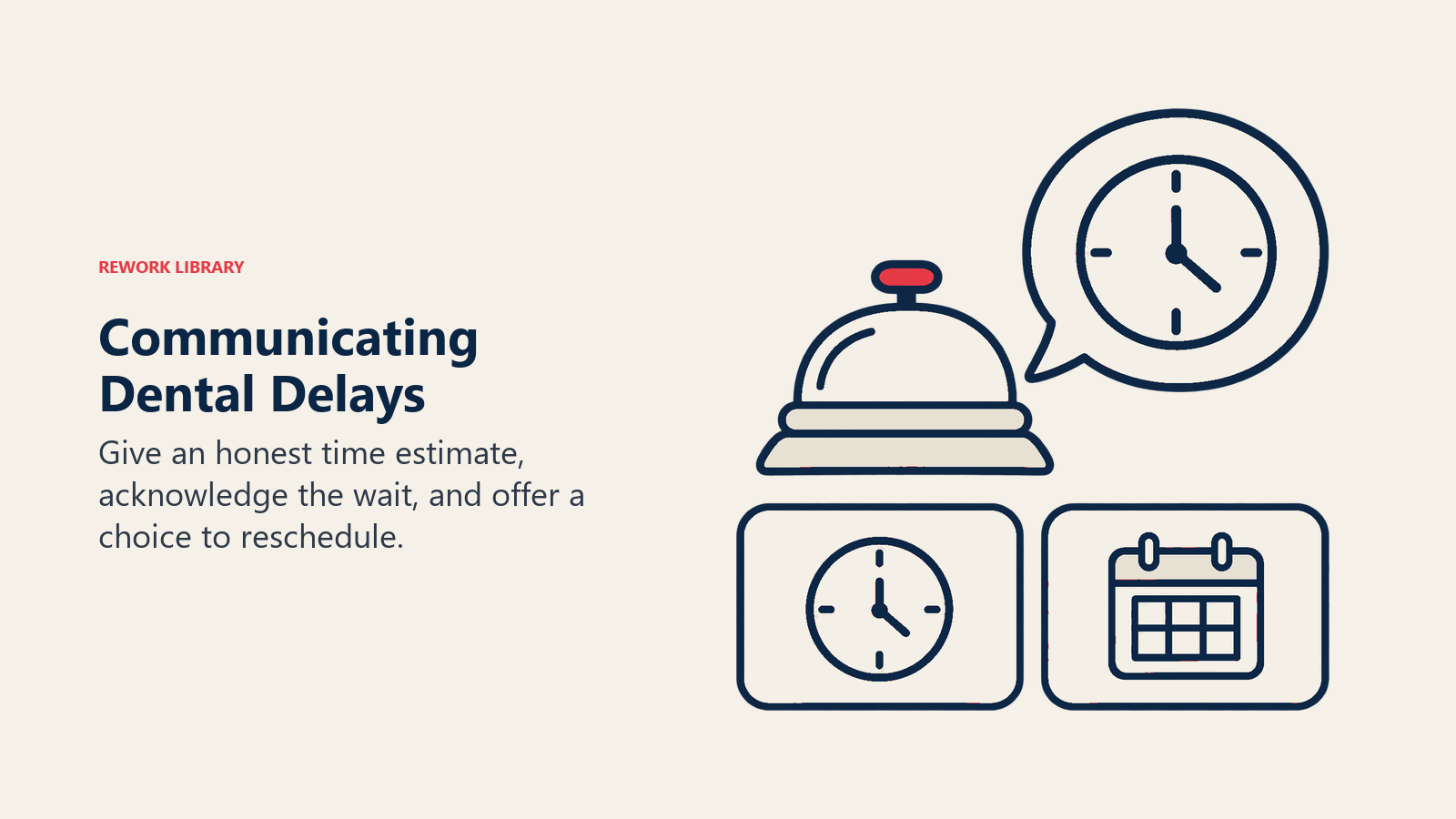
At what delay threshold to communicate. If a patient is going to wait more than 10 minutes past their scheduled appointment time, someone should acknowledge it. That's the threshold. Don't wait until they've been sitting 20 minutes and the frustration has already built. The research on this is consistent across healthcare settings: a systematic review in PMC found that patients who received clear time estimates and updates were significantly more satisfied than those who waited the same duration in silence.
What to say (and what not to say). The classic front desk error is "the doctor will be right with you" repeated every 10 minutes. This destroys trust. Patients know it's not true and they know the staff knows it's not true. It makes the wait feel worse, not better.
Instead, be specific: "Dr. Pham is finishing up with another patient. We're expecting you to be seated in about 15 minutes. I want to make sure that works for your schedule today. Is there anything I can get you while you wait?"
This script does three things: gives a real time estimate, demonstrates respect for the patient's schedule, and offers something (water, coffee, charging cable for the phone) that signals the team is aware and attending to their comfort. What you offer while patients wait connects to the broader range of patient comfort amenities that shape how a delay is experienced and whether it shows up in a negative review afterward.
Script for delay communication:
"Hi [Patient Name], I wanted to let you know we're running about [X] minutes behind schedule today. Dr. [Name] is finishing up with another patient. We expect to seat you around [time]. If that's going to be a problem for your schedule, please let me know and we can discuss options. Can I get you anything while you wait?"
The offer of options is important. Some patients will prefer to reschedule. Give them that option without making them ask for it. A patient who reschedules voluntarily doesn't leave a negative review. A patient who waited 40 minutes and felt trapped does.
New Patient Check-In Optimization
New patient check-in is one of the most controllable sources of delay, and it consistently disrupts schedules when not managed well.
Digital forms vs. paper intake. Paper intake forms take 15-20 minutes to complete in the office. Digital forms completed at home take the same amount of time but don't consume appointment time. Practices that successfully migrate to pre-visit digital forms recover 15 minutes per new patient slot. For a practice seeing 3 new patients per day, that's 45 minutes of capacity.
Pre-visit form completion rates. The bottleneck isn't sending the forms. It's getting patients to complete them before arrival. The tactics that work: send the link 72 hours in advance with a clear deadline ("Please complete before 6 PM the day before your visit"), send a reminder 24 hours before if not completed, and have the front desk confirm form completion during the confirmation call. This is part of the pre-visit communication sequence described in patient communication strategies, which also covers how to reduce no-shows for new patient appointments.
Identifying form completion failures early. If a new patient's forms aren't complete by the morning of their appointment, call them. "Hi, I noticed your new patient forms haven't been submitted yet. Do you need me to resend the link?" This gives them a chance to complete before arrival rather than discovering at check-in.
When paper is unavoidable. Some patients, particularly older demographics, won't complete digital forms regardless of how many reminders you send. Keep paper forms available, but build in 15-20 extra minutes for those appointments rather than scheduling new patients at the same time as established patients and expecting equivalent processing speed.
Measuring and Managing Wait Time
You can't improve what you don't measure. Most dental practices have no idea what their actual wait time is on an average Tuesday, let alone by provider or by appointment type.
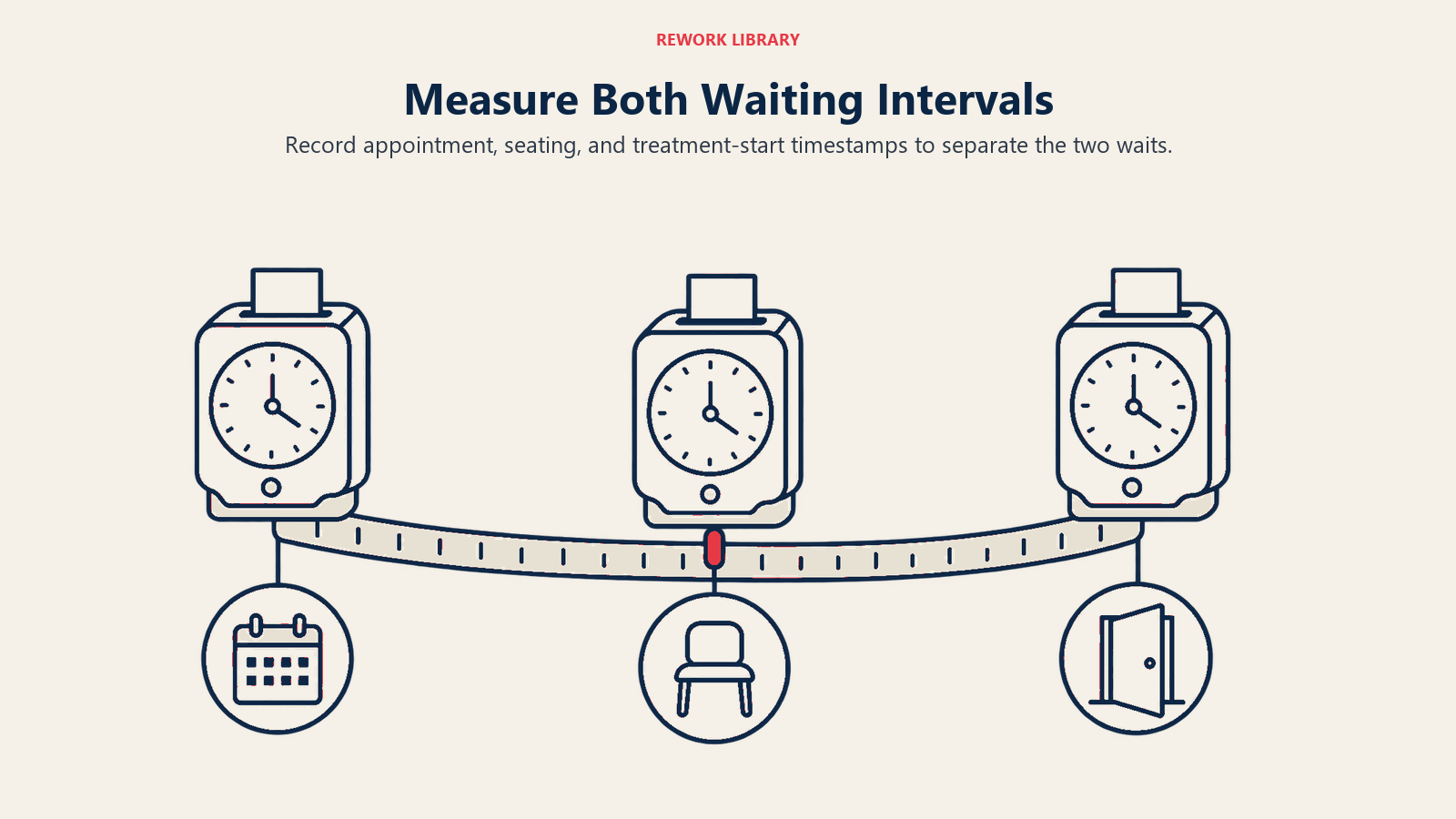
Wait time tracking. The simplest tracking method: record the scheduled appointment time, the time the patient was seated in the operatory, and the time treatment began. The gap between appointment time and operatory seat time is lobby wait time. The gap between seating and treatment start is operatory wait time. Both matter.
If your practice management software doesn't capture this automatically, have the front desk log actual seat times for one week using a simple spreadsheet. The data will show you exactly when your delays are concentrated, usually mid-morning and early afternoon.
Wait time benchmarks to target:
| Metric | Target | Alert Threshold |
|---|---|---|
| Lobby wait time (established patients) | Under 10 minutes | Over 20 minutes |
| Lobby wait time (new patients) | Under 5 minutes | Over 15 minutes |
| Operatory wait time (after seating) | Under 8 minutes | Over 15 minutes |
| On-time start rate (within 5 min) | 85%+ | Below 70% |
Patient satisfaction surveys. Post-visit surveys that include a specific wait time question will surface patterns you don't see in the operational data. Patients who experienced a 15-minute delay and felt it was handled poorly will score it as a major problem. Patients who experienced a 20-minute delay and were communicated with respectfully often don't mention it at all. The survey data tells you whether your communication protocol is working, not just whether you're running on time. Survey results related to wait time also feed directly into dental review management, the same frustrations that show up in survey data are the ones patients convert into public one-star reviews when left unaddressed.
Team accountability targets. On-time start rate should be a metric reviewed in weekly or biweekly team meetings. Not as a punitive measure, but as a system health indicator. When on-time starts drop below 70% for more than two consecutive weeks, something in the schedule design or clinical flow has changed and needs investigation. Tracking this alongside other practice health indicators is part of monitoring key financial metrics for dental practices, where scheduling efficiency shows up in per-hour production and chair utilization data.
Learn More