5 Porqués: Método de Análisis de Causa Raíz (Con Ejemplos)
Turn this article into takeaways for your work.


Each assistant summarizes the article only for you and suggests best practices for your work.
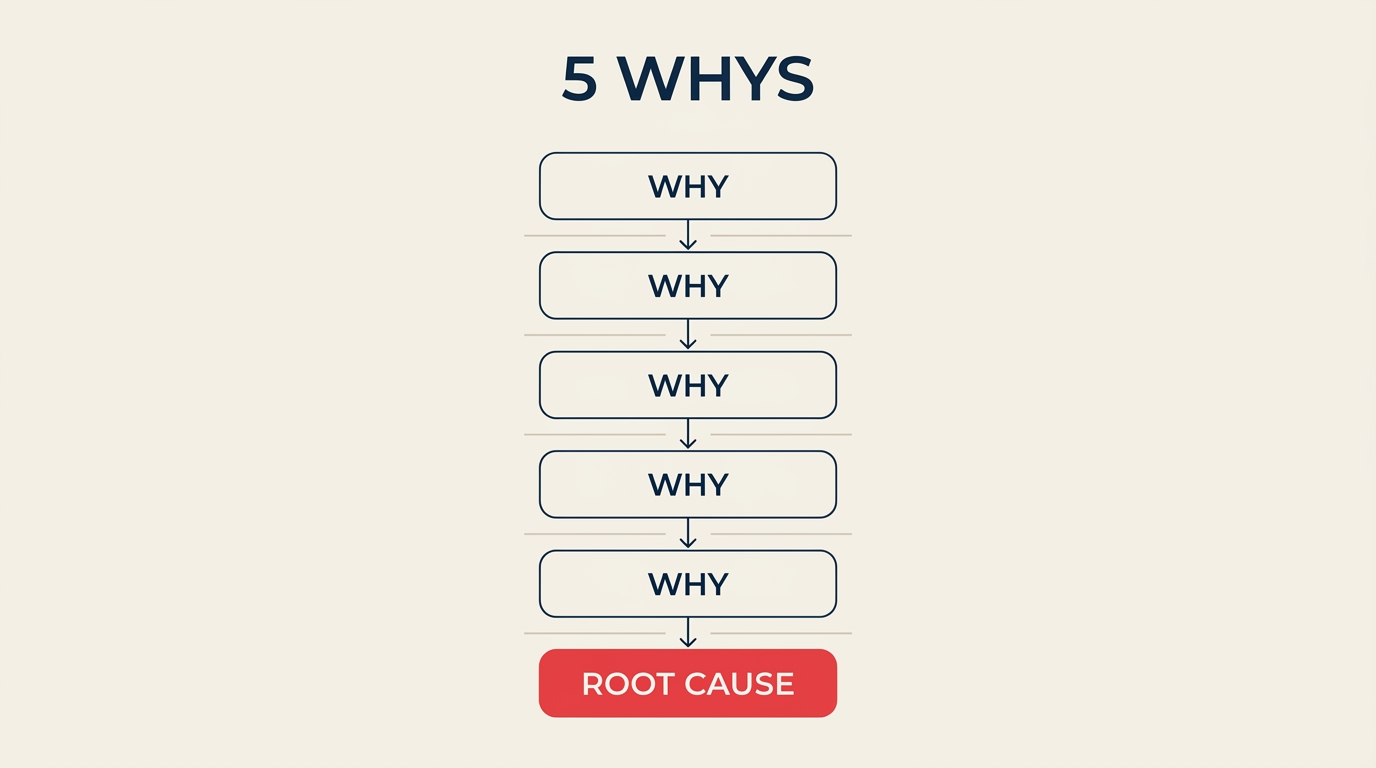
La técnica de los 5 Porqués es una de las herramientas más simples y poderosas en la mejora de procesos. Usted plantea un problema, pregunta "por qué" ocurrió, luego vuelve a preguntar "por qué" sobre su primera respuesta, y continúa hasta llegar a la causa real en lugar del síntoma. La mayoría de los equipos llega en cinco iteraciones. Algunos lo logran en tres. Unos pocos genuinamente necesitan seis o siete.
Lo que hace notable a esta técnica no es el número. Es la disciplina de no detenerse en la primera respuesta conveniente.
¿Qué son los 5 Porqués?
Los 5 Porqués son una técnica de análisis de causa raíz que utiliza el cuestionamiento iterativo para rastrear un problema hasta su origen. Se comienza con un enunciado de problema definido y se pregunta "¿por qué ocurrió esto?" repetidamente hasta descubrir la falla sistémica subyacente en lugar de un síntoma superficial.
El método fue creado por Sakichi Toyoda, fundador de Toyota Industries, a principios del siglo XX. Se convirtió en parte formal del Toyota Production System (TPS) bajo Taiichi Ohno en las décadas de 1950 y 1960. Ohno atribuyó a los 5 Porqués el mérito de ser una de las prácticas centrales que permitieron a Toyota construir la calidad dentro de su proceso de manufactura en lugar de inspeccionar defectos después del hecho. Hoy es una herramienta estándar en la metodología Lean, en el marco DMAIC de Six Sigma, y prácticamente en todo sistema de mejora continua.
La técnica no requiere software, ni formación estadística, ni ninguna certificación especial. Esa accesibilidad es exactamente la razón por la que ha sobrevivido más de 70 años tanto en plantas de producción como en salas de juntas.
Datos clave
- Taiichi Ohno, el padre del Toyota Production System, escribió en su libro de 1988 Toyota Production System: Beyond Large-Scale Production que "al repetir por qué cinco veces, la naturaleza del problema, así como su solución, se vuelve clara." Este planteamiento sigue siendo la descripción canónica de la técnica que utiliza hoy el Lean Enterprise Institute.
- La American Society for Quality (ASQ) incluye los 5 Porqués en su Body of Knowledge para Certified Quality Engineers y la enumera como una de las herramientas principales para la fase Analyze, junto con los diagramas de espina de pescado y el análisis de Pareto.
- Una encuesta de 2021 del Lean Enterprise Institute encontró que los 5 Porqués son utilizados por más del 65% de las organizaciones que han adoptado prácticas lean, convirtiéndola en la herramienta individual de causa raíz más ampliamente implementada en la gestión de operaciones.
5 Porqués versus Diagrama de Espina de Pescado versus 8D
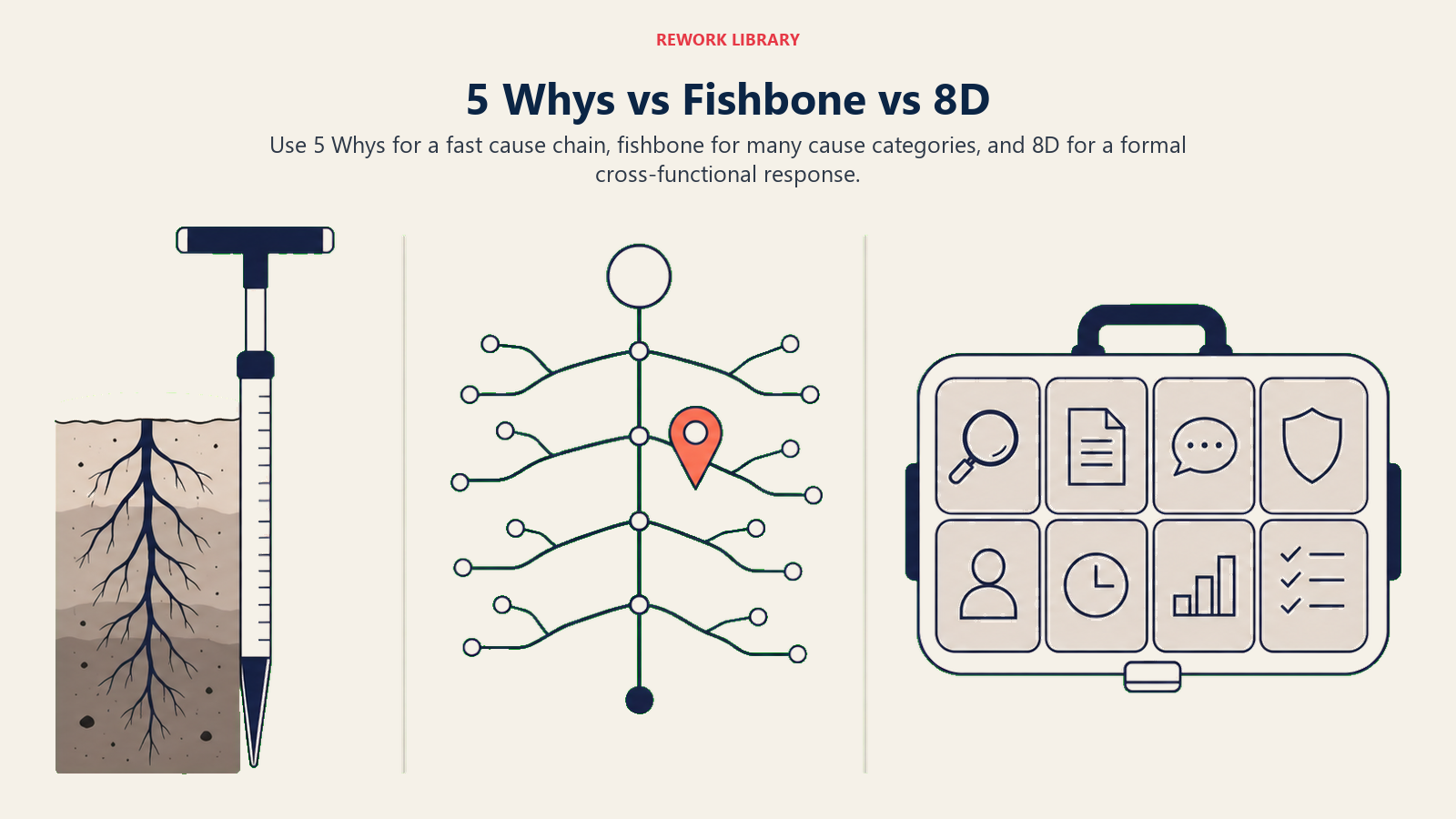
Estas tres herramientas suelen mencionarse juntas. Están relacionadas, pero no son intercambiables. Elegir la incorrecta desperdicia tiempo y produce conclusiones superficiales.
| Herramienta | Mejor para | Tamaño del equipo | Tiempo requerido | Resultado |
|---|---|---|---|---|
| 5 Porqués | Problemas únicos y bien definidos; se necesita respuesta rápida | 1-6 personas | 30-60 minutos | Una cadena de causa raíz |
| Diagrama de Espina de Pescado | Problemas complejos con muchas categorías de causas potenciales | 5-15 personas | 1-3 horas | Mapa visual de todas las posibles causas |
| Resolución de Problemas 8D | Quejas recurrentes de clientes, problemas con proveedores, eventos de seguridad | Equipo multifuncional | Días a semanas | Respuesta documentada formal de 8 pasos |
Use los 5 Porqués cuando necesite una respuesta rápida y el problema esté contenido. Use un diagrama de espina de pescado cuando no esté seguro de qué categoría de causa está impulsando el problema y necesite una estructura de lluvia de ideas. Use la resolución de problemas 8D cuando el problema requiera documentación formal, acciones de contención y verificación entre límites organizacionales.
Los 5 Porqués y el diagrama de espina de pescado funcionan realmente bien juntos. Muchos equipos usan primero la espina de pescado para mapear el espacio de posibilidades, y luego aplican los 5 Porqués a la rama más probable.
Beneficios de los 5 Porqués
Velocidad. Un equipo pequeño puede completar un análisis de 5 Porqués en menos de una hora. Para problemas operativos que están costando dinero activamente o causando retrasos, esa velocidad importa.
Accesibilidad. No necesita un estadístico ni un black belt certificado para facilitar una sesión de 5 Porqués. Cualquier líder de equipo que entienda el problema puede dirigirla.
Enfoque en los sistemas, no en las personas. Hecho correctamente, los 5 Porqués orientan la investigación lejos del error humano como causa raíz y hacia el proceso, sistema o política que permitió que ocurriera el error. Culpar a una persona no previene la recurrencia. Corregir un proceso roto sí lo hace.
Integración con otras herramientas. Los 5 Porqués encajan naturalmente en la fase Analyze de DMAIC, en la etapa Plan de PDCA, y en eventos Kaizen. Es una técnica modular, no una metodología independiente.
Claridad de la contramedida. Debido a que los 5 Porqués terminan en una causa raíz específica, la acción correctiva suele ser obvia. Ese es el objetivo. Si su respuesta es vaga, no ha llegado lo suficientemente lejos.
Errores comunes y limitaciones
Los 5 Porqués son simples. Esa simplicidad es también su principal vulnerabilidad.
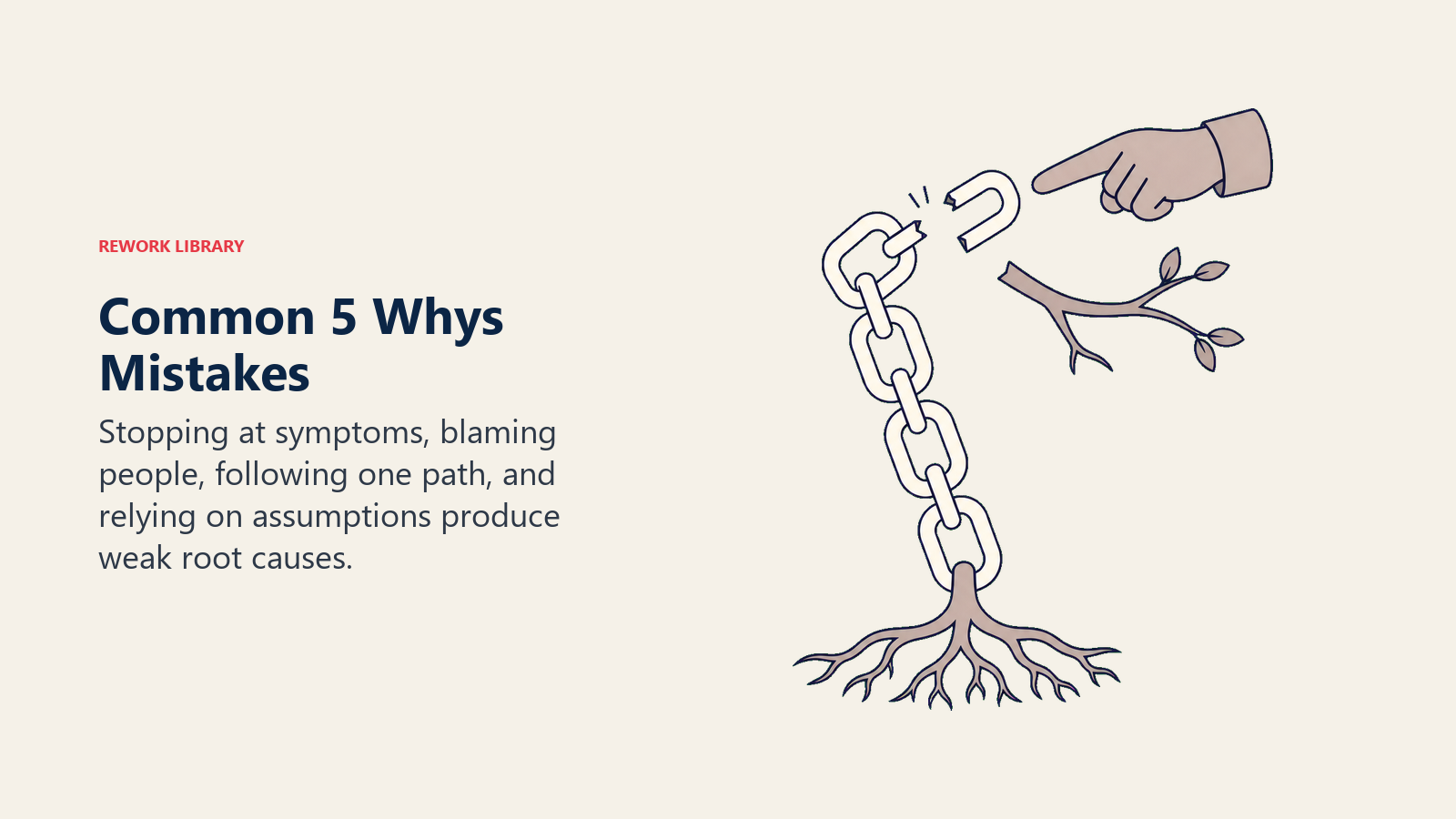
Detenerse demasiado pronto. El error más común es aceptar un síntoma como una causa. "La máquina se rompió" es un síntoma. "La máquina se rompió porque el programa de mantenimiento se recortó para reducir costos" es una causa raíz. Los equipos bajo presión de tiempo aceptan la primera respuesta plausible y siguen adelante. El problema regresa.
Seguir un solo camino. Los problemas reales a menudo tienen múltiples causas contribuyentes que se ramifican en cada nivel. Un análisis estricto de cadena única pasa por alto fallas paralelas. Para problemas complejos, dibuje la cadena como un árbol, no como una línea.
Culpar a las personas en lugar de a los procesos. Si su quinto por qué es "porque Bob no revisó el informe", no ha encontrado una causa raíz. Ha encontrado a alguien a quien culpar. Siga preguntando. ¿Por qué no existía un sistema que hiciera la revisión automática? ¿Por qué Bob no estaba capacitado? ¿Por qué Bob era el único punto de falla?
Depender de la memoria y de suposiciones. Los 5 Porqués funcionan mejor con datos, no con recuerdos. Cuando los equipos reconstruyen eventos de memoria, introducen sesgos y pasan por alto lo que realmente ocurrió. Combínelo con observación, registros de datos o un recorrido del proceso siempre que sea posible.
Usarlo para fallas complejas de múltiples sistemas. Cuando un problema involucra a cinco departamentos, tres sistemas de software y dos organismos regulatorios, una sesión de 5 Porqués en una sala de reuniones no lo captará. Ese es un trabajo para un diagrama de espina de pescado seguido de análisis estadístico, no de preguntas iterativas.
Cómo usar los 5 Porqués (paso a paso)
Paso 1: Defina el problema con claridad
Escriba el problema como un enunciado específico y observable. Los enunciados de problema vagos producen causas raíz vagas. "Las ventas están bajando" no es un enunciado de problema. "Los errores de cumplimiento de pedidos aumentaron un 23% en el segundo trimestre, causando 48 quejas de clientes" sí lo es.
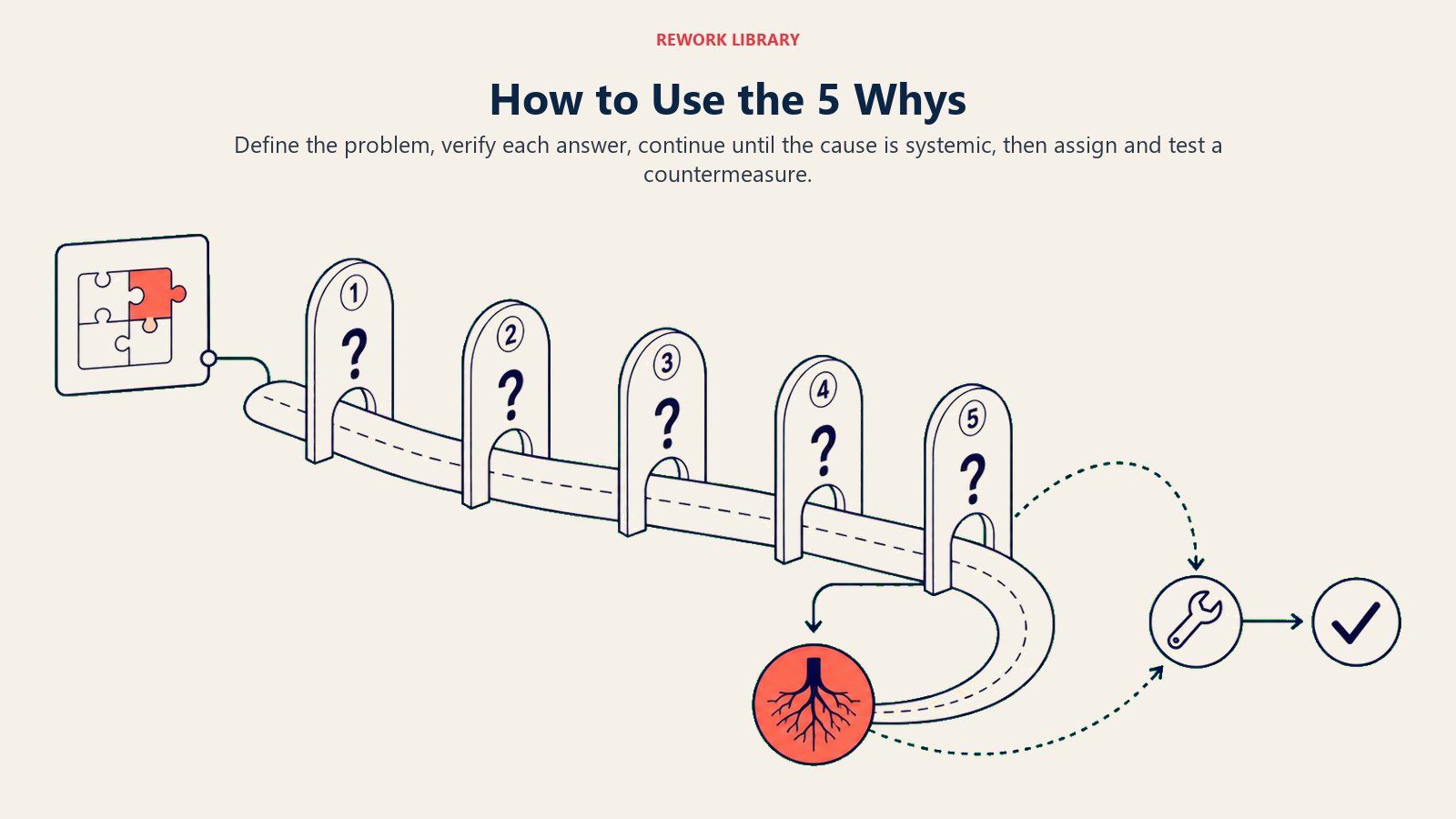
Incluya qué ocurrió, dónde ocurrió, cuándo se notó por primera vez y cuál es el impacto medible. Este paso vale cinco minutos. Ahorra horas después.
Paso 2: Pregunte "¿Por qué ocurrió esto?" (Por qué 1)
Concéntrese en el enunciado del problema. Escriba la causa inmediata, la explicación de primer nivel de lo que observó. Manténgase en los hechos. Esta respuesta debe ser verificable, no supuesta.
Paso 3: Pregunte "¿Por qué?" sobre su primera respuesta (Por qué 2)
Tome la causa que acaba de documentar y pregunte por qué ocurrió eso. Ya no está preguntando sobre el problema original. Está preguntando sobre la causa que identificó en el Paso 2. Escriba la respuesta.
Paso 4: Continúe preguntando "¿Por qué?" (Por qué 3-5)
Repita el proceso con cada nueva respuesta. En cada nivel, pregunte: ¿es esta verdaderamente la causa, o sigue siendo un síntoma? Continúe hasta que se cumpla una de estas condiciones. Primero, la respuesta revela una falla de proceso, política o sistema que realmente se puede corregir. Segundo, ha llegado a un punto donde ya no tiene control sobre la causa (regulaciones externas, física, restricciones fijas). Tercero, la respuesta revela una brecha de recursos o conocimiento que requiere una investigación separada.
No fuerce exactamente cinco iteraciones. Deténgase cuando haya llegado al origen genuino. Vaya más allá de cinco si todavía está describiendo síntomas.
Paso 5: Identifique la causa raíz
El último "por qué" que su equipo acuerda que es accionable y sistémico es su causa raíz. Escríbala explícitamente. Repase la cadena desde el problema hasta la causa raíz en voz alta para confirmar que tiene sentido lógico en cada paso.
Paso 6: Defina una contramedida y verifique
Asigne una acción correctiva específica a la causa raíz, no a un síntoma a mitad de la cadena. Fije una fecha objetivo. Asigne un responsable. Después de la implementación, verifique que el problema original ya no ocurra. Si se repite, su cadena de causa raíz estaba incompleta. Profundice más.
Ejemplos de los 5 Porqués
Manufactura: tiempo de inactividad de máquina
Aquí hay un ejemplo completamente desarrollado de un entorno de producción.
| Nivel | Pregunta | Respuesta |
|---|---|---|
| Problema | La línea de producción se detuvo durante 4 horas el martes por la mañana | |
| Por qué 1 | ¿Por qué se detuvo la línea? | El motor de accionamiento de la cinta transportadora falló |
| Por qué 2 | ¿Por qué falló el motor? | El motor se sobrecalentó y activó el corte térmico |
| Por qué 3 | ¿Por qué se sobrecalentó el motor? | El ventilador de enfriamiento no funcionaba |
| Por qué 4 | ¿Por qué no funcionaba el ventilador de enfriamiento? | El rodamiento del ventilador se había atascado por falta de lubricación |
| Por qué 5 | ¿Por qué no se lubricó el rodamiento? | La lubricación del ventilador del motor de la cinta transportadora no está incluida en la lista de mantenimiento preventivo |
| Causa raíz | Elemento faltante en la lista de mantenimiento preventivo | |
| Contramedida | Actualizar la lista de mantenimiento para incluir la lubricación del rodamiento del ventilador cada 90 días. Asignar al líder de mantenimiento como responsable. Verificar en el próximo ciclo de mantenimiento programado. |
Reemplazar el motor (el síntoma) habría costado $1,200 y dos semanas de plazo de entrega. Actualizar la lista tomó 20 minutos.
Ingeniería de software: interrupción del sistema
Una plataforma SaaS experimenta una interrupción crítica que afecta a 2,000 clientes.
- Por qué 1: El servidor de base de datos primario se quedó sin espacio en disco.
- Por qué 2: Un trabajo por lotes estaba escribiendo archivos de registro sin comprimir en el volumen de la base de datos.
- Por qué 3: El trabajo por lotes estaba configurado así por defecto y nadie lo cambió.
- Por qué 4: No existía un requisito de revisión de código para las configuraciones de trabajos por lotes.
- Por qué 5: El proceso de despliegue no marca los archivos de configuración que no son de aplicación para revisión obligatoria.
Causa raíz: Brecha en el proceso de despliegue. Los archivos de configuración no están sujetos a las mismas puertas de revisión que el código de la aplicación. Contramedida: Actualizar el pipeline de despliegue para exigir revisión de ingeniería en todos los cambios de configuración. Agregar alertas de espacio en disco al umbral del 70%.
Servicio al cliente: aumento de quejas
Una empresa de software por suscripción ve un aumento del 30% en tickets de soporte relacionados con facturación en la primera semana del mes.
- Por qué 1: Los clientes están confundidos por cargos inesperados en sus facturas.
- Por qué 2: Un cambio de nivel de precios se lanzó sin actualizar la descripción de facturación dentro de la aplicación.
- Por qué 3: Producto y finanzas actualizaron el motor de precios pero no notificaron al equipo de UX.
- Por qué 4: No existe una lista de verificación multifuncional para cambios de precios que incluya revisión de UX.
Causa raíz: Paso faltante en el proceso de cambio de precios. Contramedida: Crear un manual de cambio de precios que requiera la aprobación de UX, finanzas y customer success antes de que cualquier cambio entre en vigor.
Mejores prácticas para aprovechar al máximo los 5 Porqués
Involucre a las personas correctas. Incluya a quienes estuvieron más cerca de la falla y a quienes entienden los sistemas anteriores en la cadena. No dirija los 5 Porqués solo con gerentes que no estuvieron presentes.
Use un facilitador. Alguien debe mantener al equipo honesto, cuestionar respuestas vagas y garantizar que cada "por qué" se deriva lógicamente del anterior. El facilitador no debería ser la persona más involucrada en un resultado particular.
Documente la cadena visualmente. Escriba cada paso en una pizarra o un documento compartido para que toda la cadena sea visible. Los equipos toman mejores decisiones cuando pueden ver el flujo lógico desde el problema hasta la causa raíz.
Cuestione cada respuesta. Pregunte "¿cómo sabemos que esto es cierto?" en cada paso. Una suposición plausible no es una causa verificada. Si no puede confirmar una respuesta con datos u observación directa, márquela como suposición y valídela antes de finalizar la cadena.
Vincule las contramedidas a las causas raíz, no a los síntomas. Si su contramedida aborda el Por qué 2 en lugar del Por qué 5, ha construido una solución alternativa, no una corrección. Las soluciones alternativas enmascaran problemas. Las correcciones de causa raíz los eliminan.
Haga seguimiento. Los 5 Porqués solo son útiles si la contramedida se implementa y se verifica. Programe una revisión de seguimiento 30 días después de la implementación para confirmar que el problema no se ha repetido.
Lectura relacionada
- Análisis de Causa Raíz: Una guía más amplia de los métodos de RCA, cuándo usar cada uno, y cómo encajan en los sistemas de gestión de calidad.
- Análisis de Pareto: Priorice qué problemas investigar primero usando el principio 80/20.
- Diagrama de Espina de Pescado: El complemento visual de los 5 Porqués para mapear categorías de causas.
- DMAIC: El marco de Six Sigma que usa los 5 Porqués en su fase Analyze.
- Diagrama SIPOC: Mapee su proceso antes de comenzar un análisis de 5 Porqués para asegurar que su enunciado de problema esté correctamente delimitado.

On this page
- ¿Qué son los 5 Porqués?
- 5 Porqués versus Diagrama de Espina de Pescado versus 8D
- Beneficios de los 5 Porqués
- Errores comunes y limitaciones
- Cómo usar los 5 Porqués (paso a paso)
- Paso 1: Defina el problema con claridad
- Paso 2: Pregunte "¿Por qué ocurrió esto?" (Por qué 1)
- Paso 3: Pregunte "¿Por qué?" sobre su primera respuesta (Por qué 2)
- Paso 4: Continúe preguntando "¿Por qué?" (Por qué 3-5)
- Paso 5: Identifique la causa raíz
- Paso 6: Defina una contramedida y verifique
- Ejemplos de los 5 Porqués
- Manufactura: tiempo de inactividad de máquina
- Ingeniería de software: interrupción del sistema
- Servicio al cliente: aumento de quejas
- Mejores prácticas para aprovechar al máximo los 5 Porqués
- Lectura relacionada