What Is Market Timing and Why It Matters for Startups?
Turn this article into takeaways for your work.


Each assistant summarizes the article only for you and suggests best practices for your work.
Market timing, in a startup context, is the question of whether the world is ready for your product right now. It has nothing to do with trading stocks. Here it means launching when the technology is cheap and reliable enough, the rules allow it, and customers are ready to change how they behave.
The same product can be a failure in one year and a hit in another. Nothing about the code or the pitch changed. The market did. That's why investors keep asking the same short question, and why founders who can't answer it tend to struggle.
Why timing gets its own scrutiny
Most founders obsess over the idea and the team. Timing feels like luck, so it gets less attention. But luck can be studied, at least a little.
Bill Gross, who founded Idealab, gave a well-known TED talk on this. He looked at companies from Idealab and others, ranked them on five factors (idea, team and execution, business model, funding, and timing), and reported that timing accounted for 42 percent of the difference between success and failure. In his ranking, team and execution came second and the idea third.
Be careful with that number. It's one practitioner's analysis of his own sample, and he says himself that it isn't absolutely definitive. It isn't a controlled or peer-reviewed study, so treat it as a provocative data point rather than a law. The useful takeaway is the direction: a good idea launched at the wrong moment can lose to an average one launched at the right moment.
Gross gave an example from his own portfolio. His team started Z.com, an online entertainment company, with funding, a business model and Hollywood talent signed. But in his telling, broadband penetration was too low in 1999-2000 and watching video online was too hard. The company failed because customers couldn't use the product yet, not because the idea was bad.
The "Why now?" question
Investors have a name for this test. Sequoia's business plan guidance lists a section called "Why now?" and says that the best companies almost always have a clear "why now?". It adds the logic behind it: if your solution is so good, why hasn't someone built it before?
A strong answer points to something that changed. A weak answer says "nobody thought of it" or "the market is huge." Big markets attract competitors for years, so the real question is what shifted recently that makes your approach newly possible or newly necessary.
Too early versus too late
Timing errors run in two directions, and they hurt differently.
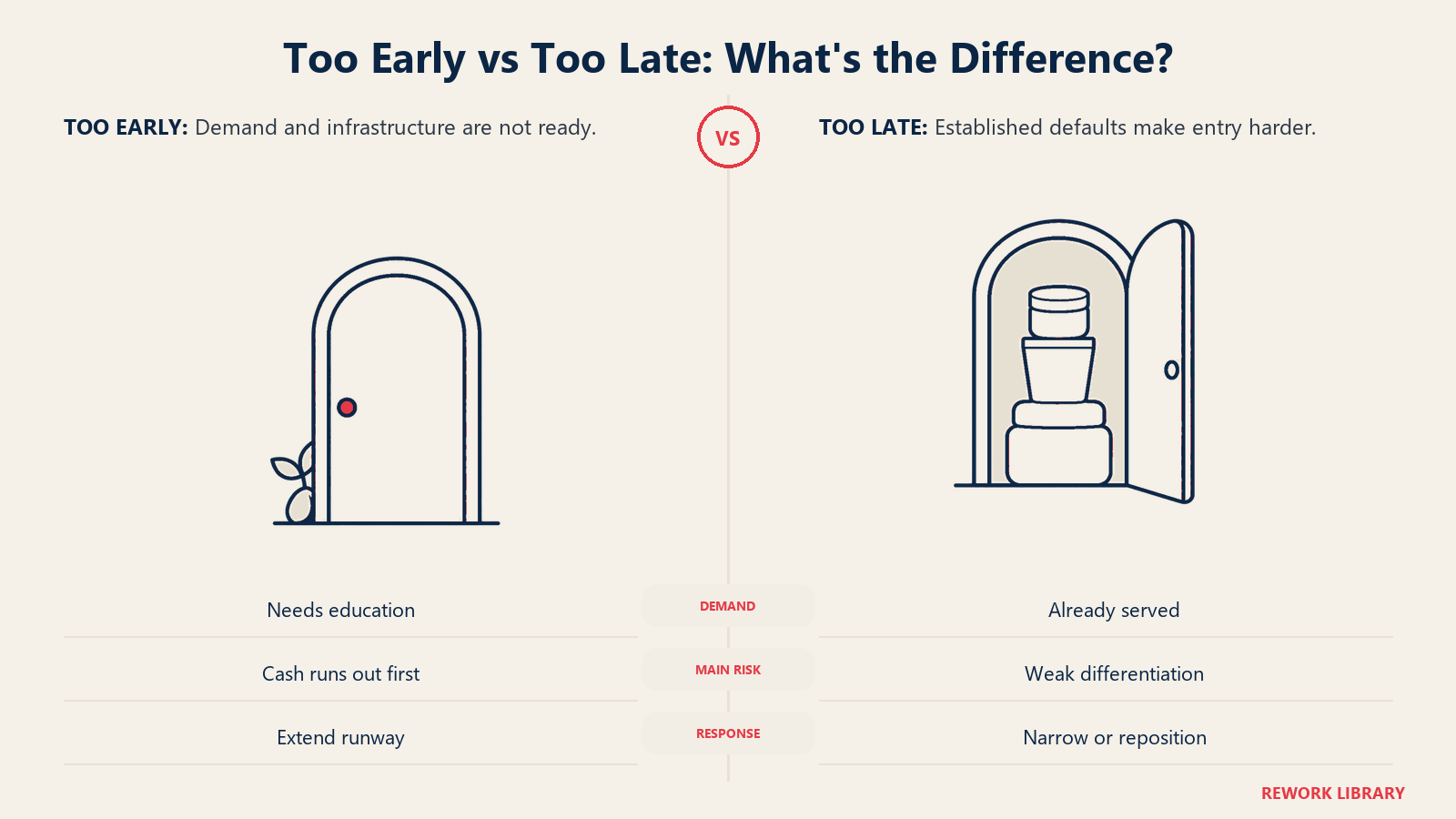
Too early. The need is real but the pieces aren't in place. Costs are too high, the infrastructure doesn't exist, customers don't trust the new behavior, or the rules haven't caught up. Early companies often burn through their runway educating a market that isn't ready to buy. They spend money creating demand that a later entrant gets to harvest.
Too late. The shift has happened and others got there first. Customers already have a default solution, switching costs are rising, and the best distribution channels are taken. You can still win, but you need a sharper angle than "the same thing, slightly better."
On time. Not a single date but a window. It opens when an enabling change makes the product viable, and it narrows as competitors and incumbents react. The founders' job is to enter inside that window with enough cash to survive until customers show up.
| Too early | On time | Too late | |
|---|---|---|---|
| Customer demand | Latent, hard to convert | Visible and growing | Served by incumbents |
| Technology or cost | Not yet viable | Just crossed the line | Commodity |
| Main risk | Running out of cash first | Execution speed | No room to differentiate |
| Typical sign | Long sales cycles, heavy education | Inbound interest, quick pilots | Price competition, low switching |
| Founder response | Stay small, extend runway | Move fast, secure distribution | Narrow the niche or reposition |
What changes create a window
Windows rarely open by accident. Three kinds of shifts do most of the work.
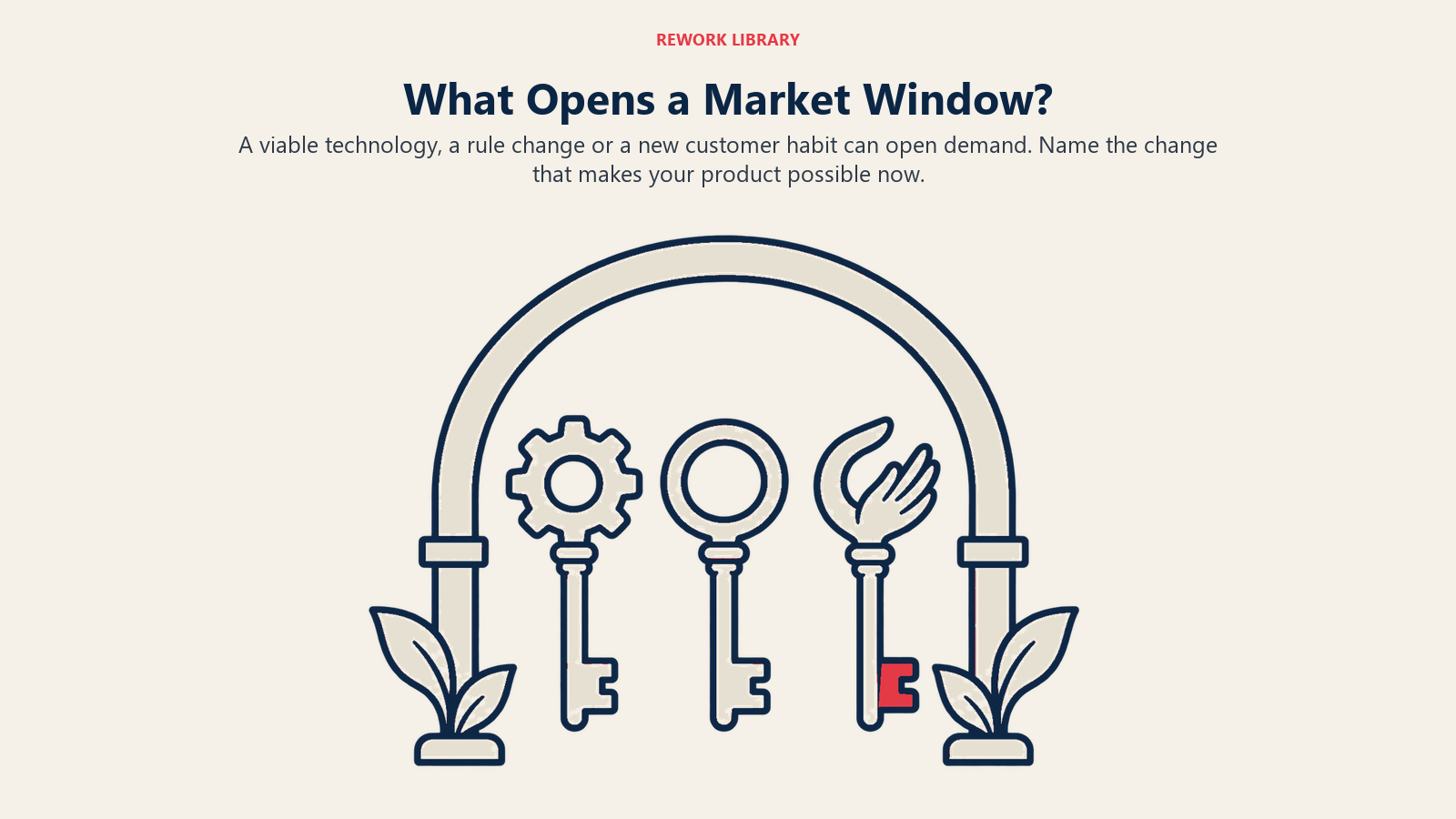
Technology and cost curves. Something that was too slow or too expensive becomes workable. Gross's own example works in reverse: video online failed in 1999-2000 because bandwidth wasn't there. When the underlying capability crosses a threshold, a whole category of products becomes possible at once.
Regulation and policy. A new law, standard or ruling can make a business legal, mandatory or cheaper to run. Compliance deadlines in particular create buyers who must act by a date. The reverse also happens, where a rule change closes a window quickly.
Customer behavior and expectations. People get used to something and expect it everywhere. Remote work, mobile payments and cloud software each normalized a habit, and products built for that habit stopped feeling strange. Behavior shifts are slower to measure than costs but often matter more.
A fourth source is a competitor or incumbent stumbling, such as a dominant vendor raising prices or neglecting a segment. That's a smaller window, but it can be enough for a focused entrant.
Signals that your "why now" is real
You can't know timing in advance, but you can collect evidence. Look for specific, checkable signals instead of a general feeling.
| Signal | What to check | Reading |
|---|---|---|
| Enabling change | Can you name the specific cost, capability or rule that changed, and when? | If you can't, the "why now" is probably weak |
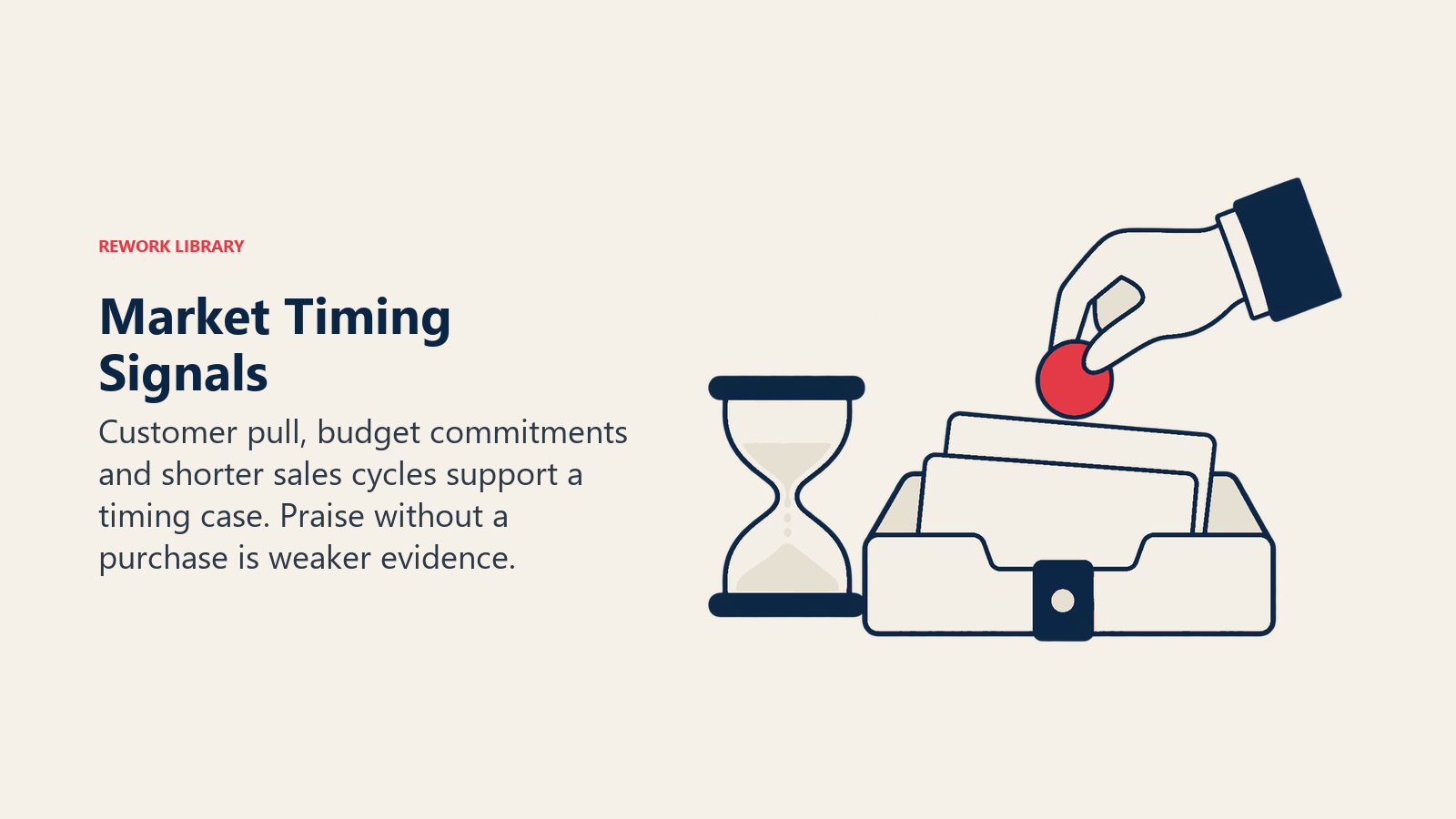
| Customer pull | Are buyers asking for this unprompted, or do you have to explain the problem first? | Pull suggests on time. Heavy explaining suggests early |
| Willingness to pay | Do prospects commit budget or time, not just praise? | Pilots and signed letters beat interest |
| Adjacent adoption | Are neighboring products already seeing usage grow? | Rising adjacent demand lowers your risk |
| Competitor activity | Are well-funded teams entering, or is the space empty? | A few entrants can confirm the window. A crowd signals lateness |
| Sales cycle | Is it getting shorter as you talk to more buyers? | Shorter cycles suggest the market is warming |
Notice that none of these require predicting the future. They ask what's already visible. If three or four point the same way, your timing case is stronger than any slide could make it.
Key Facts: Market Timing for Startups
- In a startup context, market timing means launching when technology, regulation and customer behavior make the product viable. It is unrelated to timing stock markets.
- Bill Gross reported that timing accounted for 42 percent of the difference between success and failure in his analysis, ranking it above team and execution, idea, business model and funding (TED talk transcript). It's his own analysis, not a controlled study.
- Sequoia's business plan guidance includes a "Why now?" section and says the best companies almost always have a clear one (Sequoia).
- Too early usually fails on cash and education cost. Too late usually fails on differentiation.
- A credible "why now" names a specific change, backed by customer evidence.
First mover versus fast follower
A common worry is that waiting means losing. The academic reference point is Lieberman and Montgomery's paper First-mover advantages, published in the Strategic Management Journal in 1988. It is a standard academic reference on whether being first creates lasting advantages.
The practical lesson for timing is that being first isn't the goal. Being first at the right moment is. A company that arrives early and runs out of money gets no benefit from its position, while a fast follower that arrives when customers are ready can learn from the pioneers' mistakes. Our article on first-mover advantage goes through when going first helps and when it doesn't.
Illustrative example
This is our own made-up scenario, not a real company.
Imagine a startup in 2018 that builds software to help small clinics run video appointments, billing and records in one place. Clinics like the idea, but few will pay. Patients are unfamiliar with video visits, local rules limit what can be billed, and the sales team spends most calls explaining why remote care is safe.
Now picture the same company four years later, after patient habits and billing rules have shifted. The product hasn't changed, but buyers show up already convinced, and sales cycles drop from months to weeks. In this scenario the founders didn't get smarter. The enabling conditions arrived. A founder in the first year can't force that, but can keep the company small and alive until it comes, and can collect the signals in the table above to tell whether it's coming.
What to do with timing as a founder
Treat timing as a hypothesis you test, not a fact you declare.
- Write your "why now" in two sentences. Name the change and the date it happened. If you can't, keep digging.
- Pick the signals you'll track. Choose three from the table and review them every quarter.
- Match your burn to your timing. If you suspect you're early, cut costs and stretch runway so you can still be here when the window opens. See also how stages of a startup change what proof investors expect.
- Test at the idea stage. Early customer conversations show whether the problem feels urgent. The idea-stage startup article covers what to validate before building.
- Check fit with the market. Even with good timing, you still need customers who stay. See product-market fit for SaaS.
- Plan the pivot trigger. If the evidence says the window is closed, decide in advance what you'll change. Our guide on strategic pivot timing covers it.
Good timing doesn't replace execution. It gives execution a chance to matter.
Related reading