What Is an Angel Investor?
Turn this article into takeaways for your work.


Each assistant summarizes the article only for you and suggests best practices for your work.
An angel investor is a wealthy individual who invests their own money in an early-stage company, usually in exchange for equity or a right to future equity. The Angel Capital Association (ACA) describes angels as high net-worth individuals who invest personal funds into start-up companies, hoping to earn a return when the business is sold or merges.
Angels typically show up before institutional venture capital does. They write the first outside checks, often when a company has a prototype, a handful of customers, or only a founding team and a plan. That timing is what makes them useful, and also what makes the money risky for them and the terms worth reading carefully for you.
How angel investing works
The basic mechanic is simple. A founder pitches an angel (or a group of angels). If the angel is interested, they do some due diligence, agree on a price or a structure, and wire money. In return, they get shares, or an instrument that converts into shares later.
Unlike a bank loan, there's no monthly repayment. The angel gets paid only if the company succeeds: an acquisition, an IPO, or a later sale of their shares. If the company fails, the money is usually gone. The ACA's own FAQ notes that over half of start-ups fail to return capital, and it suggests angels put no more than 5-8% of their net worth into this asset class.
Most angel money funds the stretch between "idea" and "something a venture fund will look at." It pays for product build, first hires, and early go-to-market. Founders who track burn rate and runway from day one can show angels exactly how long the check lasts and what milestone it buys.
Who counts as an angel: the US accredited investor rule
In the US, angels are almost always accredited investors. Private companies raising money under exemptions such as Regulation D generally sell to accredited investors, so the definition shapes who can write the check.
According to the SEC's accredited investor page, an individual qualifies by meeting any one of these tests:
| Route | SEC criterion |
|---|---|
| Net worth | Over $1 million, excluding primary residence (alone or with a spouse or partner) |
| Income | Over $200,000 individually, or $300,000 with a spouse or partner, in each of the prior two years, with the same expected this year |
| Professional license | Holds a Series 7, Series 65, or Series 82 license |
| Insider | Director, executive officer, or general partner of the company selling the securities |
Entities can qualify too, for example a company or trust with assets over $5 million. The rules apply in the US. Other countries set their own investor-eligibility tests, and they vary by jurisdiction, so founders raising in Singapore, Vietnam, Indonesia or elsewhere should ask local counsel what applies.
Typical instruments
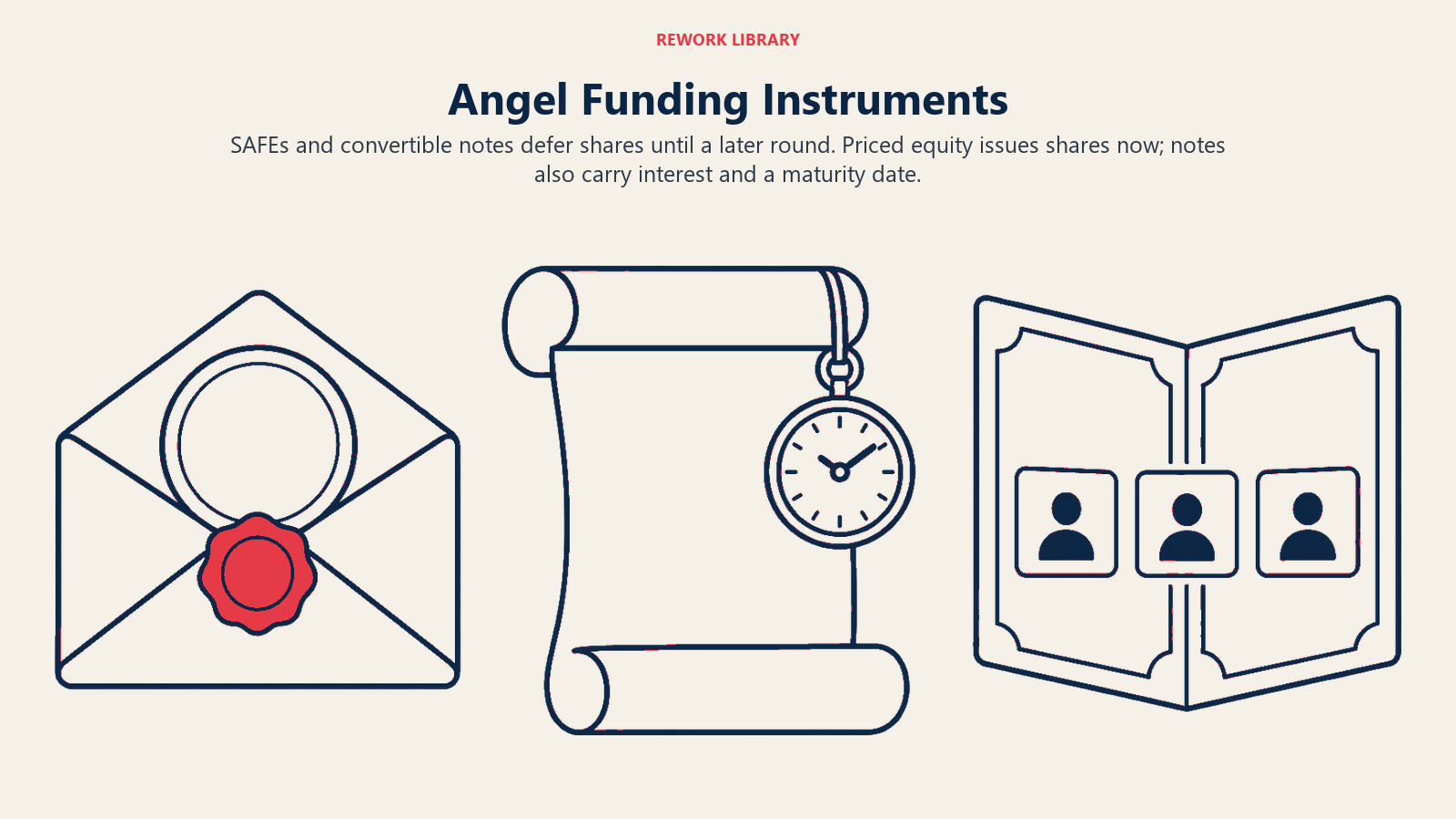
Angel deals usually take one of three forms.
| Instrument | What the angel gets | Priced now? | Key feature |
|---|---|---|---|
| SAFE | A right to shares in a future equity round | No | No interest, no maturity date |
| Convertible note | Debt that converts into shares later | No | Interest and a maturity date |
| Priced equity round | Shares at a set price today | Yes | Needs a negotiated valuation |
SAFE. Y Combinator created the Simple Agreement for Future Equity. YC states that a SAFE is not debt and not a loan, with no interest and no maturity date. It converts into preferred shares when the company raises a priced equity round. A SAFE often carries a valuation cap, which YC explains is the highest valuation at which it converts, and sometimes a discount to the next round's price.
Convertible note. A note works like a SAFE in spirit, since it also converts later, but it's legally debt. That means interest accrues and a maturity date forces a conversation if the company hasn't raised a priced round by then. See the sibling article on the convertible note for the mechanics.
Priced equity. The angel buys shares at an agreed price per share. It's cleaner for ownership math but slower and more expensive to document, which is why many very early rounds skip it.
A quick illustrative example
This is our own arithmetic, not data from any study. Say a founder raises $500,000 from angels on post-money SAFEs with a $5 million cap. On a post-money SAFE, ownership sold equals the investment divided by the cap (YC's own example uses the same formula). So $500,000 / $5,000,000 = 10% of the company, measured before any new money from a later priced round dilutes it. If the same founder later raises a seed round at a $12 million valuation, the SAFEs convert at the cap rather than the higher price, which is the reward for early risk.
Solo angels, angel groups, and super angels
Not every angel looks the same.
- Solo angels invest their own money on their own timeline. They can move fast and often add personal advice or introductions, but each one writes a small check.
- Angel groups and syndicates pool members who review pitches, share due diligence, and invest together. The ACA says its member groups frequently co-invest in rounds of $500,000 to $2 million. Groups are slower, but a single "yes" can bring a bigger combined check and a cleaner cap table.
- Super angels are individuals who invest more often and at higher volume than a typical angel, sometimes running small funds. There's no formal legal definition, so treat the label as informal.
In a syndicate, one person often acts like a lead investor: they negotiate terms and the others follow. Knowing who actually leads saves a lot of back and forth.
Angel vs VC vs friends and family
| Friends and family | Angel investor | Venture capital fund | |
|---|---|---|---|
| Whose money | Personal network's | The angel's own | Limited partners' (a fund) |
| Typical stage | Idea or earliest build | Pre-seed and seed | Seed, Series A and later |
| Check size | Smallest | Small to mid | Largest |
| Decision speed | Fast, relationship-led | Fast to moderate | Slower, process-led |
| Formality | Often loose | Light to moderate | Full term sheet and diligence |
The core difference between an angel and a VC is whose money it is. An angel risks personal funds and can decide alone. A VC manages other people's money and answers to its partners and investors, so it needs a repeatable process and a path to large returns. Friends and family invest because of the relationship, which is warm but can be awkward if things go badly.
What angels look for
Every angel has their own taste, but the questions are fairly consistent:
- The team. At this stage there's little else to judge. Do the founders have relevant skill, speed, and the persistence to survive setbacks?
- A real problem and a reachable market. Can the company explain who it serves and why they'd pay? Early signs of demand, like pilots or waitlists, help.
- Traction proportional to the stage. Revenue, users, or signed letters of intent count. For a B2B company, early unit economics show whether growth could ever be profitable.
- A plausible exit. Angels need an acquisition or later round to get paid, so they ask who might buy the company or fund the next stage.
- Reasonable terms and a clean cap table. Messy ownership scares off later investors.
Common founder watch-outs
Taking money from the wrong angel. A small check from someone who's unresponsive, or who adds friction in every decision, is expensive in other ways.
Stacking too many SAFEs without tracking dilution. Several SAFEs with different caps can convert into more ownership than expected. Model it before signing the next one, and consider cap table software once the list grows.
Ignoring investor eligibility. In the US, selling securities to non-accredited investors triggers extra rules. Check status before accepting a check.
Skipping legal review. Even simple documents have terms (information rights, side letters, pro rata rights) that matter later. Founders should have counsel review anything they sign. This article is general education, not legal advice.
Raising too little to hit a milestone. If the round doesn't cover the next proof point, the company ends up asking for a bridge round sooner than planned.
Treating the valuation cap as a trophy. A high cap feels good now but can make a later priced round awkward, and in a weak market it can set up a down round.
For the wider fundraising picture, see the strategic fundraising guide.
Key Facts: Angel Investors
- An angel invests their own personal money in early-stage companies, per the Angel Capital Association.
- In the US, the SEC's accredited investor test includes net worth over $1 million excluding primary residence, or income over $200,000 ($300,000 with a spouse or partner) for two years (SEC).
- A SAFE has no interest and no maturity date and converts into preferred shares in a later equity round (Y Combinator).
- ACA says angel groups frequently co-invest in rounds of $500,000 to $2 million.
- ACA notes that over half of start-ups fail to return capital, so angels are advised to limit exposure.
- Rules on who may invest vary by country. Check local law before raising.
Related reading