The Stages of a Startup: From Idea to Exit
Turn this article into takeaways for your work.


Each assistant summarizes the article only for you and suggests best practices for your work.
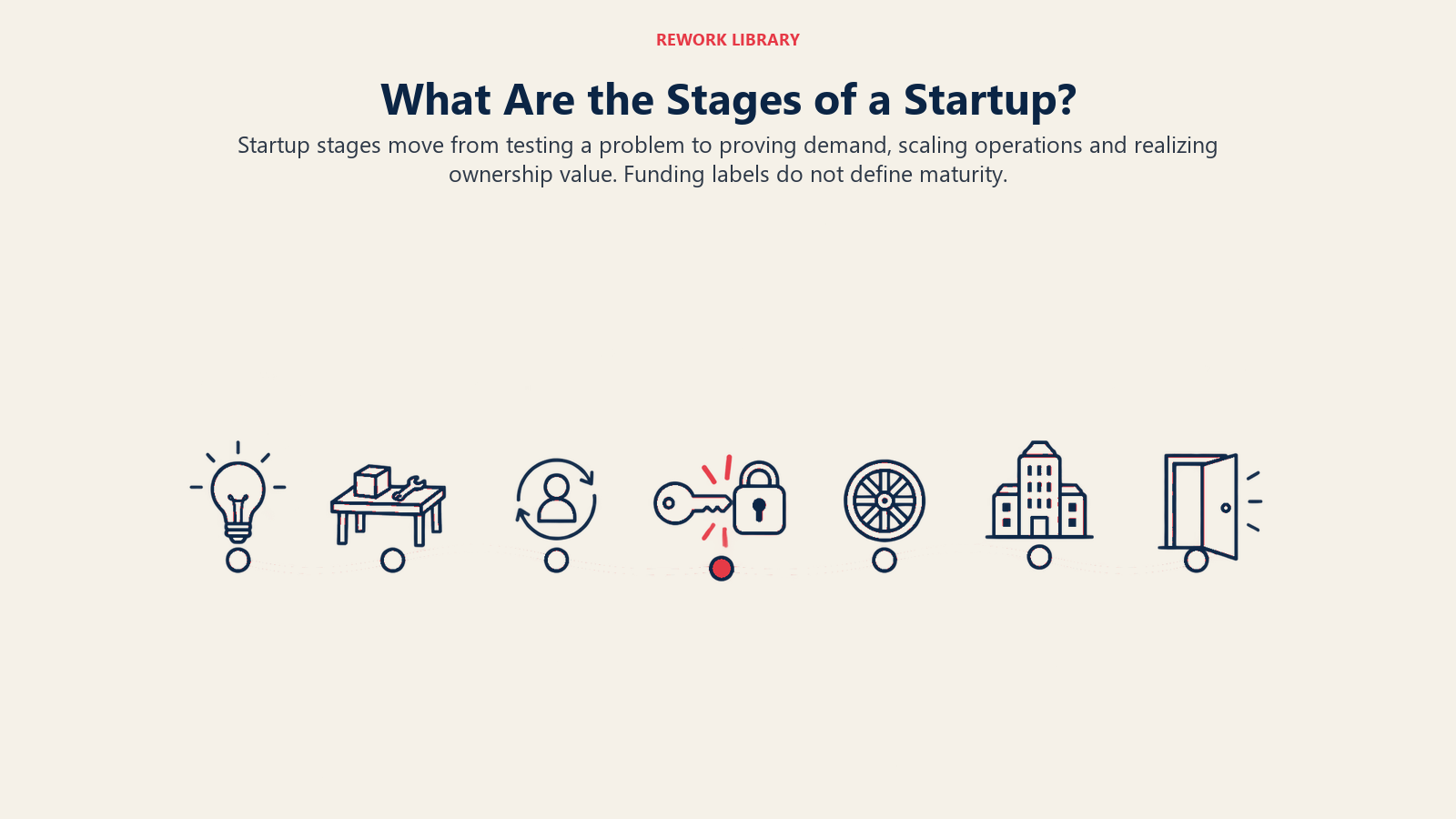
A startup usually moves through six or seven stages: idea, pre-seed, seed, early stage, growth, scale, and finally an exit such as an acquisition or a public listing. Each stage has a different job. Early on, the job is to find out whether anyone wants what you're building. Later, it's to build a machine that grows reliably, and eventually to decide how the company's story ends.
There's no official standard for these labels. Investors, accelerators and founders draw the lines in slightly different places, and the funding words (pre-seed, seed, Series A) don't map neatly onto company maturity. So treat the stages below as a working map. What matters is the question each stage has to answer, and how you know you've answered it.
Why startups have stages at all
Two well-known definitions explain why the idea of stages exists. Steve Blank describes a startup as an organization formed to search for a repeatable and scalable business model. Paul Graham puts it more bluntly: a startup is a company designed to grow fast.
Put those together and you get the shape of the journey. First comes a search, where the company doesn't yet know its customer, its product or its price. Then comes a build-out, where the model is known and the work is to repeat it faster. Graham notes the pattern in his own essay: there's an initial period of slow or no growth while the startup tries to figure out what it's doing. The stages are just a finer-grained way of describing that move from searching to executing.
It also explains why the same advice can be right at one stage and wrong at the next. Hiring a sales team before the model is proven burns cash. Refusing to hire one after it's proven stalls growth.
The stages at a glance
| Stage | Core question | Main work | Typical funding sources | Done when |
|---|---|---|---|---|
| Idea | Is this a real problem worth solving? | Customer conversations, problem definition | Founders' savings, time | You can describe a specific customer and problem with evidence |
| Pre-seed | Can we build something people will try? | Prototype or first version, founding team | Founders, friends and family, angels, accelerators | A working product in a few users' hands |
| Seed | Do people use it and come back? | Early users, iteration, first revenue or strong usage | Angels, seed funds, SAFEs or convertible notes | Clear early demand and a repeatable way to reach it |
| Early stage | Is it truly product-market fit? | Sharpen the product, first sales or marketing motions | Seed extension, Series A | Retention and growth that don't depend on heroics |
| Growth | Can we grow efficiently? | Scale acquisition, build teams and processes | Venture rounds, revenue | Growth with sensible unit economics |
| Scale and maturity | Can we defend and expand? | New markets, products, operating discipline | Late-stage capital, profits, debt | Predictable operations, market position |
| Exit | How does this end for founders and investors? | Sale, listing, or long-term independence | Buyers or public markets | Shareholders can realize value |
Stage 1: Idea
Everything starts with a problem someone cares about. At the idea stage there's often no product, no company entity, and no money. The founder or founders are testing a thesis: this group of people has this problem, and they'd pay or switch to solve it.
The work here is conversation, not code. Talk to potential customers, look at how they handle the problem today, and see whether the pain is sharp enough to change behavior. Marc Andreessen makes the case that the market matters most, and that "the #1 company-killer is lack of market." An idea stage that skips market research is gambling on that point.
The stage ends when you can name a specific customer, describe the problem in their words, and show some evidence it's real. A full breakdown lives in the dedicated article on the idea stage startup.
Stage 2: Pre-seed
Pre-seed is where an idea becomes a thing. The team forms, a first version gets built, and the company usually incorporates. It's the least standardized stage. Some founders self-fund, some join an accelerator, and some raise a small amount from friends and family or angel investors.
Early money at this point is mostly about time. A founder who knows their burn rate and runway can say exactly how many months of building the money buys, which is the only honest way to plan a pre-seed.
Funding instruments are usually light. Y Combinator created the SAFE, and it states that a SAFE is not a debt and not a loan, with no interest and no maturity date until it converts into preferred shares in a later equity financing. A convertible note does a similar job but is legally debt. Both let a company raise early money without agreeing on a valuation yet.
Pre-seed is done when a working product is in real hands. The detail is in the article on the pre-seed startup.
Stage 3: Seed
Seed is the first stage where the evidence starts to matter more than the story. The company has early users or first customers, and the question changes from "will anyone try this?" to "do they keep using it, and will they pay?"
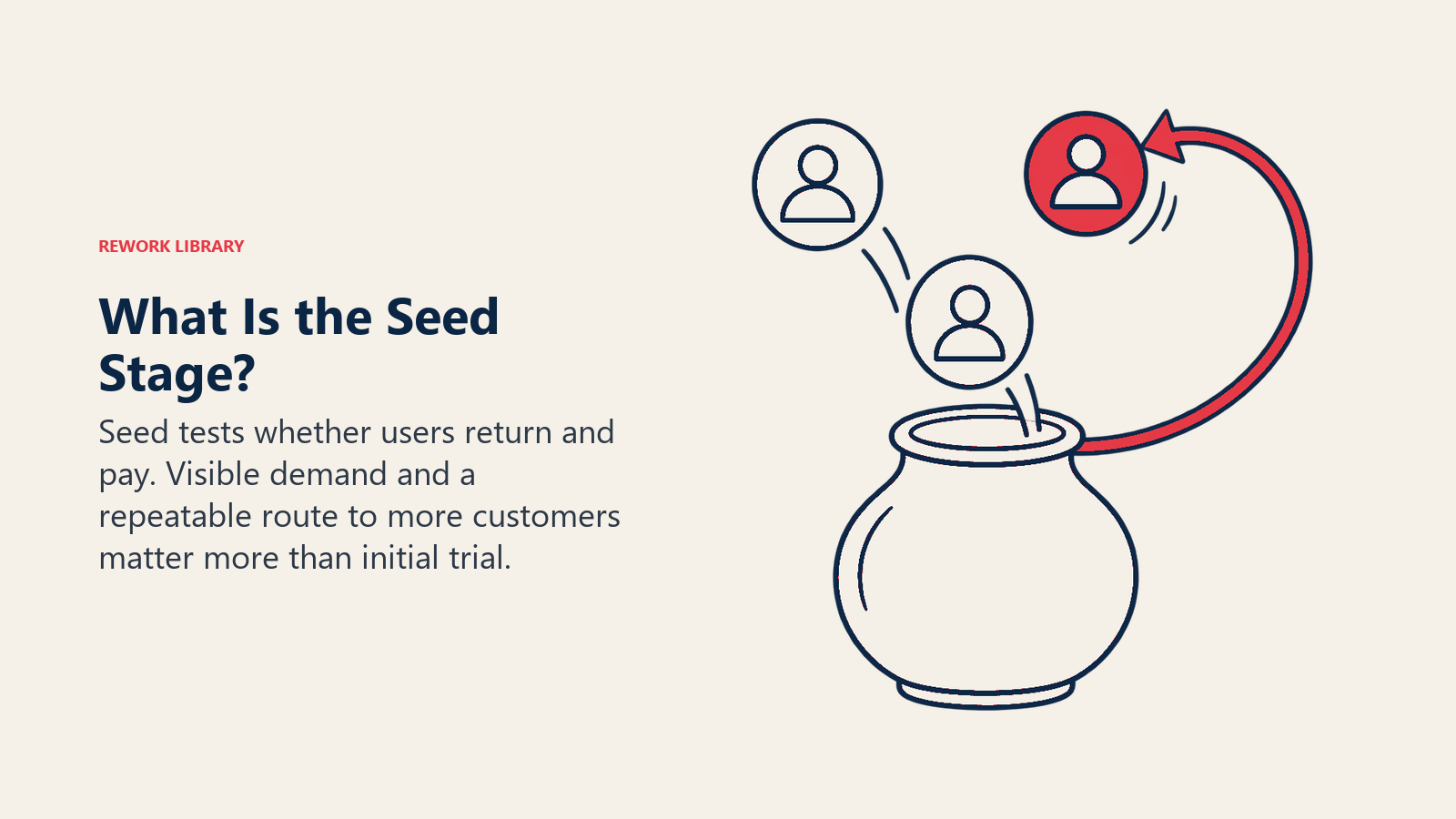
A healthy seed stage looks like this:
- A small group of users who come back without being chased.
- A clear picture of who the best-fit customer is, and who isn't.
- A first, even rough, channel for finding more of them.
- Some revenue, or usage strong enough to point toward it.
Seed money pays for iteration and the first few hires. Because round sizes and valuations shift with the market and by region, it's better to check current data for the market you're raising in than to rely on a fixed number. The SEC's rules also shape who can invest: private rounds are usually sold to accredited investors, and the SEC defines that as net worth over $1 million excluding a primary residence, or income over $200,000 (or $300,000 with a spouse or partner) in the US. Other countries set their own eligibility tests.
Seed ends when demand is visible and there's a plausible, repeatable way to reach more customers. See the full treatment of the seed stage startup.
Stage 4: Early stage and product-market fit
Early stage is the label that causes the most confusion, because people use it to mean everything from pre-seed to Series A. In this article it means the period when the company is working out whether it has product-market fit, then proving it.
Andreessen defines the term simply: product/market fit means being in a good market with a product that can satisfy that market. It sounds soft, but you can look for hard signals. Retention curves flatten instead of falling to zero. Customers refer others. Sales cycles shorten. Support is busy with questions about new use cases rather than basic confusion.
At this stage the company usually builds its first repeatable go-to-market motion, whether that's sales, self-serve, partnerships or content. The metric to watch is whether each new customer costs less than they're worth, which is where unit economics come in. For software companies, the SaaS product-market fit article goes deeper, and the early-stage growth model gives a framework for what to prioritize.
Companies that haven't found fit often need a bridge round to buy more time. That's normal, but it should come with a changed plan, not just more runway for the same one. The distinction between early and growth stage is covered in early-stage vs growth-stage.
Stage 5: Growth
Once fit is real, the question flips. Instead of "does anyone want this?" it becomes "how fast and how efficiently can we grow?" Money goes into acquisition, sales and marketing capacity, customer success, and the first layer of management.
Paul Graham offers a useful benchmark for how a young company thinks about speed: he says a good growth rate during YC is 5-7% a week, and 10% a week is exceptionally good. That figure is specific to the early, small-base phase he's describing. It isn't a target for a company with thousands of customers, where the same percentage would be impossible.
The risk at the growth stage is that things that worked when the team was ten people stop working at fifty. Communication slows, roles blur, and the founder becomes a bottleneck. Larry Greiner's classic model of organizational growth describes this as a sequence of phases separated by crises, which the article on Greiner's growth model explains. A practical way to check readiness is the growth stage assessment.
For software companies in particular, the SaaS growth stages article maps this stage onto revenue milestones.
Stage 6: Scale and maturity
Scale means growing the business without growing the cost and chaos at the same rate. Maturity is what follows when growth slows because the market is largely served. The company has an established customer base, defined processes, and often multiple products or regions.
This is where the startup stops being a startup in the strict sense. By Blank's definition, a startup searches for a business model. A scaled company has found one and is executing it. Some mature companies keep their startup spirit by launching new bets inside the larger structure, and the product life cycle offers a lens for deciding when the core offering needs renewing.
The main decisions here are about discipline: profitability, capital structure, governance, and whether to keep investing for growth or return value to owners.
Stage 7: Exit
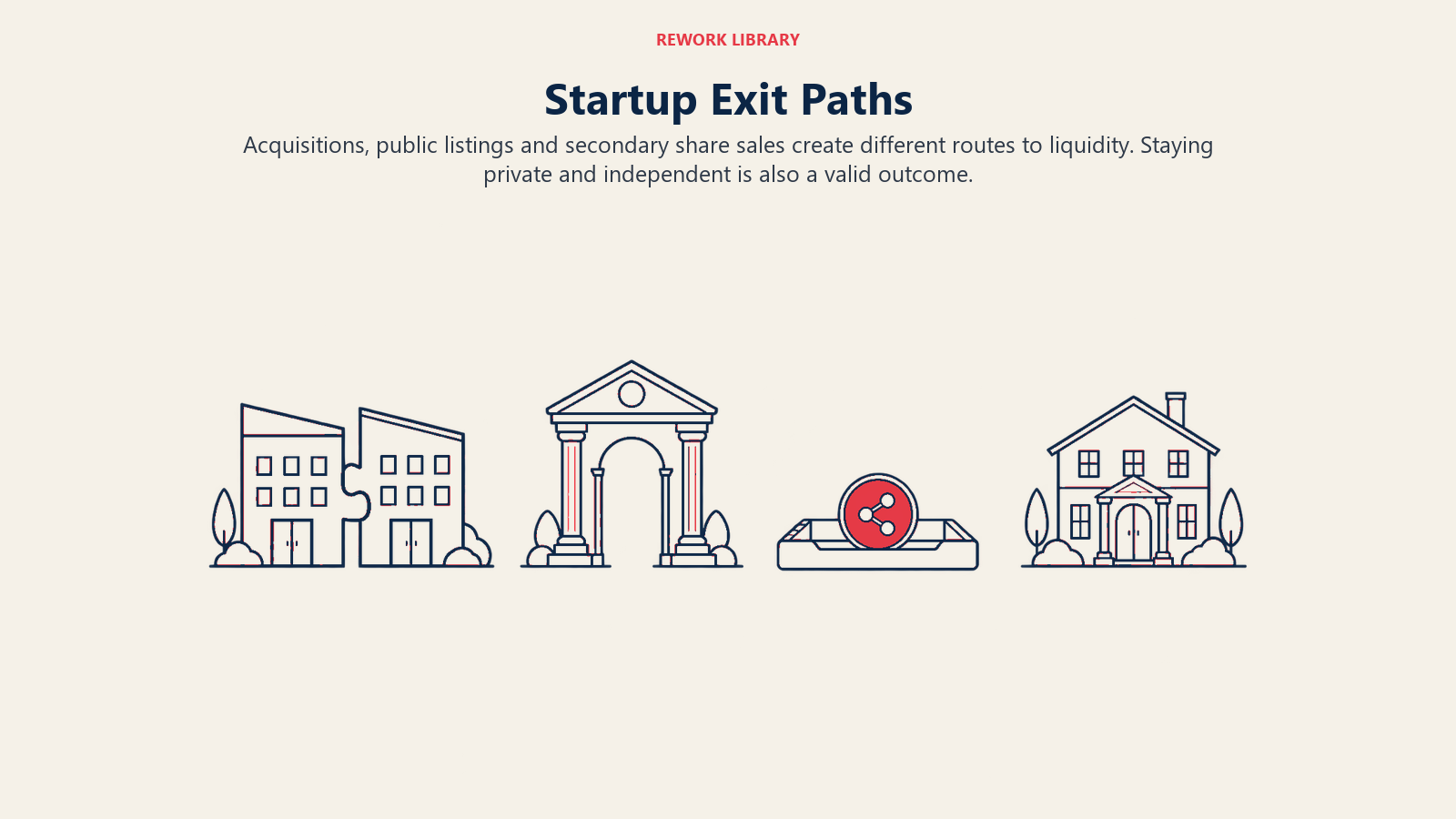
An exit is how founders and investors turn ownership into cash or liquid shares. There are a few common paths:
| Exit path | What happens | Who it suits |
|---|---|---|
| Acquisition (M&A) | Another company buys the business or its assets | Companies whose product fits a larger buyer's strategy |
| IPO | The company sells shares to the public | Large, established companies with the scale to handle public-company rules |
| Secondary sale | Early holders sell shares to new investors without the company being sold | Founders and early backers wanting partial liquidity |
| No exit | The company stays private and independent, paying dividends or reinvesting | Founders who prefer control and cash flow |
The SEC describes an IPO as a company's initial public offering of shares to the public, usually to raise additional capital, and notes that a company must file a registration statement with the SEC before offering its securities for sale. That requirement is one reason an IPO is a heavier process than most private deals.
Not every startup exits, and not every exit is a happy one. Some companies wind down, and some are sold for less than investors put in. The right plan is to know, from the early stages, which kind of outcome the investors you take money from expect.
Survival: how many startups make it
The stage map can make the path look more orderly than it is. Many young businesses don't reach the later stages. The US Bureau of Labor Statistics tracks this in its survival data for private sector establishments by opening year. For the cohort of establishments that opened in the year ended March 1994, 79.6% were still open a year later, 49.6% after five years, and 33.6% after ten.
Two cautions apply. These are all new private-sector establishments, not just venture-backed startups, and the figures come from one older cohort, so they illustrate the shape of attrition rather than predict your odds. Still, the broad point holds: surviving the early years is the first real milestone.
Common mistakes when thinking in stages
- Treating funding rounds as stages. Raising a Series A doesn't mean the company is at the growth stage. Money follows evidence, but the two don't always line up.
- Skipping ahead. Building for scale before there's fit wastes cash. Spending ahead of the evidence shortens runway.
- Staying in search mode too long. The opposite problem: endlessly tweaking the product when customers have already told you what works.
- Copying another company's timeline. A consumer app, a hardware business and a B2B software company move through the stages at very different speeds.
- Ignoring the exit. If investors expect a venture-scale outcome and the market can't support one, the mismatch causes conflict later.
Key Facts: Startup Stages
- Steve Blank defines a startup as an organization formed to search for a repeatable and scalable business model.
- Paul Graham's definition: a company designed to grow fast. He says 5-7% weekly growth is good during YC and 10% is exceptional.
- Marc Andreessen says market matters most and defines product/market fit as being in a good market with a product that can satisfy it.
- A SAFE has no interest and no maturity date and converts into preferred shares at a later equity financing (Y Combinator).
- In the US, accredited investors include people with net worth over $1 million excluding primary residence (SEC).
- Of US private-sector establishments opened in the year ended March 1994, 49.6% survived five years and 33.6% survived ten (BLS).
- A US IPO requires a registration statement filed with the SEC before shares are offered (SEC).
Related reading