What Is Founder Equity?

Turn this article into takeaways for your work.


Each assistant summarizes the article only for you and suggests best practices for your work.
Founder equity is the ownership stake that the people who start a company hold in it, normally as shares of common stock. It's the founders' claim on whatever the company becomes worth, and it's usually the only real asset they have in the first year or two.
Most early disputes between co-founders aren't about product. They're about who owns what, what happens if someone leaves, and whether the paperwork was done right. This article covers how founder equity is issued, how co-founders split it, how vesting protects the team, what acceleration means, the US 83(b) tax election, and how founder ownership shrinks across funding rounds.
It's reference material, not legal or tax advice. Terms vary by jurisdiction and by deal, and the 83(b) election is specific to the United States. Talk to a startup lawyer and a tax adviser before you issue shares.
Key Facts: Founder Equity
- Founders usually hold common stock, often issued as restricted stock that vests over time.
- A common vesting setup is four years with a one-year cliff, per Y Combinator's guidance on splitting equity.
- In the US, an 83(b) election must be filed no later than 30 days after the transfer of the shares, and it generally can't be revoked.
- Every priced round and option pool top-up dilutes founders. A 50/50 pair can plausibly hold well under 30% each by Series A (illustrative, below).
- Founders should assign their IP to the company in writing when they take their shares.
What Founder Equity Is
When a company is incorporated, it issues shares to its founders. These are normally common stock, which carries voting rights and a claim on what's left after creditors and preferred stockholders are paid. Investors later buy preferred stock, which sits ahead of common in a sale. (The mechanics are in What Is a Liquidation Preference?.)
Founders typically buy their shares for a tiny price, often a fraction of a cent per share, because the company has no value yet. That low price matters for tax, which we'll get to.
Two terms are easy to confuse:
- Shares are the actual units of ownership. A founder might hold 4,000,000 shares.
- Ownership percentage is those shares divided by all shares outstanding, including options. It's what appears on a cap table.
Founder equity is also different from options. Options are a right to buy shares later at a fixed price, and employees usually get them. Founders usually own actual stock from day one, subject to vesting.
Restricted Stock: Owning Shares That Can Be Taken Back
Founders almost always receive restricted stock. They own the shares, but the company holds a right to buy back the unvested portion at the original price if the founder leaves. This is why vesting for founders is often called "reverse vesting." Rather than earning shares over time, the founder owns everything up front and the company's buyback right shrinks as time passes.
The distinction has real consequences. Under US tax rules, until property becomes substantially vested, the regulations treat the transferor as its owner for tax purposes. That's the reason an 83(b) election exists, and why the timing of it matters so much.
How Co-Founders Split Equity
There's no formula that fits every team. There are two camps.
Equal or near-equal splits. Y Combinator's Michael Seibel argues that equal splits among co-founders should become standard. His reasoning is that building a company of real value takes 7 to 10 years, so early differences such as who had the idea or who started first matter little over that stretch.
Weighted splits. Some teams split unevenly to reflect a founder who's the CEO, who's working full time while another stays part time, or who contributes substantial cash or IP. Weighted splits aren't wrong. The risk is resentment if the weighting doesn't track what people end up doing.
A few practical points apply either way:
- Decide early, and in writing. Postponing the conversation doesn't remove it. It just moves it to a worse time, such as the week a term sheet arrives.
- Tie the split to the whole journey. A split that made sense for a part-time prototype may feel wrong two years in. Vesting is how teams protect against that.
- Leave room for later hires. Early employees and advisers will want equity too, normally from an employee option pool. Founders should ask what they'll own after that pool exists, not before.
Founder Vesting and Reverse Vesting
Vesting means the founder earns the right to keep their shares over time. According to the Y Combinator guidance above, a typical setup is four years of vesting with a one-year "cliff": if you leave in the first year you walk away with nothing, then 25% vests at the one-year mark and 1/48th of the total vests each month after.
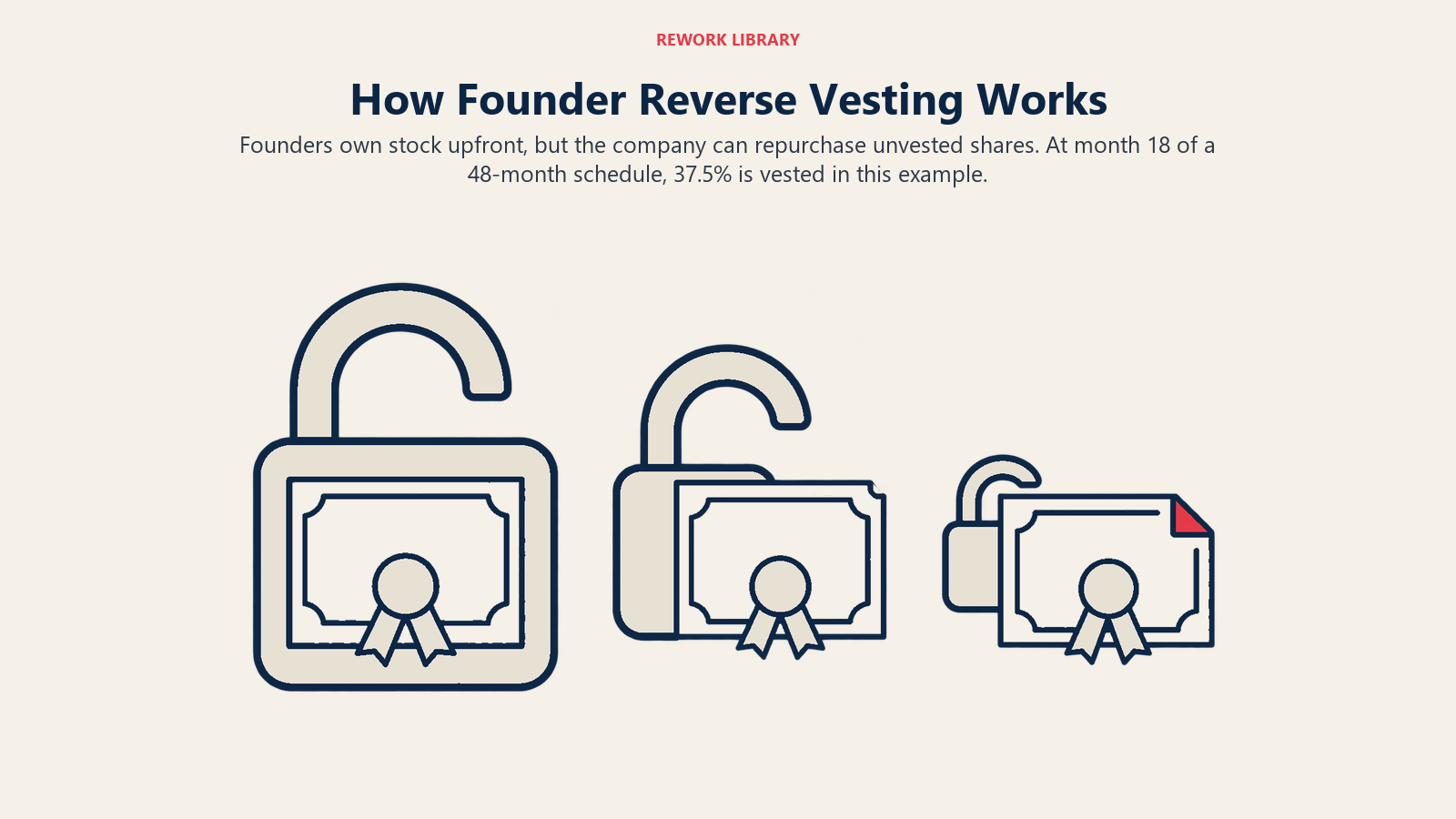
Here's an illustrative example. Two co-founders each hold 4,000,000 shares on a standard four-year schedule with a one-year cliff. One leaves at month 18.
- Vested shares: 18 / 48 = 37.5%, which is 1,500,000 shares.
- Unvested shares: 4,000,000 minus 1,500,000 = 2,500,000.
- The company can buy back those 2,500,000 shares at the founder's original purchase price, and they return to the pool of unissued shares.
The departing founder keeps 1,500,000 shares. Without vesting, they'd keep all 4,000,000 and the remaining founder would be working to build value for someone who left.
Some founders negotiate credit for work already done, for instance starting the vesting clock at the date the team began working together rather than the date of incorporation. Investors often ask founders to re-vest part of their shares at a financing, so it's worth knowing how your existing schedule compares.
Acceleration: Single vs Double Trigger
Acceleration means unvested shares vest early on a defined event, usually a sale of the company. Cooley GO's guide to the two types, Pulling the Trigger(s), explains them this way.
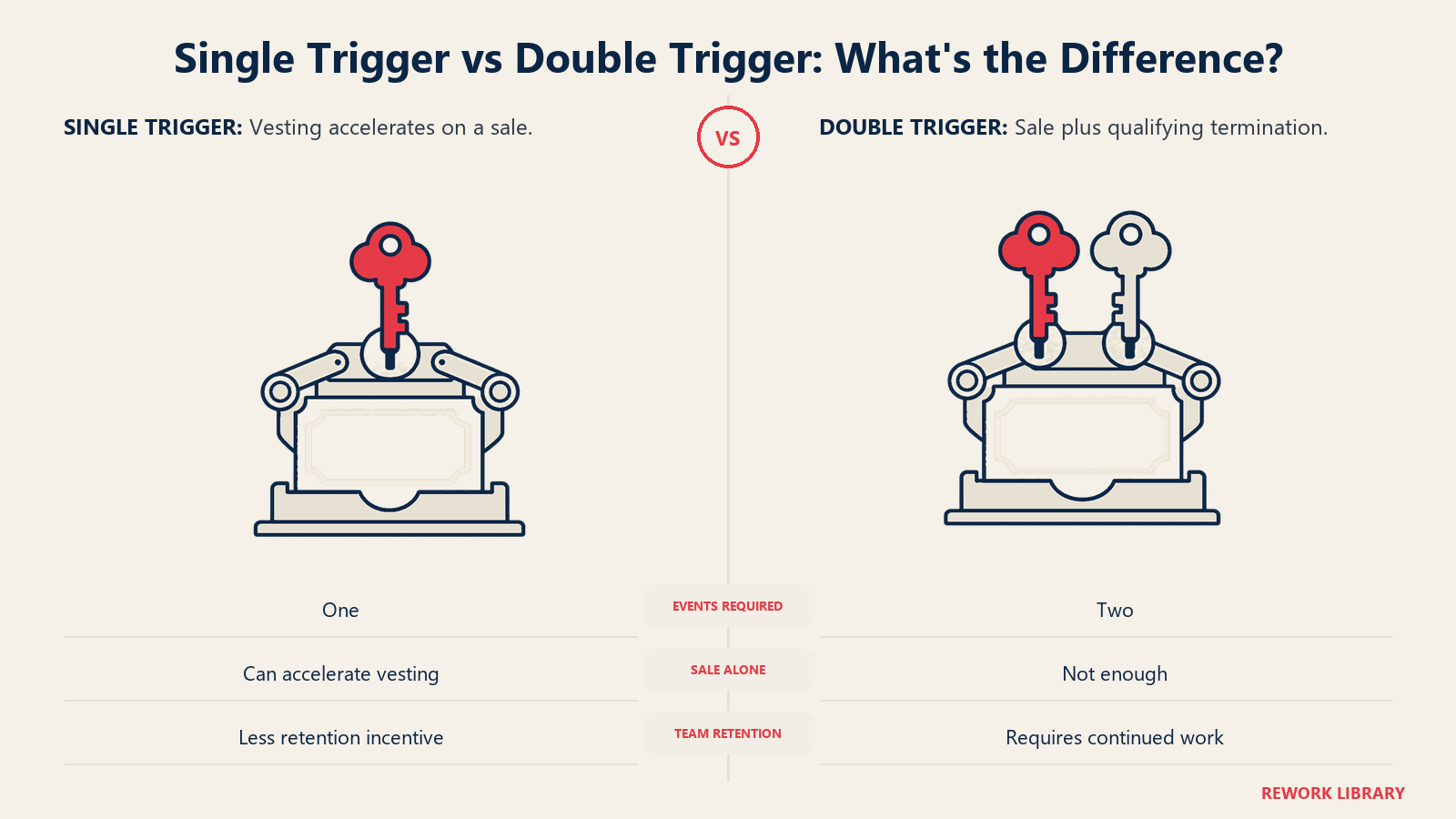
- Single-trigger acceleration happens on one event, the sale of the company. Some or all of the unvested shares vest when the deal closes, as a reward for contributing to a successful outcome.
- Double-trigger acceleration needs two events: a sale, followed by an involuntary termination without cause. Cooley describes it as the more common structure. Its logic is that it gives key people a safety net if an acquirer lets them go, while still requiring them to keep working after the deal.
Cooley also notes that double-trigger protection for options only works if the acquirer assumes the unvested options, which doesn't always happen.
Neither is right for every team. Single-trigger can reassure founders but worries acquirers who want the team to stay. Double-trigger is the usual compromise. Whatever you agree, put the exact trigger, the percentage that accelerates, and any time window in the stock purchase agreement.
The 83(b) Election (US Only)
The 83(b) election is a US federal tax filing that matters for founders holding unvested stock. Without it, the IRS generally taxes you on the stock as it vests, based on its value on each vesting date. If the company becomes valuable, that can be a large tax bill on shares you can't sell.
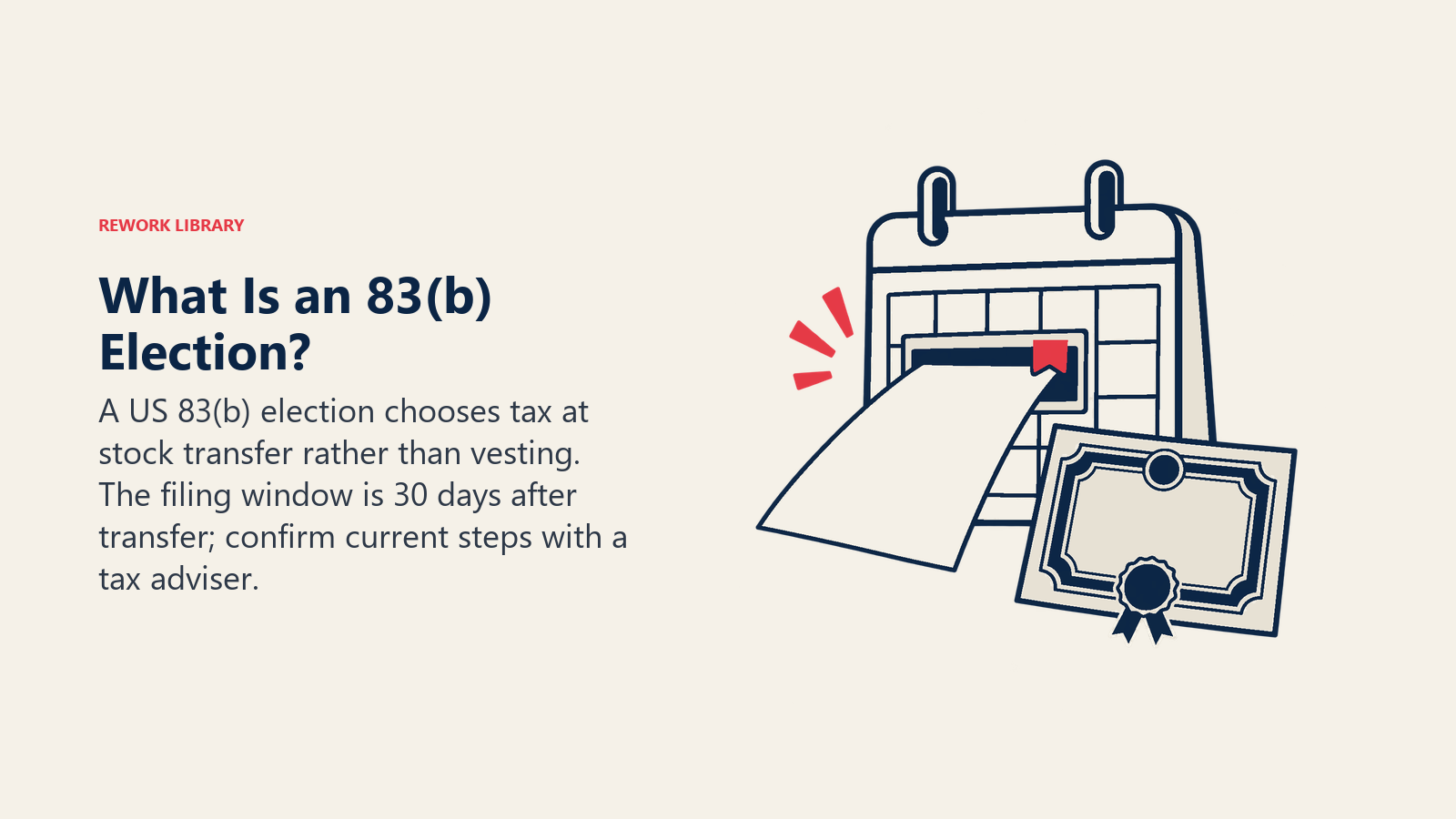
Filing an 83(b) election lets you instead be taxed once, at the time of transfer, on the difference between what the shares were worth and what you paid. If a founder buys stock at its fair market value, that difference is typically zero or close to it. The tax rules on this are technical, so treat this paragraph as orientation rather than advice.
The points to remember:
- The window is 30 days. The regulation says the election must be filed not later than 30 days after the date the property was transferred. Cooley GO's glossary says the same thing: the election is only effective if filed within 30 days of acquiring the equity that is subject to vesting.
- It can be filed early. The same regulation says the election may be filed before the date of transfer.
- It's hard to undo. An election may not be revoked except with the consent of the Commissioner, and the regulation limits that consent to a mistake of fact, with a 60-day request window. A later drop in the stock's value doesn't count.
- The IRS publishes guidance. Rev. Proc. 2012-29 supplies sample election language that may be used but isn't required, and the IRS also has a form for the election. Check the current IRS instructions for how and where to file.
If you're outside the US, don't assume anything here applies. Many countries tax share issuances and vesting differently, and some have no equivalent election.
What Happens When a Co-Founder Leaves
A departure is the situation vesting is designed for, and what follows depends on the paperwork.
- Leaves before the cliff. Under a one-year cliff, the founder forfeits all unvested shares and the company can repurchase them, which in practice means leaving with nothing.
- Leaves after the cliff. The founder keeps the vested portion and the company can buy back the rest, as in the month 18 example.
- Vested shares stay. The departing founder remains a shareholder with the voting and economic rights of that stock, unless the documents say otherwise. This surprises many teams, and it's a reason to think hard about the schedule and buyback terms before issuing shares.
- The company may have a right of first refusal on a later sale of the founder's vested shares, depending on the bylaws and stock purchase agreement.
Good leaver and bad leaver terms, which treat a founder differently depending on why they left, are more common in some markets than others. If the terms don't exist in your documents, decide whether you want them before the situation arises.
How Founder Ownership Changes Across Rounds
Founder percentages fall at each financing as new shares are issued. This is called equity dilution, and it isn't a mistake. What matters is that the total value of the founders' stake grows faster than their percentage shrinks. How much a round dilutes you depends on the pre-money and post-money valuation.
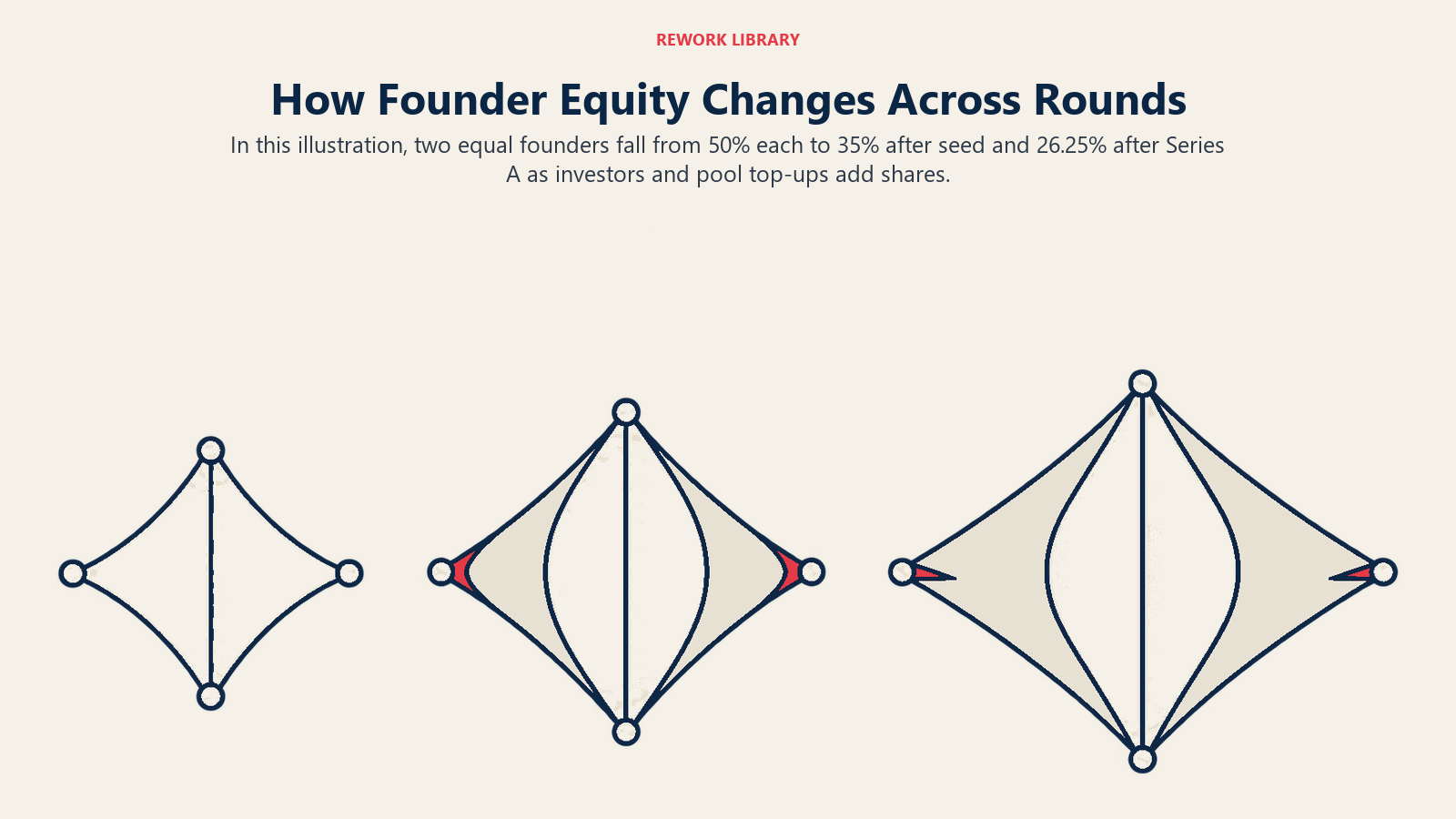
The table below is illustrative arithmetic, not data from any study or real company. Two co-founders split 50/50 with no other shareholders. At seed, new investors take 20% and a 10% option pool is created, leaving founders with 70% combined. At Series A, new investors take 20% and the pool is topped up with another 5% of the post-round company, so existing holders are scaled by 0.75.
| Stage | Founders combined | Each founder (50/50) | Others |
|---|---|---|---|
| Incorporation | 100% | 50% | 0% |
| After seed | 70% | 35% | 20% investors, 10% pool |
| After Series A | 70% x 0.75 = 52.5% | 26.25% | 15% seed investors, 20% Series A, 7.5% + 5% = 12.5% pool |
The pool figure after Series A is the 10% seed pool scaled by 0.75 (7.5%) plus the new 5% top-up. Seed investors go from 20% to 15% (20% x 0.75). The column adds up: 52.5 + 15 + 20 + 12.5 = 100.
If an existing investor wants to keep their percentage in later rounds, they may use pro rata rights, which is one more claim on the shares being issued.
IP Assignment
Founder equity only means something if the company owns the thing it's built on. Founders should sign an agreement assigning any intellectual property relevant to the business, including code, designs, domain names and prior work, to the company when they receive their shares. Investors routinely ask for this in due diligence, and a gap, for example code written before incorporation that was never assigned, can delay or derail a round. Counsel can usually fix it at formation for little cost.
Related Reading

On this page
- What Founder Equity Is
- Restricted Stock: Owning Shares That Can Be Taken Back
- How Co-Founders Split Equity
- Founder Vesting and Reverse Vesting
- Acceleration: Single vs Double Trigger
- The 83(b) Election (US Only)
- What Happens When a Co-Founder Leaves
- How Founder Ownership Changes Across Rounds
- IP Assignment
- Related Reading